Hiển thị các bài đăng có nhãn China. Hiển thị tất cả bài đăng
Thứ Hai, 26 tháng 11, 2018
China to build its third domestically made aircraft carrier
China kicked off construction of a third aircraft carrier, CNS reported on Nov. 25.
In a report on the WeChat network, Xinhua said that as the second and first Chinese-built aircraft carrier was experimenting on the sea, a "next-generation carrier" is under planning.
The article, published in honor of the sixth anniversary of the first Chinese aircrafts taking-off and landing on China's first carrier, the Liaoning CNS, did not specify the details of the "the next-generation carrier, is thought to be China's third, but this article is considered China's first public acknowledgment.
Chinese watchers and foreign observers have long claimed that China has begun construction of a third aircraft carrier at the Jiangnan Group's shipyard in Shanghai, China Shipbuilding Corp. They also predicted that the third would be bigger and stronger than Liaoning and the second was unnamed.
Shipbuilding Corp. of the state of China declined to comment on the issue.
Chinese Navy officials also did not respond to the press on November 26th.
(According to Ecns.cn, The Week)
Thứ Bảy, 10 tháng 3, 2018
Interview: 'Who Wants Cambodia To Be a Province of China?'
(RFA - March 7, 2018) Sophal Ear is an associate professor of diplomacy & world affairs at Occidental College in California who has written "Aid Dependence in Cambodia: How Foreign Assistance Undermines Democracy" and co-authored “The Hungry Dragon: How China's Resource Quest Is Reshaping the World." The policy analyst gave an interview by e-mail with Sovannarith Keo of RFA's Khmer Service about Cambodia's deepening economic relationship with China and concerns about the Southeast Asian country's growing debt to its giant northern neighbor as Beijing ramps up its signature Belt-Road Initiative infrastructure plan.
RFA: What are your general observations and assessment of Cambodia's debts to China, especially since China introduced its Belt Road Initiative (BRI) projects for Cambodia? Has such an initiative induced Cambodia to take on more debt to China than ever before? If so, is the trend a good or bad sign for Cambodia's future?
Sophal Ear: $4.3 billion in debt to China is about 20 percent of Cambodia’s GDP. This is a lot to owe one single creditor: China. Belt Road Initiative projects are just a way of categorizing a bunch of lending--much of which would have taken place anyway. It's putting a nice label on something--like the same old wine in a new bottle. Of course, it sounds so impressive, globally the spending could approach $1 trillion, but if it’s loans, it’s great for China. The money lent becomes income for Chinese companies which use Chinese workers (who receive paychecks). A win-win-win for China. As for Cambodia, if it builds infrastructure that can transform Cambodia and add value to its economy, that’s good. But if it’s just white elephant projects, ghost cities, and Potemkin villages, then (it's) terrible for Cambodia. Chinese President Xi Jinping said this for China and it applies to Cambodia: 'Houses are built to be inhabited, not for speculation.' Yet that is what is happening on Diamond Island and in other parts of Phnom Penh and Cambodia.
RFA: A new report published by the Center for Global Development (CGDEV) identified Cambodia among 23 countries at 'risk of debt distress' today as a result of Chinese BRI. But the report did not classify Cambodia among eight countries 'vulnerable to debt distress' due to future BRI-related financing. Do you agree with this finding? Which such trends, can you predict when Cambodia may face debt default as a result of such Chinese BRI financing?
Sophal Ear: It’s a reasonable finding. Cambodia’s overall debt sustainability is not bad. Look, this analysis is based on debt as a percentage of GDP, export revenue, etc. Exports bring in foreign exchange, which is used to service debt. You cannot pay foreign debt in Riels. Cambodia is in the 32 percent of debt-to-GDP range, but could be inching up to 40 percent of GDP before you know it, especially if Cambodia's economy hits a bump and a recession happens or if debt grows more rapidly than GDP growth. Right now, based on existing numbers, it’s not yet unsustainable. The acceleration of indebtedness is probably what puts it “at risk”. It’s going up, but if it goes up too quickly, that’s worrisome. The U.S. has about 106 percent debt-to-GDP. Japan’s is 245%, but most of Japan’s debt is held by Japanese citizens. China and Japan own about 5% each of U.S. debt. No-one believes the U.S. or Japan could default. The risk is very small. Cambodia, on the other hand, has a painful history of banning money. This is why the dollar is used in Cambodia and the country is still only talking about issuing bonds.
RFA: What are your general recommendations so that Cambodia can escape from a Chinese debt trap?
Sophal Ear: Diversify who you borrow from. Borrow too much from one source, especially if that source is not your own people, and you become a wholly owned subsidiary of that source: China. Who wants Cambodia to be a province of China? I don't think Cambodians want that.
RFA: Prime Minister Hun Sen recently defended his government's foreign debt status, saying that it is still healthy since the entire debt-to-GDP ratio remains lower than 40 percent or so. What is your reaction to that?
Sophal Ear: Mathematically, it is correct. However, if Cambodia’s Chinese debt-to-GDP ratio is 20 percent, and we’re still below 40 percent debt-to-GDP ratio overall (as I mentioned earlier 32%), then about 62.5% of Cambodia’s current debt is owed to China. That is an incredible level of dependency on one country. If one wishes to avoid being a wholly owned subsidiary or a province of China, one had better diversify with no foreign country lending Cambodia in excess of 50 percent of its debt, and preferably a lot less than 50 percent. The African proverb applies: "If your hand is in another man’s pocket, you must walk where he walks."
RFA: What are your general observations and assessment of Cambodia's debts to China, especially since China introduced its Belt Road Initiative (BRI) projects for Cambodia? Has such an initiative induced Cambodia to take on more debt to China than ever before? If so, is the trend a good or bad sign for Cambodia's future?
Sophal Ear: $4.3 billion in debt to China is about 20 percent of Cambodia’s GDP. This is a lot to owe one single creditor: China. Belt Road Initiative projects are just a way of categorizing a bunch of lending--much of which would have taken place anyway. It's putting a nice label on something--like the same old wine in a new bottle. Of course, it sounds so impressive, globally the spending could approach $1 trillion, but if it’s loans, it’s great for China. The money lent becomes income for Chinese companies which use Chinese workers (who receive paychecks). A win-win-win for China. As for Cambodia, if it builds infrastructure that can transform Cambodia and add value to its economy, that’s good. But if it’s just white elephant projects, ghost cities, and Potemkin villages, then (it's) terrible for Cambodia. Chinese President Xi Jinping said this for China and it applies to Cambodia: 'Houses are built to be inhabited, not for speculation.' Yet that is what is happening on Diamond Island and in other parts of Phnom Penh and Cambodia.
RFA: A new report published by the Center for Global Development (CGDEV) identified Cambodia among 23 countries at 'risk of debt distress' today as a result of Chinese BRI. But the report did not classify Cambodia among eight countries 'vulnerable to debt distress' due to future BRI-related financing. Do you agree with this finding? Which such trends, can you predict when Cambodia may face debt default as a result of such Chinese BRI financing?
Sophal Ear: It’s a reasonable finding. Cambodia’s overall debt sustainability is not bad. Look, this analysis is based on debt as a percentage of GDP, export revenue, etc. Exports bring in foreign exchange, which is used to service debt. You cannot pay foreign debt in Riels. Cambodia is in the 32 percent of debt-to-GDP range, but could be inching up to 40 percent of GDP before you know it, especially if Cambodia's economy hits a bump and a recession happens or if debt grows more rapidly than GDP growth. Right now, based on existing numbers, it’s not yet unsustainable. The acceleration of indebtedness is probably what puts it “at risk”. It’s going up, but if it goes up too quickly, that’s worrisome. The U.S. has about 106 percent debt-to-GDP. Japan’s is 245%, but most of Japan’s debt is held by Japanese citizens. China and Japan own about 5% each of U.S. debt. No-one believes the U.S. or Japan could default. The risk is very small. Cambodia, on the other hand, has a painful history of banning money. This is why the dollar is used in Cambodia and the country is still only talking about issuing bonds.
RFA: What are your general recommendations so that Cambodia can escape from a Chinese debt trap?
Sophal Ear: Diversify who you borrow from. Borrow too much from one source, especially if that source is not your own people, and you become a wholly owned subsidiary of that source: China. Who wants Cambodia to be a province of China? I don't think Cambodians want that.
RFA: Prime Minister Hun Sen recently defended his government's foreign debt status, saying that it is still healthy since the entire debt-to-GDP ratio remains lower than 40 percent or so. What is your reaction to that?
Sophal Ear: Mathematically, it is correct. However, if Cambodia’s Chinese debt-to-GDP ratio is 20 percent, and we’re still below 40 percent debt-to-GDP ratio overall (as I mentioned earlier 32%), then about 62.5% of Cambodia’s current debt is owed to China. That is an incredible level of dependency on one country. If one wishes to avoid being a wholly owned subsidiary or a province of China, one had better diversify with no foreign country lending Cambodia in excess of 50 percent of its debt, and preferably a lot less than 50 percent. The African proverb applies: "If your hand is in another man’s pocket, you must walk where he walks."
Thứ Sáu, 24 tháng 5, 2013
A Nation of Thieves
The wide world of hacking in China: The Chinese have been known to be experts at hacking for quite some time. But what might surprise some is that it's epidemic across the country in all levels of society.
By Don Reisinger

China has been cited as hacking into U.S. government and corporate networks for years now.
Generally, the thinking has been that the government is the only entity in the country actively hacking.
But a new report seems to indicate that's not even close to the truth.
The News York Times on Thursday released a report on hacking across China.
The Times found that not only does hacking occur at the highest levels of the government, but that everyone on down from local law enforcement officials to company owners to criminals are using their hacking techniques to take aim at citizens.
Companies have even sprung up with the sole purpose of locating "anyone who spreads a rumor on the Internet."
Surprised?
Here are just a few of the ways hacking has unfolded in China:
By Don Reisinger
China has been cited as hacking into U.S. government and corporate networks for years now.
Generally, the thinking has been that the government is the only entity in the country actively hacking.
But a new report seems to indicate that's not even close to the truth.
The News York Times on Thursday released a report on hacking across China.
The Times found that not only does hacking occur at the highest levels of the government, but that everyone on down from local law enforcement officials to company owners to criminals are using their hacking techniques to take aim at citizens.
Companies have even sprung up with the sole purpose of locating "anyone who spreads a rumor on the Internet."
Surprised?
Here are just a few of the ways hacking has unfolded in China:
- Hacking there reaches all levels. From taking data from foreign governments to spying on competitors to making sure no one is launching rumors against the government, hacking is everywhere.
- The Ministry of Education, along with China-based universities, sponsor hacking events designed to see who has skills the army might need.
- Corporations are increasingly turning to freelance hackers to spy on competitors. In fact, it's a somewhat common practice across the country to find out what others are doing in their respective fields.
- Local law enforcement officials have no choice but to hire hacking companies. The federal government says that it's their responsibility to ensure people in their areas are not spreading dissent on the Web.
- Cybercriminals are obviously getting in on the fun and have been known to easily hack their way into a host of online-gaming services and credit-card databases to score funds.
- Hacking can be a lucrative job in China. Highly skilled hackers can make $100,000 a year if they team up with the right hacking company.
Thứ Bảy, 20 tháng 4, 2013
China establishes surveillance system covering 4,406 islands, including disputed Spratlys
BEIJING - China has established a national island surveillance and monitoring system and completed airborne remote-sensing surveillance of what it claims to be its 4,406 islands, according to the Ministry of Land and Resources (MLR).
The national system is mainly built on aerial surveillance, with satellites, unmanned planes, and cruisers as auxiliary instruments, the MLR said in its annual land resources report issued Saturday.
Since a national plan on island protection and exploration came into effect in last April, south China's Zhejiang, Fujian, Guangdong provinces, and Guangxi Zhuang Autonomous Region have passed their own provincial-level scheme, with Liaoning, Hebei, Shandong, Jiangsu, and Hainan completing their draft plan, the ministry said.
Last year, China completed an island name survey, including on-site investigation on part of the atolls in the three island groups known as Sansha in the South China Sea which covers the disputed island groups of Spratlys, Paracels, and Macclesfield. The Philippines and Vietnam also claim sovereignty over these islands.
The country also released the standard names and geographical coordinates of the Diaoyu Island and its affiliated islands in the East China Sea, as well as other geographical entities in their surrounding waters last year, according to the MLR report. China Diaoyu is also being claimed by Japan.
Interaksyon
The national system is mainly built on aerial surveillance, with satellites, unmanned planes, and cruisers as auxiliary instruments, the MLR said in its annual land resources report issued Saturday.
Since a national plan on island protection and exploration came into effect in last April, south China's Zhejiang, Fujian, Guangdong provinces, and Guangxi Zhuang Autonomous Region have passed their own provincial-level scheme, with Liaoning, Hebei, Shandong, Jiangsu, and Hainan completing their draft plan, the ministry said.
Last year, China completed an island name survey, including on-site investigation on part of the atolls in the three island groups known as Sansha in the South China Sea which covers the disputed island groups of Spratlys, Paracels, and Macclesfield. The Philippines and Vietnam also claim sovereignty over these islands.
The country also released the standard names and geographical coordinates of the Diaoyu Island and its affiliated islands in the East China Sea, as well as other geographical entities in their surrounding waters last year, according to the MLR report. China Diaoyu is also being claimed by Japan.
Interaksyon
Thứ Tư, 27 tháng 3, 2013
China holds landing exercises in East Vietnam Sea
BEIJING (AP) — China's increasingly powerful navy paid a symbolic visit to the country's southernmost territorial claim deep in the East Vietnam Sea (south China sea) this week as part of military drills in the disputed Spratly Islands involving amphibious landings and aircraft.
The visit to James Shoal, reported by state media, followed several days of drills starting Saturday and marked a high-profile show of China's determination to stake its claim to territory disputed by Vietnam, the Philippines, Taiwan, Malaysia and Brunei amid rising tensions in the region.
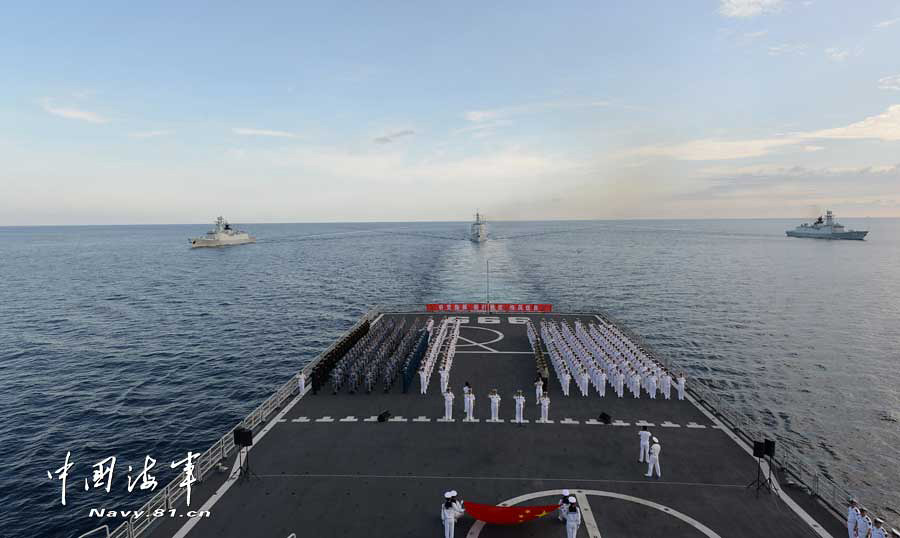
Sailors joined in the ceremony Tuesday aboard the amphibious ship Jinggangshan just off the collection of submerged rocks, located 80 kilometers (50 miles) off the coast of Malaysia and about 1,800 kilometers (1,120 miles) from the Chinese mainland, the official Xinhua News Agency reported Wednesday. China planted a monument on the shoal in 2010 declaring it Chinese territory.
Sailors gathered on the ship's helicopter deck declared their loyalty to the ruling Communist Party and vowed to "struggle arduously to realize the dream of a powerful nation," Xinhua said.
The four-ship task force is headed next to the Pacific Ocean for deep-sea exercises via the Bashi Channel separating Taiwan and the Philippines, Xinhua said.
The exercises and visit to James Shoal did not encroach on any islands where neighboring countries have any substantial presence and drew no immediate response from them, but took place in an area with a complicated patchwork of overlapping claims.
The maneuvers were an important, symbolic declaration of Chinese sovereignty intended to show that Beijing will not waver over its territorial claims despite pushback in the region, said Peking University international relations expert Zhu Feng. Militarily, it means little since the navy has visited a number of times before and has no intention of basing troops near the remote shoal, he said.
"These recent naval operations can be seen as a strong indication of Chinese resolve, but they're also a continuation of the existing Chinese stance," Zhu said.
The Spratlys and other East Vietnam Sea island groups are surrounded by rich fishing grounds and some of the world's busiest shipping lanes. China and Vietnam have also begun experimental drilling in the area in hopes of tapping a suspected wealth of oil and gas, further exacerbating frictions that date back decades and have from time to time flared into military action.
China battled Vietnam for control of territory in the region as recently as 1988, and clashes between its naval forces and fishermen from Vietnam and elsewhere are frequently reported.
In the latest incident, Vietnam accused the Chinese navy of setting fire to the cabin aboard a Vietnamese fishing boat last week off the disputed Paracel Islands north of the Spratlys. Hanoi said it filed a formal complaint with the Chinese embassy and is demanding compensation and punishment of the sailors involved.
Beijing responded indignantly on Tuesday, saying its sailors had merely fired flares to drive Vietnamese boats from an area where it said they were fishing illegally. The navy denied causing any damage to the Vietnamese boats.
China's increasingly assertive defense of its claims in the area has sparked a backlash from Vietnam, the Philippines and others. Those countries have turned to the region's traditional dominant power, the U.S., as a counterweight, adding momentum to Washington's renewed focus on security ties in the Asia-Pacific, a strategic pivot viewed by Beijing as part of an effort to encircle it and stymie its development.
Along with maintaining garrisons on territory it claims, China has stepped up patrols by both its navy and ships from civilian maritime agencies that were recently consolidated into a single department along the lines of the U.S. Coast Guard.
The naval task force taking part in the latest drills consists of the Jinggangshan, the destroyer Lanzhou, and the missile frigates Yulin and Hengshui, among China's most modern and capable naval ship, according to an online report by the official People's Daily newspaper.
The drills on and around Johnson Reef and other Chinese-garrisoned islands and outcroppings involved hovercraft, ship-born helicopters, amphibious tanks, and land-based fighters, bombers and early warning aircraft, it said. Photos accompanying the report showed hovercraft setting off from the Jinggangshan and troops in lifejackets storming a beach.
Copyright © 2013 The Associated Press. All rights reserved.
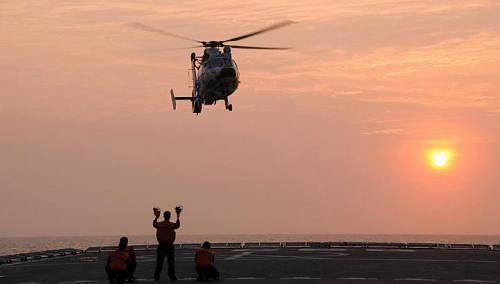
A Z-9 helicopter prepares to land on China's amphibious ship Jinggangshan in waters near south China's Hainan Province, in the East Vietnam Sea. China's increasingly powerful navy paid a symbolic visit to the country's southernmost territorial claim deep in the East Vietnam Sea this week as part of military drills in the disputed Spratly Islands involving amphibious landings and aircraft. -- PHOTO: AP |
The visit to James Shoal, reported by state media, followed several days of drills starting Saturday and marked a high-profile show of China's determination to stake its claim to territory disputed by Vietnam, the Philippines, Taiwan, Malaysia and Brunei amid rising tensions in the region.
Sailors joined in the ceremony Tuesday aboard the amphibious ship Jinggangshan just off the collection of submerged rocks, located 80 kilometers (50 miles) off the coast of Malaysia and about 1,800 kilometers (1,120 miles) from the Chinese mainland, the official Xinhua News Agency reported Wednesday. China planted a monument on the shoal in 2010 declaring it Chinese territory.
Sailors gathered on the ship's helicopter deck declared their loyalty to the ruling Communist Party and vowed to "struggle arduously to realize the dream of a powerful nation," Xinhua said.
The four-ship task force is headed next to the Pacific Ocean for deep-sea exercises via the Bashi Channel separating Taiwan and the Philippines, Xinhua said.
The exercises and visit to James Shoal did not encroach on any islands where neighboring countries have any substantial presence and drew no immediate response from them, but took place in an area with a complicated patchwork of overlapping claims.
The maneuvers were an important, symbolic declaration of Chinese sovereignty intended to show that Beijing will not waver over its territorial claims despite pushback in the region, said Peking University international relations expert Zhu Feng. Militarily, it means little since the navy has visited a number of times before and has no intention of basing troops near the remote shoal, he said.
"These recent naval operations can be seen as a strong indication of Chinese resolve, but they're also a continuation of the existing Chinese stance," Zhu said.
The Spratlys and other East Vietnam Sea island groups are surrounded by rich fishing grounds and some of the world's busiest shipping lanes. China and Vietnam have also begun experimental drilling in the area in hopes of tapping a suspected wealth of oil and gas, further exacerbating frictions that date back decades and have from time to time flared into military action.
China battled Vietnam for control of territory in the region as recently as 1988, and clashes between its naval forces and fishermen from Vietnam and elsewhere are frequently reported.
In the latest incident, Vietnam accused the Chinese navy of setting fire to the cabin aboard a Vietnamese fishing boat last week off the disputed Paracel Islands north of the Spratlys. Hanoi said it filed a formal complaint with the Chinese embassy and is demanding compensation and punishment of the sailors involved.
Beijing responded indignantly on Tuesday, saying its sailors had merely fired flares to drive Vietnamese boats from an area where it said they were fishing illegally. The navy denied causing any damage to the Vietnamese boats.
China's increasingly assertive defense of its claims in the area has sparked a backlash from Vietnam, the Philippines and others. Those countries have turned to the region's traditional dominant power, the U.S., as a counterweight, adding momentum to Washington's renewed focus on security ties in the Asia-Pacific, a strategic pivot viewed by Beijing as part of an effort to encircle it and stymie its development.
Along with maintaining garrisons on territory it claims, China has stepped up patrols by both its navy and ships from civilian maritime agencies that were recently consolidated into a single department along the lines of the U.S. Coast Guard.
The naval task force taking part in the latest drills consists of the Jinggangshan, the destroyer Lanzhou, and the missile frigates Yulin and Hengshui, among China's most modern and capable naval ship, according to an online report by the official People's Daily newspaper.
The drills on and around Johnson Reef and other Chinese-garrisoned islands and outcroppings involved hovercraft, ship-born helicopters, amphibious tanks, and land-based fighters, bombers and early warning aircraft, it said. Photos accompanying the report showed hovercraft setting off from the Jinggangshan and troops in lifejackets storming a beach.
China's High-sea training taskforce holds oath-taking ceremony in Truong Sa Islands, Vietnam |
Copyright © 2013 The Associated Press. All rights reserved.
Chủ Nhật, 24 tháng 3, 2013
China university helps army hackers
Beijing - Researchers at one of China's top universities collaborated with a Chinese army unit accused of carrying out hacking attacks on the United States, academic papers published online show.
The elite Shanghai Jiaotong University conducted network security research with People's Liberation Army (PLA) Unit 61398, the co-authored papers accessed by AFP on Sunday reveal.
A US security company said last month that the army unit, also based in China's commercial hub Shanghai, was behind serial hacking attacks on US firms, sparking a war of words between the two powers.
Last week US President Barack Obama raised cybersecurity with China's new President Xi Jinping. China has denied that it engages in hacking and claims its military is a victim of cyberattacks mostly originating in the US.
Several researchers at Shanghai Jiaotong's School of Information Security Engineering (SISE) published research with members of Unit 61938, with projects dating back to 2007, the papers easily accessed online show.
Subjects of the joint research include the design of an "intrusion monitoring system" for computer networks and ways to evaluate "attack graphs", which show how an adversary can break into a computer system.
None of the papers described plans to carry out cyberattacks on foreign targets.
The university was not immediately available for comment on Sunday.
Xue Zhi, a co-author of one of the papers and SISE's vice-president, is the developer of China's leading "cyber-penetration attack platform", according to the university's website.
Shanghai Jiaotong University is one of China's flagship educational institutions, and has attracted members of China's business and political elite, with former President Jiang Zemin amongst its alumni.
The US Department of Defense has approved a fivefold expansion of its cybersecurity force to include 4 900 troops and civilians over the coming years in response to growing online threats, The Washington Post reported in January.
- SAPA
http://vr-zone.com/articles/papers-link-shanghai-jiaotong-university-to-special-army-hacking-unit/19351.html
The elite Shanghai Jiaotong University conducted network security research with People's Liberation Army (PLA) Unit 61398, the co-authored papers accessed by AFP on Sunday reveal.
A US security company said last month that the army unit, also based in China's commercial hub Shanghai, was behind serial hacking attacks on US firms, sparking a war of words between the two powers.
Last week US President Barack Obama raised cybersecurity with China's new President Xi Jinping. China has denied that it engages in hacking and claims its military is a victim of cyberattacks mostly originating in the US.
Several researchers at Shanghai Jiaotong's School of Information Security Engineering (SISE) published research with members of Unit 61938, with projects dating back to 2007, the papers easily accessed online show.
Subjects of the joint research include the design of an "intrusion monitoring system" for computer networks and ways to evaluate "attack graphs", which show how an adversary can break into a computer system.
None of the papers described plans to carry out cyberattacks on foreign targets.
The university was not immediately available for comment on Sunday.
Xue Zhi, a co-author of one of the papers and SISE's vice-president, is the developer of China's leading "cyber-penetration attack platform", according to the university's website.
Shanghai Jiaotong University is one of China's flagship educational institutions, and has attracted members of China's business and political elite, with former President Jiang Zemin amongst its alumni.
The US Department of Defense has approved a fivefold expansion of its cybersecurity force to include 4 900 troops and civilians over the coming years in response to growing online threats, The Washington Post reported in January.
- SAPA
http://vr-zone.com/articles/papers-link-shanghai-jiaotong-university-to-special-army-hacking-unit/19351.html
Thứ Năm, 7 tháng 3, 2013
China: Groundwater Pollution Arouses Concern (Listening)
Photo taken on Jan. 6, 2013 shows Zhuozhang River which is polluted by the aniline released from the Tianji Coal Chemical Industry Group in Changzhi, north China's Shanxi Province. [Photo: Xinhua] |
Chinese environmentalists have been calling on authorities to tighten supervision over the country's water contamination and to improve transparency of monitoring data.
He Fei has the details.
Water contamination has caught increasing attention among the Chinese public.
Some have gone so far as to challenge local environmental officials to swim in a polluted river.
Ma Jun has been an active environmentalist for more than 10 years.
"About half of the surface water being monitored is polluted to some extent. And now some say 90 percent of the groundwater is contaminated as well. I think that refers to the shallow groundwater, which can be easily affected by the surface. The situation in the deep layer is better."
However, Ma adds that's nothing to be cheerful about.
"The water contamination in China is now expanding from the surface to the ground. It spreads from small spots to large areas. The latest data from the Ministry of Environmental Protection shows that by 2011, half of the water wells monitored in 200 cities are scaled as poor or very poor in quality."
Minister of Water Resources Chen Lei says the government is taking the issue seriously.
"We've drafted plans for preventing groundwater pollution. We're now working together with the Ministry of Environmental Protection and the Ministry of Land and Resources to crack down on illegal sewage discharges. People will have clean, trustworthy and safe water."
Many grassroots organizations are also getting actively involved in the cause.
For example, Ma and his Institute of Public and Environmental Affairs have set up a system to map water pollution sources. It can also provide information about the water quality and the sewage discharge situations.
"In China, nearly 300 million rural people can't have clean potable water every year. One of the main reasons for that is the groundwater pollution. It also affects the soil and causes problems for grain production."
According to Ma, China has the technical capacity and money to solve the problem but it lacks the most important thing, the impetus. The reasons range from law enforcement difficulties to a lack of social supervision.
To Ma, the disclosure of environmental information, especially pollution sources, is the key to solve the problem.
Together with many other environmentalists, Ma is pushing the government to disclose monitoring data online.
"Just think when we open the environmental information to the public, especially the information about pollution sources, we will put these polluting enterprises under the sun. Under such pressure, the local governments will have to strengthen their law enforcement. And it'll be easier to obtain evidence in environmental lawsuits as well. In this way we can improve the social supervision."
The recently issued pollutants monitoring regulation stipulates polluters must publish their monitoring data to the public.
Zhang Quan is the director of Shanghai Environmental Protection Bureau. He is also a deputy to the 12th National People's Congress.
"The information about pollutants will be more open of course. However, it needs some time. When doing so, I think, we should make sure the data is accurate, trustworthy and scientific. Wrong information may arouse panic. I think information disclosure is the key principle and covert information is only an exception."
However, information disclosure is not the final goal for environmentalists like Ma.
"We cannot stop there. I want to know the density of PM 2.5 to see whether I need a mask, but I can't do that forever. I need to know who is responsible for that and then curb it."
For CRI, I'm He Fei.
Thứ Tư, 6 tháng 3, 2013
Why big Western tech companies have made it in Vietnam but not China
Oftentimes, people like to compare Vietnam with China. In some ways, the similarities are pretty obvious. The Chinese dynasties ruled Vietnam for one thousand years. Vietnamese people celebrate Lunar New Year, and our names have Chinese roots. But online and in the tech industry, things look really different.
In Asia, there are four communist countries: China, Vietnam, Laos, and North Korea. Laos and North Korea are so small they’re not really on the tech map (even if North Korea is finally using mobile internet). That leaves China and Vietnam. In China, Baidu, Tencent, and Sina Weibo are the search and social media giants. In Vietnam, Google and Facebook are tops and Twitter isn’t blocked. What happened?
Search
China began interfering with Google’s search service in 2010, and it frequently fails to load but is not fully blocked. It’s due to China’s effort to manage the content that the majority of its population has access to; it’s also, some have argued, a big part of the protectionist success of Baidu and Sina Weibo who fill the shoes of Google and Facebook/Twitter. Today, Baidu gets an average of five-billion search queries per day, and Google gets over 100-billion searches per month. But with Google partially locked out of China (it’s still the fifth most used search engine there), Baidu basically has near-exclusive access to the biggest market in the world.
In Vietnam, Google.com.vn is the number one search site and Google.com is number three. Vietnam has some new locally made players like Wada.vn and CocCoc, but they’ll have a hard time up against Google’s dominance. In the mid 2000’s, Google was already slowly creeping into Vietnam. YouTube was and still is one of the most used and viewed websites in Vietnam and so Google was allowed to slowly creep in.
The interesting thing about Vietnam is that Google never officially opened up an office here. It still hasn’t. Google slowly entered, its value was assessed by users, and then it slowly rose to dominance. Now, if Google were blocked in Vietnam, it would leave a huge black hole in the Vietnamese cyberspace.
This is the trend in Vietnam. Let them in, assess how politically harmful they could be, and then realize it’s too late to cut them. For social media, it’s a little more complex. But the same principles apply.
Social Media
China began blocking Facebook in 2008 and Twitter in 2009. In China, the Great Firewall has been very hard to get through, so China’s users have flocked to local social services like Sina Weibo. Although many would argue that Chinese sites would still have more users even if others were not blocked. I don’t buy it. If Facebook wasn’t blocked in China, Zuckerberg would open up an office there and/or be collecting the same wealth of data that Weibo now collects on its users. Today, Sina Weibo supposedly has 500-million users. That’s more than Twitter’s 200-million and less than Facebook’s billion.
Vietnam started blocking Facebook in 2009. But the block was relatively casual. Most users still get on via DNS tweaks or using HotSpotShield with no problems. This is exactly why we’ve seen such explosive growth in Vietnam – doubling its numbers in a year. It’s currently the fastest growing Facebook country in the world, and Facebook has surpassed Zing as the nation’s top social destination.
Vietnam let Facebook in and let it grow until it was too late. Recently, I learned from an undisclosed source that Facebook supposedly has 15 to 20-million users in Vietnam already, so if authorities pull the plug it would be disastrous for users in the country. Hundreds and thousands of businesses have set up shop in Vietnam with Facebook Pages and advertisements.
And although the block has strengthened along with the political tides, that has more served to educate the population to self-censor more than deterred use of Facebook. Today, the block is as light as ever. And because of this, Vietnam has effectively avoided the need to build its own Weibo.
Oh, and as far as Twitter is concerned, in Vietnam, microblogging still hasn’t caught on. That’s probably why it’s not blocked.
What this all means
Although Vietnam and China are neighboring socialist republics and Communist comrades, they’ve taken very different political stances towards the internet. China sees the internet variously as a battle field, a business goldmine, and a threat to social stability. China’s allegory is one of a large empire controlling the biggest population in the world and eventually leading the world. Information is essential to that and it must be tightly controlled and it must be Chinese. That was underlined this week by China’s tech ministry taking a dim view of Android.
Vietnam, with about 92-million people, is smaller in population than China’s most populous province, Guangdong, with its 104 million. The allegory in Vietnam is catch up and adapt. There isn’t a global agenda. That has allowed Vietnamese users to reap the rewards of the two tech giants – both Silicon Valley and China’s web companies – but that’s at the cost of not building giants of its own. Vietnamese social media and search startups struggle to compete with Facebook and Google with no government protection, financing, or encouragement.
There are two sides to this coin. In China, the result is a lot of space for startups and mega-tech companies like Baidu to build for the local population. But they sacrifice a connection to the world. In Vietnam, startups have to compete with outsiders while also getting a little more globally connected – although many would argue people here are still very isolated. The end result may be that some Chinese tech successes are inflated because they have no “real” competitors beyond their borders; and Vietnamese startups are stunted because they can’t out-execute the big guys or regional startups who expand into the country.
But the truth is, it’s a very hard comparison. Although they’re run under relatively similar governments, the scale alone puts everything out of proportion. Chinese companies immediately have access to a huge population while also competing with a host of other fellow Chinese companies. How they triumph over these odds is what really fascinates me.
This article by Anh-Minh Do originally appeared on Tech in Asia, a Burn Media publishing partner.
Thứ Hai, 4 tháng 3, 2013
Why China is afraid of North Korea
To the outside world, there are things about North Korea even more confusing than Dennis Rodman's sudden renaissance as a diplomat. One is why China bothers to care so much about North Korea, to be its patron and protector, its representative to the outside world.
Max Fisher of The Washington Post has a pithy summary: "No war, no instability, no nukes." Six words, three reasons, each worth unpacking a little.
Obviously, China does not want North Korea to go to war with South Korea, or with any other country in the region. The reasons are as self-evident as they would be if Canada were to declare war on Mexico. On a more subtle level, though, China's status as a world power diminishes significantly if North Korea becomes an independent belligerent. There is also an inverse correlation between North Korean belligerency and Japanese nationalism, another malignant force for China.
No instability: On the one hand, this means that a war or other catastrophe in North Korea would result in a flood of refugees into China, inter-group conflict, significant dislocation and serve as a catalyst for destabilizing social movements in China. China thus supplies North Korea with food and oil. The oil goes to the North Korean military, which is the largest employer in the country.
No nukes: China is most critical of North Korea's nuclear ambitions. Since China does not control North Korea, having an uncontrolled nuclear-armed neighbor is tantamount to a declaration of independence. Keeping North Korea non-nuclear keeps North Korea in a position of subservience. It must rely on China to broker relations with the rest of the world. If North Korea successfully becomes a nuclear power — meaning that it can reliably produce weapons and weapons systems — then the United States, counter-intuitively, could become the broker of North Korea's relations with the outside world.
This is not inconceivable.
China wants to protect North Korea so that the United States cannot easily or readily help re-unify the two Koreas, which would give the United States a much larger geopolitical footprint in the China's sphere of influence. The seven-member politburo in China really does consider this a possibility, even though it sounds bizarre: North Korea rejected direct negotiations with the U.S. that would have started at the ministerial level. Kim Jong Un believes he ought to deal with President Obama directly, as Ambassador Rodman noted.
One question remains: How much influence does China actually have in North Korea? A puppetmaster Beijing is not. North Korea regularly ignores China's requests, hassles Chinese commercial ventures, hides its activities from Beijing, and shows no sign of following the prescription that Beijing has written for its neighbor, which mainly calls for more butter, and less guns. As a matter of policy, China seems to be patient because it has no other choice, and because it knows from its own normalization that change takes decades and often results from external shocks that are out of the control of any government.
What does North Korea want? Time. Independence. Respect. Better relations with South Korea. These China cannot give it.
The Week
Max Fisher of The Washington Post has a pithy summary: "No war, no instability, no nukes." Six words, three reasons, each worth unpacking a little.
Obviously, China does not want North Korea to go to war with South Korea, or with any other country in the region. The reasons are as self-evident as they would be if Canada were to declare war on Mexico. On a more subtle level, though, China's status as a world power diminishes significantly if North Korea becomes an independent belligerent. There is also an inverse correlation between North Korean belligerency and Japanese nationalism, another malignant force for China.
No instability: On the one hand, this means that a war or other catastrophe in North Korea would result in a flood of refugees into China, inter-group conflict, significant dislocation and serve as a catalyst for destabilizing social movements in China. China thus supplies North Korea with food and oil. The oil goes to the North Korean military, which is the largest employer in the country.
No nukes: China is most critical of North Korea's nuclear ambitions. Since China does not control North Korea, having an uncontrolled nuclear-armed neighbor is tantamount to a declaration of independence. Keeping North Korea non-nuclear keeps North Korea in a position of subservience. It must rely on China to broker relations with the rest of the world. If North Korea successfully becomes a nuclear power — meaning that it can reliably produce weapons and weapons systems — then the United States, counter-intuitively, could become the broker of North Korea's relations with the outside world.
This is not inconceivable.
China wants to protect North Korea so that the United States cannot easily or readily help re-unify the two Koreas, which would give the United States a much larger geopolitical footprint in the China's sphere of influence. The seven-member politburo in China really does consider this a possibility, even though it sounds bizarre: North Korea rejected direct negotiations with the U.S. that would have started at the ministerial level. Kim Jong Un believes he ought to deal with President Obama directly, as Ambassador Rodman noted.
One question remains: How much influence does China actually have in North Korea? A puppetmaster Beijing is not. North Korea regularly ignores China's requests, hassles Chinese commercial ventures, hides its activities from Beijing, and shows no sign of following the prescription that Beijing has written for its neighbor, which mainly calls for more butter, and less guns. As a matter of policy, China seems to be patient because it has no other choice, and because it knows from its own normalization that change takes decades and often results from external shocks that are out of the control of any government.
What does North Korea want? Time. Independence. Respect. Better relations with South Korea. These China cannot give it.
The Week
Chinese warships regularly patrol in S. Korean naval operation zone
SEOUL, March 3 (Yonhap) -- Chinese warships have regularly patrolled waters within the South Korean Navy's operational zone in the Yellow Sea without prior notification, multiple sources in Seoul said Sunday, sparking worries over the Asian power's growing naval presence.
Xem Bản đồ cỡ lớn hơn
China's destroyers and escort vessels have entered the so-called area of operations (AO) under the Korea Air Defense Identification Zone (KADIZ) in the Yellow Sea once or twice a week to conduct search maneuvers, the military sources said. They did not specify when the patrols started.
The KADIZ was designated by the commander of the U.S. Pacific Air Force Command in 1951 to prevent air clashes between nations surrounding the Korean Peninsula. Although the area is not South Korean airspace, the country's military supervises the zone and foreign aircraft must receive approval from the military 24 hours prior to entering the zone.
"There is no international regulations to force out foreign ships that enter the AO," a source said, asking for anonymity due to the sensitivity of the issue. "Although Chinese authorities claim it is part of their normal maritime operations, it effectively means that they don't recognize the AO."
The tensely guarded western sea was the scene of several deadly skirmishes with North Korea in the 1990s and early 2000s. Most recently, tensions escalated after Pyongyang torpedoed a South Korean warship in March 2010 and shelled Yeonpyeong Island eight months later, killing 50 South Koreans that year.
Another military source said the patrols illustrate China's growing naval presence in waters near the Korean Peninsula and Japan, calling attention to the Liaoning, China's first aircraft carrier which was recently deployed to the eastern port city of Qingdao.
"China's regular patrols within (South Korea's AO) and increasing naval capacity seem connected to (the Liaoning's deployment to Qingdao)," the source said.
The patrols come at a time when Beijing and Tokyo are at odds over territorial disputes and other Asian countries have expressed concern over China's growing naval strength in the region.
The Asian giant's latest military move sparked concern over the South Korean Navy's lack of capacity to handle long-range missions, with its role mostly limited in defense against North Korea.
South Korea's Navy chief earlier this month vowed to strengthen naval forces to cope with rising tensions in Northeast Asia, in light of the ongoing territorial disputes between China and Japan.
Adm. Choi Yoon-hee said the Navy will push to create two more naval task forces in the next two decades to respond to provocations from North Korea and safely protect its territory.
Yonhap
Xem Bản đồ cỡ lớn hơn
China's destroyers and escort vessels have entered the so-called area of operations (AO) under the Korea Air Defense Identification Zone (KADIZ) in the Yellow Sea once or twice a week to conduct search maneuvers, the military sources said. They did not specify when the patrols started.
The KADIZ was designated by the commander of the U.S. Pacific Air Force Command in 1951 to prevent air clashes between nations surrounding the Korean Peninsula. Although the area is not South Korean airspace, the country's military supervises the zone and foreign aircraft must receive approval from the military 24 hours prior to entering the zone.
"There is no international regulations to force out foreign ships that enter the AO," a source said, asking for anonymity due to the sensitivity of the issue. "Although Chinese authorities claim it is part of their normal maritime operations, it effectively means that they don't recognize the AO."
The tensely guarded western sea was the scene of several deadly skirmishes with North Korea in the 1990s and early 2000s. Most recently, tensions escalated after Pyongyang torpedoed a South Korean warship in March 2010 and shelled Yeonpyeong Island eight months later, killing 50 South Koreans that year.
Another military source said the patrols illustrate China's growing naval presence in waters near the Korean Peninsula and Japan, calling attention to the Liaoning, China's first aircraft carrier which was recently deployed to the eastern port city of Qingdao.
"China's regular patrols within (South Korea's AO) and increasing naval capacity seem connected to (the Liaoning's deployment to Qingdao)," the source said.
The patrols come at a time when Beijing and Tokyo are at odds over territorial disputes and other Asian countries have expressed concern over China's growing naval strength in the region.
The Asian giant's latest military move sparked concern over the South Korean Navy's lack of capacity to handle long-range missions, with its role mostly limited in defense against North Korea.
South Korea's Navy chief earlier this month vowed to strengthen naval forces to cope with rising tensions in Northeast Asia, in light of the ongoing territorial disputes between China and Japan.
Adm. Choi Yoon-hee said the Navy will push to create two more naval task forces in the next two decades to respond to provocations from North Korea and safely protect its territory.
Yonhap
China Carries Combined Patrol in South China Sea
A joint Chinese sea and air patrol is being carried out in the South China Sea for the first time.
Wu Jiansheng heads the Maritime Safety Administration for the province of Guangdong.
"In view of complicated maritime environment and wide navigable waters, we need a helicopter to join the patrol."
The helicopter will be patrolling for illegal fishing and overloading.
It's also tasked with carrying out rescue operations at sea.
Yongxing Island, the largest of the Xisha Islands in the South China Sea, has an area of two square kilometers.
The island serves as the seat of the prefecture-level city of Sansha of Hainan Province.
CRI English
Thứ Bảy, 2 tháng 3, 2013
China's dream of rebirth
John Lee says China's mission of national renewal is founded on resurrecting its days of glory, and the US and Japan need to understand that this implies a reworking of the current regional order.

In a speech at the Centre for Strategic and International Studies in Washington recently, Japanese Prime Minister Shinzo Abe informed the audience of officials, experts and journalists that Japan is "back" and will not stand down in its ongoing sovereignty dispute with China over the Senkaku/Diaoyu Islands. With Chinese provocations on the rise, US President Barack Obama, Abe's host, appealed for calm and restraint on both sides.
Japan is likely to accede - grudgingly - to America's request, as it remains dependent on its alliance with the US for its security. But it will be much more difficult to persuade China that it should stand down.
China's assertiveness over its sovereignty claim reflects more than a desire to exploit seabed resources, or to gain a widened strategic gateway into the western Pacific. It is also about national renewal and rejuvenation - the core of the Chinese Communist Party's raison d'être. Turning away from a fight with its former occupier and historical rival would be a step backwards in this six-decade-long quest.
The idea of Chinese renewal or rejuvenation was popularised by then premier Zhao Ziyang in the late 1980s, and frequently promoted by presidents Jiang Zemin and Hu Jintao . Most recently, incoming president Xi Jinping , visiting the National Museum of China's "Road Towards Renewal" exhibition, pledged to continue the "great renewal of the Chinese nation".
What does "renewal" or "rejuvenation" mean to Chinese? All nations - great and small - embody a combination of historical fact and myth. In this case, the Communist Party's view of rejuvenation is built on the belief that the zenith of Chinese power under the Ming and Qing dynasties represents the natural, just and permanent state of affairs for a 5,000-year-old civilisation.
When Mao Zedong took power in 1949, his immediate goal was to re-establish the "greater China" of the Qing dynasty, insisting that the Manchu-led empire was the permanent and enduring China. But, while the assault on the Qing dynasty by foreign powers is a historical fact, the notion that there has been one enduring China struggling against avaricious outsiders across several millennia is false and self-serving.
Mao achieved his goal following the so-called peaceful liberation of the East Turkestan Republic, now Xinjiang , in 1949 and of Tibet in 1950, which promptly increased China's size by more than one-third. And every Communist Party leader since has carried forward his vision of a greater China, adjusting and expanding it as the country's power grows. For example, China showed little interest in the Senkaku/Diaoyu Islands prior to 1968 - the year a geographical study pointed to vast oil reserves beneath the seabed.
The same can be said for China's growing stridency with respect to its claims in the South China Sea. In 2009, relying heavily on a dubious historical claim, China formally tabled its "nine-dotted line" map to the United Nations Commission on the Limits of the Continental Shelf, and has since referred to almost all of the South China Sea as being under its "indisputable sovereignty".
Having dominated East and Southeast Asia for all but the last two centuries of the past two millennia, China is chafing at the current US-led regional order of sovereign states, in which even the smallest enjoys the same rights, privileges and protection as the largest.
Modern China has benefited enormously from this arrangement; none-theless, there is keen resentment that the Chinese civilisation-state's vast achievements over several thousand years offer China no special status.
To a people imbued with a deep sense of superior moral worth, historical achievement, and victimisation by foreign powers, this state of affairs is unjust and unnatural. It follows that pulling back from any territorial dispute with smaller and inferior states would be seen as a humiliating defeat, rather than a step towards ensuring long-term regional stability.
Moreover, an expanding view of greater China implies that a resolution of the dispute over the Senkaku/Diaoyu Islands in China's favour would be likely to embolden rather than satisfy its ambitions. Making good on its claim to the South China Sea could be next.
As Obama and Abe forge a common strategy aimed at helping to manage China's rise peacefully, they must understand that China's conception of renewal seeks to resurrect a glorious past, and that this implies revision, not affirmation, of the existing regional order.
This means they will have to limit China's strategic and military options, even if they cannot constrain its ambitions.
John Lee is a fellow and professor at the Centre for International Security Studies, the University of Sydney. He is also a non-resident scholar at the Hudson Institute in Washington DC, and a director of the Kokoda Foundation in Canberra. Copyright: Project Syndicate.
SCMP
In a speech at the Centre for Strategic and International Studies in Washington recently, Japanese Prime Minister Shinzo Abe informed the audience of officials, experts and journalists that Japan is "back" and will not stand down in its ongoing sovereignty dispute with China over the Senkaku/Diaoyu Islands. With Chinese provocations on the rise, US President Barack Obama, Abe's host, appealed for calm and restraint on both sides.
Japan is likely to accede - grudgingly - to America's request, as it remains dependent on its alliance with the US for its security. But it will be much more difficult to persuade China that it should stand down.
China's assertiveness over its sovereignty claim reflects more than a desire to exploit seabed resources, or to gain a widened strategic gateway into the western Pacific. It is also about national renewal and rejuvenation - the core of the Chinese Communist Party's raison d'être. Turning away from a fight with its former occupier and historical rival would be a step backwards in this six-decade-long quest.
The idea of Chinese renewal or rejuvenation was popularised by then premier Zhao Ziyang in the late 1980s, and frequently promoted by presidents Jiang Zemin and Hu Jintao . Most recently, incoming president Xi Jinping , visiting the National Museum of China's "Road Towards Renewal" exhibition, pledged to continue the "great renewal of the Chinese nation".
What does "renewal" or "rejuvenation" mean to Chinese? All nations - great and small - embody a combination of historical fact and myth. In this case, the Communist Party's view of rejuvenation is built on the belief that the zenith of Chinese power under the Ming and Qing dynasties represents the natural, just and permanent state of affairs for a 5,000-year-old civilisation.
When Mao Zedong took power in 1949, his immediate goal was to re-establish the "greater China" of the Qing dynasty, insisting that the Manchu-led empire was the permanent and enduring China. But, while the assault on the Qing dynasty by foreign powers is a historical fact, the notion that there has been one enduring China struggling against avaricious outsiders across several millennia is false and self-serving.
Mao achieved his goal following the so-called peaceful liberation of the East Turkestan Republic, now Xinjiang , in 1949 and of Tibet in 1950, which promptly increased China's size by more than one-third. And every Communist Party leader since has carried forward his vision of a greater China, adjusting and expanding it as the country's power grows. For example, China showed little interest in the Senkaku/Diaoyu Islands prior to 1968 - the year a geographical study pointed to vast oil reserves beneath the seabed.
The same can be said for China's growing stridency with respect to its claims in the South China Sea. In 2009, relying heavily on a dubious historical claim, China formally tabled its "nine-dotted line" map to the United Nations Commission on the Limits of the Continental Shelf, and has since referred to almost all of the South China Sea as being under its "indisputable sovereignty".
Having dominated East and Southeast Asia for all but the last two centuries of the past two millennia, China is chafing at the current US-led regional order of sovereign states, in which even the smallest enjoys the same rights, privileges and protection as the largest.
Modern China has benefited enormously from this arrangement; none-theless, there is keen resentment that the Chinese civilisation-state's vast achievements over several thousand years offer China no special status.
To a people imbued with a deep sense of superior moral worth, historical achievement, and victimisation by foreign powers, this state of affairs is unjust and unnatural. It follows that pulling back from any territorial dispute with smaller and inferior states would be seen as a humiliating defeat, rather than a step towards ensuring long-term regional stability.
Moreover, an expanding view of greater China implies that a resolution of the dispute over the Senkaku/Diaoyu Islands in China's favour would be likely to embolden rather than satisfy its ambitions. Making good on its claim to the South China Sea could be next.
As Obama and Abe forge a common strategy aimed at helping to manage China's rise peacefully, they must understand that China's conception of renewal seeks to resurrect a glorious past, and that this implies revision, not affirmation, of the existing regional order.
This means they will have to limit China's strategic and military options, even if they cannot constrain its ambitions.
John Lee is a fellow and professor at the Centre for International Security Studies, the University of Sydney. He is also a non-resident scholar at the Hudson Institute in Washington DC, and a director of the Kokoda Foundation in Canberra. Copyright: Project Syndicate.
SCMP
Thứ Năm, 28 tháng 2, 2013
China racism case: Restaurant owner removes 'racist' sign

This photo taken on February 26 shows a Chinese cook working in a restaurant behind a sign that says "This shop does not receive the Japanese, The Philippines, The Vietnamese and Dog" at the historic tourist district of Houhai in Beijing.
A defiant Beijing restaurant manager refused to apologize Thursday despite removing a "racist" sign barring citizens of states in maritime disputes with China, along with dogs, following an international outcry, AFP reported.
The notice in the window of the Beijing Snacks restaurant read: "This shop does not receive the Japanese, the Philippines, the Vietnamese and dog(s)" in both Chinese and English.
But despite taking down the sign after accusations of racism, the manager said he had no regrets and would not apologize for any offence caused, AFP said.
The manager, surnamed Wang, said it was taken down "because it was a lot of bother".
"I don't have any regrets," he told the newswire. "I was just getting too many phone calls about it."
He seemed surprised at the attention it had generated but said he would not apologize for any offence caused, suggesting it may have been misinterpreted.
"Maybe people misunderstood our meaning... it only said we would not serve customers from those countries," he said.
The restaurant sign provoked an outcry in Vietnam and the Philippines, generating thousands of posts on Vietnamese social networking sites and newspaper comment threads.
A Vietnamese diplomat in China has said the country will respond “appropriately” to the case, BBC Vietnamese reported Wednesday.
The unnamed diplomat did not say what the response would be, but stressed that Vietnam’s viewpoint is that mutual respect and friendship has to be maintained.
Filipinos greeted the photo with a mixture of fury and amusement, AFP said. "Blatant racism at Beijing Restaurant," journalist Veronica Pedrosa wrote in one widely-shared tweet.
Meanwhile, speaking to the Tuoi Tre (Youth) newspaper, Zhai Lei Ming, Chinese consul general in Ho Chi Minh City, said the owner’s actions were wrong and did not represent a majority of the Chinese people or the Chinese government’s viewpoint.
When asked why the local government had not done anything despite the sign being posted for a long time, he said it had not been aware of it.
Responding to another question about the Chinese government’s future actions after the case was reported in the media, he said he was just a consul general, not the government or any agency that is supposed to handle it.
The photos were taken by Rose Tang, a former CNN journalist who was born in China but is now based in New York, on February 22 during her trip to Beijing, and posted on her Facebook, Tuoi Tre reported.
As of February 27, one photo which is the close-up of the shop named Beijing snacks in the capital city’s Houhai District had been shared by more than 3,700 people. The photos have drawn the attention of the international media, which has reported on the restaurant and its racist sign.
According to Tuoi Tre, it is not known when the shop’s owner, whose surname is Wang, put up the sign, but it was first mentioned on Chinese social sites like Sina and Weibo in September.
The owner was quoted as saying that he posted the notice to speak his mind, but also preferred that the Japanese, the Filipino and the Vietnamese did not read it.
However, in an interview with BBC Chinese, the shop owner said he is proud of what he has done and that he does not care what people say, the newspaper reported.
Meanwhile, speaking to Tuoi Tre, Tang said that she had posted the photos online because she felt obliged to expose what she called “racism with a twist of nationalism.” She hoped that pressure from the public and the media will teach Wang and people like him a lesson.
Many netizens have expressed their outrage on Tang’s personal page, calling the sign and the shop owner’s attitude “shocking” and “ugly.”
In one of the most liked comments, Paul Mooney, a freelance reporter in Beijing, said: “This is the [Chinese] government and Party's fault. They tell lies about other countries and distort history and so Chinese who don't know any better respond with ignorance. Very depressing.”
China is currently involved in sea territorial disputes with the Philippines and Vietnam over large areas of the East Sea, internationally known as the South China Sea. China and Japan have a separate dispute over islands in the East China Sea.
Thanhniennews.com
China moves mobile missiles near coast amid tensions with Japan over islands
United States intelligence agencies recently detected China’s military shifting road-mobile ballistic missiles closer to its southern coast near the disputed Senkaku Islands amid growing tensions between Beijing and Japan over the islands dispute.
U.S. defense officials said the movements are being watched closely as China’s military is also holding large-scale military exercises that some fear could be a trigger for a conflict with Japan that could involve U.S. forces.
The officials did not provide details of the missile movements that were tracked by U.S. aircraft, ship-based, and satellite surveillance systems in the region.
Disclosure of the missile movements comes as White House national security adviser Tom Donilon on Monday met in Seoul with China’s state councilor Liu Yandong. The two were in South Korea to attend the inauguration of South Korean President Park Geun-hye.
Tensions remain high between Japan and China over Tokyo’s nationalization last year of several uninhabited islands between Okinawa and Taiwan called the Senkakus. China claims the islands as its territory. At issue are large undersea oil and gas deposits sought by both energy-poor countries.
The officials confirmed the missile movements near the provinces of Zhejiang and Fujian after Chinese press outlets first reported them.
The most recent report appeared in the Hong Kong newspaper Oriental Daily News, a non-Chinese owned outlet that quoted a military source as saying the missile deployments included new solid-fueled DF-16 road-mobile missiles.
The Feb. 21 report said the People’s Liberation Army Second Artillery Corps, which operates missile units, were preparing to target the disputed Senkaku Islands as well as U.S. military bases in Okinawa.
The Daily News stated that the missile movements were signs the PLA is “preparing for the worst regarding the territorial dispute between China and Japan over the Senkaku Islands.”
The report also stated that the DF-16 is capable of defeating U.S.-made Patriot missile batteries that are deployed at U.S. and Japanese military bases in the region. The DF-16 is said to be armed with multiple warheads.

DF-16 missile system
According to the report, the PLA navy near the Senkakus is part of China’s “trump card” weaponry—niche military capabilities that could allow a weaker force to defeat a stronger one.
The U.S. newsletter East-Asia-Intel.com reported Feb. 13 that China’s military appeared to be making war preparations by holding large-scale exercises around the Lunar New Year, including live fire artillery and air force bombing runs.
The newsletter said state media also reported large-scale troop movements and maneuvers near the coastal Fujian and Zheijiang provinces, the areas closest to the Senkakus.
John Tkacik, a former State Department specialist on China, said Chinese television recently reported that PLA missile forces practiced saturation bombing exercises that used for the first time an automatic launch system that could fire 10 warheads accurately on one target.
“The Pentagon and the Japanese defense ministry already take the PRC ballistic missile threat to U.S. forces in the Taiwan Strait and Ryukyus seas very, very seriously,” Tkacik said. “If U.S. surveillance and reconnaissance assets show significant redeployments of road-mobile missiles, including DF-16s on China’s east coast, U.S. and Japanese forces have to respond with far higher levels of threat readiness, and that sort of thing can put the gathering crisis in the Senkakus area on a hair-trigger.”
Regarding China-Japan tensions, a Chinese warship aimed weapon-targeting radar at a Japanese warship, drawing protests from Tokyo. Such radar illumination at sea is often regarded as a hostile act in military parlance.
U.S. officials fear the dispute could lead to a small-scale military confrontation that might spiral into a major conflict.
The U.S. military is committed to defending Japan in any conflict despite Obama administration assertions that it takes no sides in territorial disputes.
China has been building up its short- and medium-range missile forces in the region for at least a decade. U.S. intelligence agencies estimate the total number of missiles in the region is between 1,200 and 1,500 missiles.
They include mainly DF-15 and DF-11 short-range missiles. Taiwan government sources have reported that China also has deployed longer-range DF-21s in the region.
A variant of the DF-21 is a special anti-ship ballistic missile designed by Beijing to sink U.S. aircraft carriers and it is one of the main reasons for the Pentagon’s buildup in Asia to counter what it calls anti-access and area-denial weapons.
A Pentagon spokesman declined to comment on the recent missile movements.
Richard Fisher, a Chinese military affairs specialist, said the deployment of DF-16s is in its third year and indicates the PLA “has deployed up to three brigades of this reported 800-kilometer to 1,000 kilometer-range missile.”
“The DF-16 is a development of the DF-11 short range ballistic missile; it simply places the modular warhead section of the DF-11 on a much larger booster stage,” said Fisher, who is with the International Assessment and Strategy Center.
“This means it could be armed with many types of warheads, including nuclear, electromagnetic pulse, fuel-air explosive, and anti-airfield submunitions. It should be expected that it eventually will have a maneuverable anti-ship warhead as well.”
Fisher said China is also moving toward deployment of a new, nuclear or conventional-tipped 3,000-kilometer range missile dubbed the DF-25.
“China’s goal is to overwhelm the United States and its democratic allies with new missiles, much as it has overwhelmed Taiwan with shorter range missiles,” Fisher said.
The growing Chinese missile threat comes as the Obama administration unilaterally retired its theater-range nuclear Tomahawk cruise missiles even as China is moving ahead with new missiles of that range.
“It is now imperative that the United States get back into the medium- and intermediate-range missile business and to help some of our allies to do the same, in order to deter China,” Fisher said.
“Only when the U.S., Japanese, and South Korean navies have enough long-range anti-ship ballistic missiles to take out China’s shiny new navy will Beijing wake up and reconsider its course of increasing aggression,” he said.
Meanwhile, China’s state-controlled media has been ramping up rhetoric indicating China is preparing for a conflict over the Senkakus. Large-scale military exercises have been held in recent weeks and Chinese leaders have been reported as telling troops to prepare for combat.
Chinese leader Xi Jinping said during a visit earlier this month to a military command that Chinese forces should be “expanding and deepening” combat readiness. Xi in December also called for intensifying “real combat” skills.
The United States and Japan held combined military exercises that ended Feb. 15 called “Exercise Iron First.” Chinese state media reported the war games were practice for “island seizure” operations and preparations for a conflict with China over the Senkakus.
More than 1,000 Marines and 280 Japanese Self-Defense Forces troops took part in the maneuvers at Camp Pendelton, Calif.
China on Monday announced that its navy has deployed the first of a new generation of radar-evading stealth warships, called a Type 056 frigate.
The official Chinese military newspaper PLA Daily stated that the new frigate will be deployed in large numbers and features low radar observability and electromagnetic signatures.
The new warship will be used for escort and anti-submarine missions.
The PLA navy also announced that it would conduct military exercises in the northern Yellow Sea near the major military port of Dalian beginning Wednesday.
Chinese state television CCTV reported Feb. 13 that PLA air force units in northeastern China carried out an “emergency war preparedness exercise.”
Three PLA warships completed a major open-ocean exercise Feb. 15 after 18 days at sea. The ships, a missile destroyer and two frigates, sailed in the East China Sea, where the Senkakus are located, as well as the Yellow Sea.
http://freebeacon.com
U.S. defense officials said the movements are being watched closely as China’s military is also holding large-scale military exercises that some fear could be a trigger for a conflict with Japan that could involve U.S. forces.
The officials did not provide details of the missile movements that were tracked by U.S. aircraft, ship-based, and satellite surveillance systems in the region.
Disclosure of the missile movements comes as White House national security adviser Tom Donilon on Monday met in Seoul with China’s state councilor Liu Yandong. The two were in South Korea to attend the inauguration of South Korean President Park Geun-hye.
Tensions remain high between Japan and China over Tokyo’s nationalization last year of several uninhabited islands between Okinawa and Taiwan called the Senkakus. China claims the islands as its territory. At issue are large undersea oil and gas deposits sought by both energy-poor countries.
The officials confirmed the missile movements near the provinces of Zhejiang and Fujian after Chinese press outlets first reported them.
The most recent report appeared in the Hong Kong newspaper Oriental Daily News, a non-Chinese owned outlet that quoted a military source as saying the missile deployments included new solid-fueled DF-16 road-mobile missiles.
The Feb. 21 report said the People’s Liberation Army Second Artillery Corps, which operates missile units, were preparing to target the disputed Senkaku Islands as well as U.S. military bases in Okinawa.
The Daily News stated that the missile movements were signs the PLA is “preparing for the worst regarding the territorial dispute between China and Japan over the Senkaku Islands.”
The report also stated that the DF-16 is capable of defeating U.S.-made Patriot missile batteries that are deployed at U.S. and Japanese military bases in the region. The DF-16 is said to be armed with multiple warheads.
DF-16 missile system
According to the report, the PLA navy near the Senkakus is part of China’s “trump card” weaponry—niche military capabilities that could allow a weaker force to defeat a stronger one.
The U.S. newsletter East-Asia-Intel.com reported Feb. 13 that China’s military appeared to be making war preparations by holding large-scale exercises around the Lunar New Year, including live fire artillery and air force bombing runs.
The newsletter said state media also reported large-scale troop movements and maneuvers near the coastal Fujian and Zheijiang provinces, the areas closest to the Senkakus.
John Tkacik, a former State Department specialist on China, said Chinese television recently reported that PLA missile forces practiced saturation bombing exercises that used for the first time an automatic launch system that could fire 10 warheads accurately on one target.
“The Pentagon and the Japanese defense ministry already take the PRC ballistic missile threat to U.S. forces in the Taiwan Strait and Ryukyus seas very, very seriously,” Tkacik said. “If U.S. surveillance and reconnaissance assets show significant redeployments of road-mobile missiles, including DF-16s on China’s east coast, U.S. and Japanese forces have to respond with far higher levels of threat readiness, and that sort of thing can put the gathering crisis in the Senkakus area on a hair-trigger.”
Regarding China-Japan tensions, a Chinese warship aimed weapon-targeting radar at a Japanese warship, drawing protests from Tokyo. Such radar illumination at sea is often regarded as a hostile act in military parlance.
U.S. officials fear the dispute could lead to a small-scale military confrontation that might spiral into a major conflict.
The U.S. military is committed to defending Japan in any conflict despite Obama administration assertions that it takes no sides in territorial disputes.
China has been building up its short- and medium-range missile forces in the region for at least a decade. U.S. intelligence agencies estimate the total number of missiles in the region is between 1,200 and 1,500 missiles.
They include mainly DF-15 and DF-11 short-range missiles. Taiwan government sources have reported that China also has deployed longer-range DF-21s in the region.
A variant of the DF-21 is a special anti-ship ballistic missile designed by Beijing to sink U.S. aircraft carriers and it is one of the main reasons for the Pentagon’s buildup in Asia to counter what it calls anti-access and area-denial weapons.
A Pentagon spokesman declined to comment on the recent missile movements.
Richard Fisher, a Chinese military affairs specialist, said the deployment of DF-16s is in its third year and indicates the PLA “has deployed up to three brigades of this reported 800-kilometer to 1,000 kilometer-range missile.”
“The DF-16 is a development of the DF-11 short range ballistic missile; it simply places the modular warhead section of the DF-11 on a much larger booster stage,” said Fisher, who is with the International Assessment and Strategy Center.
“This means it could be armed with many types of warheads, including nuclear, electromagnetic pulse, fuel-air explosive, and anti-airfield submunitions. It should be expected that it eventually will have a maneuverable anti-ship warhead as well.”
Fisher said China is also moving toward deployment of a new, nuclear or conventional-tipped 3,000-kilometer range missile dubbed the DF-25.
“China’s goal is to overwhelm the United States and its democratic allies with new missiles, much as it has overwhelmed Taiwan with shorter range missiles,” Fisher said.
The growing Chinese missile threat comes as the Obama administration unilaterally retired its theater-range nuclear Tomahawk cruise missiles even as China is moving ahead with new missiles of that range.
“It is now imperative that the United States get back into the medium- and intermediate-range missile business and to help some of our allies to do the same, in order to deter China,” Fisher said.
“Only when the U.S., Japanese, and South Korean navies have enough long-range anti-ship ballistic missiles to take out China’s shiny new navy will Beijing wake up and reconsider its course of increasing aggression,” he said.
Meanwhile, China’s state-controlled media has been ramping up rhetoric indicating China is preparing for a conflict over the Senkakus. Large-scale military exercises have been held in recent weeks and Chinese leaders have been reported as telling troops to prepare for combat.
Chinese leader Xi Jinping said during a visit earlier this month to a military command that Chinese forces should be “expanding and deepening” combat readiness. Xi in December also called for intensifying “real combat” skills.
The United States and Japan held combined military exercises that ended Feb. 15 called “Exercise Iron First.” Chinese state media reported the war games were practice for “island seizure” operations and preparations for a conflict with China over the Senkakus.
More than 1,000 Marines and 280 Japanese Self-Defense Forces troops took part in the maneuvers at Camp Pendelton, Calif.
China on Monday announced that its navy has deployed the first of a new generation of radar-evading stealth warships, called a Type 056 frigate.
The official Chinese military newspaper PLA Daily stated that the new frigate will be deployed in large numbers and features low radar observability and electromagnetic signatures.
The new warship will be used for escort and anti-submarine missions.
The PLA navy also announced that it would conduct military exercises in the northern Yellow Sea near the major military port of Dalian beginning Wednesday.
Chinese state television CCTV reported Feb. 13 that PLA air force units in northeastern China carried out an “emergency war preparedness exercise.”
Three PLA warships completed a major open-ocean exercise Feb. 15 after 18 days at sea. The ships, a missile destroyer and two frigates, sailed in the East China Sea, where the Senkakus are located, as well as the Yellow Sea.
http://freebeacon.com
Thứ Tư, 27 tháng 2, 2013
China petition urges rights reforms

Scholars, lawyers and journalists have signed a petition urging the National People’s Congress to ratify the ICCPR. Photo: Reuters
More than 120 influential scholars, lawyers and journalists have signed a petition urging the National People’s Congress to ratify an international human rights treaty as part of the leadership’s pledge to promote constitutional rights and the rule of law.
The petition, addressed to the Standing Committee of the National People’s Congress ahead of its annual session next week, calls for the International Covenant on Civil and Political Rights (ICCPR) to be ratified “as soon as possible” to promote and implement the principles of human rights and constitutionalism in the country.
“No doubt, there is still a substantial gap between the situation in China with respect to human rights and rule of law and the requirements of international human rights treaties... but now is the best time for our country to ratify the treaty,” the open letter said.
The ICCPR is part of the International Bill of Human Rights, along with the International Covenant on Economic, Social and Cultural Rights (ICESCR) and the Universal Declaration of Human Rights.
Although China signed the ICESCR in 1997 and ratified it in 2001, it has not similarly ratified the ICCPR, which was signed in 1998.
There have been repeated calls from intellectuals over the past 15 years urging the government to ratify the human rights treaty – the last petition was in early 2008, just months ahead of the Beijing Olympic Games, with over 10,000 signatories.
The covenant commits its parties to respect the civil and political rights of individuals, including the right to life, freedom of religion, freedom of speech, freedom of assembly, electoral rights and the right to due process and a fair trial. As of March 2012, the Covenant had 74 signatories and 167 parties.
SCMP
Reports: China carrier permanent base is Qingdao
BEIJING — China's first aircraft carrier has docked at its new permanent base in the northern port of Qingdao, where it will be responsible for operations in waters surrounding Japan and the Korean Peninsula, media reports said Wednesday.
Speculation has swirled over where the ship, christened the Liaoning, would call home. It officially entered service on Sept. 25 amid a series of maritime disputes between China and its neighbors, particularly Japan, with which it is engaged in a tense standoff over disputed islands in the East China Sea.
Qingdao is home to China's Northern Fleet, which is responsible for operations in the Yellow Sea, the Sea of Japan, parts of the East China Sea and the Bohai Gulf, about 150 kilometers (93 miles) from Beijing. Qingdao offers the country's longest breakwater to guard against catastrophic storms, and remains ice-free year-round.
The official Xinhua News Agency and Global Times newspaper reported that the carrier left its temporary base in the northeastern port of Dalian on Tuesday for the first sea trials of the year following a three-month refitting. Xinhua said weapons systems were tested during the voyage to Qingdao, but gave no details.
The Liaoning is a refurbished Soviet-era carrier purchased from Ukraine that China has described as an experimental model. China is believed to have plans to use its experience with the Liaoning to build four or more carriers of its own, one or more of which will be based at the southern island province of Sanya, which faces the South China Sea. China's claim to ownership of the entire South China Sea and its island groups is contested by Vietnam, the Philippines, Brunei and Malaysia.
While the Liaoning doesn't yet have an aircraft complement or battle group, the carrier program has been the most eye-catching element of China's comprehensive naval buildup, which also includes ballistic missile submarines, modern destroyers and a new generation of stealth missile frigates, the first of which was launched Monday at Shanghai's naval shipyard.
The navy conducted landings on the Liaoning in November using J-15 carrier fighters based on Russia's Su-33.
Copyright 2013 by The Associated Press. All rights reserved. This material may not be published, broadcast, rewritten or redistributed.
Speculation has swirled over where the ship, christened the Liaoning, would call home. It officially entered service on Sept. 25 amid a series of maritime disputes between China and its neighbors, particularly Japan, with which it is engaged in a tense standoff over disputed islands in the East China Sea.
Qingdao is home to China's Northern Fleet, which is responsible for operations in the Yellow Sea, the Sea of Japan, parts of the East China Sea and the Bohai Gulf, about 150 kilometers (93 miles) from Beijing. Qingdao offers the country's longest breakwater to guard against catastrophic storms, and remains ice-free year-round.
The official Xinhua News Agency and Global Times newspaper reported that the carrier left its temporary base in the northeastern port of Dalian on Tuesday for the first sea trials of the year following a three-month refitting. Xinhua said weapons systems were tested during the voyage to Qingdao, but gave no details.
The Liaoning is a refurbished Soviet-era carrier purchased from Ukraine that China has described as an experimental model. China is believed to have plans to use its experience with the Liaoning to build four or more carriers of its own, one or more of which will be based at the southern island province of Sanya, which faces the South China Sea. China's claim to ownership of the entire South China Sea and its island groups is contested by Vietnam, the Philippines, Brunei and Malaysia.
While the Liaoning doesn't yet have an aircraft complement or battle group, the carrier program has been the most eye-catching element of China's comprehensive naval buildup, which also includes ballistic missile submarines, modern destroyers and a new generation of stealth missile frigates, the first of which was launched Monday at Shanghai's naval shipyard.
The navy conducted landings on the Liaoning in November using J-15 carrier fighters based on Russia's Su-33.
Copyright 2013 by The Associated Press. All rights reserved. This material may not be published, broadcast, rewritten or redistributed.
Thứ Hai, 25 tháng 2, 2013
Huawei reveals 'fastest smartphone in the world'
BARCELONA, Spain (AP) — Huawei, a Chinese company that recently became the world's third-largest maker of smartphones, calls its new flagship product "the fastest smartphone in the world" and wants to use it to expand global awareness of its brand.
![Huawei's new flagship model, which it calls]()
Huawei's new flagship model, which it calls "the fastest smartphone in the world.
(Photo: Huawei/AP)
Parts of the presentation of the phone at a press conference Sunday in Barcelona, Spain, suggest that the company has some way to go in polishing its pitch for a global audience.
Richard Yu, head of Huawei's consumer business group said the new phone can be programmed to display more than 100 different "themes," or looks. This is important because "ladies like flowers, colorful things," Yu said.
Yu also said Huawei is learning from Apple how to make Google's Android software easier to use, a lawsuit-friendly utterance considering that Apple is on a global campaign to sue makers of Android phones for copying from the iPhone.
The new phone, the Ascend P2, will have a 4.7 inch screen. Yu said it will be available in the April to June time frame for about $525 without a contract. It's the "fastest" because it supports faster download speeds than other phones. However, today's wireless networks aren't equipped to supply those speeds.
Huawei Technologies Ltd. was the world's third largest seller of smartphones, after Samsung and Apple, in the fourth quarter of last year, according to research firm IDC. That's despite selling very few phones in the U.S., where the big phone companies mostly ignore it. It has a much better position in Europe, where cellphone companies have embraced its network equipment, and France's Orange is committed to selling the phone.
In the U.S., a congressional panel recommended in October that phone carriers avoid doing business with Huawei or its smaller Chinese rival, ZTE Corp., for fear that its network equipment could contain "back doors" that enable access to communications from outside. The Chinese government rejected the report as false and an effort to block Chinese companies from the U.S. market.
Meanwhile, a report by a private U.S. cybersecurity firm concluded recently that a special unit of China's military is responsible for sustained cyberespionage against U.S. companies and government agencies. China has denied involvement in the attacks in which massive amounts of data and corporate trade secrets, likely worth hundreds of millions of dollars, were stolen.
"It has not been an easy journey for us," Huawei's global brand director, Amy Lou, said Sunday of the company's quest to become globally recognized and trusted. She called the company "a great consumer brand in the making."
The world's largest cellphone trade show, Mobile World Congress, opens Monday in Barcelona.
Copyright 2012 The Associated Press. All rights reserved. This material may not be published, broadcast, rewritten or redistributed.
Huawei's new flagship model, which it calls "the fastest smartphone in the world.
(Photo: Huawei/AP)
Parts of the presentation of the phone at a press conference Sunday in Barcelona, Spain, suggest that the company has some way to go in polishing its pitch for a global audience.
Richard Yu, head of Huawei's consumer business group said the new phone can be programmed to display more than 100 different "themes," or looks. This is important because "ladies like flowers, colorful things," Yu said.
Yu also said Huawei is learning from Apple how to make Google's Android software easier to use, a lawsuit-friendly utterance considering that Apple is on a global campaign to sue makers of Android phones for copying from the iPhone.
The new phone, the Ascend P2, will have a 4.7 inch screen. Yu said it will be available in the April to June time frame for about $525 without a contract. It's the "fastest" because it supports faster download speeds than other phones. However, today's wireless networks aren't equipped to supply those speeds.
Huawei Technologies Ltd. was the world's third largest seller of smartphones, after Samsung and Apple, in the fourth quarter of last year, according to research firm IDC. That's despite selling very few phones in the U.S., where the big phone companies mostly ignore it. It has a much better position in Europe, where cellphone companies have embraced its network equipment, and France's Orange is committed to selling the phone.
In the U.S., a congressional panel recommended in October that phone carriers avoid doing business with Huawei or its smaller Chinese rival, ZTE Corp., for fear that its network equipment could contain "back doors" that enable access to communications from outside. The Chinese government rejected the report as false and an effort to block Chinese companies from the U.S. market.
Meanwhile, a report by a private U.S. cybersecurity firm concluded recently that a special unit of China's military is responsible for sustained cyberespionage against U.S. companies and government agencies. China has denied involvement in the attacks in which massive amounts of data and corporate trade secrets, likely worth hundreds of millions of dollars, were stolen.
"It has not been an easy journey for us," Huawei's global brand director, Amy Lou, said Sunday of the company's quest to become globally recognized and trusted. She called the company "a great consumer brand in the making."
The world's largest cellphone trade show, Mobile World Congress, opens Monday in Barcelona.
Copyright 2012 The Associated Press. All rights reserved. This material may not be published, broadcast, rewritten or redistributed.
Japan coastguard says more China ships in disputed waters
Agence France-Presse in Tokyo

A China Marine Surveillance officer photographs a Japan Coast Guard vessel near the disputed Diayou Islands last week. Photo: Xinhua
Japan said three Chinese surveillance ships entered its territorial waters off disputed East China Sea islands on Sunday, hours after one of Beijing’s fisheries patrol boats sailed into the zone.
The three marine surveillance ships entered the 12-nautical-mile territorial zone off Uotsuri, one of the Senkaku islands, shortly before 1pm, the Japan Coast Guard said in a statement.
The incident came hours after Japan said a Chinese fisheries patrol boat briefly entered the territorial waters off another disputed island on Sunday morning.
Beijing claims the Japanese-controlled islands in the East China Sea, which it calls the Diaoyus.
The incidents were the latest in a series since Tokyo nationalised three islands in the chain in September, in what it said was just an administrative change of ownership.
The same Chinese fisheries patrol ship briefly entered the territorial zone on Saturday, as Japan’s leader vowed he would not tolerate Beijing’s incursions into the area.
Prime Minister Shinzo Abe, who was on his first visit to the United States since he took office in late December, said Japan “simply cannot tolerate any challenge now and in the future” to its control of the islands.
“No nation should make any miscalculation or underestimate the firmness of our resolve,” Abe said Friday in Washington.
But speaking after White House talks with President Barack Obama, Abe also cautioned that “I have absolutely no intention to climb up the escalation ladder”.
SCMP

A China Marine Surveillance officer photographs a Japan Coast Guard vessel near the disputed Diayou Islands last week. Photo: Xinhua
Japan said three Chinese surveillance ships entered its territorial waters off disputed East China Sea islands on Sunday, hours after one of Beijing’s fisheries patrol boats sailed into the zone.
The three marine surveillance ships entered the 12-nautical-mile territorial zone off Uotsuri, one of the Senkaku islands, shortly before 1pm, the Japan Coast Guard said in a statement.
The incident came hours after Japan said a Chinese fisheries patrol boat briefly entered the territorial waters off another disputed island on Sunday morning.
Beijing claims the Japanese-controlled islands in the East China Sea, which it calls the Diaoyus.
The incidents were the latest in a series since Tokyo nationalised three islands in the chain in September, in what it said was just an administrative change of ownership.
The same Chinese fisheries patrol ship briefly entered the territorial zone on Saturday, as Japan’s leader vowed he would not tolerate Beijing’s incursions into the area.
Prime Minister Shinzo Abe, who was on his first visit to the United States since he took office in late December, said Japan “simply cannot tolerate any challenge now and in the future” to its control of the islands.
“No nation should make any miscalculation or underestimate the firmness of our resolve,” Abe said Friday in Washington.
But speaking after White House talks with President Barack Obama, Abe also cautioned that “I have absolutely no intention to climb up the escalation ladder”.
SCMP
Thứ Bảy, 23 tháng 2, 2013
China's Carrier Liaoning and its formation - CG Video(HD)
Liaoning, is the first aircraft carrier commissioned into the People's Liberation Army Navy (PLAN). Originally laid down as the Admiral Kuznetsov class multi-role aircraft carrier Riga for the Soviet Navy, she was launched on December 4, 1988 and renamed Varyag in 1990. The stripped hulk was purchased in 1998 by the People's Republic of China and towed to Dalian Shipyard in north eastern China. After being completely rebuilt and sea trials, the ship was commissioned into the PLAN as Liaoning on September 25, 2012.
China’s rejection of int’l arbitration could weaken its case: analysts
China’s rejection of the Philippines’ attempt to seek international arbitration in their East Sea territorial dispute may discourage other claimants from taking similar steps, but it will also put the East Asian giant at a disadvantage in validating its expansive claims, analysts say.

A protester burns a Chinese flag
“If China refuses to comply with the findings of the Arbitral Tribunal, other states would still face the situation where China asserts sovereign jurisdiction over the South China Sea (East Sea),” said Carl Thayer, a Vietnam expert with the University of New South Wales in Australia.
“The various arbitration provisions of UNCLOS (UN Convention on the Law of the Sea) are concerned with adjudicating disputes over maritime jurisdiction, but not sovereignty. Vietnam cannot resort to UNCLOS to establish its claims to sovereignty over the Paracel Islands (Hoang Sa Archipelago), for example. That can only be decided between China and Vietnam bilaterally or by a mutually agreed third party,” he said.
On Tuesday (February 19), China's ambassador to Manila, Ma Keqing, returned Manila's formal notification of the move seeking arbitration to a Philippine Department of Foreign Affairs official, AP quoted Chinese Foreign Ministry spokesman Hong Lei as saying.
Hong said the proposal was historically and legally incorrect and contained unacceptable accusations against China, the newswire reported.
Last month, the Philippines had informed China that it plans to take their conflicting claims to an international tribunal. It expects the tribunal to declare illegal China's moves in the potentially resource-rich waters.
The Philippines' foreign affairs department said in a statement Tuesday that China's rejection will not interfere with the arbitration process that the Southeast Asian nation has started.
In an email to Vietweek on Wednesday, Julia Ritter, press officer of the International Tribunal for the Law of the Sea (ITLOS), said her agency had not received any submission from any concerned party regarding the dispute.
While the Philippines insists on going forward with the arbitration process, analysts said that if ITLOS opens a tribunal with China in absentia, a ruling favoring the petitioner can be expected.
Thayer said it is up to the chairman of ITLOS to nominate five persons to form the Arbitral Tribunal. These persons will be selected from a list of experts already nominated by member states that have ratified UNCLOS, he said.
“The Arbitral Tribunal will comprise five individuals. It must undertake two duties. First, it must decide whether the Philippines' Claim and Notification is an abuse of international law. Second, the tribunal must decide if it has jurisdiction in this case,” he told Vietweek.
“If China refuses to recognize a ruling by the Arbitral Tribunal recognizing the maritime zones promulgated by the Philippines (territorial sea, contiguous zone, Exclusive Economic Zone and continental shelf) and declaring the occupation of low-tide elevations illegal, it would undermine UNCLOS and the fabric of international law as a means to adjudicate disputes over maritime jurisdiction.
“The decision by the Arbitral Tribunal would have the effect of nullifying China’s nine-dash line claim to the South China Sea and claims to sovereignty over low tide elevations that China claims are islands and rocks under international law. China would no longer have a basis in international law to argue for ‘indisputable sovereignty.’ The claimant states could act to defend their sovereignty on the grounds that China's claim lacks any standing in international law. In other words, there is no longer a legal dispute," Thayer said.
Mark Valencia, a Hawaii-based expert on the East Sea dispute said if China refuses to accept or abide by ITLOS’s decision, the Philippines could use the refusal as strong propaganda for its own claims.
However, he also opined that in making this move, the Philippines would only be digging itself “into a deeper hole” instead of “coming to terms with the now dominant nation in Asia which is growing stronger day by day.”
Thanhnien News

A protester burns a Chinese flag
“If China refuses to comply with the findings of the Arbitral Tribunal, other states would still face the situation where China asserts sovereign jurisdiction over the South China Sea (East Sea),” said Carl Thayer, a Vietnam expert with the University of New South Wales in Australia.
“The various arbitration provisions of UNCLOS (UN Convention on the Law of the Sea) are concerned with adjudicating disputes over maritime jurisdiction, but not sovereignty. Vietnam cannot resort to UNCLOS to establish its claims to sovereignty over the Paracel Islands (Hoang Sa Archipelago), for example. That can only be decided between China and Vietnam bilaterally or by a mutually agreed third party,” he said.
On Tuesday (February 19), China's ambassador to Manila, Ma Keqing, returned Manila's formal notification of the move seeking arbitration to a Philippine Department of Foreign Affairs official, AP quoted Chinese Foreign Ministry spokesman Hong Lei as saying.
Hong said the proposal was historically and legally incorrect and contained unacceptable accusations against China, the newswire reported.
Last month, the Philippines had informed China that it plans to take their conflicting claims to an international tribunal. It expects the tribunal to declare illegal China's moves in the potentially resource-rich waters.
The Philippines' foreign affairs department said in a statement Tuesday that China's rejection will not interfere with the arbitration process that the Southeast Asian nation has started.
In an email to Vietweek on Wednesday, Julia Ritter, press officer of the International Tribunal for the Law of the Sea (ITLOS), said her agency had not received any submission from any concerned party regarding the dispute.
While the Philippines insists on going forward with the arbitration process, analysts said that if ITLOS opens a tribunal with China in absentia, a ruling favoring the petitioner can be expected.
Thayer said it is up to the chairman of ITLOS to nominate five persons to form the Arbitral Tribunal. These persons will be selected from a list of experts already nominated by member states that have ratified UNCLOS, he said.
“The Arbitral Tribunal will comprise five individuals. It must undertake two duties. First, it must decide whether the Philippines' Claim and Notification is an abuse of international law. Second, the tribunal must decide if it has jurisdiction in this case,” he told Vietweek.
“If China refuses to recognize a ruling by the Arbitral Tribunal recognizing the maritime zones promulgated by the Philippines (territorial sea, contiguous zone, Exclusive Economic Zone and continental shelf) and declaring the occupation of low-tide elevations illegal, it would undermine UNCLOS and the fabric of international law as a means to adjudicate disputes over maritime jurisdiction.
“The decision by the Arbitral Tribunal would have the effect of nullifying China’s nine-dash line claim to the South China Sea and claims to sovereignty over low tide elevations that China claims are islands and rocks under international law. China would no longer have a basis in international law to argue for ‘indisputable sovereignty.’ The claimant states could act to defend their sovereignty on the grounds that China's claim lacks any standing in international law. In other words, there is no longer a legal dispute," Thayer said.
Mark Valencia, a Hawaii-based expert on the East Sea dispute said if China refuses to accept or abide by ITLOS’s decision, the Philippines could use the refusal as strong propaganda for its own claims.
However, he also opined that in making this move, the Philippines would only be digging itself “into a deeper hole” instead of “coming to terms with the now dominant nation in Asia which is growing stronger day by day.”
Thanhnien News
Đăng ký:
Bài đăng (Atom)