Hiển thị các bài đăng có nhãn Vietnam-China. Hiển thị tất cả bài đăng

Thứ Tư, 19 tháng 6, 2013

China's Xi tells Vietnam wants peace in South China Sea

(Reuters) - Chinese President Xi Jinping told his visiting Vietnamese counterpart of Wednesday that maintaining peace and stability in the contested South China Sea was vital for both countries, who should remember their traditional friendship.

Beijing's assertion of sovereignty over a vast stretch of the South China Sea has set it directly against Vietnam and the Philippines, while Brunei, Taiwan and Malaysia also lay claim to other parts of the sea, making it Asia's biggest potential military troublespot.

At stake are potentially massive offshore oil reserves. The seas also lie on shipping lanes and fishing grounds.

Vietnam has accused China of harassing or attacking Vietnamese fishing boats in the South China Sea where their mutual territorial claims overlap, while China has told Vietnam to better educate their sailors to stay out of Chinese waters.

In December, Vietnam accused Chinese ships of sabotaging an exploration operation by state oil and gas company, Petrovietnam, by cutting a seismic cable.

But Xi took a more conciliatory line during his meeting with President Truong Tan Sang in Beijing's central Great Hall of the People, where Sang was given full military honors at his welcome ceremony.

"China and Vietnam must both act in a spirit of responsibility towards history and their people, put the broader picture of Sino-Vietnam friendship and bilateral development first, make up their minds to ... push for a political resolution to the South China Sea issue and prevent it from affecting ties," Xi said, according to China's Foreign Ministry.

"What is crucial is maintaining stability and promoting cooperation," added Xi, who assumed the presidency in March.

"TRADITIONAL FRIENDSHIP"

China "needs a peaceful and stable neighboring environment", he added.

However, Xi reiterated China's position that the South China Sea must be resolved by direct talks between the claimant nations, rejecting outside involvement.

China has resisted proposals for a multilateral code of conduct for the waters, preferring to try to negotiate disputes with each of the far less powerful individual claimants.

Beijing has been angered by U.S. attempts to involve itself in the dispute, and has looked on warily as Washington strengthens military ties with both Hanoi and Manila.

China has also stepped up activity in the region, including establishing garrisons on some of the disputed islands, and accused Washington of seeking to stir up trouble far from home.

Sang told Xi that Vietnam wanted to resolve their disputes through talks too, China's Foreign Ministry added.

"The two countries have a deep traditional friendship, and this is a treasure for the two peoples (to cherish)," he added.

Unprecedented arguments over the sea prevented an Association of Southeast Asian Nations (ASEAN) summit last July from issuing a joint communique, the first time this had happened in the 10-member bloc's 45-year history.

Despite China giving Vietnam steadfast support against U.S. forces in the Vietnam war, ties have been testy since, and only partly because of the maritime arguments.

China invaded Vietnam in February 1979 to punish Hanoi for toppling the Beijing-backed Khmer Rouge in Cambodia one month earlier, poisoning relations for decades between the two Communist neighbors.

Reuters


Xi Jinping and Vietnamese President Truong Tan Sang Tan South China Sea issue: To prevent interference with the South China Sea issues of bilateral relations

(Reporter Ma Chuang President Xi Jinping at the Great Hall on June 19 with Vietnamese President Truong Tan Sang held talks two heads of state in a friendly and candid atmosphere, in the new situation to deepen the Sino-Vietnamese comprehensive strategic cooperation in-depth exchange of views and reached broad consensus.)

About South China Sea issue, Xi Jinping stressed that both China and Vietnam must be based on the history and the people responsible for the spirit of Sino-Vietnamese friendship and bilateral development plan as the most important, determined to guide and promote a political solution to the South China Sea, to prevent interference with bilateral relations. Lies Maintenance stability and promote cooperation. Both sides should adhere to promoting bilateral negotiations and friendly consultations, not to take anything that might make the controversial complicate or escalate unilateral action to prevent the South China Sea issue international. China is willing to make joint efforts with Vietnam to increase the mouth of the Beibu Bay waters outside the working group negotiating strength and density, for simultaneously promoting common development and demarcation of the Beibu Bay as soon as possible to carry out joint inspection estuary waters(http://www.best-news.us/).

Truong Tan Sang said that Vietnam would like to earnestly implement the consensus reached by the two countries through friendly consultation and properly handle relevant issues, and actively discuss maritime demarcation of the Beibu Bay estuary and joint development, and jointly safeguard peace and stability at sea, as not to affect bilateral relationship.

Best-News

China, Vietnam should seek South China Sea solution: Chinese President

BEIJING, June 19 (Xinhua) -- Chinese President Xi Jinping said here Wednesday that China and Vietnam should push forward with seeking a political solution to the South China Sea issue.

Xi and visiting Vietnamese President Truong Tan Sang held three-hour-long talks amidst Song's first ever visit to China.

Chinese President Xi Jinping (L) and Vietnamese President Truong Tan Sang wave during a welcoming ceremony in Beijing, capital of China, June 19, 2013. (Xinhua/Yao Dawei)

"China and Vietnam should make a decision to direct and push forward on seeking a political solution to the South China Sea issue in line with taking responsibilities for history and people. We should proceed from the Chinese-Vietnamese friendship and the development of both countries, so the issue does not affect bilateral ties," Xi stressed.

The key to resolving the dispute lies in maintaining stability and promoting cooperation, Xi added.

Both should adhere to pushing forward bilateral negotiations and friendly consultations while taking no unilateral move that may lead to the dispute further being complicated and increased, he said.

Efforts should also be made to avoid the issue becoming internationalized, he said.

China is willing to work with Vietnam to increase the intensity and frequency of negotiations between the working groups for sea waters out of the mouth of Beibu Bay and meanwhile strive to conduct joint development and demarcation concurrently, Xi said. He added that China also hopes both sides carry out joint research in sea waters out of the mouth of Beibu Bay at an early date.

Sang said Vietnam is willing to implement the consensus between the two countries and properly handle relevant problems through friendly consultations.

Vietnam agreed to actively hold talks on joint development and demarcation in sea waters out of the mouth of Beibu Bay while making efforts to jointly safeguard maritime peace and stability so as to avoid the issue affecting bilateral relations.

Xi: China, Vietnam should follow path of friendly cooperation

BEIJING, June 19 (Xinhua) -- Chinese President Xi Jinping on Wednesday urged China and Vietnam to "unswervingly march together along the path of friendly cooperation" despite distractions.

Xi made the comments during his three-hour-long talks with visiting Vietnamese President Truong Tan Sang.

They exchanged views on how to strengthen the bilateral comprehensive strategic cooperation under a new environment and reached broad consensus.

Noting that China and Vietnam are important neighbors and partners of cooperation, Xi said over 60 years of history of bilateral relations tells the two countries that they should unswervingly pursue the path of friendly cooperation despite problems and distractions ahead.

Xi emphasized that China is striving for the goals and tasks set by the 18th National Congress of the Communist Party of China and therefore needs peaceful and stable surroundings.

China attaches great importance to developing relations with Vietnam and will firmly uphold the fundamental policy of developing friendly ties, he said.

Xi said that under complicated and profound changes of international political and economic circumstances, the two countries are facing an important stage of affirming traditions and ushering in the future. He said this requires the two sides to follow the development of the bilateral relationship, unswervingly cement and promote friendship, increase strategic mutual trust and properly handle differences.

Sang said that Vietnam and China enjoy a deep traditional friendship, which is the treasure of the two peoples and serves as the foundation for the two countries' future development.

He said the party, the government and people of Vietnam will never forget China's support and assistance and hope the Chinese people will make greater achievements in building socialism with Chinese characteristics and realize their goals in building a comprehensive well-off society.

Vietnam is willing to work with China to strengthen good neighborhood and comprehensive cooperation, increase mutual trust, properly handle differences, carry forward traditional friendship and forge a stronger bilateral relationship to create sound surroundings for their respective development.

Both heads of states agreed during the talks that China and Vietnam are facing key stages of their respective economic and social development and the two sides need to further strengthen comprehensive cooperation. They also agreed on the following issues:

Firstly, the two sides will maintain high level contacts, enhance strategic communication, exchange views on major issues regarding bilateral relations, strengthen communication on party-to-party relations and exchange information on governance experience.

Secondly, the two sides will promote pragmatic cooperation in all fields with a bigger role for the China-Vietnam Steering Committee for Bilateral Cooperation. They will implement an action plan for promoting the China-Vietnam comprehensive strategic cooperative partnership and upgrade the level of cooperation in defense and law enforcement.

Thirdly, the two countries will strengthen strategic coordination on their economic development and make efforts to reach the goal of 60 billion USD in bilateral trade before 2015.

Fourthly, the two sides will expand friendly contacts in youth, culture and education, organize the 2nd China-Vietnam youth gala program and establish a cultural center in each other's country as soon as possible.

Fifthly, the two countries will step up multilateral cooperation and work with other ASEAN countries to upgrade the China-ASEAN strategic partnership to a higher level.

The two presidents witnessed the signing of various documents on the two sides' cooperation.

Prior to their talks, Xi held a welcoming ceremony for Sang.

China hopes to enhance trust with Vietnam: FM spokeswoman

BEIJING, June 14 (Xinhua) -- China hopes to enhance political mutual trust with Vietnam when its President Truong Tan Sang visits the country, Chinese Foreign Ministry spokeswoman Hua Chunying said on Friday.

Sang will pay a state visit to China on June 19-21, as a guest of Chinese President Xi Jinping.

During the visit, leaders of the two countries will hold talks on bilateral relations, regional affairs as well as issues of common concern, said Hua.

She said relevant departments of the two countries are negotiating on cooperative documents on politics, the economy, trade and culture.

China and Vietnam are important neighbors and partners, said Hua, adding that the two countries are both at a crucial period of reform and development.

"The sound and stable development of bilateral relations conforms to the common interests of both countries," she said.

She said China expects to enhance political mutual trust through Sang's visit, promote pragmatic cooperation, as well as strengthen communication and coordination in a bid to push forward the development of the bilateral comprehensive strategic partnership.

Xinhua

Thứ Bảy, 25 tháng 5, 2013

Chinese ship attacks Vietnamese fishing boat

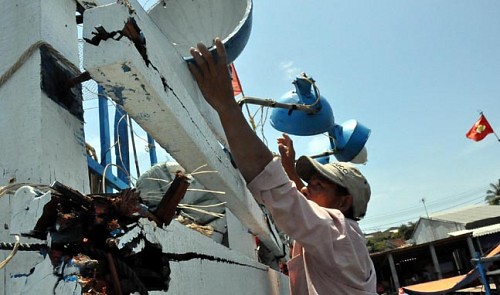
A fishing boat of central Quang Ngai Province with 15 fishermen on board was hit broken by a Chinese ship while it was operating off Vietnam’s Hoang Sa (Paracel) archipelago in the East Sea on May 20, authorities reported.

The fishing ship of Quang Ngai Province was damaged heavily after being hit twice by a Chinese ship off Hoang Sa (Paracel) Islands on May 20, 2013.

>> Fishery control stations to be set up on Truong Sa
>> Chinese fishing boats violate Vietnam’s territorial waters
>> China’s attack on fishing boat is inhuman: law experts

Pham Dinh Chi, chief secretariat of the province’s Binh Son District People’s Committee, said the Binh Thanh Commune People’s Committee had reported that a local fishing boat, QNg 90917 TS, was attacked by a Chinese boat that day while it was fishing off the islands in the East Sea.

After receiving the report, the district authorities have sent an urgent report to the provincial People’s Committee.

That afternoon, while the boat was to about 27 nautical miles off the Tri Ton Island to was, part of the Hoang Sa, it encountered a fleet of 18 Chinese ships.

The boat then tried to sail back toward inland in Quang Ngai, but these foreign ships surrounded it, preventing it from escaping to the shore.

During the seige, crew members on the Chinese ships photographed and videotaped the Vietnamese boat.

At 5:30 pm one of the Chinese ships crashed into the right side of the fishing boat twice, causing it being broken, said Tran Van Trung, the boat’s captain.

The attacking ship was painted red and had number 246 on its hull, Trung said.

The boat eventually managed to return to the Quang Ngai shore on May 21 night.

The total damage causing the attack is estimated at VND100 million (US$4,800), Trung added.

A similar case happened on March 20, when the QNg 96382 TS fishing boat of Quang Ngai was chased and shot at by Chinese vessels while it was operating off the Hoang Sa archipelago.

Answering reporters’ queries about the case, Foreign Ministry spokesperson Luong Thanh Nghi said on March 25 that this is an extremely serious incident that violated Vietnam’s sovereignty over Hoang Sa and threatened the lives of and causes damage to Vietnamese fishermen.

In another related development, China recently deployed 32 fishing boats to the Truong Sa (Spratly) archipelago area in the East Sea. At a press conference in Hanoi on May 9, Nghi said that Vietnam has indisputable sovereignty over Truong Sa, so all activities of parties in this area without Vietnam’s approval violate the country’s sovereignty.

Tuoitre News

Thứ Bảy, 18 tháng 5, 2013

South China Sea Disputes Strain Vietnam–China Relations

If not carefully managed and eventually resolved, the disputes will continue to put the substantive cooperative ties between the two countries in other fields at great risk.

Since 1991, comprehensive Vietnam–China relations have developed but remain constrained by the South China Sea (SCS) disputes.

What makes the disputes highly relevant for future bilateral relations is that they have proven intractable, leaving the possibility of an eventual solution a matter of almost infinite uncertainty.

The intractability of the disputes is rooted in their complicated nature as well as setbacks in possible settlements.

First, both countries’ claims, especially those regarding the sovereignty of the Paracels and the Spratlys, are grounded in each country’s historical evidence. The assessment of the validity of this evidence is both complicated and painful, but it is not impossible if both sides submit themselves to a jointly agreed competent arbitration authority. However, China has always refused to seek international arbitration regarding its SCS disputes, precluding an important option for permanently solving the disputes peacefully.

Second, international legal rules governing the arbitration of maritime claims in the case of the SCS disputes are controversial and not well-defined. This is due to the different views on the status of features forming the two archipelagos and their maritime entitlements. In its joint submission with Malaysia to the Commission on the Limits of the Continental Shelf in early May 2009, Vietnam implicitly held the position that features in the two archipelagos do not qualify as islands, thus having no exclusive economic zone (EEZ) and continental shelf of their own. But in its Note Verbale to the UN Secretary General protesting the joint submission, China held the position that at least a number of features in the SCS are qualified as islands and entitled to their own territorial sea, EEZ and continental shelf.

These differing views can be settled by an arbitrational process. But as the judgments offered by such a process are likely to be based on the interpretation of Article 121 of the UN Convention on the Law of the Sea (UNCLOS), rather than concrete evidence, not only China but also Vietnam may feel discouraged from taking that path for fear of being disadvantaged.

Third, the dispute is made ever more intractable by the nine-dotted line that China has been using to assert its claims, the meaning and legal basis of which China has never clarified. China’s above-mentioned Note Verbale added some light to China’s claims and the meaning of the line but failed to completely make it clear.

The Note Verbale asserted that China not only had ‘sovereignty over the islands in the SCS and the adjacent waters’ but also enjoyed ‘sovereign rights and jurisdiction over the relevant waters’. The terms ‘adjacent waters’ and ‘relevant waters’ are ambiguous, leaving one to wonder whether these waters correspond to those defined under the UNCLOS or whether they refer to the entire water column enclosed by the nine-dotted line. As the nine-dotted line cuts deep into Vietnam’s EEZ and continental shelf, the ambiguity around its meaning makes it difficult to define clearly the disputed areas and further strains efforts to manage and settle the disputes.

Due to the disputes’ intractability, various incidents in the SCS have made bilateral relations ‘warm outside but cold inside’. The most recent notable ones include the cutting of a Vietnamese seismic survey ship’s cable by Chinese maritime surveillance vessels within Vietnam’s EEZ in May 2011, China’s offering of nine blocks within Vietnam’s EEZ to international bidders in June 2012, and the firing on a Vietnamese trawler by a Chinese patrol ship near the Paracels in March 2013.

Incidents like these have generated incessant tensions between the two countries. In Vietnam, following the cable cutting incident, anti-China demonstrations broke out, and Vietnamese leaders have spoken strongly against China’s aggression. In China, for example, following the firing incident in March 2013, the Global Times ran an op-ed stating that ‘the Philippines and Vietnam would face more troubles if they choose to seek fierce confrontation with China’.

One useful way to see how constant the SCS disputes present themselves as an irritant to bilateral relations is to look at statements issued by the Vietnamese Ministry of Foreign Affairs (MOFA) spokesperson. For example, in 2012, bilateral disputes, such as China’s unilateral fishing moratorium, featured prominently in 20 out of 49 press releases and statements of the MOFA spokesperson throughout the year.

If the frequency of the mention of SCS disputes in MOFA statements is used as a barometer for Vietnam-China relations, then these disputes are the most important factor shaping the mood for the relations; and that mood, at least over the last five years, has been going from bad to worse. So, if not carefully managed and eventually resolved, the disputes will continue to put the substantive cooperative ties between the two countries in other fields at great risk.

Le Hong Hiep is a lecturer at the Faculty of International Relations, Vietnam National University, Ho Chi Minh City, and is a PhD candidate at the University of New South Wales, Australian Defence Force Academy, Canberra.

A longer version of the article was first published here by the Institute of Southeast Asian Studies.


Economonitor

Thứ Tư, 8 tháng 5, 2013

Vietnam must keep cool head in China row

China's behavior is self-harming and will not likely result in success. It is contravening a number of international laws and norms set forth by multilateral bodies, as well as behavioral expectations of a rising great power, and thus is showing itself as an irresponsible global actor.

By Andrew Billo, Special to CNN

Editor’s note: Andrew Billo is assistant director Policy Programs at the Asia Society's New York headquarters. The views expressed are his own.

Ten days ago, I travelled to Ly Son Island, a volcanic atoll thirty kilometers off Vietnam’s central coast. I wasn’t there for the island's famous garlic and seafood, but rather as a participant on a Vietnamese government-sponsored trip to see the island from which the country claims Nguyen lords in the late 16th century launched exploratory trips to the Paracel and Spratly archipelagos.

But if I had taken a similar tour to China’s southern Hainan Island, the information I received would have been much different. China claims it took possession of the Paracels as far back as the Han Dynasty in 110 AD. Whether Chinese or Vietnamese ancestors occupied those islands first is now a question at the center of the two countries’ stormy territorial dispute, and shows both the difficulty – and necessity – for both countries to find resolutions grounded in contemporary realities.

Just this week, China promised to look for peaceful solutions to territorial disputes at a meeting of the Association of Southeast Asian Nations, but much of the world increasingly views China's efforts to claim the South China Sea as belligerent and bullying. If its neighbors were persuaded by the country's aspirations for “a peaceful rise” in the last decade, their trust is quickly fading.

It doesn't help that countries such as Vietnam can share stories like that of Vietnamese fishermen Bui Van Phai. Bui claims his boat was fired at by a Chinese patrol vessel near the Paracels in March of this year. As we spoke beneath the scorching late-April sun, Bui's vessel floated idly behind us, its rooftop a blackened skeleton. It was void of any fishing nets or other equipment, which were lost in the blaze at an estimated cost of more than $13,000.

But even the altercation in March, as with the centuries old history, is being strongly contested. While China admits that flares were fired at Bui's boat, it denies having made a direct hit.

Unfortunately, Vietnam may have few options but showing the scars of China’s aggression if the country continues to fight for exclusive territorial sovereignty. In reality, Vietnam, as with all of China’s smaller neighbors, lacks the economic, military, and political power to deter its neighbor's possession of these territories. Even international law, which the Philippines pursued earlier this year, is challenged by China’s refusal to participate in arbitration and the lack of an enforcement mechanism with respect to the ruling.

That’s why Vietnam can gain more through an unemotional, cool, and calculated response that involves negotiation, insofar as it's possible. In doing so, Vietnam can coax China to back down from its current position, rather than pushing its big neighbor into a corner by insisting on territorial sovereignty in the disputed areas.

In fact, the two countries have had limited success on bilateral cooperation in maritime areas. In 2004, China and Vietnam entered into a joint fisheries agreement in the Gulf of Tonkin, although the agreement excluded the contested areas in the Paracel and Spratly Islands.

While nobody likes the schoolyard bully (unless he happens to be on your side), even a bully will tire of his aggression, particularly if he has nobody to pick on. Remaining above the fray will aid Vietnam's international standing, evidencing a maturity in its foreign policy and placing Vietnam on better footing as an attractive locale for international cooperation.

China's behavior is self-harming and will not likely result in success. It is contravening a number of international laws and norms set forth by multilateral bodies, as well as behavioral expectations of a rising great power, and thus is showing itself as an irresponsible global actor. Yet simultaneously, so long as China is persistently being chastised for its actions, it is unlikely to make peace.

China’s maneuvering may partially be a knee jerk response to increased U.S. interest in the region. But Beijing would more effectively gain the favor of Southeast Asian countries by showing a willingness to cooperate with the global legal architecture it voluntarily acceded to. A transparent China would also make America’s job of gaining favor in the region more challenging, when Southeast Asian states are hedging between these two great powers.

The U.S. has increasingly shown support for Vietnam over this issue, sending its Consul General in Ho Chi Minh City (but not its ambassador in Hanoi) to visit the administrative office of the disputed Paracel Islands. But the U.S. has repeatedly emphasized the need for peaceful resolution. While the government of Vietnam may welcome this public show of support, it is also wary: the U.S. has shown in the last few decades a willingness to both forge and scrap alliances, almost in the same breath.

Still, beyond the troubled bilateral relationship with Vietnam and the Philippines, there are also signs that the Southeast Asian community is looking to make progress with China on other fronts, including economic cooperation. Its ability to discuss cooperation at the recent ASEAN summit in Brunei contrasts starkly with last year’s fiasco at the ASEAN foreign minister’s meeting in Phnom Penh, when the regional grouping failed to issue a joint statement.

But ASEAN is still susceptible to division. China’s foreign minister made his first official trip abroad this week, visiting key “neutral” Southeast Asian states whose favor could ultimately be tipped toward China in the ongoing South China Sea dispute. The four countries he visited – Thailand, Indonesia, Singapore, and Brunei – have so far sought to balance the interests of the United States, China, and ASEAN.

All of this seems to play to China's policy of strategic ambiguity, but with America adopting a similarly opaque strategy, there is a risk of the most globally important economic region becoming a playground for the world's two great powers as they try to sort out their relations.

As a result, a strategy for managing the dispute that recognizes historical differences while seeking compromise for all parties based on legal principles is needed. Vietnam – and others – should not allow themselves to be incited by China's aggressive proclamations. The world is watching closely, and quietly hoping China's behavior might change.

CNN World

Thứ Tư, 10 tháng 4, 2013

Psychological warfare in the South China Sea

To fight and conquer in all your battles is not supreme excellence; supreme excellence consists in breaking the enemy's resistance without fighting. - The Art of War, ancient Chinese military treatise attributed to Sun Tzu.

HANOI - Maritime disputes between China and Vietnam have entered a dangerous new realm: psychological warfare. Tit-for-tat provocations, including marine patrol deployments in disputed areas in the South China Sea and Beijing's decision to include territories it claims on maps printed in its national passports, have intensified in recent months, adding new destabilizing variables to an already volatile situation.

While both sides have repeatedly stated their intention to achieve a peaceful solution through negotiations, including through a joint statement issued in 2011, at present there is little or no direct dialogue between the two governments. Beijing and Hanoi must now also face rising nationalism among their citizens, including periodic anti-China street protests in Vietnam and widespread anti-Vietnam rhetoric on Chinese citizens' private blogs and Facebook pages related to the South China Sea disputes.

Rather than dialogue, China and Vietnam seem to be increasingly engaged in a thorny game of psychological warfare, with the apparent aim to undermine the other sides' ability to conduct potential combat operations in the disputed areas. While Vietnam's reactions to China's moves have appeared more defensive than offensive, China's actions have more clearly aimed at deterring and demoralizing Vietnam's smaller and comparatively poorly equipped military and navy.

When an annual fishing ban imposed by China over northern areas of the South China Sea was lifted last August, more than 14,000 fishing boats registered in China's Guangdong province and another 9,000 ships carrying over 35,000 fishermen from nearby Hainan Island overwhelmed contested maritime areas. Vietnamese officials suggested at the time that the intention behind the seemingly coordinated dispatchment of such a large number of vessels "was not to fish''.

The Brussels-based International Crisis Group said in a report entitled "Stirring up the South China Sea II: Regional Responses" that the large number of fishing boats "also provide a pretext for increased civilian patrols in the South China Sea and rally nationalist sentiment''.

In late January, Vietnam reacted by establishing a new fishery bureau to patrol waters it claims in the South China Sea. According to the enabling executive decree, members of the new ''Vietnam Fisheries Patrol'' will have authority to impose penalties on local and foreign fishing organizations and individuals that operate within Vietnam's claimed maritime areas.

The patrol group will also be involved in disaster prevention and control, as well as search and rescue missions, according to the decree. The bureau's creation follows on a Law of the Sea passed last year by Vietnam's General Assembly. China vigorously protested on the grounds the new law violated its sovereign territory. The government-influenced CCTV commented similarly that the new bureau's creation represented a violation of China's "sovereignty and maritime rights''.

In apparent tit-for-tat response, Chinese officials announced plans in early March to establish a new village on Mischief Reef, a large reef in the Spratly archipelago. On March 7, Hanoi reaffirmed its sovereignty over the Spratly and Paracel archipelagos, prompting China for the first time to deploy a marine surveillance unit outfitted with helicopters to carry out patrol and observation missions near the contested islands.

On March 10, three China Marine Surveillance (CMS) ships departed with fanfare from the port of the newly created Sansha City on Hainan Island. Three days later, China's official news agency Xinhua reported that two Vietnam-registered fishing ships were driven out of China's territorial waters by one of the CMS vessels. The report said the Vietnamese boats were suspected of illegal fishing within China's territorial waters.

Position of weakness

Hanoi did not issue an official statement in response to the incident, which significantly occurred while Vietnam commemorated a 1988 sea battle in the contested Spratly Islands in which China routed Vietnamese forces, killing 64 soldiers. Vietnamese state-controlled media, which reported widely on the anniversary, continues to assert that Gac Ma island in the same archipelago is illegally occupied by China - a notion that activists rallied around at anti-China protests held last month in Hanoi.

Days later, on March 25, Hanoi strongly protested when a Chinese boat shot flares at a Vietnamese fishing vessel in the contested Paracel archipelago. Vietnamese officials demanded that Beijing investigate and take action against the perpetrators for what Hanoi viewed as a "wrongful and inhumane" act. Chinese foreign ministry spokesman Hong Lei responded that the action was "legitimate and necessary" because it occurred in what Beijing views as Chinese territory.

Militarily, China can afford to take such a hard line. According to official statistics, China's military budget of US$91.5 billion was more than 40 times greater than Vietnam's $2.6 billion in 2011. Beijing also dominates on the economic front, with Vietnam's trade deficit with China rising to $16.4 billion in 2012 from $9 billion in 2007.

Some analysts suggest that the next phase of China's psychological warfare campaign could be to impose trade bans on Vietnam, similar to the ones it imposed on rare earth exports to Japan in 2010 and last year's ban on banana imports from the Philippines. Both Japan and the Philippines are also embroiled in maritime disputes with China. Such tactics, however, risk undermining over two decades of diplomacy aimed at building confidence and economic linkages with Southeast Asia.

Vietnam has increasingly pointed to international law and the non-binding "Declaration on Conduct of the Parties in the East Sea" reached between China and the Association of Southeast Asian Nations (ASEAN) to defend its position. While China reaffirmed its commitment to the declaration earlier this month at the 19th ASEAN-China Senior Official Meeting in Beijing, it has worked behind the scenes to prevent ASEAN from developing a unified position on the disputes.

Beijing's undefined position, including over how many of the features included its wide-reaching nine-dash map of the South China Sea it actually claims, has played into its psychological warfare with Vietnam. "Big powers have advantages in maintaining strategic ambiguity," said Huang Jing, director of the Center on Asia and Globalization at the National University of Singapore. He suggests that China has learned how the United States often makes use of strategic ambiguity in its international relations.

The situation has also been complicated by China's leadership transition from Hu Jintao to Xi Jinping. According to academic Jing, under Xi South China Sea issues can no longer be perceived as solely an international issue but rather also a domestic one. "Public opinion does matter in decision making. [China's] new leaders have no choice - they have to play tougher in [the] South China Sea," said Jing.

Writer Roberto Tofani who is a freelance journalist and analyst covering Southeast Asia. He is also the co-founder of PlanetNext (www.planetnext.net), an association of journalists committed to the concept of "information for change".

(Copyright 2013 Asia Times Online (Holdings) Ltd. All rights reserved. Please contact us about sales, syndication and republishing.)

Thứ Hai, 8 tháng 4, 2013

China in Row with Vietnam over Tourist Plans for South China Sea Islands

(IBTimes) China has announced plans to allow tourist cruises to islands in the South China Sea, even though the archipelago is also claimed by Vietnam.


Chinese soldiers exercise during a training session at a beach on the Xisha islands

The Far Eastern superpower will let tourists visit the Xisha Islands, called the Paracel Islands in Vietnam, ahead of the forthcoming May Day holiday.

Vietnam has long disputed China's claim to the Paracel Islands, which China has occupied since a brief war between the two countries in 1974. The cluster comprises about 40 islets, sandbanks and reefs.

Hanoi last month accused a Chinese vessel of firing on one of its fishing boats which had sailed into the disputed waters.

However Tan Li, executive vice governor of the southern-most province of Hainan, told the state-run Xinhua news agency that the islands provide the perfect opportunity for cruise travel.

Tourists will eat and sleep on the cruise ships and can land on the islands for sightseeing, he added.

The announcement came as a speech from China's new President Xi Jinping called for peace and stability in the Asian region.

"Stability in Asia faces new challenges, as hotspot issues keep emerging and both traditional and non-traditional security threats exist," he said to the Times of India.

The announcement was also made from Hainan, which forms part of the headquarters of China's South China Sea naval fleet, which has begun conducting aggressive patrols in recent months.

China claims sovereignty over almost the entire South China Sea; in addition to the dispute with Vietnam Beijing has also been embroiled in a long-running conflict with Japan over a separate chain of islands.

Thailand has also objected to maps on the Chinese passports with a U-shaped mark claiming a stretch of the sea running in defiance of exclusive economic zones mapped out by the UN Convention on the Law of the Sea (UNCLOS).

Tan said details on the tour routes, capacity of the tourist reception and cruise ships will be released at a later date.


China has been asserting its rights on the oil-rich islands which it has controlled since a short war with South Vietnam in 1974 (nasha.gov)

Cruise tours are the popular choice for the islands as hotels and other facilities to accommodate tourists are inadequate, Tan said.

There is only one hotel with 56 rooms on the 2.13-square-kilometre Yongxing Island, the largest island among the group and home to the government offices of Sansha city.

ibtimes

Thứ Ba, 2 tháng 4, 2013

Vietnam marine police to step up East Sea protection for fishermen

The Vietnam Marine Police Department has said it would beef up protection for Vietnamese fishermen fishing in the nation’s territorial waters with frequent patrols of the East Sea including areas off remote islands that it has clear sovereignty over.


A marine police ship sailing the East Sea

It would even accompany Vietnamese fishing boats if needed, the department said, adding these measures were being taken in response to a Chinese ship illegally opening fire on a Vietnamese fishing boat recently.
“We will stay 24/24 in remote islands and coordinate with other forces to support, or even accompany the fishermen to protect them,” a VnExpress report quoted department director, Major General Nguyen Dam, as saying.

Dam said the action of the Chinese ship firing flares at Vietnamese fishing boats on March 20 was a serious violation of international laws as well as the Declaration on the Conduct of Parties in the South China Sea (DOC).

Vietnamese marine police will ask Chinese forces to abide by international laws, he said.

On March 20, the fishing boat of Bui Van Phai, who hails from the central province of Quang Ngai, encountered a Chinese vessel at around 10 a.m. when it was winding up its fishing activities for the day in the Hoang Sa (Paracels) Archipelago.

The Chinese ship gave chase for about 30 minutes, firing flares and leaving after the boat’s cabin caught fire. The nine fishermen on board managed to put out the flames and prevent a potential explosion, Phai said.

On March 25, Ministry of Foreign Affairs spokesman Luong Thanh Nghi condemned the firing as "wrongful and inhumane,” as the boat was fishing in traditional fishing grounds in Vietnam's Hoang Sa Archipelago.

Dam, the Vietnamese general, said marine police are increasing their patrols in specific areas in the East Sea, internationally known as the South China Sea, where Vietnamese fishermen have been fishing for a long time.

“One of our most important tasks is to maintain security and a safe environment for fishermen and ensure marine economic activities,” he said.

The department held a conference in Hanoi on March 29 to review a campaign to enforce sea patrols from November 15, 2011 to March 15 this year.

According to a report released at the event, the national marine police chased away more than 350 foreign fishing boats violating Vietnamese waters during that period.

Dam said Vietnam marine police would continue chasing away foreign boats, including Chinese ones, fishing illegally in Vietnamese waters.

“This is our permanent task and we will have to do it better in the future,” he said.

“We are determined not to let other countries complicate the situation in the seas under Vietnam’s sovereignty and jurisdiction.”

China and four members of the Association of Southeast Asian Nations (ASEAN) – Vietnam, the Philippines, Malaysia and Brunei – are embroiled in sovereignty disputes over the East Sea.

China’s claim is the largest, covering most of the sea’s 1.7 million square kilometers.

Though this has been emphatically rejected by the other claimants and independent experts, analysts warn that Beijing is unlikely to back down from its expansive claims in the region, stretching from the eastern Himalayas to the East Sea.

The East Sea is thought to hold vast untapped reserves of oil and natural gas that could potentially place China, the Philippines, Vietnam, and other claimant nations alongside the likes of Saudi Arabia, Russia, and Qatar.

The waters hold around 11 billion barrels of oil and 190 trillion cubic feet of natural gas in proven and probable reserves, Reuters reported, citing the US Energy Information Administration.

Thanhnien News

Thứ Sáu, 29 tháng 3, 2013

China’s attack on fishing boat is inhuman: law experts

Many Vietnamese law experts have condemned China’s recent pursuit and subsequent firing at a Vietnamese fishing boat in the waters off Vietnam’s Hoang Sa (Paracel) archipelago. They consider the incident to be inhuman and boldly in violation of Vietnam’s sovereignty.


The captain of the fishing boat that was fired at by a Chinese naval ship, Pham Quang Thanh, is seen on board the fired boat

Commenting on the incident, which involved a fishing boat from the central province of Quang Ngai on March 20, lawyer Truong Xuan Tam, a member of the National Lawyers Council and deputy president of the Ba Ria-Vung Tau Province Bar Association, pointed out that China has not stopped at threatening to use force, but it has actually used force in violating Vietnam’s sovereignty.
“We need to consider taking proceedings against China to the International Court of Justice to claim compensation for Vietnamese fishermen for their damage and demand that China respect Vietnam’s sovereignty,” the lawyer said.

Tam condemned the incident as extremely dangerous and a bold, rough and defiant violation of Vietnam’s sovereignty.

Another lawyer, Hoang Ngoc Giao, head of the Research Institute for Policy, Law and Development, said: “No armed conflict has taken place between China and Vietnam, but China has used force towards Vietnamese civilians. As far as I know, no country has behaved as badly as China in this case.”
The former Vietnamese consul general to China’s Guangzhou Province, Duong Danh Hy, also condemned the aggressive action. “The attack on fishermen is a bold escalation by China in violating Vietnam’s sovereignty. Besides the objections made through diplomatic channels, we must pay more attention to protecting the lives of our fishermen.”

Nguyen Ngoc Duc, Chief of the Secretariat of the Vietnamese Fishery Association, said the organization has proposed that relevant Vietnamese agencies take measures to “prevent wrong actions by China, safeguard the life and property of Vietnamese fishermen, and protect Vietnam’s sovereignty over its seas and islands.”

As previously reported, the QNg 96382 TS fishing boat from Quang Ngai was conducting normal fishing activity in the traditional fishing ground around the Hoang Sa archipelago when it was chased and shot at by Chinese vessels on March 20. The assault caused a fire that burned the boat’s cabin.
In answering reporters’ queries regarding Vietnam’s response to the incident, Foreign Ministry Spokesman Luong Thanh Nghi said this was an extremely serious act that violated Vietnam’s sovereignty over the archipelago and threatened the lives of, and caused damage to, Vietnamese fishermen.

It also seriously violates the spirit of the Declaration on the Conduct of Parties in the East Sea (DOC), breaches the principles of international law and the agreement on the basic principles guiding the settlement of sea issues between Vietnam and China, Nghi added.

Meanwhile, at a press conference on March 26, Chinese foreign ministry spokesman Hong Lei said that China had taken unspecified but "legitimate and reasonable" actions against Vietnamese boats working “illegally in Chinese waters”. He denied that any boats had been damaged.

In a statement released the same day, the Chinese Defense Ministry also refuted the incident and said that a Chinese navy vessel had fired two flares into the air after four Vietnamese fishing boats failing to respond to whistles, shouts and signal flags requesting that they stop fishing and leave the area, which China claims as its territorial waters.

Tuoitre News

Thứ Tư, 27 tháng 3, 2013

Flares, gunshots, and fires, oh my: The latest South China Sea accusations fly

Vietnam accused China of firing on a fishing boat near the Paracel Islands, something China denies. China claims territorial rights over the entire south China sea, but several nations dispute this.


Vietnamese fishing boats are seen near Da Tay island in the Spratly archipelago in January.
Quang Le/Reuters

China has denied Hanoi's accusations that it fired upon a Vietnamese fishing boat last week near the Paracel Islands as "sheer fabrication," and claims that its patrol vessel only fired flares and did not damage the boat.

Beijing said yesterday that despite Vietnamese accusations that the fishing vessel was fired upon and its cabin "burned down" during a confrontation last week near the Paracels, which both China and Vietnam lay claim to, the Chinese patrol vessel's actions were "necessary and legitimate," reports state newspaper the China Daily.

Chinese Foreign Ministry spokesman Hong Lei told reporters that China has indisputable sovereignty over the Xisha Islands [the Chinese name for the Paracels] and their adjacent waters, and the Vietnamese fishing boat entered the waters for "illegal fishing operations".

"According to confirmation by relevant parties, no harm was done to the Vietnamese ship at that time and place," Hong said.

An unnamed Chinese navy official goes further, Chinese state news agency Xinhua reports, calling the Vietnamese description of events a "sheer fabrication" that "revealed the ulterior motives of the relevant Vietnamese authorities."

Staff aboard the Chinese patrolling vessel tried repeatedly to persuade and demand the Vietnamese boats to leave by whistle blowing, shouting and handflag guiding, but all failed.

Then the Chinese vessel fired into the sky two warning signal shells, which burned out and extinguished in the air.

There is no such things [sic] that Chinese vessel fired with weapons or the Vietnamese boats caught fire, said the official.

This is just the latest event in an ongoing dispute between Vietnam and China over islands in the south China sea. China claims to have historical territorial rights over the entire sea, but Vietnam, Japan, the Philippines, Taiwan, and several other nations each lay claim to various islands within the region – including the Paracels and the Spratleys, which Vietnam claims.

HANOI, Vietnam (AFP)- Activists in Hanoi lay flowers and chant anti-China slogans at a protest marking the anniversary of a battle over the contested Spratly Islands in which 64 Vietnamese soldiers died.

The Vietnamese government publicized the issue on Monday, saying that the Chinese vessel illegally chased and fired upon the Vietnamese vessel as it fished in what Thanh Nien News called its "traditional fishing grounds" in the Hoang Sa Archipelago, the Vietnamese name for the Paracels.

"This is an extremely serious issue, violating Vietnam's sovereignty over Hoang Sa Archipelago, threatening the lives and damaging properties of Vietnamese fishermen," [Foreign ministry spokesman Luong Thanh Nghi] said.

"This has seriously violated international laws and agreements on basic principles in solving sea issues between Vietnam and China, and is counter to the Declaration of Parties in the [South China] Sea (DOC)."

Radio Free Asia reports that Pham Quang Thanh, the captain of the fishing boat, said that "When we saw the vessel from afar, we left right away. But after about 30 to 40 minutes, they were already right behind us."

“I tried to head east to get away, but they were close to us, and they started shooting at us,” Thanh said.

Thanh then ran inside the boat’s cabin, he said.

“I heard four explosions and found that the boat’s cabin was on fire, and I called everybody to put out the fire with sea water.”

His Chinese attackers had meanwhile left, eventually halting about five or six nautical miles away, he said.

“They just left. They didn’t show any willingness to help, or even to stop to check on us. They wanted to destroy us.”


Sailor Pham sits in his damaged fishing boat, which was allegedly attacked by Chinese boats in the disputed south China sea

Citing an earlier news report, Thanh Nien News describes a similar scene, but names the ship captain as Bui Van Phai, who said his boat collided with the Chinese vessel before the chase began.

----------


Europe Editor

Arthur Bright is the Europe Editor at The Christian Science Monitor.  He has worked for the Monitor in various capacities since 2004, including as the Online News Editor and a regular contributor to the Monitor's Terrorism & Security blog.  He is also a licensed Massachusetts attorney.


The Christian Science Mornitor

Chinese action against Vietnamese fisherman was 'legitimate'


Sailor Pham sits in his damaged fishing boat, which was allegedly attacked by Chinese boats in the disputed South China Sea

The action taken by Chinese authorities regarding a Vietnamese boat "illegally fishing" last week in the waters off "China's Islands" in the south China sea was "necessary and legitimate", Beijing said on Tuesday.

Chinese Foreign Ministry spokesman Hong Lei told reporters that China has "indisputable sovereignty" over the so-called "Xisha Islands" and their adjacent waters, and the Vietnamese fishing boat entered the waters for "illegal fishing operations".

"According to confirmation by relevant parties, no harm was done to the Vietnamese ship at that time and place," Hong said.

Vietnam claimed on Monday that a Vietnamese boat was "chased and fired at" by an unknown number of Chinese ships, and "its cabin was burned down" in the waters on March 20, according to Vietnamese Foreign Ministry spokesman Luong Thanh Nghi.

The fishing boat came from Vietnam's Quang Ngai province.

Hanoi urged Beijing to investigate and "compensate Vietnamese fishermen for their loss" in a statement on the ministry's website.

The statement did not say how many Chinese ships or what kind of vessels were involved, and Hanoi has not conceded that the fishing operation was illegal.

"China urges the Vietnamese to take effective measures to improve education and management of its fishermen and stop illegal operations," Hong said.

Wu Shicun, director of the National Institute for South China Sea Studies, said China's "Xisha Islands" are not within the scope of a territorial dispute, and Vietnam's hype about the confrontation is meant to aggravate the regional situation.

China has exercised restraint on the issue, but "Vietnam has planned to bluff the international community by playing the role of victim, and it is actually trying to justify its illegal claim over the islands", Wu warned.

As for the Vietnamese ship, it was not the first time it was caught illegally fishing, as previous media reports showed that it was among the two Vietnam-registered fishing ships that were driven out of China's territorial waters by a China Marine Surveillance fleet on March 13.

The two ships were driven out of the waters by the patrol ships Haijian 262 and Haijian 263, Xinhua News Agency reported.

Similar cases of illegal fishing were reported in recent years, and Beijing had previously sent warnings to Hanoi on acts by Vietnamese fishermen.

On March 4, 2012, Chinese authorities investigated and punished two Vietnamese fishing boats and 21 Vietnamese fishermen for illegally fishing in waters off the "Xisha Islands".

Li Guoqiang, deputy director of the Center for Chinese Borderland History and Geography at the Chinese Academy of Social Sciences, said the waters off the "Xisha Islands" have seen a growing number of illegal operations by Vietnamese fishermen, and Hanoi's policies and attitudes have been widely viewed as contributing to the incidents.

"Vietnam should be aware of the impact on bilateral ties with China," Li warned.

Relations between the two nations soured after Vietnam's National Assembly passed a "Vietnamese Law of the Sea" in June, claiming China's "Xisha and Nansha Islands" in the south China sea as being "within Vietnam's sovereignty and jurisdiction".

Asia One

Thứ Tư, 20 tháng 3, 2013

Vietnam PM pledges to defend sovereignty

Prime Minister Nguyen Tan Dung (L) shakes hands with a veteran of the historic 1954 Battle of Dien Bien Phu
Vietnam is always prepared to safeguard its sovereignty under any circumstances, Prime Minister Nguyen Tan Dung told veterans of the 1954 Battle of Dien Bien Phu at a meeting on Tuesday in the northern port city of Hai Phong.

Dung stressed that the Party and the government would always honor and appreciate the contributions of military officers and veterans who fought for liberation of the Vietnamese people.

“If there were no great fights like the August Revolution, the 1954 Battle of Dien Bien Phu and Dien Bien Phu in the Air, etc. there would have been no Doi Moi (Renovation).

“Younger generations will promote that tradition as they try their best to develop the country, while making sure to protect its sacred sovereignty,” Tuoi Tre (Youth) newspaper quoted Dung as saying.

About 20 veterans who fought in the Battle of Dien Bien Phu currently reside in Hai Phong. They shared with the Prime Minister their opinions and wishes concerning the nation’s socio-economic and national security situations and on a current draft proposal that if approved, would amend Vietnam’s 1992 Constitution.

China maritime surveillance ship chasing a Vietnamese fishing vessel around Paracel Islands' sea on February 20th, 2013. Photo: tienphong.vn
In related news, Vietnam once again rejected the legitimacy of what China has been referring to as “Sansha City” and demanded that Beijing cease violating Vietnamese sovereignty and impeding the legal activities of Vietnamese fishing vessels, a representative of the National Boundary Commission said Tuesday.

The official said that Vietnam has sufficient legal and historical evidence which affirms its sovereignty over the Hoang Sa (Paracel) and Truong Sa (Spratly) archipelagoes and validates its right to protest China’s recent activities off the two sets of islands.

China recently approved the establishment of the so-called “Sansha” radio-television and satellite television stations; and dispatched marine surveillance ships and a helicopter to patrol the Hoang Sa Islands.

Chinese forces also used coercion to drive away two Vietnamese fishing boats that had been conducting legal fishing activities in the area.

In the latest move, China sent a Fishery Resource and Environmental Science Survey Ship, the Nan Feng, to the waters off the Truong Sa Islands to investigate the area’s fishery resources.

The above-mentioned activities have violated Vietnam’s sovereignty, said the representative of Vietnam’s National Boundary Commission.

Thanhnien News

Vietnam demands China to end sovereignty violation

A Vietnamese fishing vessel is chased by a China Maritime Surveillance around Paracel Islands on February 20th,2013. Photo: nld.com.vn
Vietnam once again rejects the so-called Sansha City and requests China to end violations of its sovereignty, and take no action to impede the legal fishing activities of Vietnamese fishing boats and fishermen, a representative of the National Boundary Commission stated on March 19.

The official went on to say that Vietnam has sufficient legal and historic evidence affirming its sovereignty over Hoang Sa (Paracel) and Truong Sa (Spratly) archipelagoes in an action to protest a series of activities recently carried out by China in the two archipelagoes.

China recently approved the establishment of the “Sansha” radio-television and the “Sansha” satellite television station, dispatched a detachment of marine surveillance ships, including the Haijian 83 along with Haijian helicopter B-7103, Haijian 262 and Haijian 263 to patrol Vietnam’s Hoang Sa archipelago.

The Chinese side also drove away Vietnamese fishing boats No. QNg96417TS and QNg96382TS, which were conducting legal fishing activities in the area.

In the latest move, China sent a Fishery Resource and Environmental Science Survey Ship, Nan Feng, to the waters of Vietnam’s Truong Sa archipelago to investigate the area’s fishery resources.

The above-mentioned activities have violated Vietnam’s sovereignty, said the representative of Vietnam’s National Boundary Commission.

Source: Vietnam Plus

Thứ Ba, 12 tháng 3, 2013

The forgotten battle in South China Sea - Truong Sa sea battle

Teh transport ship HQ-603 was taken photo on March 10, 1988 -- four days before it was sunk at Gac Ma Atoll in Truong Sa archipelago Photo: Archives photo of Brigade 125
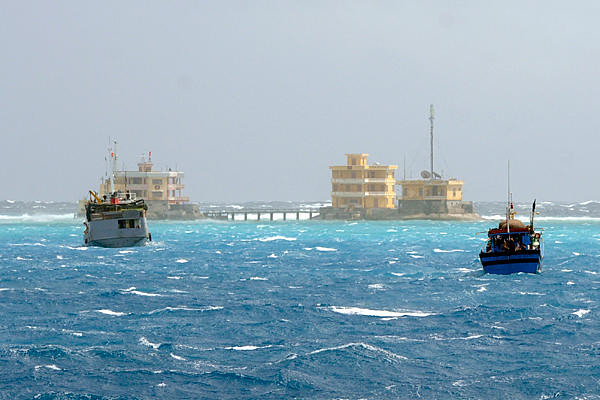
(Tuoitre News) On Mar 14, 1988 a fierce sea battle took place between Vietnamese soldiers and Chinese troops around Co Lin, Len Dao and Gac Ma, which are part of the Truong Sa (Spratly) archipelago.


Hosting: Kiwi6.com

However, few people know the details of this battle.

The Vietnamese soldiers’ extraordinary gallantry and dogged determination to safeguard the nation’s territory was defeated by Chinese state-of-the-art weaponry and ruthlessness. Since then Gac Ma Island has been illigimately occupied by China.

The immediate cause

In response to the imminent, illegitimate occupation of Truong Sa by the Chinese invaders, prior to March 14, 1988, the Vietnamese transport ships HQ-505, HQ-604 and HQ-605, under the command of the 125 and 146 Brigades and the E83 Military Engineering Regiment, were immediately sent to the atolls of Co Lin, Len Dao and Gac Ma, where they built fortifications and other infrastructure during the CQ88 campaign, which was a relentless attempt to maintain Vietnamese ownership of Truong Sa.

The imbalanced, bloodstained battle

25 years have passed since the fight, yet that morning has been firmly imprinted in the mind of Nguyen Van Lanh, a naval soldier who took part in the battle.

Late in the evening of March 13, HQ-604 arrived at Gac Ma, while the other two ships headed for Co Lin and Len Dao, Lanh recalled.

The group led by Second Lieutenant Tran Van Phuong was in charge of pitching and safeguarding the Vietnamese national flag on the island.

Nearby, the Vietnamese flag was also flying on Co Lin island.

Lieutenant-colonel Tran Duc Thong commanded that the soldiers focus on the task despite the Chinese warships lurking in the vicinity.

At dawn on March 14, Chinese ships closed in on HQ-604. These ships were fully equipped with advanced firepower and lethal weaponry, whereas the Vietnamese vessels were merely designed to carry soldiers, food and construction materials.

The majority of the Vietnamese soldiers were sappers who specialized in carrying out construction work on the islands.

Despite the serious imbalance in power, the Vietnamese captains and soldiers unwaveringly resolved to safeguard the islands.

At around 6 am, the Chinese force sent small boats filled with armed-to-the-teeth soldiers to close in on the Gac Ma corals.

To counter this, on Gac Ma, the Vietnamese soldiers formed a circle, which was later respectfully named ‘the immortal circle’, in an unwavering attempt to guard the Vietnamese flag in the center.
As there were few Vietnamese naval soldiers on the island, Lanh and all the other sappers, armed with merely hoes and shovels, were immediately summoned to aid Phuong’s regular group.
The battle became heated in an instant. The Chinese troops landed in large numbers and tried to break the circle, but failed.

Plastic sandals, bowls, clothes, and weapons found in the HQ-604 in 2008 (Photo: Tuoi Tre)

After a firefight the Chinese troops were able to approach Second Lieutenant Phuong, who was holding onto the flag for dear life.

Phuong and Lanh struggled with all their might to keep the flag until Phuong was suddenly shot in the head. He collapsed, but still tried to hold onto the bloody flag.

Lanh managed to keep the flag until Chinese soldiers stabbed him from behind and finally shot him with an AK-47.

The battle continued to rage. The Chinese ships fired heavy machine guns and 37 mm cannons at the unyielding Vietnamese soldiers.

The fight was also ferocious aboard the HQ-604 ship, which was incessantly bombarded with long-range fire power, Mai Van Hai, one of the survivors, recalled. B-40 and B-41 on the Vietnamese ship couldn’t reach the enemy.

Right after the battle began, Captain Vu Phi Tru dashed into the engine room, planning to land the ship on the Gac Ma corals. All of a sudden, the engine room was hit and burst into flames, engulfing Tru, leaving the ship unable to land, Hai added.

Hai then tried to see Lieutenant-colonel Tran Duc Thong and Captain Phong right as they were fired upon with heavy machine guns.


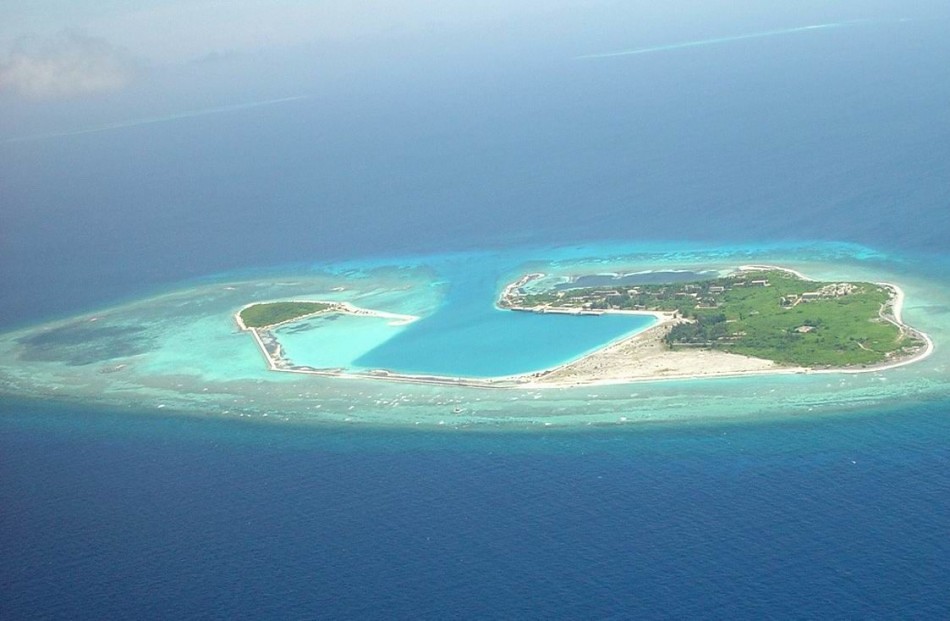
The Spratly Islands are a group of more than 750 reefs,islets, atolls, cays and islands in the Southeast Asia Sea. In 1998, those Chinese attacked, stole Vietnamese islands and killed their soldiers there.
Thong and Phong both perished, and the HQ- 604 ship gradually sank into the sea, taking down with it dozens of soldiers.

“A normal transportation vessel, the HQ-604 could only fire from 500 meters at most, while it was roughly 3.6-5.4 km away from the enemy ships. They were perhaps trying to steer the ship nearer to the Chinese ones to get into firing range, but it couldn’t withstand the enemy barrage,” colonel Tran Thanh Tam explained, 25 years later.

Immediately after finishing off HQ-604 off Gac Ma, the Chinese warships turned to bombard HQ-605 with heavy weaponry.

The ship burst into intense flames, and Captain Son of HQ-605 ordered everyone on board to evacuate.

The map of atolls Gac Ma, Co Lin, and Len Dao in Truong Sa archipelago in the East Sea (Photo: Tuoi Tre)

Tuoi Tre News

China's ships crash Vietnamese fishing vessels, 2 missing

China rushes to put 21 large and medium-sized fishing vessels, and more than 3,000 personnel to South China Sea citing "security and the legitimate interests of Chinese fishermen". Meanwhile, the border guard force in Thanh Hoa province of Vietnam announced that two fishermen have been missed by China's ships crashed in the area of 26 knots from Bach Long Vi Island.

Bach Long Vi Island, Vietnam

On the same day, at the area of 26 knots, toward the northeast, from Bach Long Vi island, a fishing ship (hull number TH 90 599 TS 130 CV ) owned by Mr. Hoang Van Thao residing in Bac Tho village (Ngu Loc commune, Hau Loc district, Thanh Hoa province) was suddenly hit by a China's ship.

The strong collision which made two fishermen on board crashed into the sea and disappeared. Currently, the Thanh Hoa province's border forces is working with local authorities and fishermen searching for two fishermen missing at sea due to the ship crashed.

After crashing on the above vessels, the China's vessels left. The fishermen on the ship coding TH 90 599 TS had to call the nearby fishing vessel to rescue and has sent five people to the shore. Meanwhile, the identity of two missing fishermen have not been clearly defined.

A day earlier, on March 9th a fleet of China maritime surveillance (CMS) officially stationed in the so-called "Sansha City" which essentially consists of the Paracel and Spratly archipelagos of Vietnam.

Vietnam affirms its sovereignty over Hoang Sa (Paracel) and Truong Sa (Spratly) archipelagoes, Foreign Ministry Spokesperson Luong Thanh Nghi said at a regular press briefing in Hanoi Thursday, March 9th.

Nghi pledged to he answer reporters’ queries regarding Vietnam’s response to the recent Chinese sea patrol in the East Sea, including the country’s two archipelagoes.

All actions in the region that take place without Vietnam’s permission are violations of its sovereignty which the country resolutely opposes, he claimed.

Translated by Google. Source: Xa Luan ( http://www.xaluan.com/modules.php?name=News&file=article&sid=555213 )

Note: Due to pressure from Beijing, Vietnamese state media often called Chinese ships in the South China Sea are "strange ships" (Vietnamese: "tàu lạ").

Thứ Hai, 11 tháng 3, 2013

China plans daily fishery patrols in East Vietnam Sea in 2014

GUANGZHOU - China will conduct daily fishery administrative patrols in the East Vietnam Sea (the South China Sea ) in 2014 to better safeguard the legitimate interests of domestic fishermen, a fishery official said Thursday.

Wu Zhuang, chief of the South China Sea Fishery Bureau under the Ministry of Agriculture, said the timeframe for the patrols is based on his bureau's growing law enforcement capacity.

"A noticeable improvement will be seen in our enforcement capacity in the next two years, as the bureau has entered a period of rapid development, " he said.

Describing 2012 as "a most challenging year," Wu said his bureau has taken a very strong position regarding fishery patrols and protection.

He said the bureau's fishery patrol ships stayed at sea for a record high of 183 days on average last year.

"Thanks to our more frequent patrols and quicker responses, no Chinese vessels engaging in normal fishery operations in the Nansha waters were illegally seized by foreign countries last year," he said.

On Thursday morning, on behalf of the Chinese government, Wu sent Lunar New Year greetings to the China Yuzheng 302 and China Yuzheng 311, vessels posted in waters off the Meiji Reef and Huangyan Island, respectively.

"As the Chinese Lunar New Year approaches and at a time of family reunions, you, subordinated to the needs of the county, stand fast at your posts in the motherland's southern frontier and strive valiantly to safeguard state sovereignty and the legitimate interests of domestic fishermen," he said.

More than 400 fishing vessels are currently operating in the South China Sea, most of which will have to usher in the Year of Snake, which begins on February 10, at sea.

"Where there is a fishing vessel, there is our patrol ship. We will overcome all difficulties to protect fishermen," said Captain Yang Jia'en, who heads the China Yuzheng 302.

A video feed from the patrol ship also showed three Chinese fishing vessels operating near the Meiji Reef.

In the Huangyan Island, fishery inspectors onboard the China Yuzheng 311 can only communicate with the China Fishery Command Center for the South China Sea through marine satellites.

Thứ Tư, 6 tháng 3, 2013

Why big Western tech companies have made it in Vietnam but not China

Vietnam Flag/ Vietnamese flag

Oftentimes, people like to compare Vietnam with China. In some ways, the similarities are pretty obvious. The Chinese dynasties ruled Vietnam for one thousand years. Vietnamese people celebrate Lunar New Year, and our names have Chinese roots. But online and in the tech industry, things look really different.

In Asia, there are four communist countries: China, Vietnam, Laos, and North Korea. Laos and North Korea are so small they’re not really on the tech map (even if North Korea is finally using mobile internet). That leaves China and Vietnam. In China, Baidu, Tencent, and Sina Weibo are the search and social media giants. In Vietnam, Google and Facebook are tops and Twitter isn’t blocked. What happened?

Search

China began interfering with Google’s search service in 2010, and it frequently fails to load but is not fully blocked. It’s due to China’s effort to manage the content that the majority of its population has access to; it’s also, some have argued, a big part of the protectionist success of Baidu and Sina Weibo who fill the shoes of Google and Facebook/Twitter. Today, Baidu gets an average of five-billion search queries per day, and Google gets over 100-billion searches per month. But with Google partially locked out of China (it’s still the fifth most used search engine there), Baidu basically has near-exclusive access to the biggest market in the world.

In Vietnam, Google.com.vn is the number one search site and Google.com is number three. Vietnam has some new locally made players like Wada.vn and CocCoc, but they’ll have a hard time up against Google’s dominance. In the mid 2000’s, Google was already slowly creeping into Vietnam. YouTube was and still is one of the most used and viewed websites in Vietnam and so Google was allowed to slowly creep in.

The interesting thing about Vietnam is that Google never officially opened up an office here. It still hasn’t. Google slowly entered, its value was assessed by users, and then it slowly rose to dominance. Now, if Google were blocked in Vietnam, it would leave a huge black hole in the Vietnamese cyberspace.

This is the trend in Vietnam. Let them in, assess how politically harmful they could be, and then realize it’s too late to cut them. For social media, it’s a little more complex. But the same principles apply.

Social Media

China began blocking Facebook in 2008 and Twitter in 2009. In China, the Great Firewall has been very hard to get through, so China’s users have flocked to local social services like Sina Weibo. Although many would argue that Chinese sites would still have more users even if others were not blocked. I don’t buy it. If Facebook wasn’t blocked in China, Zuckerberg would open up an office there and/or be collecting the same wealth of data that Weibo now collects on its users. Today, Sina Weibo supposedly has 500-million users. That’s more than Twitter’s 200-million and less than Facebook’s billion.

Vietnam started blocking Facebook in 2009. But the block was relatively casual. Most users still get on via DNS tweaks or using HotSpotShield with no problems. This is exactly why we’ve seen such explosive growth in Vietnam – doubling its numbers in a year. It’s currently the fastest growing Facebook country in the world, and Facebook has surpassed Zing as the nation’s top social destination.

Vietnam let Facebook in and let it grow until it was too late. Recently, I learned from an undisclosed source that Facebook supposedly has 15 to 20-million users in Vietnam already, so if authorities pull the plug it would be disastrous for users in the country. Hundreds and thousands of businesses have set up shop in Vietnam with Facebook Pages and advertisements.

And although the block has strengthened along with the political tides, that has more served to educate the population to self-censor more than deterred use of Facebook. Today, the block is as light as ever. And because of this, Vietnam has effectively avoided the need to build its own Weibo.

Oh, and as far as Twitter is concerned, in Vietnam, microblogging still hasn’t caught on. That’s probably why it’s not blocked.

What this all means

Although Vietnam and China are neighboring socialist republics and Communist comrades, they’ve taken very different political stances towards the internet. China sees the internet variously as a battle field, a business goldmine, and a threat to social stability. China’s allegory is one of a large empire controlling the biggest population in the world and eventually leading the world. Information is essential to that and it must be tightly controlled and it must be Chinese. That was underlined this week by China’s tech ministry taking a dim view of Android.

Vietnam, with about 92-million people, is smaller in population than China’s most populous province, Guangdong, with its 104 million. The allegory in Vietnam is catch up and adapt. There isn’t a global agenda. That has allowed Vietnamese users to reap the rewards of the two tech giants – both Silicon Valley and China’s web companies – but that’s at the cost of not building giants of its own. Vietnamese social media and search startups struggle to compete with Facebook and Google with no government protection, financing, or encouragement.

There are two sides to this coin. In China, the result is a lot of space for startups and mega-tech companies like Baidu to build for the local population. But they sacrifice a connection to the world. In Vietnam, startups have to compete with outsiders while also getting a little more globally connected – although many would argue people here are still very isolated. The end result may be that some Chinese tech successes are inflated because they have no “real” competitors beyond their borders; and Vietnamese startups are stunted because they can’t out-execute the big guys or regional startups who expand into the country.

But the truth is, it’s a very hard comparison. Although they’re run under relatively similar governments, the scale alone puts everything out of proportion. Chinese companies immediately have access to a huge population while also competing with a host of other fellow Chinese companies. How they triumph over these odds is what really fascinates me.

This article by Anh-Minh Do originally appeared on Tech in Asia, a Burn Media publishing partner.

Thứ Ba, 26 tháng 2, 2013

Vietnamese Angry Over Beijing Restaurant Racism

A Beijing restaurant’s refusal to serve customers from countries locked in maritime territorial disputes with China has drawn the ire of netizens from at least one of the nations—Vietnam.


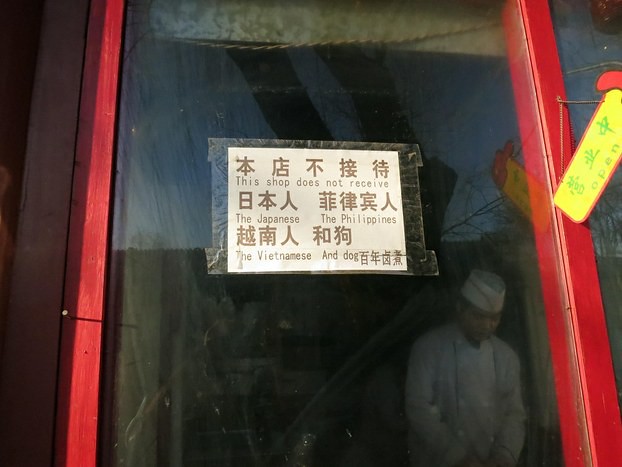
A sign at a restaurant in Beijing refusing service to Japanese, Vietnamese, and Filipinos shown in a photo taken by Facebook user Rose Tang on Feb. 22, 2013.

The restaurant has put up on its window racially charged signs in Chinese and English that said, “This shop does not welcome Japanese, Filipinos, and Vietnamese, and dogs,” according to photo posted on the Facebook social networking site last week.

The owner of the restaurant in Beijing’s Houhai neighborhood, surnamed Wang, told BBC News this week he didn’t care what others felt about the sign and that he had put it up out of “patriotism.”

“Chinese customers support me,” he said.

China is currently embroiled in territorial disputes with Japan over islands in the East China Sea, and with the Philippines and Vietnam over islands in the South China Sea. Tensions with Japan over the disputes boiled over into a wave of anti-Japanese protests in Chinese cities last fall.

But the restaurant’s action has drawn strong criticism in Vietnam, where tensions over the Spratly and Paracel islands have sparked a series of anti-China protests over the past two years.

Activists have also criticized the Vietnamese government for not standing up enough to what they see as China’s “aggressive” foreign policy in the region.

Dissident lawyer Le Hieu Dang said he thought Chinese authorities’ should have taken action against the restaurant owner.

“They should have told the restaurant to take that note off and disciplined them because that insults other people in the world. It is racism. The Beijing government should have strong measures against that,” he told RFA’s Vietnamese Service.

“The government of Vietnam should see their true colors through this fact that they let their own people do such things.”

'Bullying' neighbor

He said the racism evident in the sign was similar to China’s “bullying” of its smaller neighbors in its foreign policy.

“I think people around the world will have strong reactions against this extreme nationalism, which shows the hatred between nations and how big country bullies small countries,” he said.

The photo, posted last week by a Chinese-American user from New York, drew a mixed response from netizens in China.

Some blasted the restaurant’s sign as nationalist racism, and others supported the restaurant owner’s action.

Dissident academic Tran Khue said he thought he felt the Beijing restaurant owner’s actions reflected a Sinocentric attitude that he thought was common in China.

“This mentality dates back so many years,” he said.

He said the sign was reminiscent of China’s colonial era, when British-owned establishments barred Chinese from entering.

“I think they are following what the English did before. The English said, ‘No Chinese and no dogs,’” he said.

'Not representative'

George P. Jan, a U.S.-based former professor of Chinese politics, said that the views of one restaurant owner should not be taken to represent all of China.

“This sign does not represent the attitude of most Chinese people. I think it is unwise and emotional. Chinese people are not opposed to all Japanese, Filipinos, or Vietnamese indiscriminately,” he said.

He said nationalism could cause people to get carried away with their views.

“Patriotism is a double-edged sword. On the one hand, it can unite people. But on the other, it will bring disasters to a country,” he added.

Xie Xuanjun, another U.S.-based scholar, said he thought the restaurant owner had succeeded more in embarrassing Chinese people than in denigrating those of other races.

“The sign itself is a symbol of racism, and ironically the restaurant owner has drawn ridicule on the Chinese ourselves,” he said.

He asked why the restaurant owner had not refused to serve patrons from Russia, which was embroiled in a long-running dispute over islands near China’s northeast until 2008.

“If he refuses to serve people from Japan, the Philippines, and Vietnam because of their territorial disputes with China, why doesn’t he refuse to serve Russians? Russia has grabbed more lands from China than the other three countries.”

“Is it because Russians are Caucasians?” he said.

Rose Tang, the original poster of the photo, has asked netizens to share the photo widely in the hopes it will spark more discussion about racism.

“Please share it with as many people as possible. I'm hoping pressure from the public and media will teach these guys a lesson,” she said in a comment on Facebook.

Reported by Thanh Quang for RFA’s Vietnamese Service and by Xi Wang for the Mandarin Service. Translated by Ping Chen. Written in English by Rachel Vandenbrink.

RFA Vietnamese