Hiển thị các bài đăng có nhãn China racism. Hiển thị tất cả bài đăng

Thứ Năm, 28 tháng 2, 2013

China racism case: Restaurant owner removes 'racist' sign


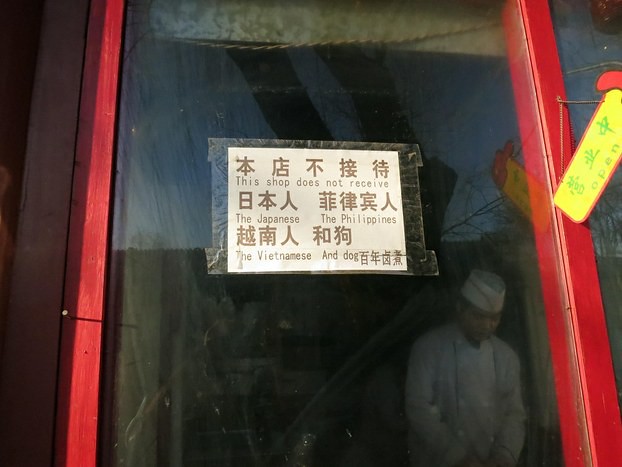
This photo taken on February 26 shows a Chinese cook working in a restaurant behind a sign that says "This shop does not receive the Japanese, The Philippines, The Vietnamese and Dog" at the historic tourist district of Houhai in Beijing.

A defiant Beijing restaurant manager refused to apologize Thursday despite removing a "racist" sign barring citizens of states in maritime disputes with China, along with dogs, following an international outcry, AFP reported.

The notice in the window of the Beijing Snacks restaurant read: "This shop does not receive the Japanese, the Philippines, the Vietnamese and dog(s)" in both Chinese and English.

But despite taking down the sign after accusations of racism, the manager said he had no regrets and would not apologize for any offence caused, AFP said.

The manager, surnamed Wang, said it was taken down "because it was a lot of bother".

"I don't have any regrets," he told the newswire. "I was just getting too many phone calls about it."

He seemed surprised at the attention it had generated but said he would not apologize for any offence caused, suggesting it may have been misinterpreted.

"Maybe people misunderstood our meaning... it only said we would not serve customers from those countries," he said.

The restaurant sign provoked an outcry in Vietnam and the Philippines, generating thousands of posts on Vietnamese social networking sites and newspaper comment threads.

A Vietnamese diplomat in China has said the country will respond “appropriately” to the case, BBC Vietnamese reported Wednesday.

The unnamed diplomat did not say what the response would be, but stressed that Vietnam’s viewpoint is that mutual respect and friendship has to be maintained.

Filipinos greeted the photo with a mixture of fury and amusement, AFP said. "Blatant racism at Beijing Restaurant," journalist Veronica Pedrosa wrote in one widely-shared tweet.

Meanwhile, speaking to the Tuoi Tre (Youth) newspaper, Zhai Lei Ming, Chinese consul general in Ho Chi Minh City, said the owner’s actions were wrong and did not represent a majority of the Chinese people or the Chinese government’s viewpoint.

When asked why the local government had not done anything despite the sign being posted for a long time, he said it had not been aware of it.

Responding to another question about the Chinese government’s future actions after the case was reported in the media, he said he was just a consul general, not the government or any agency that is supposed to handle it.

The photos were taken by Rose Tang, a former CNN journalist who was born in China but is now based in New York, on February 22 during her trip to Beijing, and posted on her Facebook, Tuoi Tre reported.

As of February 27, one photo which is the close-up of the shop named Beijing snacks in the capital city’s Houhai District had been shared by more than 3,700 people. The photos have drawn the attention of the international media, which has reported on the restaurant and its racist sign.

According to Tuoi Tre, it is not known when the shop’s owner, whose surname is Wang, put up the sign, but it was first mentioned on Chinese social sites like Sina and Weibo in September.

The owner was quoted as saying that he posted the notice to speak his mind, but also preferred that the Japanese, the Filipino and the Vietnamese did not read it.

However, in an interview with BBC Chinese, the shop owner said he is proud of what he has done and that he does not care what people say, the newspaper reported.

Meanwhile, speaking to Tuoi Tre, Tang said that she had posted the photos online because she felt obliged to expose what she called “racism with a twist of nationalism.” She hoped that pressure from the public and the media will teach Wang and people like him a lesson.

Many netizens have expressed their outrage on Tang’s personal page, calling the sign and the shop owner’s attitude “shocking” and “ugly.”

In one of the most liked comments, Paul Mooney, a freelance reporter in Beijing, said: “This is the [Chinese] government and Party's fault. They tell lies about other countries and distort history and so Chinese who don't know any better respond with ignorance. Very depressing.”

China is currently involved in sea territorial disputes with the Philippines and Vietnam over large areas of the East Sea, internationally known as the South China Sea. China and Japan have a separate dispute over islands in the East China Sea.

Thanhniennews.com

Thứ Ba, 26 tháng 2, 2013

Vietnamese Angry Over Beijing Restaurant Racism

A Beijing restaurant’s refusal to serve customers from countries locked in maritime territorial disputes with China has drawn the ire of netizens from at least one of the nations—Vietnam.


A sign at a restaurant in Beijing refusing service to Japanese, Vietnamese, and Filipinos shown in a photo taken by Facebook user Rose Tang on Feb. 22, 2013.

The restaurant has put up on its window racially charged signs in Chinese and English that said, “This shop does not welcome Japanese, Filipinos, and Vietnamese, and dogs,” according to photo posted on the Facebook social networking site last week.

The owner of the restaurant in Beijing’s Houhai neighborhood, surnamed Wang, told BBC News this week he didn’t care what others felt about the sign and that he had put it up out of “patriotism.”

“Chinese customers support me,” he said.

China is currently embroiled in territorial disputes with Japan over islands in the East China Sea, and with the Philippines and Vietnam over islands in the South China Sea. Tensions with Japan over the disputes boiled over into a wave of anti-Japanese protests in Chinese cities last fall.

But the restaurant’s action has drawn strong criticism in Vietnam, where tensions over the Spratly and Paracel islands have sparked a series of anti-China protests over the past two years.

Activists have also criticized the Vietnamese government for not standing up enough to what they see as China’s “aggressive” foreign policy in the region.

Dissident lawyer Le Hieu Dang said he thought Chinese authorities’ should have taken action against the restaurant owner.

“They should have told the restaurant to take that note off and disciplined them because that insults other people in the world. It is racism. The Beijing government should have strong measures against that,” he told RFA’s Vietnamese Service.

“The government of Vietnam should see their true colors through this fact that they let their own people do such things.”

'Bullying' neighbor

He said the racism evident in the sign was similar to China’s “bullying” of its smaller neighbors in its foreign policy.

“I think people around the world will have strong reactions against this extreme nationalism, which shows the hatred between nations and how big country bullies small countries,” he said.

The photo, posted last week by a Chinese-American user from New York, drew a mixed response from netizens in China.

Some blasted the restaurant’s sign as nationalist racism, and others supported the restaurant owner’s action.

Dissident academic Tran Khue said he thought he felt the Beijing restaurant owner’s actions reflected a Sinocentric attitude that he thought was common in China.

“This mentality dates back so many years,” he said.

He said the sign was reminiscent of China’s colonial era, when British-owned establishments barred Chinese from entering.

“I think they are following what the English did before. The English said, ‘No Chinese and no dogs,’” he said.

'Not representative'

George P. Jan, a U.S.-based former professor of Chinese politics, said that the views of one restaurant owner should not be taken to represent all of China.

“This sign does not represent the attitude of most Chinese people. I think it is unwise and emotional. Chinese people are not opposed to all Japanese, Filipinos, or Vietnamese indiscriminately,” he said.

He said nationalism could cause people to get carried away with their views.

“Patriotism is a double-edged sword. On the one hand, it can unite people. But on the other, it will bring disasters to a country,” he added.

Xie Xuanjun, another U.S.-based scholar, said he thought the restaurant owner had succeeded more in embarrassing Chinese people than in denigrating those of other races.

“The sign itself is a symbol of racism, and ironically the restaurant owner has drawn ridicule on the Chinese ourselves,” he said.

He asked why the restaurant owner had not refused to serve patrons from Russia, which was embroiled in a long-running dispute over islands near China’s northeast until 2008.

“If he refuses to serve people from Japan, the Philippines, and Vietnam because of their territorial disputes with China, why doesn’t he refuse to serve Russians? Russia has grabbed more lands from China than the other three countries.”

“Is it because Russians are Caucasians?” he said.

Rose Tang, the original poster of the photo, has asked netizens to share the photo widely in the hopes it will spark more discussion about racism.

“Please share it with as many people as possible. I'm hoping pressure from the public and media will teach these guys a lesson,” she said in a comment on Facebook.

Reported by Thanh Quang for RFA’s Vietnamese Service and by Xi Wang for the Mandarin Service. Translated by Ping Chen. Written in English by Rachel Vandenbrink.

RFA Vietnamese