Hiển thị các bài đăng có nhãn Listening. Hiển thị tất cả bài đăng

Thứ Hai, 18 tháng 3, 2013

China's nuclear powered aircraft carrier programme rings alarm bells in India

A China's nuclear powered aircraft carrier programme
China's plans of building a nuclear powered aircraft carrier using reactors of existing submarines has led to alarm bells ringing as the warships could be used to patrol the Indian Ocean, which is 2,500 km from its coast.

So is China flexing its muscles in India's strategic space and what should India's response be?

A clumsily worded sentence on the website of China's Shipbuilding Industry Corporation sparked off a firestorm on the internet that the Chinese military's biggest shipyard was going to build a nuclear powered aircraft carrier with reactors probably based on its existing submarine reactors. Within days, the words were off the website, but it tied in with Indian naval assessments that China was planning a permanent and sustainable strategic thrust into the Indian Ocean 2,500 miles away from its coast and through which bulk of its energy supplies pass.

Preparations had been obvious since 2008 when a submarine base began operations on Hainan Island on the South China Sea, close to the Malacca Straits. In recent months, speculation about China pressing the Maldives to allow a submarine base has intensified. Then there is the Chinese airfield project in Hambantota in Sri Lanka and recently Pakistan's Gwadar Port was dredged to a depth of 14 metre to allow large vessels to dock.

Retired Rear Admiral Raja Menon said, "These are potential places, but whether they become bases, that's a big leap, because that means accepting Indian hostility to giving a base to China. From that point of view the best bet would be Gwadar because they already face anti-Indian opinion."

Dr Sreekanth Kondapalli, Chinese Navy analyst, said, "Being a regional local navy and power, India has huge territorial advantage by being closer to the IOR, yet India cannot claim ownership to the region because it is the third largest ocean with open navigation principles."

Naval strategists say India should build its own nuclear powered aircraft carrier and counter China in the east and south China seas. It should also form alliances with the Japanese and Korean navies with the aim being to tie down large elements of the Chinese navy.

That apart, a maritime dialogue between the two navies covering the Indian Ocean and South China Sea, would be a useful confidence building measure. But China is reluctant, while it does not see the Indian Ocean as India's Ocean, its recent actions have clearly demonstrated that the SCS is China's own.

ibn live

Chủ Nhật, 17 tháng 3, 2013

North Korea Threatens South with Large Scale Military Drill

North Korea's Worker-Peasant Red Guards conduct a military drill.

The civil defence force group, numbering around 5.7 million, held the exercise against a background of rising hostilities on the Korean peninsula.

South Korean and U.S. troops took part in the joint computer-simulated drill "Key Resolve" on Friday in Seoul.

The annual joint drills started on Monday to practice combined and joint command-post military operations to defend South Korea.

But North Korea is threatening military action against its southern neighbour and the United States if the drills continue.

About 200,000 Korean troops and 10,000 U.S. forces are expected to be mobilized for a separate exercise, "Foal Eagle'', before the end of April.

A spokesman for South Korea's Defence Ministry said on Friday it was keeping an eye on its unpredictable northern neighbour, and that it would be prepared in case of war.

Last week, Pyongyang scrapped the 1953 armistice deal that ended the Korean War and on Monday they cut off the inter-Korean communication hotline.

NTDTV.org

Thứ Năm, 14 tháng 3, 2013

PLA navy undergoes transformation

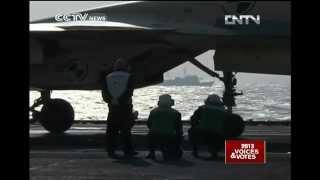
The last decade has seen a major shift for China's Navy, from coastal defense, to greater responsibilities in the deep sea. The country is increasingly concerned about the safety of its sea lanes and the security of development. CCTV reporter Han Bin finds out how the People's Liberation Army Navy is meeting the challenges.

China's nuclear submarines, anti-ship ballistic missiles, and its first aircraft carrier. Symbols of a rising naval power.

Rear Admiral Yin Zhuo says the navy is undergoing a profound transformation.


Video: PLA navy undergoes transformation
Rear Adm. Yin Zhuo, Director of Navy Information Expert Committee, PLA, said, "The key motives for the transformation of the PLA Navy come from the requirements of the country's economic development, which is connected with the deep blue sea. The navy has to protect both the security and economic interests of China. "

The admiral is a member of China's political advisory body. Over the years, his proposals have focused on China's maritime rights. He believes any future battles are most likely to take place at sea.

Training has been intensified, and especially in what's known as blue water missions, those in the open seas.

Senior Captain Cao Weidong showed us the route of the most recent training. It goes through the East China Sea, the Miyako Strait, and waters off the eastern coast of Taiwan.

Sr. Capt. Cao Weidong, Naval Research Institute, PLA, said, "The fleets relied completely on themselves to carry out their maritime combat capabilities, like air defense, anti-submarine and open-sea combat. Deep sea training is the most realistic training that simulates actual combat situations."

Training for the carrier-based fighters and pilots has made remarkable breakthroughs. The Liaoning now docks in the eastern port of Qingdao, waiting for possible deep sea training later in the year.

"The aircraft carrier can fundamentally change the structure of naval forces. It can form a battle group with frigates, amphibious fleets and submarines. This reveals the direction of PLA naval development in line with maritime powers. " Said Yin.

Under a new strategy, the PLA's warships will pass through more international straits and waters to improve overall capabilities.

china.org.cn

Thứ Ba, 12 tháng 3, 2013

The forgotten battle in South China Sea - Truong Sa sea battle

Teh transport ship HQ-603 was taken photo on March 10, 1988 -- four days before it was sunk at Gac Ma Atoll in Truong Sa archipelago Photo: Archives photo of Brigade 125
(Tuoitre News) On Mar 14, 1988 a fierce sea battle took place between Vietnamese soldiers and Chinese troops around Co Lin, Len Dao and Gac Ma, which are part of the Truong Sa (Spratly) archipelago.


Hosting: Kiwi6.com

However, few people know the details of this battle.

The Vietnamese soldiers’ extraordinary gallantry and dogged determination to safeguard the nation’s territory was defeated by Chinese state-of-the-art weaponry and ruthlessness. Since then Gac Ma Island has been illigimately occupied by China.

The immediate cause

In response to the imminent, illegitimate occupation of Truong Sa by the Chinese invaders, prior to March 14, 1988, the Vietnamese transport ships HQ-505, HQ-604 and HQ-605, under the command of the 125 and 146 Brigades and the E83 Military Engineering Regiment, were immediately sent to the atolls of Co Lin, Len Dao and Gac Ma, where they built fortifications and other infrastructure during the CQ88 campaign, which was a relentless attempt to maintain Vietnamese ownership of Truong Sa.

The imbalanced, bloodstained battle

25 years have passed since the fight, yet that morning has been firmly imprinted in the mind of Nguyen Van Lanh, a naval soldier who took part in the battle.

Late in the evening of March 13, HQ-604 arrived at Gac Ma, while the other two ships headed for Co Lin and Len Dao, Lanh recalled.

The group led by Second Lieutenant Tran Van Phuong was in charge of pitching and safeguarding the Vietnamese national flag on the island.

Nearby, the Vietnamese flag was also flying on Co Lin island.

Lieutenant-colonel Tran Duc Thong commanded that the soldiers focus on the task despite the Chinese warships lurking in the vicinity.

At dawn on March 14, Chinese ships closed in on HQ-604. These ships were fully equipped with advanced firepower and lethal weaponry, whereas the Vietnamese vessels were merely designed to carry soldiers, food and construction materials.

The majority of the Vietnamese soldiers were sappers who specialized in carrying out construction work on the islands.

Despite the serious imbalance in power, the Vietnamese captains and soldiers unwaveringly resolved to safeguard the islands.

At around 6 am, the Chinese force sent small boats filled with armed-to-the-teeth soldiers to close in on the Gac Ma corals.

To counter this, on Gac Ma, the Vietnamese soldiers formed a circle, which was later respectfully named ‘the immortal circle’, in an unwavering attempt to guard the Vietnamese flag in the center.
As there were few Vietnamese naval soldiers on the island, Lanh and all the other sappers, armed with merely hoes and shovels, were immediately summoned to aid Phuong’s regular group.
The battle became heated in an instant. The Chinese troops landed in large numbers and tried to break the circle, but failed.

Plastic sandals, bowls, clothes, and weapons found in the HQ-604 in 2008 (Photo: Tuoi Tre)

After a firefight the Chinese troops were able to approach Second Lieutenant Phuong, who was holding onto the flag for dear life.

Phuong and Lanh struggled with all their might to keep the flag until Phuong was suddenly shot in the head. He collapsed, but still tried to hold onto the bloody flag.

Lanh managed to keep the flag until Chinese soldiers stabbed him from behind and finally shot him with an AK-47.

The battle continued to rage. The Chinese ships fired heavy machine guns and 37 mm cannons at the unyielding Vietnamese soldiers.

The fight was also ferocious aboard the HQ-604 ship, which was incessantly bombarded with long-range fire power, Mai Van Hai, one of the survivors, recalled. B-40 and B-41 on the Vietnamese ship couldn’t reach the enemy.

Right after the battle began, Captain Vu Phi Tru dashed into the engine room, planning to land the ship on the Gac Ma corals. All of a sudden, the engine room was hit and burst into flames, engulfing Tru, leaving the ship unable to land, Hai added.

Hai then tried to see Lieutenant-colonel Tran Duc Thong and Captain Phong right as they were fired upon with heavy machine guns.


The Spratly Islands are a group of more than 750 reefs,islets, atolls, cays and islands in the Southeast Asia Sea. In 1998, those Chinese attacked, stole Vietnamese islands and killed their soldiers there.
Thong and Phong both perished, and the HQ- 604 ship gradually sank into the sea, taking down with it dozens of soldiers.

“A normal transportation vessel, the HQ-604 could only fire from 500 meters at most, while it was roughly 3.6-5.4 km away from the enemy ships. They were perhaps trying to steer the ship nearer to the Chinese ones to get into firing range, but it couldn’t withstand the enemy barrage,” colonel Tran Thanh Tam explained, 25 years later.

Immediately after finishing off HQ-604 off Gac Ma, the Chinese warships turned to bombard HQ-605 with heavy weaponry.

The ship burst into intense flames, and Captain Son of HQ-605 ordered everyone on board to evacuate.

The map of atolls Gac Ma, Co Lin, and Len Dao in Truong Sa archipelago in the East Sea (Photo: Tuoi Tre)

Tuoi Tre News

Thứ Sáu, 8 tháng 3, 2013

UN Imposes New Sanctions on North Korea

The United Nations Security Council has unanimously passed a new resolution imposing new sanctions on North Korea.

As CRI's Washington correspondent Lv Xiaohong reports, while China has thrown its support behind the new sanctions, it's also calling for a diplomatic solution.


The UN Security Council has adopted the new sanctions on North Korea for its prohibited nuclear test last month.

The United States UN Ambassador Susan Rice says the new sanctions are going to have a strong impact.

"First, resolution 2094 imposes tough, new financial sanctions, when North Korea tries to move money, to pay its nuclear and ballistic missile programs, countries must now block those transfers, even if the money is being carried in suitcases full of bulk cash. "

In addition to tightening sanctions on North Korea's banking and trade sectors, the existing travel restrictions have also been extended.

Stringent checks are also going to continue on North Korean cargo ships.

And for the first time, Pyongyang's diplomats are also included on the checklist, with the resolution calling for countries to expel any North Korean agent if he or she is found involved in Pyongyang's nuclear or ballistic missile programs.

U.N. Secretary-General Ban Ki-moon says he welcomes the adoption of the new sanctions, saying the international community has sent "an unequivocal message" to North Korea that it will not tolerate its pursuit of nuclear weapons.

The Chinese side is also voicing its support of the new UN resolution.

Chinese Ambassador to the UN, Li Baodong, says China supports a balanced and proportionate approach towards this issue.

"China is a country of principle. We're firmly committed to safeguarding peace, stability on the Korean Peninsula. We're committed firmly to safeguarding the international nuclear no-proliferation regime, promoting the denuclearization of Korean Peninsula. And also we're committed to peaceful settlement of relevant issues through negotiations and dialogue."

Just hours before the Security Council's vote on the new sanctions, North Korea re-issued its threat to launch a preemptive nuclear strike against the United States.
....
Chinese Ambassador Li Baodong is calling on everyone to cool down and look for a diplomatic solution.

"The top priority now is to defuse the tension, bring down the heat, focus on diplomatic track and bring the situation back on the track of diplomacy, of negotiations and consultations."

Li Baodong admits a nuclear-free Korean peninsula is going to be hard to achieve, but says it can be possible if the six-party talks can resume.

Pyongyang has said it no longer wants any part of the six-party talks.

For CRI, this is Xiaohong in Washington.

CRI

Fat Traffic Cops Banned – Vietnam

Pot-bellied, short, or abusive traffic policemen will be barred from working on the streets of Vietnam's capital, as Hanoi police try to clean up their unsavoury image.

Hanoi's traffic police chief told a local newspaper that short officers and those with "too big a belly" will be moved to desk jobs instead of guiding traffic and settling violations.

This Hanoi resident welcomes the new policy.

[Nguyen Dinh Dau, Hanoi Resident]:
"I think not allowing pot-bellied policemen to be out on the street is very appropriate, and is welcomed by everybody."

Inspectors of the city's traffic police are following the worst offenders closely and compiling lists of those to be reassigned.

Crackdowns on overweight policemen have taken place in Thailand, Pakistan, Britain, Indonesia and the Philippines in recent years.

Several of those countries ordered officers to get fit and lose weight before they could return to work.

Thứ Năm, 7 tháng 3, 2013

What Can Outspend China's Military?

The Chinese regime unveiled its defense budget yesterday (March 5) during the opening of the 12th National People’s Congress. It will increase by more than 10% to 114 billion dollars.

But the domestic security budget under the Political and Legal Affairs Committee will swell to almost 124 billion dollars.

Guangdong rights activists Chen Qitang believes that the budget is mostly for monitoring ordinary people.


[Chen Qitang, Guangdong Rights Activist]:
"[The government] monitors everybody. Even the ten-year-old daughter of Zhang Lin was arrested and detained by public security. Such big expense is needed. How can't they increase it? The situation now is like a pressure-cooker. When the pressure is too much, the government will release the gas a little bit. In fact, the core is not changed. The stability maintenance fee will be increased every year until the[CCP] falls from power. "

The internal security budget is the highest in the past three years.

[Li Tianxiao, NTD China Analyst]:
"[The draft budget] explains the unique phenomenon under the CCP's dictatorship. It also indicates that the CCP rule is very unstable. The inside of the CCP has already gone to the edge of collapse."

Most recently, police forces have surrounded the village of Shangpu in Guangdong Province. Villagers there blockaded the central square and called for democratic elections to protest corrupt land dealings by their local party secretary.

NTDTV.org

China: Groundwater Pollution Arouses Concern (Listening)

Photo taken on Jan. 6, 2013 shows Zhuozhang River which is polluted by the aniline released from the Tianji Coal Chemical Industry Group in Changzhi, north China's Shanxi Province. [Photo: Xinhua]

Chinese environmentalists have been calling on authorities to tighten supervision over the country's water contamination and to improve transparency of monitoring data.

He Fei has the details.


Water contamination has caught increasing attention among the Chinese public.

Some have gone so far as to challenge local environmental officials to swim in a polluted river.

Ma Jun has been an active environmentalist for more than 10 years.

"About half of the surface water being monitored is polluted to some extent. And now some say 90 percent of the groundwater is contaminated as well. I think that refers to the shallow groundwater, which can be easily affected by the surface. The situation in the deep layer is better."

However, Ma adds that's nothing to be cheerful about.

"The water contamination in China is now expanding from the surface to the ground. It spreads from small spots to large areas. The latest data from the Ministry of Environmental Protection shows that by 2011, half of the water wells monitored in 200 cities are scaled as poor or very poor in quality."

Minister of Water Resources Chen Lei says the government is taking the issue seriously.

"We've drafted plans for preventing groundwater pollution. We're now working together with the Ministry of Environmental Protection and the Ministry of Land and Resources to crack down on illegal sewage discharges. People will have clean, trustworthy and safe water."

Many grassroots organizations are also getting actively involved in the cause.

For example, Ma and his Institute of Public and Environmental Affairs have set up a system to map water pollution sources. It can also provide information about the water quality and the sewage discharge situations.

"In China, nearly 300 million rural people can't have clean potable water every year. One of the main reasons for that is the groundwater pollution. It also affects the soil and causes problems for grain production."

According to Ma, China has the technical capacity and money to solve the problem but it lacks the most important thing, the impetus. The reasons range from law enforcement difficulties to a lack of social supervision.

To Ma, the disclosure of environmental information, especially pollution sources, is the key to solve the problem.

Together with many other environmentalists, Ma is pushing the government to disclose monitoring data online.

"Just think when we open the environmental information to the public, especially the information about pollution sources, we will put these polluting enterprises under the sun. Under such pressure, the local governments will have to strengthen their law enforcement. And it'll be easier to obtain evidence in environmental lawsuits as well. In this way we can improve the social supervision."

The recently issued pollutants monitoring regulation stipulates polluters must publish their monitoring data to the public.

Zhang Quan is the director of Shanghai Environmental Protection Bureau. He is also a deputy to the 12th National People's Congress.

"The information about pollutants will be more open of course. However, it needs some time. When doing so, I think, we should make sure the data is accurate, trustworthy and scientific. Wrong information may arouse panic. I think information disclosure is the key principle and covert information is only an exception."

However, information disclosure is not the final goal for environmentalists like Ma.

"We cannot stop there. I want to know the density of PM 2.5 to see whether I need a mask, but I can't do that forever. I need to know who is responsible for that and then curb it."

For CRI, I'm He Fei.

US holds large military drill in S.Korea

US forces in South Korea have held a large military drill. This follows North Korea's threat on Tuesday to scrap the 1953 armistice agreement that ended the Korean War.

The drill took place at a US base in Dongducheon in northern South Korea on Thursday. About 250 US and South Korean soldiers participated in maneuvers.
They practiced landing on the ground from 3 transport helicopters hovering 20 meters high.

The US forces say this is their first major landing drill in South Korea involving a special airborne unit from the US mainland.

One soldier who took part says the drill will deepen bilateral ties and help maintain peace and stability in the region.

General James Thurman is the top US military commander in South Korea. He says the armistice agreement has ensured peace and stability on the Korean Peninsula for 60 years.

Thurman says the United States is ready to defend South Korea.

NHK

Thứ Hai, 4 tháng 3, 2013

China Carries Combined Patrol in South China Sea

China's patrol ship

A joint Chinese sea and air patrol is being carried out in the South China Sea for the first time.

Wu Jiansheng heads the Maritime Safety Administration for the province of Guangdong.

"In view of complicated maritime environment and wide navigable waters, we need a helicopter to join the patrol."

The helicopter will be patrolling for illegal fishing and overloading.

It's also tasked with carrying out rescue operations at sea.

Yongxing Island, the largest of the Xisha Islands in the South China Sea, has an area of two square kilometers.

The island serves as the seat of the prefecture-level city of Sansha of Hainan Province.

CRI English

First civil flight training course in Vietnam

Vietnam marked a milestone in the training of pilots for the national civil aviation industry when the first ‘batch’ of 23 local pilots graduated late last year from a course conducted completely in Vietnam.


Before, Vietnamese pilots had studied only flight theory in Vietnam and practiced actual flight techniques in France.

The first 23 pilots, including one woman, who finished the course late last year and now fly domestic routes in Vietnam were trained at the Cam Ranh Flight Training Center – the only such facility in the country.

The training was held by the Bay Viet (Viet Flight) Company under cooperation with several other agencies, including the ESMA aviation institute of France, the flagship national air carrier Vietnam Airlines, the Helicopter Flight Company under the Vietnam Ministry of National Defense, the Vietnam Plane Leasing Company, and the ADCC Company of Vietnam’s Air Force.

Established in 2008, Bay Viet has conducted six flight courses for 110 pilots. However, the VFT2 was the first ‘made in Vietnam’ course for civil aviation. The average cost to train a pilot over a two-year course is about VND2.25 billion (US$108,200).
According to Bay Viet, each VFT2 pilot had to have 45 hours of domestic flying time, including 10 hours of solo flying, to be able to get a flight license and work for an airline.

Bay Viet has been preparing to become the first flight school in Vietnam.

First pilots

Nguyen Thi Ngoc Bich is checking her plane before a flight (Photo: Tuoi Tre)

Nguyen Thi Ngoc Bich, 25, from the northern city of Hai Phong, is the only female who has graduated from the VFT2 course so far.

She started her career in the civil aviation by working as a stewardess for three years for Vietnam Airlines. After hearing that the carrier was recruiting pilot trainees, she applied.

Bich was chosen over 120 other applicants, she recalled.

“During the six months of flight practice in Cam Ranh, I used no cosmetics,” she said, raising her sun-scorched hands to prove this true.

The youngest pilot to graduate from the first civil flight course was Phung Anh Huy, 20, a native of Ho Chi Minh City.

Tran Trong Nhan, the deputy director of Bay Viet, told Tuoi Tre that Vietnam is in desperate need of local pilots, especially for domestic flights.

“Only half of the pilots flying for Vietnamese airlines are Vietnamese, and the cost to hire a foreign pilot is three to five times higher than a local pilot,” he added.

Pilot trainees of the VFT2 course in Cam Ranh (Photo: Courtesy of the Bay Viet Company)

Tuoi Tre News