Hiển thị các bài đăng có nhãn China's stealing. Hiển thị tất cả bài đăng

Thứ Sáu, 28 tháng 6, 2013

Did Chinese Steal The Blueprints For Russia's First Stealth Fighter?

Russia's Mysterious First Stealth Fighter Found on Bing Maps


(FP)- This might be the easiest ever find of an MIA airplane. You're looking at a Bing Maps image of the Mikoyan (MiG) Project 1.44, Russia's first attempt at building a flyable stealth fighter and the jet that some said was sent to China to help kick-start Beijing's stealth development program. The jet is the larger of the two shown above sitting just outside of Moscow at Zhukovsky airfield (we have no idea what the smaller, darker plane alongside the 1.44 is).

Project 1.44 was meant to be the Soviet Union (and later Russia's) super-fast, super-maneuverable answer to the United States' premier fighter, the F-22 Raptor. However, the jet was underfunded in the days following the collapse of the Soviet Union. When the plane finally took its maiden flight in 2000, its designers found multiple flaws with the aircraft and the project was abandoned.

The 1.44 was designed with stealth-like angles, an internal weapons bay and supposedly used electronic countermeasures and special coatings to help reduce its radar signature. It also featured digital flight controls along with thrust vectoring engines and canards (little wings) on the front of the fuselage aimed at making the jet incredibly maneuverable.

But, in 2001, Russian officials shelved Project 1.44 in favor of a more modern design from MiG's rival Sukhoi -- the T-50 PAK FA. The 1.44 supposedly disappeared into storage after that. A quick Google Images search reveals recent-looking photos of the jet in storage -- some of which claim they are from 2009 and taken near Moscow. (Google Maps also shows grainy satellite imagery the plane sitting on the ramp at Zhukovsky airfield.)

However, the saga of Project 1.44 doesn't end there.


In late 2010 China unveiled its J-20 stealth fighter, a jet that struck many as an updated version of the Project 1.44 design. Just look at the tail-end of both jets and you'll see where this idea comes from. The J-20, like the 1.44, is a big, single seat, twin-engine jet complete with an internal weapons bay and canards on the front. The obvious differences disappear there. The lines of the J-20 are a lot stealthier than the 1.44's. The engines are laid out differently on the two jets (the 1.44's air intakes are slung below the fuselage while the J-20's hug the plane's sides).

While MiG has denied giving information on Project 1.44 to the Chinese, Reuters in August 2011 cited a senior Russian official as saying "it looks like they got access . . . to documents related to the Mikoyan."

The wire service also cited an "independent analyst" named Adil Mukashev as saying that China bought the tail section of the MiG 1.44.

It's important to note that the Russians refused to sell Beijing Sukhoi Su-33 aircraft carrier-borne fighters after it was discovered China was attempting to reverse-engineer and build an unlicensed version of the Su-33's predecessor. Beijing's J-11B land-based fighter and the J-15 carrier-based fighter are the results of that effort. (Though there are rumors that the work on these Chinese jets actually occurred under a secret contract with Russia.)

As you can see from the image above, Project 1.44 still sits in Russia. Maybe the Chinese bought the tail of a non-flying mock up of the aircraft or just got access to the designs. Heck, maybe the Russians aren't lying about not giving information on the 1.44 to the Chinese. Maybe someone like China's Red Star hacking crew stole the designs. Red Star is suspected by Russian cybersecurity giant Kaspersky Lab of stealing defense, industrial and diplomatic secrets on behalf of the Chinese government, with a focus on victims in Russia and Asia.

FP

Thứ Sáu, 21 tháng 6, 2013

PAS 2013: China’s Fighters, Drone Look Like U.S. Aircraft


PARIS — China’s models of military planes at the Paris Air Show bear resemblance to U.S. aircraft, drawing attention to the rising concern in the Defense Department that the country is using cyber espionage to obtain sensitive defense technology.

The state-run Aviation Industry Corporation of China had a large exhibit of military and civilian models of aircraft at the show, held outside Paris at the historic Le Bourget airfield.

The display included three fighters and a drone: a single-seat version of the FC-1, a single-engine fighter built for the Pakistani air force and designated JF-17; a dual-seat variant of the FC-1 in development; the dual-seat, twin-engine L-15 trainer; and an unmanned system called Wing Loong.

The fighters looked like the F-16 made by Lockheed Martin Corp. and the drone bore resemblance to the MQ-1 Predator made by General Atomics Aeronautical Systems Inc., without the inverted tail. The Chinese drone is designed as a low-altitude craft that can fly up to 16,500 feet and loiter for 20 hours.

A spokesman from the Beijing-based corporation was quick to note that the FC-1 is “a lot cheaper than the F-16,” though he declined to provide a figure. The man gave a brief overview of the systems to Military​.com but declined to be named, citing corporation policy.

Notably missing from the exhibit was any display of the J-20, China’s classified stealth-fighter program.

During talks this month at an estate in Rancho Mirage, Calif., President Barack Obama reportedly warned the new Chinese President Xi Jinping that cyber attacks against the U.S. threaten the two countries’ strategic relationship. Xi insisted China is also the victim of computer hacking.


Obama faced pressure to raise the issue after the recent leak of a classified section of a Defense Department report showed that designs for the most advanced U.S. weapons have been compromised by suspected Chinese hackers. The list of weaponry includes the F-35 Joint Strike Fighter, the Littoral Combat Ship, and the Aegis Ballistic Missile Defense System, among others.

The Pentagon in its latest annual assessment of China’s armed forces for the first time blamed China directly for targeting its computer networks. The attacks were focused on extracting information, including sensitive defense technology.

“In 2012, numerous computer systems around the world, including those owned by the U.S. government, continued to be targeted for intrusions, some of which appear to be attributable directly to the Chinese government and military,” it states. “The accesses and skills required for these intrusions are similar to those necessary to conduct computer network attacks.”

That document also concluded that the People’s Liberation Army, or PLA, considers the strategy of “information dominance” a critical form of defense against countries that it views as “information dependent,” such as the U.S.

China called the accusations “groundless” and “not in line with the efforts made by both sides to strengthen mutual trust and cooperation,” according to a May 9 article published on the state-run website, “People’s Daily Online.” The country is a “victim itself of cyberattacks,” it states.

A Chinese espionage group since 2006 has stolen hundreds of terabytes of information from at least 141 companies across 20 major industries, including aerospace and defense, according to a February report from Mandiant, a closely held company based in Alexandria, Va., which sells information-security services.

Defense Tech

Thứ Sáu, 24 tháng 5, 2013

A Nation of Thieves

The wide world of hacking in China: The Chinese have been known to be experts at hacking for quite some time. But what might surprise some is that it's epidemic across the country in all levels of society. 
By Don Reisinger

China has been cited as hacking into U.S. government and corporate networks for years now.
Generally, the thinking has been that the government is the only entity in the country actively hacking.
But a new report seems to indicate that's not even close to the truth.
The News York Times on Thursday released a report on hacking across China.
The Times found that not only does hacking occur at the highest levels of the government, but that everyone on down from local law enforcement officials to company owners to criminals are using their hacking techniques to take aim at citizens.
Companies have even sprung up with the sole purpose of locating "anyone who spreads a rumor on the Internet."
Surprised?
Here are just a few of the ways hacking has unfolded in China:
  • Hacking there reaches all levels. From taking data from foreign governments to spying on competitors to making sure no one is launching rumors against the government, hacking is everywhere.
  • The Ministry of Education, along with China-based universities, sponsor hacking events designed to see who has skills the army might need.
  • Corporations are increasingly turning to freelance hackers to spy on competitors. In fact, it's a somewhat common practice across the country to find out what others are doing in their respective fields.
  • Local law enforcement officials have no choice but to hire hacking companies. The federal government says that it's their responsibility to ensure people in their areas are not spreading dissent on the Web.
  • Cybercriminals are obviously getting in on the fun and have been known to easily hack their way into a host of online-gaming services and credit-card databases to score funds.
  • Hacking can be a lucrative job in China. Highly skilled hackers can make $100,000 a year if they team up with the right hacking company.
It appears, if nothing else, that it's a hack-centric world out there.

Thứ Ba, 14 tháng 5, 2013

Chinese hackers caught trying to steal secrets of British& US stealth fighters

Chinese cyber spies have been caught trying to steal the secrets of Britain’s most sophisticated combat jet, The Mail on Sunday has learned.

A covert unit within the Chinese Army has been using highly sophisticated cyber weapons in a desperate attempt to acquire classified information about the stealthy Joint Strike Fighter (JSF).

Manufacturer Lockheed Martin claims it is thwarting tens of thousands of computer attacks every week to keep secure secrets about the jet – due to be in service with the Royal Navy and RAF by 2018.

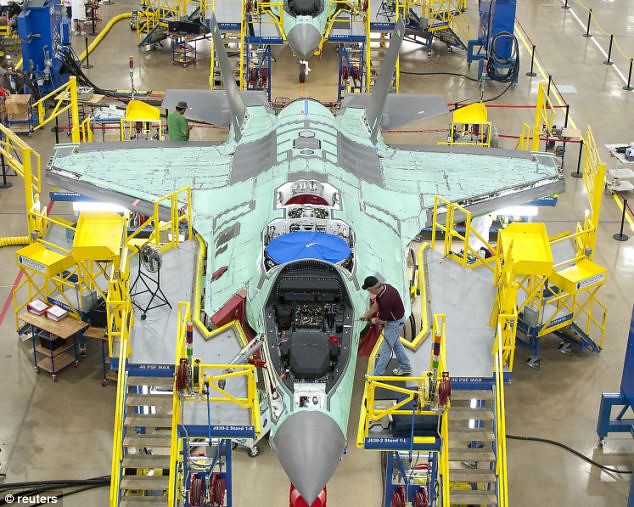
An F-35 fighter taking shape. Each of the jets costs £100million

Full article: http://www.dailymail.co.uk/news/article-2323067/Chinese-hackers-caught-trying-steal-secrets-new-stealth-fighter-tens-thousands-cyber-attacks-launched-jet-manufacturer-week.html