
Hiển thị các bài đăng có nhãn Vietnam. Hiển thị tất cả bài đăng
Hiển thị các bài đăng có nhãn Vietnam. Hiển thị tất cả bài đăng
Thứ Hai, 26 tháng 11, 2018
Cai Rang floating market – a work of art in southern Vietnam

In Picture, Tam Chuc - The Largest Pogoda In The World

Tam Chuc Resort (Ba Sao, Kim Bang, Ha Nam)(*) is known as "Ha Long Bay on land" with beautiful wild nature, wonderful as the dream place where those who put come to feel the purity, serenity and quiet to incredible. In particular, Tam Chuc Pagoda, its unique design with 2,250 years old Bodhi Tree, is derived from the "Jaya Sri Maha Bodhi", in the Mahamegha Temple, the ancient capital of Anuradhapura, Sri Lanka. ...
Tam Chuc Temple is one of the works located on an area of nearly 5,000 hectares of Tam Chuc Resort in Ha Nam, a northern province of Vietnam.


The perfective of Tam Chuc Pagoda
(*): Ba Sao Village, Kim Bang District, Ha Nam province - border Hanoi Capital to the north.
Thứ Tư, 21 tháng 11, 2018
A forgotten paradise in Vietnam’s Central Highlands
As tourists flock to Da Lat in the Central Highlands region of Vietnam to enjoy the city’s most beautiful time of the year, they tend to overlook its twin sister Bao Loc, a forgotten paradise that’s on par with Da Lat in terms of beauty, but without the hassle.

Layers of mountains are seen from atop the Dai Binh Mountain in Bao Loc City. Photo: Le Van Cuong
Located around 1,000 meters above sea level in the Lang Biang Plateau, Bao Loc City in Lam Dong Province is 500 meters lower than Da Lat.
It is 190 kilometers north of Ho Chi Minh City, or 120 kilometers closer to the southern metropolis than Da Lat.
The relatively close distance of Da Lat from Ho Chi Minh City, and most importantly its established reputation as a perfect summer hideout, made it a more preferable choice for holiday seekers over Bao Loc.
However, those who take a chance on Bao Loc rarely regret their decision.

A tea farm in Bao Loc City. Photo: Le Van Cuong
The city welcomes its visitors with untouched beauty and heavenly landscapes that are rarely seen even in Da Lat, where urbanization are slowly take its toll on the city’s beauty.
Bao Loc’s beauty if for the soul rather than the eyes, as it has no more tourist attractions than can be counted on one hand.
Its hillsides are not littered with flower-growing greenhouses, and vast swaths of green forest, soaked in creamy clouds, bring calmness to even the most adventurous souls.
Vantage points in Bao Loc are popular spots for professional and amateur photographers looking for a brilliant shot.
It is said that those who spend a night in Bao Loc often find themselves waking up in a paradise on Earth.

Red algae blossoms on a lake in Bao Loc City. Photo: Le Van Cuong

Dong Nai Lake in downtown Bao Loc City. Photo: Le Van Cuong

The Dai Binh Mountain in Bao Loc City. Photo: Le Van Cuong

A part of Bao Loc City is bathed in sunlight and fog. Photo: Le Van Cuong

Linh Quy Phap An Pagoda, nicknamed ‘Gate of Heaven’, in Bao Loc City. Photo: Le Van Cuong

Rolling clouds are seen above mountain ranges in Bao Loc City. Photo: Le Van Cuong

A church rises above the clouds in Bao Loc City. Photo: Le Van Cuong

Downtown Bao Loc City in the early morning. Photo: Le Van Cuong

The Dai Binh Mountain in Bao Loc City. Photo: Le Van Cuong

A motorcyclist on his way to the top of Dai Binh Mountain in Bao Loc City. Photo: Le Van Cuong
Source: Tuoitrenews.vn

Layers of mountains are seen from atop the Dai Binh Mountain in Bao Loc City. Photo: Le Van Cuong
Located around 1,000 meters above sea level in the Lang Biang Plateau, Bao Loc City in Lam Dong Province is 500 meters lower than Da Lat.
It is 190 kilometers north of Ho Chi Minh City, or 120 kilometers closer to the southern metropolis than Da Lat.
The relatively close distance of Da Lat from Ho Chi Minh City, and most importantly its established reputation as a perfect summer hideout, made it a more preferable choice for holiday seekers over Bao Loc.
However, those who take a chance on Bao Loc rarely regret their decision.

A tea farm in Bao Loc City. Photo: Le Van Cuong
The city welcomes its visitors with untouched beauty and heavenly landscapes that are rarely seen even in Da Lat, where urbanization are slowly take its toll on the city’s beauty.
Bao Loc’s beauty if for the soul rather than the eyes, as it has no more tourist attractions than can be counted on one hand.
Its hillsides are not littered with flower-growing greenhouses, and vast swaths of green forest, soaked in creamy clouds, bring calmness to even the most adventurous souls.
Vantage points in Bao Loc are popular spots for professional and amateur photographers looking for a brilliant shot.
It is said that those who spend a night in Bao Loc often find themselves waking up in a paradise on Earth.

Red algae blossoms on a lake in Bao Loc City. Photo: Le Van Cuong

Dong Nai Lake in downtown Bao Loc City. Photo: Le Van Cuong

The Dai Binh Mountain in Bao Loc City. Photo: Le Van Cuong

A part of Bao Loc City is bathed in sunlight and fog. Photo: Le Van Cuong

Linh Quy Phap An Pagoda, nicknamed ‘Gate of Heaven’, in Bao Loc City. Photo: Le Van Cuong

Rolling clouds are seen above mountain ranges in Bao Loc City. Photo: Le Van Cuong

A church rises above the clouds in Bao Loc City. Photo: Le Van Cuong

Downtown Bao Loc City in the early morning. Photo: Le Van Cuong

The Dai Binh Mountain in Bao Loc City. Photo: Le Van Cuong

A motorcyclist on his way to the top of Dai Binh Mountain in Bao Loc City. Photo: Le Van Cuong
Source: Tuoitrenews.vn
Vietnamese photographer captures stunning aerial photos of Saigon
A Ho Chi Minh City-based photographer has released a collection of photos capturing the iconic locations and landmarks of the southern metropolis from an aerial or bird's eye view.

An aerial and panoramic view of the busy area of Ben Thanh Market in District 1. Photo: Nguyen Tan Tuan
Nguyen Tan Tuan, with a great love for Saigon and passion for aerial photography, has been inspired to ‘give birth’ to beautiful photos of the dynamic city.
The photographer named the album “Saigon Skyline,” referring to the former name of Ho Chi Minh City, as he either snapped his shutter from atop the high-rise buildings in the city or shot the photos by a drone camera, or flycam.
“Photographers always have to choose between Ho Chi Minh City’s many unique high-rise buildings and architectural works, carefully studying the subject and selecting appropriate angles so that the photos are beautiful and new,” Tuan shared his experience of taking aerial photos.

An aerial view of Ho Chi Minh City starting from Nhieu Loc Canal that spans across the city’s several districts. Photo: Nguyen Tan Tuan

An aerial and panoramic view of the busy area of Ben Thanh Market in District 1. Photo: Nguyen Tan Tuan
Saigon at dawn, sunset and under the light of the night became more sparkling and magnificent when they are captured from the sky. Sometimes, the sudden rains or the cloudy days make the city ‘shine’ in its own way, bringing viewers from one level of emotion to another.
“There are early mornings when Saigon looked like floating in the fog, with clear blue clouds, but there are also sunny days,” the photographer said.
“Saigon sky changes constantly; one minute the sun shines, the next the rain suddenly comes.
“And rain is sometimes like the rhythm of the busy Saigon people.”
Below are some photos from the “Saigon Skyline” collection by Nguyen Tan Tuan.

The Landmark 81, the now-tallest building in Ho Chi Minh City, is blurry in the clouds. Photo: Nguyen Tan Tuan

An aerial view of fireworks at Me Linh Square in District 1 on the occasion of 2018 New Year’s Eve. Photo: Nguyen Tan Tuan

An aerial view of District 1 from the other side of the Saigon River in Binh Thanh District. Photo: Nguyen Tan Tuan

An aerial view of the Landmark 81, the new icon of Ho Chi Minh City. Photo: Nguyen Tan Tuan

An aerial view of the Landmark 81 and the Vinhomes Central Park residential area. Photo: Nguyen Tan Tuan

An aerial view of the iconic Notre-Dame Cathedral Basilica in District 1 from Diamond Plaza Building. Photo: Nguyen Tan Tuan

An aerial view of fireworks seen from District 4 on Vietnam Reunification Day on April 30, 2018. Photo: Nguyen Tan Tuan

An aerial view of the Phu My Bridge connecting District 2 and District 7. Photo: Nguyen Tan Tuan

An aerial view of fireworks seen from District 4 on Vietnam National Day on September 2, 2018. Photo: Nguyen Tan Tuan

An aerial view of Ho Chi Minh City’s once-tallest Bitexco and nearby buildings. Photo: Nguyen Tan Tuan
Source: Tuoitrenews.vn

An aerial and panoramic view of the busy area of Ben Thanh Market in District 1. Photo: Nguyen Tan Tuan
Nguyen Tan Tuan, with a great love for Saigon and passion for aerial photography, has been inspired to ‘give birth’ to beautiful photos of the dynamic city.
The photographer named the album “Saigon Skyline,” referring to the former name of Ho Chi Minh City, as he either snapped his shutter from atop the high-rise buildings in the city or shot the photos by a drone camera, or flycam.
“Photographers always have to choose between Ho Chi Minh City’s many unique high-rise buildings and architectural works, carefully studying the subject and selecting appropriate angles so that the photos are beautiful and new,” Tuan shared his experience of taking aerial photos.

An aerial view of Ho Chi Minh City starting from Nhieu Loc Canal that spans across the city’s several districts. Photo: Nguyen Tan Tuan

An aerial and panoramic view of the busy area of Ben Thanh Market in District 1. Photo: Nguyen Tan Tuan
Saigon at dawn, sunset and under the light of the night became more sparkling and magnificent when they are captured from the sky. Sometimes, the sudden rains or the cloudy days make the city ‘shine’ in its own way, bringing viewers from one level of emotion to another.
“There are early mornings when Saigon looked like floating in the fog, with clear blue clouds, but there are also sunny days,” the photographer said.
“Saigon sky changes constantly; one minute the sun shines, the next the rain suddenly comes.
“And rain is sometimes like the rhythm of the busy Saigon people.”
Below are some photos from the “Saigon Skyline” collection by Nguyen Tan Tuan.

The Landmark 81, the now-tallest building in Ho Chi Minh City, is blurry in the clouds. Photo: Nguyen Tan Tuan

An aerial view of fireworks at Me Linh Square in District 1 on the occasion of 2018 New Year’s Eve. Photo: Nguyen Tan Tuan
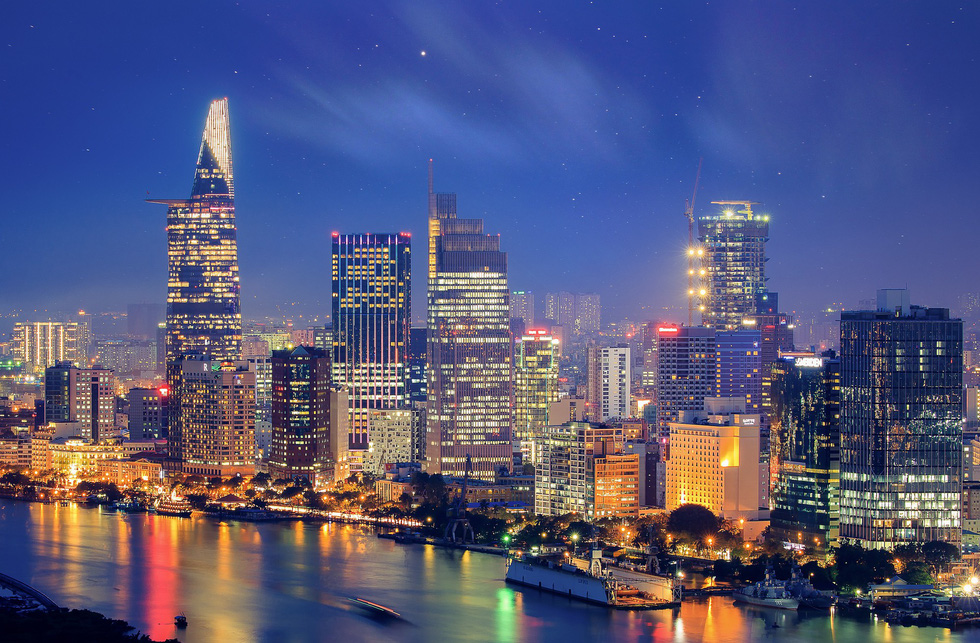
An aerial view of District 1 from the other side of the Saigon River in Binh Thanh District. Photo: Nguyen Tan Tuan

An aerial view of the Landmark 81, the new icon of Ho Chi Minh City. Photo: Nguyen Tan Tuan

An aerial view of the Landmark 81 and the Vinhomes Central Park residential area. Photo: Nguyen Tan Tuan

An aerial view of the iconic Notre-Dame Cathedral Basilica in District 1 from Diamond Plaza Building. Photo: Nguyen Tan Tuan

An aerial view of fireworks seen from District 4 on Vietnam Reunification Day on April 30, 2018. Photo: Nguyen Tan Tuan

An aerial view of the Phu My Bridge connecting District 2 and District 7. Photo: Nguyen Tan Tuan

An aerial view of fireworks seen from District 4 on Vietnam National Day on September 2, 2018. Photo: Nguyen Tan Tuan

An aerial view of Ho Chi Minh City’s once-tallest Bitexco and nearby buildings. Photo: Nguyen Tan Tuan
Source: Tuoitrenews.vn
Thứ Sáu, 9 tháng 3, 2018
The quiet night glow of Bai Dinh pagoda
Bai Dinh pagoda in the northern province of Ninh Binh has been attracting many pilgrims during early days of the lunar New Year due to its remarkable Buddhist architectural structures and for the tranquil atmosphere and stunning beauty at night.

Bai Dinh is Vietnam’s largest pagoda. It is open to 9pm daily for visitors and is accessible around the clock during the festival.

The highlight of Bai Dinh pagoda is the night time view of 13-storey Bao Thien tower. It costs VND50,000 for each visitor to go up to the tower by elevator.

Bai Dinh pagoda festival opens on the 6th day of the first lunar month and lasts until March. Visitors have the chance to discover giant bronze Buddha statues during the night time tour of the pagoda.

Tam The temple is the highest structure in the pagoda and is home to many giant Buddha statues.

Concluding the tour, visitors can enjoy coffee on the summit of Dinh Mountain while enjoying the cool and quiet ambience of Bai Dinh pagoda at night.

VOV / VNE

Bai Dinh is Vietnam’s largest pagoda. It is open to 9pm daily for visitors and is accessible around the clock during the festival.

The highlight of Bai Dinh pagoda is the night time view of 13-storey Bao Thien tower. It costs VND50,000 for each visitor to go up to the tower by elevator.

Bai Dinh pagoda festival opens on the 6th day of the first lunar month and lasts until March. Visitors have the chance to discover giant bronze Buddha statues during the night time tour of the pagoda.

Tam The temple is the highest structure in the pagoda and is home to many giant Buddha statues.

Concluding the tour, visitors can enjoy coffee on the summit of Dinh Mountain while enjoying the cool and quiet ambience of Bai Dinh pagoda at night.

VOV / VNE
Thứ Sáu, 2 tháng 3, 2018
Japan invests $ 37.5 billion in a super project in Hanoi
In less than a decade, some Hanoi residents might be able to live and work in a smart town that’s built entirely with Japanese technologies.

According to an in-depth feature by Nikkei Asian Review, the Japanese government is teaming up with more than 20 companies to construct a smart town in Vietnam from scratch. Work on the project – the biggest Japan-led project overseas so far – is already underway and aiming for a 2023 launch.
The town spans 310 hectares and will cost JPY4 trillion (US$37.3 billion). Funding for the town will come from the pocket of the companies, the Japanese government’s overseas development assistance, and subsidies from the Vietnamese government.
Plans for developing the high-tech town is in line with Japan’s initiative to attract more international orders by using the Vietnam project as a platform for Japanese companies to showcase the quality and convenience of their products, from logistic solutions to subway construction to retail and services.
The 20-odd involved firms each brings their own expertise into making the town a reality. General trader Sumitomo Corp. leads the consortium while the Japan International Cooperation Agency (JICA) helps with negotiating on the Vietnam side.
Architecture firm Nikken Sekkei will design the smart town, which will be situated just 15 minutes away from Hanoi’s downtown. In the future, urbanites can also travel to the “Japan town” via Hanoi’s Metro Line 2. There have also been talks to establish a link to Noi Bai International Airport.
Among the project partners are Mitsubishi and Tokyo Metro. The former is set to populate the future town with self-driving buses and electric charging stations while the latter will lend its expertise to subway operation. Within the new town, the consortium hopes to add a Japanese touch with scores of cherry trees.
The article revealed that the town could commence work on the first phase this October, putting some 7,000 residential and commercial structures on the map by the end of 2019. These condo units will be available at JPY10-15 million each (VND2.1-3.2 billion) and come outfitted with Japanese amenities, such as Panasonic appliances, air-conditioning from Daikin, and smart meters from telecommunication firm KDDI. - Saigoneer

According to an in-depth feature by Nikkei Asian Review, the Japanese government is teaming up with more than 20 companies to construct a smart town in Vietnam from scratch. Work on the project – the biggest Japan-led project overseas so far – is already underway and aiming for a 2023 launch.
The town spans 310 hectares and will cost JPY4 trillion (US$37.3 billion). Funding for the town will come from the pocket of the companies, the Japanese government’s overseas development assistance, and subsidies from the Vietnamese government.
Plans for developing the high-tech town is in line with Japan’s initiative to attract more international orders by using the Vietnam project as a platform for Japanese companies to showcase the quality and convenience of their products, from logistic solutions to subway construction to retail and services.
The 20-odd involved firms each brings their own expertise into making the town a reality. General trader Sumitomo Corp. leads the consortium while the Japan International Cooperation Agency (JICA) helps with negotiating on the Vietnam side.
Architecture firm Nikken Sekkei will design the smart town, which will be situated just 15 minutes away from Hanoi’s downtown. In the future, urbanites can also travel to the “Japan town” via Hanoi’s Metro Line 2. There have also been talks to establish a link to Noi Bai International Airport.
Among the project partners are Mitsubishi and Tokyo Metro. The former is set to populate the future town with self-driving buses and electric charging stations while the latter will lend its expertise to subway operation. Within the new town, the consortium hopes to add a Japanese touch with scores of cherry trees.
The article revealed that the town could commence work on the first phase this October, putting some 7,000 residential and commercial structures on the map by the end of 2019. These condo units will be available at JPY10-15 million each (VND2.1-3.2 billion) and come outfitted with Japanese amenities, such as Panasonic appliances, air-conditioning from Daikin, and smart meters from telecommunication firm KDDI. - Saigoneer
Thứ Ba, 30 tháng 1, 2018
Hanoi falls in a huge crowd welcoming the soccer team of Vietnam U23

Thứ Hai, 8 tháng 1, 2018
Fly Across the Length of Vietnam in Filmmaker Thang Soi's Latest Short Film

The clip continues with awe-inspiring aerial shots of cloud-shawled karsk mountains, wave-ravished coasts, flocks of domestic ducks and colorful floating markets set to music by the Maius Philharmonic Orchestra. As buoyant flute notes transition to guitar riffs, the scenes move from lush rivers to construction sites, traffic-tangled intersections and looming skyscrapers.
Thứ Ba, 2 tháng 1, 2018
What a nice skill: Bottle blowing - Artist Mai Dinh Toi

Thứ Hai, 16 tháng 12, 2013
Natural exotic: Snow in the tropical country of Vietnam

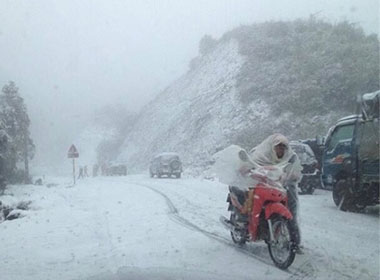
Snow started falling in Sapa town in the northern mountain province of Lao Cai on December 15th. Snow-dressed Sapa town, which has already been Vietnam’s major tourist attraction, bring visitors breathtaking landscapes.
O Quy Ho pass, Silver waterfall, and the Fansipan peak were the first places to experience snowfall.
Snowfall is a particularly interesting natural phenomenon in Vietnam. Tourists flocked to Sapa to admire snow with their own eyes.


Thứ Ba, 11 tháng 6, 2013
A politically progressive step in Vietnam

Premier Nguyen Tan Dung is under pressure because of his mishandling of the economy, previously one of Asia's best performing but now mired in massive levels of bad debt and a lackluster investment climate. Last year, he survived a leadership challenge at a meeting of top party leaders.
Dung and 46 other ministers and top state officials faced the vote by members of the national assembly, the first in what will be an annual process aimed at showing an increasingly assertive public that its leaders are more responsive to their demands. Voting in what was a secret ballot took place on Monday. Results were announced Tuesday.
Given more than 90 percent of the 498 members of the assembly are Communist Party cardholders, no one expected any of the officials to get the kind of poor showing that could trigger resignations.
Still, more than 30 percent gave Dung a "low confidence" vote, a clear sign of the divisions within the party over his second-term in office, due to end in 2016. Analysts said this showing by itself wouldn't impact his position, but could be used by rivals in internal negotiations over his future.
Assembly members got to vote on whether they had "high confidence," ''confidence" or "low confidence" in the officials. The rules of the secret ballot state that officials with more than a 60 percent "low confidence vote" might have to resign.
Dung received 160 "low confidence" votes out of 492 ballots, the third highest number of negative votes cast. President Truong Tan Sang, the man widely thought to be his main political challenger behind the tightly closed doors of party meetings, got just 28 negative votes.
The central bank governor received 209 "low confidence" marks, presumably a reflection of his handling of the economy. The education minister got 177. Aside from the economy, concern over the poor standard of schools and universities is a major public concern.
"This really does show that the assembly delegates are doing their job," said Edmund Malesky, a Vietnam expert at Duke University in the United States. "There definitely appears to some sort of responsiveness to constituencies. The two people associated with economic performance had a lower percentage of confidence votes than the mean."
National assembly deputy Duong Trung Quoc said the voting reflected "the reality of life and pressing issues and ... partly reflect the people's grievances."
The structural problems plaguing the economy and the increasing criticism and scrutiny of the party over the Internet have triggered calls for reforms by some in the party. While still arresting dissidents, it is revising the constitution, and will possibly water down language over the state's role in the economy.
Jonathan London, a Vietnam expert at Hong Kong's City University, said the ballot showed "Vietnam was charting its own course," albeit slowly. He asserted that a similar event wouldn't happen in China, Vietnam's much larger, Communist neighbor.
"Perhaps by necessity it is going for a brand of politics that has many of the trappings of a semi-accountable system," he said. "For a party that has a tradition of assuming its leaders were pristine and of outstanding caliber, it is a change of tune."
ABC News
Thứ Hai, 3 tháng 6, 2013
Vietnam keen to boost defense ties with countries
Vietnam wishes to further strengthen friendship and cooperation, including defense ties, with countries in the region and the world, said Deputy Defense Minister Senior Lieutenant General Nguyen Chi Vinh.

Deputy Defense Minister General Nguyen Chi Vinh addresses the 12th Shangri-La Dialogue in Singapore
The General made his statement at his bilateral meetings on June 1 with the Ministers of Malaysia, New Zealand and Australia; the Deputy Defense Ministers of Singapore, Brunei, Russia and the Republic of Korea, the US Pacific Commander and the Vice Chief of the General Staff of the Chinese People’s Liberation Army on the sidelines of the 12th Shangri-La Dialogue that ended on June 2 in Singapore after three days of working.
Vinh thanked these countries for assisting Vietnamese army in various fields and praised international support to Vietnam’s stance on building a peaceful and stable environment in the region in line with international law.
During their meetings, the two sides discussed ways to further strengthen bilateral defense ties on the basis of traditional friendship.
They pledged to promote development cooperation to reach common voices on major regional and global issues of mutual concern like peace, maritime security and anti-terrorism.
They also exchanged views on regional security situation and reviewed bilateral army relations.
Earlier when delivering an important speech the Shangri-La Dialogue, General Vinh, who led a Vietnamese delegation to the event, also emphasized the need to promote defense cooperation for a collective strength to cope with common challenges.
Vinh pointed that the trend of cooperation, including that in the Asia-Pacific, is taking place more vigorously than any other regions in the world and has been expanded multilaterally.
He considered the enhancement of defense links as one of the key measures to maintain peace, stability and development to meet the aspiration of nearly four billion in the Asia-Pacific region.
The General reiterated the request for further cooperation among the Navies, Maritime Polices and Border Guards and for the establishment of the hotline among ASEAN Defense Ministers.
He suggested the ASEAN Ministers of Defense consider the signing of a no-first-use-of-force agreement in order to consolidate the mutual trust among ASEAN countries, saying the experience gained from this will be eventually expanded to the nations of the Asia-Pacific Region.

Deputy Defense Minister General Nguyen Chi Vinh addresses the 12th Shangri-La Dialogue in Singapore
The General made his statement at his bilateral meetings on June 1 with the Ministers of Malaysia, New Zealand and Australia; the Deputy Defense Ministers of Singapore, Brunei, Russia and the Republic of Korea, the US Pacific Commander and the Vice Chief of the General Staff of the Chinese People’s Liberation Army on the sidelines of the 12th Shangri-La Dialogue that ended on June 2 in Singapore after three days of working.
Vinh thanked these countries for assisting Vietnamese army in various fields and praised international support to Vietnam’s stance on building a peaceful and stable environment in the region in line with international law.
During their meetings, the two sides discussed ways to further strengthen bilateral defense ties on the basis of traditional friendship.
They pledged to promote development cooperation to reach common voices on major regional and global issues of mutual concern like peace, maritime security and anti-terrorism.
They also exchanged views on regional security situation and reviewed bilateral army relations.
Earlier when delivering an important speech the Shangri-La Dialogue, General Vinh, who led a Vietnamese delegation to the event, also emphasized the need to promote defense cooperation for a collective strength to cope with common challenges.
Vinh pointed that the trend of cooperation, including that in the Asia-Pacific, is taking place more vigorously than any other regions in the world and has been expanded multilaterally.
He considered the enhancement of defense links as one of the key measures to maintain peace, stability and development to meet the aspiration of nearly four billion in the Asia-Pacific region.
The General reiterated the request for further cooperation among the Navies, Maritime Polices and Border Guards and for the establishment of the hotline among ASEAN Defense Ministers.
He suggested the ASEAN Ministers of Defense consider the signing of a no-first-use-of-force agreement in order to consolidate the mutual trust among ASEAN countries, saying the experience gained from this will be eventually expanded to the nations of the Asia-Pacific Region.
Thứ Năm, 4 tháng 4, 2013
Fire-breathing dragon bridge opens in Vietnam
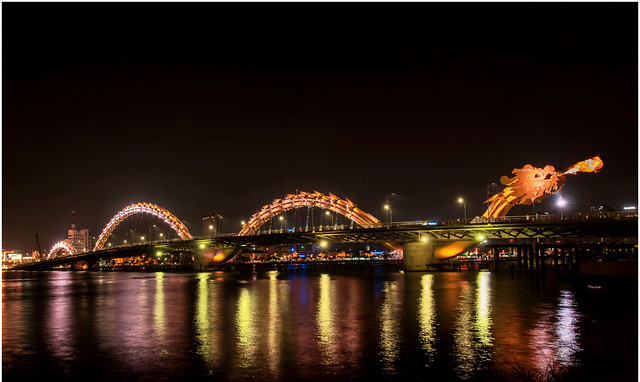
To celebrate the 38th anniversary of the end of the Vietnam War, authorities in the port city of Da Nang have opened the world's largest dragon bridge. Featuring more than 2,500 energy-efficient Philips LED lights, the dragon is capable of releasing bursts of fire from its mouth and can spit water during the country's major festivals or at weekends.

According to VietnamNet, work began on the bridge in 2009 and cost a reported $85 million. Connecting the city’s international airport and beaches, the structure simulates the shape of the dragon in the Ly Dynasty, a symbolic creature that is part of Vietnam folklore. The 166-meter-long steel arch is the longest such structure in Vietnam, with the dragon's body measuring a total of 568 meters and more than 2,000 tons in weight.
The Verge
According to VietnamNet, work began on the bridge in 2009 and cost a reported $85 million. Connecting the city’s international airport and beaches, the structure simulates the shape of the dragon in the Ly Dynasty, a symbolic creature that is part of Vietnam folklore. The 166-meter-long steel arch is the longest such structure in Vietnam, with the dragon's body measuring a total of 568 meters and more than 2,000 tons in weight.
The Verge
Chủ Nhật, 24 tháng 3, 2013
Old maps proving Vietnam’s island sovereignty displayed
Eighteen maps, including four ancient ones, affirming Vietnam’s sovereignty over Hoang Sa (Paracel) and Truong Sa (Spratly) archipelagos, were on display at an exhibition in the southern province of Dong Nai on March 22.
The old maps, including “An Nam dai quoc hoa do” ( Map of the Great Country of An Nam) published in 1838, “Dai Nam thong nhat toan do” ( Complete Map of Unified Dai Nam) published during the Minh Mang reign in 1834, and a 1904 map of Indochinese weather stations.
There was also a Chinese administrative map of provincial boundaries published under the Qing dynasty in 1904. The map shows that the southernmost point of China at that time ended at Hainan Island.
Additionally, the exhibition introduced over 100 photos featuring the two archipelagos as well as activities of Dong Nai people towards the country’s seas and islands.
Tran Dang Ninh, Director of Tran Bien Temple of Literature, where the exhibition took place, said the event will go on until April 30.
Within the framework of the event, there will be a wide range of activities, including a film making contest on Vietnam ’s seas and islands.
Tuoitre News
 |
Photo: Maps displayed at the exhibition. Photo: VNA |
The old maps, including “An Nam dai quoc hoa do” ( Map of the Great Country of An Nam) published in 1838, “Dai Nam thong nhat toan do” ( Complete Map of Unified Dai Nam) published during the Minh Mang reign in 1834, and a 1904 map of Indochinese weather stations.
There was also a Chinese administrative map of provincial boundaries published under the Qing dynasty in 1904. The map shows that the southernmost point of China at that time ended at Hainan Island.
Additionally, the exhibition introduced over 100 photos featuring the two archipelagos as well as activities of Dong Nai people towards the country’s seas and islands.
Tran Dang Ninh, Director of Tran Bien Temple of Literature, where the exhibition took place, said the event will go on until April 30.
Within the framework of the event, there will be a wide range of activities, including a film making contest on Vietnam ’s seas and islands.
Tuoitre News
Thứ Ba, 19 tháng 3, 2013
Aust to help Vietnam prepare UN mission

Defence Minister Stephen Smith met Vietnam's Minister of National Defense General Phung Quang Thanh for the inaugural annual Australia-Vietnam Defence Ministers' meeting in Canberra on Tuesday.
Mr Smith said 2013 marked the 40th anniversary of diplomatic relations between Australia and Vietnam and a close and prosperous relationship had developed.
"This includes a strong defence relationship, which has grown in recent years based on practical cooperation, people-to-people links and dialogue on strategic and defence issues," he said in a statement.
In Vietnam in October 2010, the ministers signed the Australia-Vietnam Memorandum of Understanding on Defence Cooperation.
Mr Smith said they had now agreed to further practical steps to enhance the defence relationship.
Australian and Vietnam will conduct an annual "1.5 track" defence dialogue, bringing together experts to share opinions and views on regional issues and to discuss methods to enhance bilateral cooperation.
Australia will also provide training to Vietnam as it prepares to deploy troops on United Nations peacekeeping missions for the first time, Mr Smith said.
Eighty places for military and English training will be offered in Australia including a further post-graduate scholarship position for the Vietnam People's Army in 2014.
It takes the total post-graduate scholarship positions offered to Vietnam to 11 in 2013 and 12 in 2014.
"Minister Thanh and I also undertook to look for further opportunities to enhance military engagement, including in areas such as maritime security cooperation," Mr Smith said.
The ministers laid a wreath at the Australian War Memorial and visited Governor-General Quentin Bryce.
9News National
Vietnam to Participate in UN Peacekeeping Missions
Thứ Năm, 14 tháng 3, 2013
Russian defence company opens office in Vietnam’s Cam Ranh Bay
 |
| Rear Admiral Nguyen Van Kiem, Mr. Konstantin Silov, Mr. Nguyen Chien Thang cut the ribbon to inaugurate the office of Avrora Company |
“The opening of the concern’s office in Vietnam is a milestone in strengthening friendly and promising relations between the two countries,” he said. “Undoubtedly, our constant presence here will make a significant contribution to enhancement of cooperation between Russia and Vietnam.”
“Avrora’s office in Nha Trang will represent the company’s interests in relations with Vietnam’s authorities, will help expand the company’s activity on Vietnam’s market and promote its products at exhibitions and seminars organized there,” Kulayev said.
The office located close to Vietnam’s Cam Ranh naval base was unveiled by Avrora director-general Konstantin Shilov. The Vietnamese side was represented by the chairman of the people’s committee of Khanh Hoa Province, Nguyen Chien Thang.
This year Russia will export the first two diesel submarines to Vietnam that is creating its submarine fleet with Russia’s support.
Đăng ký:
Bài đăng (Atom)