Hiển thị các bài đăng có nhãn Asian sea disputes. Hiển thị tất cả bài đăng

Thứ Tư, 21 tháng 11, 2018

China building on new reef in South China Sea, think tank says


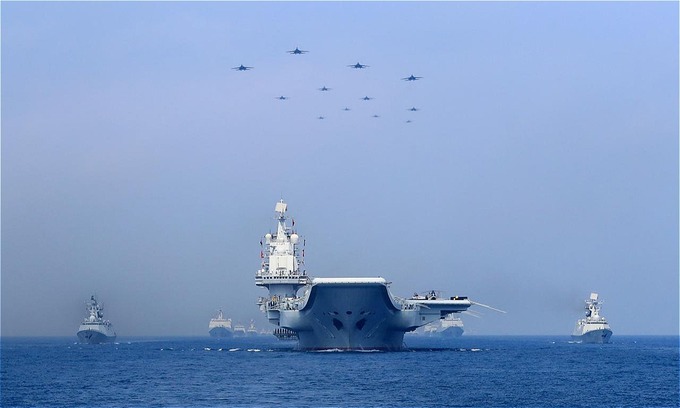
Warships and fighter jets of Chinese People's Liberation Army (PLA) Navy take part in a military display in the South China Sea, April 12, 2018. Photo by Reuters/Stringer

China has installed a new platform on a remote part of the Paracel Islands in the disputed South China Sea which could be used for military purposes.

The strategic waterway is claimed almost in its entirety by China, whose continued building of military and other installations on artificial islands and reefs there has unnerved the region and angered Washington, according to recent satellite images reviewed by a U.S. think tank.

The Asia Maritime Transparency Initiative of Washington's Center for Strategic and International Studies said the images showed a "modest new structure" on Bombay Reef, topped by a radome and solar panels.

"The development is interesting given Bombay Reef's strategic location, and the possibility that the structure's rapid deployment could be repeated in other parts of the South China Sea," the group said in a statement on Tuesday.

The purpose of the platform and radome was unclear, but it could be for military use, it said.

"The reef is directly adjacent to the major shipping lanes that run between the Paracels and the Spratly Islands to the south, making it an attractive location for a sensor array to extend Chinese radar or signals intelligence collection over that important sea lane," the group said.

China's Defense Ministry did not respond to a request for comment.

Foreign Ministry spokesman Geng Shuang said China's sovereignty over the Paracel Islands was not in dispute, and there is nothing wrong with China carrying out construction work on its own territory.

"As for the specific situation you mention, I have no understanding of it," Geng told a daily news briefing.

Vietnam calls the waters the East Sea and has often declared its sovereignty over its Paracels and Spratlys. Vietnam's foreign ministry did not immediately respond to a request for comment.

Emphasis on civil infrastructure

Separately, an influential state-run paper said on Wednesday that China should put more focus on building civilian facilities on islands in the South China Sea and less emphasis on the military to soothe regional fears about China's intentions.

In a commentary, China's Study Times said there was a "potential risk of war" for areas surrounding the country such as the South China Sea.

"Unprecedented outside military interference is the biggest threat to peace and stability in the South China Sea," said the paper, published by the Central Party School which trains rising officials.

"Without the strong deterrence power of our military in the South China Sea, then protecting regional peace and stability is merely idle theorising and falls short of what we would wish."

But there must be a greater role for non-military actors in the South China Sea, it added.

"Facilities on the reefs and islands of the South China Sea should be more civilian and less military," the paper wrote.

That means there should be more focus on building lighthouses, civilian airports, maritime search and rescue, scientific research and weather forecasting, it added.

"Just as the Chinese government has repeatedly stressed, after the completion of the island facilities, they will actively provide relevant public security products and services to regional countries," the paper said.

This will help the international community with things like counter-terror and anti-piracy operations, to jointly safeguard peace and security in the South China Sea, it added.

China has said some civilian facilities on the islands are intended for use by others in the region, but the government has given few details about how that may work in practice.

The islands China occupies in the South China Sea are off-limits to foreigners, with access under the effective control of the People's Liberation Army despite them technically being administratively part of China's southern Hainan province.

Vietnam, Malaysia, the Philippines, Taiwan and Brunei also have competing claims in the South China Sea.

China has frequently lambasted the United States and its allies for freedom of navigation naval operations near to Chinese-occupied islands.

The United States earlier this month again urged China to halt militarisation of the South China Sea.

China said it had the right to build "necessary defense facilities" on what it considers its own territory and urged Washington to stop sending warships and military planes close to the islands that Beijing claims.

Source: https://e.vnexpress.net/news/world/china-building-on-new-reef-in-south-china-sea-think-tank-says-3842672.html

Thứ Hai, 8 tháng 7, 2013

Japan warns of toughening security climate in east Asia


TOKYO (Reuters) – Japan faces increasingly serious threats to its security from China and North Korea, a defence ministry report said on Tuesday, as ruling politicians call for the military to beef up its ability to respond to such threats.

The report was likely to prompt a sharp response from Beijing, whose ties with Tokyo are strained by a territorial row and remarks by Prime Minister Shinzo Abe suggesting he wants to cast Japan’s wartime history in a less apologetic tone.

“There are various issues and destabilising factors in the security environment surrounding Japan, some of which are becoming increasingly tangible, acute and serious,” the annual defence white paper said.

“China has attempted to change the status quo by force based on its own assertion, which is incompatible with the existing order of international law.”

China and Japan have been locked in a dispute over rival claims to a group of tiny East China Sea islets.

Patrol ships from both countries routinely shadow each other near the islands, raising concerns that an unintended collision or other incident could lead to a broader clash.

“Some of China’s activities involve its intrusion into Japan’s territorial waters, its violation of Japan’s territorial airspace and even dangerous actions that could cause a contingency, and are extremely regrettable,” the paper said.

Defence Minister Itsunori Onodera said in February that a Chinese naval vessel had locked its fire control radar on a Japanese destroyer. Directing such radar at a target can be considered a step away from actual firing.

China denied the warship had locked its radar on the Japanese vessel. But the white paper said Beijing’s assertion was “inconsistent with the facts”.

Abe returned to power for a rare second term after his ruling bloc won a general election late last year, promising to revive the economy and strengthen Japan’s defences. He also wants to revise the post-World War Two pacifist constitution to legitimise the military, although winning support for contentious revisions is likely to take time.

Japan is already bolstering its islands’ defence and this year raised its defence budget for the first time in 11 years.

The military is conducting joint drills with the United States, its main security ally, and fortifying defences against missile attacks, while the government is reviewing its mid-term defence policy.

BALANCE OF POWER

Japan plans to draw up a new defence plan by December, and Abe’s Liberal Democratic Party (LDP) last month submitted to the government recommendations that included looking into acquiring the capability to attack enemy targets.

Japan has long maintained that it has the right to strike enemy targets when an intention to attack Japan is clear, the threat is imminent and there are no other options.

But any sign that Japan is moving to obtain such capabilities could upset China and South Korea, where resentment against Japan’s wartime aggression and colonisation runs deep.

The LDP also recommended that, in order to boost the defence of remote islands, the military should set up an amphibious Marines division equipped with tilt-rotor aircraft like the V-22 Osprey.

“The balance of power will be lost if we don’t start considering striking back when attacked,” said Osaka University professor Kazuya Sakamoto, who sits on a panel advising Abe on security policies.

“If we don’t have weapons that reach an enemy, Japan cannot defend itself. It cannot maintain deterrence.”

Such moves, Sakamoto added, should not unnerve China, with its arsenal of nuclear weapons.

Abe, whose LDP is expected to cement its grip on power in this month’s upper house election, also wants to revise an interpretation of the constitution that bans using the right of collective self-defence, or aiding an ally under attack.

A panel set up during Abe’s first 2006-7 term recommended that the ban be lifted in certain cases, such as intercepting ballistic missiles bound for the United States. A new committee of advisers is expected to reach similar conclusions.

North Korea launched a missile in December, stepping up the threat that the isolated, impoverished state poses to rivals. In February, it conducted a third nuclear test, which moved Pyongyang closer to developing long-range nuclear missiles.

“The launch of a missile … showed that North Korea has advanced its technologies to extend the range and improve the accuracy of ballistic missiles,” the white paper said.

The report added that if North Korea develops ballistic missiles based on technologies tested in December, they could reach the central and western parts of the U.S. mainland.

Japan’s defence spending has fallen 5 percent in the past decade even after this year’s small gain. China saw its defence budget quadruple during the same period, the white paper said.

Euro News

Thứ Tư, 3 tháng 7, 2013

Rivals play down China's overture in South China Sea

(Reuters) - Philippine Foreign Minister Albert del Rosario walked into a regional security forum this week to hear his Chinese counterpart Wang Yi reel off a list of complaints against Manila for stirring tensions over the South China Sea.

Taiwan navy soldiers run to a S-70C helicopter after it landed on a Taiwan naval Lafayette-class frigate during a joint military drill outside a navy base in Kaohsiung port, southern Taiwan May 16, 2013. Credit: Reuters/Pichi Chuang

Del Rosario was not scheduled to speak, but after hearing Wang's speech at Sunday's closed-door meeting in the kingdom of Brunei, he raised his hand and proceeded to rebut China's allegations one by one, according to Philippine diplomats. The Singapore foreign minister called it "testy exchanges".

The departure from the usual diplomatic niceties that mark such multilateral gatherings was the latest display of animosity over competing claims in the oil-rich South China Sea, one of Asia's most dangerous military flashpoints.

Despite rare progress towards easing tensions between China and Southeast Asian nations at the Brunei meeting, a binding agreement remains a distant prospect, with Beijing seen in no rush to limit a growing naval reach that is alarming neighbors such as Vietnam and the Philippines.

"My response was simply that the core issue is that China has taken the position that they have indisputable sovereignty over nearly the entire South China Sea," Del Rosario told reporters later. "Since that is a grossly excessive claim, we need to settle this in accordance with international law. So I asked everyone to support that."

China's agreement later that day to hold talks with Southeast Asia on maritime rules appeared to mark a new chapter in efforts to resolve the dispute. After years of resisting efforts by the 10-member Association of Southeast Asian Nations (ASEAN) to start talks on the proposed Code of Conduct, China said it would host talks between senior officials in September.

The code however would not touch on countries' territorial claims but would set "rules of the road" for actions by ships, aiming to minimize the risk of a misstep that could lead to conflict.

The talks to be held in China are relatively low-level and were carefully described in the joint ASEAN-China statement on Sunday as "consultations" rather than "negotiations" - an important nuance that signals that no real progress is likely.

China also succeeded in securing ASEAN's agreement to involve a board of experts such as academics and former diplomats - so-called "eminent persons" - in guiding the process. ASEAN countries had previously been against this, amid concerns it will result in further delays.

A senior U.S. administration official who attended the Brunei meeting said the new talks were welcome, but by no means a breakthrough.

"It's not enough to simply promise some form of talks in the run-up to a multilateral meeting as a way of abating criticism and creating the appearance of progress," the official said.

"There has to be a full-fledged effort to try to work out in practical terms what a mechanism or set of mechanisms would be (to lower tensions)."

GROWING MILITARISATION

Friction over the South China Sea, one of the world's most important waterways, has surged as China uses its growing naval might to more forcefully assert its vast claims over the oil and gas rich sea, raising fears of a military clash. Four ASEAN nations, including Vietnam and the Philippines, have overlapping claims with China.

Washington, an ally of the Philippines and also Vietnam, has not taken sides, but Secretary of State John Kerry reiterated in Brunei its strategic interest in freedom of navigation through the busy sea and desire to see a Code of Conduct signed quickly.

Those risks have risen in recent weeks as three Chinese ships have converged just 5 nautical miles from a small reef where the Philippines maintains a small military force.

China has condemned the Philippine presence at the Second Thomas Shoal as an "illegal occupation", even though the reef is within Manila's 200-nautical mile economic exclusion zone.

The encroachment is part of China's strategy of sending ships to far-flung parts of the sea to protect fishing fleets and press its sovereignty claims, which Manila condemned this week as causing "increasing militarization."

Las month, Chinese state media warned that a "counterstrike" against the Philippines was inevitable if it continued to provoke Beijing in the South China Sea.

The Philippines has one of the least equipped militaries in Asia, but is pursuing a $1.8 billion modernisation program and has revived plans to build new air and naval bases at Subic, just 124 miles from one of the contentious areas on the South China Sea.

Philippine President Benigno Aquino, who retires in 2016, said last week: "Rest assured that before I step down from office, guarding our skies are new and modern equipment like lead-in fighters, long-range patrol aircraft, close air support aircraft, light-lift fixed-wing aircraft, medium-lift aircraft, attack helicopters, combat utility helicopters and air defense radars."

On Sunday, Beijing complaints against Manila included: the Philippines' decision this year to appeal for U.N. arbitration over maritime claims without informing China and its joint military exercises last week with the United States near a disputed shoal.

Wang also condemned the Philippines for grounding an old navy ship in the Second Thomas Shoal to claim the area.

China and the Philippines accuse each other of violating the Declaration of Conduct, a non-binding confidence-building agreement on maritime conduct signed by China and ASEAN in 2002. Such differences could be another obstacle to agreeing a more comprehensive pact as China has stressed that countries must first show good faith by abiding by the DoC.

Still, the Philippines appeared to welcome the progress at the Brunei meeting, even if it was scant.

"It's more than a chit-chat," Evan Garcia, the Philippines' deputy foreign secretary told reporters. "We have to start the process."

Thailand's foreign minister described Sunday's agreement as "very significant", but most other ASEAN ministers gave it a more cautious welcome.

"The quality of the process is as important as the result. We want to make sure that we (use) every possible opportunity for as much consultation as possible," said Marty Natalegawa, Indonesia's foreign minister.

"Breakthrough makes it sound very dramatic."

Thứ Hai, 1 tháng 7, 2013

China Agrees to Asean Sea Talks Amid Philippines Warning

China agreed to talks with Southeast Asian nations on a set of rules to avoid conflict in the South China Sea, winning praise from diplomats even as the Philippines warned of increased “militarization” of the waters.

Wang Yi, China's foreign minister, center, listens during a ASEAN-China Ministerial Meeting in Brunei's capital Bandar Seri Begawan on June 30, 2013.

Talks on a code of conduct between China and the 10-member Association of Southeast Asian Nations will begin in September, according to a joint statement released after the two sides met in Brunei yesterday. The move represents a reversal from a year ago, when Asean failed to show a united front amid Chinese pressure to avoid discussing the topic at regional meetings.

“China and Asean countries are close neighbors and we are like members of one big family,” China Foreign Minister Wang Yi told reporters. “We believe that a united, prosperous and dynamic Asean that seeks greater strength through unity is in China’s strategic interest.”

May 21 (Bloomberg) -- Philippine President Benigno Aquino talks about the challenges facing the nation's economic growth. Aquino also discusses reforms to the domestic judicial system and the territorial dispute with China. He spoke May 8 in Manila with John Dawson on Bloomberg Television's "Asia's Business." (Source: Bloomberg)
China had resisted the talks as competition for oil, gas and fish in the waters increased tensions with fellow claimants including the Philippines, which has boosted military ties with the U.S. and Japan. Secretary of State John Kerry is in Brunei today to attend the annual meetings after holding talks with Palestinian and Israel leaders.

The Philippines said yesterday “the massive presence of Chinese military and para-military ships” around two land features it claims in the South China Sea posed “threats to efforts to maintain maritime peace and stability in the region.” At the same time, the country backs Asean’s bid for a binding code of conduct, it said in a statement.

Situation ‘Stable’

Wang, in his first Asean meeting as foreign minister since President Xi Jinping took office in March, called the overall situation in the South China Sea “stable.” He pledged to upgrade an Asean-China trade agreement and “push forward” talks on the Regional Comprehensive Economic Partnership, which includes Asean, China and five other Asia-Pacific countries.

Two years ago, Asean and China approved guidelines to implement the 2002 agreement that called on countries to avoid occupying disputed islands, inform others of military exercises and resolve territorial disputes peacefully. Since then, China had rebuffed Asean’s efforts to start talks on a code of conduct, saying it would only do so “when conditions are ripe.”

The U.S.’s declared interest in maintaining freedom of navigation in the waters has irked China, which prefers solving the disputes through direct dialogue with claimants. U.S. officials have repeatedly called for China and Asean to agree on a code of conduct, most recently Secretary of Defense Chuck Hagel in a visit to Singapore in early June.

‘Enduring Presence’

Kerry’s visit to the region gives the U.S. another chance to assure its allies that its military shift to the region is sustainable, even as it faces as much as $500 billion in defense budget cuts over nine years, and to tell China that what has become known as the “Asia pivot” is not about containing its strategic aspirations.

The U.S. would preserve its greater engagement in Asia, Kerry told Asean leaders after arriving in Brunei today. “We take our Pacific responsibilities and our partnerships seriously, and we will continue to build an active and enduring presence in every respect,” Kerry said. “But I want to emphasize importantly our actions are not intended to contain or to counterbalance any one country.”

‘Strategic Misjudgment’

President Benigno Aquino’s government last week said it’s crafting an agreement that would give the U.S. military access to Subic Bay. The Philippines needs allies to help with security or “bigger forces will bully us,” Defense Secretary Voltaire Gazmin said on June 28.

Last week, Wang said that moves by countries to rely on “external forces” to push territorial claims are “futile and will eventually prove to be a strategic misjudgment where the loss will outweigh the gain.” Yesterday he took a softer tone, while saying that China has abided by the provisions of the non-binding 2002 agreement to keep peace in the waters.

“China will continue to properly handle its specific differences with some countries through friendly consultations,” Wang said.

Speaking alongside him as Asean’s representative, Thai Foreign Minister Surapong Tovichakchaikul hailed the bloc’s “strong” relationship with China. Talks on a code of conduct are “a process that needs time, patience and prudence,” Surapong said.

China’s Map

Singapore Foreign Minister K. Shanmugam said that non-claimants like the city-state can’t get involved in determining which countries own certain features, adding the talks are a positive step.

“This has been something that many countries have been asking for,” Shanmugam told reporters. “Let’s not get away with the impression that, therefore, we’re all going to have an agreement very soon. But the important thing is we’ve agreed on a start date, and hopefully that sets the tone.”

Vietnam and the Philippines reject China’s map of the waters as a basis for joint development, a solution pushed by China. China National Offshore Oil Corp. estimates the South China Sea may hold about five times more undiscovered natural gas than the country’s current proved reserves, according to the U.S. Energy Information Administration.

Cables Cut

An oil research vessel said to be owned by Shanghai Offshore Petroleum Co., a unit of Sinopec, entered Japan’s exclusive economic zone near disputed islands in the East China Sea in June without giving prior notice to the Japanese government, the Sankei newspaper reported today, citing the Japan Coast Guard. A call to Sinopec’s Beijing office by Bloomberg News was unanswered before business hours.

Since 2010, China has cut the cables of survey ships working for Vietnam, chased away an exploration vessel near the Philippines and sent its first deep-water drilling rig to the region. Last year, China National Offshore invited bids for exploration blocks that Vietnam had already awarded to companies including Exxon Mobil Corp. (XOM) and OAO Gazprom.

While core disputes over territory remain, Asean ministers are unified on the need for a code of conduct, Indonesian Foreign Minister Marty Natalegawa said. The Philippines has sought international arbitration to settle disputes, saying that direct talks with China have failed to stem tensions.
“The common position is to try to resolve these issues through dialogue,” Natalegawa told reporters yesterday. “The code of conduct will keep things orderly so that we can have conditions conducive for these negotiations to take place.”

Bloomberg

US wades into maritime disputes in South China Sea


US Secretary of State John Kerry has said he hopes for progress on a Code of Conduct to help resolve maritime disputes in the South China Sea and ensure regional stability.

Speaking at the Association of Southeast Asian Nations, (ASEAN), Summit in Brunei, Kerry said: “We have a strong interest in the manner in which the disputes of the South China Sea are addressed and in the conduct of the parties. We very much hope to see progress soon on a substantive Code of Conduct in order to ensure stability in this vital region.”

Regional analysts suggest that Beijing would be unlikely to sign up to such an agreement and is keen to cement its claims over the sea.

Japan said it had monitored four Chinese ships entering its territorial waters around the disputed Senaku islands in the East China Sea early on July 1. China, which calls the islands Diaoyu, maintains that it discovered them in the fourteenth century.

Euronews

Any use of force in South China Sea not acceptable to India

BANDAR SERI BEGAWAN: Ahead of India-ASEAN Post Ministerial Conference, foreign minister Salman Khurshid on Monday said India will reject any use of force in the South China Sea where several Asean countries are locked in a territorial dispute with China. Later in the day, Khurshid will also have a bilateral meeting with his Chinese counterpart Wang Yi.

Khurshid was replying to a query here about India's position about the call for a freedom of navigation by some Asean nations for a code of conduct in South China Sea.

"The Code of conduct is a work in progress but at part of the broad principles, we support freedom of navigation in South China Sea; the use of force is something which India rejects,'' said Khurshid.

The ongoing 46th Asean foreign ministers' meeting here has seen China, in a bid to prevent further escalation of strife, agreeing to hold official consultations over the issue. This was after Beijing's latest stand-off with Philippines which saw its foreign minister accusing China of increasing militarization in the region.

Apart from his bilateral with Wang, Khurshid is slated to have 9 other bilateral meetings Monday, including with his counterparts from Bangladesh, Canada, Cambodia and North Korea. About his meeting with the North Korean foreign minister, Khurshid said he was looking to firmly'' convey India's message over the issue of non-proliferation.

Times Of India

Thứ Bảy, 29 tháng 6, 2013

PH slams China for retaliation threat

MANILA, Philippines—The Philippines scored China’s “provocative” threat of retaliation in the West Philippine Sea (South China Sea) on Saturday, urging Beijing to defer instead to peaceful means of resolving maritime disputes under the United Nations Convention on the Law of the Sea.

A Fililipino protester holds a slogan beside a Philippine flag during a rally outside the Chinese Consulate in suburban Makati, south of Manila, Philippines. FILE PHOTO

--> China media warns Philippines of 'counterstrike' in South China Sea

In a statement, the Department of Foreign Affairs reminded China of its obligation under international law to settle disputes without the use of threat or force.

“China has an obligation under international law, especially the UN Charter, to pursue a peaceful resolution of disputes, meaning without the use of force, the threat to use force such as this recent provocative statement of a counterstrike,” said DFA spokesperson Raul Hernandez.

“There is no place in the relations of civilized nations to use such provocative language,” he added.
Hernandez made the statement in response to the Chinese People’s Daily’s scathing commentary on the Philippines on Saturday, which warned of a “counterstrike” as it accused Manila of “seven sins” in the disputed West Philippine Sea, which is how the Philippine government calls part of the South China Sea that is within in exclusive economic zone.

Among other things, the paper, a mouthpiece of the Chinese Communist Party, accused the Philippines of “illegal occupation” of the Spratly Islands, part of which Manila contends to be within its exclusive economic zone.

The commentary also blasted the Philippines for advocating the “internationalization” of the waters, a critical international sea lane that has been under the close watch of Philippine allies, the United States in particular.

China issued its criticism amid war games between the Philippines and the US Navy off the Panatag (Scarborough) Shoal, a territory in the West Philippine Sea that saw a tense standoff between Philippine and Chinese ships last year. At least three Chinese patrol vessels are known to still be in the area.

The commentary also came out as leaders of the Association of Southeast Asian Nations met in Brunei in hopes of drafting a legally binding Code of Conduct that is aimed at ensuring peace in the disputed waters.

Despite Beijing’s sharp statements, the DFA called for sobriety and invoked peace in hopes of averting further escalation of tensions.

“We call on China to be a responsible member in the community of nations. The way towards a peaceful resolution of disputes is through the dispute resolution mechanism under the UN Charter, which is rules-based, transparent, binding and non-provocative,” said Hernandez.

“A peaceful and rules-based resolution to the disputes in the West Philippine Sea is durable and beneficial to all and will ensure peace and stability in the region,” he added.

The Philippines haled China to arbitral proceedings in the United Nations in January in a bid to peacefully settle the maritime dispute. The move has gained the support of the United States, the European Parliament and Japan, which also has a dispute with China in the East China Sea.

Now pending before a five-member arbitral tribunal, the legal action seeks to prevent further Chinese incursions into established Philippine maritime boundaries in the West Philippine Sea and to invalidate Beijing’s “excessive” nine-dash line claim encompassing almost all of the South China Sea.

China has rejected the proceedings, asserting “indisputable sovereignty” over the West Philippine Sea.

It has been calling for a bilateral solution to its territorial disputes with the Philippines, Vietnam, Brunei, Malaysia, and Taiwan. The Philippines has meanwhile been pushing for a multilateral approach.

Inquerer Global Nation

In pictures, U.S. and Philippine Conduct Joint Military Exercises

US navy soldiers and their Philippine counterparts operate two boats during a joint military exercises between the Philippines and the United States at the South China Sea, June 28, 2013. The Philippines and US Naval forces began joint military exercises codenamed Cooperation Afloat Readiness and Training (CARAT) at the South China Sea on June 27. (CNS Photo)

U.S. navy soldiers and their Philippine counterparts disembark from a speed boat after a surveillance operation training during a joint military exercises between the Philippines and the United States at the South China Sea, June 28, 2013. The Philippines and U.S. Naval forces began joint military exercises codenamed Cooperation Afloat Readiness and Training (CARAT) at the South China Sea on June 27 to enhance the capability of both sides through practical exercises and lectures. (Xinhua/Rouelle Umali)

A U.S. navy soldier (L) instructs his Philippine counterpart during a joint military exercises between the Philippines and the United States at the South China Sea, June 28, 2013. The Philippines and U.S. Naval forces began joint military exercises codenamed Cooperation Afloat Readiness and Training (CARAT) at the South China Sea on June 27 to enhance the capability of both sides through practical exercises and lectures. (Xinhua/Rouelle Umali)

U.S. navy soldiers and their Philippine counterparts launch an unmanned aerial vehicle (UAV) during a joint military exercises between the Philippines and the United States at the South China Sea, June 28, 2013. The Philippines and U.S. Naval forces began joint military exercises codenamed Cooperation Afloat Readiness and Training (CARAT) at the South China Sea on June 27 to enhance the capability of both sides through practical exercises and lectures. (Xinhua/Rouelle Umali)

U.S. navy soldiers and their Philippine counterparts operate a boat during a joint military exercises between the Philippines and the United States at the South China Sea, June 28, 2013. The Philippines and U.S. Naval forces began joint military exercises codenamed Cooperation Afloat Readiness and Training (CARAT) at the South China Sea on June 27 to enhance the capability of both sides through practical exercises and lectures. (Xinhua/Rouelle Umali)

U.S. navy soldiers and their Philippine counterparts disembark from a speed boat after a surveillance operation training during a joint military exercises between the Philippines and the United States at the South China Sea, June 28, 2013. The Philippines and U.S. Naval forces began joint military exercises codenamed Cooperation Afloat Readiness and Training (CARAT) at the South China Sea on June 27 to enhance the capability of both sides through practical exercises and lectures. (Xinhua/Rouelle Umali)

USS Fitzgerald, a guided-missile destroyer, docks in Subic’s Alava Pier yesterday for the Phl-US CARAT exercise. ERNIE PENAREDONDO

China media warns Philippines of 'counterstrike' in South China Sea

(Reuters) - China's state media warned on Saturday that a "counterstrike" against the Philippines was inevitable if it continues to provoke Beijing in the South China Sea, potentially Asia's biggest military troublespot.

New recruits of the Chinese Navy march with their guns during the parade marking the end of their first training session in Qingdao, Shandong province, March 4, 2013. Credit: Reuters/Stringer
New recruits of the Chinese Navy march with their guns during the parade marking the end of their first training session in Qingdao, Shandong province, March 4, 2013.
Credit: Reuters/Stringer

The warning comes as ministers from both countries attend an Association of Southeast Asian Nations meeting in Brunei, starting Saturday, which hopes to reach a legally binding code of conduct to manage maritime conduct in disputed areas.

At stake are potentially massive offshore oil reserves. The seas also lie on shipping lanes and fishing grounds.

Both China and the Philippines have been locked in a decades-old territorial squabble over the South China Sea, with tensions flaring after the Philippines moved new soldiers and supplies last week to a disputed coral reef, prompting Beijing to condemn Manila's "illegal occupation".

The overseas edition of the People's Daily, the official newspaper of the Chinese Communist Party, said in a front-page commentary that the Philippines had committed "seven sins" in the South China Sea.

These include the "illegal occupation" of the Spratly Islands, inviting foreign capital to engage in oil and gas development in the disputed waters and promoting the "internationalization" of the waters, said the commentary.

The Philippines has called on the United States to act as a "patron", while ASEAN has become an "accomplice," said the commentary, which does not amount to official policy but can reflect the government's thinking.

"The Philippines, knowing that it's weak, believes that 'a crying child will have milk to drink'," the People's Daily said, accusing Manila of resorting to many "unscrupulous" tricks in the disputed waters.

Beijing's assertion of sovereignty over a vast stretch of the South China Sea has set it directly against Vietnam and the Philippines, while Brunei, Taiwan and Malaysia also lay claim to other parts of the sea.

The 10-member ASEAN hopes to reach a legally binding Code of Conduct to manage maritime conduct in disputed areas. For now a watered-down "Declaration of Conduct" is in place.

On Thursday, China's Foreign Minister Wang Yi warned that countries with territorial claims in the South China Sea that look for help from third parties will find their efforts "futile", adding that the path of confrontation would be "doomed".

Last week, China vowed to protect its sovereignty over the Second Thomas Shoal, known in China as the Ren'ai reef. The Philippines is accusing China of encroachment after three Chinese ships, including a naval frigate, converged just five nautical miles (nine km) from an old transport ship that Manila ran aground on a reef in 1999 to mark its territory.

Last year, China and the Philippines were locked in a tense two-month standoff at the Scarborough Shoal, which is only about 124 nautical miles off the Philippine coast. Chinese ships now control the shoal, often chasing away Filipino fishermen.

Thứ Năm, 27 tháng 6, 2013

Japan to take Phl's side in South China Sea dispute


File photo of Japan's Minister of Defense Itsunori Onodera at a Pentagon honor cordon last April. AARON HOSTUTLER
MANILA, Philippines - Japanese Defense Minister Itsunori Onodera on Thursday assured the Philippines that Japan will be on its side in defending disputed territories in the South China Sea.

Onodera, who is in a two-day visit in Manila, told Department of National Defense Secretary Voltaire Gazmin in a courtesy call that Japan will cooperate to resolve the sea row with China.

"We agreed that we will further cooperate in terms of defense of remote islands as well as the defense of territory, or territorial sea as well as protection of maritime interest ... We will cooperate with the Philippine side in this matter," Onodera said.

The Japanese official said that both countries are facing "common concerns" as China feuds with different states over territorial claims in overlapping waters.

"I also said that Japan(ese) side is very concerned that this kind of situation in South China Sea (as it) could affect the situation in East China Sea," he said.

Onodera also said that peaceful means over military might should remain paramount and that the rule of law must be considered in seeking arbitration.

"I would like to emphasize here that the current situation should not be changed with use of force ... I think this the concept that is agreed upon in international communities these days," he said.

Likewise, Onodera lauded the Philippines' action in seeking arbitration to resolve the matter.

“I have also learned about the Philippines’ efforts for the United Nations (UN) arbitration process in the principle that the Philippine side seeks to solve this problem based on the rule of law. Japan side is totally supporting these kinds of efforts,” he said.

He added that Japan's priority, meanwhile, is to keep and protect its own territorial space in sea or air more than to get involved in international matters.

Onodera visited U.S. naval base at Subic Bay before meeting with Gazmin, while Japanese Prime Minister Shinzo Abe intends to visit the country in July.

Japan claims that China had intruded into the Senkaku Islands, which China calls Diaoyu Islands.

The Philippines for its part, accuses China of intruding into various areas that are within its exclusive economic zone

Chinese intruders have strengthened their presence in the Panatag (Scarborough) Shoal off Zambales and Ayungin Shoal off Palawan.

They have also built structures in the Mischief Reef or Panganiban Reef, which is about 70 nautical miles from Palawan and Subi Reef, an islet 12 nautical miles southwest of Pag-asa Island in the same province.

The Philippines has been advocating a multilateral rules-based approach to settle the West Philippine Sea dispute. It has also

China, however, insists that the row be addressed through direct bilateral negotiations.

A report from the newspaper The Japan Times said the meeting between Onodera and Gazmin was meant “to keep China in check.”

The report also quoted an unnamed source as saying that Onodera and Gazmin would work out a “coordinated response” toward China.

Onodera clarified that their security efforts are not directed against a specific country.

“The Japanese government is not aiming at protecting from any specific nation but our stance is that we keep out territorial space, territorial air and sea space well-protected. This should be done according to the rule of law,” he said.

Last January, the Philippines challenged China’s territorial claim to most of the West Philippine Sea before an international tribunal of the UN.

China claims almost the entire West Philippine Sea and the East Sea. The area, delineated by a so-called nine-dash line, covers more than 100 islets, atolls and reefs.

The Philippines believes China’s nine-dash line, which outlined its claims over most of the sea, is illegal. China’s claims also overlap with those of the Philippines, Malaysia, Taiwan, Brunei and Vietnam.

Philstar

US passed resolution condemning intimidation by China

United States Senate Committee on Foreign Relations recently has passed a resolution condemning China's actions related to the territorial dispute in the East China Sea and South China Sea. ANTĐ reported on June 27.

Japanese media reported on June 15 that a bipartisan group of U.S. senators has introduced a resolution condemning intimidation by China in its assertion of territorial claims in the South and East China Seas and reaffirming the U.S. support for the peaceful resolution of territorial disputes in the region.

The resolution, put forward by Robert Menendez (D-New Jersey), Chairman of the Foreign Relations Committee, and other senators on the committee, is expected to be approved at a plenary session of the Senate after passing the committee.

It warns against threatening moves by China to claim sovereignty over the Japanese-controlled Senkaku Islands in the East China Sea.

The U.S. government "acknowledges that they are under the administration of Japan and opposes any unilateral actions that would seek to undermine such administration," the resolution says.

It also says the government "affirms that the unilateral actions of a third party will not affect" that acknowledgement and "remains committed" under the U.S.-Japan security treaty to "respond to any armed attack in the territories under the administration of Japan."

In an other move, on June 26, Sankei newspaper reported that Japan's Defense Ministry is considering developing long-range ballistic missile with a range of 400-500 km, in order to prevent a potential attack on Senkaku islands / Diaoyu. Ballistic missile is expected to be located on the island of Okinawa, southern Japan. If this project is done, this will be the first time the Japanese Self-Defense Forces are equipped with far ranged attack weapons.


From The Philippines:

Department of Foreign Affairs spokesperson Raul Hernandez on Friday welcomed US Senate Resolution 167, filed June 10 in an effort to ease tensions in the South China Sea and the East China Sea.

The resolution, filed by US Senator Robert and his co-sponsors Senators Benjamin Cardin, Marco Rubio and Bob Corker, particularly cited China’s aggressive assertion of its nine-dash line claim in regional waters and sought to calm the tense air among claimants.

“We understand that the resolution has yet to undergo the necessary congressional process before it is passed by the US Senate, nonetheless, we extend our appreciation on the mere fact that some US senators have deigned it necessary to express their views on a fundamental issue that affects the peace and stability of the Asia-Pacific region,” Hernandez said in a statement issued Friday afternoon.

Hernandez said the Philippines “especially appreciates the reaffirmation of the peaceful resolution of disputes,” earlier expressed by top US officials in supporting the Philippines.

The resolution noted recent tension in Asia-Pacific waters, including Chinese incursions into the Ayungin and Panatag Shoals within the Philippines’ exclusive economic zone in the West Philippine Sea, as the Manila government refers to part of the South China Sea.

It also cited China’s “unilateral steps” in laying claim to the Japanese-controlled Senkaku Islands (Diaoyu Islands to the Chinese) in the East China Sea.

The resolution also made reference to the Philippines’ arbitration bid against China in the United Nations, a process that seeks to clarify maritime boundaries in the West Philippine Sea, stop Chinese incursions into the country’s EEZ and nullify China’s nine-dash line claim to the waters.

It sought the US Senate’s condemnation of “the use of coercion, threats, or force… to assert disputed maritime or territorial claims or alter the status quo” and “strongly urges that all parties… to exercise self-restraint” in undertaking their respective activities within the waters.

The Philippines, China, Taiwan, Vietnam, Malaysia and Brunei have been asserting their respective claims to parts of the South China Sea while Japan and China bicker over the East China Sea islands.

The resolution also expressed support for peaceful and diplomatic means of settling maritime disputes and for the United States’ political and military role in maintaining stability in the waters.

ANTĐ/ Global Nation/ Japan Times

Thứ Tư, 26 tháng 6, 2013

Japan vigilant about China's military buildup: white paper

Japan is vigilant against China's military buildup and North Korea's nuclear and missile development programs amid what it considers a worsening security environment, an overview of the Defense Ministry's white paper for 2013 showed Tuesday.

Japanese Ground Self-Defense Force soldiers disembark from a US Marine MV-22 Osprey during a US-Japan joint military drill at the Camp Pendleton Marine Corps base, Calif, in Feb. Japanese troops will converge on California's southern coast in the next two weeks, the middle of June 2013, as part of a military exercise with US troops aimed at improving that country's amphibious attack abilities. Kyodo News/AP/File
Japanese Ground Self-Defense Force soldiers disembark from a US Marine MV-22 Osprey during a US-Japan joint military drill at the Camp Pendleton Marine Corps base, Calif, in Feb. Japanese troops will converge on California's southern coast in the next two weeks, the middle of June 2013, as part of a military exercise with US troops aimed at improving that country's amphibious attack abilities.

The ministry says a lack of transparency in Chinese military and security affairs is "a concern" for the region and the international community, as the world's second-largest economy has quadrupled its defense budget over the past decade.

The latest annual paper, a summary of which was presented at a meeting of the ruling Liberal Democratic Party, is expected to be approved by the Cabinet soon.

China has continued to send ships to waters near the Senkaku Islands since Japan purchased major parts of the islets last year. The uninhibited islands are administered by Japan, but claimed by China, and have been at the center of heightened tensions between Tokyo and Beijing.

In such a situation, the ministry considers it important to beef up the capabilities of the Self-Defense Forces to dispatch troops to remote areas and conduct joint drills with the U.S. military to prepare the SDF to recapture any lost control of remote islands, according to the summary.

On North Korea, which has been defying international pressure to denuclearize, the ministry predicts the country's dependence on the military will continue, and says Japan cannot tolerate Pyongyang's nuclear and missile development, which "greatly impairs peace and stability" in the world.

As the United States has been trying to cut spending due to its poor fiscal health, Japan is closely watching how it will affect its strategy in Asia, according to the summary.

It also said the U.S. military's MV-22 Osprey aircraft will greatly contribute to peace and stability in the region as they are expected to strengthen U.S. deterrence, despite strong local opposition to their deployment in Japan.

==Kyodo

Copyright 2013 Kyodo News International.

http://english.sina.com/world/2013/0625/602412.html

Thứ Hai, 24 tháng 6, 2013

DFA chief notes challenges in Phl’s quest for peace

MANILA, Philippines - Department of Foreign Affairs (DFA) Secretary Albert del Rosario yesterday said the statement of a top US diplomat before the US Congress that there is no place for “coercion and bullying” in settling maritime disputes in the West Philippine Sea highlights the challenges the Philippines faces in the quest for peace.

“The recent testimony of Mr. Danny Russell before the US Congress in connection with his confirmation as Assistant Secretary of State for East Asia and the Pacific highlights the challenges that all of us face in our quest for a just and lasting peace in our region,” Del Rosario told The STAR.

Russell, the nominee to the top US diplomatic post in East Asia, declared during his Senate confirmation hearing the support for a peaceful approach to settling territorial disputes in the West Philippine Sea and South China Sea.

He told a Senate panel that he will do everything in his power to “lower the temperature” in territorial disputes in the South and East China Seas and push claimants, including China, toward diplomacy.

He also said it was “unacceptable” for China to demand only bilateral negotiations with the other claimants. He voiced strong US support for efforts by Southeast Asia to negotiate as a bloc and frame a “code of conduct” to manage the disputes, an issue to be taken up at regional security talks in Brunei later this month.

Del Rosario welcomed Russell’s statement, describing it as “timely,” “relevant” and as “the insights of a key official of a crucial partner and major player.”

“Department of Foreign Affairs officials have met and dialogued with Mr. Russell and have seen the depth of his knowledge and the breath of his vision in terms of the role the US can play in supporting all efforts to ensure a durable peace in our part of the world,” Del Rosario added.

China’s suspicion against US

A defense expert, however, said Russell’s statement might confirm China’s suspicion that the US is involved in the Philippines’ strategy on the dispute.

“Russell is conveying a message to China that the US fully supports the Philippines in internationalizing the South China Sea disputes and in upholding a rules-based approach in peacefully managing the disputes,” said Rommel Banlaoi, vice president of the Philippine Association of Chinese Studies.

“But Russell’s statement may confirm China’s suspicion that the US is behind the formulation of the Philippines’ current strategy in the South China Sea,” he added.

Asked what could happen if China validates its suspicions, Banlaoi said “China will continue its current strategy of asserting its territorial claims through increased vigilance manifested through enhanced maritime patrols in its claimed waters.”

Russell is currently White House senior director for Asian affairs. He is nominee to become assistant secretary for East Asian and Pacific Affairs, replacing Kurt Campbell who resigned in February to enter business.

The Philippines resorted to the rule of law by initiating arbitral proceedings under the 1982 United Nations Convention on the Law of the Sea (UNCLOS) to clarify the country’s maritime entitlements in the West Philippine Sea.

The case concerns China’s interpretation and application of UNCLOS, specifically its nine-dash line claim, which interferes with the lawful exercise by the Philippines of its sovereign rights and jurisdiction in its exclusive economic zone and continental shelf.

China lays claim to nearly the entire South China Sea and the East Sea. The area, delineated by a so-called nine-dash line, covers over 100 islets, atolls and reefs.

Del Rosario said that the Philippines’ recourse to arbitration is firmly rooted in the tradition of good global citizenship, and that the Philippine arbitral initiative, when objectively considered, will benefit all parties.

He explained that for China, an arbitral award would finally clarify for the Chinese its lawful maritime entitlements in the South China Sea under the UNCLOS. This will enable China to provide responsible leadership towards fostering stability in the region.

Military: Dispute settlement beneficial

The defense department also said that the country’s call to settle the West Philippine Sea dispute through international law would be “most beneficial” to all claimant countries.

Reacting to Russell’s statement, defense department spokesman Peter Galvez said adherence to international law and freedom of navigation would promote development in the region.

“Freedom of navigation and more importantly adherence to international maritime law are the pillars that would usher the region towards achieving its maximum potential for development,” Galvez told The STAR yesterday.

“It is important to acknowledge allies and the rest of the international community taking cognizance of this issue, seeing it for themselves and realizing that the position we made is indeed the position that is right and most beneficial to all,” he added.

China has been conducting patrols and constructing structures in disputed areas to assert its territorial claims, triggering concerns among other claimants in the region.

A security official said that early this month, 18 Chinese vessels have intruded into the Philippine territory, raising the need to pour more resources to defense spending.

Moreover, China has reportedly imposed an “exclusion zone” in Panatag (Scarborough) Shoal, effectively barring Filipino fishermen from fishing in the area.

The shoal, also known as Bajo de Masinloc in the Philippines, is 124 nautical miles from the nearest point in Zambales and is well within the Philippines’ exclusive economic zone.

Chinese occupation of the Panatag Shoal began on April 10, 2012, when surveillance vessels from Beijing prevented the Philippine Navy from arresting Chinese fishermen who had poached endangered marine species.

China has also built a military garrison in Mischief Reef (Panganiban Reef), one of the areas being claimed by the Philippines. Mischief Reef, about 70 nautical miles from Palawan, has been occupied by China since 1995.

China initially built structures on stilts at the reef, supposedly to provide shelter for fishermen but these were later converted into a military garrison with powerful radars.

– With Alexis Romero

Philstar

Thứ Sáu, 21 tháng 6, 2013

US opposes bullying by China in disputed seas

WASHINGTON (June 20) -- The nominee to become the top U.S. diplomat in East Asia delivered pointed comments about China in his confirmation hearing Thursday, saying there's no place for "coercion and bullying" in the region's seas.

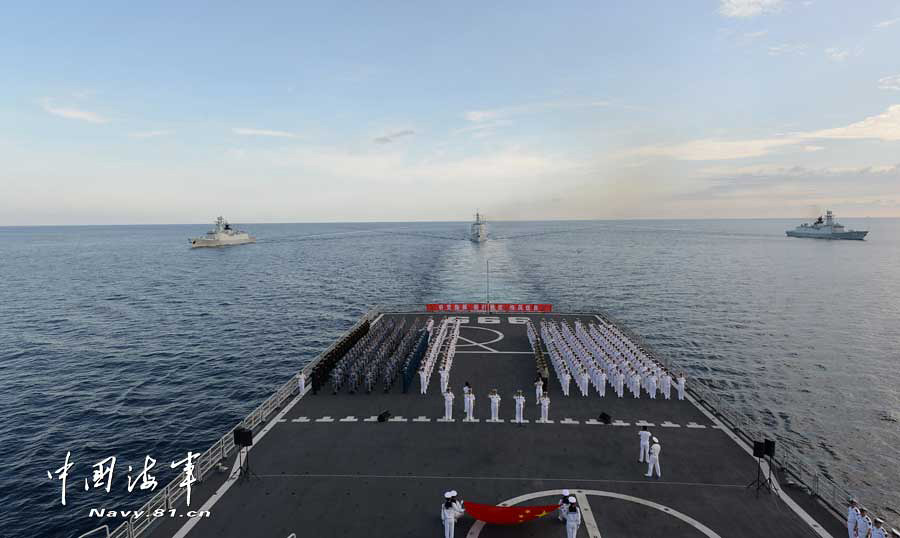
China's High-sea training taskforce holds oath-taking ceremony in Truong Sa Islands, Vietnam

Danny Russel told a Senate panel that he'll do everything in his power to "lower the temperature" in territorial disputes in the South and East China seas and push claimants including China toward diplomacy.

-->Barack Obama nominee Danny Russel cites North Korea, South China Sea

He also said it was "unacceptable" for China to demand only bilateral negotiations with the other claimants and voiced strong U.S. support for efforts by Southeast Asia to negotiate as a bloc and frame a "code of conduct" to manage the disputes - an issue to be taken up at regional security talks in Brunei later this month.

Russel is currently White House senior director for Asian affairs. He is nominee to become assistant secretary for East Asian and Pacific affairs, replacing Kurt Campbell, who resigned in February to enter business.

Russel is a 28-year career diplomat, less ebullient than Campbell, with long experience in Japan and Korea. His association with Asia began in his 20s when he spent three years studying martial arts in Japan.

He has played a central role in the Obama administration's strategic "pivot" to Asia. That's seen the U.S. stake out a diplomatic position on maritime issues that has irked Beijing, with Washington saying it has a national interest in the peaceful resolution of disputes in the South China Sea.

Six governments have overlapping claims to tiny reefs and islands across those resource-rich waters, with China claiming it has sovereignty over virtually all of it. While the U.S. itself is not a claimant, it says it has a stake in the freedom of navigation in its busy sea lanes, which are crucial to world trade.

"I certainly will do everything in my power to try to lower the temperature, push claimants including China into a diplomatic track and continue to warn them that the region in which China will flourish is a region of law, a region of order and a region of respect for neighbors, not one in which there is space for coercion and bullying," Russel said.

He said that President Barack Obama and Secretary of State John Kerry have raised the issue of China's behavior on the seas with its leaders, and the Chinese "are in no doubt that America stands by our allies."

The most volatile maritime disputes involving China in the past couple of years have involved U.S. treaty allies, the Philippines and Japan - nations which Beijing has blamed for triggering tensions.

While acknowledging U.S.-China competition, Russel said the U.S. supports the rise of a China that is stable, prosperous and abides by international rules and norms. He said the U.S. seeks "practical cooperation" that benefits both countries and the region.

He said positive cooperation with China would be "essential" in getting North Korea to abandon its nuclear weapons.

Russel confirmed that he has visited Pyongyang during his time at the White House. He said helping to achieve a halt or rollback in the North's atomic program would be a top priority if he becomes assistant secretary of state.

The full Senate must confirm his appointment.

Stripes

Thứ Năm, 20 tháng 6, 2013

The Plan To Stop China


Filipino defense officials are meeting with their Japanese and American counterparts to plan coordinated action against growing Chinese aggression in the South China Sea and adjacent waters. The Chinese claim just about every uninhabited islet and reef in the region, despite older and more substantial claims by nations that are closer to the disputed areas. Chinese pressure comes mainly in the form of intimidation by their growing fleet of warships and patrol boats. Actual force (usually bumping into “trespassing” fishing boats or other commercial ships) is usually done by Chinese non-military ships, under orders from nearby Chinese warships or warplanes. New tactics and procedures have to be worked out to counter these Chinese methods.

Peace negotiations with MILF grind on. The delays are largely the result of MILF demanding territory and power (especially over non-Christians) that the majority of Filipinos (only eight percent are Moslem) will not go along with. The MILF knows this but expectations are high in the south and MILF wants to get credit for at least trying hard to get what the majority of Filipinos will never give up.

June 17, 2013: In the south (Davao del Norte province) five unarmed soldiers were kidnapped by NPA rebels. The soldiers were on their way to a local market to buy food when they encountered a phony checkpoint manned by NPA gunmen wearing army uniforms.

June 14, 2013: A general, who had retired in 1994, was ordered to pay $300,000 in restitution to the government, after being convicted of corruption while he was in service. The general had refused to pay so a judge ordered properties seized and sold until the full amount was paid. This general has been investigated and prosecuted for over a decade. Corrupt officers are often able to litigate their way out of trouble, but that is becoming more difficult because the anti-corruption prosecutors and courts are more determined and less corrupt these days.

June 8, 2013: MILF is protesting the arrest of four of its members in the south (provinces of Sultan Kudarat, South Cotabato, and Lanao del Norte). This is part of the preliminary peace deals already signed, which prohibits arrests unless there is good cause. The four were picked up on warrants for past crimes and MILF is seeking to increase its popularity by using the deals signed so far act as a “get out jail” card for MILF members. The government is fighting this, even though people in the south are growing impatient about how long the peace negotiations are taking.

June 6, 2013: A former police colonel was sentenced (after a trial lasting a year) to 15-20 years in prison for providing years of protection for a methamphetamine lab.

In picture: BRP Ramon Alcaraz Could Gain An Anti-submarine & Surface-to-surface Missiles Warfare Capability

Strategy Page

Thứ Ba, 18 tháng 6, 2013

Time for a "South China Sea Council"

On the face of it, there seems to be little similarly between the Arctic and the South China Sea. The Arctic, after all, is ice-covered, limiting navigation at least for now, and the Arctic Circle is home to only some 4 million people, whereas the South China Sea is the second most used sea-lane in the world and is bordered by 10 nations with a combined population of approximately 1.9 billion. But dig deeper and similarities multiply. Both areas, for example, contain significant resources, and as a result are confronting territorial disputes. Yet while the Arctic States have been able to keep the peace and move toward sustainably developing an area that could be home to 25 percent of the world's undiscovered oil reserves through the regional Arctic Council, the South China Sea has been described as a "powder keg." The time has come to apply the lessons of the Arctic and form a South China Sea Council (SCSC).

The Arctic Council was established in 1996 as a forum for promoting cooperation between the Arctic bordering states, which include Canada, Denmark, Finland, Iceland, Norway, Russia, Sweden, and the United States. The original aims were modest, including conducting joint scientific studies on climate change, petroleum drilling, and Arctic shipping. It was not until 2011 that the first binding treaty came into effect involving search and rescue. Now, though, the importance of the Arctic Council has reached a tipping point. Last month, the Council met and admitted five Asian states as observers, including Japan, India, China, South Korea, and Singapore, with the EU's application pending, at an event attended by U.S. Secretary of State John Kerry.

Starting small and building on common ground, such as sustainable development and search and rescue, has proved to be an effective catalyst enabling the mission creep now evident in the Council. At the last meeting, a new agreement was signed on oil pollution and emergency preparedness. In short, as was reported by Heather Exner-Pirot in the Arctic Dispatch, "[t]he Arctic Council has come of age. It is productive and collegial. It focuses appropriately on common environmental security challenges, and it is making good progress on addressing these." Can the same be accomplished in the South China Sea?

The story of the Arctic Council should inform efforts to improve regional cooperation in the South China Sea. China, Taiwan, Vietnam, Malaysia, Brunei, and the Philippines, for example, could begin by working on common environmental concerns such as marine pollution in the same way that the Arctic countries signed the Arctic Environmental Protection Strategy in 1991, which became a stepping-stone to the formation of the Council. The South China Sea nations could then establish a Council with a limited mandate, such as the sustainable development of the area, and work toward agreements on scientific collaboration and issues such as search and rescue before moving on to more difficult territorial and security concerns.

Even though the Arctic Council enjoys a limited mandate from its member states, it has been successful at environmental governance and diffusing tensions in a potentially volatile region. The Council has already achieved considerable success in generating knowledge about the Arctic and bringing added attention to the region in global forums. Although the analogy is certainly not perfect, the United States and other Arctic nations should encourage the South China Sea nations establish a SCSC without delay. With some luck, a pole of peace could be replicated to cool tensions in a regional hotspot. And you never know, before long the Arctic nations could be applying to the SCSC for observer status.

Huffington Post

Thứ Bảy, 15 tháng 6, 2013

China and the Falklands Analogy: Preparing for the Wrong War?

If the Pentagon’s reading of China’s interest in “Falklands-style” campaigns of long-range power projection is accurate, the task of maintaining a U.S.-centric security order in East Asia may turn out to be more manageable than expected. But the PLA Navy cannot be counted on to dilute its efforts to the extent DoD now thinks plausible.

To this day, Britain’s 1982 campaign to recapture the Falkland Islands remains among the most relevant examples both of long-range maritime power projection with limited means, and of a weaker power using niche capabilities to complicate operational access and inflict significant damage on the opponent’s projection forces.

As a valued colleague of mine has noted in a recent post here at the NextWar Blog, DoD’s latest Annual Report on Military and Security Developments Involving the People’s Republic of China explicitly picks up on the Falklands analogy in its discussion of China’s future expeditionary capabilities:

“The PLA Navy’s goal over the coming decades is to become a stronger regional force that is able to project power across the globe for high-intensity operations over a period of several months, similar to the United Kingdom’s deployment to the South Atlantic to retake the Falkland Islands in the early 1980s.”

The analogy as such is hardly new, of course, and has already spawned a small literature of its own, including Lyle Goldstein’s insightful piece in Survival and a thorough analysis by Christopher Yung. A more recent contribution by CDR Jim Griffin, USN in Proceedings makes many of the same arguments in a more implicit fashion. All three treatments suggest that the Falklands experience has considerable relevance for the PLAN in both strategic and war-fighting terms. What is new in the Pentagon report, however, is the rather one-dimensional spin it imparts to the PLAN’s adoption of the Falklands campaign as a potential paradigm for future operations.

If we accept DoD’s take on the analogy, we would expect that China will cast itself unambiguously in the role of the expeditionary power (i.e., Great Britain) and, over the next several decades, spare no efforts to attain at least a limited capability for sustained power projection over transoceanic distances. It is certainly true that this would serve the desire of many Chinese naval enthusiasts to climb the rungs of the global naval hierarchy, Felix Seidler’s discussion of which I find most useful. However, it is not yet clear that the Pentagon’s interpretation accurately reflects what Chinese strategists have in mind when they plan for “Falklands-style” campaigns.

As Robert Ross argues in his 2009 piece on “China’s Naval Nationalism,” a blue-water orientation is not a natural strategic choice for a continental power that faces multiple potential threat axes on land as well as from the sea. For such actors, access-denial strategies, broadly conceived, tend to provide a much better return on investment. Thus, to the extent that the operational requirements for access-denial and long-range power projection differ, the strong Mahanian tendency that is evident in the Chinese discourse about maritime strategy would seem to give rise to an additional diffusion of effort (brown/green-water and blue-water) within the more fundamental diffusion of effort between land and sea. (It should be noted here that, for all his insistence of control over maritime communications, such a course would have been utterly foreign to Mahan.)

In other words, given China’s current position and the many uncertainties it continues to face, any attempt at replicating the capability profile of a “Rank 3″navy [“conducting one major ‘out of area operation and (…) engaging in high-level naval operations in closer ocean areas” (Grove 1990: 238)] would amount to a distraction from its key strategic dilemmas. A transoceanic expeditionary capability, in particular, would almost certainly constitute a misinvestment of limited resources. In a very real sense, every yuan invested in dedicated long-range projection forces is a yuan not invested in the control over China’s immediate regional environment. And every Type 052D sailing the Mediterranean on anything other than a one-off port visit will mean several destroyers not sailing the West Pacific.

Of course, this is not to say that China won’t do its potential opponents the favor of going down this risky path. Speaking in broad historical terms, rising continental powers do it all the time – and suffer the consequences. But Goldstein’s and Yung’s works on the PLA’s engagement with the Falklands experience suggest that PLA planners have so far emphasized an “Argentina Plus” approach that combines the far more compatible paradigms of robust access-denial and regional power-projection, and may continue to do so for the foreseeable future.

If such is the case, there will still be more than enough to write about in the Pentagon’s next Annual Report to Congress. As far as analogies go, a much more formidable Argentina that chooses to threaten U.S. interests where it is strong seems to me a far more worrying prospect than a cut-rate Great Britain that is all over the map.

Michael Haas is a Graduate Research Assistant at the Peace Research Institute Frankfurt (PRIF), Germany. The views presented here are his alone and do not reflect an institutional perspective.

CIMSEC

Is War Looming Between China And Japan?

Is war looming as Japan strengthens its military power and tensions escalate over disputed East China Sea islands?


In the waters of the East China Sea, a daily show of aggression is displayed around the uninhibited Senakaku/Diaoyutai Islands. Coast guards from China and Japan play a dangerous game of cat and mouse as both sides try to lay claim to the disputed resource-rich territory. The concern is - that the two powers are riding towards war.


101 East presenter Steve Chao takes a trip to the disputed Senkaku/Diaoyutai Islands, 200km from Taiwan and 2,000km from Tokyo. This region is home to rich fishing grounds and potential gas deposits.

With China’s growing hostility and nuclear missile threats from North Korea, Japan’s newly-elected Prime Minister Shinzo Abe vows to strengthen the country’s military power to defend the islands at all cost. And that task falls on Japan’s Self-Defense Force (SDF), made up of ground, maritime and air units.

During this time of heightened tensions, Japan’s Self-Defense Force granted 101 East rare and exclusive access into its operations to showcase the depth of its military prowess. No other media outlets have had this level of openness. We are allowed deep into the inner workings of the force and speak to commanders and soldiers who – for the first time in generations – are preparing to put their lives on the line to protect the country.

Japan’s Self-Defense Force was formed in 1954. It is Japan’s first defense unit since the country was forced to end its aggressions after World War II. Under government guidelines, the force is meant to be defensive, not offensive, and leaders have so-far prevented labeling it, as a military – although it is increasingly seen as such internationally.

101 East speaks with General Shigeru Iwasaki, chief of defence staff, who says the current threats around Japan justifies the SDF.

In order to understand the strength of the force, we went onboard the Hyuga-class carrier. It is a 13,500 tonne contradiction – the constitution forbids the building of an aircraft carrier. Instead it is reclassified as a destroyer class vessel.

We also visited the F15 Squadron at the Naha airbase in Okinawa. It is the closest airbase to the Senkaku/Diaoyutai Islands. In the past year, they scrambled 306 times against foreign incursions.

In January this year, an F15 incepted a Chinese aircraft headed for the islands. Japan’s ally, the US have since sounded warnings to China about the intrusions.

On the ground, Japan’s elite force, the 1st Airborne Brigade holds wargames and military exercises as a very public demonstration to China. The mission – be prepared to retake the islands if necessary. In a potential armed conflict, the unit is expected to be the first deployed as a rapid reaction force. We speak to the commander and elite paratroopers of the 1st Airborne Brigade and they have very bold answers on how the SDF should be changed, and China’s perceived threats.

As Japan begins to reshape, rename and transform what many consider its “military power”, constitutional advisors, like Setsu Kobayashi worry that a change in the hands of its current leaders will restore militarism, going against longheld and cherished ideals of pacifism for which Japan stands for.

Katsumoto Saotome, the director of the Tokyo Air Raid Museum, is also hesitant of Japan changing its constitution to allow for a full military. The museum, he says, is a reminder of love and peace for the next generation, a place where the Japanese can learn from their past mistakes. The photographs displayed there paint a picture of devastated Tokyo after the US bombing raids in the late 1940s.

Considering its past aggression in World War II, is Japan ready to revive its military might?


Aljazeera

Thứ Sáu, 14 tháng 6, 2013

China's 'behavior' needs even larger PHL defense spending - NSC

A ranking official of the National Security Council on Thursday detailed China's “aggressive behavior” in the West Philippine Sea, as he called for additional defense spending to uphold the Philippines' interests in the region.


Retired Navy Rear Admiral Vicente Agdamag, now Deputy Director General of the NSC Secretariat, said China’s actions confirmed its “clear intention to consolidate its control” over the disputed areas in line with the Chinese government’s nine-dash line claim.

“It started, actually, in March 2011 when a Chinese patrol ship challenged MV Veritas Voyager conducting a survey for Forum Energy, 85 nautical miles off Palawan,” he said, referring to an incident at the Reed Bank in the Spratly Islands.

Defense and military officials said two Chinese ships harassed the Department of Energy-commissioned survey ship. The Chinese ships told the crew of the Filipino ship to cease their activities because that was part of Chinese territory.

The Chinese vessels left when the AFP Western Command, based in Puerto Princesa City, promptly dispatched a Navy BN-2 Islander maritime patrol aircraft and an Air Force OV-10 light attack/reconnaissance aircraft. No armed confrontation was reported.

Agdamag also cited how Chinese ships prevented a Philippine Navy vessel, the BRP Gregorio del Pilar, from arresting Chinese fishermen caught illegally fishing at the Scarborough Shoal, locally known as the Bajo de Masiloc, in April last year.

The incident triggered a standoff between the China and Philippines, though China now is in virtual control of the shoal. The Philippine government withdrew its two ships from the shoal due to inclement weather, leaving China in complete control of the area, which is about 124 nautical miles from Zambales.

“Lately, we received reports that [Chinese] surveillance ships are imposing a 24 kilometer wide ban on fishing in the area. They are imposing an exclusion zone already in Bajo de Masinloc,” said Agdamag.

As of April this year, he said there were nine Chinese vessels at the shoal – five Fisheries Law Enforcement Command (FLEC) vessels and four Chinese Maritime Surveillance ships.

He also cited China’s establishment of Sansha City in Woody Island near China and Vietnam “to oversee and exercise the administrative control” over its claimed islands in the West Philippine Sea.

Agdamag also noted China’s issuance of passports showing a nine-dash line map and threats to board foreign vessels in the disputed areas.

He also said Pagasa town Mayor Eugenio Bitoonon was harassed twice by Chinese vessels – once in November last year and the latest just last May – at the disputed areas.

Last February, Agdamag said three Chinese Navy ships entered the West Philippine Sea to conduct patrol and training missions and anti-piracy drills. A month later, several Chinese “modern warships” were also dispatch to the Bashi channel, between Taiwan and the Philippines, for training missions.

Also last March, a Chinese destroyer, two frigates, an amphibious ship and helicopters and amphibious tanks conducted an eight-day military drill in the Spratly Islands. The Spratlys is being claim in part or in whole by the Philippines, China, Taiwan, Malaysia, Brunei and Vietnam.

“Right now, there are 18 maritime surveillance ships operating in our area,“ the official also said. He did not say if there were FLECs or Chinese military ships still within Philippine territory.

Further increase in defense expenditures

Agdamag said the issue is being addressed by political, diplomatic, and legal actions taken against China.

He said the military is establishing a “minimum deterrent capability,” alluding to the military’s modernization program. President Aquino recently signed the modernization law allocating P75 billion for the implementation of the military modernization program until the end of his term in 2016.

Nevertheless, the official said his office is recommending a further increase in defense expenditures. “We are recommending that we commit an increase in our investment for defense, from .5 to 1 percent of the GDP (Gross National Product),” he said.

Agdamag explained that their proposed increase is on top of the budget of the defense and military establishment which is equivalent to 1.1 percent of the national budget.

“We are recommending an additional of .5 to 1 percent (of GDP), not only to be at par with our neighbors, [but] more importantly to develop a modicum of a credible defense capability to protect our maritime and strategic interest,” he said.

Agdamag added that the country also needed to enhance its security relations with other countries, specially with the US, “when it is still able to deter China”, to buy time for the Philippines to develop its military capability.

“We need to pursue a healthy and friendly relationship with China and work with her for regional peace and prosperity.... to buy us time to grow our economy and expand our military capabilities,” he explained further.

“So right now, we are buying time, we need at least 10 years with sustained economic growth of 7 to eight percent in order to grow our capability upgrade program.”

Also, Agdamag disclosed an ongoing review of the “contingency plans” of the AFP’s Northern Luzon Command and Western Command, as per Executive Order 82 issued by President Aquino last year.

NOLCOM has responsibility over the Scarborough Shoal, while WESCOM has the West Philippine Sea as its area of concern. — DVM, GMA News