Hiển thị các bài đăng có nhãn Philippines. Hiển thị tất cả bài đăng

Thứ Năm, 30 tháng 5, 2013

Plucky or rash, the Philippines is right to challenge China

(By David Pilling) It is a shame others have not been bold enough to test their maritime claims

Nine dashes, five judges, two contestants. It sounds like a reality television show. In fact, it is the rather obscure – but very important – beginning of a process to delineate fiercely disputed Asian maritime borders according to the rule of law, rather than the law of the jungle.

The nine dashes belong to China. They mark what Beijing says is its historical claim to most of the South China Sea, a vast waterway that borders several other Asian countries. The five judges have been chosen to sit on a tribunal that will determine the validity of that claim under the UN Convention on the Law of the Sea.

The two contestants are the Philippines, which brought the case, and China, whose nine-dash line is being challenged. Strictly speaking, there is only one contestant, since Beijing, though a signatory of Unclos, has not deigned to recognise the process.

Asian countries, particularly the not inconsiderable number that have maritime disputes of their own with China, are watching the case with intense interest. Few, though, have dared say much in public for fear of offending Beijing. Whether you judge it plucky or rash, the Philippines has gone out on a limb.

Manila’s hope is to put its bilateral dispute with Beijing over the ownership of waters and islands close to the Philippine coast to international arbitration. There is an air of desperation about its gambit, which suggests it sees no possible progress through dialogue. Professor Jerome Cohen, an authority on Chinese and international law at New York University School of Law, says the Philippine “bombshell” has shocked Beijing with its audacity.

The case, launched in January, will take perhaps four years to chug through the Unclos system. It has potentially huge implications for a region riddled with explosive territorial disputes, including that between Japan and China over uninhabited islands in the East China Sea.

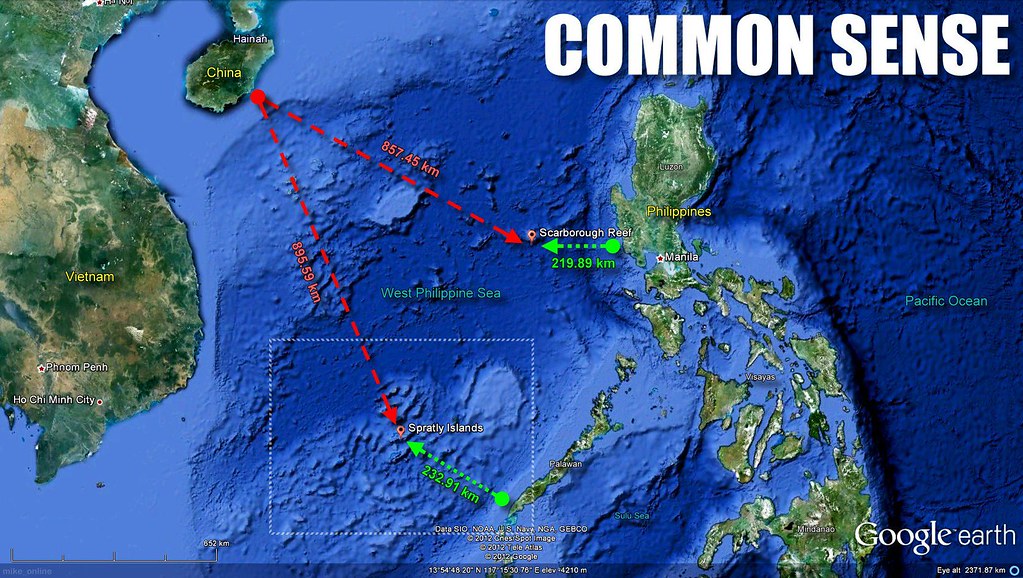
The Philippines has asked Unclos to adjudicate on the validity of the nine-dash line, produced by China in 1947 to illustrate what it said was its longstanding jurisdiction over almost all the South China Sea. That claim overlaps with the Philippines’ 200 mile economic exclusion zone extending from its coastline.

The case will proceed with or without China. Beijing waived its right to nominate arbitrators, but they have been nominated anyway. The first thing they will have to establish is whether Unclos has jurisdiction in the case. It may not.

Concluded in 1982, the convention is actually quite narrow in scope. Mostly, it confines its activities to matters such as whether a rock counts as an island – and thus whether it generates a 12-mile territorial sea and a 200-mile EEZ. The question of whether the island belongs to country Y or country X does not fall under its remit.

Even if Unclos declares itself competent to judge the case, there are at least three things to bear in mind before we become too excited. First, contrary to what is often assumed, international law is not some Newtonian absolute. Rather, it is a set of common rules agreed by nations that emerged from a post-second world war order, and whose realities it reflects. International law is not the word of God.

Second, there is very little “morality” when it comes to territorial disputes, no matter how loud countries shout about their inalienable rights. In most cases, it is the job of international law to decide who grabbed which territory first. Nation states with their fixed borders are a relatively new phenomenon. Today’s boundaries have more to do with armies and warships than righteousness.

Third, the case for international law is undermined by the fact that the US, in whose image the postwar order has been created, often stands on the sidelines. Washington, for example, has never ratified Unclos. That makes it hard to insist that Beijing should abide by its decisions.

To cite just one example of how Washington has thumbed its nose at international law when it is inconvenient: in 1986 the International Court of Justice ruled that the US had violated Nicaragua’s rights by mining its ports and funding the Contra rebels. Ronald Reagan, then American president, simply ignored the decision. Might is generally right. Yukichi Fukuzawa, the great 19th-century Japanese student of western thinking, learnt the lesson well. “One hundred volumes of international law are not the equal of a few cannons,” he concluded.

That does not mean the Philippines is wrong to bring the case. It has done the right thing. It is just a shame that other countries have not been plucky enough to test their claim through international arbitration. Step up, Vietnam, Japan and Indonesia.

One day, China may even participate in such a procedure itself. Prof Cohen tells the story of when, in 1972, he suggested to Zhou Enlai, China’s premier, that Beijing should name someone to sit on the International Court of Justice. The room fell silent before Zhou roared with laughter at the very idea of communist China joining “a racist, bourgeois institution that would never give [it] a fair shake”.

Yet, just over a decade later, China did exactly as Prof Cohen had suggested and nominated a candidate to the ICJ. If the Philippines waits long enough, it may yet get its day in court.

Copyright @ The Financial Times Limited 2013. You may share using our article tools.
Please don't cut articles from FT.com and redistribute by email or post to the web.

Thứ Bảy, 18 tháng 5, 2013

Chinese warship chases Philippine Kalayaan town boat carrying mayor-elect

MANILA, Philippines - A Chinese warship chased and tailed, in a provocative manner, the utility boat of Kalayaan island town with 147 civilian passengers, including the group of re-elected Mayor Eugenio Bito-onon, while sailing back to Palawan from Pag-Asa Island in the hotly-contested Spratly region.

Bito-onon said the Chinese warship coming from the east side area of Ayungin Reef, used its powerful floodlights while chasing and tailing M/T Queen Seagull early Thursday.

"The Chinese warship was only 50 meters away from our own boat," Bito-onon said, adding that the incident started when M/T Queen Seagull, that left Pag-Asa Island Wednesday morning, was passing by the Philippine-occupied Ayungin Reef at past midnight.

A grounded Philippine Navy (PN) transport ship, BRP Sierra Madre, is now being used as a Naval detachment by the Western Command (Wescom) to house Filipino troops on forward deployment in Ayungin.

Several Chinese warships and surveillance ships were monitored to have taken up position in the area for several days now as part of China’s aggressive move in laying its territorial claim to almost the entire South China Sea.

Bito-onon said the Chinese warship only stopped tailing them when their boat was already navigating around the Half Moon Shoal, an area where a Chinese gunboat ran aground last year.

“For almost an hour, the Chinese warship tailed our boat,” Bito-onon said in a phone interview shortly after the docking of M/T Seagull at Buliluyan Port in Palawan’s southern town of Bataraza.

Bito-onon is heading back to Puerto Princesa City after winning the three-cornered mayoralty contest in Kalayaan town in the Spratlys region during the conduct of the May 13 mid-term national and local elections.

Out of the total number of registered voters in the island town, Bito-onon got 108 votes, while his closest rival, businessman Noel Osorio got 69 and retired military man and former Kalayaan Vice Mayor Rosendo Mantes, got 46 votes.

The conduct election in Kalayaan has been considered as the fastest electoral process in the country’s history. Voting started in the island at about 7 a.m. and in a matter of six hours the electoral process was completed, with Bito-onon emerging as a runaway winner.

“Aside from the PCOS result, we also conducted a parallel manual count. The election in the island is the most peaceful,” Bito-onon said.

Philstar.com

Thứ Sáu, 17 tháng 5, 2013

Taipei sets PH against One-China diplomacy

Taipei is using the death of a Taiwanese fisherman off Batanes Island last week as a basis for making tough demands that will force the Philippines to violate its One-China policy, a former chairman of the congressional committee on foreign affairs said on Thursday.

“Taiwan saw an opportunity to push for recognition as a country instead of just an economic state. Taiwan is pushing us to violate the One-China policy,” former Negros Occidental representative Apolinario Lozada said.

But the House foreign affairs committee chairman said the government must review its One-China policy and convene the National Security Council to discuss security measures resulting from the shooting, which could develop into a diplomatic crisis.

Albay Rep. Al Francis Bichara said Malacañang appeared “clueless” on how to handle the incident, and the hands of the Department of Foreign Affairs are tied because of the One-China policy, which considers Taiwan as just an economic state.

“We have to look at the ramifications of that kind of a foreign policy. It is time to reassess the government’s foreign policy,” Bichara said.

The fisherman was killed last May 9 when his boat strayed into Philippine waters. Taiwan rejected an apology from President Aquino and snubbed the Filipino envoy he sent to Taipei.

Premiere Jiang Yi-huah announced sanctions against Manila, including removal of the Philippines from its visa-waiver program. More than 80,000 Filipinos work in Taiwan.

Bichara said the One-China policy had resulted in foreign policy blunders, and the first one was sending to China the Taiwanese nationals caught poaching in Philippine seas a few years ago, which angered both the Chinese and Taiwanese governments.

“How many more blunders do we need before we finally decide to reassess the One-China policy?” he said.

“In the meantime, what is the Palace doing? Why is the NSC not being reconvened? It is incumbent upon President Aquino to gather the NSC member for brainstorming,” he said.

The NSC is composed of the President, Vice President, executive secretary, and Cabinet members. Former presidents are also members.

“Our constituents are asking us. We cannot simply say it is all up to the President. We have to have some explanations that we can give to our people. What are our options? What are the possible scenarios? The people demand to know,” Bichara said.

He said the Palace must allow Congress to get involved and the people must be assured of their safety in case another country attacked the Philippines.

“The reason we need to reassess the foreign policy is to avoid military confrontations with our neighbors. Let’s face it. They are more equipped military-wise than us. Our fishermen, as well as theirs, don’t know where the border is onshore,” Bichara said.

He said Congress must be involved because there were other issues as well, such as the Spratly’s dispute with China, the Sabah claim with Malaysia, and now the One-China policy.

Lozada said Aquino should consider sending former President Fidel Ramos to Taiwan as his special envoy.

“It will be a win-win solution. The former president, because of his stature, cannot be rejected by Taiwan. And since he is already a private citizen, we will not be violating the One-China policy,” Lozada said.

http://manilastandardtoday.com/2013/05/17/taipei-sets-ph-against-one-china-diplomacy/

Thứ Sáu, 10 tháng 5, 2013

Philippine president warns China over sea disputes


Bloomberg, (U.S.) May 9th, reported Philippine President Benigno Aquino III said that China could hurt relations with trading partners if it does not respect the decision of the UN International Court of Arbitration sponsored in the event that Philippines sues China over its claim on disputed territory in the South China Sea (known as The West Philippine Sea in The Philippines).

In an interview with Bloomberg reporter on May 8th in the capital of Manila (Philippines), Mr. Benigno Aquino warned as above when he asked whether China's ability to comply with the judgment of the International Court of Arbitration or not.

He explained that if China wants to maintain growth, this country has access to foreign markets and resources. But when the partners fear of trade relations with China, the access will be difficult. He said there is no clear indication that there is a policy for economic blockade against China in the region except China expresses intention to use military force to resolve disputes in the South China Sea in the near future.

He said there is a bit difficult to understand the intentions of the Chinese people. President Benigno Aquino, a Chinese descent, had been to visit his ancestral hometown in Fujian Province in 2011.

Meanwhile, the television station TV5 (Philippines) quoted a senior military officer said on May 9th, about five to eight Chinese fishing boats entered Ayungin reefs. The source said the Chinese fishermen had built reasonable structural iron and rope on Ayungin reefs.

According to television station TV5, the previous day, Philippine fishing boats had to flee when two Chinese ships, including a battleship and a naval patrol ships appeared just 9-11 km from Ayungin reef.

Source: Phapluattp.vn

Fisherman’s shooting sparks South China Sea tensions

TAIPEI, Taiwan – The fatal shooting of a Taiwanese fisherman by the Philippine Coast Guard has become the latest incident to roil tensions over territorial disputes in and around the South China Sea, with Taipei on Friday calling for Manila to apologise for the shooting.

Taiwan said that the Philippine Coast Guard opened fire on Thursday on a 65-year-old fisherman in waters claimed by both governments. The Philippines acknowledged the Taiwanese claim, but said its personnel were acting in self-defence.

Meanwhile, China sought to make common cause with Taiwan against Manila, deploring the shooting in harsh rhetoric that threatened to spark another diplomatic tussle between Beijing and the Philippines, a key US ally in one of Asia’s most contentious areas.

Speaking to reporters in Taipei, foreign minister David Lin blamed the Philippine coast guard for opening fire on the fisherman’s boat, the Kuang Ta Hsing No. 28, on Thursday, from a vessel belonging to the fisheries department of the Philippines Department of Agriculture in the Bashi Strait, about midway between southern Taiwan and the northern Philippines.

“We strongly condemn the fatal shooting of a Taiwanese fisherman by the Philippine fishery department,” Lin said. “We urge the Philippine government to open a full investigation on this case and send their apology to Taiwan’s government.”

Even before Lin spoke, the Chinese foreign ministry in Beijing had condemned the incident, a clear attempt to side with Taiwan on a matter of nationalistic pride involving disputed maritime territory.
Spokeswoman Hua Chunying called it a “brutal act” and echoed Taiwan’s demand that Manila investigate.
“We are expressing our deep grief on the death of the Taiwan compatriot and condolences to the victim’s family,” Hua said.

Taiwan and China split amid civil war in 1949 and Beijing continues to claim the democratic island as part of its territory. In recent months it has made repeated attempts to bring Taiwan on to its side in its maritime disputes with Japan and other countries in the region. Taiwan has so far resisted, reflecting its own claims of national sovereignty.

Underscoring China’s interest in playing the incident up, government channel CCTV led its noontime news on Friday with an emotional report on the death of the Taiwanese fisherman, and the Communist Party-controlled Global Times newspaper called on the Chinese navy to increase its presence in the South China Sea, amid angry condemnations of the Philippines as a “savage” country.

Taiwan’s freewheeling media also gave prominent attention to the incident, with newspapers reporting it in banner headlines and cable television news stations giving it round-the-clock coverage.

In Manila, the Philippine coastguard acknowledged that its personnel had opened fire on the Taiwanese boat, but claimed they acted in self-defence.

“They were forced to fire the shots because the fishing vessel attempted to ram them,” said coastguard chief Rear Adm. Rodolfo Isorena.

Isorena said an investigation into the incident was being launched.

Relations between the Philippines and China, already hampered by simmering tensions over the Spratly Islands, deteriorated sharply last year when Chinese maritime vessels took control of a disputed shoal in the South China Sea.

The Philippines has turned to its American ally to beef up its dilapidated military assets and train its forces, and angered Beijing by seeking UN arbitration on South China Sea disputes.

Copyright The Financial Times Limited 2013. You may share using our article tools.
Please don't cut articles from FT.com and redistribute by email or post to the web.
Thứ Năm, 9 tháng 5, 2013

Philippine Navy opens fire at Taiwanese fishing boat, 1 dead

Taipei expressed its "grave concern" to Manila yesterday after a Taiwanese fisherman was killed by armed men aboard a Philippine vessel.

The incident in waters 164 nautical miles off the southernmost tip of Taiwan came as the Philippine navy intensified its patrols after Beijing reportedly sent one of its largest fishing fleets to the disputed Spratly Islands in the South China Sea.

Taiwan's foreign ministry said the death occurred in overlapping economic zones of both the island and the Philippines when an armed vessel, identified as a Philippine ship, suddenly shot at a Taiwan-registered fishing boat operating in the area.

"The shooting caused serious damage to the boat, which subsequently lost mobility, and killed fisherman Hung Shih-cheng, 65," the ministry said in a statement. It added that the Philippine vessel was unaccounted for after the incident.

The fishing boat was towed back to Taiwan by two other Taiwanese fishing vessels, under the escort of the coastguard.

Three other crew members, including the skipper, were safe, the statement said.

The ministry asked Taiwan's representative office in Manila to "express our grave concern to the Philippine government over the incident and demand an immediate investigation of the case", as well as to find and penalise those responsible.

Taiwanese President Ma Ying-jeou had instructed all relevant government agencies to remain on top of the development of the case.

Taiwanese media quoted one of the crew members as saying the armed men were aboard a Philippine naval vessel.

But the ministry identified it only as a grey vessel with a white hold, which local media said matched that of a naval vessel.

Yang Yi , spokesman for the Taiwan Affairs Office under the mainland State Council, yesterday condemned what he described as "a barbarian act".

Though the incident did not happen anywhere in the vicinity of the highly disputed Spratly Islands, the use of firearms and an alleged Philippine naval vessel further stoked tensions in the South China Sea.

A flotilla of fishing vessels in Danzhou , Hainan , reportedly set sail on Monday for the Spratly Islands, which are claimed by the mainland, Taiwan, the Philippines, Brunei, Malaysia and Vietnam.

Philippine navy spokesman Colonel Edgardo Arevalo was quoted on Wednesday as saying that the Philippine navy was closely monitoring the movements of the Chinese flotilla.

SCMP
------------


Philippine Coast Guard admits killing Taiwanese fisherman, claims self-defense

MANILA, Philippines -- The Philippine Coast Guard on Friday admitted responsibility for the death of a Taiwanese fisherman off the coast of Batanes the day before, but said its personnel acted in self-defense when the foreign fishing vessel attempted to ram one of its ships.

A radio report said PCG commandant Admiral Rodolfo Isorena has ordered a thorough investigation of the incident in which Taiwanese fisherman as Hung Shih-Cheng, 65, died.

The report said the Coast Guard ship BFAR MCS 3001 fired at the fishing vessel "Guang Ta Hsin 28" which had a crew of three Taiwanese and an Indonesian some 164 nautical miles off Balintang Channel.

The PCG ship was attempting to accost the Guang Ta Hsin 28 and two other Taiwanese vessels.

However, the Guang Ta Hsin 28 reportedly headed for the PCG vessel to ram it, prompting its crew to open fire.

Earlier, Chinese media reported the incident involved the Philippine Navy.

The Navy denied any involvement and said all vessels of Naval Forces Northern Luzon were in port at Subic or in Sual, Pangasinan.

"The Philippine Navy denies any involvement in, much as we were saddened by, the news about an incident where a Taiwanese fisherman was reportedly shot and the wound led to his death," Navy spokesman on the West Philippine Sea, Colonel Edgard Arevalo, said.

A report run by the Chinese news agency Xinhua, quoted Tsay Tzu-yaw, deputy head of Taiwan's fishery administration, as saying a Philippine military ship opened fire on the fishing boat some 180 nautical miles off Erluanbi, the southernmost tip of Taiwan.

The Xinhua report also said the Filipino ship continued to chase and fire at the fleeing Taiwanese vessel, which sustained heavy damage.

“We strongly protest and condemn that a Philippine government boat attacked our fishing boat and demand the Philippines formally apologize, apprehend the murderer and compensate,” a statement from Taiwan’s Ministry of Foreign Affairs said.

Asked about the report, Foreign Secretary Albert del Rosario said: "We cannot confirm it. We will check that."

The Philippine Navy on Friday denied reports in Chinese media that its personnel killed a Taiwanese fisherman Thursday morning.

The Philippines and Taiwan, along with Brunei, China and Malaysia, have conflicting claims to parts of the South China Sea.

China and Taiwan have been ruled separately since the end of a civil war in 1949, although Beijing claims the island. The Philippines has no diplomatic ties with Taiwan but maintains economic and cultural links. (with a report from Jaime Sinapit, InterAksyon.com and Agence France-Presse)

Interaksyon

Taiwanese Fisherman's body shot dead by Philippine Coast Guard arrives in Taiwan:

Thứ Bảy, 27 tháng 4, 2013

PH won’t give up claims to South China Sea territories

MANILA, Philippines—The Aquino administration turned the tables on Beijing on Saturday, accusing the Chinese government of occupying a piece of Philippine territory in the South China Sea.

A Palace spokesperson made it clear that Manila was not about to surrender areas in the South China Sea it claims to be part of the Philippines’ exclusive economic zone and refers to as the West Philippine Sea, a day after China claimed that the Philippines was trying to legalize its occupation of islands in the disputed area by going to the United Nations International Tribunal for the Law of the Sea or ITLOS.

“What’s our position when it comes to Bajo de Masinloc? That’s ours. And we will continue to exercise sovereignty over our territory,” said Palace spokeswoman Abigail Valte Valte in a radio interview.
Valte reminded China that the Aquino administration had already filed the case in the ITLOS, “and we are waiting for developments on that.”
When asked by phone if the Philippine government was still hoping that China would change its mind and accede to an arbitration process by a third party, Valte said, “It is the position of the Philippine government that taking the case before the arbitral tribunal is well within the framework we have chosen to adopt, which is a rules-based approach.”

Foreign Secretary Albert del Rosario, for his part, accused Beijing of occupying Bajo de Masinloc, one of the other names for the Scarbourough Shoal, an outcropping of rocks in a shallow section of the West Philippine Sea.

“The Chinese have tried to establish a de facto occupation of Bajo de Masinloc. When we last checked, I think they had two maritime surveillance vessels there, and then they had a fisheries law enforcement boat. So they have three vessels there,” he said in a briefing at the Palace Friday.

He said this prompted the government to avail itself of the option of seeking international arbitration under the United Nations Convention on the Law of the Sea (UNCLOS).

“That train has left the station, and we are trying to proceed with that. We believe that that will yield the results that we’re after in terms of providing a durable solution. Any solution that we would have come up with, short of a solution that is derived from the [UNCLOS], I think, at best, would be a transactional solution, and not a durable one,” said Del Rosario.
He said the UN arbitral tribunal might begin deliberations on the merits of the Philippine case by July, and that the deliberations would proceed even without the participation of China.

Del Rosario said the tribunal’s decision would be “final and unappealable.”

Del Rosario did not make it a secret that the government of President Aquino was counting on Vietnam and the rest of the Association of Southeast Asian Nations for support in the country’s decision to seek international arbitration.

“And we also are looking at the solidity and the very good working arrangements that we have in terms of our cooperation on maritime security. We are trying to see how that can be improved,” he said, referring to warming bilateral relations between the Philippines and Vietnam, which has its own territorial dispute with China over the Paracel islands in the South China Sea.

“We’re happy about our cooperation, as I said, on the South China Sea. We received the compliments of Vietnam… their agreement [with our decision] in terms of what we’re trying to do, the processes that we’ve adopted. And they’re fully on board in terms of cooperating with us. We agreed on how well we are doing in terms of other regional cooperation, and essentially that was it,” said Del Rosario.
During his two-day attendance at the 22nd Asean summit in Brunei early this week, President Aquino held bilateral talks with Vietnam Prime Minister Nguyen Tan Dung.

Both leaders were upbeat over “the progress of economic relations” between the two countries as they agreed to “further enhance” and strengthen relations, said the Palace.

Told that Filipino fishermen were now barred from entering Bajo de Masinloc by Chinese authorities, he said: “We have to take a position that we need to move in concert with what our legal advisers are able to provide us in terms of guidance. And right now, they believe that we should give priority to the arbitration case.”

Inquerer

Thứ Ba, 23 tháng 4, 2013

PH nears deal on purchase of Korean fighter jets

MANILA - The Department of National Defense (DND) is in the last stages of procuring 12 fighter jets from South Korea worth P18 billion.

Some of the hitches that authorities saw in the transaction can be ironed out by May.

DND spokesman Peter Paul Galvez said the terms of reference could be finished by next month. The terms of reference contains provisions on the delivery, technical specifications, payment scheme, among others.

“It’s in the final stages of crafting, in preparation for the procurement of the jets…After that (crafting of TOR), the contract follows, the negotiations for the contract (starts)," he said.

DND undersecretary for finance, munitions, installations and materiel Fernando Manalo said issues will need to be clarified before a contract is pursued.

"Within the month of May, the issues may be resolved…(We're hoping) that the issues will be settled within the month of May," said Manalo.

Asked when the contract will finally be signed, he said: "We are following a process.”

The purchase of the fighter jets is part of the military's modernization program.

It is also a signal that the country will finally have a "credible external defense."

The Air Force decommissioned its F-5s in 2005, leaving the country without a legitimate fighter aircraft to address external threats, such as in the West Philippine Sea.

ABS CBN News

Thứ Hai, 25 tháng 3, 2013

Manila’s South China Sea Gambit

Ever since the South China Sea disputes resurfaced a few years ago, country after country has insisted that the issue be managed, clarified and resolved in line with international law. From Jakarta to Tokyo, Washington to Brussels, Singapore to Seoul, Canberra to New Delhi, the refrain has been broadly familiar – the solution to security tensions near the world’s busiest sea-lanes needs to involve a rules-based order.

Yet for a full two months since one claimant country decided to put this idea into practice, the rule-of-law cheer squad has been strangely mute. On January 22 this year, Manila notified Beijing that it would be seeking international arbitration under the United Nations Convention on the Law of the Sea. The process is due to go ahead in ITLOS, an international tribunal under that convention, not in the International Court of Justice, because that would require the consent of both parties. China is most pointedly withholding its consent. It is refusing to acknowledge the proceedings.

Why the almost worldwide silence? One explanation is that not encouraging the Philippines will help perpetuate regional stability, however fragile that may be. The logic here is that a public round of praise for Manila’s decision to take legal action would further isolate China, adding to its perceptions of being encircled and therefore playing to the arguments of China’s hawks. But surely a chorus of moral support for the principle of international arbitration under a UN convention could also feed into the necessary debate in China about its self-inflicted failures in projecting a non-threatening image to the world.

Another argument is that this bid will damage further the prospects for the Association of Southeast Asian Nations (ASEAN) and China to negotiate a binding code of conduct to manage South China Sea disputes. If this really amounts to the Philippines letting down ASEAN, surely it can say it was let down by ASEAN first. After last year’s debacle, in which China successfully used Cambodia as its proxy to prevent ASEAN consensus in support of a binding code, what are the prospects for a serious agreement anyway?

In the South China Sea, as in the East China Sea, Chinese maritime agencies seem repeatedly to have used the risk of an incident at sea as a tool of policy, a tactic to draw attention to China’s claims – and there’s no evidence yet they are willing to give that instrument away.

Manila’s quest could take several years of legal proceedings, but it is not quixotic. The submission was carefully put. It is not asking for maritime boundaries to be delineated. Instead, it is asking for a ruling on the validity under UNCLOS of China’s expansive ‘Nine-Dashed Line,’ and on whether the land features in the South China Sea are rocks or submerged features rather than islands. Of course, this latter point would affect the limits of the territorial waters that China could claim. In addition, the Philippines has submitted that China is occupying rocks, not islands, on the contested Scarborough Reef, that China is building illegal structures on submerged features, and that Chinese harassment of Philippine nationals at sea is also illegal under UNCLOS.

Unless China or others somehow persuade it to withdraw its case, the Philippines presumably stands a chance of eventually obtaining a ruling that suits its interests on one or more of these points. Even if China refuses to recognize the outcome, this could still provide precedent and arguments for other countries to advance in other circumstances. Even that could prove to be in the wider interests of a rules-based maritime order for the Indo-Pacific commons. It would be curious to see which countries, silent now, might welcome such an outcome.

The Diplomat

Thứ Sáu, 22 tháng 3, 2013

PH sea patrols to check on China naval exercises

MANILA, Philippines—Philippine naval security forces are set to conduct “sovereignty patrols” in the West Philippines Sea ("South China Sea" called in China/ "East Vietnam Sea" called in Vietnam) to check on possible intrusions by Chinese vessels conducting naval exercises within the country’s maritime boundaries, the Department of Foreign Affairs (DFA) said Thursday.

DFA spokesman Assistant Secretary Raul Hernandez said Thursday the Philippine Navy and Philippine Coast Guard were sailing to waters in disputed areas within the Philippines’ exclusive economic zone and continental shelf to check on the presence of Chinese navy ships.

The Philippines and China are locked in a struggle over parts of the Spratlys group of islands and Panatag (Scarborough) Shoal, which are clearly within the Philippines’ EEZ.

A fleet of Chinese vessels has reportedly deployed for drills on “actual combat” scenarios in the West Philippine Sea, the waters of which are almost wholly being claimed by China and partially claimed by the Philippines, Malaysia, Vietnam, Brunei and Taiwan.

The Philippines has a pending case for arbitration against China in the United Nations arbitral tribunal to stop Chinese incursions into Philippine-claimed parts of the West Philippine Sea. The legal action also seeks to invalidate China’s nine-dash line claim, which encroaches on Philippine maritime borders.

China has rejected the arbitration plea but the Philippines is confident proceedings will continue even without the other party’s participation.

“Our Philippine Navy and Philippine Coast Guard [were] asked to verify [if there were] reported intrusions,” Hernandez said.

China’s state-run Xinhua news agency reported earlier this week that four Chinese warships—equipped with four helicopters and a hovercraft—deployed off southern China’s Hainan province for training exercises in the West Philippine Sea.

Xinhua said the warships would undertake training exercises that include “command post establishment, operational maneuvering from the sea and high sea convoy missions.”

Without directly commenting on the report, Hernandez said, “It is always important that other countries respect our maritime zones and territories because such exercises could not be undertaken without our permission if they are done [in areas that] encompass part of our national territory.”

The Chinese naval exercises are part of China’s People’s Liberation Army’s “regular arrangement” under its annual training program. Seven similar exercises were held last year, according to Xinhua.

Inquerer

Thứ Năm, 7 tháng 3, 2013

Philippines: TOR for F/A-50 'Golden Eagle' now being crafted

F/A-50
MANILA — The Philippines is now on track to operate again supersonic jet aircraft as the "term of reference" (TOR) for the F/A-50 "Golden Eagle" is now in the works.

"Procurement for the F/A-50 will be on a government-to-government basis," the Department of National Defense (DND) observer stressed.

He also said the go-ahead signal for the TOR only came last week.

The order came from the Government Procurement Policy Board (GPPB), an attached agency of the Department of Budget and Management.

The DND observer declined to comment on when the TOR will be completed but stressed that it will be done within the year.

But he expressed confidence that the Philippine Air Force (PAF) will be flying the F/A-50 within two years time.

The last supersonic planes operated by the country was the Northrop F-5 "Freedom Fighter" which was decommissioned due to lack of parts and air frame aging sometime in 2005.

The TOR describes the purpose and structure of a project, committee, meeting and negotiation.

It also defines the vision, objectives, scope and deliverables (i.e. what has to be achieved); stakeholders, roles and responsibilities (i.e. who will take part in it); resource, financial and quality plans (i.e. how it will be achieved); work breakdown structure and schedule (i.e. when it will be achieved) and includes success factors/risks and restraints.

The Philippines is in the market for 12 supersonic trainer aircraft which can double as interim fighter and attack planes for the PAF. It has allocated P18 billion for this program.

The GPPB earlier gave the DND the "green-light" to start pre-negotiations with the South Korean government for 12 F/A 50 aircraft last January.

The plane is manufactured by the Korea Aerospace Industries (KAI). The F/A-50 is also known as the TA-50.

The F/A-50 design is largely derived from the F-16 "Fighting Falcon", and they have many similarities: use of a single engine, speed, size, cost, and the range of weapons.

KAI's previous engineering experience in license-producing the KF-16 was a starting point for the development of the F/A-50.

The aircraft can carry two pilots in tandem seating. The high-mounted canopy developed by Hankuk Fiber is applied with stretched acrylic, providing the pilots with good visibility and has been tested to offer the canopy with ballistic protection against four-pound objects impacting at 400 knots.
The altitude limit is 14,600 meters (48,000 feet), and airframe is designed to last 8,000 hours of service.

There are seven internal fuel tanks with capacity of 2,655 liters (701 US gallons), five in the fuselage and two in the wings.

An additional 1,710 liters (452 US gallons) of fuel can be carried in the three external fuel tanks.
Trainer variants have a paint scheme of white and red, and aerobatic variants white, black, and yellow.
The F/A-50 "Golden Eagle" uses a single General Electric F404-102 turbofan engine license-produced by Samsung Techwin, upgraded with a full authority digital engine control system jointly developed by General Electric and KAI.

The engine consists of three-staged fans, seven axial stage arrangement, and an afterburner.
The aircraft has a maximum speed of Mach 1.4-1.5.

Its engine produces a maximum of 78.7 kN (17,700 lbf) of thrust with afterburner. (PNA)

FPV/PFN

Thứ Hai, 4 tháng 3, 2013

South Korea Offers Incheon-Class-Frigate to Philippines

South Korean defense manufacturer signifies interest to provide DND's frigate requirements

Incheon class frigate (photo : KDN)

MANILA (PNA) -- A South Korean defense manufacturer is now talking with the Department of National Defense (DND) regarding its requirements for two brandnew frigates.

A DND observer said that the company is offering the Philippines varieties of the "Incheon" class frigates.

"Some initial talks are now being held and hopefully, the company will get a chance to bid for our frigate requirements," he stressed.

He also pointed out that talks with the South Korean defense manufacturer came about when the DND decided to not go ahead with the planned purchase of the Italian "Maestrale" frigates due to questions of cost and hull aging.

The "Incheon" are coastal defense frigates of the Republic of Korea Navy with its lead ship launched on April 29, 2011.

The "Incheon" class frigates will replace the aging fleet of "Pohang" class corvettes and "Ulsan" class frigates, and take over multi-role operations such as coast patrol, anti-submarine warfare and transport support.

Later batches are planned to be specialized on anti-air and anti-submarine warfare.

"Incheon" class frigates are armed with the 127mm/L62 Mk. 45 Mod 4 naval gun.

Point-defense armaments include a single 20 mm Phalanx CIWS and a RIM-116 Rolling Airframe Missile Block 1 21-round launcher.

Anti-Submarine Warfare armaments consists of K745 LW Cheong Sahng-uh (Blue Shark) torpedoes.

Its anti-ship capability is provided by 16 SSM-700K Hae Sung (Sea Star) long-range anti-ship missile, each with performance similar to the US Harpoon while land-attack capability is provided by the recently-developed Hyunmoo IIIC (Guardian of the Northern Sky) cruise missile, which is similar to the US Tomahawk.

It has a length of 374 feet, speed of 30 knots, capable of carrying a naval helicopter and a complement of 140 officers and men.

"Incheon" frigates weigh around 3,000 tons and has cruising range of 5,000 miles.

Philippines News Agency

Thứ Sáu, 1 tháng 3, 2013

Philippines rejects Chinese sea patrol

The Philippine government expressed its objection to China’s plan to intensify patrols on the contested islands and waters in the West Philippine Sea (South China Sea).

Philippines rejects Chinese sea patrol

Raul Hernandez, spokesman of the department of foreign affairs, said that patrol activities in the disputed territories are “contrary to China’s obligation” under the international law, including the 1982 UN Convention on the Law of the Sea (Unclos).

“The Philippines strongly objects to the Chinese patrol of Philippine maritime domain in the West Philippine Sea,” Hernandez said.

He urged China to “act responsibly” and refrain from taking further actions that would escalate the political and diplomatic tension among claimant-countries.

Portions of the West Philippine Sea are being claimed by the Philippines, Vietnam, Malaysia and Brunei Darussalam.

China and Taiwan claim about 90% of the region based on their nine-dash line, which can be found in ancient Chinese maps. But although Beijing and Taipei have similar claims, China has been more aggressive in pressing its claim.

“We continue to call on China to act responsibly and refrain from taking further action that will heighten tensions in the region,” Hernandez said.

“The Philippines exercises sovereign rights over the waters and features in the EEZ (exclusive economic zone) and continental shelf in the West Philippine Sea,” he added.

The EEZ is a 200-nautical mile delineation provided by Unclos to allow countries to exclusively explore and exploit the resources of the area.

On Monday, a report from the Chinese government’s web portal said that “routine fishery administrative patrols” will be conducted “to better safeguard the legitimate interests of Chinese fishermen” in the West Philippine Sea.

Wu Zhuang, chief of the South China Sea fishery bureau under the ministry of agriculture, said that carrying out routine fishery patrols in the territorial waters surrounding the Spratly Islands will be the top priority in 2013.

The Philippines and China were signatories to the Unclos, which defined ownership of coastal waters, exclusive economic zones and continental shelves of each country. The Unclos had stated that the 200 nautical mile, exclusive economic zone, which is measured from the country’s coasts belonged to the Philippines and was therefore the only country which is allowed to explore or acquire maritime resources within the area.

Gulf-news.com

Thứ Bảy, 23 tháng 2, 2013

China’s rejection of int’l arbitration could weaken its case: analysts

China’s rejection of the Philippines’ attempt to seek international arbitration in their East Sea territorial dispute may discourage other claimants from taking similar steps, but it will also put the East Asian giant at a disadvantage in validating its expansive claims, analysts say.

A protester burns a Chinese flag

“If China refuses to comply with the findings of the Arbitral Tribunal, other states would still face the situation where China asserts sovereign jurisdiction over the South China Sea (East Sea),” said Carl Thayer, a Vietnam expert with the University of New South Wales in Australia.

“The various arbitration provisions of UNCLOS (UN Convention on the Law of the Sea) are concerned with adjudicating disputes over maritime jurisdiction, but not sovereignty. Vietnam cannot resort to UNCLOS to establish its claims to sovereignty over the Paracel Islands (Hoang Sa Archipelago), for example. That can only be decided between China and Vietnam bilaterally or by a mutually agreed third party,” he said.

On Tuesday (February 19), China's ambassador to Manila, Ma Keqing, returned Manila's formal notification of the move seeking arbitration to a Philippine Department of Foreign Affairs official, AP quoted Chinese Foreign Ministry spokesman Hong Lei as saying.

Hong said the proposal was historically and legally incorrect and contained unacceptable accusations against China, the newswire reported.

Last month, the Philippines had informed China that it plans to take their conflicting claims to an international tribunal. It expects the tribunal to declare illegal China's moves in the potentially resource-rich waters.

The Philippines' foreign affairs department said in a statement Tuesday that China's rejection will not interfere with the arbitration process that the Southeast Asian nation has started.

In an email to Vietweek on Wednesday, Julia Ritter, press officer of the International Tribunal for the Law of the Sea (ITLOS), said her agency had not received any submission from any concerned party regarding the dispute.

While the Philippines insists on going forward with the arbitration process, analysts said that if ITLOS opens a tribunal with China in absentia, a ruling favoring the petitioner can be expected.

Thayer said it is up to the chairman of ITLOS to nominate five persons to form the Arbitral Tribunal. These persons will be selected from a list of experts already nominated by member states that have ratified UNCLOS, he said.

“The Arbitral Tribunal will comprise five individuals. It must undertake two duties. First, it must decide whether the Philippines' Claim and Notification is an abuse of international law. Second, the tribunal must decide if it has jurisdiction in this case,” he told Vietweek.

“If China refuses to recognize a ruling by the Arbitral Tribunal recognizing the maritime zones promulgated by the Philippines (territorial sea, contiguous zone, Exclusive Economic Zone and continental shelf) and declaring the occupation of low-tide elevations illegal, it would undermine UNCLOS and the fabric of international law as a means to adjudicate disputes over maritime jurisdiction.

“The decision by the Arbitral Tribunal would have the effect of nullifying China’s nine-dash line claim to the South China Sea and claims to sovereignty over low tide elevations that China claims are islands and rocks under international law. China would no longer have a basis in international law to argue for ‘indisputable sovereignty.’ The claimant states could act to defend their sovereignty on the grounds that China's claim lacks any standing in international law. In other words, there is no longer a legal dispute," Thayer said.

Mark Valencia, a Hawaii-based expert on the East Sea dispute said if China refuses to accept or abide by ITLOS’s decision, the Philippines could use the refusal as strong propaganda for its own claims.

However, he also opined that in making this move, the Philippines would only be digging itself “into a deeper hole” instead of “coming to terms with the now dominant nation in Asia which is growing stronger day by day.”

Thanhnien News

Thứ Năm, 24 tháng 1, 2013

China Likely to Ignore Philippines' Challenge in South China Sea

Jan 23, 2013- Analysts say China will likely ignore the Philippines' decision to take a long-running territorial feud to an international tribunal, continuing its insistence on solving maritime disputes without third party involvement.

Philippine foreign secretary Albert del Rosario said Tuesday his government will take the issue to an arbitral tribunal under the U.N. Convention on the Law of the Sea (UNCLOS), which has been ratified by both countries.


Philippine Foreign Affairs Secretary Albert Del Rosario has asked an international tribunal to intervene in its long-standing South China Sea territorial dispute with China, January 22, 2013.

The Philippines wants the panel to reject China's claims to nearly the entire South China Sea. It is also challenging what it says is China's "illegal" activity around reefs and rocks it says are part of Manila's exclusive economic zone under the U.N. convention.

Most observers say China will almost certainly not agree to participate in the panel, in keeping with its long-standing policy of solving territorial disputes through direct negotiations.

Carl Thayer of Australia's University of New South Wales tells VOA the tribunal may be able to move forward without Chinese participation. He says the Philippines hopes a favorable decision would give it a moral victory.

"It's [a case] that not only has the legal side, but also has a strong moral suasion. If the tribunal ruled even partly in the Philippines' favor, it would deflate China's claims and give more legality and international cover to the Philippines."

But Thayer says the court's decision, though technically "binding," could easily be ignored by China, since there is no mechanism included to enforce any possible ruling.

Sam Bateman, a maritime security expert, acknowledges China's refusal to participate in the tribunal "probably won't be a great public relations success." But he tells VOA that may be exactly what the Philippines government is aiming for.

"I see it in many ways as a bold gesture by the Philippines, hoping that China will respond negatively," says Bateman, a senior fellow at the S. Rajaratnam School of International Studies in Singapore, who described the move as Manila's "attempt to take the high ground."

"If China were to choose to opt out [of the tribunal], of course this would lead to another round of perhaps international condemnation, you know another example of China's assertiveness and lack of preparedness to operate, and those sort of things."

But Bateman says all countries, including China, have the right under UNCLOS to opt out of arbitration that involves binding decisions on issues related to maritime boundaries and sovereignty disputes.

That appears to be the route chosen by Beijing. On Tuesday, the Chinese ambassador to the Philippines reasserted China's "indisputable sovereignty" over waters in the South China Sea, saying China supports a negotiated settlement "through peaceful means."

In any case, most analysts agree that the competing claims of China and the Philippines are unlikely to be resolved soon, and that the case will take three to four years to work through the international tribunal.

voanews