Thứ Hai, 26 tháng 11, 2018
China to build its third domestically made aircraft carrier
China kicked off construction of a third aircraft carrier, CNS reported on Nov. 25.
In a report on the WeChat network, Xinhua said that as the second and first Chinese-built aircraft carrier was experimenting on the sea, a "next-generation carrier" is under planning.
The article, published in honor of the sixth anniversary of the first Chinese aircrafts taking-off and landing on China's first carrier, the Liaoning CNS, did not specify the details of the "the next-generation carrier, is thought to be China's third, but this article is considered China's first public acknowledgment.
Chinese watchers and foreign observers have long claimed that China has begun construction of a third aircraft carrier at the Jiangnan Group's shipyard in Shanghai, China Shipbuilding Corp. They also predicted that the third would be bigger and stronger than Liaoning and the second was unnamed.
Shipbuilding Corp. of the state of China declined to comment on the issue.
Chinese Navy officials also did not respond to the press on November 26th.
(According to Ecns.cn, The Week)
Thứ Hai, 10 tháng 6, 2013
America’s China policy is broken
WASHINGTON (MarketWatch) — Americans owe a hearty “thank you” to the China-United States Exchange Foundation. In advance of Friday’s U.S.-China summit, the Hong Kong-based nonprofit has demonstrated vividly that the case for the longstanding American economic strategy toward China, faithfully pursued by President Barack Obama, has become as broken as politics in Washington.
Not that this is the Foundation’s intended message. Quite the contrary. Its new study “US-China Economic Relations in the Next Ten Years” insists that bilateral economic relations since the Nixon Administration’s opening have benefited both countries so spectacularly that they should now seek even deeper economic ties, preferably by signing a new free trade agreement.
In fact, the biggest danger identified in the report stems from current, but overwhelmingly avoidable, tensions over trade and investment, which the report says could destroy decades of win-win progress and further weaken a fragile world economy.
To highlight the supposed stakes, the “Next Ten Years” effort has marshaled support from many of U.S.-China economic relations’ biggest guns, including Nobel Prize-winning economist Michael Spence, former chief White House economic advisor Michael Boskin, former Cabinet secretaries and senior officials Carlos Gutierrez and John Podesta, corporate titans Bill Gates, Hank Greenberg and Andrew Liveris, and even the living embodiment of post-Cold War U.S.-China rapprochement, Henry Kissinger.
Matching this lineup, title for title, are comparable heavyweights from China’s power structure. Leading scholars from both sides of the Pacific helped with research and analysis.
Missing the facts
If appeals to authority alone could win policy battles, “The Next Ten Years” would unquestionably achieve its authors’ and funders’ aims, quiet dissident voices, and guide America’s economic approach to the PRC for decades. Read more: China’s pain is America’s gain.
Fortunately for both countries and the world economy their decisions will make or break, American politics at least still attaches some importance to substance. As a barely disguised brief for policies that have enriched outsourcing-happy multinational companies and their financiers — but weakened America’s economy and destabilized global finance — “The Next Ten Years’” cavalier regurgitation of discredited myths, cynical policy fakery, and thinly disguised moral equivalence won’t convert anyone not already in the choir. But its glaring flaws are the same that have driven Washington’s China policies far off-course for so many years.
Like many leading U.S. policymakers, the study can’t even get some of the most basic facts about U.S.-China economic relations straight.
For example, although China’s industrial and technological progress is noted, the authors repeatedly insist that America’s huge margin of superiority can long keep fueling robust and mutually beneficial trade expansion — as Americans exchange their super-advanced goods and services for China’s cheap consumer products.
Completely missed is the skyrocketing share of bilateral trade that’s head to head, as China’s exports to the U.S. have leaped up the technology and value chains.
In fact, in 2000, when China’s landmark entry into the World Trade Organization was approved, high-value manufacturers represented 35% of China’s exports to the U.S. Last year, they represented almost 59%. In addition, in 2000, products made in China (often in factories owned or affiliated by U.S. multinationals) held less than 1% of the entire U.S. market for a wide-ranging group of more than 100 advanced manufacturing sectors. The latest (2011) data show that this figure has more than quintupled.
“The Next Ten Years” also keeps claiming that Americans will gain from China’s steady transition from an export-driven economy to one whose growth is fueled by domestic demand. No doubt Chinese household consumption has risen strongly in absolute terms. But the latest figures show that despite major government programs to juice personal spending, its share of the economy remained unchanged from 2011 to 2012, and has actually dropped from around 50% in 2000 to just under 36% last year.
And though fixed investment seems to have replaced overseas sales as China’s growth driver during this period, the export share’s shrinkage seems largely cyclical — stemming from the financial crisis and weak ensuing global growth — and obscured by investment data’s failure to distinguish properly export-oriented and domestic-focused capital spending.
Changes in attitude
The study’s interpretation of key bilateral economic developments is no better — contending that the overall expansion of bilateral trade has significantly boosted overall economic growth in both countries.
But this neglects a crucial lesson of the credit-fueled near-global crash just five years ago and still-limping recovery: not all growth is created equal. The wildly lopsided nature of U.S.-China trade, shaped by predatory Chinese practices that deprived Americans of valuable earnings opportunities, contributed to a dangerous U.S. bubble during the 2000s, not to healthy output. In one chapter, Chinese financier John Zhao even recklessly lauds Beijing’s massive purchases of U.S. government debt as contributing to national prosperity and global financial stability, whereas it has actually been instrumental in addicting Americans to debt-fueled growth.
The policy recommendations in “The Next Ten Years” focus just as single-mindedly on preserving the status quo and just as conveniently ignore its failures and perils. These proposals expose the report’s biggest and most glaring weaknesses. Even the thorniest bilateral disputes, like those over cyberhacking or intellectual property theft (currency manipulation, revealingly, never makes the agenda), are belittled as the diplomatic equivalent of newlywed spats. Their allegedly typical origins: alarmist or simply impatient American politicians misguidedly but worrisomely rail against cumbersome, culturally antiquated Chinese governing structures, and against the PRC’s economic under-development itself.
The study’s standard prescription? “Urgent” negotiations with artificial deadlines. Undoubtedly, time-buying exercises, empty promises, and do-nothing agreements can keep the China cash and influence-peddling machines run by many of the sponsors’ companies humming awhile longer — as they have for the last two decades. But the very scale of “The Next Ten Years” suggests that their political allies are growing restless, as a wide range of Chinese provocation grows ever more serious, and as entirely legitimate concerns simply become too pressing to define out of existence — like those arising from the growing presence of China’s kleptocratic business system in the American economy, or the proliferation of Chinese manufacturers in U.S. defense supply chains.
In time, popular pressures for real responses from Washington could become harder to resist. And the critical mass of U.S. leaders seems increasingly aware that the longer Washington dithers, the less capable America can be in dealing with this often-unfriendly rival from a position of strength. Just as important, voters and officials who keep hearing about deep-seated political and cultural obstacles delaying even minimal Chinese accommodation logically could ask whether cooperative relations are in fact hopeless and U.S. strategy needs major rethinking.
The sponsors of “The Next Ten Years” will no doubt continue controlling America’s China policy for now, given the megabucks they shower on Washington. But as this dressed-up propaganda tract makes all too clear, there’s nothing else behind their success.
Alan Tonelson is a fellow at the U.S. Business and Industry Council, which represents nearly 2,000 small and medium-sized manufacturers. Follow him on Twitter (@AlanTonelson) and Facebook (Tonelsonontheeconomy), and AmericanEconomicAlert.org .
U.S. military parts imported from China
(CBS News) WASHINGTON The cybersecurity issues aren't the only U.S. concern has about China. The Pentagon is growing increasingly worried about relying on military components made in China.
The hellfire missile -- launched from helicopters, jets and predator drones -- has been a critical weapon in the war on terror. But the propellant that fires the missile must be imported from China.
It's not the only area where the Pentagon military depends on imports. The glass in U.S.-made night vision goggles requires a soft white-colored metal called lanthanum, 90 percent of which comes from China.
"We need to onshore our critical defense supply chains," said retired Army Gen. John Adams. He is the author of a new report, which lists 14 categories where the military relies on imported minerals or technologies. Some of those supplies, Adams said, could be stopped during a conflict.
"We need to make sure that our most advanced and our most critical weapons systems don't depend upon our strategic competitor to supply those components to us," he said.
A Pentagon spokesman tells CBS News by email that the military has a process "to determine where U.S.-sourced components are necessary for security reasons. But where they are not, the U.S. taxpayer expects...cost-effective procurement, including sourcing from foreign companies..."
But the Pentagon has grown concerned over Chinese imports. During a diplomatic clash between China and Japan over a disputed island chain, China stopped exports of rare minerals that Japan needed for manufacturing.
"We've already seen glimmers of where a country like China decides to use the supply chain and its economic muscle for diplomatic and geopolitical purposes," said CBS News national security analyst Juan Zarate.
Pentagon officials say they have already addressed two of the areas identified in the report. Officials have ordered the Pentagon to purchase more domestically-produced minerals for use in night vision goggles, and they have invested in a new domestic supplier to make propellant for the hellfire missile.
CBS News
Thứ Bảy, 8 tháng 6, 2013
The Chinese Plan To Encircle And Contain America
Rising Red tide: China encircles U.S. by sailing warships in American waters, arming neighbors
China has been quietly taking steps to encircle the United States by arming western hemisphere states, seeking closer military, economic, and diplomatic ties to U.S. neighbors, and sailing warships into U.S. maritime zones.
The strategy is a Chinese version of what Beijing has charged is a U.S. strategy designed to encircle and “contain” China. It is also directed at countering the Obama administration’s new strategy called the pivot to Asia. The pivot calls for closer economic, diplomatic, and military ties to Asian states that are increasingly concerned about Chinese encroachment throughout that region.
“The Chinese are deftly parrying our ‘Pivot to the Pacific’ with their own elegant countermoves,” said John Tkacik, a former State Department Asia hand.
Chinese President Xi Jinping is expected to question President Barack Obama about the U.S. pivot during the summit meeting set to begin Friday afternoon in California. Chinese state-run media have denounced the new U.S. policy as an effort to “contain” China and limit its growing power.
The Chinese strategy is highlighted by Xi’s current visit to Trinidad, Costa Rica, and Mexico where he announced major loans of hundreds of millions of dollars that analysts say is part of buying influence in the hemisphere.
U.S. officials say the visit to the region has several objectives, including seeking to bolster Chinese arms sales to the region amid efforts by Russian arms dealers to steal market share.
States including Venezuela, Ecuador, Bolivia, and Mexico recently purchased Chinese arms but are said to be unhappy with the arms’ low quality. For example, Chinese YLC radar sold to Ecuador in 2009 did not work properly and sales of Chinese tanks to Peru also ran into quality problems. Both states are now looking to buy Russian weaponry, a U.S. official said.
Venezuela, a key oil-producing U.S. adversary, announced Thursday that China agreed to a $4 billion loan for oil development.
And in Mexico this week, Xi announced China is extending a $1 billion line of credit for oil development and pledged another $1 billion trade deal.
A joint Mexico-China statement said Mexico pledged not to interfere in China’s affairs on Taiwan and Tibet, a reference to the previous government of Mexican President Felipe Calderon who in 2011 invited exiled Tibetan leader the Dalia Lama, a move that angered Beijing.
U.S. officials say there are concerns that the pro-Beijing shift by the current government of Mexican President Enrique Pena Nieto, who visited China in April, will be exploited by China for such political goals, and could be used to generate support for China’s claims to Japan’s Senkaku Islands.
U.S. officials said there are growing fears that some type of military confrontation could break out between China and Japan over the disputed islands that are said to contain large underwater gas and oil reserves.
North of the U.S. border, Canada this week concluded a military cooperation agreement with China during the visit to Beijing by Canadian Defense Minister Peter G. Mackay. The agreement calls for closer cooperation between the two militaries, including bilateral military exchanges.
Chinese ambassador to Canada Zhang Junsai said China is deepening ties to Canada for infrastructure development, in Calgary last month. Chinese state-run companies have spent $30 billion for Canadian oil sands and natural gas, he said.
At a security conference in Singapore last month, the commander of U.S. military forces in the Pacific, Adm. Samuel Locklear, confirmed the earlier disclosure by a Chinese military officer that China’s military has been conducting naval incursions into the 200-mile U.S. Economic Exclusion Zone around U.S. territory.
The Washington Times
Amid tensions, Obama urges 'new model' of US-China relations
RANCHO MIRAGE - US President Barack Obama and Chinese President Xi Jinping pledged Friday to look for a new way of cooperation as they started a weekend of talks on a slew of disputes.
Obama welcomed the Chinese president to the sprawling Sunnylands resort in sun-scorched southeastern California, the first encounter between the leaders since Xi took full power in the rising Asian power in March.
Speaking to reporters at the start of the talks, Obama said he wanted to achieve a "new model of cooperation" with China - a goal many feel eluded him in his first term when dealing with former Chinese president Hu Jintao.
A strong relationship between the world's two largest economies is "important... for the world," Obama said.
Obama voiced hope that the two countries would "work together" on issues including cyber-security, which has soared to the top of the agenda amid charges of a vast hacking campaign by China against the United States.
For his part, Xi said he hoped the meetings will "shape the future" of the US-China relationship," and renewed his call for a "new model" of relationships between major world powers.
Obama and Xi had not been scheduled to meet until a Group of 20 summit in Russia in September, but both sides decided to hold a less formal and more free-flowing meeting to try to develop a chemistry between the leaders.
US experts believe that Xi, the son of one of communist China's founding revolutionaries, has rapidly consolidated power and may prove to be a more dynamic leader than his notoriously stiff predecessor Hu Jintao.
Interaksyon
Thứ Sáu, 7 tháng 6, 2013
Secret Intelligence Fuels U.S. Hacking Fight With China
When Barack Obama meets with President Xi Jinping at a California estate known as Sunnylands today, China’s hacking will be high on the agenda, pushed there by a drumbeat of bad news linking that country’s military to attacks on U.S. companies and defense contractors.
The seeds of the dispute, though, are at least three years old. That’s when a set of key intelligence breakthroughs and devastating attacks, including a breach of Google Inc. (GOOG)’s computers, reshaped the White House view of China’s cyber spying.

U.S. spy catchers were zeroing in on Chinese hackers a few years ago. Photographer: Stephen Morton/Bloomberg
U.S. President Barack Obama, right, meets with Xi Jinping, then vice president of China, in the Oval Office of the White House in Washington, D.C., on Feb. 14, 2012. The presidents will meet at a California estate known as Sunnylands today.
U.S. President Barack Obama, right, meets with Xi Jinping, then vice president of China, in the Oval Office of the White House in Washington, D.C., on Feb. 14, 2012. The presidents will meet at a California estate known as Sunnylands today. Photographer: Martin H. Simon/Pool via Bloomberg
Although public information about the breach at Google and almost three dozen other companies was sketchy, that wasn’t the case for the U.S. government, according to a person familiar with the investigation.
Within 24 hours of Google’s January 12, 2010, announcement, U.S. investigators knew the attack had been state sponsored. Within three weeks, they had pinned it on a specific unit of the People’s Liberation Army, the person said. The attacks on Google and the other companies were especially worrisome because they targeted technology that makes up the underpinnings of the Internet.
The attack on Google, dubbed Operation Aurora by McAfee Inc. (MFE) researchers, came about the same time that U.S. investigators were making a separate breakthrough. After years of trying, they identified several key individuals in the attacks against U.S. companies, placing them at the heart of China’s intelligence apparatus.
The Justice Department’s national security division is now considering criminal indictments against some of those individuals, according to a second person familiar with the matter who asked not to be identified because it wasn’t public.
No Chance
Prosecutors have virtually no chance of getting China’s spies into a U.S. courtroom. Instead, a criminal indictment would lay out the detailed evidence of China’s involvement in trade secrets theft -- a far more significant step than any the U.S. has taken so far.
“The decision to hold China publicly accountable reflects a high degree of confidence in the intelligence community as to who is responsible for the attacks,” said Paul Tiao, a partner at Hunton & Williams LLP (1130L) and until recently, senior counselor for cyber security to FBI Director Robert Mueller. “Certainty about attribution enables operational professionals and policy makers to explore different ways to deal with this threat.”
The conflict over China’s hacking puts the White House in a delicate position. The U.S. is trying to draw a bright line around economic espionage while still retaining the right to hack into foreign computer systems as part of more traditional spying efforts, which are focused on military secrets.
Managing Anger
American officials also must manage the anger of U.S. companies and voters, on one hand, and China, on the other, as they lay out the case that one of the country’s largest trading partners and a rising power has been caught red-handed rifling the jewels of the U.S. economy.
Over the last three months, that case has mostly consisted of a series of public remarks and visits to Asia by high-level officials, including the secretaries of Defense, Chuck Hagel, and Treasury, Jacob Lew. In a speech in Singapore on June 1, Hagel said growing cyber-attacks on U.S. companies “appear to be tied to the Chinese government and military.”
In the days leading to this week’s summit, China and the U.S. agreed to hold regular meetings, beginning in July, to establish norms when it comes to hacking and economic espionage.
Extracting Data
Less visible actions could be more significant in the long run. In February, the Department of Homeland Security released a set of indicators that companies could use to detect China espionage teams in their computers, among them computer IP addresses used by hackers to extract data.
The move was controversial within intelligence circles because it could tip off China to how the much the U.S. knows about the hacking, according to one former intelligence official. The White House intervened and pushed for the release, signaling the administration wanted to make a dent in China’s activities, the former official said.
An indictment of some of China’s cyber spies would go several steps beyond a recent Pentagon report that accused China of stealing weapons technology from U.S. defense contractors.
Evidence Chain
A detailed criminal indictment typically provides a chain of evidence and an account of why the person is accused of a crime. In this case, prosecutors would probably establish the theft of commercial or military technology and show what information the government has on the hackers’ relationships to China’s military intelligence organizations.
“Anything that we can read ourselves, instead of having to take some official’s word for it, is really powerful,” Stewart Baker, former general counsel for the National Security Agency, said in a phone interview. “The more detail that comes out, the greater the pressure.”
While U.S. spy catchers were zeroing in on Chinese hackers a few years ago, Operation Aurora demonstrated how the line was becoming blurred between traditional espionage and the theft of trade secrets.
Google’s willingness to announce publicly that it had been hacked was unusual. Still, the company kept secret that the hackers had accessed a server containing court orders, which could reveal the identity of U.S. government surveillance targets, including China’ agents in the U.S. and elsewhere. That access was reported five weeks ago by a researcher at Microsoft Corp. and confirmed to Bloomberg News by a senior official involved in the investigation.
Raytheon, Intel
The wider list of victims was just as worrying. According to three people involved in the government and private investigations, the list included major defense contractors -- Raytheon Co. (RTN) and Northrop Grumman Corp. (NOC) -- as well as a handful of technology companies including Intel Corp. (INTC), Adobe Systems Inc (ADBE)., Yahoo! Inc. (YHOO), Juniper Networks Inc (JNPR)., Symantec Corp. (SYMC) and Microsoft.
Morgan Stanley (MS), the New York-based investment bank, was attacked, as was eBay Inc., the online auction site.
The investigation involved agents from the FBI, Defense Department and Department of Homeland Security, a response so broad that the agencies had to develop new rules to sort out their roles.
Once U.S. officials linked the attack to the PLA, the information was provided to senior executives of several companies, including Google co-founder Sergey Brin, who was granted a temporary classified clearance to sit in on the briefing, according to a person familiar with the investigation.
In several cases -- including those of Google, Adobe and Intel -- investigators discovered that the attackers had accessed source code repositories.
Zero-Day Exploits
It’s unlikely the hackers were trying to replicate Adobe or Google products, investigators believe. The real danger is that the hackers were mining for unknown flaws in the software’s programming -- known as zero-day exploits. Those exploits can be used to take over computers, essentially giving China’s cyber spies the keys to millions of computers worldwide as the software was shipped by major manufacturers. In the case of Intel, it would be hard-wired into the chip sets as firmware.
“I don’t think you can come to any other conclusion,” said Stuart McClure, former chief technology officer for McAfee, which aided the government’s investigation.
The seriousness of the attacks steeled the administration’s resolve, while the intelligence breakthroughs provided the necessary proof.
Defending Networks
Over the next several months, the administration took several steps to help defend critical networks, including finalizing the Defense Industrial Base pilot project, which provided sensitive intelligence on China’s hackers to defense contractors.
By then, however, administration officials had decided that a purely defensive approach wouldn’t work. The only solution was pushing China to change its behavior. This weekend’s meeting between the leaders of the two countries will be the best indicator so far of whether the plan is working.
“The idea of being victimized over and over again without taking action is not one you can stomach for very long,” said Tiao, the former FBI agent. “After a while you reach this boiling point, and we’re finally seeing the response.”
To contact the reporter on this story: Michael Riley in Washington at michaelriley@bloomberg.net
To contact the editor responsible for this story: Michael Hytha at mhytha@bloomberg.net
Bloomberg
Thứ Năm, 6 tháng 6, 2013
America Admits China Took It All
It’s no secret that Chinese intelligence collecting efforts in the last decade have been spectacularly successful. As the rest of the world comes to realize the extent of this success there is a building desire for retaliation. What form that payback will take remains to be seen. Collecting information, both military and commercial, often means breaking laws and hacking back at the suspected attackers will involve even more felonies. China has broken a lot of laws. Technically, China has committed acts of war because of the degree to which it penetrated military networks and carried off highly secret material. The U.S., and many other victims, has been warning China there will be consequences. As the extent of Chinese espionage becomes known and understood, the call for “consequences” becomes louder.
China has tried hard to conceal its espionage efforts. Not just denying anything and everything connected to its hacking and conventional spying but also taking precautions. But as their success continued year after year, they became sloppy. At the same time, the victims became more adept at detecting Chinese efforts and tracing them back to specific Chinese government organizations or non-government hackers inside China.
Undeterred, China has sought to keep its espionage effort going and even expanded operations. For example, during the last five years China has opened National Intelligence Colleges in many major universities. In effect, each of these is an "Espionage Department" where, each year, several hundred carefully selected applicants are accepted in each school, to be trained as spies and intelligence operatives. China has found that espionage is an enormously profitable way to steal military and commercial secrets and rewards those who have talent and make a career of it. The Internet based operations, however, are only one part of China’s espionage efforts.
While Chinese Cyber War operations in this area get a lot of publicity, the more conventional spying brings in a lot of stuff that is not reachable on the Internet. One indicator of this effort is the fact that American counter-intelligence efforts are snagging more Chinese spies. This may be due to increased spying effort by China, rather than more success by the FBI and CIA. All this espionage, in all its forms, has played a large part in turning China into one of the mightiest industrial and military powers on the planet. China is having a hard time hiding the source of the new technologies they are incorporating into their weapons and commercial products. Many of the victims had a hard time accepting the fact that the oh-so-eager (to export) Chinese were robbing their best customers of intellectual property on a grand scale.
China has been getting away with something the Soviet Union never accomplished; stealing Western technology, then using it to move ahead of the West. The Soviets lacked the many essential supporting industries found in the West (largely founded and run by entrepreneurs) and was never able to get all the many pieces needed to match Western technical accomplishments. Soviet copies of American computers, for example, were crude, less reliable, and less powerful. It was the same situation with their jet fighters, tanks, and warships.
China gets around this by making it seemingly profitable for Western firms to set up factories in China, where Chinese managers and workers can be taught how to make things right. At the same time, China allows thousands of their best students to go to the United States to study. While many of these students will stay in America, where there are better jobs and more opportunities, some will come back to China and bring American business and technical skills with them. Finally, China energetically uses the "thousand grains of sand" approach to espionage. This involves China trying to get all Chinese going overseas, and those of Chinese ancestry living outside the motherland, to spy for China, if only a tiny bit.
This approach to espionage is nothing new. Other nations have used similar systems for centuries. What is unusual is the scale of the Chinese effort and that makes a difference. Supporting it all is a Chinese intelligence bureaucracy back home that is huge, with nearly 100,000 people working just to keep track of the many Chinese overseas and what they could, or should, be trying to grab for the motherland. This is where many of the graduates of the National Intelligence College program will work.
It begins when Chinese intelligence officials examine who is going overseas and for what purpose. Chinese citizens cannot leave the country, legally, without the state security organizations being notified. The intel people are not being asked to give permission. They are being alerted in case they want to have a talk with students, tourists, or business people before they leave the country. Interviews are often held when these people come back as well.
Those who might be coming in contact with useful information are asked to remember what they saw or bring back souvenirs (legal or otherwise). Over 100,000 Chinese students go off to foreign universities each year. Even more go abroad as tourists or on business. Most of these people were not asked to actually act as spies but simply to share, with Chinese government officials (who are not always identified as intelligence personnel), whatever information they obtained. The more ambitious of these people are getting caught and prosecuted. But the majority are quite casual and individually bring back relatively little and are almost impossible to catch.
Like the Russians, the Chinese are also employing the traditional methods, using people with diplomatic immunity to recruit spies, and offering cash, or whatever, to get people to sell them information. This is still effective and when combined with the "thousand grains of sand" methods, brings in a lot of secrets. The final ingredient is a shadowy venture capital operation, sometimes called Project 863, that offers money for Chinese entrepreneurs who will turn the stolen technology into something real. No questions asked. If you can get back to China with the secrets, you are home free and potentially very rich.
But there are some legal problems. When the Chinese steal some technology, and produce something that the Western victims can prove was stolen (via patents and prior use of the technology), legal action can make it impossible, or very difficult, to sell anything using the stolen tech outside of China. For that reason, the Chinese like to steal military technology. This kind of stuff rarely leaves China. And in some cases, like manufacturing technology, there's an advantage to not selling it outside of China. Because China is still a communist dictatorship, the courts do as they are told, and they are rarely told to honor foreign patent claims.
But increasingly, Chinese firms are boldly using their stolen technology, daring foreign firms to try and use Chinese courts to get justice. Instead, the foreign firms are trying to muster support from their governments for lawsuits outside China. Naturally, the Chinese government will howl and insist that it’s all a plot to oppress China. This has worked for a long time, but many of the victims are now telling China that this conflict is being taken to a new, and more dangerous, level.
Strategy Page
Thứ Ba, 4 tháng 6, 2013
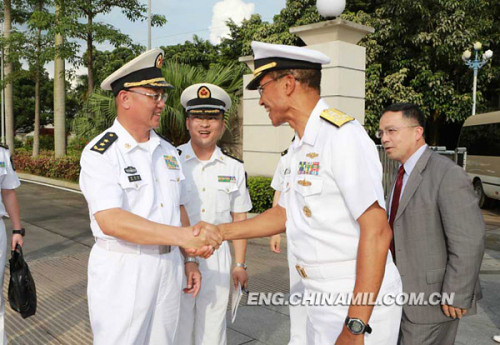
Commander of US Pacific Fleet visits South China Sea Fleet
Vice Admiral Jiang Weilie, commander of the South China Sea Fleet of the Navy of the Chinese People's Liberation Army (PLAN), is shaking hands with Admiral Haney, commander of the US Pacific Fleet.
During the talks, Jiang Weilie, commander of the South China Sea Fleet, expressed warm welcome on behalf of all the officers and men of the South China Sea Fleet to Admiral Harney and the U.S.S. Shiloh (CG 67). In recent years, the navies of China and the United States have launched a series of pragmatic exchanges and cooperation with remarkable results, which has increasingly deepened and developed the friendly relationship. Jiang Weilie expressed that the South China Sea Fleet is willing to work together with the U.S. Navy to continue to strengthen maritime exchange and cooperation, push forward the establishment of a harmonious ocean, maintain regional security and stability, and promote common prosperity and development. He sincerely wished that the friendly relations between China and the United States and the two militaries, especially the navies of the two countries, will continue to deepen and expand.
Adm. Cecil Haney, commander of U.S. Pacific Fleet, right, receives a briefing on capabilities and equipment at the People’s Liberation Army (PLA) Navy’s South Sea Fleet (SSF) Marine Corps 1st Brigade headquarters. Haney’s visit to Zhanjiang, part of a wider introductory visit to China to meet with PLA officials to discuss issues of mutual concern and identify areas of further cooperation, coincides with a port visit by the guided-missile cruiser USS Shiloh (CG 67). (U.S. Navy photo by Mass Communication Specialist 1st Class N. Ross Taylor/Released)
Admiral Haney, on behalf of the visiting officers and men, thanked the South China Sea Fleet of the PLAN for its warm reception. He briefly introduced the situation of the visiting US warship and fully affirmed the achievements made by the Chinese Navy in their escort missions in the Gulf of Aden and the waters off the Somali coast, as well as that made in the mutual military exchanges. He hoped that the Chinese Navy and the US Navy would continue to maintain good communication, exchange and cooperation, so as to improve mutual trust constantly and strengthen cooperation.
After the talks, Jiang Weilie and Haney exchanged souvenirs. On the evening of that day, Haney and his party also attended the welcome reception hosted by Jiang Weilie.
Accompanied by Commander Jiang Weilie, Admiral Haney and his party visited a marine brigade under the South China Sea Fleet and observed the display of marine equipment and the demonstration of basic subjects on the morning of May 31, 2013. In the afternoon, they also visited the "Lanzhou" guided missile destroyer, the "Hengyang" guided missile frigate and the "Changbai Mountain" amphibious dock landing ship under the South China Sea Fleet. In the evening, Jiang Weilie was invited by Admiral Haney to attend the reception held on the deck of the U.S.S. Shiloh.
People Daily
Thứ Hai, 1 tháng 4, 2013
South China Sea Dispute: U.S. Proxy Conflict With China
China will not be passive in sea disputes
Despite the fact that John Kerry, the new US secretary of state, has stepped into office and some side effects brought by his predecessor’s aggressive approach are in decline, the US stance on the South China Sea will not fundamentally change. Behind China’s frictions with the Philippines and Vietnam is actually the rivalry between Beijing and Washington over the South China Sea.
Chinese naval fleets recently conducted patrols on the South China Sea, reaching as far as Zengmu Reef, the southernmost part of Chinese territory. In an oath-taking ceremony on board Tuesday, the troops and officials vowed to safeguard China’s sovereignty.
Earlier this month, a Chinese vessel fired two warning signal shells into the sky to prevent illegal fishing operations by Vietnamese fishermen. Both showed China’s firm determination to insist upon its stance amid the South China Sea disputes.
Washington expressed its concerns in both cases, reinforcing its attitude that the US can interfere in the South China Sea issue any time.
Despite the fact that John Kerry, the new US secretary of state, has stepped into office and some side effects brought by his predecessor’s aggressive approach are in decline, the US stance on the South China Sea will not fundamentally change. Behind China’s frictions with the Philippines and Vietnam is actually the rivalry between Beijing and Washington over the South China Sea.
After Hillary Clinton’s four-year intervention into the South China Sea issue with her “smart power” diplomacy, and Manila and Hanoi’s frictions with Beijing, all kinds of risks within the South China Sea issue have become evident. All parties involved now have a clearer understanding of each other’s national strength and determination.
China, through powerful countermeasures against Manila and Hanoi’s provocations, has changed its passive status. Beijing had been worried that frictions on the South China Sea would cause deterioration in its surrounding environment and thus undermine its period of strategic opportunities. Now most of its concerns have been dispelled.
Crises like the Huangyan Island standoff have made one thing explicit – those were, after all, conflicts between countries whose strength were unequally matched. Manila and Hanoi would not have any chance of victory if the South China Sea issue escalated into a confrontation of national strength.
China has no plan to wage a war and recover all the islands illegally occupied by the Philippines and Vietnam. However, China has become more resolute in terms of strikes against the two’s provocations.
China’s growing leverage over the South China Sea issue stems from stable domestic development. Meanwhile, Manila and Hanoi are witnessing a reduced ability to provoke Beijing over those disputes. Washington is also seeing an increasing number of restraints in its South China Sea policy. The Philippines and Vietnam would face more troubles if they choose to seek fierce confrontation with China.
China should focus on peaceful development. But meanwhile, it is not afraid of adopting resolute measures to protect core national interests. China should avoid external misjudgments toward it, which is pivotal to the nation’s long-term strategic environment.
Thứ Hai, 25 tháng 2, 2013
Investigation Proves China’s Army Is Hacking the U.S.

A shadowy branch of the Chinese military is one of the world’s “most prolific cyberespionage groups,” according to a report released Tuesday by a leading computer security company.
The report by Virginia-based Mandiant is significant because, before its publication, public evidence proving that the Chinese government sponsors the torrent of cyberattacks originating in China was in short supply. The document’s 60 pages are mostly about investigations Mandiant has conducted on a group of hackers it calls Advanced Persistent Threat 1 (APT1).
Evidence conclusively ties APT1 to attacks on 141 different organizations—mostly entities in America’s military, defense industry, energy infrastructure sectors, telecommunications industry and hi-tech research groups.
Despite Beijing’s persistent claims to the contrary, APT1 is not a group of rogue Chinese hackers.
PLA Unit 61398
“Our analysis has led us to conclude that APT1 is likely government-sponsored,” the report says. It goes on to pinpoint the Chinese military as the branch of the government sponsoring the espionage.
“[O]ur research found that People’s Liberation Army (PLA) Unit 61398 is similar to APT1 in its mission, capabilities, and resources. PLA Unit 61398 is also located in precisely the same area from which APT1 activity appears to originate. … [T]he totality of evidence” reveals that “APT1 is Unit 61398,” the report summarized.
(Unit 61398 is located inside a building on the outskirts of Shanghai that the Trumpet was able to locate on Google maps.)
With a degree of sarcasm, the authors explain the only other possible explanation for their findings:
A secret, resourced organization full of mainland Chinese speakers with direct access to Shanghai-based telecommunications infrastructure is engaged in a multi-year, enterprise-scale computer espionage campaign right outside of Unit 61398’s gates, performing tasks similar to Unit 61398’s known mission.
Unit 61398 is very seldom mentioned in China’s official descriptions of its military, but Mandiant’s findings reveal that it is perhaps the PLA’s most effective and destructive unit.
Washington’s Response
The day after the report was released, the Obama administration announced a new effort to fight the growing theft of American trade secrets. Yet, the statement made no mention of China, the Chinese military or the threat posed to U.S. military and infrastructure.
Washington’s refusal to confront China’s assault in any meaningful way has worried some American leaders. “If the Chinese government flew planes into our airspace, our planes would escort them away. If it happened two, three or four times, the president would be on the phone and there would be threats of retaliation,” said Shawn Henry, former FBI executive assistant director. “This is happening thousands of times a day.”
Cyberattacks—which the U.S. officially labels “acts of war”—are happening thousands of times a day, and mountains of evidence shows that China’s military is behind many of the most destructive and persistent ones. The U.S. is bleeding military secrets, technological information, corporate strategies and billions of dollars. Evidence suggests that America has already suffered trial attacks on its vital infrastructure. Yet, U.S. leaders address Beijing’s brazen ongoing assaults only in the most indirect and toothless terms. They do absolutely nothing to retaliate against the attacks.
One unnamed intelligence official said “huge diplomatic sensitivities” were the cause of Washington’s reluctance to take any action against China.
Many of these “sensitivities” link to the fact that China is the U.S.’s biggest creditor. A staggering number of American politicians and entrepreneurs prioritize profit over patriotism. Chinese policymakers recognize that, under President Obama, the U.S. does not have any stomach for confrontation. So they continue these “acts of war” against America without fear of retaliation.
Trumpet editor in chief Gerald Flurry has warned of the U.S.’s cyber vulnerability for many years. In May 2006, he wrote:
I believe one key end-time Bible prophecy could well be fulfilled through … cyberterrorism … ‘they have blown the trumpet, even to make all ready; but none goeth to the battle: for my wrath is upon all the multitude thereof’ (Ezekiel 7:14). The trumpet of war is to be blown in Israel—mainly America and Britain. It seems everybody is expecting our people to go into battle, but the greatest tragedy imaginable occurs! Nobody goes to battle—even though the trumpet is blown! Will it be because of computer terrorism?
The Chinese government’s relentless cyber assaults against the U.S. are now public knowledge. The whole world can hear the shrill blasts of the trumpet of war. By refusing to take action to stop the attacks, America is showing the world that its will to use its power is broken.
To understand more, read “U.S. Vulnerable to Cyber Pearl Harbor.” ▪
The Trum Pet