Hiển thị các bài đăng có nhãn South China Sea. Hiển thị tất cả bài đăng

Thứ Hai, 26 tháng 11, 2018

China to build its third domestically made aircraft carrier


Type-001A, the Chinese first domestically made aircraft carrier

China kicked off construction of a third aircraft carrier, CNS reported on Nov. 25.

In a report on the WeChat network, Xinhua said that as the second and first Chinese-built aircraft carrier was experimenting on the sea, a "next-generation carrier" is under planning.

The article, published in honor of the sixth anniversary of the first Chinese aircrafts taking-off and landing on China's first carrier, the Liaoning CNS, did not specify the details of the "the next-generation carrier, is thought to be China's third, but this article is considered China's first public acknowledgment.

Chinese watchers and foreign observers have long claimed that China has begun construction of a third aircraft carrier at the Jiangnan Group's shipyard in Shanghai, China Shipbuilding Corp. They also predicted that the third would be bigger and stronger than Liaoning and the second was unnamed.

Shipbuilding Corp. of the state of China declined to comment on the issue.

Chinese Navy officials also did not respond to the press on November 26th.

(According to Ecns.cn, The Week)

Chủ Nhật, 25 tháng 11, 2018

Austal - Philippines Navy Offshore Patrol Vessel (OPV) Simulation


Austal’s OPV design for the Philippine Navy is based on a proven platform that has demonstrated success operating in tropical environments and conducting border patrol and maritime operations.

Principal Particulars

Length Overall: 81.7 metres
Beam (moulded): 13.3 metres
Hull draft (maximum): 4 metres

-->More details

* Video source: https://www.youtube.com/watch?v=cc934osX438

Thứ Tư, 21 tháng 11, 2018

China building on new reef in South China Sea, think tank says


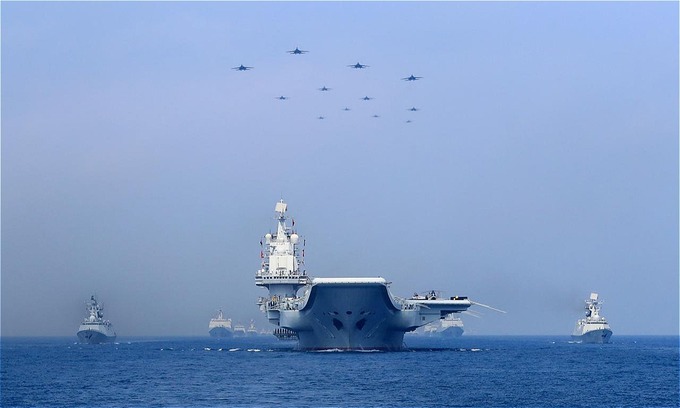
Warships and fighter jets of Chinese People's Liberation Army (PLA) Navy take part in a military display in the South China Sea, April 12, 2018. Photo by Reuters/Stringer

China has installed a new platform on a remote part of the Paracel Islands in the disputed South China Sea which could be used for military purposes.

The strategic waterway is claimed almost in its entirety by China, whose continued building of military and other installations on artificial islands and reefs there has unnerved the region and angered Washington, according to recent satellite images reviewed by a U.S. think tank.

The Asia Maritime Transparency Initiative of Washington's Center for Strategic and International Studies said the images showed a "modest new structure" on Bombay Reef, topped by a radome and solar panels.

"The development is interesting given Bombay Reef's strategic location, and the possibility that the structure's rapid deployment could be repeated in other parts of the South China Sea," the group said in a statement on Tuesday.

The purpose of the platform and radome was unclear, but it could be for military use, it said.

"The reef is directly adjacent to the major shipping lanes that run between the Paracels and the Spratly Islands to the south, making it an attractive location for a sensor array to extend Chinese radar or signals intelligence collection over that important sea lane," the group said.

China's Defense Ministry did not respond to a request for comment.

Foreign Ministry spokesman Geng Shuang said China's sovereignty over the Paracel Islands was not in dispute, and there is nothing wrong with China carrying out construction work on its own territory.

"As for the specific situation you mention, I have no understanding of it," Geng told a daily news briefing.

Vietnam calls the waters the East Sea and has often declared its sovereignty over its Paracels and Spratlys. Vietnam's foreign ministry did not immediately respond to a request for comment.

Emphasis on civil infrastructure

Separately, an influential state-run paper said on Wednesday that China should put more focus on building civilian facilities on islands in the South China Sea and less emphasis on the military to soothe regional fears about China's intentions.

In a commentary, China's Study Times said there was a "potential risk of war" for areas surrounding the country such as the South China Sea.

"Unprecedented outside military interference is the biggest threat to peace and stability in the South China Sea," said the paper, published by the Central Party School which trains rising officials.

"Without the strong deterrence power of our military in the South China Sea, then protecting regional peace and stability is merely idle theorising and falls short of what we would wish."

But there must be a greater role for non-military actors in the South China Sea, it added.

"Facilities on the reefs and islands of the South China Sea should be more civilian and less military," the paper wrote.

That means there should be more focus on building lighthouses, civilian airports, maritime search and rescue, scientific research and weather forecasting, it added.

"Just as the Chinese government has repeatedly stressed, after the completion of the island facilities, they will actively provide relevant public security products and services to regional countries," the paper said.

This will help the international community with things like counter-terror and anti-piracy operations, to jointly safeguard peace and security in the South China Sea, it added.

China has said some civilian facilities on the islands are intended for use by others in the region, but the government has given few details about how that may work in practice.

The islands China occupies in the South China Sea are off-limits to foreigners, with access under the effective control of the People's Liberation Army despite them technically being administratively part of China's southern Hainan province.

Vietnam, Malaysia, the Philippines, Taiwan and Brunei also have competing claims in the South China Sea.

China has frequently lambasted the United States and its allies for freedom of navigation naval operations near to Chinese-occupied islands.

The United States earlier this month again urged China to halt militarisation of the South China Sea.

China said it had the right to build "necessary defense facilities" on what it considers its own territory and urged Washington to stop sending warships and military planes close to the islands that Beijing claims.

Source: https://e.vnexpress.net/news/world/china-building-on-new-reef-in-south-china-sea-think-tank-says-3842672.html

Thứ Hai, 16 tháng 4, 2018

South China Sea drills show Xi Jinping and Donald Trump locked in a dangerous game


The Chinese show of naval force in the South China Sea last week, to warn Taiwan and show support for Russia, shows that President Xi Jinping is giving as good as he gets when it comes to American bellicosity in the world (“China announces surprise live-fire Taiwan Strait drills after massive navy parade,” April 12).

Like President Donald Trump, the Chinese leader is conducting diplomacy wearing a velvet glove on one hand and holding a sword in the other. In this stand-off, it’s a question of who will blink first.

It’s a dangerous game they are playing, and the cost of it going wrong could be high for all of us.

All the more so with tensions rising between East and West in the Middle East, over the atrocious chemical attacks in Syria.

Terry Hewton, Adelaide/ SCMP

Chủ Nhật, 15 tháng 4, 2018

Vietnam's Fishing ‘Militia’ to Defend Against China


FILE - A Vietnamese boat (L) which was rammed and then sunk by Chinese vessels near disputed Paracels Islands in 2014.


MP3 Link: https://drive.google.com/file/d/14jdugN05tFwMPTfVjV6DkmdYhB_fWsAz/view
Vietnam is reported to be quietly developing a state-supported fishing boat militia to hold off China at sea. The fishing militia is being created at a time when the two sides talk about easing territorial disputes.

That is the opinion of experts who follow those disputes.

Vietnam watchers say the country is asking its commercial fishers to use stronger boats and take military-trained people to sea in case of a clash with Chinese fishers. China has its own fishing militia operating in the same waters.

“I think it’s a good policy to avoid future conflicts where militia fishermen are out in the sea,” said Trung Nguyen. He serves as dean of international relations at the Ho Chi Minh University of Social Sciences and Humanities.

Vietnam has been working to develop the fishing militia since at least 2009. Over that time, the two countries have been holding talks. Just last week, Vietnam’s Communist Party general secretary met the visiting Chinese foreign minister. The party official suggested “joint safeguarding (of) maritime peace,” China’s Xinhua News Agency reported.

Vietnam may be trying to appear strong now in case talks fail to produce results, noted Eduardo Araral of the National University of Singapore’s school of public diplomacy.


FILE - A Vietnamese naval soldier stands quard at Thuyen Chai island in the Spratly archipelago.

How the militia works

The Vietnamese fishing militia has not gone to battle with China. If the militia did, it would risk facing the third largest military in the world.

But Vietnamese military forces are arming fishing boats, said Southeast Asia expert Carl Thayer. That may be similar to the deployment of former soldiers to help keep order as needed on land in Vietnam, Thayer noted.

The Vietnamese government requires conscription, he added, so fishermen would already have some military skills.

“Putting them at sea would just be getting people the right age and giving them that training,” he said. “All they did is move what they do on land, how to defend factories … and extend that to sea.

Thayer is emeritus professor at the University of New South Wales in Australia.

Thirteen fishing militia platoons have been helping more than 3,000 fishermen work near the Paracel Islands in the South China Sea. That information comes from a 2017 study by the S. Rajaratnam School of International Studies in Singapore. China controls the Paracels, but Vietnam also claims the islands.

The study found that more than 10,000 fishermen and about 2,000 fishing boats in southern Vietnam have received military equipment.

In 2014, Vietnam prepared a list of rules to aid fishermen who build “modern large capacity ships” to expand their reach, the study found. It said Vietnamese banks had lent $176 million to fishermen for improvements to about 400 ships.


South China Sea territorial claims map

Record of clashes

China claims about 90 percent of the 3.5 million-square-kilometer South China Sea. Vietnam says it should control the sea’s waters off its long north-south coastline, extending into the Paracels and Spratly Islands.

Sailors died in clashes between the two countries in 1974 and 1988. In 2014, the deployment of a Chinese oil rig in the South China Sea caused a boat-ramming incident at sea and deadly rioting in Vietnam against Chinese interests.

China has long had its own fishing militia with military support and attention from the Chinese President, notes the United States-based Naval War College. Armed fishing boats help defend China’s maritime claims by pushing away foreign boats, the political intelligence service Stratfor reported in 2016.

Five other governments claim all or parts of the South China Sea. They oppose Chinese efforts to build up and expand islands in the waterway.

Vietnam and China often hold talks about settling maritime problems, but talks often fall short of a decision because of historic distrust, Araral said. He added that Vietnam may be sending China the message that while we talk, we assert our rights.

A Vietnamese fishing militia will not be as large as China's militia, he said, but Vietnam feels it must try.

I'm Susan Shand

Susan Shand adapted this story from VOA. George Grow was the editor.


Words in This Story

maritime – adj. of or relating to sailing on the sea or doing business (such as trading) by sea

conscription – n. the act of calling citizens to serve in the military

platoon – n. part of a company-sized military force; a group of people who are doing something together

emeritus – ​adj. a person retired from professional life but permitted to retain as an honorary title the rank of the last office held​

capacity – ​n. ​the ability to hold or contain people or things — usually singular​

rig – n. a large structure on the sea

assert – v. to state or declare, often forcefully

ramming – adj. striking something violently

dean – n. the head of a college or school at a university

commercial – adj. related to or used in the buying and selling of products

Source: https://learningenglish.voanews.com/a/vietnams-fishing-militia-to-defend-against-china/4340613.html

Thứ Sáu, 13 tháng 4, 2018

Video: Chinese President Xi Jinping reviews naval parade in South China Sea

Chinese President Xi Jinping, who is also general secretary of the Communist Party of China (CPC) Central Committee and chairman of the Central Military Commission (CMC), reviews the People's Liberation Army (PLA) naval parade in the South China Sea on the morning of April 12, 2018. (ChinaMil / Photo by Feng Kaixuan)


Thứ Hai, 9 tháng 4, 2018

How China is quietly increasing its ability to wage war at sea

More intensive naval training is steadily improving the navy’s combat readiness, writes Collin Koh


The People’s Liberation Army Navy has been on a roll over the past month, staging successive air, naval and marine amphibious assault exercises across the Western Pacific.

Most notably, a large naval deployment was observed on satellite imagery in late March – about 40 vessels including what appeared to be the aircraft carrier Liaoning.

It was followed not far astern by a slightly smaller combat support ship, plus other vessels including submarines and two distinct three-aircraft aerial formations.

Clearly, there should be no dispute among naval observers that the formation in which the fleet sailed amounted to what can be termed a photo and PR exercise.

Some dismissed the manoeuvres as a propaganda exercise designed to flaunt the navy’s muscle, but others cautioned this could imply the PLA Navy has intensified its peacetime combat readiness and training.

Neither side is wrong, for both schools of thought encapsulate the meaning of gunboat diplomacy – the limited threat or use of naval force for the attainment of limited political objectives.

Usually some form of photo opportunity is obligatory on major naval exercises and examples are bountiful. Examples include Exercise Malabar in July last year, with all three carriers of the US, Indian and Japanese navies sailing in formation with fighter jets blazing above, plus the Thailand-hosted Asean Multinational Naval Exercise late last year, to name just a few.

The latest huge naval turnout in the South China Sea appears no different. But would it make sense for China to burn expensive fuel, taking so many warships and their crews away from other tasks, only to stage a photo op?

Focusing on the apparent propaganda value of the manoeuvres solely based on the satellite pictures diverts one’s attention away from a more pertinent phenomenon. That is, while much focus has been on the Chinese coastguard and fabled maritime militia in the South China Sea and in other East Asian maritime flashpoints involving China, the PLA Navy has been gradually improving its ability to fight in a high-intensity war. There is nothing radically new about this. The navy has been steadily building new ships over the years. Just over the past two years alone, over 40 new vessels were commissioned or launched.

But combat capability does not just emanate from inducting new hardware. Clearly the navy understands the value of honing its combat readiness through intense training. While one could question the various other factors that contribute to combat readiness – for example, command and control protocols – the fact of the matter is that in recent years, corresponding with the rate of naval shipbuilding efforts, there has also been an upswing in the navy’s training and exercise regimen.

New hardware allows the fleet to maintain a higher level of readiness compared to using older ships simply because of reduced maintenance requirements. Suffice to say, for now the navy has the luxury of utilising its new-built fleet of vessels to intensify training – more sea time for its crews, which translates into more familiarity with operating their vessels under varying conditions and getting acquainted with the strengths and weaknesses of their combat systems.

Until laggard maintenance schedules catch up eventually, which nobody can be certain of, one should assume that the navy will remain fixated with building a more proficient fleet capable of undertaking large-scale operations.

Also noteworthy is the growing amount of inter-fleet coordination. This is also nothing new – the PLA Navy South Sea, East Sea and North Sea fleets have mobilised assets to train with each other in the past. What is different this time around and will be in the future is that such inter-fleet exchanges will take place on a larger scale thanks to new ships and equipment available. To add to that, the navy has also been honing its interoperability with both the coastguard and maritime militia.

If one takes seriously the incessant exhortations from Beijing’s political elites to “train as you fight”, large-scale naval manoeuvres similar to the one observed in late March would plausibly not be a one-off event, but represent a new normal, made possible only as the navy gains new capabilities and its personnel acquire new-found confidence.

That could mean two things for peace and stability for the South China Sea and Southeast Asia.

On the one hand, a more capable PLA Navy might contribute towards the promotion of defence diplomacy. On the other, a more capable and overconfident PLA Navy may serve more as a tool of coercion. A navy is such a flexible instrument for foreign policy that it can well perform either of these tasks. It depends on how the navy’s political masters choose to utilise this capability.

The increasing power of China’s navy and its enhanced combat readiness should not be kept off everyone’s radar. It remains a force with an increasingly large shadow, ready to weigh in at any point of confrontation at sea with Beijing’s rivals. While not overexaggerating this threat, we should ignore this growing Chinese naval challenge at our peril.

Koh Swee Lean Collin is a research fellow at the maritime security programme at the S Rajaratnam School of International Studies, Nanyang Technological University, Singapore

Thứ Bảy, 10 tháng 3, 2018

Japan mulls over requests for defence equipment from Southeast Asia

Japan is studying several requests from Southeast Asian governments for donations of defence equipment.

However, Japanese operational requirements will take precedence over assistance to foreign governments, a top military official has told Jane’s.


Japan is studying requests by Southeast Asian countries to donate military equipment but refuted reports that it has offered Malaysia the P-3C aircraft, two of which are pictured here. Source: JMSDF

The Japanese Maritime Self Defense Force (JMSDF) has said it is aware of several requests from countries in the Southeast Asian region for donations of excess defence equipment.

Besides military hardware, the Japanese government has also been approached by these Association of Southeast Asian Nations (ASEAN) countries to share technical knowledge and expand on bilateral military collaborations.

Japan has donated five King Air TC-90 aircraft, which were previously in service with the JMSDF’s training squadron, to the Philippine government as part of wider efforts to improve maritime capabilities of its partners in Southeast Asia.

Two of the airframes have been delivered to the Philippine Navy, while three other aircraft are currently scheduled for handover in 2018. The JMSDF is also providing training support on the TC-90 platform for Philippine Navy pilots and maintenance crew.

To strengthen its defence relationships with countries in Southeast Asia, the Japanese government has embarked on several initiatives to improve maritime of government agencies in the region in recent years, especially with those from the Philippines.

Besides the transfer of TC-90 aircraft, Tokyo has also aided the Philippine Coast Guard (PCG) to procure 10 new multirole response vessels from Japanese shipbuilder Japan Maritime United Corporation (JMUC). The PCG has so far received seven vessels in the programme, and is scheduled to receive the remaining hulls by the end of 2018.

Jane's

Won't give an inch of South China Sea: China to US

BEIJING: China's foreign minister sought Thursday to downplay concerns about Beijing's global ambitions, while also hinting at consequences for countries that don't fall in line on issues like Taiwan.


As US president Donald Trump threatens a trade war with China, Wang warned that Beijing is ready to take an "appropriate and necessary response".

Pledging that China had no desire to "replace America" on the global stage, Wang Yi said the Asian nation's path "is totally different than the one that has already been taken by traditional major powers".

"The more China develops, the more it can contribute to the world," Wang said in a wide-ranging press conference.

Wang spoke as 3,000 members of China's mostly ceremonial national legislature have gathered for their annual meeting in Beijing, where they are set to grant President Xi Jinping a nearly limitless mandate to realise his vision of a resurgent China.

Xi's ambitions are not limited to home: he has clearly articulated his vision of putting China at the centre of world affairs, a position reflecting its Chinese name: "the Middle Kingdom."

The departure from the country's long-held stance of keeping a low profile had raised fears abroad of spreading Chinese influence.

On Thursday, Wang tried to strike a balance between reassurance and assertiveness, as Beijing deals with pressure from countries like the US to change its behaviour.

Here are some of the main takeaways:

As US president Donald Trump threatens a trade war with China, Wang warned that Beijing is ready to take an "appropriate and necessary response".

"China's development and rejuvenation can't be stopped," he said.

"Some Americans think that therefore China wants to replace the US's international role, but that is a fundamental strategic misjudgement."

China and the US "don't need to be rivals, they should be partners".

Nevertheless, China will not give an inch in the South China Sea, where it has built an archipelago of artificial islands hosting military facilities that the US and other nations say threaten freedom of navigation through the strategically vital waterway.

Beijing's "resolve to protect the peace and the stability of the South China Sea cannot be shaken", Wang said about the region, where it has overlapping territorial claims with the Philippines, Vietnam, Taiwan, Malaysia and Brunei.

The problems in the region are due to "foreign forces" which "have sent fully armed warships and fighters to the South China Sea to flaunt their military might", he said, referring to operations by the US, Australia and Britain to assert their right to sail through the region.

Although China does not recognise the self-ruled island as an independent nation, Wang took questions about Beijing's relationship with Taipei, warning that the Taiwanese government must come around to China's way of thinking if it hopes to enjoy "peaceful development".

The relationship between Beijing and Taipei has soured since the election of President Tsai Ying-wen, who has refused to acknowledge the so-called "1992 consensus", which agrees that there is only one China without specifying whether Beijing or Taipei is its rightful representative.

"The person who locked the door should open it," Wang said.

Only by taking the "correct path" of recognising the consensus can "cross-strait relations restart building a promising prospect for peaceful development".

Japanese Prime Minister Abe is expected to make a visit to China after years of tense relations set off by a territorial dispute and festering disagreements over the legacy of the Second World War.

After mocking a Japanese reporter's Chinese language skills, Wang said that China "wants the Japanese side to speak credibly in its politics, to behave properly in its actions".

Wang cautiously welcomed the apparent breakthrough over the North Korea nuclear issue as an "important step in the right direction".

He urged the US and North Korea to hold talks as soon as possible after Seoul said that Pyongyang was ready to discuss denuclearisation with Washington in return for security guarantees.

"Now is the crucial moment to test the sincerity of the parties to solve the nuclear issue," he said.

The Economic Times

Thứ Sáu, 9 tháng 3, 2018

Singapore Deploys MBDA’s Aster 30 Air-Defense Missile

The Aster 30 medium-range air-defense missile (highlighted in red) is shown to have attained operational status in this graphic released March 2 by Singapore’s Ministry of Defence, five years after it placed an order. (image : Sing MoD)


Singapore has announced for the first time that it has operationally deployed the MBDA Aster 30 air defense system that it had ordered at the end of summer 2013. This is the first time that the ground-launched version of the Aster medium-range missile is deployed by a non-European nation.

Singapore Defense Minister Ng Eng Hen confirmed the delivery of the system in a speech to Parliament’s defense committee on March 2.

Ng Eng Hen had first announced the Aster’s acquisition decision in September 2013 to replace the aging American Hawk system acquired more than thirty years ago.

At the time, replying to a Parliamentary question, said “I would like to announce today that the SAF will also be acquiring the ASTER-30 Surface-to-Air Missile System. This missile defence system against airborne threats is used by advanced militaries such as France and Italy. The ASTER-30's capabilities are many times more potent than our current I-HAWK ground-based air defence system.

“The ASTER will allow us to engage multiple threats simultaneously and from a longer distance. It will complement the [Israel Aerospace Industries] SPYDER, which we have already operationalised - it is a mobile, shorter-range, quick reaction ground-based air defence system - and together, they will provide a layered air defence shield.

A fact sheet on the Aster 30 was published at the same time on the Singapore defense ministry’s website.

Also at the time, the CEO of European missile maker MBDA, Antoine Bouvier, noted that the Aster 30 had been selected over competing American and Israeli systems thanks to its "performance" and "price."

“Our skies will be better protected with advanced weapon systems,” Ng said March 2, adding that “We also recently added the ASTER-30 surface-to-air missile system.” The Aster 30 is also included in an infographic illustrating the most capable in-service weapon systems.

Although the Aster 30 was only recently delivered, it would likely already be part of the Air Force Island Air Defense (IAD) system of the Republic of Singapore Air Force (RSAF). The IAD network, covering the whole of Singapore (42 kilometers long and 23 kilometers wide), connects all RSAF weapons and air defense sensors, including fighters, air-to-surface systems and radar.

The Aster 30 missile system is operated by a single unit, 163 Squadron.

China warns US and Vietnam after US carrier docks in Vietnam

Beijing accuses ‘external powers’ of flexing muscles in South China Sea after US carrier docks in Vietnam. Arrival of ‘fully armed vessel’ in disputed waterway is ‘greatest disturbance to peace and stability’, Foreign Minister Wang Yi says.


China’s foreign minister on Thursday took a veiled swipe at a US aircraft carrier’s highly symbolic visit to a Vietnamese port, saying “external powers” were showing off their military muscle and creating a great disturbance in the South China Sea region.

Speaking at a press conference in Beijing on the sidelines of the National People’s Congress – the annual session of the country’s ceremonial parliament – Wang Yi said also that China and the Association of Southeast Asian Nations planned to hold at least three rounds of talks on a code of conduct for handling disputes in the South China Sea, though he avoided answering a question on whether such a code would be legally binding.

The USS Carl Vinson arrived in Da Nang, Vietnam, on Monday, becoming the first aircraft carrier to dock in the country since the end of the Vietnam war in 1975. The visit was seen by some as a warning to Beijing over its military build-up in the region.


China's Foreigh Minister Wang Yi

“Now the major challenge is that there are certain external powers who are unwilling to accept the stability in the South China Sea and always want to stir up trouble,” Wang said.
“Sending a fully armed vessel and aircraft to show off its military powers in the South China Sea has become the greatest disturbance to the peace and stability in the South China Sea.”

The US aircraft carrier was accompanied on the port call by the guided missile cruiser USS Lake Champlain and destroyer USS Wayne E. Meyer. The three ships had a combined crew of about 6,500 sailors and Marines.


Meanwhile, a recent report by the Centre for Strategic and International Studies, a US think tank, said China has completed the construction of a large communications/sensor array on Fiery Cross Reef in the Spratly Islands, which could be used for intelligence gathering.


The US Navy’s guided missile cruiser USS Lake Champlain (left) and destroyer USS Wayne E. Meyer accompanied aircraft carrier USS Carl Vinson on its port visit to Dan Nang in Vietnam. Photo: EPA-EFE

Beijing claims almost all of the South China Sea, through which about US$5 trillion worth of goods passes every year. And despite a landmark ruling in 2016 by the Permanent Court of Arbitration in The Hague that said there was no legal basis for China’s maritime claims, it has pressed ahead with island building in the disputed waterway.

The Philippine Inquirer newspaper reported last month that China has almost finished transforming seven reefs in the Spratly Islands into military bastions, with ports, air strips, lighthouses, hangars and multistorey buildings.

Despite the concerns over its rapid militarisation in the region, Wang said China remained steadfast in its commitment to maintaining peace and stability.

“The basis of our handling of South China Sea issues is that … we are responsible for the Chinese people, we are responsible for the historical facts, we are responsible for peace in the region, and we are responsible for the international rule of law,” he said.

China has been Asean’s biggest trading partner for the past nine years, with the value of bilateral trade reaching US$500 billion last year, Wang said.
China would continue to build on its relations with Asean, with the focus on increasing cooperation on political and security issues, economics and trade, cultural exchanges, and the Mekong River, he said. - SCMP

Chủ Nhật, 4 tháng 3, 2018

India, Vietnam emphasise freedom of navigation in South China Sea

Amid increasing Chinese assertiveness in the region, India and Vietnam have underlined the importance of freedom of navigation and overflight in the South China Sea, while calling for peaceful settlement of disputes without threat or use of force.

Prime Minister Modi and President Tran had a convergence of views on various bilateral and international issues, including the regional security situation in Asia, a joint statement said.

After delegation-level talks between Prime Minister Narendra Modi and Vietnamese President Tran Dai Quang yesterday, the two countries also resolved to deepen cooperation in the field of defence and security.

The Vietnamese side reiterated its consistent support for India's permanent membership to United Nations Security Council (UNSC), a joint statement said.

The two sides had also inked pacts for cooperation in the field of nuclear energy, trade and investment, and agriculture following Modi-Tran talks.

India and Vietnam also agreed to further cooperate in maintaining peace, stability and development in the Indo-Pacific region as well as in the world at large.

"They also reiterated the importance of, and the need for complete compliance with international law, notably the United Nations Convention on the Law of the Sea 1982 (UNCLOS), including the implementation of international legal obligations," the statement said.

Read more: https://economictimes.indiatimes.com/news/defence/india-vietnam-emphasise-freedom-of-navigation-in-south-china-sea/articleshow/63158850.cms

The supercarrier USS Carl Vinson's operations in Vietnam

USS Carl Vinson and other US Navy warships entering the port of Da Nang, began a five-day visit to Vietnam.
The visit of a U.S. aircraft carrier to Vietnam for the first time since the end of the Vietnam War is a powerful symbol of the growing strategic ties between the former foes.


* More video here: https://www.facebook.com/kimluctv/videos/1413910502051573/


USS Lake Champlain at Tien Sa port. This is the Ticonderoga class cruiser, which has been in operation since 1988.

- 12:26

USS Carl Vinson has been anchored at Tien Sa port, 1 km from the shore.

- 11:50 GMT+7

USS Carl Vinson is entering the port of Tien Sa


Vietnamese navigators began to approach the USS Carl Vinson. Four ships of the border guards guard the outer of the carrier.


USS Carl Vinson is about 5 km from shore of Da Nang


At 9:30 am on March 5, an US Navy officer was on Vong Canh Hill at Son Tra peninsula to check, monitor, prepare to welcome the ships dock. About 3,000 American sailors will be present during this visit. The escort of USS Carl Vinson aircraft carrier are USS Lake Champlain cruiser and the USS Wayne E. Meyer destroyer.

Thứ Sáu, 2 tháng 3, 2018

Philippine Navy's first modern frigates to act as anti-air platforms

The state-run Philippine News Agency quoted Philippine Navy chief Rear Adm. Robert Empedrad as saying that the two frigates from South Korea will be employed as anti-air platforms.

Once completed and delivered fully functional in 2020, the two missile-armed frigates contracted from Hyundai Heavy Industries (HHI), will serve as the Navy's first anti-air missile platform.


This was the response of Philippine Navy flag-officer-in-command Rear Admiral Robert Empedrad when asked if the PN has any "anti-access or area capability" during the Senate hearing on the Frigate Acquisition Project (FAP) last week.

"In the current inventory of the PN, we don’t have capability for aerial denial. Wala pa tayong (We do not have) anti-air missile capability na ship that can hit an incoming aerial object. But except for our frigates supposedly kung ma-deliver (once delivered), ito lang iyong (this will only be the) first time that we will have that capability for aerial denial," he added.

The frigates, now being built by HHI, will be armed with weapons capable of neutralizing surface, sub-surface and air threats aside from capable of electronic warfare.

The above-mentioned ships have a contract of PHP18 billion, including their weapons systems and munitions.

In the FAP hearing, issues concerning the brand of combat management system to be installed were discussed. (PNA)

Thứ Năm, 1 tháng 3, 2018

India, Vietnam set to ink nuclear energy pact, boost defence ties

During Vietnam President Tran Dai Quang’s visit this week, the two sides will discuss developments in South China Sea


Indian warship INS Shivalik visited Hai Phong port in 2014. (Image: Indian Embassy)

New Delhi: In a move that could put China on the back foot, strategic partners India and Vietnam are to boost defence ties and sign pacts on civil nuclear cooperation and port development during a visit by Vietnamese President Tran Dai Quang later this week.

The two countries will also exchange views on developments in the South China Sea where Vietnam and some other South-East Asian nations are locked in a maritime dispute with China, Vietnam’s ambassador to India Ton Sinh Thanh told reporters in New Delhi on Tuesday.

The three-day visit starting on Friday comes at a time when India is warily watching China make inroads into its neighbourhood with an increased naval presence as well as a stepped up infrastructure profile in countries like the Maldives, Nepal and Sri Lanka as part of its multi-billion dollar Belt and Road Initiative. India views South Asia and the Indian Ocean Region as its traditional sphere of influence while China sees the South China Sea as its backyard. In the past, China has objected to India’s ONGC Videsh Ltd exploring for oil in blocks off the Vietnamese coast in the South China Sea—claiming it to be in its territorial waters.

President Tran Dai Quang’s first visit to India will start from Bodh Gaya, a noted Buddhist site that is frequented by pilgrims from Japan and South-East Asia. On the second day of his visit on Saturday, he will meet Prime Minister Narendra Modi and President Ram Nath Kovind.

Of the 26 countries that Vietnam has a strategic partnership with, “the level of the strategic partnership with India is the highest,” Ton Sinh Thanh said, adding that there was “strong political trust” between the two countries as there was a “strong convergence of strategic interests.”

The Vietnamese president’s visit would aim to make the partnership more comprehensive with the addition of economic, scientific and cultural elements, he said, adding that one of the agreements expected to be signed was in the area of peaceful uses of civil nuclear energy.

Apart from the civil nuclear pact, which will be signed between the two governments, three other pacts—including one on the development of a port in the Nghe An province in north-central Vietnam —will be signed with Indian companies, Tran Le Tien, economic counsellor in the Vietnamese embassy in New Delhi, said.

Indian companies will be looking at “developing the port for operations, to raise its capacity to 5 million tonnes (cargo handling) capacity,” he said. Another pact envisages the setting up a $50 million coal terminal in Vietnam, Tran Le Tien said.

According to the ambassador, the two countries will aim to deepen trade and defence ties during the president’s trip. India had extended a $500 million line of credit to purchase military equipment during a visit by Modi to Vietnam in 2016. This was in addition to another $100 million extended in 2014. “We are buying some equipment from India for the (Vietnamese) army and navy,” Ton Sinh Thanh said, but did not confirm media reports that the Vietnamese government had purchased the India-Russia co-developed BrahMos cruise missile.

The situation in the “South China Sea will be discussed” with Indian leaders, the ambassador said, describing the current state of the dispute as “complicated.” China and other countries that are party to the dispute had agreed to a code of conduct in the South China Sea aimed at minimizing friction, he said.

Source: Livemint

Thứ Tư, 28 tháng 2, 2018

The British are Coming to the South China Sea


British Defense Secretary Gavin Williamson recently announced that the Royal Navy would be conducting a South China Sea Freedom of Navigation Operation (FONOP) after its visit to Australia later this year. His statement also contained a rare full-throated specific endorsement of U.S. FONOPs in the region. “We absolutely support the U.S. approach on this, we very much support what the U.S. has been doing,” he commented, adding, “The U.S. can only concentrate on so many things at once. The U.S. is looking for other countries to do more. This is a great opportunity for the U.K. and Australia to do more, to exercise leadership.”

I am sure that Williamson’s comments were warmly welcomed in Washington: It seems clear that current U.S. policy seeks to encourage or even push allies to conduct South China Sea FONOPs. During his recent joint appearance with Australian Prime Minister Malcolm Turnbull, President Trump said he would “love for Australia” to join U.S. FONOPs in the South China Sea. Turnbull did not rule out such FONOPs, and neither did Australia’s foreign minister Julie Bishop during a recent television interview. This not-so-subtle U.S. pressure is also highlighted by the nomination of U.S. Pacific Command chief Adm. Harry Harris (a China hawk) to the position of U.S. ambassador to Australia.

In the past, the U.S. has also sought to encourage FONOPs in the South China Sea by the Japanese Maritime Self-Defense Forces. In 2016, then-French Defense Minister (and current Foreign Minister) Jean-Yves Le Drian has expressed interest in bolstering Europe’s maritime presence in the South China Sea. India, a member of the emerging “Quad” in the Indo-Pacific (along with Japan, the U.S. and Australia) is an obvious candidate to conduct FONOPs as well.

A skeptic might ask: How will FONOPs by other countries help deter Chinese expansionism in the South China Sea if U.S. FONOPs alone have not done so? The Chinese state media is already sneering at the no-longer-mighty Royal Navy daring to interfere in the region. The U.S. does not lack naval firepower; what it has largely lacked, until now, was action by other countries demonstrating support for its views on freedom of navigation rights in the South China Sea. Britain is about to provide such tangible support, and as a bonus, it is also calling on Australia to do the same.

Officially, FONOPs are merely expressions of a country’s views about its rights under international law. But China’s increasingly harsh public criticisms of FONOPs have actually transformed these operations into a useful tool for demonstrating a country’s willingness to suffer Chinese disapprobation. That is certainly what FONOPs have become for the United States.

While the U.S. has shown its willingness to irritate or even anger China, up until now, countries like Britain and (especially) Australia have not. This reticence is probably due to those countries’ strong economic ties with China. Getting those countries to join FONOPs will bolster the U.S. view of international law, but, more significantly, it will bolster confidence that countries other than the U.S. are willing to defy China on this sensitive point. That is why it will be important to convince Japan and India to join the FONOP party at some point as well, in order to demonstrate those countries’ confidence in their ability to withstand withering Chinese criticism and anger.

FONOPs, even joint FONOPs with other nations, will not by itself roll back China’s expansion in the South China Sea. But more FONOPs conducted by more nations will globalize the dispute beyond U.S.-China relations and make China incur new costs for its policies. Hopefully, they will also cause China to think twice about further regional expansionism. - Lawfare

Chủ Nhật, 11 tháng 2, 2018

China sends Su-35 fighter jet for patrolling the South China Sea

China's Defense Ministry website on Feb. 9, 1818, published a video showing that its Su-35 fighter jets participated in patrols in the South China Sea. This video also shows scenes of Su-35 missile firing. The Su-35 is a Russian 4+ generation fighter developed from the Sukhoi multirole fighter platform.

Thứ Ba, 17 tháng 12, 2013

Philippines plans further upgrades to ex-US Coast Guard cutters

The BRP Ramon Alcaraz (PF 16), the newest vessel of the Philippine navy, leaves the Federal Law Enforcement Training Center, Charleston, S.C., following simple ceremonies attended by members of the Filipino community on June 10, 2013. Philippine Embassy photo by Elmer G. Cato

The Philippine Navy (PN) is planning further upgrades for its two ex-US Coast Guard Hamilton-class cutters, PN spokesman Lieutenant Commander Gregory Fabic told IHS Jane's on 17 December.

Contracts to modernise the two vessels, which are described by the PN as patrol frigates, are expected to be tendered next year and will feature upgrades for navigation, propulsion, communication, surveillance, and weapons systems.

IHS Jane's understands that the PN is also seeking to equip the vessels with an anti-submarine warfare capability and surface-to-surface missiles, although funding restrictions are likely to determine the full extent of the modernisation programme.

Lt Cdr Fabic said the planned upgrade will enhance the PN's capability to protect and secure its assets in and around the country's exclusive economic zone, in which tension has remained high in recent years due to territorial disputes between the Philippines and China.

Jane's

US warns China against imposing South China Sea air zone

US Secretary of State John Kerry warned China Tuesday against imposing an air defence zone over the South China Sea, similar to one it declared over disputed islands in the East China Sea.

MANILA: US Secretary of State John Kerry warned China Tuesday against imposing an air defence zone over the South China Sea, similar to one it declared over disputed islands in the East China Sea. "The zone should not be implemented and China should refrain from taking similar, unilateral actions elsewhere in the region, and particularly over the South China Sea," Kerry told a news conference in Manila.
The Philippines warned last month that China's announcement of an Air Defence Identification Zone (ADIZ) in the East China Sea raised the prospect of it doing the same for the South China Sea.

The Philippines, China, Vietnam, Malaysia, Brunei and Taiwan have overlapping claims to parts of the strategically vital and potentially resource-rich South China Sea.

"Today, I raised our deep concerns about China's announcement of an East China Sea air defence identification zone," Kerry said, referring to his discussions in Manila with Philippine Foreign Secretary Albert del Rosario.

"I told the foreign secretary that the United States does not recognise that (East China Sea) zone and does not accept it."

Beijing's East China Sea air defence zone requires aircraft to provide flight plans when traversing the area, declare their nationality and maintain two-way radio communication, or face "emergency defensive measures".

The zone covers disputed Tokyo-controlled islands -- known as Senkaku in Japan and Diaoyu in China -- where ships and aircraft from the two countries already shadow each other.

Analysts warn that the ADIZ in the East China Sea is a forerunner to a similar zone in the South China Sea, which Beijing claims almost in its entirety.

Kerry, in Manila for a two-day visit, threw his support behind the Philippines over its simmering South China Sea territorial row with China, calling Manila a "key treaty ally".

Tensions between the Philippines and China have risen in recent years as Beijing becomes more forthright in asserting its claim over most of the South China Sea.

Earlier this year, Manila took Beijing to a United Nations tribunal over the contested Scarborough Shoal, which lies about 220 kilometres (135 miles) from the Philippines' main island of Luzon and has been controlled by Chinese government vessels since last year.

"The United States is committed to working with the Philippines to address its most pressing security challenges," Kerry said.

"That is why we are negotiating a strong and enduring framework agreement that will enhance defence cooperation under our alliance, including through an increased rotational presence in the Philippines," he said.

Both sides are in the final stages of hammering out a deal allowing more US troops, aircraft and ships to temporarily pass through the Philippines, where the last US bases closed in 1992.

- AFP/ec

Thứ Bảy, 14 tháng 12, 2013

Philippine Navy Receives First Three AW109 Power Helicopters

AW-109 Power helicopter of the Philippine Navy (photo : Mckoyzzz)

MANILA, Philippines – Three of five Agusta Westland AW109 maritime choppers for the Philippine Navy were delivered over the weekend, the military said.

Philippine Fleet spokespersons Lieutenant Junior Grade Rommel Rodriguez told INQUIRER.net on Wednesday that the three choppers arrived last Sunday and are currently being assembled at Villamor Air Base in Pasay City.

The choppers are being assembled and checked for testing.

“When you buy something you want to make sure it is [completely working],” he said.

But Rodriguez could not immediately give details, such as commissionship of the choppers, saying that they were still “straightening out” details.

He said, however, said that the choppers will be commissioned within the month.

Two batches of pilots and crewmembers underwent six months training in Italy for the choppers. After commissionship, the choppers will likely be deployed with the two biggest warships — BRP Gregorio del Pilar and Ramon Alcaraz, but more pilots would also undergo training first.

Two more choppers are scheduled to arrive in the first quarter of 2014. All the five choppers are worth P1.33 billion and they are part of the military’s capability upgrade program.

The naval choppers are capable of “wide range” missions such as economic zone protection, surface surveillance, search and rescue and maritime security. The contract includes initial logistics support and training for aircrew and maintenance personnel.

Inquerer