Hiển thị các bài đăng có nhãn China military news. Hiển thị tất cả bài đăng
Thứ Hai, 26 tháng 11, 2018
China to build its third domestically made aircraft carrier
China kicked off construction of a third aircraft carrier, CNS reported on Nov. 25.
In a report on the WeChat network, Xinhua said that as the second and first Chinese-built aircraft carrier was experimenting on the sea, a "next-generation carrier" is under planning.
The article, published in honor of the sixth anniversary of the first Chinese aircrafts taking-off and landing on China's first carrier, the Liaoning CNS, did not specify the details of the "the next-generation carrier, is thought to be China's third, but this article is considered China's first public acknowledgment.
Chinese watchers and foreign observers have long claimed that China has begun construction of a third aircraft carrier at the Jiangnan Group's shipyard in Shanghai, China Shipbuilding Corp. They also predicted that the third would be bigger and stronger than Liaoning and the second was unnamed.
Shipbuilding Corp. of the state of China declined to comment on the issue.
Chinese Navy officials also did not respond to the press on November 26th.
(According to Ecns.cn, The Week)
Thứ Bảy, 3 tháng 3, 2018
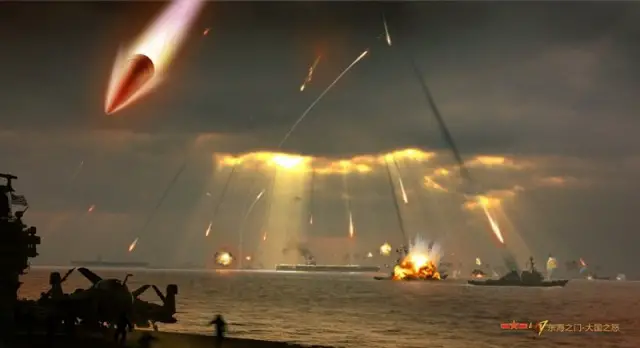
China shows its missiles can strike covering US bases in Japan and S. Korea
China recently launched a video projecting military power, launching a series of cruise missiles capable of carrying nuclear warheads, the range that covered US bases in Korea and Japan.
According to the Daily Star, state-run Chinese media recently posted video of DF-10 cruise missiles firing from ground launchers.
The missile has a range of 1,500 kilometers, covering the US military base in Korea and on the Japanese island of Okinawa.
Thứ Năm, 1 tháng 3, 2018
China to develop its first nuclear-powered aircraft carrier
MELBOURNE, Australia — One of China’s largest shipbuilders has revealed plans to speed up the development of China’s first nuclear-powered aircraft carrier, as part of China’s ambition to transform its navy into a blue-water force by the middle of the next decade.

The Chinese aircraft carrier Liaoning arrives in Hong Kong waters on July 7, 2017, less than a week after a high-profile visit by president Xi Jinping. (Anthony Wallace/AFP via Getty Images)
In a since-amended news release outlining the company’s future strategic direction in all of its business areas, the state-owned China Shipbuilding Industry Corporation, or CSIC, said the shipbuilding group will redouble efforts to achieve technological breakthroughs in nuclear-powered aircraft carriers, new nuclear-powered submarines, quieter conventionally powered submarines, underwater artificial intelligence-based combat systems and integrated networked communications systems.
CSIC is responsible for both civilian and military shipbuilding activities in the north and the west of China.
The company release added that these breakthroughs are required for China’s People’s Liberation Army Navy, or PLAN, to enhance its capability to globally operate in line with the service’s aim to become a networked, blue-water navy by 2025.
The original news release, which Defense News has seen and translated, has since been deleted from CSIC’s website and replaced by one missing all references to the details listed above. The updated release instead merely notes that the company “must resolutely implement (Chinese President) Xi Jinping’s thinking on strengthening our armed forces and take the building of a modern warfare system with Chinese characteristics as a guide to speed up breakthroughs in key core technologies.”

Chinese J-15 fighter jets are launched from the deck of the Liaoning aircraft carrier during military drills in the South China Sea on Jan. 2, 2017. (STR/AFP via Getty Images)
CSIC was responsible for the refurbishment of China’s sole operational aircraft carrier, which was originally laid down as the Soviet Union’s Admiral Kuznetsov-class carrier Varyag. The hulk was acquired from Ukraine in the late 1990s and entered service with the PLAN in 2012 as the Liaoning.
The company is also building China’s first indigenously built aircraft carrier, a slightly modified version of the Liaoning featuring various improvements. The ship is currently being fitted out at CSIC’s shipyard in Dalian, where the Liaoning was refurbished.
China is also reportedly planning a larger, conventionally powered aircraft carrier that will be equipped with electromagnetic catapults to launch aircraft, having previously claimed that it has made a breakthrough that will see the ship generating sufficient power to operate the power-hungry catapults.
The PLAN is already operating a pair of catapults — one believed to be steam-driven while the other an electromagnetic catapult — for carrier operations training at its air base in Liaoning Province where its Shenyang J-15 Flying Shark carrier-borne fighters are based.
The PLAN’s current aircraft carriers can only launch aircraft using ski-jumps, which restrict their ability to operate aircraft such as turboprop-powered airborne early warning aircraft.
That particular aircraft’s engines are unable to generate sufficient thrust to take off from an aircraft carrier without catapults, instead relying on lower-flying helicopters fitted with radars for the carrier-borne early warning mission. This in turn limits the PLAN’s carrier battle groups’ effectiveness in the fleet’s defense mission.
Collin Koh, a research fellow at the Maritime Security Programme of the S. Rajaratnam School of International Studies in Singapore, told Defense News that a Chinese nuclear-powered aircraft carrier will facilitate the continued increase in China’a naval presence, with its longer endurance compared to conventionally powered aircraft carriers allowing longer “out of area” operations in distant waters such as the Western Pacific and the Indian Ocean.
It will also allow the PLAN to respond faster to contingencies, such as showing presence at regional hot spots, or humanitarian assistance and disaster relief operations. Koh cited the U.S. Navy’s use of an aircraft carrier during relief efforts following the devastating 2004 Indian Ocean tsunami.
He added that the PLAN will benefit from its experience with operating nuclear-powered submarines if or when it introduces nuclear-powered aircraft carriers, despite the possibility of initial complications regarding logistics and infrastructure to support nuclear-powered surface vessels. - Defense News

The Chinese aircraft carrier Liaoning arrives in Hong Kong waters on July 7, 2017, less than a week after a high-profile visit by president Xi Jinping. (Anthony Wallace/AFP via Getty Images)
In a since-amended news release outlining the company’s future strategic direction in all of its business areas, the state-owned China Shipbuilding Industry Corporation, or CSIC, said the shipbuilding group will redouble efforts to achieve technological breakthroughs in nuclear-powered aircraft carriers, new nuclear-powered submarines, quieter conventionally powered submarines, underwater artificial intelligence-based combat systems and integrated networked communications systems.
CSIC is responsible for both civilian and military shipbuilding activities in the north and the west of China.
The company release added that these breakthroughs are required for China’s People’s Liberation Army Navy, or PLAN, to enhance its capability to globally operate in line with the service’s aim to become a networked, blue-water navy by 2025.
The original news release, which Defense News has seen and translated, has since been deleted from CSIC’s website and replaced by one missing all references to the details listed above. The updated release instead merely notes that the company “must resolutely implement (Chinese President) Xi Jinping’s thinking on strengthening our armed forces and take the building of a modern warfare system with Chinese characteristics as a guide to speed up breakthroughs in key core technologies.”

Chinese J-15 fighter jets are launched from the deck of the Liaoning aircraft carrier during military drills in the South China Sea on Jan. 2, 2017. (STR/AFP via Getty Images)
CSIC was responsible for the refurbishment of China’s sole operational aircraft carrier, which was originally laid down as the Soviet Union’s Admiral Kuznetsov-class carrier Varyag. The hulk was acquired from Ukraine in the late 1990s and entered service with the PLAN in 2012 as the Liaoning.
The company is also building China’s first indigenously built aircraft carrier, a slightly modified version of the Liaoning featuring various improvements. The ship is currently being fitted out at CSIC’s shipyard in Dalian, where the Liaoning was refurbished.
China is also reportedly planning a larger, conventionally powered aircraft carrier that will be equipped with electromagnetic catapults to launch aircraft, having previously claimed that it has made a breakthrough that will see the ship generating sufficient power to operate the power-hungry catapults.
The PLAN is already operating a pair of catapults — one believed to be steam-driven while the other an electromagnetic catapult — for carrier operations training at its air base in Liaoning Province where its Shenyang J-15 Flying Shark carrier-borne fighters are based.
The PLAN’s current aircraft carriers can only launch aircraft using ski-jumps, which restrict their ability to operate aircraft such as turboprop-powered airborne early warning aircraft.
That particular aircraft’s engines are unable to generate sufficient thrust to take off from an aircraft carrier without catapults, instead relying on lower-flying helicopters fitted with radars for the carrier-borne early warning mission. This in turn limits the PLAN’s carrier battle groups’ effectiveness in the fleet’s defense mission.
Collin Koh, a research fellow at the Maritime Security Programme of the S. Rajaratnam School of International Studies in Singapore, told Defense News that a Chinese nuclear-powered aircraft carrier will facilitate the continued increase in China’a naval presence, with its longer endurance compared to conventionally powered aircraft carriers allowing longer “out of area” operations in distant waters such as the Western Pacific and the Indian Ocean.
It will also allow the PLAN to respond faster to contingencies, such as showing presence at regional hot spots, or humanitarian assistance and disaster relief operations. Koh cited the U.S. Navy’s use of an aircraft carrier during relief efforts following the devastating 2004 Indian Ocean tsunami.
He added that the PLAN will benefit from its experience with operating nuclear-powered submarines if or when it introduces nuclear-powered aircraft carriers, despite the possibility of initial complications regarding logistics and infrastructure to support nuclear-powered surface vessels. - Defense News
Chủ Nhật, 16 tháng 2, 2014
China plans to build 4 carriers, including nuclear: report
China plans to build four aircraft carriers in total to boost its naval power and exert its maritime claims, according to a Russian media report.
Official reports in January said that the PLA plans to have at least two aircraft carriers by 2015 or 2016 and said the country's second aircraft carrier is indeed under construction as previous unofficial reports had claimed. The country plans to build four aircraft carriers in total, the state newswire Xinhua citing a Russian weekly newspaper as reporting.
China commissioned the Liaoning, a refitted Soviet-era carrier purchased from Ukraine, in 2012. Future carriers are expected to be built domestically and take the Liaoning as their blueprint, at least initially.
The report further said construction appears to be behind schedule, but Beijing has mapped out a clear plan for its development. China's aircraft carrier program is set to be implemented in two phases, the report said, the aim being to build two carriers to establish carrier battle fleets to operate while two more advanced carriers are developed.
The report said the first two planned conventionally powered aircraft carriers may have a displacement of between 50,000 to 55,000 tonnes. The second phase may see the construction of two nuclear-powered carriers with an electromagnetic catapult system and displacement of 65,000 tonnes. These could possibly enter service by the late 2020s.
In order to carry out the second phase, the government approved a plan in February to build vessels that use nuclear power, the report said.
However, the Ministry of National Defense denied claims that it has plans to build more aircraft carriers at present.
The Communist Party secretary of Liaoning province, Wang Min, had said in January that an aircraft carrier was being built in Dalian, the port city where the Liaoning carrier was refitted. But reports related to Wang's remarks were promptly deleted from the internet for unknown reasons.
Want China Times
Thứ Hai, 23 tháng 12, 2013
Chinese aircraft carrier Liaoning's combat capability tested: Photo
BEIJING, Dec. 23 (Xinhuanet) -- China's first aircraft carrier, the Liaoning, has conducted more than 100 tests and training tasks since early December, when it began a training mission in the South China Sea, the navy said on Sunday.
"The Liaoning successfully performed several tests of the combat system today and organized for the first time comprehensive combat training," the People's Liberation Army navy said in a statement. "Through this operation, we tested the carrier's combat capability and tried the performance of its propulsion and seaworthiness."
This is the first time the Liaoning has made a long-distance training voyage since it was commissioned into the PLA navy last year, the statement said, adding that the mission is characterized by a large number of tests, rigorous standards, complicated circumstances as well as collaboration with multiple military units.
The ship left its homeport of Qingdao, Shandong province, on Nov 26 and anchored at a naval base in Sanya, Hainan province, three days later. On Dec 5, it set out on the training mission.
Two missile destroyers, the Shenyang and Shijiazhuang, and two missile frigates, the Yantai and Weifang, participated in the mission. They escorted the carrier along the whole voyage from Qingdao to Sanya.
"The South China Sea has deep waters, strong wind and big waves, making it a suitable place for the aircraft carrier to conduct tests and training," said Senior Captain Zhang Zheng, captain of the Liaoning.
Crewmembers also have performed a series of tests on items such as the ship structure's resistance to stress, sailing speed in deep waters and stability of weapons and equipment, he added, noting that combat departments practiced exercises to defend incoming hostile aircraft, ships and submarines.
Several types of aircraft, combat ships and submarines were dispatched to cooperate with the carrier during the mission, which simulates real combat situations, according to Zhang.
After entering active service in September 2012, the Liaoning has carried out 12 sea trials and tests, including landings and takeoffs for the J-15 fighter jet.
The ship is still in the test and exercise stage, according to Senior Captain Mei Wen, Liaoning's political commissar.
"We have commanded the basic capability to operate and coordinate fighter jets and helicopters with the carrier," Mei said. "We have accumulated much experience in logistic support for the J-15 fighters and improved a lot in terms of damage control and handling of equipment malfunctions."
"The Liaoning successfully performed several tests of the combat system today and organized for the first time comprehensive combat training," the People's Liberation Army navy said in a statement. "Through this operation, we tested the carrier's combat capability and tried the performance of its propulsion and seaworthiness."
This is the first time the Liaoning has made a long-distance training voyage since it was commissioned into the PLA navy last year, the statement said, adding that the mission is characterized by a large number of tests, rigorous standards, complicated circumstances as well as collaboration with multiple military units.
The ship left its homeport of Qingdao, Shandong province, on Nov 26 and anchored at a naval base in Sanya, Hainan province, three days later. On Dec 5, it set out on the training mission.
Two missile destroyers, the Shenyang and Shijiazhuang, and two missile frigates, the Yantai and Weifang, participated in the mission. They escorted the carrier along the whole voyage from Qingdao to Sanya.
"The South China Sea has deep waters, strong wind and big waves, making it a suitable place for the aircraft carrier to conduct tests and training," said Senior Captain Zhang Zheng, captain of the Liaoning.
Crewmembers also have performed a series of tests on items such as the ship structure's resistance to stress, sailing speed in deep waters and stability of weapons and equipment, he added, noting that combat departments practiced exercises to defend incoming hostile aircraft, ships and submarines.
Several types of aircraft, combat ships and submarines were dispatched to cooperate with the carrier during the mission, which simulates real combat situations, according to Zhang.
After entering active service in September 2012, the Liaoning has carried out 12 sea trials and tests, including landings and takeoffs for the J-15 fighter jet.
The ship is still in the test and exercise stage, according to Senior Captain Mei Wen, Liaoning's political commissar.
"We have commanded the basic capability to operate and coordinate fighter jets and helicopters with the carrier," Mei said. "We have accumulated much experience in logistic support for the J-15 fighters and improved a lot in terms of damage control and handling of equipment malfunctions."
Thứ Bảy, 21 tháng 12, 2013
China plans to build a 110,000 ton 'super aircraft carrier' to rival US naval power
CHINA has declared it is building a nuclear-powered aircraft carrier of a size to rival the biggest in United States naval service in the first move of a major new arms race.
Chinese website qianzhan.com cites "top People's Liberation Army" sources as saying the 110,000-ton aircraft carrier should be launched by 2020.
"By that time, China will be able to confront the most advanced US carrier-based fighter jets in high sea," the Chinese-language article reads.
The news follows rising tensions in the South and East China Seas where the most recent incident involved a near-collision with a US cruiser shadowing China's first aircraft carrier, the refurbished Liaoning which was purchased from Ukraine.

Pride of the fleet ... Crew stand on-board China's aircraft carrier "Liaoning" in Dalian, northeast China's Liaoning Province. (AP /Xinhua, Zha Chunming) Source: AP
China's first homegrown aircraft carrier will be a larger version of Liaoning. The first of two such vessels is due to hit the water in 2015.
The design is reportedly based on drawings from the former Soviet Union of a nuclear-powered, 80,000 ton vessel capable of carrying 60 aircraft.
"Despite their lack of experience, Chinese scientific research personnel have the ambition to overcome various difficulties to master lots of new technologies and techniques in building China's own powerful aircraft carrier," the article reads.

America’s latest aircraft carrier, the USS Ford, undergoes final construction work before entering service earlier this year. Source: Supplied
Heraldsun
Chinese website qianzhan.com cites "top People's Liberation Army" sources as saying the 110,000-ton aircraft carrier should be launched by 2020.
"By that time, China will be able to confront the most advanced US carrier-based fighter jets in high sea," the Chinese-language article reads.
The news follows rising tensions in the South and East China Seas where the most recent incident involved a near-collision with a US cruiser shadowing China's first aircraft carrier, the refurbished Liaoning which was purchased from Ukraine.
Pride of the fleet ... Crew stand on-board China's aircraft carrier "Liaoning" in Dalian, northeast China's Liaoning Province. (AP /Xinhua, Zha Chunming) Source: AP
China's first homegrown aircraft carrier will be a larger version of Liaoning. The first of two such vessels is due to hit the water in 2015.
The design is reportedly based on drawings from the former Soviet Union of a nuclear-powered, 80,000 ton vessel capable of carrying 60 aircraft.
"Despite their lack of experience, Chinese scientific research personnel have the ambition to overcome various difficulties to master lots of new technologies and techniques in building China's own powerful aircraft carrier," the article reads.
America’s latest aircraft carrier, the USS Ford, undergoes final construction work before entering service earlier this year. Source: Supplied
Heraldsun
Thứ Năm, 19 tháng 12, 2013
Chinese Military's Secret to Success: European Engineering
By David Lague, Reuters
HONG KONG — If the People's Liberation Army went to war tomorrow, it would field an arsenal bristling with hardware from some of America's closest allies: Germany, France and Britain.
Most of China's advanced surface warships are powered by German and French-designed diesel engines. Chinese destroyers have French sonar, anti-submarine-warfare helicopters and surface-to-air missiles.
Above the battlefield, British jet engines drive PLA fighter bombers and anti-ship strike aircraft. The latest Chinese surveillance aircraft are fitted with British airborne early warning radars. Some of China's best attack and transport helicopters rely on designs from Eurocopter, a subsidiary of pan-European aerospace and defense giant EADS.
But perhaps the most strategic item obtained by China on its European shopping spree is below the waterline: the German-engineered diesels inside its submarines.
Emulating the rising powers of last century - Germany, Japan and the Soviet Union - China is building a powerful submarine fleet, including domestically built Song and Yuan-class boats. The beating hearts of these subs are state-of-the-art diesel engines designed by MTU Friedrichshafen GmbH of Friedrichshafen, Germany. Alongside 12 advanced Kilo-class submarines imported from Russia, these 21 German-powered boats are the workhorses of China's modern conventional submarine force.
With Beijing flexing its muscles around disputed territory in the East China Sea and South China Sea, China's diesel-electric submarines are potentially the PLA's most serious threat to its American and Japanese rivals. This deadly capability has been built around robust and reliable engine technology from Germany, a core member of the U.S.-led North Atlantic Treaty Organization.
Arms trade data from the Stockholm International Peace Research Institute (SIPRI) to the end of 2012 shows that 56 MTU-designed diesels for submarines have been supplied to the Chinese navy.
“They are the world's leading submarine diesel engines,” says veteran engineer Hans Ohff, former managing director of the Australian Submarine Corporation, the company that built Australia's Collins-class conventional submarines.
MTU declined to answer questions about transfers to the Chinese navy, future deliveries or whether it supplies technical support or servicing. “All MTU exports strictly follow German export laws,” a company spokesman said.
China's military market
The Chinese defense ministry says the PLA's dependence on foreign arms technology is overstated. “According to international practice, China is also engaged in communication and cooperation with some countries in the area of weaponry development,” the ministry said in a statement responding to this series. “Some people have politicized China's normal commercial cooperation with foreign countries, smearing our reputation.”
Transfers of European technology to the Chinese military are documented in SIPRI data, official EU arms trade figures and technical specifications reported in Chinese military publications.
These transfers are crucial for the PLA as it builds the firepower to enforce Beijing's claims over disputed maritime territory and challenge the naval dominance of the U.S. and its allies in Asia.
China now has the world's second-largest defense budget after the United States and the fastest growing military market. Many of Europe's biggest defense contractors have been unable to resist its allure. High-performance diesels from MTU and French engine maker Pielstick also drive many of China's most advanced surface warships and support vessels, SIPRI data shows. Pielstick was jointly owned by MTU and German multinational Man Diesel & Turbo until 2006, when Man took full control.
Some military analysts remain skeptical about the quality of China's military hardware. They say the engines and technology the PLA is incorporating from Europe and Russia fall short of the latest equipment in service with the United States and its allies in Asia, including Japan, South Korea and Australia. This leaves the PLA a generation behind and struggling to integrate gear from a range of different suppliers, they say.
Others counter that China doesn't need to match all of the most complex weapons fielded by the United States and its allies. Even if it deploys less than the best gear, Beijing can achieve its strategic goal of blunting U.S. power.
“At what point do they become good enough?” says Kevin Pollpeter, a specialist on Chinese military innovation at the University of California Institute on Global Conflict and Cooperation at San Diego. “If they have sufficient quantities of good-enough weapons systems, maybe that will carry the day.”
Limits of embargo
Russia remains China's most important outside source of arms and technical assistance. The Chinese navy's best-known vessel - its sole aircraft carrier, the Liaoning - was purchased from Ukraine. A U.S. Navy vessel nearly collided with a Chinese warship last week while maneuvering near the Liaoning, during a time of heightened tensions over Beijing's recent declaration of a new air-defense zone in the East China Sea.
European hardware and know-how fills critical gaps, however. It wasn't supposed to play out this way.
The European Union has had an official embargo on arms shipments to China since the 1989 Tiananmen crackdown. Washington imposes even tighter restrictions on transfers of U.S. military technology to China, inspiring energetic efforts by Beijing to smuggle American gear and know-how. Europe's embargo, however, has been far more loosely interpreted and enforced. Thus weapons and, perhaps more importantly for the PLA, dual-use technology have steadily flowed from America's European allies to China.
EU arms makers have been granted licenses to export weapons worth almost 3 billion euros ($4.1 billion) to China in the 10 years to 2011, according to official figures from Brussels collated by the London-based Campaign Against Arms Trade. EU governments approved the sale of aircraft, warships, imaging equipment, tanks, chemical agents and ammunition, according to official figures.
Michael Mann, an EU spokesman in Brussels, said the EU arms embargo issued in June 1989 “does not refer to dual use goods.” It is up to individual member states to exercise control over such goods, Mann said.
From China's perspective, France and the UK interpret the arms embargo most generously, mostly blocking only lethal items or complete weapons systems. France was by far the biggest EU supplier, accounting for almost 2 billion euros of these licenses. The United Kingdom ranked second with almost 600 million euros, followed by Italy with 161 million euros. The value of weapons actually shipped is difficult to extract from the data because some countries, including the UK and Germany, don't report these figures.
The value of German export licenses for weapons was a relatively modest 32 million euros in the decade to 2011. However, EU arms trade figures don't include dual-use technology that in many cases can be sold without licenses. Examples of such technology include many kinds of diesel engines. The same applies to transfers of commercial aerospace design software that can be used for fighters, bombers and unmanned aerial vehicles.
Arms industry experts say dual-use transfers are almost certainly more valuable to the PLA than the actual weapons Europe has delivered. But it's impossible to calculate a hard number for European-Chinese trade: The EU lacks a consistent system for tracking these transfers amid the vast flow of goods, services and intellectual property to China. Europe shipped goods worth 143.9 billion euros to China in 2012, according to EU trade statistics.
Critics of the EU's arms trade with China say member states have failed to devise a system to enforce the embargo. They say this reflects the loose structure of the EU, where each member state interprets the restrictions differently according to domestic law, regulations and trade policies.
Geography plays a role, too: The distance between Europe and Asia means there is ambivalence about the rapid growth of Chinese military power. From Europe, China looks like an opportunity, not a threat.
Selling components
The embargo is nevertheless an embarrassment for Beijing; senior Chinese officials routinely call for it to be lifted, and pressure from Washington keeps it in place. That means the sale of complete weapons like the pan-European Eurofighter, German submarines or Spanish aircraft carriers remain impossible for the foreseeable future.
In the meantime, Europe has discovered a lucrative trade selling components, particularly if they incorporate dual-use technologies that fall outside the embargo.
“Nobody sells entire weapons systems,” says Otfried Nassauer, director of the Berlin Information Center for Transatlantic Security and an expert on Germany's arms trade. “But components, especially pricey high tech components, that works OK.”
Under Beijing's long-term policies to promote innovation, domestic arms makers are encouraged to import the foreign technology that China lacks. The challenge is to adapt this range of components and know-how into locally built weapons.
One example is how German engine makers have contributed technology to support China's expanding fleet of support vessels that monitor satellites and missiles.
Man Diesel & Turbo last year announced it would supply engines built under license in China for two new transport vessels for the China Satellite Maritime Tracking and Controlling Department, part of the PLA's General Armament Department (GAD). The GAD oversees weapons research and development and manages all of China's military and civilian space operations, including the tracking of satellites and missiles. The European engine maker will also supply gear boxes, propellers and propulsion control systems for the ships from its Danish manufacturing unit, it said.
A spokesman for Man Diesel & Turbo said about 250 of its engines had been made under license in China and supplied to the Chinese navy. The company also provided some selected services and spare parts including fuel equipment.
“All our business does fully comply with the applicable export control or embargo regulations set by Germany and the European Union,” the spokesman said. He added that Pielstick brand engines supplied to the PLA navy by Chinese licensees were not subject to export approval. “None of these engines is specifically designed for military purposes,” he said. “There is a broad variety of civil applications for these engines, too.”
Underwater disaster
Reliable submarine engines top Beijing's shopping list, and China's navy has good reason to want the best.
In the late spring of 2003, a disabled Chinese submarine was found drifting, partly submerged, in the Bohai Sea off China's northern coast. When the boat was raised, rescuers found all 70 of its crew dead. Their deaths were blamed on “mechanical difficulties,” according to reports at the time in China's state-controlled media. The outcome of any inquiry was never made public.
Since then, submariners all over the world have speculated about what went wrong aboard Ming class submarine number 361, a Chinese copy of an obsolete Russian design. Most agree it was probably a fault with its diesels. The engines either didn't shut down immediately when the submarine submerged, sucking the oxygen out of the hull in minutes, or the suffocating exhaust vented internally rather than outside the hull. Either way, the outcome was catastrophic.
It was one of Communist China's worst peacetime military disasters, and the navy chief and three other senior officers were sacked. But the People's Liberation Army navy was already taking delivery of diesels from MTU. Engineers at the Wuchang Shipyard on the Yangtze River were fitting these power plants in China's first indigenously designed and built conventional submarines, the Song class.
MTU is a unit of Germany's Tognum Group, which is jointly owned by UK-based multinational Rolls Royce Group PLC and Germany's Daimler AG. Contracts with the PLA and powerful defense manufacturers give MTU and its parent influence in competing for contracts in China's massive civilian market. China's biggest arms maker, China North Industries Group Corporation, or Norinco, has been making MTU engines under license since 1986.
In 2010, Tognum opened a joint venture with Norinco to assemble large, high speed MTU diesel engines and emergency generators at a plant in the city of Datong in Shanxi Province. A major goal of the joint venture is to win orders for emergency backup generators for China's expanding roster of nuclear power plants, Tognum said in a press statement. MTU engines are also built under license at the Shaanxi Diesel Engine Heavy Industry Co Ltd, a subsidiary of one of China's two sprawling military and commercial shipbuilders.
Submarine diesel technology is hardly new, but these engines are built to exacting standards to ensure reliability under extreme conditions. MTU has been building them for more than 50 years. The engine delivered to China for the Song and Yuan classes, the MTU 396 SE84 series, is one of the world's most widely used submarine power plants. Each of the Chinese submarines has three MTU diesels, according to technical specifications listed in Chinese military affairs journals and websites.
China's military is reluctant to acknowledge the role of foreign technology in its latest weapons, preferring to recognize the performance of its domestic designers and arms makers. But articles in maritime magazines and naval websites have credited the close relationship between MTU and China's domestic industry for providing the Song class with “the world's most advanced submarine power system.”
In its promotional brochures, MTU says almost 250 of these engines in service with submarines around the world have racked up over 310,000 hours in operation. Some have also been fitted to nuclear submarines as back-up power plants, the company says. MTU also sells different versions of the 396 series for use in locomotives, power generation and mining.
A spokesman for the Federal Office for Economics and Export Control (BAFA), the German authority that has to approve dual-use exports, said exports of diesel engines built especially for military use would be illegal. Engines that can be used for both civilian and military purposes would have to be approved by BAFA, he said - and in the case of China, such dual-use engines “would probably not be approvable.” He declined to comment specifically, however, about the MTU diesel engine sales to China's navy.
Stealthy submarines
Top quality diesel engines like the MTU designs minimize vibration and noise, reducing the risk of detection by enemy sonar. In the hands of a capable crew, modern diesel submarines can be fiendishly difficult to detect. When using their electric motors, they are significantly stealthier than nuclear submarines such as those in service with the United States, naval warfare experts say. For a relatively modest investment, a diesel electric sub could sink a hugely expensive aircraft carrier or surface warship.
With whisper-quiet engines, China's best conventional submarines armed with modern torpedoes and missiles may pose the biggest danger to any potential adversary - including the U.S. Navy. Beijing's naval strategists are banking on their growing fleet of subs to keep the Americans and their allies far away from strategic flashpoints in the event of conflict, such as Taiwan or disputed territories in the East China Sea and South China Sea.
That means the Pentagon's favored method of modern warfare - parking carriers near the coast of an enemy and conducting massive air strikes - would be very risky in any clash with China.
The PLA navy has already demonstrated this capability. In 2006, a Song class submarine shocked the U.S. Navy when it surfaced about five miles from the U.S. aircraft carrier Kitty Hawk, well within torpedo range, in waters off the Japanese island of Okinawa. The Chinese boat had been undetected while it was apparently shadowing the U.S. carrier and its escorts, U.S. officials later confirmed.
PLA submarines are becoming much more active. Recorded Chinese submarine patrols increased steadily from four in 2001 to 18 in 2011, according to U.S Naval Intelligence data supplied in response to freedom of information requests from a Federation of American Scientists researcher, Hans M. Kristensen.
A senior U.S. Navy official declined to comment on German delivery of diesel engines to China, but said the United States is well aware of the challenges such submarines pose. “Diesel engines are notoriously difficult to detect, but we are also always investing in improving own capabilities to make our submarines quieter,” the official said.
Thứ Tư, 18 tháng 12, 2013
China PLA lauches new "Aegis destroyer" Type 052D
China's Huanqiu Newspaper on Dec 17, 2013 posted some new pictures of Chinese new missile destroyer Type 052D. The picture shows the ship was installed new active phased array radar, the scaffolding (second image) was removed, the actual shape of the Type 052D destroyer has become apparent.
According to Want China Times, The Type 052D is one of the most powerful naval combat systems in PLA Navy service. A modified version of its predecessor, the Type 052C, the Type 052D adds a new 130mm main gun, equipping it with both sea-to-air and sea-to-land attack capabilities. It also has the Active Electronically Scanned Array (AESA) radar system.
The Chengdu is the 10th Chinese surface combat vessel to be referred as the "Chinese Aegis." With AESA radar and a 64-cell vertical launching system, the destroyer is comparable to Arleigh Burke-class destroyers in the US Navy. It also boasts advanced weapons systems such as HQ-9 long-range air defense missiles and DH-10 cruise missiles.
The nation's first Type 052D destroyer — Kunming — has completed a test of its propulsion systems in the East China Sea, according to the report.
China is now capable of deploying between two and three advanced surface combat ships while Japan is limited to one. In addition, China is designing a new Type 055 guided-missile destroyer comparable to the US Zumwalt-class. Equipped with a railgun and HQ-26 surface-to-air missiles, the Type 055 will serve as PLA Navy's main surface combat ship between 2020 and 2030./.
According to Want China Times, The Type 052D is one of the most powerful naval combat systems in PLA Navy service. A modified version of its predecessor, the Type 052C, the Type 052D adds a new 130mm main gun, equipping it with both sea-to-air and sea-to-land attack capabilities. It also has the Active Electronically Scanned Array (AESA) radar system.
The Chengdu is the 10th Chinese surface combat vessel to be referred as the "Chinese Aegis." With AESA radar and a 64-cell vertical launching system, the destroyer is comparable to Arleigh Burke-class destroyers in the US Navy. It also boasts advanced weapons systems such as HQ-9 long-range air defense missiles and DH-10 cruise missiles.
The nation's first Type 052D destroyer — Kunming — has completed a test of its propulsion systems in the East China Sea, according to the report.
China is now capable of deploying between two and three advanced surface combat ships while Japan is limited to one. In addition, China is designing a new Type 055 guided-missile destroyer comparable to the US Zumwalt-class. Equipped with a railgun and HQ-26 surface-to-air missiles, the Type 055 will serve as PLA Navy's main surface combat ship between 2020 and 2030./.
Thứ Ba, 17 tháng 12, 2013
After Near-Collision in S China Sea, China tests New Long-Range Missile
DF-41 is second test of road-mobile, likely MIRV-capable ICBM
China’s military conducted the second flight test of its newest long-range missile that is capable of hitting targets in the United States with a nuclear warhead, according to defense officials.
The flight test of the new Dong Feng-41, or DF-41, took place Friday from the Wuzhai missile launch center in Shanxi province to an impact range in western China, said officials familiar with details of the tests.
It was the second test of the new, road-mobile, long-range ICBM that U.S. intelligence agencies assess will be outfitted with up to 10 multiple, independently-targetable reentry vehicles, or MIRVs.
Prior to Friday’s flight test, the last DF-41 flight test took place July 24, 2012.
Pentagon spokesmen did not return emails seeking comment on the missile test.
The most recent test indicates that China’s long-range missile development is continuing, and the missile is raising new concerns about China’s professed nuclear doctrine of not being the first to use nuclear weapons in a conflict.
Disclosure of the nuclear missile flight test comes as tensions remain heightened between the United States and China over the near collision between the USS Cowpens, a guided missile cruiser, and a Chinese navy tank landing ship in the South China Sea on Dec. 5.
The State Department and Pentagon protested the incident, which involved the Chinese ship stopping in the path of the Cowpens, forcing the cruiser to make an abrupt maneuver to avoid a collision. The incident took place near China’s first aircraft carrier, the Liaoning.
The DF-41, with its range of between 6,835 miles and 7,456 miles and expected multiple-warhead capability, is viewed as a potential “first strike” weapon, or a weapon capable of carrying out a surprise nuclear attack that would knock out an enemy’s arsenal and limit its counterstrike capability.
A report by the Air Force National Air and Space Intelligence Center made public in May referred to China’s development of a new long-range missile with multiple warheads, in addition to current long-range DF-31 and DF-31A mobile ICBMs.
“China has the most active and diverse ballistic missile development program in the world,” the NASCI report said. “It is developing and testing offensive missiles, forming additional missile units, qualitatively upgrading missile systems, and developing methods to counter ballistic missile defenses.”
“The Chinese ballistic missile force is expanding in both size and types of missiles.”
Without mentioning the DF-41, the report said, “China may also be developing a new road-mobile ICBM capable of carrying a MIRV payload, and the number of warheads on Chinese ICBMs capable of threatening the United States is expected to grow to well over 100 in the next 15 years.”
Defense officials said the report was referring to the DF-41.
Rick Fisher, a China military affairs expert and senior fellow at the International Assessment and Strategy Center, said reports of the latest DF-41 test coincide with disclosures on Chinese military enthusiast websites showing a new 18-wheel transporter erector launcher for the new DF-41.
“It appears that this new large MIRV-capable ICBM is making progress toward achieving an operational status,” Fisher said.
Fisher said there are reports that the Second Artillery Corps, as China’s missile service is called, includes at least one reload missile for each mobile missile-launcher system.
If the new DF-41 is deployed in the future with a reload missile per launcher, it would vastly increase the numbers of nuclear warheads in the Chinese arsenal, as many as 120 to 240 warheads for each DF-41 unit.
“What this means is that Obama administration suggestions that the United States can continue to reduce its number of deployed warheads, perhaps to 1,000 or less, is simply irrational,” Fisher said.
“What we know and don’t know about China’s ability to rapidly increase its warhead numbers points to an unacceptable level of risk for the United States.”
In addition to the DF-41, China also has begun to deploy its submarine-launched ballistic missile called the JL-2 and may develop a follow-on JL-2A with up to three warheads.
“Inasmuch as the U.S. Navy estimates there will be up to five of the 12-missile carrying Type 094 nuclear powered ballistic missile submarines, this at least indicates that [missile submarines] could become another source for fast Chinese warhead growth,” he said.
The publication Jane’s Strategic Weapon Systems reported in 2012 that the Chinese were developing the DF-41, also designated the CSS-X-10, and that it is intended to replace easy-to-target silo-based DF-5 and DF-5A missiles.
Larry Wortzel, a former military intelligence officer and member of the congressional U.S.-China Economic and Security Review Commission, told the House Armed Services Committee in testimony last month that the new DF-41 is part of China’s growing nuclear missile arsenal.
“China is enhancing its nuclear deterrent capability by modernizing its nuclear force,” Wortzel said Nov. 20. “It is taking measures such as developing a new road-mobile intercontinental ballistic missile (ICBM), the DF-41. This missile could be equipped with a multiple independently targetable reentry vehicle (MIRV), allowing it to carry as many as 10 nuclear warheads.”
Wortzel said the Chinese, in addition to MIRVs, could outfit their missiles with “penetration aids” designed to defeat U.S. missile defenses. China also may be developing rail-mobile ICBMs, he said.
The Chinese nuclear buildup could have a profound impact on regional security. China recently has been bullying its neighbors, specifically Japan and Philippines, over islands and maritime claims.
“When China achieves a position of nuclear parity or even superiority, we can expect that it will make far more vigorous demands on the United States that could diminish the security of America and its friends and allies,” Fisher said.
Mark Stokes, a former Pentagon official and specialist on China’s strategic nuclear systems has said the DF-41 has been mentioned in Chinese military writings and appears to involve a larger, solid fuel rocket motor derived from the DF-31 series ICBMS.
Ground tests of the DF-41 motor have been detected over the past several years.
There are suspicions among U.S. intelligence analysts that the DF-41 is based on Russia’s mobile ICBM known as the SS-27 and that the DF-41 will incorporate Russian missile guidance technology.
China in August conducted two flight tests of the DF-31A ICBM and in November 2012, another DF-31A was flight-tested.
Tsai The-sheng, Taiwan’s director of the National Security Bureau, as the intelligence service for the island nation is called, told Taiwan’s legislature that China is still developing the DF-41 and the sub-launched JL-2.
“Neither of them has been deployed at any Chinese military base yet,” Tsai said, the official Central News Agency reported April 15.
Tsai said that China’s fast pace of military technology development makes it very likely the People’s Liberation Army will deploy a multi-warhead DF-41 in the future.
by Bill Gertz
Freebeacon
China’s military conducted the second flight test of its newest long-range missile that is capable of hitting targets in the United States with a nuclear warhead, according to defense officials.
The flight test of the new Dong Feng-41, or DF-41, took place Friday from the Wuzhai missile launch center in Shanxi province to an impact range in western China, said officials familiar with details of the tests.
It was the second test of the new, road-mobile, long-range ICBM that U.S. intelligence agencies assess will be outfitted with up to 10 multiple, independently-targetable reentry vehicles, or MIRVs.
Prior to Friday’s flight test, the last DF-41 flight test took place July 24, 2012.
Pentagon spokesmen did not return emails seeking comment on the missile test.
The most recent test indicates that China’s long-range missile development is continuing, and the missile is raising new concerns about China’s professed nuclear doctrine of not being the first to use nuclear weapons in a conflict.
Disclosure of the nuclear missile flight test comes as tensions remain heightened between the United States and China over the near collision between the USS Cowpens, a guided missile cruiser, and a Chinese navy tank landing ship in the South China Sea on Dec. 5.
The State Department and Pentagon protested the incident, which involved the Chinese ship stopping in the path of the Cowpens, forcing the cruiser to make an abrupt maneuver to avoid a collision. The incident took place near China’s first aircraft carrier, the Liaoning.
The DF-41, with its range of between 6,835 miles and 7,456 miles and expected multiple-warhead capability, is viewed as a potential “first strike” weapon, or a weapon capable of carrying out a surprise nuclear attack that would knock out an enemy’s arsenal and limit its counterstrike capability.
A report by the Air Force National Air and Space Intelligence Center made public in May referred to China’s development of a new long-range missile with multiple warheads, in addition to current long-range DF-31 and DF-31A mobile ICBMs.
“China has the most active and diverse ballistic missile development program in the world,” the NASCI report said. “It is developing and testing offensive missiles, forming additional missile units, qualitatively upgrading missile systems, and developing methods to counter ballistic missile defenses.”
“The Chinese ballistic missile force is expanding in both size and types of missiles.”
Without mentioning the DF-41, the report said, “China may also be developing a new road-mobile ICBM capable of carrying a MIRV payload, and the number of warheads on Chinese ICBMs capable of threatening the United States is expected to grow to well over 100 in the next 15 years.”
Defense officials said the report was referring to the DF-41.
Rick Fisher, a China military affairs expert and senior fellow at the International Assessment and Strategy Center, said reports of the latest DF-41 test coincide with disclosures on Chinese military enthusiast websites showing a new 18-wheel transporter erector launcher for the new DF-41.
“It appears that this new large MIRV-capable ICBM is making progress toward achieving an operational status,” Fisher said.
Fisher said there are reports that the Second Artillery Corps, as China’s missile service is called, includes at least one reload missile for each mobile missile-launcher system.
If the new DF-41 is deployed in the future with a reload missile per launcher, it would vastly increase the numbers of nuclear warheads in the Chinese arsenal, as many as 120 to 240 warheads for each DF-41 unit.
“What this means is that Obama administration suggestions that the United States can continue to reduce its number of deployed warheads, perhaps to 1,000 or less, is simply irrational,” Fisher said.
“What we know and don’t know about China’s ability to rapidly increase its warhead numbers points to an unacceptable level of risk for the United States.”
In addition to the DF-41, China also has begun to deploy its submarine-launched ballistic missile called the JL-2 and may develop a follow-on JL-2A with up to three warheads.
“Inasmuch as the U.S. Navy estimates there will be up to five of the 12-missile carrying Type 094 nuclear powered ballistic missile submarines, this at least indicates that [missile submarines] could become another source for fast Chinese warhead growth,” he said.
The publication Jane’s Strategic Weapon Systems reported in 2012 that the Chinese were developing the DF-41, also designated the CSS-X-10, and that it is intended to replace easy-to-target silo-based DF-5 and DF-5A missiles.
Larry Wortzel, a former military intelligence officer and member of the congressional U.S.-China Economic and Security Review Commission, told the House Armed Services Committee in testimony last month that the new DF-41 is part of China’s growing nuclear missile arsenal.
“China is enhancing its nuclear deterrent capability by modernizing its nuclear force,” Wortzel said Nov. 20. “It is taking measures such as developing a new road-mobile intercontinental ballistic missile (ICBM), the DF-41. This missile could be equipped with a multiple independently targetable reentry vehicle (MIRV), allowing it to carry as many as 10 nuclear warheads.”
Wortzel said the Chinese, in addition to MIRVs, could outfit their missiles with “penetration aids” designed to defeat U.S. missile defenses. China also may be developing rail-mobile ICBMs, he said.
The Chinese nuclear buildup could have a profound impact on regional security. China recently has been bullying its neighbors, specifically Japan and Philippines, over islands and maritime claims.
“When China achieves a position of nuclear parity or even superiority, we can expect that it will make far more vigorous demands on the United States that could diminish the security of America and its friends and allies,” Fisher said.
Mark Stokes, a former Pentagon official and specialist on China’s strategic nuclear systems has said the DF-41 has been mentioned in Chinese military writings and appears to involve a larger, solid fuel rocket motor derived from the DF-31 series ICBMS.
Ground tests of the DF-41 motor have been detected over the past several years.
There are suspicions among U.S. intelligence analysts that the DF-41 is based on Russia’s mobile ICBM known as the SS-27 and that the DF-41 will incorporate Russian missile guidance technology.
China in August conducted two flight tests of the DF-31A ICBM and in November 2012, another DF-31A was flight-tested.
Tsai The-sheng, Taiwan’s director of the National Security Bureau, as the intelligence service for the island nation is called, told Taiwan’s legislature that China is still developing the DF-41 and the sub-launched JL-2.
“Neither of them has been deployed at any Chinese military base yet,” Tsai said, the official Central News Agency reported April 15.
Tsai said that China’s fast pace of military technology development makes it very likely the People’s Liberation Army will deploy a multi-warhead DF-41 in the future.
by Bill Gertz
Freebeacon
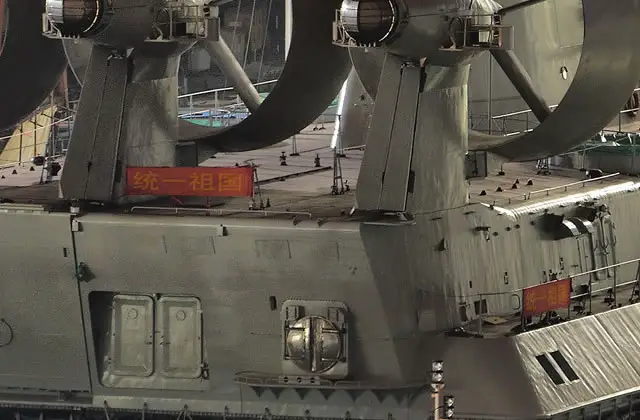
First Chinese built Zubr class LCAC for Chinese Navy (PLAN) reaching completion
The first Zubr (project 1232.2) amphibious hovercraft locally built in China is almost complete, as can be seen on a picture that recently emmerged on the Chinese internet. The Chinese Navy has placed an order for four landing craft at a reported cost of 315 million US dollars. Two were built by Feodosiya shipbuilding company and already delivered, and a second pair of vessels are being built in China under the supervision of Ukrainian technicians.
Currently the world’s largest hovercraft, development of Zubr landing ships started in the USSR in 1978, and the first serial ship joined Soviet Navy in 1988. Its carrying capacity is 3 main battle tanks with overall mass of 150 tons or 10 armored personnel carriers weighing up to 131 tons plus 140 marines, or 8 infantry fighting vehicles with mass up to 115 tons. If not carrying armor, Zubr is capable to accommodate 366 men.
In total, 14 Zubr-class ships have been launched; only two of them remain in inventory of Russian Navy. Five ships were decommissioned , two uncompleted, and five sold to Greece for the Hellenic Navy and where they are generally used in support of Special Forces. With the recent Chinese order, the total of Zubr-class ships to have been launched will reach 18.
Taiwan and its allies are concerned that these platforms may be used as part of Chinese offensive against Taiwan. According to sources, the banner displayed at the back of the Chinese built Zubr translates into "Reuniting the Motherland".
http://www.navyrecognition.com
Currently the world’s largest hovercraft, development of Zubr landing ships started in the USSR in 1978, and the first serial ship joined Soviet Navy in 1988. Its carrying capacity is 3 main battle tanks with overall mass of 150 tons or 10 armored personnel carriers weighing up to 131 tons plus 140 marines, or 8 infantry fighting vehicles with mass up to 115 tons. If not carrying armor, Zubr is capable to accommodate 366 men.
In total, 14 Zubr-class ships have been launched; only two of them remain in inventory of Russian Navy. Five ships were decommissioned , two uncompleted, and five sold to Greece for the Hellenic Navy and where they are generally used in support of Special Forces. With the recent Chinese order, the total of Zubr-class ships to have been launched will reach 18.
Taiwan and its allies are concerned that these platforms may be used as part of Chinese offensive against Taiwan. According to sources, the banner displayed at the back of the Chinese built Zubr translates into "Reuniting the Motherland".
http://www.navyrecognition.com
Thứ Bảy, 14 tháng 12, 2013
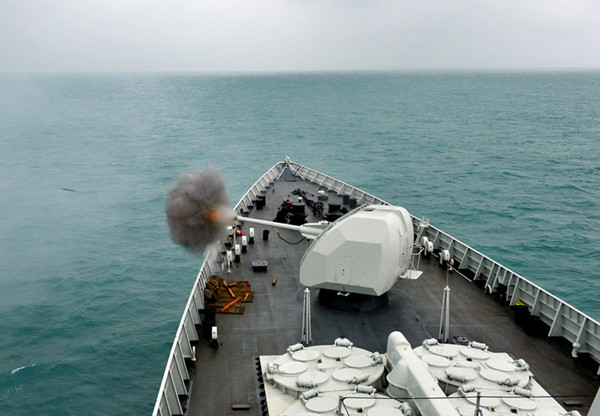
PLA Navy fires anti-ship missile
PLA Navy has launched anti-ship missile for training, Xinhua reported on Dec 15, 2013 without telling what kind of missile being fired but it looks like the YJ-82/ YJ-83 (Yingji-83) anti-ship missile.
The Yingji-83 (or YJ-83 - Chinese: 鹰击-83, literally "Eagle Strike") is a Chinese anti-ship missile based on the earlier YJ-82 model of the same class. It was designed as a supersonic successor to the subsonic YJ-82. The weapon's export designation is C-803.
Electronic Countermeasures maybe only way to counter Chinese DF-21D Ballistic Missile
According to a report from Russian Military Analysis , the only way to defeat the DF-21D ballistic missile may be through electronic countermeasures. The Dong-Feng 21D, is People's Liberation Army Navy's supersonic anti-ship ballistic missile with a a top speed of Mach 10 and a range of 1,450 kilometers.
Russian Military Analysis report explains that air defense system can be used to intercept high-speed flying objectives, as the USS Lake Erie, a Ticonderoga-class guided-missile cruiser, successfully destroyed malfunctioning spy satellite USA-193 with a RIM-161 Standard Missile 3 about 247 km above the Pacific in 2008; however, the report also noted that Lake Erie had an abundance of information regarding the trajectory of the satellite.
Lacking sufficient knowledge about the launch point of the missile, the only way to defeat the DF-21D is through electronic countermeasures which would allow the United States Navy a chance to evade the attack by changing the ballistic trajectory of the missile. There remains no other way for a US aircraft carrier to defend itself from an attack by the DF-21D, the report said.
navyrecognition.com
Russian Military Analysis report explains that air defense system can be used to intercept high-speed flying objectives, as the USS Lake Erie, a Ticonderoga-class guided-missile cruiser, successfully destroyed malfunctioning spy satellite USA-193 with a RIM-161 Standard Missile 3 about 247 km above the Pacific in 2008; however, the report also noted that Lake Erie had an abundance of information regarding the trajectory of the satellite.
Lacking sufficient knowledge about the launch point of the missile, the only way to defeat the DF-21D is through electronic countermeasures which would allow the United States Navy a chance to evade the attack by changing the ballistic trajectory of the missile. There remains no other way for a US aircraft carrier to defend itself from an attack by the DF-21D, the report said.
navyrecognition.com
Thứ Sáu, 13 tháng 12, 2013
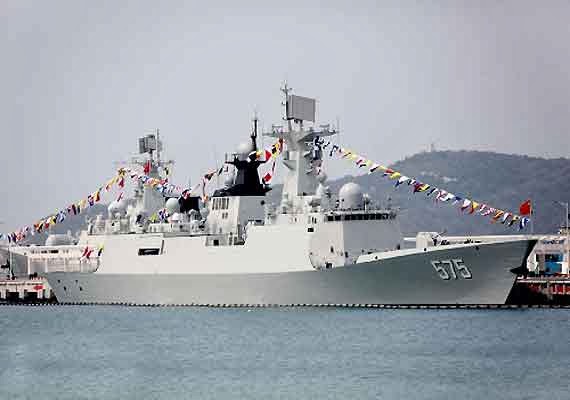
New missile frigate Sanya joins Chinese Navy
Beijing: Guided missile frigate Sanya joined China's People's Liberation Army Navy during a ceremony held Friday, according to military sources.
Independently developed and made by China, the Sanya is capable of attacking enemy ships and submarines and is especially adept in long distance vigilance and aerial defence combat, reports Xinhua.
The ship will serve as a new generation leading battleship for the Navy, sources said.
During Friday's ceremony, Wang Kai, captain of the Sanya, vowed that the ship's crew would manage and use their weapons well, strive to safeguard national sovereignty and contribute to building the country into a strong oceanic power.
Thứ Tư, 11 tháng 12, 2013
China's new aircraft carriers to be built in Dalian and Shanghai
China will construct two conventionally powered aircraft carriers in Dalian and Shanghai between 2014 and 2015, a source from China's Central Military Commission has told Duowei News, an outlet run by overseas Chinese.
Under the Commission's Project 048, China aims to establish three carrier battle groups by 2020 so that all three major fleets of the PLA Navy will be able to carry out missions with the full support of an aircraft carrier. The two new Type 001A indigenous carriers will be updated versions of China's first aircraft carrier, the Liaoning, which was originally a Soviet-era Admiral Kuznetsov-class aircraft carrier purchased from Ukraine in 1998. They will also likely be designed with a ski-jump ramp, according to Duowei.
Sources said that the General Equipment Department of the PLA has already signed a contract with the Beijing-based China Shipbuilding Industry Corporation to build the two carriers. The price of the two vessels is estimated to be worth US$9 billion.
China has yet to decide whether its J-31 stealth fighter will replace the J-15 to become the country's next generation carrier-based fighter, according to sources. The J-31 fighter entered service before the J-15, and is able to land or take off from the flight deck of the Liaoning. Sources said that a decision will only be made after the construction of the nation's second and third aircraft carriers is completed. This will give the PLA more time to think about the type of carrier-based fighter it will need in the future, the sources added.
Want China Times
Chinese military expert argues to deploy aircraft carrier in the S China Sea
Hong Kong, Dec. 11 (CNA) China's first aircraft carrier, the Liaoning, should be deployed in the South China Sea to strengthen the country's claim to the region, a Chinese military expert has argued.
"The South China Sea would be the best place for the Liaoning battle group to show its prowess," Song Zhongping was quoted as saying in an article in the Wednesday edition of the Hong Kong Chinese-language daily Wen Wei Po, a pro-Beijing newspaper.
Song said China needs to deploy an aircraft carrier in the South China Sea because it is facing many severe challenges in the region, including the occupation by several other countries of many islets, reefs or shoals in the sprawling region.
China claims the South China Sea as its territory, but other claimant countries such as the Philippines, Vietnam, Malaysia and Brunei that are geographically closer to the disputed islands see China as a belligerent bully.
Taiwan also has claims in the region and controls the Pratas Islands (also known as Dongsha Islands) and Taiping Island, the biggest of the Spratly Islands in the South China Sea.
As some South China Sea islands are located far away from the Chinese mainland, China has to deploy an aircraft carrier battle group in the region to defend its sovereignty claims, Song said.
The James Shoal in the southernmost part of the South China Sea just off the coast of East Malaysia, for instance, is 2,500 kilometers away from China, Song noted.
While Beijing's land-based warplanes can reach the remote islet, they can only stay airborne for relatively short periods of time, making it hard to gain air supremacy, Song said.
"If China can effectively deploy an aircraft carrier in the South China Sea, it will be able to extend its military presence in the region," Song said.
In another action seen as an attempt by Beijing to unilaterally push its contested sovereignty claims, China recently demarcated an East China Sea air defense identification zone (ADIZ) early this month that extended to the disputed Diaoyutai Islands, about 330 kilometers away from the Chinese coast.
The move ratcheted up tensions with Japan, which controls the islands, but Song said China would do the same in the South China Sea and could use the aircraft carrier group to defend it.
"China set up an ADIZ in the East China Sea, and when it sets up one in the South China Sea in the future, all of the airspace needs to be visible and controllable," Song said.
Deploying the aircraft carrier group in the region would be an important step to achieving the goal, he said, because air fighters would have trouble covering such a big area and long distances.
Escorted by four warships, the Liaoning is currently on its first-ever long-distance test and training mission in the South China Sea.
"The South China Sea would be the best place for the Liaoning battle group to show its prowess," Song Zhongping was quoted as saying in an article in the Wednesday edition of the Hong Kong Chinese-language daily Wen Wei Po, a pro-Beijing newspaper.
Song said China needs to deploy an aircraft carrier in the South China Sea because it is facing many severe challenges in the region, including the occupation by several other countries of many islets, reefs or shoals in the sprawling region.
China claims the South China Sea as its territory, but other claimant countries such as the Philippines, Vietnam, Malaysia and Brunei that are geographically closer to the disputed islands see China as a belligerent bully.
Taiwan also has claims in the region and controls the Pratas Islands (also known as Dongsha Islands) and Taiping Island, the biggest of the Spratly Islands in the South China Sea.
As some South China Sea islands are located far away from the Chinese mainland, China has to deploy an aircraft carrier battle group in the region to defend its sovereignty claims, Song said.
The James Shoal in the southernmost part of the South China Sea just off the coast of East Malaysia, for instance, is 2,500 kilometers away from China, Song noted.
While Beijing's land-based warplanes can reach the remote islet, they can only stay airborne for relatively short periods of time, making it hard to gain air supremacy, Song said.
"If China can effectively deploy an aircraft carrier in the South China Sea, it will be able to extend its military presence in the region," Song said.
In another action seen as an attempt by Beijing to unilaterally push its contested sovereignty claims, China recently demarcated an East China Sea air defense identification zone (ADIZ) early this month that extended to the disputed Diaoyutai Islands, about 330 kilometers away from the Chinese coast.
The move ratcheted up tensions with Japan, which controls the islands, but Song said China would do the same in the South China Sea and could use the aircraft carrier group to defend it.
"China set up an ADIZ in the East China Sea, and when it sets up one in the South China Sea in the future, all of the airspace needs to be visible and controllable," Song said.
Deploying the aircraft carrier group in the region would be an important step to achieving the goal, he said, because air fighters would have trouble covering such a big area and long distances.
Escorted by four warships, the Liaoning is currently on its first-ever long-distance test and training mission in the South China Sea.
Thứ Ba, 10 tháng 12, 2013
Navy destroyer Haikou returns to duty after refit

The PLA navy destroyer Haikou has undertaken more than 30 missions since the vessel was commissioned in 2005. Provided to China Daily
The destroyer Haikou, one of the most advanced warships in the People's Liberation Army navy, will be ready for duty this month after a 10-month maintenance period.
The Type 052C-class destroyer underwent the routine maintenance period scheduled for every 10 years of the ship's life, with work conducted at a military port in Guangdong province, according to authorities.
Construction on the ship started in 2002, and in 2005, it entered service in the South Sea Fleet, based in Guangdong province.
The maintenance included checking major components of the ship and repainting the main internal and external areas, said Li Hui, the ship's captain.
The ship's sailors and officers worked hard to ensure the combat readiness of the ship after maintenance was completed.
Wang Dong, a technician working on the Haikou, said many sailors worked in the shipyard that performed the maintenance and learned repair skills there that may be useful at sea. The idea was to prepare sailors to make emergency repairs when necessary, reducing the chances of the ship being out of action for long periods at sea.
Over the 10-month maintenance, the Haikou's crew continued to take part in various training operations. More than 100 sailors and officers participated in different missions, such as a joint Chinese-Russian military drill in July, Li said.
"The ship is ready for any mission now that the repair work is finished," Li said.
The ship's crew of 277, 16 of whom are women, receives training that simulates "real combat" environments, according to the ship's publicity officer.
The Haikou spends 280 days a year in "voyage training" at sea. Since it was commissioned in 2005, the ship has undertaken more than 30 missions, said Wu Chao, a publicity official for the PLA navy.
The Haikou is a successful example of PLA navy's performance at sea and combat capabilities, Wu said.
The Haikou participated in the first and 10th of the warships escort tours, each time accompanied by another destroyer and a supply ship. So far, the PLA navy has escorted 5,200 ships through the dangerous Somali waters.
In February 2009, the Haikou was dispatched to receive the Chinese commercial ship, the Tianyu No 8 after its release by Somali pirates. The ship had been hijacked and held by pirates for more than 80 days.
When it was released, it was running very low on supplies.
The Haikou's officers and soldiers donated food and clothes to help the commercial ship's crew after their release.
More importantly, the destroyer provided 60 tons of fuel as well as other supplies for the Tianyu No 8, despite difficulties posed by bad weather in the area.
As word of the PLA navy's safe and effective escorts spread in the area, more foreign ships, including those from Singapore, Cyprus and Greece, applied to join the Chinese escort fleets.
To meet their requests, the Haikou selected sailors who could speak fluent English to liaise with their partner ships. It set up a 24-hour bilingual signal channel and maintained contact with commercial ships from China and other countries by e-mail and fax.
The Haikou's contribution won the appreciation of foreign ships and international associations. In November 2009, the Haikou was awarded the Certificates for Exceptional Services Rendered to Shipping and Mankind by the International Maritime Organization.
ecns
Chủ Nhật, 8 tháng 12, 2013
Chinese aircraft carrier has major weaknesses: China Youth Daily
Liaoning aircraft carrier docks at a port in Sanya in China's southern island province of Hainan for supplies before it sets off to carry out experiments and military exercises in the South China Sea, Nov. 29. (Photo/CNS)
By sending its first aircraft carrier to the South China Sea, Beijing aims at more effective control over disputed islands in the region, but the vessel has five major weaknesses that make it unable to match up against US carriers, according to a Nov. 6 report in a Chinese state-run newspaper.
The China Youth Daily said that training in the South China Sea, where the Liaoning aircraft carrier headed for the first time Nov. 26, will allow it and other vessels to get more familiar with the maritime environment that is expected to become their main area of operation, but it will be some time before the Liaoning is combat-ready due to five major weaknesses, the official newspaper of the Communist Youth League of China said, listing them in order.
First, the Liaoning relies on Russian technology that limits the ship's range and usefulness in open sea; Secondly, the carrier cannot match the capabilities of US aircraft carriers, which can launch unmanned fighters with a range of up to 200 nautical miles; The electronics and weapons systems of the Liaoning and its J-15 fighter jets are far inferior to American carriers and their F/A-18 E/F Super Hornets, and the US carriers also boast E-2 Hawkeye early warning aircraft with a flying altitude and range that outclasses the Liaoning's Kamov KA-31 helicopter; Lastly, the paper said that China does not yet have a large-size battle group centered around the Liaoning, and the ability of its warships to take part in coordinated fighting is not yet mature.
China Declares Lunar Defense Obliteration Zone (LDOZ)
BEIJING — Following the successful launch of its first lunar rover, the Chinese government has declared a defensive zone extending vertically from China into space and encompassing the moon.
The Lunar Defense Obliteration Zone, according to newly appointed space minister Wu Houyi, “will protect China’s core interests and interplanetary sovereignty.” All foreign spacecraft, satellites, comets and space debris must notify China before passing through or into the zone.
Due to orbital complications, the boundaries of the LDOZ will shift daily in accordance with the position of the moon relative to its sovereign power. China’s Ministry of Space has issued diagrams of the shifting boundaries, dubbed “the lasso.”
Many countries have disputed China’s ability to establish such a zone, but Chinese officials are adamant about the country’s claim to Earth’s only natural satellite.
“China’s historical ties to the moon date back at least five thousand years, perhaps more,” said Chen Guang, an official historian from the Chinese Academy of Social Sciences. “We made a whole calendar based on it for Christ’s sake.”
As for the political ramifications, the Ministry of Space has promised not to impose terrestrial laws on the celestial object, nor push immediately for reunification.
“The moon will retain full autonomy,” Wu told reporters on Thursday, “and will continue to orbit the Earth as normal under the ‘One Country, Two Circumgyrating Bodies’ system.”
So far, the LDOZ has received widespread support from the public and government-issued propaganda posters have cropped up around Beijing and Shanghai bearing the slogan “China Dream, Moon Dream.”
One Weibo user, @永远玉兔 (Jade Rabbit Forever), suggested that China should enforce the defensive zone by constructing a giant laser which will point at whichever country is currently meeting with the Dalai Lama, and at Tokyo the rest of the time.
As America and Russia are expected to dispute the territorial boundaries, Chinese scientists, according to leaked classified documents, are investigating the feasibility of striking an obsolete satellite to trigger a chain reaction of space debris that will orbit the earth every 90 minutes, preventing all access to the LDOZ.
http://www.miniharm.com/2013/12/07/china-declares-lunar-defense-obliteration-zone/
Liaoning and J-15 jets to conduct drills in South China Sea
China's first aircraft carrier, the Liaoning, has set sail from the Qingdao naval base in northern China's Shandong province and will reach the disputed South China Sea within months to conduct a range of military training exercises, our sister paper Want Daily reports.
The J-15 naval carrier-based fighter jets will also join in the military exercises and will conduct live-fire tests to enhance air defense anti-missile, anti-ship, anti-submarine capabilities in three areas.
The live-fire tests will begin next year in the South China Sea, testing the J-15 fighter's capability in air combat and anti-ship warfare missions, according to a report by Hong Kong's Phoenix New Media.
The J-15 fighters will also test their scrambling capabilities and perform nighttime drills in the next three to five months to ensure they possess the power to attack remote outposts and their 24-hour fighting capability, the report said.
In addition to the J-15, the aircraft-carrier fleet includes two destroyers, two cruisers and two frigates to match the Liaoning. The country's nuclear-powered submarines will also join the fleet in the training exercises.
Meanwhile, observers said the aircraft carrier will run exercises in different areas and open waters, and the Liaoning and J-15 jets will have to prove whether they are capable of operating in the hot temperatures and high humidity of the South China Sea.
A number of countries lay claim to islands in the region, notably the Spratly islands consisting of more than 750 reefs, islets, atolls, cays and islands. They are claimed in whole or in part by China, Malaysia, the Philippines, Brunei, Vietnam and Taiwan.
Want China Times
The J-15 naval carrier-based fighter jets will also join in the military exercises and will conduct live-fire tests to enhance air defense anti-missile, anti-ship, anti-submarine capabilities in three areas.
The live-fire tests will begin next year in the South China Sea, testing the J-15 fighter's capability in air combat and anti-ship warfare missions, according to a report by Hong Kong's Phoenix New Media.
The J-15 fighters will also test their scrambling capabilities and perform nighttime drills in the next three to five months to ensure they possess the power to attack remote outposts and their 24-hour fighting capability, the report said.
In addition to the J-15, the aircraft-carrier fleet includes two destroyers, two cruisers and two frigates to match the Liaoning. The country's nuclear-powered submarines will also join the fleet in the training exercises.
Meanwhile, observers said the aircraft carrier will run exercises in different areas and open waters, and the Liaoning and J-15 jets will have to prove whether they are capable of operating in the hot temperatures and high humidity of the South China Sea.
A number of countries lay claim to islands in the region, notably the Spratly islands consisting of more than 750 reefs, islets, atolls, cays and islands. They are claimed in whole or in part by China, Malaysia, the Philippines, Brunei, Vietnam and Taiwan.
Want China Times
Đăng ký:
Bài đăng (Atom)


+Chinese+Nuclear+Second+Artillery+Corps+(SAC)+2nd++multiple+independently+targetable+re-entry+vehicle+(MIRV)+(5).jpg)