Hiển thị các bài đăng có nhãn Vietnam- China. Hiển thị tất cả bài đăng

Thứ Tư, 21 tháng 11, 2018

China building on new reef in South China Sea, think tank says


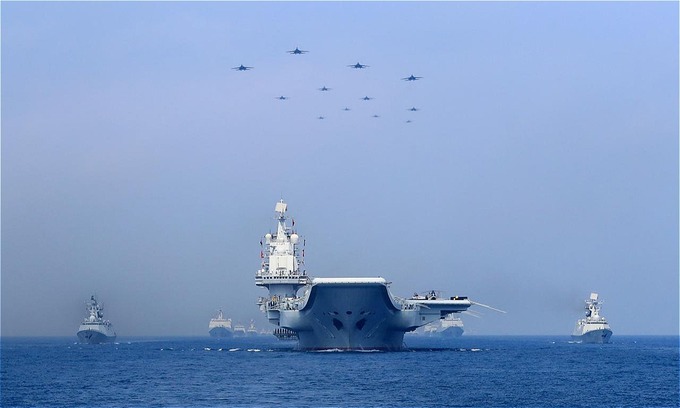
Warships and fighter jets of Chinese People's Liberation Army (PLA) Navy take part in a military display in the South China Sea, April 12, 2018. Photo by Reuters/Stringer

China has installed a new platform on a remote part of the Paracel Islands in the disputed South China Sea which could be used for military purposes.

The strategic waterway is claimed almost in its entirety by China, whose continued building of military and other installations on artificial islands and reefs there has unnerved the region and angered Washington, according to recent satellite images reviewed by a U.S. think tank.

The Asia Maritime Transparency Initiative of Washington's Center for Strategic and International Studies said the images showed a "modest new structure" on Bombay Reef, topped by a radome and solar panels.

"The development is interesting given Bombay Reef's strategic location, and the possibility that the structure's rapid deployment could be repeated in other parts of the South China Sea," the group said in a statement on Tuesday.

The purpose of the platform and radome was unclear, but it could be for military use, it said.

"The reef is directly adjacent to the major shipping lanes that run between the Paracels and the Spratly Islands to the south, making it an attractive location for a sensor array to extend Chinese radar or signals intelligence collection over that important sea lane," the group said.

China's Defense Ministry did not respond to a request for comment.

Foreign Ministry spokesman Geng Shuang said China's sovereignty over the Paracel Islands was not in dispute, and there is nothing wrong with China carrying out construction work on its own territory.

"As for the specific situation you mention, I have no understanding of it," Geng told a daily news briefing.

Vietnam calls the waters the East Sea and has often declared its sovereignty over its Paracels and Spratlys. Vietnam's foreign ministry did not immediately respond to a request for comment.

Emphasis on civil infrastructure

Separately, an influential state-run paper said on Wednesday that China should put more focus on building civilian facilities on islands in the South China Sea and less emphasis on the military to soothe regional fears about China's intentions.

In a commentary, China's Study Times said there was a "potential risk of war" for areas surrounding the country such as the South China Sea.

"Unprecedented outside military interference is the biggest threat to peace and stability in the South China Sea," said the paper, published by the Central Party School which trains rising officials.

"Without the strong deterrence power of our military in the South China Sea, then protecting regional peace and stability is merely idle theorising and falls short of what we would wish."

But there must be a greater role for non-military actors in the South China Sea, it added.

"Facilities on the reefs and islands of the South China Sea should be more civilian and less military," the paper wrote.

That means there should be more focus on building lighthouses, civilian airports, maritime search and rescue, scientific research and weather forecasting, it added.

"Just as the Chinese government has repeatedly stressed, after the completion of the island facilities, they will actively provide relevant public security products and services to regional countries," the paper said.

This will help the international community with things like counter-terror and anti-piracy operations, to jointly safeguard peace and security in the South China Sea, it added.

China has said some civilian facilities on the islands are intended for use by others in the region, but the government has given few details about how that may work in practice.

The islands China occupies in the South China Sea are off-limits to foreigners, with access under the effective control of the People's Liberation Army despite them technically being administratively part of China's southern Hainan province.

Vietnam, Malaysia, the Philippines, Taiwan and Brunei also have competing claims in the South China Sea.

China has frequently lambasted the United States and its allies for freedom of navigation naval operations near to Chinese-occupied islands.

The United States earlier this month again urged China to halt militarisation of the South China Sea.

China said it had the right to build "necessary defense facilities" on what it considers its own territory and urged Washington to stop sending warships and military planes close to the islands that Beijing claims.

Source: https://e.vnexpress.net/news/world/china-building-on-new-reef-in-south-china-sea-think-tank-says-3842672.html

Thứ Sáu, 9 tháng 3, 2018

China warns US and Vietnam after US carrier docks in Vietnam

Beijing accuses ‘external powers’ of flexing muscles in South China Sea after US carrier docks in Vietnam. Arrival of ‘fully armed vessel’ in disputed waterway is ‘greatest disturbance to peace and stability’, Foreign Minister Wang Yi says.


China’s foreign minister on Thursday took a veiled swipe at a US aircraft carrier’s highly symbolic visit to a Vietnamese port, saying “external powers” were showing off their military muscle and creating a great disturbance in the South China Sea region.

Speaking at a press conference in Beijing on the sidelines of the National People’s Congress – the annual session of the country’s ceremonial parliament – Wang Yi said also that China and the Association of Southeast Asian Nations planned to hold at least three rounds of talks on a code of conduct for handling disputes in the South China Sea, though he avoided answering a question on whether such a code would be legally binding.

The USS Carl Vinson arrived in Da Nang, Vietnam, on Monday, becoming the first aircraft carrier to dock in the country since the end of the Vietnam war in 1975. The visit was seen by some as a warning to Beijing over its military build-up in the region.


China's Foreigh Minister Wang Yi

“Now the major challenge is that there are certain external powers who are unwilling to accept the stability in the South China Sea and always want to stir up trouble,” Wang said.
“Sending a fully armed vessel and aircraft to show off its military powers in the South China Sea has become the greatest disturbance to the peace and stability in the South China Sea.”

The US aircraft carrier was accompanied on the port call by the guided missile cruiser USS Lake Champlain and destroyer USS Wayne E. Meyer. The three ships had a combined crew of about 6,500 sailors and Marines.


Meanwhile, a recent report by the Centre for Strategic and International Studies, a US think tank, said China has completed the construction of a large communications/sensor array on Fiery Cross Reef in the Spratly Islands, which could be used for intelligence gathering.


The US Navy’s guided missile cruiser USS Lake Champlain (left) and destroyer USS Wayne E. Meyer accompanied aircraft carrier USS Carl Vinson on its port visit to Dan Nang in Vietnam. Photo: EPA-EFE

Beijing claims almost all of the South China Sea, through which about US$5 trillion worth of goods passes every year. And despite a landmark ruling in 2016 by the Permanent Court of Arbitration in The Hague that said there was no legal basis for China’s maritime claims, it has pressed ahead with island building in the disputed waterway.

The Philippine Inquirer newspaper reported last month that China has almost finished transforming seven reefs in the Spratly Islands into military bastions, with ports, air strips, lighthouses, hangars and multistorey buildings.

Despite the concerns over its rapid militarisation in the region, Wang said China remained steadfast in its commitment to maintaining peace and stability.

“The basis of our handling of South China Sea issues is that … we are responsible for the Chinese people, we are responsible for the historical facts, we are responsible for peace in the region, and we are responsible for the international rule of law,” he said.

China has been Asean’s biggest trading partner for the past nine years, with the value of bilateral trade reaching US$500 billion last year, Wang said.
China would continue to build on its relations with Asean, with the focus on increasing cooperation on political and security issues, economics and trade, cultural exchanges, and the Mekong River, he said. - SCMP

Chủ Nhật, 16 tháng 2, 2014

Vietnam anti-China activists mark 1979 war

China invaded Vietnam's northernmost provinces in February 1979, angered by Vietnam's ousting of the Beijing-backed Khmer Rouge regime in Cambodia.


Protesters in Hanoi shout anti-China slogans in Vietnamese that means "The people has never forgotten, 1979 - 2014" during a rally marking the anniversary of the border war with China on February 16, 2014 (AFP, Hoang Dinh Nam)

-->See more picture

Vietnamese activists have marked the 35th anniversary of a bloody border war with China, chanting slogans, singing patriotic songs and laying flowers at a temple in central Hanoi.

The two communist countries are locked in long-standing territorial disputes over the Paracel and Spratly islands in the South China Sea, and often trade diplomatic barbs over oil exploration and fishing rights in the contested waters.

Beijing's increasingly assertive stance in the South China Sea has triggered public anger and rare protests in authoritarian Vietnam where the demonstrations are sometimes allowed to go ahead and on other occasions forcefully broken up.

China invaded Vietnam's northernmost provinces in February 1979, angered by Vietnam's ousing of the Beijing-backed Khmer Rouge regime in Cambodia.

The short but bloody conflict claimed tens of thousands of lives on both sides and ended with Chinese forces withdrawing and both Hanoi and Beijing claiming victory.

Vietnamese troops remained in Cambodia until 1989.

Although Vietnam fetes its military victories over the French and American armies, it has not arranged any official events to mark the China border war - much to the chagrin of veterans and activists.

"Vietnamese leaders may have received pressure from China, so they don't want to talk about that war. They seem to want to deny the past," Nguyen Trong Vinh, a former Vietnamese ambassador to China, told AFP.

China has long been one of Vietnam's largest trading partners, state media has said, with bilateral trade at more than $US40 billion ($A45 billion) in 2012.

On Sunday, around 100 activists tried to lay flowers at a statue of Ly Thai To - the founder of Hanoi and a nationalist figurehead - in the centre of the capital.

But dozens of people had been at the monument since early morning, playing loud music and dancing, which prevented the protesters from holding their planned ceremony - in what activists said was a counter protest.

"It was deliberate... they (authorities) hired many people," economist Nguyen Quang told AFP at the protest.

Protesters, wearing red headbands and carrying white roses with black ribbons saying "the people will never forget", then walked around the central Hoan Kiem lake.

They laid their flowers and made brief speeches at the Ngoc Son Temple - a popular tourist destination - before peacefully dispersing.

Plain clothed and uniformed police closely monitored the event but did not make any arrests.

Source AAP