Hiển thị các bài đăng có nhãn SCS Disputes. Hiển thị tất cả bài đăng

Thứ Tư, 21 tháng 11, 2018

China building on new reef in South China Sea, think tank says


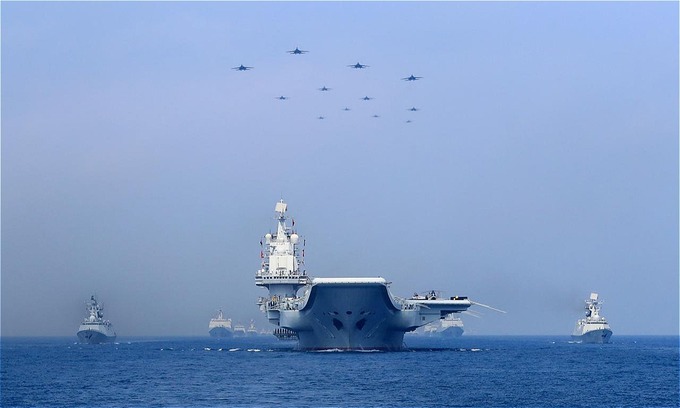
Warships and fighter jets of Chinese People's Liberation Army (PLA) Navy take part in a military display in the South China Sea, April 12, 2018. Photo by Reuters/Stringer

China has installed a new platform on a remote part of the Paracel Islands in the disputed South China Sea which could be used for military purposes.

The strategic waterway is claimed almost in its entirety by China, whose continued building of military and other installations on artificial islands and reefs there has unnerved the region and angered Washington, according to recent satellite images reviewed by a U.S. think tank.

The Asia Maritime Transparency Initiative of Washington's Center for Strategic and International Studies said the images showed a "modest new structure" on Bombay Reef, topped by a radome and solar panels.

"The development is interesting given Bombay Reef's strategic location, and the possibility that the structure's rapid deployment could be repeated in other parts of the South China Sea," the group said in a statement on Tuesday.

The purpose of the platform and radome was unclear, but it could be for military use, it said.

"The reef is directly adjacent to the major shipping lanes that run between the Paracels and the Spratly Islands to the south, making it an attractive location for a sensor array to extend Chinese radar or signals intelligence collection over that important sea lane," the group said.

China's Defense Ministry did not respond to a request for comment.

Foreign Ministry spokesman Geng Shuang said China's sovereignty over the Paracel Islands was not in dispute, and there is nothing wrong with China carrying out construction work on its own territory.

"As for the specific situation you mention, I have no understanding of it," Geng told a daily news briefing.

Vietnam calls the waters the East Sea and has often declared its sovereignty over its Paracels and Spratlys. Vietnam's foreign ministry did not immediately respond to a request for comment.

Emphasis on civil infrastructure

Separately, an influential state-run paper said on Wednesday that China should put more focus on building civilian facilities on islands in the South China Sea and less emphasis on the military to soothe regional fears about China's intentions.

In a commentary, China's Study Times said there was a "potential risk of war" for areas surrounding the country such as the South China Sea.

"Unprecedented outside military interference is the biggest threat to peace and stability in the South China Sea," said the paper, published by the Central Party School which trains rising officials.

"Without the strong deterrence power of our military in the South China Sea, then protecting regional peace and stability is merely idle theorising and falls short of what we would wish."

But there must be a greater role for non-military actors in the South China Sea, it added.

"Facilities on the reefs and islands of the South China Sea should be more civilian and less military," the paper wrote.

That means there should be more focus on building lighthouses, civilian airports, maritime search and rescue, scientific research and weather forecasting, it added.

"Just as the Chinese government has repeatedly stressed, after the completion of the island facilities, they will actively provide relevant public security products and services to regional countries," the paper said.

This will help the international community with things like counter-terror and anti-piracy operations, to jointly safeguard peace and security in the South China Sea, it added.

China has said some civilian facilities on the islands are intended for use by others in the region, but the government has given few details about how that may work in practice.

The islands China occupies in the South China Sea are off-limits to foreigners, with access under the effective control of the People's Liberation Army despite them technically being administratively part of China's southern Hainan province.

Vietnam, Malaysia, the Philippines, Taiwan and Brunei also have competing claims in the South China Sea.

China has frequently lambasted the United States and its allies for freedom of navigation naval operations near to Chinese-occupied islands.

The United States earlier this month again urged China to halt militarisation of the South China Sea.

China said it had the right to build "necessary defense facilities" on what it considers its own territory and urged Washington to stop sending warships and military planes close to the islands that Beijing claims.

Source: https://e.vnexpress.net/news/world/china-building-on-new-reef-in-south-china-sea-think-tank-says-3842672.html

Chủ Nhật, 15 tháng 4, 2018

Vietnam's Fishing ‘Militia’ to Defend Against China


FILE - A Vietnamese boat (L) which was rammed and then sunk by Chinese vessels near disputed Paracels Islands in 2014.


MP3 Link: https://drive.google.com/file/d/14jdugN05tFwMPTfVjV6DkmdYhB_fWsAz/view
Vietnam is reported to be quietly developing a state-supported fishing boat militia to hold off China at sea. The fishing militia is being created at a time when the two sides talk about easing territorial disputes.

That is the opinion of experts who follow those disputes.

Vietnam watchers say the country is asking its commercial fishers to use stronger boats and take military-trained people to sea in case of a clash with Chinese fishers. China has its own fishing militia operating in the same waters.

“I think it’s a good policy to avoid future conflicts where militia fishermen are out in the sea,” said Trung Nguyen. He serves as dean of international relations at the Ho Chi Minh University of Social Sciences and Humanities.

Vietnam has been working to develop the fishing militia since at least 2009. Over that time, the two countries have been holding talks. Just last week, Vietnam’s Communist Party general secretary met the visiting Chinese foreign minister. The party official suggested “joint safeguarding (of) maritime peace,” China’s Xinhua News Agency reported.

Vietnam may be trying to appear strong now in case talks fail to produce results, noted Eduardo Araral of the National University of Singapore’s school of public diplomacy.


FILE - A Vietnamese naval soldier stands quard at Thuyen Chai island in the Spratly archipelago.

How the militia works

The Vietnamese fishing militia has not gone to battle with China. If the militia did, it would risk facing the third largest military in the world.

But Vietnamese military forces are arming fishing boats, said Southeast Asia expert Carl Thayer. That may be similar to the deployment of former soldiers to help keep order as needed on land in Vietnam, Thayer noted.

The Vietnamese government requires conscription, he added, so fishermen would already have some military skills.

“Putting them at sea would just be getting people the right age and giving them that training,” he said. “All they did is move what they do on land, how to defend factories … and extend that to sea.

Thayer is emeritus professor at the University of New South Wales in Australia.

Thirteen fishing militia platoons have been helping more than 3,000 fishermen work near the Paracel Islands in the South China Sea. That information comes from a 2017 study by the S. Rajaratnam School of International Studies in Singapore. China controls the Paracels, but Vietnam also claims the islands.

The study found that more than 10,000 fishermen and about 2,000 fishing boats in southern Vietnam have received military equipment.

In 2014, Vietnam prepared a list of rules to aid fishermen who build “modern large capacity ships” to expand their reach, the study found. It said Vietnamese banks had lent $176 million to fishermen for improvements to about 400 ships.


South China Sea territorial claims map

Record of clashes

China claims about 90 percent of the 3.5 million-square-kilometer South China Sea. Vietnam says it should control the sea’s waters off its long north-south coastline, extending into the Paracels and Spratly Islands.

Sailors died in clashes between the two countries in 1974 and 1988. In 2014, the deployment of a Chinese oil rig in the South China Sea caused a boat-ramming incident at sea and deadly rioting in Vietnam against Chinese interests.

China has long had its own fishing militia with military support and attention from the Chinese President, notes the United States-based Naval War College. Armed fishing boats help defend China’s maritime claims by pushing away foreign boats, the political intelligence service Stratfor reported in 2016.

Five other governments claim all or parts of the South China Sea. They oppose Chinese efforts to build up and expand islands in the waterway.

Vietnam and China often hold talks about settling maritime problems, but talks often fall short of a decision because of historic distrust, Araral said. He added that Vietnam may be sending China the message that while we talk, we assert our rights.

A Vietnamese fishing militia will not be as large as China's militia, he said, but Vietnam feels it must try.

I'm Susan Shand

Susan Shand adapted this story from VOA. George Grow was the editor.


Words in This Story

maritime – adj. of or relating to sailing on the sea or doing business (such as trading) by sea

conscription – n. the act of calling citizens to serve in the military

platoon – n. part of a company-sized military force; a group of people who are doing something together

emeritus – ​adj. a person retired from professional life but permitted to retain as an honorary title the rank of the last office held​

capacity – ​n. ​the ability to hold or contain people or things — usually singular​

rig – n. a large structure on the sea

assert – v. to state or declare, often forcefully

ramming – adj. striking something violently

dean – n. the head of a college or school at a university

commercial – adj. related to or used in the buying and selling of products

Source: https://learningenglish.voanews.com/a/vietnams-fishing-militia-to-defend-against-china/4340613.html