Hiển thị các bài đăng có nhãn US vs China. Hiển thị tất cả bài đăng

Thứ Sáu, 20 tháng 12, 2013

Can a China-Russia Axis Bankrupt the US?

Russia and China have studied the end of the Cold War and how the US ultimately defeated the USSR by bankrupting it.

By J. Michael Cole

According to Chinese State Councilor Yang Jiechi and Secretary of the Security Council of the Russian Federation Nikolai Platonovich Patrushev, 2013 was “a year of harvest” for Sino-Russian relations. It was also a year of new lows for the countries’ relations with the West — and from the look of it, things could get worse in 2014.

Much has been said in recent years about how two difficult wars in Iraq and Afghanistan and a sagging economy cut the U.S. at the knees and created space for China. During this same period, China was enjoying double-digit economic growth and a relatively stable security environment, emerging as a hegemon in Asia. As the U.S. was struggling to extricate itself from, and was pouring billions of dollars into, unwinnable wars, Beijing was reaping the benefits of its “peaceful rise” by building its economy, resolving longstanding territorial disputes with neighbors, consolidating ties with smaller powers within the region, and neutralizing Taiwan as a potential source of armed conflict.

Thus, when China began flexing its muscles in the East and South China Seas, Beijing was not cowed by the U.S. “pivot,” or “rebalancing,” to Asia. For one thing, it was apparent that Washington’s renewed interest in East Asia would not — at least not in the medium term — be accompanied by a willingness to allocate sufficient capital and resources to make the pivot a credible counter to China. As Beijing and many U.S. defense experts saw it, the rebalancing was more a wish list and academic exercise than an actual strategy, let alone one that was anywhere near implementation. That is the reason why Beijing suffered little consequences when it threatened to alter the status quo within the region, such as with the November 23 declaration of its extended Air Defense Identification Zone (ADIZ) in the East China Sea. (There is every reason to believe that a credible U.S. pivot to Asia would have deterred Beijing, which ostensibly does not seek war at this point in time, from embarking on such adventurism.)

Now by working together, China and Russia could make sure that the U.S. rebalance to Asia, if it ever materializes, remains a diluted, and therefore ineffective, affair. They could do so by enlarging the spatial scope of U.S. security responsibilities and further stretching its military’s diminished resources. A few years ago, Bobo Lo, an associate fellow at Chatham House, proposed the term “axis of convenience” to describe the relationship between China and Russia. Five years after the publication of his book of the same title, the relationship has never been more convenient. For the time being at least, Beijing and Moscow appear to have set their own territorial disputes aside, and by cooperating at the strategic level they are hoping to force the U.S. out of Asia altogether.

A substantial amount of attention has been paid to China’s Anti-Access/Area Denial (A2/AD) strategy, with the DF-21D anti-ship ballistic missile (ASBM) serving as one of its principal components, and to which we can now perhaps add the ADIZ. Less, however, has been said of Russia’s ongoing efforts to keep the U.S. out of its backyard. It is interesting to note that two weeks after China’s ADIZ announcement, Russian President Vladimir Putin, meeting top military officers, stated that Russia would bolster its presence in the potentially resource-rich Arctic. Earlier that month and a little more than a week after China sprung its ADIZ surprise, the Russian navy announced that the Arctic would be its priority in 2014. As The Diplomat reported earlier this month, Russia is currently deploying aerospace defense and electronic warfare units to the area, and is now building a comprehensive early-warning missile radar system near Vorkuta in the extreme north, among other developments.

The growing presence of the Russian military in the Arctic — which stands to turn into a region of strategic importance — will surely prompt a countervailing response from the U.S. (it has already indicated plans to increase its foothold in the region). However, doing so — let’s call it a “rebalancing to the Arctic” — would further strain the U.S. military budget and thereby take resources away from the “pivot” to Asia.

Simultaneously, the Russian military confirmed on December 16 that it had deployed nuclear-capable Iskander-M tactical ballistic missile systems, with a range of approximately 400km, into its Baltic exclave of Kaliningrad and along its border with NATO members Poland, Estonia, Latvia, and Lithuania. The news followed reports the previous weekend that satellite imagery had unveiled the presence of 10 such launchers in the exclave. Although President Putin denied the deployment on December 19, Russia has shown every indication that it seeks to expand its operations in its Western Military District, which aside from Kaliningrad also includes much of the European part of Russia.

There are questions over whether Washington can afford to substantially increase defense spending without bankrupting the country. It will find itself unable to counter both a resurgent China in East and Southeast Asia, where it has been speculated that China could eventually announce a second ADIZ, and a more muscular Russian presence in the Arctic and near the Baltic states. Either the U.S. will focus on one, or it will attempt to meet all contingencies, but do so with less-than optimal resources. With Washington feeling it has little choice but to choose the latter course of action, China and Russia will both benefit by confronting a diffuse and distracted opponent or succeed in breaking the U.S.’s back by forcing it to overspend — unless other countries like Japan and NATO members agree to greatly expand their defense spending, which appears unlikely. Furthermore, there are also doubts about whether the Japanese would agree to constitutional changes of the sort that would allow for military burden sharing of the type envisaged here.

Whether the U.S. has a “right” to be an actor in what Russia and China consider as their backyard is a question we’d better seek to answer elsewhere. But what is clear is that a weakened U.S., whose ability to meet the challenge of China’s “rise” is already very much in doubt, now seems on the brink of facing a multi-pronged challenge from a Sino-Russian axis that, if it is to be countered effectively, will require a number of “pivots.” Whether Russia’s economy can sustain a military expansion on the scale necessary to prompt a U.S. realignment is questionable, though the increasingly authoritarian nature of its leadership means that Moscow will be far less vulnerable than Washington to public discontent with huge defense spending in times of austerity.

Both Russia and China have closely studied the end of the Cold War and how the U.S. ultimately defeated the U.S.S.R. by bankrupting it. Two decades later, it looks like Moscow and Beijing are trying to return the favor.

The Diplomat


Outstanding comment: There is no need for the Russians and Chinese to get together and bankrupt the U.S. .... the U.S. is doing a very good job at bankrupting itself by consistently electing politicians who enjoy spending money that is borrowed and will need to be paid one day (maybe).

Thứ Ba, 17 tháng 12, 2013

After Near-Collision in S China Sea, China tests New Long-Range Missile

DF-41 is second test of road-mobile, likely MIRV-capable ICBM

China’s military conducted the second flight test of its newest long-range missile that is capable of hitting targets in the United States with a nuclear warhead, according to defense officials.

The flight test of the new Dong Feng-41, or DF-41, took place Friday from the Wuzhai missile launch center in Shanxi province to an impact range in western China, said officials familiar with details of the tests.

It was the second test of the new, road-mobile, long-range ICBM that U.S. intelligence agencies assess will be outfitted with up to 10 multiple, independently-targetable reentry vehicles, or MIRVs.

DF-41 Launcher/ DF-41 missile/ DF-41 ICBM
DF-41D Launcher

Prior to Friday’s flight test, the last DF-41 flight test took place July 24, 2012.

Pentagon spokesmen did not return emails seeking comment on the missile test.

The most recent test indicates that China’s long-range missile development is continuing, and the missile is raising new concerns about China’s professed nuclear doctrine of not being the first to use nuclear weapons in a conflict.

Disclosure of the nuclear missile flight test comes as tensions remain heightened between the United States and China over the near collision between the USS Cowpens, a guided missile cruiser, and a Chinese navy tank landing ship in the South China Sea on Dec. 5.

The State Department and Pentagon protested the incident, which involved the Chinese ship stopping in the path of the Cowpens, forcing the cruiser to make an abrupt maneuver to avoid a collision. The incident took place near China’s first aircraft carrier, the Liaoning.

The DF-41, with its range of between 6,835 miles and 7,456 miles and expected multiple-warhead capability, is viewed as a potential “first strike” weapon, or a weapon capable of carrying out a surprise nuclear attack that would knock out an enemy’s arsenal and limit its counterstrike capability.

A report by the Air Force National Air and Space Intelligence Center made public in May referred to China’s development of a new long-range missile with multiple warheads, in addition to current long-range DF-31 and DF-31A mobile ICBMs.

“China has the most active and diverse ballistic missile development program in the world,” the NASCI report said. “It is developing and testing offensive missiles, forming additional missile units, qualitatively upgrading missile systems, and developing methods to counter ballistic missile defenses.”

“The Chinese ballistic missile force is expanding in both size and types of missiles.”

Without mentioning the DF-41, the report said, “China may also be developing a new road-mobile ICBM capable of carrying a MIRV payload, and the number of warheads on Chinese ICBMs capable of threatening the United States is expected to grow to well over 100 in the next 15 years.”

Defense officials said the report was referring to the DF-41.

Rick Fisher, a China military affairs expert and senior fellow at the International Assessment and Strategy Center, said reports of the latest DF-41 test coincide with disclosures on Chinese military enthusiast websites showing a new 18-wheel transporter erector launcher for the new DF-41.

“It appears that this new large MIRV-capable ICBM is making progress toward achieving an operational status,” Fisher said.

Fisher said there are reports that the Second Artillery Corps, as China’s missile service is called, includes at least one reload missile for each mobile missile-launcher system.

If the new DF-41 is deployed in the future with a reload missile per launcher, it would vastly increase the numbers of nuclear warheads in the Chinese arsenal, as many as 120 to 240 warheads for each DF-41 unit.

“What this means is that Obama administration suggestions that the United States can continue to reduce its number of deployed warheads, perhaps to 1,000 or less, is simply irrational,” Fisher said.

“What we know and don’t know about China’s ability to rapidly increase its warhead numbers points to an unacceptable level of risk for the United States.”

In addition to the DF-41, China also has begun to deploy its submarine-launched ballistic missile called the JL-2 and may develop a follow-on JL-2A with up to three warheads.

“Inasmuch as the U.S. Navy estimates there will be up to five of the 12-missile carrying Type 094 nuclear powered ballistic missile submarines, this at least indicates that [missile submarines] could become another source for fast Chinese warhead growth,” he said.

The publication Jane’s Strategic Weapon Systems reported in 2012 that the Chinese were developing the DF-41, also designated the CSS-X-10, and that it is intended to replace easy-to-target silo-based DF-5 and DF-5A missiles.

Larry Wortzel, a former military intelligence officer and member of the congressional U.S.-China Economic and Security Review Commission, told the House Armed Services Committee in testimony last month that the new DF-41 is part of China’s growing nuclear missile arsenal.

“China is enhancing its nuclear deterrent capability by modernizing its nuclear force,” Wortzel said Nov. 20. “It is taking measures such as developing a new road-mobile intercontinental ballistic missile (ICBM), the DF-41. This missile could be equipped with a multiple independently targetable reentry vehicle (MIRV), allowing it to carry as many as 10 nuclear warheads.”

Wortzel said the Chinese, in addition to MIRVs, could outfit their missiles with “penetration aids” designed to defeat U.S. missile defenses. China also may be developing rail-mobile ICBMs, he said.

The Chinese nuclear buildup could have a profound impact on regional security. China recently has been bullying its neighbors, specifically Japan and Philippines, over islands and maritime claims.

“When China achieves a position of nuclear parity or even superiority, we can expect that it will make far more vigorous demands on the United States that could diminish the security of America and its friends and allies,” Fisher said.

Mark Stokes, a former Pentagon official and specialist on China’s strategic nuclear systems has said the DF-41 has been mentioned in Chinese military writings and appears to involve a larger, solid fuel rocket motor derived from the DF-31 series ICBMS.

Ground tests of the DF-41 motor have been detected over the past several years.

There are suspicions among U.S. intelligence analysts that the DF-41 is based on Russia’s mobile ICBM known as the SS-27 and that the DF-41 will incorporate Russian missile guidance technology.

China in August conducted two flight tests of the DF-31A ICBM and in November 2012, another DF-31A was flight-tested.

Tsai The-sheng, Taiwan’s director of the National Security Bureau, as the intelligence service for the island nation is called, told Taiwan’s legislature that China is still developing the DF-41 and the sub-launched JL-2.

“Neither of them has been deployed at any Chinese military base yet,” Tsai said, the official Central News Agency reported April 15.

Tsai said that China’s fast pace of military technology development makes it very likely the People’s Liberation Army will deploy a multi-warhead DF-41 in the future.

by Bill Gertz

Freebeacon

US warns China against imposing South China Sea air zone

US Secretary of State John Kerry warned China Tuesday against imposing an air defence zone over the South China Sea, similar to one it declared over disputed islands in the East China Sea.

MANILA: US Secretary of State John Kerry warned China Tuesday against imposing an air defence zone over the South China Sea, similar to one it declared over disputed islands in the East China Sea. "The zone should not be implemented and China should refrain from taking similar, unilateral actions elsewhere in the region, and particularly over the South China Sea," Kerry told a news conference in Manila.
The Philippines warned last month that China's announcement of an Air Defence Identification Zone (ADIZ) in the East China Sea raised the prospect of it doing the same for the South China Sea.

The Philippines, China, Vietnam, Malaysia, Brunei and Taiwan have overlapping claims to parts of the strategically vital and potentially resource-rich South China Sea.

"Today, I raised our deep concerns about China's announcement of an East China Sea air defence identification zone," Kerry said, referring to his discussions in Manila with Philippine Foreign Secretary Albert del Rosario.

"I told the foreign secretary that the United States does not recognise that (East China Sea) zone and does not accept it."

Beijing's East China Sea air defence zone requires aircraft to provide flight plans when traversing the area, declare their nationality and maintain two-way radio communication, or face "emergency defensive measures".

The zone covers disputed Tokyo-controlled islands -- known as Senkaku in Japan and Diaoyu in China -- where ships and aircraft from the two countries already shadow each other.

Analysts warn that the ADIZ in the East China Sea is a forerunner to a similar zone in the South China Sea, which Beijing claims almost in its entirety.

Kerry, in Manila for a two-day visit, threw his support behind the Philippines over its simmering South China Sea territorial row with China, calling Manila a "key treaty ally".

Tensions between the Philippines and China have risen in recent years as Beijing becomes more forthright in asserting its claim over most of the South China Sea.

Earlier this year, Manila took Beijing to a United Nations tribunal over the contested Scarborough Shoal, which lies about 220 kilometres (135 miles) from the Philippines' main island of Luzon and has been controlled by Chinese government vessels since last year.

"The United States is committed to working with the Philippines to address its most pressing security challenges," Kerry said.

"That is why we are negotiating a strong and enduring framework agreement that will enhance defence cooperation under our alliance, including through an increased rotational presence in the Philippines," he said.

Both sides are in the final stages of hammering out a deal allowing more US troops, aircraft and ships to temporarily pass through the Philippines, where the last US bases closed in 1992.

- AFP/ec

How China's Weapons Technology Snatchers Are Penetrating US Defenses


OAKLAND, California (Reuters) - Agents from Homeland Security sneaked into a tiny office in Oakland's Chinatown before sunrise on December 4, 2011. They tread carefully, quickly snapping digital pictures so they could put everything back in place. They didn't want Philip Chaohui He, the businessman who rented the space, to learn they had been there.

Seven months had passed since they'd launched an undercover operation against a suspected Chinese arms-trafficking network - one of scores operating in support of Beijing's ambitious military expansion into outer space.

The agents had allowed a Colorado manufacturer to ship He a type of technology that China covets but cannot replicate: radiation-hardened microchips. Known as rad-chips, the dime-sized devices are critical for operating satellites, for guiding ballistic missiles, and for protecting military hardware from nuclear and solar radiation.

It was a gamble. This was a chance to take down an entire Chinese smuggling ring. But if He succeeded in trafficking the rad-chips to China, the devices might someday be turned against U.S. sailors, soldiers or pilots, deployed on satellites providing the battlefield eyes and ears for the People's Liberation Army.

Entering He's office at 2:30 that December morning, the agents looked inside the FedEx boxes. The microchips were gone. The supervisor on the case, Greg Slavens, recoiled.

"There are a bunch of rad-chips headed to China," Slavens recalls thinking, "and I'm responsible.'"

In the past 20 years, the United States has spent trillions of dollars to create and deploy the world's best military technology. It also has enacted laws and regulations aimed at keeping that technology away from potential adversaries such as Iran, North Korea and the nation that poses perhaps the most significant long-term threat to U.S. military supremacy, China.

China's efforts to obtain U.S. technology have tracked its accelerated defense buildup. The Chinese military budget - second only to America's - has soared to close to $200 billion.

President Xi Jinping is championing a renaissance aimed at China's asserting its dominance in the region and beyond. In recent weeks, Beijing has declared control over air space in the contested East China Sea and launched China's first rover mission to the moon.

IMMEDIATE THREAT

As China rises to challenge the United States as a power in the Pacific, American officials say Beijing is penetrating the U.S. defense industry in ways that not only compromise weapons systems but also enable it to secure some of the best and most dangerous technology. A classified Pentagon advisory-board report this year, for instance, asserted that Chinese hackers had gained access to plans for two dozen U.S. weapons systems, according to the Washington Post.

But the smuggling of technology such as radiation-hardened microchips out of America may present a more immediate challenge to the U.S. military, Reuters has found. If China hacks into a sensitive blueprint, years might pass before a weapon can be manufactured. Ready-made components and weapons systems can be - and are - used immediately.

Beijing says its efforts to modernize its military are above-board. "China has mainly relied on itself for research and development and manufacturing," the Chinese defense ministry said in a statement to Reuters. "China always complies with relevant laws and cooperation agreements and protects intellectual property rights."

How often the Chinese succeed at acquiring U.S.-made weaponry or components is unclear. U.S. government officials say they don't know, in part because the problem is too widespread and difficult to track. By its very definition, black market smuggling is hard to monitor and quantify. Quite often, sensitive U.S. technology is legally shipped to friendly nations and then immediately and illegally reshipped to China.

China also presents a special challenge: It is both the largest destination for legally exported American-made goods outside North America and the most or second-most frequent destination for smuggled U.S. technology. A 2010 classified Pentagon assessment showed a spike in legal shipments to China of "dual-use" technology - products that have civilian and military purposes, a person involved in the study said.

The technology products the Chinese military seeks tend to be miniaturized, and thus aren't easily identifiable to U.S. border agents - unlike drugs, for example. And trafficking in these goods isn't technically illegal until someone tries to export them.

"When you think about how many legitimate transactions go to a place like China, it makes it very difficult to track," said Craig Healy, a senior Homeland Security official who directs the U.S. export enforcement center.

Officially published U.S. estimates of how frequently American arms technology gets smuggled are incomplete. By one Pentagon calculation, suspicious queries to U.S. defense manufacturers by entities linked to China increased 88 percent from 2011 to 2012. The government won't disclose the number of cases that underlie that percentage.

U.S. defense and intelligence officials said that although they closely monitor the Chinese buildup, they believe China remains at least a decade behind America. "They still have a long way to go," said one senior U.S. defense official.

Reuters analyzed court records from 280 arms-smuggling cases brought by the U.S. government from October 1, 2005 to October 1, 2013. Reporters also interviewed two dozen counter-proliferation agents and reviewed hundreds of internal Federal Bureau of Investigation, Homeland Security and Commerce Department documents.

The number of counter-proliferation arrests related to all countries quadrupled from 54 to 226 from 2010 to 2012, internal law enforcement records show. Since 2008, the number of China-related space-technology investigations - like the undercover case against the Oakland man - has increased approximately 75 percent, U.S. law enforcement sources said. Since late 2012, federal agents say they have begun nearly 80 space-and-satellite-related investigations.

"I think we're getting better at this, but this stuff is rampant," said FBI assistant director for counter-intelligence Robert Anderson Jr. Anderson was referring to cases involving all potentially hostile nations, not just China. "The more you dig in these cases," he said, "the more potential investigations you find."

Said a U.S. diplomat based in China: "I think we do a good job on the cases that we learn about, but it's really just a finger in the dike."

A MAN NAMED "HOPE"

U.S. counter-proliferation agents say the 2011 Oakland sting is typical of dozens launched recently against people trying to acquire space and missile technology for China. It also demonstrates the difficulty in dismantling smuggling networks, even when a target appears patently suspicious from the outset.

The Oakland investigation began in spring 2011. The manufacturer, Aeroflex of Colorado Springs,Colorado, received an email from a man who called himself Philip Hope of Oakland. The man wanted to buy two kinds of rad-chips - 112 of one type and 200 of the other. The total cost:

$549,654.

The initial email triggered suspicion.

People and companies who buy these kinds of rad-chips are usually well-established, repeat customers - more multinational corporation than mom & pop. Aeroflex salesmen had never heard of "Philip Hope" or his company, "Sierra Electronic Instruments."

Most suspicious of all, just days after placing the order, Hope sent Aeroflex a certified check for the full amount, $549,654. That was rare. Buyers were expected to make a deposit, but nobody paid up front.

The suspicious Aeroflex employees contacted Homeland Security Investigations (HSI), a division of Immigration and Customs Enforcement, which keeps a special counter-proliferation office in the space technology hub of Colorado Springs.

Based on quick record checks, the HSI agents drew a portrait of "Philip Hope." The man was a Chinese immigrant and legal permanent resident, Philip Chaohui He, an engineer for the state of California assigned to a Bay Bridge renovation project. Sierra Electronic Instruments was a start-up run from the one-room office in Chinatown.

The HSI agents concluded that He was buying the rad-chips on behalf of someone else. Someone rich. Someone who couldn't legally acquire them. Probably someone in China - likely the China Aerospace Science and Technology Corp, a state-run entity that operates nearly all of China's military and civilian space projects.

China Aerospace officials did not respond to requests for comment. An official at a Shanghai subsidiary said he was unaware of the He purchases.

The rad-chips He ordered from Aeroflex are not the most powerful on the market, and could not operate a sophisticated military satellite on their own. But experts say they have few uses other than as one of the many components of a sophisticated satellite.

"You wouldn't spend that kind of money on those microchips unless you intended to use them in much bigger satellites," said Alvar Saenz-Otero, associate director of the Space Systems Lab at the Massachusetts Institute of Technology. "They fit the design of a satellite that you'd want to stay in space for a reasonably long time, and therefore are likely small parts of a bigger satellite."

Despite the concerns about where and how the components might be used, He's order of 312 rad-chips violated no law. These chips may be legally sold domestically, and to foreign buyers who obtain a State Department license. They may not be exported outside the United States to certain nations, including China. He had the chips sent to his office address in Oakland, making the deal legal. If He tried to take them abroad, he'd be breaking the law.

THE AGENTS' DILEMMA

The agents faced the key question that comes in almost every counter-proliferation case: Could they lure the suspect into a sting? If so, would it be worth the trouble?

Undercover operations are time-consuming, expensive and risky. If agents dangled rad-chips in front of the suspect and he got away, the components would probably end up on Chinese satellites. If they delivered the chips and watched him closely, he might lead them to a network traceable to Beijing.

The agents in the case faced another complication: At the time, Aeroflex - the very manufacturer enlisted to help with the sting - was itself under civil investigation for sending rad-chips to China.

Although that investigation was still under way, Aeroflex had already admitted that it sent more tha n14,500 rad-chips to China between 2003 and 2008. Aeroflex exported more than half of those chips even after U.S. officials had directed it to stop doing so.

The company declined to comment. But documents show two mitigating factors - Aeroflex voluntarily disclosed the transgressions, and it blamed them in part on misreading complex and sometimes competing Commerce Department and State Department regulations.

Even so, State Department regulators would ultimately conclude: "The exports directly supported Chinese satellites and military aircraft, and caused harm to U.S. national security."

Thus, if the HSI agents wanted to attempt a sting against the man in Oakland, they would have to trust a company that had admitted aiding a potential enemy on a much larger scale.

On July 28, 2011, a federal agent posing as a Federal Express driver arrived at He's office building in Oakland. The agent handed He's wife a package containing the first order, 112 rad-chips. She leaned it against a wall.

The undercover agent wore a hidden camera that recorded the office's 10-by-12-foot interior. The place had sleeping bags and mattresses on the floor. There was no satellite research equipment.

The agent departed, but not before leaving a tiny surveillance device. For the next five weeks, the device indicated that the box didn't move. Agents also put a camera outside the office door, placed a keystroke-logger on He's computer and monitored his movements based on his cell phone location. They placed his name on an automated watch list at airports and border crossings.

But they didn't have the manpower to tail him. He slipped out of the country on September 6, taking a flight to San Diego and driving across the border at Tijuana.

The agents received an automated security alert only the following day, September 7. They also learned that He was booked on a flight from Tijuana to Shanghai that evening. It was too late. They'd missed him.

Was China about to receive 112 military-grade microchips for its space program? There was no way to know for sure.

The agents had two options: Drop the case, or send He the second batch of chips and try to catch him exporting those.

ANOTHER SURPRISE

On October 6, an undercover agent helped FedEx deliver the second shipment, 200 radiation-hardened chips. Once again, the agents waited and watched.

When two months passed with no indication that He had moved the microchips, Slavens sought the sneak-and-peak warrant. The late night search, on December 4, turned up empty boxes. Slavens then sought a warrant for He's home and renewed the airport and border look-outs.

On the morning of December 10 - before the agents could complete the search warrants - the smuggler surprised them again. An agent noticed He's cell phone on the move, far south of Oakland, heading toward Los Angeles - presumably to Tijuana again, and then on to China. Slavens scrambled Homeland Security Investigations agents near Los Angeles.

The L.A. agents followed the cell-tracker to a Best Western hotel south of the city. In the early evening, they located He's Honda sedan in the hotel parking lot. They confirmed that He had checked in, and they settled in for surveillance.

At about 8:45 a.m. on December 11, 2011, He left his hotel room with an unidentified traveling companion and pulled the Honda onto Interstate 110, driving south. Tijuana was two hours away. The HSI agents planned to stop him at the Mexico border.

But after just 3 miles, He pulled into the Port of Long Beach. Then, he used a Transportation Safety Administration pass - a badge he carried for his Bay Bridge repair assignment - to swiftly get through port security.

The agents caught up as the Honda drew near a red and white cargo ship flying a Chinese flag. Stenciled on the mast were the letters ZPMC. This was the same company with the Bay Bridge repair contract to which He had been assigned by the California transit agency. A coincidence? The agents couldn't be sure. (ZPMC did not respond to requests from Reuters for comment.)

HSI agents stopped He and his friend as they approached the ship captain. An agent opened the trunk. Stuffed inside a tub of Similac infant formula, authorities found 200 radiation-hardened Aeroflex microchips.

The agents say the captain told them that he expected to receive "household goods" and other consumer purchases from He for delivery to friends in China. The captain and He's driving companion were permitted to leave. He was handcuffed.

Under questioning, He told the agents that he'd started his Oakland business at the behest of a Shanghai electronics broker who promised to reward him with a condominium in China for his assistance.

THE MISSING CHIPS

In August, more than five years after Aeroflex admitted wrongdoing, the State Department announced an $8 million fine for the company's 2003 to 2008 satellite microchip shipments to China. If Aeroflex completes remedial measures, such as training employees to follow rules the company already should have been following, half of the fine will be suspended.

In September, He pleaded guilty in federal court in Colorado. He is scheduled to be sentenced Wednesday. Federal guidelines call for a sentence of 46 to 57 months.

In a court filing, his lawyer disputed the government's assertion that He knew the rad-chips were destined for use by the Chinese government. Assistant federal defender Robert Pepin said He believed they would be used for commercial mining satellites. Pepin said He deserves a sentence of no more than 24 months, noting that He faces certain deportation when his sentence concludes, and potential separation from his children, who are U.S.-born citizens.

"The life he knew and enjoyed is destroyed," Pepin said.

Despite the scope of the investigation, no one else was charged. The others in the suspected network - the ship captain, the Shanghai broker, the traveling partner and another Oakland suspect - were not arrested.

The fate of the first shipment of 112 radiation-hardened chips - the ones that got away - is unknown. U.S. officials strongly suspect they are either in China or orbiting the Earth aboard one of Beijing's satellites.

(Edited by Blake Morrison)

This post originally appeared at Reuters. Copyright 2013.

Thứ Hai, 16 tháng 12, 2013

Defense analysts tell Congress to devise war plan aiming at China

The US military needs a specific war plan designed to counter China, especially after its recent declaration of an air defense zone over the East China Sea, a group of defense analysts advised a congressional panel.

South Korea and US warships participate in their joint military drill Foal Eagle in South Korea’s West sea on March 17, 2013.

The defense analysts told the US House Armed Services’ Seapower and Projection Forces Subcommittee on Wednesday that the Pentagon should begin a massive arms build-up, including additional nuclear submarines and long-range anti-ship missiles for a possible confrontation with China.

“Chinese leaders are ambitious and they are moving toward great power status. The US is not taking this possibility as seriously as it should,” Seth Cropsey, a senior fellow at The Hudson Institute, told the subcommittee, according to DoD Buzz.

To respond to this threat, he added, the US needs to devise a more focused war plan for China.

Much of the hearing was focused on how the US can counter Chinese strategic moves in the region through the use of its military assets. The analysts said China has sought to control waterways, choke points and restrict access to key islands and territories in the region.

China’s military spending has increased dramatically in the past ten years, from an estimated $45 billion in 2003 to $115 to $200 billion currently, said Jim Thomas, vice president and director of studies at the Center for Strategic and Budgetary Assessments.

China is investing heavily on military ships, long-range missiles, fighter jets and submarines, he explained.

Rep. Randy Forbes (R-VA), the subcommittee chairman, said that this military modernization is “emboldening the Chinese government to exert their interests by bullying their neighbors and pushing back the United States in the Asia Pacific region.”

Andrew Erickson, associate professor at the US Naval War College, testified that the US should deploy its Virginia-class nuclear-powered attack submarines to deny China the ability “to hold and resupply any forcefully seized islands.”

The relations between the United States and China have been further strained after Beijing announced an air defense zone over the East China Sea last month.

Washington has said it will not recognize the defense zone. The US flew two B-52 bombers over disputed islands in the East China Sea to challenge Beijing’s declaration.

An American guided missile cruiser and a Chinese warship “nearly collided” in the sea about a week ago, US Pacific Fleet announced on Friday.

Presstv

Chủ Nhật, 15 tháng 12, 2013

US warship threatened China's security: state media

Beijing — A US warship that was forced to manoeuvre to avoid a collision with a Chinese naval vessel had "posed a threat", state-run media said Monday, after Washington accused China of being the aggressor.

A Chinese People's Liberation Army-Navy Harbin Z-9 flies alongside the People's Liberation Army-Navy destroyer Qingdao (DDG 113) during a search and rescue exercise off the coast of Hawaii on September 9, 2013 (US NAVY/AFP, -)

The Global Times newspaper, which often takes a nationalistic stance, said the USS Cowpens guided missile cruiser had "come to China's threshold and posed a threat to China's military security".
Washington issued a formal protest after the incident in the South China Sea between the USS Cowpens and a Chinese People's Liberation Army (PLA) Navy vessel on December 5, insisting that the ships were in international waters.

Beijing claims almost the whole of the strategically significant South China Sea, even areas close to the coasts of other littoral states.

"If the American navy and air force always encroach near China's doorstep, 'confrontation' is bound to take place," the Global Times said. "As China's strength grows, the US should learn to communicate with and respect China if it doesn't want a collision on the sea or in the air."

The stand-off underscored tensions that escalated after Beijing last month declared an expanded "air defence identification zone" in the East China Sea.

Chinese authorities have not yet made any official comment on the near-miss at sea, the most significant maritime incident between the two powers since 2009, when five Chinese ships surrounded and harassed a US Navy surveillance ship in the same waters.

US naval officers and defence officials said last week that the Chinese ship had crossed directly in front of the USS Cowpens and halted less than 500 metres away, forcing the American ship to take evasive action to avoid a collision.

The Global Times quoted an anonymous Chinese military expert as saying the US "was tailing after and harassing" China's Liaoning aircraft carrier, which was conducting drills in the area, and that the USS Cowpens had come within 45 kilometres of the "inner defence layer of the Chinese fleet".

"Bad guys always claim innocence first," the source told the paper, adding that the US warship "took offensive actions at first towards the Liaoning formation on the day of the confrontation".

Su Hao, a professor of Asia-Pacific studies at China Foreign Affairs University, defended the Chinese vessel's actions, saying they were necessary to protect Beijing's maritime rights.

"The Chinese took action only after the US vessels refused to comply with warnings," he told the China Daily newspaper.

AFP

Thứ Bảy, 14 tháng 12, 2013

Why China forced a confrontation at sea with US Navy

The USS Cowpens had to veer sharply to avoid colliding with a Chinese military vessel in international waters earlier this month, the US Navy has confirmed. In the USS Cowpens incident, what message was China sending?

By Anna Mulrine, Staff writer / December 13, 2013

US Navy FA-18 Hornets cram the flight deck of the USS George Washington during a joint military exercise with Japan in the Pacific Ocean near Japan's southernmost island of Okinawa in November. The 13-day drill ended in the day as an air defense zone newly declared by China on Nov. 23 in the East China Sea has raised some tensions in the region. Kyodo News/AP

Reports that a Chinese navy vessel tried this month to force a US warship to a halt in international waters have senior US officials and longtime Asia analysts asking what, precisely, China was trying to prove by the maneuver.

US naval officials note that the USS Cowpens – a guided missile warship – was “lawfully operating” in waters near the South China Sea when it had an encounter with a People's Liberation Army (PLA) vessel “that required maneuvering to avoid a collision,” according to an article in the Washington Free Beacon.

The incident followed China’s announcement that it will establish an air defense identification zone (IDIZ) in the East China Sea, a move that elicited howls of objection from the US military, as well as from China’s neighbors in Southeast Asia, who worry about Beijing's growing willingness to flex its military muscle in the region.

While US Navy officials confirm the episode, they also caution that these sorts of standoffs with China happen with relative frequency in the Pacific and that, according to one Navy officer with knowledge of the event, it’s important not to “overhype” the incident.

That said, the recent run-in holds a larger message, analysts say. The chief one may be that the US will not be able to comfortably troll the waters of the western Pacific.

“The Chinese are trying to make it clear that, if the US wants to operate in these waters, then it should be prepared to be operating under a high state of tension,” says Dean Cheng, senior research fellow for Chinese political and security affairs at the Heritage Foundation. “If the US doesn’t want tension, then it’s very simple: leave.”

The confrontation, he adds, was “a deliberate effort to intimidate.”

If this is the case, then to what end? After all, a majority of elites in China prefer to strengthen the bilateral relationship with the United States rather than to pursue "hawkish," hegemonic ambitions, according to a recent report from Michael Swaine, senior associate at the Carnegie Endowment for International Peace.

One possible answer is that recent PLA moves indicate that the “Chinese are now trying to establish a much greater presence in the western Pacific,” says Dr. Swaine. “In a sense, they want to convey to other countries that they are out there, they’re operating, and other people need to recognize this and abide by their desires.”

The USS Cowpens was conducting surveillance of China’s new aircraft carrier, the Liaoning, at the time. According to the Washington Free Beacon, a Chinese ship that was accompanying the carrier moved in front of the Cowpens to try to make it come to a full halt – hardly a safe maneuver. The bottom line is that China is out “to make sure that the US shows respect to China – that they acknowledge a sphere of influence,” says Patrick Cronin, senior director of the Asia-Pacific Security Program at the Center for Strategic and International Studies.

For this reason, he adds, “China’s military posture is increasingly assertive.”

But that doesn’t mean the PLA “is devoted to taking over the western Pacific and ejecting the US,” says Swaine.

More likely, China is interested in establishing greater ability to deter other forces – including Japan and the US – ”from being able to prevail in possible confrontations over Taiwan and other disputed territories,” he says.

In other words, says Swaine, China wants to make it “much more difficult for the US and Japan to be confident that they can use military coercion or force to try to deflect Chinese behavior or threaten China in some way.”

And while “it’s probably true that China doesn’t have imperial ambitions, on the other hand it’s imperious,” Dr. Cronin says.

The net result, Cronin adds, could be that China is behaving in a way that increasingly coalesces an anti-China faction – "the very one that China is purporting to be trying to guard against."

Electronic Countermeasures maybe only way to counter Chinese DF-21D Ballistic Missile

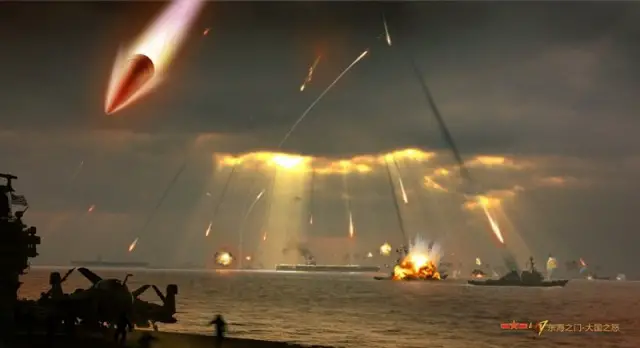
According to a report from Russian Military Analysis , the only way to defeat the DF-21D ballistic missile may be through electronic countermeasures. The Dong-Feng 21D, is People's Liberation Army Navy's supersonic anti-ship ballistic missile with a a top speed of Mach 10 and a range of 1,450 kilometers.

Chinese DF-21D Launcher

Russian Military Analysis report explains that air defense system can be used to intercept high-speed flying objectives, as the USS Lake Erie, a Ticonderoga-class guided-missile cruiser, successfully destroyed malfunctioning spy satellite USA-193 with a RIM-161 Standard Missile 3 about 247 km above the Pacific in 2008; however, the report also noted that Lake Erie had an abundance of information regarding the trajectory of the satellite.

Lacking sufficient knowledge about the launch point of the missile, the only way to defeat the DF-21D is through electronic countermeasures which would allow the United States Navy a chance to evade the attack by changing the ballistic trajectory of the missile. There remains no other way for a US aircraft carrier to defend itself from an attack by the DF-21D, the report said.


"Artist Impression" of DF-21D Warheads coming down on a US CVBG

navyrecognition.com

Thứ Sáu, 13 tháng 12, 2013

Call Made to Congress for China War Plan

By Kris Osborn

GROTON, Conn. (June 1, 2010) -- The Virginia-class attack submarine USS New Mexico (SSN 779) transits the Thames River to her new homeport at Naval Submarine Base New London. New Mexico joins Submarine Squadron (SUBRON) 4.

The U.S. military needs a more focused war plan specific to China, especially after China’s recent declaration of an air defense zone over the East China Sea, a group of defense analysts told a prominent House subcommittee Wednesday.

As part of the Pentagon’s overall defense strategy to pivot to the Pacific, the U.S. should buy more Virginia-class attack submarines, prioritizing long-range anti-ship missiles, carrier-based drones, and missile defense technology, the analysts told the House Armed Services’ Seapower and Projection Forces Subcommittee.

Seth Cropsey, a senior fellow at The Hudson Institute, told the subcommittee that the U.S needs a detailed war plan for China in the event that conflict arises.

“Chinese leaders are ambitious and they are moving toward great power status. The U.S. is not taking this possibility as seriously as it should,” said

Much of the hearing was focused on how the U.S. can counter-balance Chinese strategic moves to deny access to certain areas in the region through the use of long-range missiles, guided missile destroyers and submarines. In particular, the analysts said China have sought to control waterways, choke points and restrict access to key islands and territories in the region.

China has already provoked tensions in the region by declaring an air-defense zone in the East China Sea. U.S. leaders flew two unarmed B-52s through the area shortly after the announcement. However, the White House has also asked civilian U.S. airliners to alert China when their aircraft fly through the zone.

“While Naval modernization is a natural development for any sea-faring nation such as China, it is clear the modernization is emboldening the Chinese government to exert their interests by bullying their neighbors and pushing back the United States in the Asia Pacific region,” said Rep. Randy Forbes, R-Va., chairman of the Seapower and Projection Forces Subcommittee.

If China succeeds in restricting access to or controlling its near seas, that would present “major implications for U.S. strategy and constitute a major challenge to the post World War II international order,” said Ronald O’Rourke, specialist in Naval Affairs, Congressional Research Service.

Chinese defense spending has increased from an estimated $45 to $60-billion annually in 2003 to $115 to $200 billion today, said Jim Thomas, vice president and director of studies, Center for Strategic and Budgetary Assessments.

This includes investments in ships, long-range missiles, fighter jets and submarines, he explained. Unlike the U.S. which maintains a global posture, the Chinese military can spend all of its funds on regional counter-intervention, Thomas said.

The Chinese military has as many as 100 land-based strike fighters equipped with sophisticated avionics, sensors and advanced air-to-air missiles, he testified. Thomas also mentioned China’s DF-21D long-range ballistic missile, a weapon with a maneuverable warhead able to attack large surface combatants at ranges up to 930 miles.

“A decade ago China was reliant upon Russian assistance in its armaments, but is now increasingly shifted toward indigenous design and production. It is rapidly building up a modernized submarine force and its advanced guided missile destroyers represent a major improvement in fleet air defenses,” he told the Subcommittee.

These defenses are designed to protect aircraft carriers and help China push its Naval perimeter further off the coast, Thomas added. China also has an armada of small, armed fast-attack craft which could make it difficult for foreign forces to approach to within 200 nautical miles of the Chinese coast, Thomas testified.

Being able to thwart or spoof command and control and intelligence, surveillance and reconnaissance networks needs to be a key part of a counter-China defense strategy, Thomas emphasized as well.

Andrew Erickson, associate professor at the U.S. Naval War College, testified that the U.S. should do more to deny China the ability to seize and hold off-shore territory. This includes developing anti-ship cruise missiles such as the recently tested Long Range Anti-Ship Missile as well as long-range surface to air missiles, he said.

Erickson said offensive mine warfare could also provide key elements of the strategy. Most of all, however, Erickson emphasized that the U.S. should use its undersea technological advantage to deny China the ability to seize territory.

He stressed that the Navy should maintain its current pace of building two Virginia-class attack submarines, called SSNs, per year.

“It is therefore essential to ensure the present two-a-year construction rate of Virginia-class, nuclear-powered attack submarines. These SSNs are ideal for denying China the ability to hold and re-supply any forcefully seized islands. Given China’s ongoing limitations in anti-submarine warfare and the inherent difficulty of progressing in this field, China could spend many times the cost of these SSNs and still not be able to counter them effectively,” Erickson.

Rourke also told the Subcommittee that the U.S. might want to consider acquiring three Virginia-class submarines per year, citing the importance of the platform.

Dodbuzz.com

Thứ Tư, 11 tháng 12, 2013

US plans for Guam missile base seen as countering strength of China

Countering the North Korea missile threat is the stated objective, but many see the move as being more directed at the strength of China

The US is planning to station anti-ballistic-missile systems on the Pacific island of Guam, a move ostensibly to defend against unpredictable North Korea, but which analysts say may be intended to counter China.

Within Washington's defence plans for next year are provisions for siting terminal high-altitude area defence (Thaad) systems on the island territory, combined with the broader realignment of US forces in the Asia-Pacific region.

Under those movements, United States troop numbers on the Japanese island of Okinawa are due to be cut, with troops from the Futenma air station relocated to an enlarged base in the northeast of the prefecture, while others will be reassigned to Guam, South Korea and Australia.

The report on the defence planning states that: "The committee recognises the strategic importance of providing ballistic missile defence for Guam and the current US asset based there.

"The committee further recognises that as part of bilateral negotiations with the government of Japan, the US military presence on the island and the need to protect it from missile threat are projected to increase."

Thaad systems and Patriot interceptor missiles have been stationed on Guam in the past, supplementing warships, but the report cites the "immediate threat of missiles launches from the Democratic People's Republic of Korea toward US military assets on Guam" as reason for the move.

Politicians on Guam also requested that it have permanent missile systems as defence against North Korean missiles.

However, Go Ito, a professor of international relations at Tokyo's Meiji University said: "My feeling is that while they may be naming North Korea, this is more aimed at China.

"North Korea has missile technology and there are concerns about political stability in Pyongyang at the moment, but China has developed its own missile capabilities, so that is the bigger concern for the US.

"These missiles are targeted at any prospective threats that China might pose in the future," he said. "And putting them on Guam does away with the possibility of causing new political problems in Okinawa."

Siting missiles in Guam was the latest move in the military game of chess that was being played out in the region, he added.

"But I'm actually quite optimistic about how things will play out," he said. "Both China and Japan know that a military confrontation will only have negative consequences.

"That is, admittedly, based on a rational calculation and such rational calculations are not always equal on both sides, but I believe China understands that it benefits from foreign direct investment into its economy and that its development is still quite fragile."

SCMP

Thứ Ba, 10 tháng 12, 2013

China Adopts Board-Game Strategy to Blunt U.S. Pivot to Asia

The foreign policy strategy emerging from China’s new leadership may include a series of incremental steps calibrated to blunt U.S. influence across Asia and sow doubt about America’s commitment to its allies in the region.

Potential next steps following last month’s imposition of an air defense zone over the East China Sea in the face of U.S. condemnation include more vigorously challenging aircraft that enter the area, imposing a similar zone over disputed territory in the South China Sea and asserting naval control over islands also claimed by other nations.

“Such actions, if they occur, will cause greater worries in the region and increase calls for the U.S. to strengthen its military, diplomatic and economic presence,” said Bonnie Glaser, a senior Asia adviser at the Center for Strategic and International Studies in Washington. “The risk is of greater U.S.-China strategic competition.”

A year into his term as head of the Communist Party, President Xi Jinping is taking measures to bolster his nation’s standing in the region and counter an increased U.S. military deployment to Asia. The strategy features such steps as the air-zone declaration that fall short of direct confrontation yet in time alter spheres of geographic influence, according to Douglas Paal, director of the Asia Program at the Carnegie Endowment for International Peace in Washington.

Classic Game

“China is playing the classic game of weiqi, wherein it slowly expands influence through steps that are not a threshold to violence and do not trigger a forcible response,” Paal said, referring to the strategic board game known as Go in English. “Next steps are likely in the South China Sea, but this will be delayed as China builds out its radar and intercept infrastructure.”

Since Xi took over, Japan has accused Chinese ships of locking fire-control radar on its vessels and China dispatched ships and aircraft near islands claimed by both sides. The Chinese navy last month deployed its Liaoning aircraft carrier to the South China Sea, parts of which are also claimed by the Philippines and Vietnam.

The air defense zone that China announced Nov. 23 and which also drew criticism from Japan and South Korea as it covered islands they claim, gives it a strategic advantage, Li Jei, a senior captain at the China Ocean Research Center, wrote Dec. 6 in the state-run Global Times newspaper. The zone gives America and Japan “no option but to face the reality, negotiate with us, giving us favorable strategic circumstances,” Li wrote.

Sending Message

China’s actions are aimed at sending a message to the U.S. that it’s serious about challenging an Asian order in which America has been the dominant power for 40 years, said Hugh White, a professor of strategic studies at Australian National University in Canberra.

“They’re saying to America that we’re so serious about this that we’re prepared to take the risks of being provocative, in order to persuade you to take seriously that we want to change the order,” said White, author of the book “The China Choice: Why America Should Share Power.”

The increased use of naval vessels and aircraft heightens the danger of an accident or misstep that could escalate out of control. During a visit to the region last week, Vice President Joe Biden called on all sides to take practical steps to “lower the temperature.”

Using Force

At the same time, the U.S. pivot “will certainly generate a lot of suspicion and worry in China,” said Dong Wang, director of the Center for Northeast Asian Strategic Studies at Peking University in Beijing.

“Each and every one of the things China has done has been in response to what it perceives as a provocation,” Dong said, citing Japan’s decision to buy some of the islands disputed with China last year. “China is not making provocations on its own initiative.”

Japanese Prime Minister Shinzo Abe said in October he wouldn’t allow China to alter the situation around disputed islands by force. He approved a plan to shoot down any drones that enter Japan’s airspace, while a Chinese defense ministry spokesman responded that the shooting down of a drone would prompt retaliation.

“Things move much faster in the air than they do on the water and it looks like the kind of cat-and-mouse games really are transferring from the water now,” said Benjamin Charlton, Asia-Pacific analyst at Oxford Analytica, a strategic consulting firm based in Oxford, England. “That inherently raises the risk of miscalculation.”

Taken Steps

While China has taken steps to expand its air and naval footprint, the U.S. has sent more surveillance aircraft to Japan and is stationing anti-missile interceptors on Guam as part of the rebalancing strategy that President Barack Obama detailed in 2011. The U.S. is also shifting 2,500 Marines to the Australian city of Darwin from Okinawa, Japan.

Biden made it clear on a trip to China last week that the U.S. won’t reverse its rebalancing policy. “We are and will remain a Pacific power diplomatically, economically, and militarily,” he said in a Dec. 5 speech in Beijing.

For its part, China hasn’t neglected the diplomatic front in its battle to curtail U.S. influence. With Obama distracted by tensions in the Middle East and domestic politics, China has sought to fill the vacuum and boost ties with its South East Asian neighbors, some of whom have conflicts with it over islands in the South China Sea.

Canceled Trip

A day after Obama announced in October he had canceled an Asian tour due to the government shutdown at home, China signed agreements to boost economic cooperation and defense ties with Malaysia. And while Obama sent Secretary of State John Kerry to the region in his stead, Xi went to the Asia-Pacific Economic Cooperation summit in Bali, where he described the region as “a big family.”

“We will have to see what the U.S. will do to shore up the idea that they are in Asia to stay,” said Roderick MacFarquhar, professor emeritus of Chinese politics at Harvard University in Cambridge, Massachusetts. “That they’re not going to quit the stage and leave it to China, and that they’re not going to desert their friends and allies.”

To contact Bloomberg News staff for this story: Henry Sanderson in Beijing at hsanderson@bloomberg.net; Indira A.R. Lakshmanan in Washington at ilakshmanan@bloomberg.net

To contact the editor responsible for this story: Rosalind Mathieson at rmathieson3@bloomberg.net

Thứ Bảy, 18 tháng 5, 2013

Could the United States really go to war with China?


Are we on the brink of a new Cold War? The question isn't as outlandish as it seemed only a few years ago. The United States is still the sole reigning superpower, but it is being challenged by the rising power of China, just as ancient Rome was challenged by Carthage, and Britain was challenged by Germany in the years before World War I. Should we therefore think of the United States and China as we once did about the United States and the Soviet Union, two gladiators doomed to an increasingly globalized combat until one side fades?

Or are we entering a new period of diversified global economic cooperation in which the very idea of old-fashioned imperial power politics has become obsolete? Should we see the United States and China as more like France and Germany after World War II, adversaries wise enough to draw together in an increasingly close circle of cooperation that subsumes neighbors and substitutes economic exchange for geopolitical confrontation?

Full Article: http://www.foreignpolicy.com/articles/2013/05/16/china_united_states_cool_war_power?utm_source=feedly