Hiển thị các bài đăng có nhãn Asian defense news. Hiển thị tất cả bài đăng

Thứ Sáu, 9 tháng 3, 2018

China warns US and Vietnam after US carrier docks in Vietnam

Beijing accuses ‘external powers’ of flexing muscles in South China Sea after US carrier docks in Vietnam. Arrival of ‘fully armed vessel’ in disputed waterway is ‘greatest disturbance to peace and stability’, Foreign Minister Wang Yi says.


China’s foreign minister on Thursday took a veiled swipe at a US aircraft carrier’s highly symbolic visit to a Vietnamese port, saying “external powers” were showing off their military muscle and creating a great disturbance in the South China Sea region.

Speaking at a press conference in Beijing on the sidelines of the National People’s Congress – the annual session of the country’s ceremonial parliament – Wang Yi said also that China and the Association of Southeast Asian Nations planned to hold at least three rounds of talks on a code of conduct for handling disputes in the South China Sea, though he avoided answering a question on whether such a code would be legally binding.

The USS Carl Vinson arrived in Da Nang, Vietnam, on Monday, becoming the first aircraft carrier to dock in the country since the end of the Vietnam war in 1975. The visit was seen by some as a warning to Beijing over its military build-up in the region.


China's Foreigh Minister Wang Yi

“Now the major challenge is that there are certain external powers who are unwilling to accept the stability in the South China Sea and always want to stir up trouble,” Wang said.
“Sending a fully armed vessel and aircraft to show off its military powers in the South China Sea has become the greatest disturbance to the peace and stability in the South China Sea.”

The US aircraft carrier was accompanied on the port call by the guided missile cruiser USS Lake Champlain and destroyer USS Wayne E. Meyer. The three ships had a combined crew of about 6,500 sailors and Marines.


Meanwhile, a recent report by the Centre for Strategic and International Studies, a US think tank, said China has completed the construction of a large communications/sensor array on Fiery Cross Reef in the Spratly Islands, which could be used for intelligence gathering.


The US Navy’s guided missile cruiser USS Lake Champlain (left) and destroyer USS Wayne E. Meyer accompanied aircraft carrier USS Carl Vinson on its port visit to Dan Nang in Vietnam. Photo: EPA-EFE

Beijing claims almost all of the South China Sea, through which about US$5 trillion worth of goods passes every year. And despite a landmark ruling in 2016 by the Permanent Court of Arbitration in The Hague that said there was no legal basis for China’s maritime claims, it has pressed ahead with island building in the disputed waterway.

The Philippine Inquirer newspaper reported last month that China has almost finished transforming seven reefs in the Spratly Islands into military bastions, with ports, air strips, lighthouses, hangars and multistorey buildings.

Despite the concerns over its rapid militarisation in the region, Wang said China remained steadfast in its commitment to maintaining peace and stability.

“The basis of our handling of South China Sea issues is that … we are responsible for the Chinese people, we are responsible for the historical facts, we are responsible for peace in the region, and we are responsible for the international rule of law,” he said.

China has been Asean’s biggest trading partner for the past nine years, with the value of bilateral trade reaching US$500 billion last year, Wang said.
China would continue to build on its relations with Asean, with the focus on increasing cooperation on political and security issues, economics and trade, cultural exchanges, and the Mekong River, he said. - SCMP

Thứ Năm, 2 tháng 1, 2014

China's military presence is growing. Does a superpower collision loom?

Who holds the key to the future of East Asia? As US influence recedes, arch-enemies China and Japan are flexing their muscles


Show of power … soldiers from the Chinese People’s Liberation Army (PLA) Special Operations Forces. Photograph: Joe Chan/Reuters

Generally speaking, Japanese bureaucrats are not much given to exaggeration. So when a senior government insider in Tokyo, speaking off the record, recently compared the deteriorating security situation in East Asia to Europe in the 1930s amid the rise of fascism, it was time to sit up and take notice.

"Tensions are getting very high in this part of the world," the official said. "The security position is extremely severe. There are huge arms sales from Russia, the US and Europe. China's defence spending has seen double-digit growth each year since 1989. They [Beijing] are not a responsible partner. US influence in the region is receding."

Bad blood between Japan and China runs deep and, in the modern era, dates from the 1931 invasion of Manchuria. Following its defeat in 1945 and its adoption of a pacifist constitution, Japan became wholly dependent on the US for its defence. Some analysts claim it has long been in Tokyo's interests to play up the China "threat". But objectively speaking, the threat is real, and it becomes tangibly more worrying by the day.

Extraordinarily rapid economic growth in China in recent decades, which has seen it overtake Japan as the world's second-largest economy, and the concomitant expansion of Beijing's political, diplomatic and military might have set alarm bells clanging across the region as never before. Today the talk at embassy cocktail parties is not so much about how to "contain" China – the great, lost conceit of hawkish American geostrategists – as how to appease it.

Tellingly, the Japanese official's warning came days before China unexpectedly declared a new air-defence zone in the East China sea, covering the Senkaku islands (Diaoyu to China) that are viewed in Tokyo as sovereign Japanese territory. The ensuing row saw Japan, the US and South Korea send fighter aircraft into the zone in open, dangerous defiance of Beijing's strictures. A subsequent mediation mission by US vice-president Joe Biden failed to resolve the stand-off, in effect leaving a powder keg smouldering and untended.

Nobody is talking openly about a third world war, not yet at least. But there is a growing awareness that the seeds of a possible future superpower collision are being sown around the islands, rocks and shoals, and in the overpopulated sea lanes and airspace beyond China's historic borders, to which Beijing lays claim with growing political robustness and ever-improving military capacity. The lack of a regional security organisation, the absence of a hotline between Beijing and Tokyo, and the ever-present menace represented by the nuclear-armed, Chinese-backed regime in North Korea all add to the inherent dangers of the current situation.

Like any empire in the past, as China's power grows, that power is ineluctably projected to encompass immediate neighbours and, in time, geographical regions and even whole continents. For Beijing, the final frontier in this reverse engineering of manifest destiny is the Pacific basin itself. But to achieve dominance, it must first displace the US, the world's most militarily powerful nation. This contest has years to run. But it is now kicking off, hence the whispers of war.

Three men currently hold the key to what may happen in 2014. One is Xi Jinping, paramount leader of the Chinese Communist party and People's Liberation Army, who succeeded Hu Jintao as president last March. In a sharp change of tone, Xi has dropped Hu's talk of a magnanimous China's peaceful rise and substituted a tougher, nationalist-sounding message stressing pride in one's country at home and asserting China's rights on the international stage with "indomitable will".

The ideological underpinning for this approach was set out in Xi's "China dream" inaugural speech, an obvious attempt to provide an alternative to the American dream. As the People's Daily commented, his idea was "to construct a more open and charismatic Communism that makes people excited to be Chinese".

At a recent party plenum, Xi successfully pushed through an ambitious reform programme while strengthening his grip on power. "Xi emerged from the plenum as the most powerful Chinese leader since Deng Xiaoping," said analyst William Pesek. "Xi may be especially willing to risk a confrontation with Japan right now in order to distract opponents of his proposed reforms, as well as ordinary Chinese who are growing restless over pollution, income inequality and official corruption. Nothing brings China's 1.3 billion people together so easily as hating the Japanese."

Xi's rise to power has coincided with the emergence of a similarly hard-headed individual as Japan's prime minister. Shinzo Abe, who took office around the same time as Xi, has his own agenda for dealing with China. It sometimes makes his American allies and the 10 members of the Association of South-East Asian Nations (Asean) – China's smaller neighbours – wince with anxiety.

An unrepentant nationalist, Abe says it is past time for Japan to drop its pacifist laws, recognise the many threats to its security, and stand up boldly for its interests and values. To this end he has increased defence spending, created a new national security council, strengthened alliances with countries such as the Philippines (which has its own territorial dispute with China), and plans to buy advanced new US weaponry.

"Japan is back," Abe declared during a visit to Washington last year. For this and other reasons, Xi has refused to meet him, as has South Korea's president. Official media denounce Abe as a revisionist and militarist. This chilly impasse has worsened the strains over China's new air zone.

The third key player in this unfolding drama is Barack Obama, who has bigger guns and more ships and planes than the other two combined. Like the rest of the world, the US administration can think of a thousand reasons why a war in East Asia would be disastrously self-defeating for all concerned, starting with the negative impact on international trade, finance and American debt.

But aware of the perception that US regional influence is receding, and that the smallest spark could cause a conflagration, Obama has shifted his approach. His so-called "pivot" to Asia, giving the area a higher foreign policy priority, is principally aimed (despite denials) at countering Chinese blue-water navy ambitions in the Pacific and other unsettling manifestations of Chinese power projection.

Regional observers question how serious Obama is about the China "threat" and whether, for example, he would really come to Japan's defence if the Senkaku dispute degenerated into a shooting war. Perhaps 2014 will provide the answer.

The Guardian

Thứ Sáu, 20 tháng 12, 2013

Can a China-Russia Axis Bankrupt the US?

Russia and China have studied the end of the Cold War and how the US ultimately defeated the USSR by bankrupting it.

By J. Michael Cole

According to Chinese State Councilor Yang Jiechi and Secretary of the Security Council of the Russian Federation Nikolai Platonovich Patrushev, 2013 was “a year of harvest” for Sino-Russian relations. It was also a year of new lows for the countries’ relations with the West — and from the look of it, things could get worse in 2014.

Much has been said in recent years about how two difficult wars in Iraq and Afghanistan and a sagging economy cut the U.S. at the knees and created space for China. During this same period, China was enjoying double-digit economic growth and a relatively stable security environment, emerging as a hegemon in Asia. As the U.S. was struggling to extricate itself from, and was pouring billions of dollars into, unwinnable wars, Beijing was reaping the benefits of its “peaceful rise” by building its economy, resolving longstanding territorial disputes with neighbors, consolidating ties with smaller powers within the region, and neutralizing Taiwan as a potential source of armed conflict.

Thus, when China began flexing its muscles in the East and South China Seas, Beijing was not cowed by the U.S. “pivot,” or “rebalancing,” to Asia. For one thing, it was apparent that Washington’s renewed interest in East Asia would not — at least not in the medium term — be accompanied by a willingness to allocate sufficient capital and resources to make the pivot a credible counter to China. As Beijing and many U.S. defense experts saw it, the rebalancing was more a wish list and academic exercise than an actual strategy, let alone one that was anywhere near implementation. That is the reason why Beijing suffered little consequences when it threatened to alter the status quo within the region, such as with the November 23 declaration of its extended Air Defense Identification Zone (ADIZ) in the East China Sea. (There is every reason to believe that a credible U.S. pivot to Asia would have deterred Beijing, which ostensibly does not seek war at this point in time, from embarking on such adventurism.)

Now by working together, China and Russia could make sure that the U.S. rebalance to Asia, if it ever materializes, remains a diluted, and therefore ineffective, affair. They could do so by enlarging the spatial scope of U.S. security responsibilities and further stretching its military’s diminished resources. A few years ago, Bobo Lo, an associate fellow at Chatham House, proposed the term “axis of convenience” to describe the relationship between China and Russia. Five years after the publication of his book of the same title, the relationship has never been more convenient. For the time being at least, Beijing and Moscow appear to have set their own territorial disputes aside, and by cooperating at the strategic level they are hoping to force the U.S. out of Asia altogether.

A substantial amount of attention has been paid to China’s Anti-Access/Area Denial (A2/AD) strategy, with the DF-21D anti-ship ballistic missile (ASBM) serving as one of its principal components, and to which we can now perhaps add the ADIZ. Less, however, has been said of Russia’s ongoing efforts to keep the U.S. out of its backyard. It is interesting to note that two weeks after China’s ADIZ announcement, Russian President Vladimir Putin, meeting top military officers, stated that Russia would bolster its presence in the potentially resource-rich Arctic. Earlier that month and a little more than a week after China sprung its ADIZ surprise, the Russian navy announced that the Arctic would be its priority in 2014. As The Diplomat reported earlier this month, Russia is currently deploying aerospace defense and electronic warfare units to the area, and is now building a comprehensive early-warning missile radar system near Vorkuta in the extreme north, among other developments.

The growing presence of the Russian military in the Arctic — which stands to turn into a region of strategic importance — will surely prompt a countervailing response from the U.S. (it has already indicated plans to increase its foothold in the region). However, doing so — let’s call it a “rebalancing to the Arctic” — would further strain the U.S. military budget and thereby take resources away from the “pivot” to Asia.

Simultaneously, the Russian military confirmed on December 16 that it had deployed nuclear-capable Iskander-M tactical ballistic missile systems, with a range of approximately 400km, into its Baltic exclave of Kaliningrad and along its border with NATO members Poland, Estonia, Latvia, and Lithuania. The news followed reports the previous weekend that satellite imagery had unveiled the presence of 10 such launchers in the exclave. Although President Putin denied the deployment on December 19, Russia has shown every indication that it seeks to expand its operations in its Western Military District, which aside from Kaliningrad also includes much of the European part of Russia.

There are questions over whether Washington can afford to substantially increase defense spending without bankrupting the country. It will find itself unable to counter both a resurgent China in East and Southeast Asia, where it has been speculated that China could eventually announce a second ADIZ, and a more muscular Russian presence in the Arctic and near the Baltic states. Either the U.S. will focus on one, or it will attempt to meet all contingencies, but do so with less-than optimal resources. With Washington feeling it has little choice but to choose the latter course of action, China and Russia will both benefit by confronting a diffuse and distracted opponent or succeed in breaking the U.S.’s back by forcing it to overspend — unless other countries like Japan and NATO members agree to greatly expand their defense spending, which appears unlikely. Furthermore, there are also doubts about whether the Japanese would agree to constitutional changes of the sort that would allow for military burden sharing of the type envisaged here.

Whether the U.S. has a “right” to be an actor in what Russia and China consider as their backyard is a question we’d better seek to answer elsewhere. But what is clear is that a weakened U.S., whose ability to meet the challenge of China’s “rise” is already very much in doubt, now seems on the brink of facing a multi-pronged challenge from a Sino-Russian axis that, if it is to be countered effectively, will require a number of “pivots.” Whether Russia’s economy can sustain a military expansion on the scale necessary to prompt a U.S. realignment is questionable, though the increasingly authoritarian nature of its leadership means that Moscow will be far less vulnerable than Washington to public discontent with huge defense spending in times of austerity.

Both Russia and China have closely studied the end of the Cold War and how the U.S. ultimately defeated the U.S.S.R. by bankrupting it. Two decades later, it looks like Moscow and Beijing are trying to return the favor.

The Diplomat


Outstanding comment: There is no need for the Russians and Chinese to get together and bankrupt the U.S. .... the U.S. is doing a very good job at bankrupting itself by consistently electing politicians who enjoy spending money that is borrowed and will need to be paid one day (maybe).

Thứ Năm, 19 tháng 12, 2013

Chinese Military's Secret to Success: European Engineering

A Chinese Naval submarine docks at the Ngong Shuen Chau Naval Base in Hong Kong

By David Lague, Reuters

HONG KONG — If the People's Liberation Army went to war tomorrow, it would field an arsenal bristling with hardware from some of America's closest allies: Germany, France and Britain.

Most of China's advanced surface warships are powered by German and French-designed diesel engines. Chinese destroyers have French sonar, anti-submarine-warfare helicopters and surface-to-air missiles.

Above the battlefield, British jet engines drive PLA fighter bombers and anti-ship strike aircraft. The latest Chinese surveillance aircraft are fitted with British airborne early warning radars. Some of China's best attack and transport helicopters rely on designs from Eurocopter, a subsidiary of pan-European aerospace and defense giant EADS.

But perhaps the most strategic item obtained by China on its European shopping spree is below the waterline: the German-engineered diesels inside its submarines.

Emulating the rising powers of last century - Germany, Japan and the Soviet Union - China is building a powerful submarine fleet, including domestically built Song and Yuan-class boats. The beating hearts of these subs are state-of-the-art diesel engines designed by MTU Friedrichshafen GmbH of Friedrichshafen, Germany. Alongside 12 advanced Kilo-class submarines imported from Russia, these 21 German-powered boats are the workhorses of China's modern conventional submarine force.

With Beijing flexing its muscles around disputed territory in the East China Sea and South China Sea, China's diesel-electric submarines are potentially the PLA's most serious threat to its American and Japanese rivals. This deadly capability has been built around robust and reliable engine technology from Germany, a core member of the U.S.-led North Atlantic Treaty Organization.

Arms trade data from the Stockholm International Peace Research Institute (SIPRI) to the end of 2012 shows that 56 MTU-designed diesels for submarines have been supplied to the Chinese navy.

“They are the world's leading submarine diesel engines,” says veteran engineer Hans Ohff, former managing director of the Australian Submarine Corporation, the company that built Australia's Collins-class conventional submarines.

MTU declined to answer questions about transfers to the Chinese navy, future deliveries or whether it supplies technical support or servicing. “All MTU exports strictly follow German export laws,” a company spokesman said.

China's military market

The Chinese defense ministry says the PLA's dependence on foreign arms technology is overstated. “According to international practice, China is also engaged in communication and cooperation with some countries in the area of weaponry development,” the ministry said in a statement responding to this series. “Some people have politicized China's normal commercial cooperation with foreign countries, smearing our reputation.”

Transfers of European technology to the Chinese military are documented in SIPRI data, official EU arms trade figures and technical specifications reported in Chinese military publications.

These transfers are crucial for the PLA as it builds the firepower to enforce Beijing's claims over disputed maritime territory and challenge the naval dominance of the U.S. and its allies in Asia.

China now has the world's second-largest defense budget after the United States and the fastest growing military market. Many of Europe's biggest defense contractors have been unable to resist its allure. High-performance diesels from MTU and French engine maker Pielstick also drive many of China's most advanced surface warships and support vessels, SIPRI data shows. Pielstick was jointly owned by MTU and German multinational Man Diesel & Turbo until 2006, when Man took full control.

Some military analysts remain skeptical about the quality of China's military hardware. They say the engines and technology the PLA is incorporating from Europe and Russia fall short of the latest equipment in service with the United States and its allies in Asia, including Japan, South Korea and Australia. This leaves the PLA a generation behind and struggling to integrate gear from a range of different suppliers, they say.

Others counter that China doesn't need to match all of the most complex weapons fielded by the United States and its allies. Even if it deploys less than the best gear, Beijing can achieve its strategic goal of blunting U.S. power.

“At what point do they become good enough?” says Kevin Pollpeter, a specialist on Chinese military innovation at the University of California Institute on Global Conflict and Cooperation at San Diego. “If they have sufficient quantities of good-enough weapons systems, maybe that will carry the day.”

Limits of embargo

Russia remains China's most important outside source of arms and technical assistance. The Chinese navy's best-known vessel - its sole aircraft carrier, the Liaoning - was purchased from Ukraine. A U.S. Navy vessel nearly collided with a Chinese warship last week while maneuvering near the Liaoning, during a time of heightened tensions over Beijing's recent declaration of a new air-defense zone in the East China Sea.

European hardware and know-how fills critical gaps, however. It wasn't supposed to play out this way.

The European Union has had an official embargo on arms shipments to China since the 1989 Tiananmen crackdown. Washington imposes even tighter restrictions on transfers of U.S. military technology to China, inspiring energetic efforts by Beijing to smuggle American gear and know-how. Europe's embargo, however, has been far more loosely interpreted and enforced. Thus weapons and, perhaps more importantly for the PLA, dual-use technology have steadily flowed from America's European allies to China.

EU arms makers have been granted licenses to export weapons worth almost 3 billion euros ($4.1 billion) to China in the 10 years to 2011, according to official figures from Brussels collated by the London-based Campaign Against Arms Trade. EU governments approved the sale of aircraft, warships, imaging equipment, tanks, chemical agents and ammunition, according to official figures.

Michael Mann, an EU spokesman in Brussels, said the EU arms embargo issued in June 1989 “does not refer to dual use goods.” It is up to individual member states to exercise control over such goods, Mann said.

From China's perspective, France and the UK interpret the arms embargo most generously, mostly blocking only lethal items or complete weapons systems. France was by far the biggest EU supplier, accounting for almost 2 billion euros of these licenses. The United Kingdom ranked second with almost 600 million euros, followed by Italy with 161 million euros. The value of weapons actually shipped is difficult to extract from the data because some countries, including the UK and Germany, don't report these figures.

The value of German export licenses for weapons was a relatively modest 32 million euros in the decade to 2011. However, EU arms trade figures don't include dual-use technology that in many cases can be sold without licenses. Examples of such technology include many kinds of diesel engines. The same applies to transfers of commercial aerospace design software that can be used for fighters, bombers and unmanned aerial vehicles.

Arms industry experts say dual-use transfers are almost certainly more valuable to the PLA than the actual weapons Europe has delivered. But it's impossible to calculate a hard number for European-Chinese trade: The EU lacks a consistent system for tracking these transfers amid the vast flow of goods, services and intellectual property to China. Europe shipped goods worth 143.9 billion euros to China in 2012, according to EU trade statistics.

Critics of the EU's arms trade with China say member states have failed to devise a system to enforce the embargo. They say this reflects the loose structure of the EU, where each member state interprets the restrictions differently according to domestic law, regulations and trade policies.

Geography plays a role, too: The distance between Europe and Asia means there is ambivalence about the rapid growth of Chinese military power. From Europe, China looks like an opportunity, not a threat.

Selling components

The embargo is nevertheless an embarrassment for Beijing; senior Chinese officials routinely call for it to be lifted, and pressure from Washington keeps it in place. That means the sale of complete weapons like the pan-European Eurofighter, German submarines or Spanish aircraft carriers remain impossible for the foreseeable future.

In the meantime, Europe has discovered a lucrative trade selling components, particularly if they incorporate dual-use technologies that fall outside the embargo.

“Nobody sells entire weapons systems,” says Otfried Nassauer, director of the Berlin Information Center for Transatlantic Security and an expert on Germany's arms trade. “But components, especially pricey high tech components, that works OK.”

Under Beijing's long-term policies to promote innovation, domestic arms makers are encouraged to import the foreign technology that China lacks. The challenge is to adapt this range of components and know-how into locally built weapons.

One example is how German engine makers have contributed technology to support China's expanding fleet of support vessels that monitor satellites and missiles.

Man Diesel & Turbo last year announced it would supply engines built under license in China for two new transport vessels for the China Satellite Maritime Tracking and Controlling Department, part of the PLA's General Armament Department (GAD). The GAD oversees weapons research and development and manages all of China's military and civilian space operations, including the tracking of satellites and missiles. The European engine maker will also supply gear boxes, propellers and propulsion control systems for the ships from its Danish manufacturing unit, it said.

A spokesman for Man Diesel & Turbo said about 250 of its engines had been made under license in China and supplied to the Chinese navy. The company also provided some selected services and spare parts including fuel equipment.

“All our business does fully comply with the applicable export control or embargo regulations set by Germany and the European Union,” the spokesman said. He added that Pielstick brand engines supplied to the PLA navy by Chinese licensees were not subject to export approval. “None of these engines is specifically designed for military purposes,” he said. “There is a broad variety of civil applications for these engines, too.”

Underwater disaster

Reliable submarine engines top Beijing's shopping list, and China's navy has good reason to want the best.

In the late spring of 2003, a disabled Chinese submarine was found drifting, partly submerged, in the Bohai Sea off China's northern coast. When the boat was raised, rescuers found all 70 of its crew dead. Their deaths were blamed on “mechanical difficulties,” according to reports at the time in China's state-controlled media. The outcome of any inquiry was never made public.

Since then, submariners all over the world have speculated about what went wrong aboard Ming class submarine number 361, a Chinese copy of an obsolete Russian design. Most agree it was probably a fault with its diesels. The engines either didn't shut down immediately when the submarine submerged, sucking the oxygen out of the hull in minutes, or the suffocating exhaust vented internally rather than outside the hull. Either way, the outcome was catastrophic.

It was one of Communist China's worst peacetime military disasters, and the navy chief and three other senior officers were sacked. But the People's Liberation Army navy was already taking delivery of diesels from MTU. Engineers at the Wuchang Shipyard on the Yangtze River were fitting these power plants in China's first indigenously designed and built conventional submarines, the Song class.

MTU is a unit of Germany's Tognum Group, which is jointly owned by UK-based multinational Rolls Royce Group PLC and Germany's Daimler AG. Contracts with the PLA and powerful defense manufacturers give MTU and its parent influence in competing for contracts in China's massive civilian market. China's biggest arms maker, China North Industries Group Corporation, or Norinco, has been making MTU engines under license since 1986.

In 2010, Tognum opened a joint venture with Norinco to assemble large, high speed MTU diesel engines and emergency generators at a plant in the city of Datong in Shanxi Province. A major goal of the joint venture is to win orders for emergency backup generators for China's expanding roster of nuclear power plants, Tognum said in a press statement. MTU engines are also built under license at the Shaanxi Diesel Engine Heavy Industry Co Ltd, a subsidiary of one of China's two sprawling military and commercial shipbuilders.

Submarine diesel technology is hardly new, but these engines are built to exacting standards to ensure reliability under extreme conditions. MTU has been building them for more than 50 years. The engine delivered to China for the Song and Yuan classes, the MTU 396 SE84 series, is one of the world's most widely used submarine power plants. Each of the Chinese submarines has three MTU diesels, according to technical specifications listed in Chinese military affairs journals and websites.

China's military is reluctant to acknowledge the role of foreign technology in its latest weapons, preferring to recognize the performance of its domestic designers and arms makers. But articles in maritime magazines and naval websites have credited the close relationship between MTU and China's domestic industry for providing the Song class with “the world's most advanced submarine power system.”

In its promotional brochures, MTU says almost 250 of these engines in service with submarines around the world have racked up over 310,000 hours in operation. Some have also been fitted to nuclear submarines as back-up power plants, the company says. MTU also sells different versions of the 396 series for use in locomotives, power generation and mining.

A spokesman for the Federal Office for Economics and Export Control (BAFA), the German authority that has to approve dual-use exports, said exports of diesel engines built especially for military use would be illegal. Engines that can be used for both civilian and military purposes would have to be approved by BAFA, he said - and in the case of China, such dual-use engines “would probably not be approvable.” He declined to comment specifically, however, about the MTU diesel engine sales to China's navy.

Stealthy submarines

Top quality diesel engines like the MTU designs minimize vibration and noise, reducing the risk of detection by enemy sonar. In the hands of a capable crew, modern diesel submarines can be fiendishly difficult to detect. When using their electric motors, they are significantly stealthier than nuclear submarines such as those in service with the United States, naval warfare experts say. For a relatively modest investment, a diesel electric sub could sink a hugely expensive aircraft carrier or surface warship.

With whisper-quiet engines, China's best conventional submarines armed with modern torpedoes and missiles may pose the biggest danger to any potential adversary - including the U.S. Navy. Beijing's naval strategists are banking on their growing fleet of subs to keep the Americans and their allies far away from strategic flashpoints in the event of conflict, such as Taiwan or disputed territories in the East China Sea and South China Sea.

That means the Pentagon's favored method of modern warfare - parking carriers near the coast of an enemy and conducting massive air strikes - would be very risky in any clash with China.

The PLA navy has already demonstrated this capability. In 2006, a Song class submarine shocked the U.S. Navy when it surfaced about five miles from the U.S. aircraft carrier Kitty Hawk, well within torpedo range, in waters off the Japanese island of Okinawa. The Chinese boat had been undetected while it was apparently shadowing the U.S. carrier and its escorts, U.S. officials later confirmed.

PLA submarines are becoming much more active. Recorded Chinese submarine patrols increased steadily from four in 2001 to 18 in 2011, according to U.S Naval Intelligence data supplied in response to freedom of information requests from a Federation of American Scientists researcher, Hans M. Kristensen.

A senior U.S. Navy official declined to comment on German delivery of diesel engines to China, but said the United States is well aware of the challenges such submarines pose. “Diesel engines are notoriously difficult to detect, but we are also always investing in improving own capabilities to make our submarines quieter,” the official said.

Thứ Tư, 18 tháng 12, 2013

Pakistan Launches Production of New Fighter Jet

KAMRA, PAKISTAN — Pakistan on Wednesday launched production of a new version of a combat aircraft featuring upgraded avionics and weapons system.

Pakistan's Prime Minister Nawaz Sharif speaks during a Dec. 18 ceremony at the Pakistan Aeronautical Complex in Kamra. Pakistan launched production of a new version of a combat aircraft featuring upgraded avionics and weapons system. The plane, to be called Block-II JF-17, will be manufactured at the Pakistan Aeronautical Complex west of Islamabad, which has so far produced 50 older-model Block-I JF-17s for the air force. (Aamir Qureshi / Getty Images)


The plane, to be called Block-II JF-17, will be manufactured at the Pakistan Aeronautical Complex west of Islamabad, which has so far produced 50 older-model Block-I JF-17s for the air force.

The complex on Wednesday formally handed over the 50th indigeneously produced Block-I JF-17 Thunder aircraft to the air force at a ceremony presided over by Prime Minister Nawaz Sharif.

The JF-17 Thunder has been co-developed and co-produced with the China National Aero-technology Import and Export Corporation.

“The indigenous manufacturing of JF-17s will not only lead to self-reliance and industrialization but will also further strengthen Pakistan’s friendship with China,” Sharif told the ceremony.

“The first Block-II JF-17 will be ready by June next year,” chief project director Air Vice Marshal Javaid Ahmad told AFP.


The Block-II will have improved versions of avionics sub-systems, air-to-air refueling capability, additional weapons carriage capability and some extra operational capabilities.

Ahmad said several countries in Central Asia, South America and Africa had shown interest in buying the new plane.

The Pakistan Aeronautical Complex, which overhauls and rebuilds the air force’s whole range of combat aircraft, has the capacity to roll out 16-25 aircraft per year.

Defensenews

Thứ Hai, 16 tháng 12, 2013

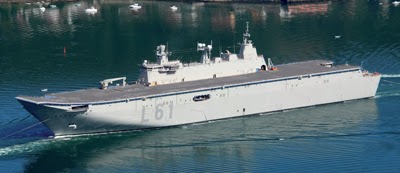
India to acquire the 20,000 tons amphibious assault ships

(Infodefensa.com) Madrid - The Indian Navy has opened the competition to acquire four amphibious assault ships of 20,000 tons each. The first step of this program valued at 2,600 million dollars (about 1,900 million), has been sending the relevant documentation to the local shipyards Larsen & Toubro (L & T), Pipavav Defence and Offshore Engineering , and ABG Shipyard , so they can compete in it.

This process is followed with great interest in Spain , since the domestic construction Navantia is associated with one of these local firms (L & T, specifically) to bid based on the ship design Juan Carlos I of the Spanish Armada . Pipavav Defence , for meanwhile, has partnered with French DCNS , construction of ships Mistral , and ABG Shipyard has an agreement with the U.S. Alion .

Thus, the Spanish design of this type of vessel will return to see the faces with the French design in an international competition. Currently, in addition to the units employed by their respective navies, the French model Mistral has been chosen by Russia to acquire at least two units, while Spain has manufactured two for Australia derived from his ship Juan carlos I.

In the case of India, only local companies are allowed to attend the competition, hence its association with Western companies, and none of them have experience in this type of vessel.

The company that makes the offer with the lowest price to build two ships and assign design to state-owned Hindustan Shipyard Ltd. (HSL) to build the other two.

A length of 215 meters maximum

Each vessel must not be more than 215 meters in length (the Juan Carlos I has the original 231 and Mistral , 199) nor more than 8 meters deep. They must have electric propulsion motors and a battery life of 45 days with a maximum sustained speed of not less than 20 knots.

Craft should be prepared to operate helicopters up to 35 tons, and its interior will have to be able to transport, each at least six tanks, twenty combat infantry vehicles and forty trucks. They will also operate both as hovercraft landing craft.

Also be trained to accommodate up to 1,430 people, distributed as follows: 60 officers, 470 sailors and 900 soldiers.

To his defense will include missile defense systems and torpedoes, decoys and both light machine guns and heavy.

Photos: Gines Soriano / Infodefensa.com, Navantia and DCNS

Chủ Nhật, 15 tháng 12, 2013

US warship threatened China's security: state media

Beijing — A US warship that was forced to manoeuvre to avoid a collision with a Chinese naval vessel had "posed a threat", state-run media said Monday, after Washington accused China of being the aggressor.

A Chinese People's Liberation Army-Navy Harbin Z-9 flies alongside the People's Liberation Army-Navy destroyer Qingdao (DDG 113) during a search and rescue exercise off the coast of Hawaii on September 9, 2013 (US NAVY/AFP, -)

The Global Times newspaper, which often takes a nationalistic stance, said the USS Cowpens guided missile cruiser had "come to China's threshold and posed a threat to China's military security".
Washington issued a formal protest after the incident in the South China Sea between the USS Cowpens and a Chinese People's Liberation Army (PLA) Navy vessel on December 5, insisting that the ships were in international waters.

Beijing claims almost the whole of the strategically significant South China Sea, even areas close to the coasts of other littoral states.

"If the American navy and air force always encroach near China's doorstep, 'confrontation' is bound to take place," the Global Times said. "As China's strength grows, the US should learn to communicate with and respect China if it doesn't want a collision on the sea or in the air."

The stand-off underscored tensions that escalated after Beijing last month declared an expanded "air defence identification zone" in the East China Sea.

Chinese authorities have not yet made any official comment on the near-miss at sea, the most significant maritime incident between the two powers since 2009, when five Chinese ships surrounded and harassed a US Navy surveillance ship in the same waters.

US naval officers and defence officials said last week that the Chinese ship had crossed directly in front of the USS Cowpens and halted less than 500 metres away, forcing the American ship to take evasive action to avoid a collision.

The Global Times quoted an anonymous Chinese military expert as saying the US "was tailing after and harassing" China's Liaoning aircraft carrier, which was conducting drills in the area, and that the USS Cowpens had come within 45 kilometres of the "inner defence layer of the Chinese fleet".

"Bad guys always claim innocence first," the source told the paper, adding that the US warship "took offensive actions at first towards the Liaoning formation on the day of the confrontation".

Su Hao, a professor of Asia-Pacific studies at China Foreign Affairs University, defended the Chinese vessel's actions, saying they were necessary to protect Beijing's maritime rights.

"The Chinese took action only after the US vessels refused to comply with warnings," he told the China Daily newspaper.

AFP

Japan extends patrol ship carrot to Vietnam, plus ¥96 billion loan

Japan and Vietnam will discuss the idea of providing Japanese patrol ships to the Vietnam coast guard to help counter China’s growing claims to contested reefs and islands in the South China Sea, Prime Minister Shinzo Abe said Sunday.

“Our countries’ cooperation is extremely important for regional peace and stability, especially for maintaining maritime order as well as international aviation order,” Abe said at a joint press conference with Vietnamese Prime Minister Nguyen Tan Dung after their talks in Tokyo.

And to boost Vietnam’s economy, Abe pledged about ¥96 billion in new loans mainly for highway and port construction projects.

Vietnam and some other ASEAN states are at odds with Beijing over overlapping territorial claims in the South China Sea. In July, Japan said it would provide Manila with 10 coast guard patrol ships through a yen loan.

In Sunday’s meeting, Dung told Abe that he “understands” Japan’s concern with China’s newly declared air defense identification zone over the East China Sea, which covers the Japanese-administered Senkaku Islands, said Deputy Chief Cabinet Secretary Hiroshige Seko.

“There is a need to secure peace, stability and prosperity in the region by ensuring freedom of overflight and freedom of navigation in line with international law,” Dung said.

Dung was quoted by Seko as saying that he is worried about coercive moves to change the status quo in the South China Sea and hopes that an effective and legally binding Code of Conduct can be drafted to prevent potential conflicts over such claims.

In a joint statement issued Saturday after the main summit talks concluded between Japan and ASEAN, Japan praised the fact that official talks on such a code were launched between China and ASEAN in September.

ASEAN groups Brunei, Cambodia, Indonesia, Laos, Malaysia, Myanmar, the Philippines, Singapore, Thailand and Vietnam.

Thứ Bảy, 14 tháng 12, 2013

Japan SDF ranked top 1 of Asian armed forces

China or Japan: Which wields more military clout?

By Peter Ford, Christian Science Monitor

Territorial disputes and China's air defense identification zone have focused new attention on the question.

Japan's Aegis destroyer
Japanese weapons always evaluated leading the world

BEIJING

There is a widespread assumption that China is Asia’s leading military power.

Not so fast. In fact, that spot belongs to Japan. Yes, Japan.

The Japanese postwar Constitution may “forever renounce war as a sovereign right of the nation” and its military forces may carry the benign-sounding title of “Self Defense Forces.” But “you don’t want to mess with them,” as Larry Wortzel, a leading analyst of Asian military affairs, put it recently.

In terms of simple numbers, Japan lags far behind. It has just one-tenth the number of men in uniform that China does, four times fewer combat aircraft, and its fleet is about half the size of China’s in terms of tonnage.

But when it comes to training and technology, the key elements in modern warfare, the Japanese easily outclass the Chinese. If the territorial dispute over the Diaoyu/Senkaku islands ever sparked “kinetic action” as the military strategists put it, Japan would come out on top.

Another consideration that would give Chinese generals pause for thought: the United States would almost certainly step into any armed conflict on Japan’s side. And though China has been building up its armed forces as fast as it can recently, it is “at least two decades behind the United States in terms of military technology and capability,” a recent report by the Council on Foreign Relations concluded.

Christian Science Monitor


Performed by Japan Ground Self-Defense Force Fuji School, the school of infantry, tank and field artillery of the JGSDF. On July 7, 2013 at JGSDF Fuji School, Shizuoka Prefecture, Japan.

Philippine Navy Receives First Three AW109 Power Helicopters

AW-109 Power helicopter of the Philippine Navy (photo : Mckoyzzz)

MANILA, Philippines – Three of five Agusta Westland AW109 maritime choppers for the Philippine Navy were delivered over the weekend, the military said.

Philippine Fleet spokespersons Lieutenant Junior Grade Rommel Rodriguez told INQUIRER.net on Wednesday that the three choppers arrived last Sunday and are currently being assembled at Villamor Air Base in Pasay City.

The choppers are being assembled and checked for testing.

“When you buy something you want to make sure it is [completely working],” he said.

But Rodriguez could not immediately give details, such as commissionship of the choppers, saying that they were still “straightening out” details.

He said, however, said that the choppers will be commissioned within the month.

Two batches of pilots and crewmembers underwent six months training in Italy for the choppers. After commissionship, the choppers will likely be deployed with the two biggest warships — BRP Gregorio del Pilar and Ramon Alcaraz, but more pilots would also undergo training first.

Two more choppers are scheduled to arrive in the first quarter of 2014. All the five choppers are worth P1.33 billion and they are part of the military’s capability upgrade program.

The naval choppers are capable of “wide range” missions such as economic zone protection, surface surveillance, search and rescue and maritime security. The contract includes initial logistics support and training for aircrew and maintenance personnel.

Inquerer

Electronic Countermeasures maybe only way to counter Chinese DF-21D Ballistic Missile

According to a report from Russian Military Analysis , the only way to defeat the DF-21D ballistic missile may be through electronic countermeasures. The Dong-Feng 21D, is People's Liberation Army Navy's supersonic anti-ship ballistic missile with a a top speed of Mach 10 and a range of 1,450 kilometers.

Chinese DF-21D Launcher

Russian Military Analysis report explains that air defense system can be used to intercept high-speed flying objectives, as the USS Lake Erie, a Ticonderoga-class guided-missile cruiser, successfully destroyed malfunctioning spy satellite USA-193 with a RIM-161 Standard Missile 3 about 247 km above the Pacific in 2008; however, the report also noted that Lake Erie had an abundance of information regarding the trajectory of the satellite.

Lacking sufficient knowledge about the launch point of the missile, the only way to defeat the DF-21D is through electronic countermeasures which would allow the United States Navy a chance to evade the attack by changing the ballistic trajectory of the missile. There remains no other way for a US aircraft carrier to defend itself from an attack by the DF-21D, the report said.


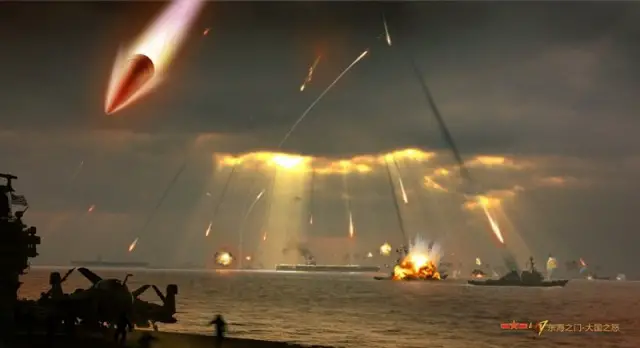
"Artist Impression" of DF-21D Warheads coming down on a US CVBG

navyrecognition.com

Thứ Tư, 11 tháng 12, 2013

US plans for Guam missile base seen as countering strength of China

Countering the North Korea missile threat is the stated objective, but many see the move as being more directed at the strength of China

The US is planning to station anti-ballistic-missile systems on the Pacific island of Guam, a move ostensibly to defend against unpredictable North Korea, but which analysts say may be intended to counter China.

Within Washington's defence plans for next year are provisions for siting terminal high-altitude area defence (Thaad) systems on the island territory, combined with the broader realignment of US forces in the Asia-Pacific region.

Under those movements, United States troop numbers on the Japanese island of Okinawa are due to be cut, with troops from the Futenma air station relocated to an enlarged base in the northeast of the prefecture, while others will be reassigned to Guam, South Korea and Australia.

The report on the defence planning states that: "The committee recognises the strategic importance of providing ballistic missile defence for Guam and the current US asset based there.

"The committee further recognises that as part of bilateral negotiations with the government of Japan, the US military presence on the island and the need to protect it from missile threat are projected to increase."

Thaad systems and Patriot interceptor missiles have been stationed on Guam in the past, supplementing warships, but the report cites the "immediate threat of missiles launches from the Democratic People's Republic of Korea toward US military assets on Guam" as reason for the move.

Politicians on Guam also requested that it have permanent missile systems as defence against North Korean missiles.

However, Go Ito, a professor of international relations at Tokyo's Meiji University said: "My feeling is that while they may be naming North Korea, this is more aimed at China.

"North Korea has missile technology and there are concerns about political stability in Pyongyang at the moment, but China has developed its own missile capabilities, so that is the bigger concern for the US.

"These missiles are targeted at any prospective threats that China might pose in the future," he said. "And putting them on Guam does away with the possibility of causing new political problems in Okinawa."

Siting missiles in Guam was the latest move in the military game of chess that was being played out in the region, he added.

"But I'm actually quite optimistic about how things will play out," he said. "Both China and Japan know that a military confrontation will only have negative consequences.

"That is, admittedly, based on a rational calculation and such rational calculations are not always equal on both sides, but I believe China understands that it benefits from foreign direct investment into its economy and that its development is still quite fragile."

SCMP

Japan to introduce early-warning aircraft in new defense program

Japan will strengthen its surveillance capabilities in response to China's growing assertiveness over a territorial dispute by introducing new early-warning aircraft and airborne warning and control systems, an outline of a new medium-term defense program showed Wednesday.

Japan wants to reflect the changes in the envisioned program, set to cover a five-year period from April next year, as tensions with China remain high over a row on the sovereignty of the Japanese-controlled Senkaku Islands in the East China Sea. China claims the islands and calls them Diaoyu.

The government also wants to list the acquisition of surveillance drones in the envisioned program which is set to be adopted next Tuesday along with the new longer-term defense policy known as the National Defense Program Outline.

Prime Minister Shinzo Abe vowed in a meeting with security experts to bolster the defense framework to maximize the potential of the Self-Defense Forces to counter threats, calling the long-term defense policy a "historic document" to shape Japan's security strategy.

To protect Japan's Nansei Islands including the Senkakus, the government also plans to reorganize the troops in charge of the E-2C airborne early-warning aircraft based at the Air Self-Defense Force's Naha Air Base and increase the number of troops behind the F-15 fighters, according to the outline of the medium-term defense program.

Since Japan's purchase in September last year of three of the five islands in the Senkaku group from a private Japanese owner, China has repeatedly sent patrol airplanes and ships to surrounding areas.

With the Senkakus in mind, Japan aims to bolster the ability to protect remote islands from attacks, setting up amphibious forces and also creating new units within the Ground Self-Defense Force, the outline said.

To speed up the troops' mobility, Japan will also introduce aircraft capable of short takeoff and vertical landing, having the U.S. military Osprey transport aircraft in mind.

Abe's government, formed in December last year, has decided to replace the existing long-term and medium-term defense programs compiled in 2010 to bolster SDF equipment and manpower in light of China's growing assertiveness and North Korea's nuclear ambitions.

==Kyodo

Japan's defence plans focus on China and islands dispute

Dec 11 (Reuters) - Japan will set up a new amphibious military unit and deploy unarmed surveillance drones in its southwest, where it faces a row with China over disputed islands, according to drafts of the nation's latest defence plans seen on Wednesday.

Prime Minister Shinzo Abe ordered the defence policy review after returning to office last December, pledging to strengthen the military and boost Japan's global security role.

The new defence guideline and military build-up plan, to be approved by the government next week, follow China's declaration in November of a new air defence identification zone in an area that includes the disputed isles, triggering protests from Tokyo, as well as Washington and Seoul.

The drafts of the two plans were made available at a meeting of ruling Liberal Democratic Party (LDP) lawmakers and shown to reporters. Final versions of the defence guideline, which lays out Japan's defence policy for the next 10 years, and the build-up plan, called the mid-term defence programme and covering a five-year period, will be unveiled next Tuesday.

Citing Japan's concerns about what it calls Beijing's attempts to change the status quo with force, the guideline says Japan will "respond calmly and resolutely to the rapid expansion and step-up of China's maritime and air activities."

Japan plans to set up an amphibious unit designed to take back the remote islands in case of invasion and boost the number of fighter jet squadrons at its Naha base on Japan's southern island of Okinawa to two from one to maintain air superiority.

One squadron usually consists of 20 fighter jets.

It also plans to procure unmanned surveillance planes and establish a unit of E-2C early warning aircraft at the Naha base, the draft of the build-up plan said.

E-2Cs, routinely used to keep watch in the area surrounding the disputed islands called the Senkaku in Japan and Diaoyu in china, are currently based in northern Japan's Misawa base.

MISSILE DEFENCE, LOVE OF COUNTRY

Japan will also bolster its overall capability to respond to missile attacks in the face of improvement in North Korea's ballistic missile technology, the guideline draft said.

But it stopped short of a call to acquire the capability to strike enemy targets - a controversial and costly step that would further stretch what Japan dubs its "purely defensive" defence posture allowed under decades-old interpretations of its post-World War Two pacifist constitution.

"North Korea has repeated conduct that heightens regional tensions ... Its nuclear and missile development, along with provocative words and deeds against us, represent a grave and imminent threat to our country's security," the draft said.

Japan's concerns over a rising China and unpredictable North Korea were also echoed in the country's new national security strategy, a draft of which was also made available.

In a move likely to raise red flags among Abe's critics, who say the hawkish leader is a nationalist ideologue, the draft strategy document calls for "cultivating love of country" and expanding "security education" in institutions of higher learning. Putting more patriotism in school curricula was the aim of a revision of a law on education enacted during Abe's first 2006-2007 term, which ended when he abruptly quit in the face of a parliamentary deadlock and ill health.

As expected, the security strategy draft also said Japan will review its self-imposed ban on weapons exports, a move that could reinvigorate Japan's struggling defence industry.

Japan in 1967 drew up "three principles" on arms exports - banning sales to countries with communist governments, those involved in international conflicts or those subject to United Nations sanctions.

The rules eventually became almost a blanket ban on arms exports and on the development and production of weapons, stifling Japanese defence contractors and making it difficult for them to keep up with cutting-edge arms technology. Recent governments have made some exceptions including for joint development with the United States. (Reporting by Kiyoshi Takenaka; Editing by Linda Sieg and Raju Gopalakrishnan)

Thứ Ba, 10 tháng 12, 2013

Japan plans to raise military spending to 240 bln US dollars

Japanese Prime Minister Shinzo Abe says he wants to raise his military spending budget by around 6 percent over the next five years, that’s according to Kyodo news agency.

Abe’s government is requesting a defense budget of more than 240 billion US dollars. The Japanese government says it’s in response to a number of growing security concerns, including nuclear development in the Democratic People’s Republic of Korea.

However, the Finance Ministry has previously asked the Defense Ministry to CUT its budget. The budget request will be discussed at a cabinet meeting on December the 17th. Local media reports say the government wants to make air defense a priority, and is planning to buy a guided-missile cruiser.
If the budget is approved, it will be Japan’s first increase in defense spending in over a decade.

CNTV

Meet The Tiny Rock That Could Start World War III

Sunday morning, South Korea announced that it was extending its air defense zone to include a tiny reef off its coast. Now China, Japan, and South Korea’s flight zones overlap for the first time, upping military tensions in a region already rife with them.

Socotra Rock, known as Ieodo in Korea and Suyan Rock in China, is a submerged reef that houses a Korean research station. Both Korea and China claim it as part of their “exclusive economic zones,” (EEZ) a legal term for the maritime region in which the country has special development rights.

South Korea’s expansion of its air defense identification zone (ADIZ) to include Socotra is a direct response to China doing the same. An ADIZ denotes the area in which another country can’t fly its planes safely without identifying themselves, and, in late November, China expanded its zone to include Socotra. At the time, China’s play for Socotra was overshadowed by its move for the Senkaku-Diayou island chain, which Japan also claims. But South Korea’s counter has brought the simmering Socotra dispute to the fore.

After China’s move, South Korea military officials asked China to peacefully remove Socotra from its ADIZ, perhaps in exchange for taking China’s side in its dispute with Japan. But China refused, prompting Sunday’s escalation.

Many Koreans believe Socotra is critically important to their nation’s security. “Ieodo itself has a huge significance,” Koh Choong-suk president of the Ieodo Research Society, said. “Waters near it are part of key shipping routes through which some 90 percent of Korea’s inbound and outbound shipments pass.” Korean control over Socotra also limits China’s maneuvering room in the East China Sea, where the islands it disputes with Japan lie, and the reef is believed to house natural gas and mineral deposits.


The real danger in the overlapping Korean-Chinese ADIZ is accidental war. When another country’s aircraft, civilian or military, fly into a foreign ADIZ, they have to identify themselves or risk being fired on. Japanese planes that fly in the Senkaku-Diayou chain refuse to identify themselves beforehand to Beijing in protest of China’s claim, upping the chance that China might blow them out of the sky. If Korean or Chinese aircraft do the same in Socotra, it’ll increase the risk of a deadly accident. That could very well escalate to war between the Asian powers, a war that could pull in the United States.

“The issue of the air defense identification zone is making the already difficult regional situations even more difficult to deal with,” South Korean Foreign Minister Yun Byung-se said after China’s initial ADIZ announcement. “Things can take a dramatic turn for the worse if territorial conflicts and historical issues are merged with nationalism.”

Of course, a war between China and South Korea (perhaps aided by the United States and Japan) would be a catastrophe for all parties. Socotra is important, but not nearly important enough to pay the cost in blood and treasure necessary to wrest it from another party through force — to say nothing of the nuclear risk posed by conflict between an American ally and China.

Under these conditions, accidental war is unlikely. “Historians have demonstrated that most wars initially deemed ‘accidental,” University of Kentucky political scientist Robert Farley writes, “have in actuality resulted from deliberative state policy, even if the circumstances of the war were unplanned.” Accidental wars do happen, but they tend to occur in cases where there is poor communication between the warring nations and a lot to gain from decisive, rapid military action — conditions that do not hold in the Socotra dispute.

Regardless, the conflict over Socotra is yet another complication in the fraught, ever-shifting relations between South Korea, Japan, and China. According to John Delury, an assistant professor at Yonsei University whose research focuses on East Asian politics, relations between China and South Korea haven’t been this close in over 100 years. “The kerfuffle over the overlap between China’s new ADIZ and Korea’s old ADIZ should not distract too much attention from the deeper strategic shift taking shape,” he wrote three days before the Korean announcement. Delury sees as-of-yet improving relations between South Korea and China as part of a broader Chinese strategy to peacefully weaken the American-made alliance system that has set the terms of East Asian politics since the 50s.


South Korean research station in Ieodo

South Korea’s initial attempt to deescalate the ADIZ situation through diplomacy fits Delury’s thesis, but China’s refusal to play ball doesn’t. “Now, the [Korean] government has no choice but to stand with the United States, Australia, and Japan in staunch opposition to the ADIZ,” Victor Cha, an expert on the Koreas at Georgetown and the Center for Strategic and International Studies, concludes. “Perhaps this was not Seoul’s first choice, but it is the smarter long-term strategic play. Cutting an individual ‘deal’ with China only further isolates the ROK from its allies and sets it up to be dominated by China.”

It’d also be a mistake to think of Korean-Chinese-Japanese relations as being governed solely by the dictates of power politics. There are economic reasons to think they’d avoid conflict; war is bad for business, after all. And don’t discount the power of historical grievances and ideology to shift a nation’s thinking. South Korea and Japan have been at loggerheads recently over another territorial dispute and the legacy of Japan’s colonial conquest of Korea in the early 20th century, tensions China has been cannily exploiting.

Socotra may be an opportunity for the two American allies to make up, but the only durable solution to the long-simmering tensions in the region is some kind of compromise between the three countries and the United States. Sheila Smith, a Japan expert at the Council on Foreign Relations, suggests that a formal “code of conduct,” a model pioneered elsewhere in Asia, could calm things down. Until something like that happens, though, expect continued rockiness over Socotra Rock.

India's Longest Range Ballistic Missile All Set for Undersea Launch

India is finally gearing up for the maiden test firing of its submarine launch of longest range and nuclear capable ballistic missile code-named K-4 from an underwater platform off the Vizag coast by end of next month. The missile flies in hypersonic speed and is the world’s best weapon in this class.

The much-awaited test which was scheduled for September was postponed due to technological developments. The indigenously developed 3,500-km range missile has been planned to be test launched from a pontoon (replica of a submarine) positioned nearly 50 feet under the sea surface.

The missile is the longer version of K-15, dubbed as B-05 missile which has been test fired at least 10 times. Though it has been designed to cover a distance of 3,500 kms, sources told The Express that this time the test would be conducted for a range of about 1,500 km.

The K-4 missile was developed very fast as many systems used in the missile were already perfected during the development of B-05 missile. The new missile will enable India to target China and Pakistan from its waters.

A defence scientist associated with the missile said some of its sub-systems had already been tested successfully earlier and the missile with full configuration was ready for its first launch. “We are leaving no stone unturned to make the mission successful. We want to achieve close to zero circular error probability (CEP) accuracy,” he said.

The K-4 is one of the most ambitious projects of the Defence Research Development Organisation (DRDO) and it was kept under wrap for years. Plans are also afoot to induct the B-05 missile, which has a strike range of nearly 700 kms, in the armed forces next year. This missile will also be test fired from the indigenously built India’s first submarine INS Arihant after it completes sea trials in 2014.

Defence sources said the K-4 missile is about 12 metre tall having a diameter of 1.3 metre and weighs around 17 tonne. It is capable of carrying a warhead of around 2 tonne and uses solid propellant.

Once inducted, the missile will not only complete India’s third leg of the nuclear deterrent, but also be the second strike weapon system in its much touted nuclear doctrine. It can target major Chinese cities even remaining away from the Chinese water. It could better be characterised as a hypersonic cruise missile, since it remains within the earth’s atmosphere. Making the K-4 even more survivable is its ability to manoeuvre, following a twisting path to the target which makes it very difficult to shoot it down.

The next missile in this series is K-5 which will have a strike range of nearly 5,000 km.

AGNI-III ON SCHEDULE

Range integration was conducted in the Integrated Test Range (ITR) off the Odisha coast for the proposed test firing of 3,500 km range nuclear capable ballistic missile Agni-III. The weapon is scheduled to be test fired from the Wheeler Island by the Strategic Forces Command (SFC) of the Indian Army on December 18. It is the second user trial of the indigenously built surface-to-surface missile. This test will follow one each developmental trial of 4,000-km range Agni-IV and 5,000-km range Agni-V missile next month.

New Indian Express

Navy destroyer Haikou returns to duty after refit

The PLA navy destroyer Haikou has undertaken more than 30 missions since the vessel was commissioned in 2005. Provided to China Daily


The destroyer Haikou, one of the most advanced warships in the People's Liberation Army navy, will be ready for duty this month after a 10-month maintenance period.

The Type 052C-class destroyer underwent the routine maintenance period scheduled for every 10 years of the ship's life, with work conducted at a military port in Guangdong province, according to authorities.

Construction on the ship started in 2002, and in 2005, it entered service in the South Sea Fleet, based in Guangdong province.

The maintenance included checking major components of the ship and repainting the main internal and external areas, said Li Hui, the ship's captain.

The ship's sailors and officers worked hard to ensure the combat readiness of the ship after maintenance was completed.

Wang Dong, a technician working on the Haikou, said many sailors worked in the shipyard that performed the maintenance and learned repair skills there that may be useful at sea. The idea was to prepare sailors to make emergency repairs when necessary, reducing the chances of the ship being out of action for long periods at sea.

Over the 10-month maintenance, the Haikou's crew continued to take part in various training operations. More than 100 sailors and officers participated in different missions, such as a joint Chinese-Russian military drill in July, Li said.

"The ship is ready for any mission now that the repair work is finished," Li said.

The ship's crew of 277, 16 of whom are women, receives training that simulates "real combat" environments, according to the ship's publicity officer.

The Haikou spends 280 days a year in "voyage training" at sea. Since it was commissioned in 2005, the ship has undertaken more than 30 missions, said Wu Chao, a publicity official for the PLA navy.

The Haikou is a successful example of PLA navy's performance at sea and combat capabilities, Wu said.

Smoke billows from the Haikou
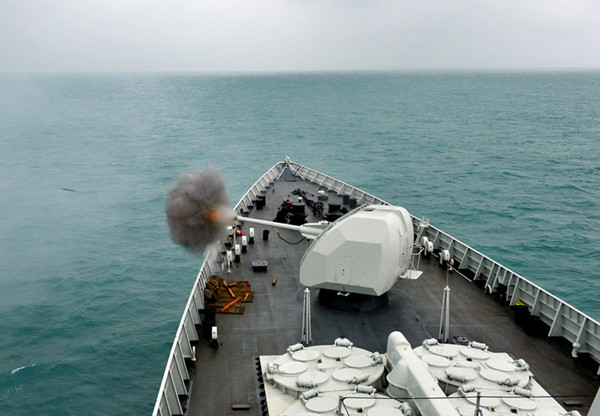
Smoke billows from the Haikou's main deck gun during a training exercise. Gao Yi / for China Daily

The Haikou participated in the first and 10th of the warships escort tours, each time accompanied by another destroyer and a supply ship. So far, the PLA navy has escorted 5,200 ships through the dangerous Somali waters.

In February 2009, the Haikou was dispatched to receive the Chinese commercial ship, the Tianyu No 8 after its release by Somali pirates. The ship had been hijacked and held by pirates for more than 80 days.

When it was released, it was running very low on supplies.

The Haikou's officers and soldiers donated food and clothes to help the commercial ship's crew after their release.

More importantly, the destroyer provided 60 tons of fuel as well as other supplies for the Tianyu No 8, despite difficulties posed by bad weather in the area.

As word of the PLA navy's safe and effective escorts spread in the area, more foreign ships, including those from Singapore, Cyprus and Greece, applied to join the Chinese escort fleets.

To meet their requests, the Haikou selected sailors who could speak fluent English to liaise with their partner ships. It set up a 24-hour bilingual signal channel and maintained contact with commercial ships from China and other countries by e-mail and fax.

The Haikou's contribution won the appreciation of foreign ships and international associations. In November 2009, the Haikou was awarded the Certificates for Exceptional Services Rendered to Shipping and Mankind by the International Maritime Organization.

ecns

Taiwan thinking of building its own submarines

Taiwan is evaluating the feasibility of building submarines on its own with technical assistance from the United States, according to a local newspaper.

The U.S. government approved the sale of eight diesel-powered submarines to Taiwan in 2001, but no progress has been made on the project since then.

Frustrated by the country's inability to procure submarines, Taiwan's military has gradually changed its attitude from "waiting for U.S. approval" to considering building submarines on its own with U.S. technological support, the United Daily News (UDN) said in a special report Monday.

The shift became even more evident after Yen Ming became defense minister and Adm. Chen Yung-kang took over the helm of the Navy Command Headquarters, according to the paper.

The following are excerpts from the UDN special report on the submarine-related issues:

Both the military and local shipbuilding community are assessing the feasibility of building conventional diesel-powered submarines at home instead of procuring them from the U.S.

A shipbuilding industry association is scheduled to come up with a comprehensive assessment report by June 2014.

Sources familiar with the Navy's submarine procurement project cited several reasons why the potential deal with the United States has remained stalemated.

First, the U.S. asked Taiwan to pay a contract design fee of more than NT$10 billion (US$338.36 million) even before the type of submarine to be sold to Taiwan was determined.

Partisan wrangling over the issue at the time prompted Taiwan's Legislature to balk at making the upfront payment.

A more critical obstacle to progress lies in the U.S. Navy's reluctance to build diesel-electric submarines at a U.S. shipyard because it fears that Congress would ask it to buy the conventional submarines to save money if an American shipyard had the capability to build such a ship.

Acting on the instructions of Defense Minister Yen, the Navy sponsored a closed-door seminar at the Armed Forces Club in Taipei in late November to discuss the feasibility of building submarines in Taiwan.

Adm. Chen chaired the meeting, which was attended by representatives from government agencies as well as academia and the private sector.

All participants reportedly agreed to list "building submarines locally" as an option.

Military and shipbuilding industry executives admitted that Taiwan still cannot build torpedoes, sonar, propulsion systems, combat systems and submarine periscope lenses.

Taiwan also needs to upgrade its blueprint design technology, they said.

Against this backdrop, they said Taiwan should seek U.S. technology transfer in those fields if it wants to build submarines at home.

A model used in Taiwan's building of Ching-kuo indigenous defense fighters (IDFs) in the past could be applied to the submarine building project, they said. U.S.-based General Dynamics had helped with IDF design. (Dec. 9, 2013).

focustaiwan.tw

Chủ Nhật, 8 tháng 12, 2013

China Declares Lunar Defense Obliteration Zone (LDOZ)

China Declares Lunar Defense Obliteration Zone (LDOZ)

BEIJING — Following the successful launch of its first lunar rover, the Chinese government has declared a defensive zone extending vertically from China into space and encompassing the moon.

The Lunar Defense Obliteration Zone, according to newly appointed space minister Wu Houyi, “will protect China’s core interests and interplanetary sovereignty.” All foreign spacecraft, satellites, comets and space debris must notify China before passing through or into the zone.

Due to orbital complications, the boundaries of the LDOZ will shift daily in accordance with the position of the moon relative to its sovereign power. China’s Ministry of Space has issued diagrams of the shifting boundaries, dubbed “the lasso.”

Many countries have disputed China’s ability to establish such a zone, but Chinese officials are adamant about the country’s claim to Earth’s only natural satellite.


Orbital variations of the LDOZ.

“China’s historical ties to the moon date back at least five thousand years, perhaps more,” said Chen Guang, an official historian from the Chinese Academy of Social Sciences. “We made a whole calendar based on it for Christ’s sake.”

As for the political ramifications, the Ministry of Space has promised not to impose terrestrial laws on the celestial object, nor push immediately for reunification.

“The moon will retain full autonomy,” Wu told reporters on Thursday, “and will continue to orbit the Earth as normal under the ‘One Country, Two Circumgyrating Bodies’ system.”

So far, the LDOZ has received widespread support from the public and government-issued propaganda posters have cropped up around Beijing and Shanghai bearing the slogan “China Dream, Moon Dream.”
One Weibo user, @永远玉兔 (Jade Rabbit Forever), suggested that China should enforce the defensive zone by constructing a giant laser which will point at whichever country is currently meeting with the Dalai Lama, and at Tokyo the rest of the time.

As America and Russia are expected to dispute the territorial boundaries, Chinese scientists, according to leaked classified documents, are investigating the feasibility of striking an obsolete satellite to trigger a chain reaction of space debris that will orbit the earth every 90 minutes, preventing all access to the LDOZ.

http://www.miniharm.com/2013/12/07/china-declares-lunar-defense-obliteration-zone/