Thứ Tư, 11 tháng 12, 2013
US plans for Guam missile base seen as countering strength of China
The US is planning to station anti-ballistic-missile systems on the Pacific island of Guam, a move ostensibly to defend against unpredictable North Korea, but which analysts say may be intended to counter China.
Within Washington's defence plans for next year are provisions for siting terminal high-altitude area defence (Thaad) systems on the island territory, combined with the broader realignment of US forces in the Asia-Pacific region.
Under those movements, United States troop numbers on the Japanese island of Okinawa are due to be cut, with troops from the Futenma air station relocated to an enlarged base in the northeast of the prefecture, while others will be reassigned to Guam, South Korea and Australia.
The report on the defence planning states that: "The committee recognises the strategic importance of providing ballistic missile defence for Guam and the current US asset based there.
"The committee further recognises that as part of bilateral negotiations with the government of Japan, the US military presence on the island and the need to protect it from missile threat are projected to increase."
Thaad systems and Patriot interceptor missiles have been stationed on Guam in the past, supplementing warships, but the report cites the "immediate threat of missiles launches from the Democratic People's Republic of Korea toward US military assets on Guam" as reason for the move.
Politicians on Guam also requested that it have permanent missile systems as defence against North Korean missiles.
However, Go Ito, a professor of international relations at Tokyo's Meiji University said: "My feeling is that while they may be naming North Korea, this is more aimed at China.
"North Korea has missile technology and there are concerns about political stability in Pyongyang at the moment, but China has developed its own missile capabilities, so that is the bigger concern for the US.
"These missiles are targeted at any prospective threats that China might pose in the future," he said. "And putting them on Guam does away with the possibility of causing new political problems in Okinawa."
Siting missiles in Guam was the latest move in the military game of chess that was being played out in the region, he added.
"But I'm actually quite optimistic about how things will play out," he said. "Both China and Japan know that a military confrontation will only have negative consequences.
"That is, admittedly, based on a rational calculation and such rational calculations are not always equal on both sides, but I believe China understands that it benefits from foreign direct investment into its economy and that its development is still quite fragile."
SCMP
Japan to introduce early-warning aircraft in new defense program
Japan wants to reflect the changes in the envisioned program, set to cover a five-year period from April next year, as tensions with China remain high over a row on the sovereignty of the Japanese-controlled Senkaku Islands in the East China Sea. China claims the islands and calls them Diaoyu.
The government also wants to list the acquisition of surveillance drones in the envisioned program which is set to be adopted next Tuesday along with the new longer-term defense policy known as the National Defense Program Outline.
Prime Minister Shinzo Abe vowed in a meeting with security experts to bolster the defense framework to maximize the potential of the Self-Defense Forces to counter threats, calling the long-term defense policy a "historic document" to shape Japan's security strategy.
To protect Japan's Nansei Islands including the Senkakus, the government also plans to reorganize the troops in charge of the E-2C airborne early-warning aircraft based at the Air Self-Defense Force's Naha Air Base and increase the number of troops behind the F-15 fighters, according to the outline of the medium-term defense program.
Since Japan's purchase in September last year of three of the five islands in the Senkaku group from a private Japanese owner, China has repeatedly sent patrol airplanes and ships to surrounding areas.
With the Senkakus in mind, Japan aims to bolster the ability to protect remote islands from attacks, setting up amphibious forces and also creating new units within the Ground Self-Defense Force, the outline said.
To speed up the troops' mobility, Japan will also introduce aircraft capable of short takeoff and vertical landing, having the U.S. military Osprey transport aircraft in mind.
Abe's government, formed in December last year, has decided to replace the existing long-term and medium-term defense programs compiled in 2010 to bolster SDF equipment and manpower in light of China's growing assertiveness and North Korea's nuclear ambitions.
==Kyodo
China's new aircraft carriers to be built in Dalian and Shanghai
China will construct two conventionally powered aircraft carriers in Dalian and Shanghai between 2014 and 2015, a source from China's Central Military Commission has told Duowei News, an outlet run by overseas Chinese.
Under the Commission's Project 048, China aims to establish three carrier battle groups by 2020 so that all three major fleets of the PLA Navy will be able to carry out missions with the full support of an aircraft carrier. The two new Type 001A indigenous carriers will be updated versions of China's first aircraft carrier, the Liaoning, which was originally a Soviet-era Admiral Kuznetsov-class aircraft carrier purchased from Ukraine in 1998. They will also likely be designed with a ski-jump ramp, according to Duowei.
Sources said that the General Equipment Department of the PLA has already signed a contract with the Beijing-based China Shipbuilding Industry Corporation to build the two carriers. The price of the two vessels is estimated to be worth US$9 billion.
China has yet to decide whether its J-31 stealth fighter will replace the J-15 to become the country's next generation carrier-based fighter, according to sources. The J-31 fighter entered service before the J-15, and is able to land or take off from the flight deck of the Liaoning. Sources said that a decision will only be made after the construction of the nation's second and third aircraft carriers is completed. This will give the PLA more time to think about the type of carrier-based fighter it will need in the future, the sources added.
Want China Times
Japan's defence plans focus on China and islands dispute
Prime Minister Shinzo Abe ordered the defence policy review after returning to office last December, pledging to strengthen the military and boost Japan's global security role.
The new defence guideline and military build-up plan, to be approved by the government next week, follow China's declaration in November of a new air defence identification zone in an area that includes the disputed isles, triggering protests from Tokyo, as well as Washington and Seoul.
The drafts of the two plans were made available at a meeting of ruling Liberal Democratic Party (LDP) lawmakers and shown to reporters. Final versions of the defence guideline, which lays out Japan's defence policy for the next 10 years, and the build-up plan, called the mid-term defence programme and covering a five-year period, will be unveiled next Tuesday.
Citing Japan's concerns about what it calls Beijing's attempts to change the status quo with force, the guideline says Japan will "respond calmly and resolutely to the rapid expansion and step-up of China's maritime and air activities."
Japan plans to set up an amphibious unit designed to take back the remote islands in case of invasion and boost the number of fighter jet squadrons at its Naha base on Japan's southern island of Okinawa to two from one to maintain air superiority.
One squadron usually consists of 20 fighter jets.
It also plans to procure unmanned surveillance planes and establish a unit of E-2C early warning aircraft at the Naha base, the draft of the build-up plan said.
E-2Cs, routinely used to keep watch in the area surrounding the disputed islands called the Senkaku in Japan and Diaoyu in china, are currently based in northern Japan's Misawa base.
MISSILE DEFENCE, LOVE OF COUNTRY
Japan will also bolster its overall capability to respond to missile attacks in the face of improvement in North Korea's ballistic missile technology, the guideline draft said.
But it stopped short of a call to acquire the capability to strike enemy targets - a controversial and costly step that would further stretch what Japan dubs its "purely defensive" defence posture allowed under decades-old interpretations of its post-World War Two pacifist constitution.
"North Korea has repeated conduct that heightens regional tensions ... Its nuclear and missile development, along with provocative words and deeds against us, represent a grave and imminent threat to our country's security," the draft said.
Japan's concerns over a rising China and unpredictable North Korea were also echoed in the country's new national security strategy, a draft of which was also made available.
In a move likely to raise red flags among Abe's critics, who say the hawkish leader is a nationalist ideologue, the draft strategy document calls for "cultivating love of country" and expanding "security education" in institutions of higher learning. Putting more patriotism in school curricula was the aim of a revision of a law on education enacted during Abe's first 2006-2007 term, which ended when he abruptly quit in the face of a parliamentary deadlock and ill health.
As expected, the security strategy draft also said Japan will review its self-imposed ban on weapons exports, a move that could reinvigorate Japan's struggling defence industry.
Japan in 1967 drew up "three principles" on arms exports - banning sales to countries with communist governments, those involved in international conflicts or those subject to United Nations sanctions.
The rules eventually became almost a blanket ban on arms exports and on the development and production of weapons, stifling Japanese defence contractors and making it difficult for them to keep up with cutting-edge arms technology. Recent governments have made some exceptions including for joint development with the United States. (Reporting by Kiyoshi Takenaka; Editing by Linda Sieg and Raju Gopalakrishnan)
ADCOM Systems unveiled the first fixed wing UAV for anti-submarine warfare
At the Dubai Airshow 2013, which was held in November, UAE based company ADCOM Systems which specializes in Unmanned Aerial Vehicles (UAV) unveiled its “NAVY UAV”. This new UAV project is designed specifically for Anti-Submarine Warfare (ASW). This makes it the world’s first fixed wing UAV project dedicated to ASW missions.
The Navy UAV is based on ADCOM’s existing UNITED 40 block 5, a Medium Altitude Long Endurance (MALE) UAV. The Navy UAV has a wingspan of 17.53 meters and a length of 11.13 meters. Its payload capacity is 1050 kg (2315 lb). Its glider-like, high aspect ratio wings and dual engine set up allows for endurance in excess of 100 hours.
According to ADCOM, the Navy UAV would detect submarines through the use of sonobuoys. The ASW UAV is expected to carry a maximum of two torpedoes and would detect and attack submarines autonomously or with live control from an operator depending on the mission and flight plan.
Chinese military expert argues to deploy aircraft carrier in the S China Sea
"The South China Sea would be the best place for the Liaoning battle group to show its prowess," Song Zhongping was quoted as saying in an article in the Wednesday edition of the Hong Kong Chinese-language daily Wen Wei Po, a pro-Beijing newspaper.
Song said China needs to deploy an aircraft carrier in the South China Sea because it is facing many severe challenges in the region, including the occupation by several other countries of many islets, reefs or shoals in the sprawling region.
China claims the South China Sea as its territory, but other claimant countries such as the Philippines, Vietnam, Malaysia and Brunei that are geographically closer to the disputed islands see China as a belligerent bully.
Taiwan also has claims in the region and controls the Pratas Islands (also known as Dongsha Islands) and Taiping Island, the biggest of the Spratly Islands in the South China Sea.
As some South China Sea islands are located far away from the Chinese mainland, China has to deploy an aircraft carrier battle group in the region to defend its sovereignty claims, Song said.
The James Shoal in the southernmost part of the South China Sea just off the coast of East Malaysia, for instance, is 2,500 kilometers away from China, Song noted.
While Beijing's land-based warplanes can reach the remote islet, they can only stay airborne for relatively short periods of time, making it hard to gain air supremacy, Song said.
"If China can effectively deploy an aircraft carrier in the South China Sea, it will be able to extend its military presence in the region," Song said.
In another action seen as an attempt by Beijing to unilaterally push its contested sovereignty claims, China recently demarcated an East China Sea air defense identification zone (ADIZ) early this month that extended to the disputed Diaoyutai Islands, about 330 kilometers away from the Chinese coast.
The move ratcheted up tensions with Japan, which controls the islands, but Song said China would do the same in the South China Sea and could use the aircraft carrier group to defend it.
"China set up an ADIZ in the East China Sea, and when it sets up one in the South China Sea in the future, all of the airspace needs to be visible and controllable," Song said.
Deploying the aircraft carrier group in the region would be an important step to achieving the goal, he said, because air fighters would have trouble covering such a big area and long distances.
Escorted by four warships, the Liaoning is currently on its first-ever long-distance test and training mission in the South China Sea.
Amazing 360 degree look inside Britain's newest Typhoon fighter
Test flights have begun on the latest version of the £80 million Typhoon, which will be able to carry more fuel, heavier weapons and a new generation of radar.
The RAF will next year start taking delivery of 40 of the new fighters which are the third version of the Eurofighter jet.
The latest production run, called tranche 3, is designed to allow air forces to carry more powerful, longer range weapons and enough updated electronics and sensors to accommodate weapons of the future.
New RAF Typhoons will be able to carry Storm Shadow cruise missiles and also Meteor long range air-to-air missiles.
Extra fuel tanks can be fitted along the side of the plane, giving it greater range and allowing it to carry heavier payloads.
The new aircraft can also eventually be fitted with a faster, more sensitive new E-scan radar which can pinpoint more targets and control more weapons.
Upgraded electronics mean pilots will also for the first time be able to handle ground and air targets at the same time, potentially firing at ground forces while locked in a dogfight.
The Typhoon project is now the biggest industrial programme in Britain and BAE Systems, which assembles the fighters, hopes the third version will also generate sales in The Gulf and Malaysia.
The Telegraph was the first newspaper to witness test flights, which began last week at Warton Aerodrome in Lancashire, BAE’s production line and test facility for the jet.
Mark Bowman, chief test pilot, said: “It’s more than a match for anything out there on the market at the moment.”
Nat Makepeace, the pilot who has undergone forces of 9g during the test flights, said: “It’s a fantastic aircraft. It’s got absolutely exceptional handling and performance.
“It’s an honour and a little bit of an achievement to be the test pilot, but my role in this is pretty small.”
The RAF currently has 115 of 160 Typhoons on order, with 53 from the first tranche and 67 from the second tranche.
Mark Kane, BAE’s managing director for combat aircraft, said: “For casual observers the aircraft is little changed from its sleek predecessor, but it has a number of provisions that will allow it to take on additional capability in the future.”
The fighter is built by a consortium of British, German, Spanish and Italian defence and aerospace companies, but jets bound for the RAF and Gulf are put together by BAE at Warton.
Construction is so sensitive that the jets are placed on floating platforms in the massive assembly hall to counter the movement of tides in the nearby Ribble Estuary.
The Typhoon project employs 6,000 people at BAE and a total of 40,000 people across the UK.
David Cameron pressed the case for a deal with the UAE during a visit to the Gulf state last month. A deal could involve as many as 60 jets and be worth more than £6bn.
Thứ Ba, 10 tháng 12, 2013
Obama, Raul Castro Shake Hands
Obama stopped to shake Castro’s hand on his way to the podium for his remarks, according to reporters. He also greeted Brazilian president Dilma Rousseff, who canceled her Washington trip earlier this year over revelations of the United States’ spying on her and the country’s government.
Japan plans to raise military spending to 240 bln US dollars
Abe’s government is requesting a defense budget of more than 240 billion US dollars. The Japanese government says it’s in response to a number of growing security concerns, including nuclear development in the Democratic People’s Republic of Korea.
However, the Finance Ministry has previously asked the Defense Ministry to CUT its budget. The budget request will be discussed at a cabinet meeting on December the 17th. Local media reports say the government wants to make air defense a priority, and is planning to buy a guided-missile cruiser.
If the budget is approved, it will be Japan’s first increase in defense spending in over a decade.
CNTV
S. Korea: North Korea Engaged in 'Reign of Terror'
SEOUL — South Korea has called the recently announced political purges at the top of North Korea's leadership a “reign of terror” that could further destabilize their already shaky relations. Meanwhile, North Korean media continue to attack the uncle of leader Kim Jong Un who was very publicly removed from power.
South Korea's President Park Geun-hye at a Tuesday Cabinet meeting said North Korea's massive purges appear aimed at consolidating leader Kim Jong Un's power.
North Korea on Monday confirmed earlier reports that Jang Song Thaek, the uncle of Kim Jong Un and assumed second in command had been abruptly removed from power over disloyal and corrupt behavior.
South Korea's spy agency broke the story last week and said two of Jang's assistants were executed in public in November. It said authorities are going after his followers.
President Park said the dismissals and executions amounted to a “reign of terror” with potentially destabilizing effects.
She says North-South Korea relations could become more unstable from now on. At a time like this, she says, it is the duty of the state, as well as the political parties that represent the people, to firmly protect the South Korean people's security and liberal democracy.
Jang was labeled as leading a self-indulgent, “capitalist” lifestyle that included drug use, womanizing, and gambling. North Korea's state media published photographs and accounts of Jang being arrested at a Korean Workers Party meeting by uniformed officers.
The official Rodong Sinmun newspaper on Tuesday quoted North Korean citizens saying Jang and his supporters should be put to death. The newspaper urged unity and loyalty under Kim Jong Un vowing to never forgive traitors.
Jung Sung-jang, a researcher at Seoul's Sejong Institute, says it is unlikely that Jang’s purging will impact North Korean policy in any dramatic way. But he says it will definitely stiffen the dynamics within the country, which could prompt Pyongyang to temporarily adopt a more stringent stance.
Jang was also accused of selling off North Korea's resources at a cheap price, an apparent reference to China which buys most of its exports. He was in charge of negotiating Chinese investment in special economic zones.
Some Western political analysts say Jang may have been removed because Pyongyang believed he became too close to Beijing.
But Professor of Korean history at Kookmin University Andrei Lankov argues Jang's role in the bilateral relationship was not so clear and ties with Beijing are not likely to be affected.
“He is not a China hand. He is not a person who has close, personal connections in China, a good understanding of how China works and so on. I would say that probably it will not change much or maybe will not change anything because Chinese will be equally eager to talk to a new face,” he said.
Beijing's state run Global Times newspaper Tuesday said China should help bring about Kim Jong-Un's visit as soon as possible for the benefit of friendly ties and long-term stability.
The 30-year-old Kim Jong Un's neglecting to visit China since coming to power two years ago, and a third nuclear test in March, were widely viewed as a snub.
The editorial noted balancing friendship with Pyongyang while opposing its nuclear weapons is a test for China's diplomacy. Beijing is trying to revive the long-stalled six-nation talks it hosts on denuclearizing North Korea.
Japan, South Korea, and the United States are refusing to negotiate until North Korea demonstrates it is serious about giving up its nuclear programs.
VOA Seoul producer Youmi Kim contributed to this report.
China Adopts Board-Game Strategy to Blunt U.S. Pivot to Asia
Potential next steps following last month’s imposition of an air defense zone over the East China Sea in the face of U.S. condemnation include more vigorously challenging aircraft that enter the area, imposing a similar zone over disputed territory in the South China Sea and asserting naval control over islands also claimed by other nations.
“Such actions, if they occur, will cause greater worries in the region and increase calls for the U.S. to strengthen its military, diplomatic and economic presence,” said Bonnie Glaser, a senior Asia adviser at the Center for Strategic and International Studies in Washington. “The risk is of greater U.S.-China strategic competition.”
A year into his term as head of the Communist Party, President Xi Jinping is taking measures to bolster his nation’s standing in the region and counter an increased U.S. military deployment to Asia. The strategy features such steps as the air-zone declaration that fall short of direct confrontation yet in time alter spheres of geographic influence, according to Douglas Paal, director of the Asia Program at the Carnegie Endowment for International Peace in Washington.
Classic Game
“China is playing the classic game of weiqi, wherein it slowly expands influence through steps that are not a threshold to violence and do not trigger a forcible response,” Paal said, referring to the strategic board game known as Go in English. “Next steps are likely in the South China Sea, but this will be delayed as China builds out its radar and intercept infrastructure.”
Since Xi took over, Japan has accused Chinese ships of locking fire-control radar on its vessels and China dispatched ships and aircraft near islands claimed by both sides. The Chinese navy last month deployed its Liaoning aircraft carrier to the South China Sea, parts of which are also claimed by the Philippines and Vietnam.
The air defense zone that China announced Nov. 23 and which also drew criticism from Japan and South Korea as it covered islands they claim, gives it a strategic advantage, Li Jei, a senior captain at the China Ocean Research Center, wrote Dec. 6 in the state-run Global Times newspaper. The zone gives America and Japan “no option but to face the reality, negotiate with us, giving us favorable strategic circumstances,” Li wrote.
Sending Message
China’s actions are aimed at sending a message to the U.S. that it’s serious about challenging an Asian order in which America has been the dominant power for 40 years, said Hugh White, a professor of strategic studies at Australian National University in Canberra.
“They’re saying to America that we’re so serious about this that we’re prepared to take the risks of being provocative, in order to persuade you to take seriously that we want to change the order,” said White, author of the book “The China Choice: Why America Should Share Power.”
The increased use of naval vessels and aircraft heightens the danger of an accident or misstep that could escalate out of control. During a visit to the region last week, Vice President Joe Biden called on all sides to take practical steps to “lower the temperature.”
Using Force
At the same time, the U.S. pivot “will certainly generate a lot of suspicion and worry in China,” said Dong Wang, director of the Center for Northeast Asian Strategic Studies at Peking University in Beijing.
“Each and every one of the things China has done has been in response to what it perceives as a provocation,” Dong said, citing Japan’s decision to buy some of the islands disputed with China last year. “China is not making provocations on its own initiative.”
Japanese Prime Minister Shinzo Abe said in October he wouldn’t allow China to alter the situation around disputed islands by force. He approved a plan to shoot down any drones that enter Japan’s airspace, while a Chinese defense ministry spokesman responded that the shooting down of a drone would prompt retaliation.
“Things move much faster in the air than they do on the water and it looks like the kind of cat-and-mouse games really are transferring from the water now,” said Benjamin Charlton, Asia-Pacific analyst at Oxford Analytica, a strategic consulting firm based in Oxford, England. “That inherently raises the risk of miscalculation.”
Taken Steps
While China has taken steps to expand its air and naval footprint, the U.S. has sent more surveillance aircraft to Japan and is stationing anti-missile interceptors on Guam as part of the rebalancing strategy that President Barack Obama detailed in 2011. The U.S. is also shifting 2,500 Marines to the Australian city of Darwin from Okinawa, Japan.
Biden made it clear on a trip to China last week that the U.S. won’t reverse its rebalancing policy. “We are and will remain a Pacific power diplomatically, economically, and militarily,” he said in a Dec. 5 speech in Beijing.
For its part, China hasn’t neglected the diplomatic front in its battle to curtail U.S. influence. With Obama distracted by tensions in the Middle East and domestic politics, China has sought to fill the vacuum and boost ties with its South East Asian neighbors, some of whom have conflicts with it over islands in the South China Sea.
Canceled Trip
A day after Obama announced in October he had canceled an Asian tour due to the government shutdown at home, China signed agreements to boost economic cooperation and defense ties with Malaysia. And while Obama sent Secretary of State John Kerry to the region in his stead, Xi went to the Asia-Pacific Economic Cooperation summit in Bali, where he described the region as “a big family.”
“We will have to see what the U.S. will do to shore up the idea that they are in Asia to stay,” said Roderick MacFarquhar, professor emeritus of Chinese politics at Harvard University in Cambridge, Massachusetts. “That they’re not going to quit the stage and leave it to China, and that they’re not going to desert their friends and allies.”
To contact Bloomberg News staff for this story: Henry Sanderson in Beijing at hsanderson@bloomberg.net; Indira A.R. Lakshmanan in Washington at ilakshmanan@bloomberg.net
To contact the editor responsible for this story: Rosalind Mathieson at rmathieson3@bloomberg.net
Meet The Tiny Rock That Could Start World War III
Socotra Rock, known as Ieodo in Korea and Suyan Rock in China, is a submerged reef that houses a Korean research station. Both Korea and China claim it as part of their “exclusive economic zones,” (EEZ) a legal term for the maritime region in which the country has special development rights.
South Korea’s expansion of its air defense identification zone (ADIZ) to include Socotra is a direct response to China doing the same. An ADIZ denotes the area in which another country can’t fly its planes safely without identifying themselves, and, in late November, China expanded its zone to include Socotra. At the time, China’s play for Socotra was overshadowed by its move for the Senkaku-Diayou island chain, which Japan also claims. But South Korea’s counter has brought the simmering Socotra dispute to the fore.
After China’s move, South Korea military officials asked China to peacefully remove Socotra from its ADIZ, perhaps in exchange for taking China’s side in its dispute with Japan. But China refused, prompting Sunday’s escalation.
Many Koreans believe Socotra is critically important to their nation’s security. “Ieodo itself has a huge significance,” Koh Choong-suk president of the Ieodo Research Society, said. “Waters near it are part of key shipping routes through which some 90 percent of Korea’s inbound and outbound shipments pass.” Korean control over Socotra also limits China’s maneuvering room in the East China Sea, where the islands it disputes with Japan lie, and the reef is believed to house natural gas and mineral deposits.
The real danger in the overlapping Korean-Chinese ADIZ is accidental war. When another country’s aircraft, civilian or military, fly into a foreign ADIZ, they have to identify themselves or risk being fired on. Japanese planes that fly in the Senkaku-Diayou chain refuse to identify themselves beforehand to Beijing in protest of China’s claim, upping the chance that China might blow them out of the sky. If Korean or Chinese aircraft do the same in Socotra, it’ll increase the risk of a deadly accident. That could very well escalate to war between the Asian powers, a war that could pull in the United States.
“The issue of the air defense identification zone is making the already difficult regional situations even more difficult to deal with,” South Korean Foreign Minister Yun Byung-se said after China’s initial ADIZ announcement. “Things can take a dramatic turn for the worse if territorial conflicts and historical issues are merged with nationalism.”
Of course, a war between China and South Korea (perhaps aided by the United States and Japan) would be a catastrophe for all parties. Socotra is important, but not nearly important enough to pay the cost in blood and treasure necessary to wrest it from another party through force — to say nothing of the nuclear risk posed by conflict between an American ally and China.
Under these conditions, accidental war is unlikely. “Historians have demonstrated that most wars initially deemed ‘accidental,” University of Kentucky political scientist Robert Farley writes, “have in actuality resulted from deliberative state policy, even if the circumstances of the war were unplanned.” Accidental wars do happen, but they tend to occur in cases where there is poor communication between the warring nations and a lot to gain from decisive, rapid military action — conditions that do not hold in the Socotra dispute.
Regardless, the conflict over Socotra is yet another complication in the fraught, ever-shifting relations between South Korea, Japan, and China. According to John Delury, an assistant professor at Yonsei University whose research focuses on East Asian politics, relations between China and South Korea haven’t been this close in over 100 years. “The kerfuffle over the overlap between China’s new ADIZ and Korea’s old ADIZ should not distract too much attention from the deeper strategic shift taking shape,” he wrote three days before the Korean announcement. Delury sees as-of-yet improving relations between South Korea and China as part of a broader Chinese strategy to peacefully weaken the American-made alliance system that has set the terms of East Asian politics since the 50s.
South Korea’s initial attempt to deescalate the ADIZ situation through diplomacy fits Delury’s thesis, but China’s refusal to play ball doesn’t. “Now, the [Korean] government has no choice but to stand with the United States, Australia, and Japan in staunch opposition to the ADIZ,” Victor Cha, an expert on the Koreas at Georgetown and the Center for Strategic and International Studies, concludes. “Perhaps this was not Seoul’s first choice, but it is the smarter long-term strategic play. Cutting an individual ‘deal’ with China only further isolates the ROK from its allies and sets it up to be dominated by China.”
It’d also be a mistake to think of Korean-Chinese-Japanese relations as being governed solely by the dictates of power politics. There are economic reasons to think they’d avoid conflict; war is bad for business, after all. And don’t discount the power of historical grievances and ideology to shift a nation’s thinking. South Korea and Japan have been at loggerheads recently over another territorial dispute and the legacy of Japan’s colonial conquest of Korea in the early 20th century, tensions China has been cannily exploiting.
Socotra may be an opportunity for the two American allies to make up, but the only durable solution to the long-simmering tensions in the region is some kind of compromise between the three countries and the United States. Sheila Smith, a Japan expert at the Council on Foreign Relations, suggests that a formal “code of conduct,” a model pioneered elsewhere in Asia, could calm things down. Until something like that happens, though, expect continued rockiness over Socotra Rock.
India's Longest Range Ballistic Missile All Set for Undersea Launch
The much-awaited test which was scheduled for September was postponed due to technological developments. The indigenously developed 3,500-km range missile has been planned to be test launched from a pontoon (replica of a submarine) positioned nearly 50 feet under the sea surface.
The missile is the longer version of K-15, dubbed as B-05 missile which has been test fired at least 10 times. Though it has been designed to cover a distance of 3,500 kms, sources told The Express that this time the test would be conducted for a range of about 1,500 km.
The K-4 missile was developed very fast as many systems used in the missile were already perfected during the development of B-05 missile. The new missile will enable India to target China and Pakistan from its waters.
A defence scientist associated with the missile said some of its sub-systems had already been tested successfully earlier and the missile with full configuration was ready for its first launch. “We are leaving no stone unturned to make the mission successful. We want to achieve close to zero circular error probability (CEP) accuracy,” he said.
The K-4 is one of the most ambitious projects of the Defence Research Development Organisation (DRDO) and it was kept under wrap for years. Plans are also afoot to induct the B-05 missile, which has a strike range of nearly 700 kms, in the armed forces next year. This missile will also be test fired from the indigenously built India’s first submarine INS Arihant after it completes sea trials in 2014.
Defence sources said the K-4 missile is about 12 metre tall having a diameter of 1.3 metre and weighs around 17 tonne. It is capable of carrying a warhead of around 2 tonne and uses solid propellant.
Once inducted, the missile will not only complete India’s third leg of the nuclear deterrent, but also be the second strike weapon system in its much touted nuclear doctrine. It can target major Chinese cities even remaining away from the Chinese water. It could better be characterised as a hypersonic cruise missile, since it remains within the earth’s atmosphere. Making the K-4 even more survivable is its ability to manoeuvre, following a twisting path to the target which makes it very difficult to shoot it down.
The next missile in this series is K-5 which will have a strike range of nearly 5,000 km.
AGNI-III ON SCHEDULE
Range integration was conducted in the Integrated Test Range (ITR) off the Odisha coast for the proposed test firing of 3,500 km range nuclear capable ballistic missile Agni-III. The weapon is scheduled to be test fired from the Wheeler Island by the Strategic Forces Command (SFC) of the Indian Army on December 18. It is the second user trial of the indigenously built surface-to-surface missile. This test will follow one each developmental trial of 4,000-km range Agni-IV and 5,000-km range Agni-V missile next month.
New Indian Express
Navy destroyer Haikou returns to duty after refit

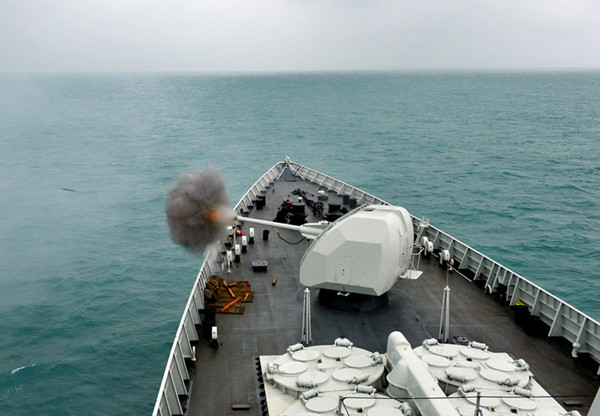
The PLA navy destroyer Haikou has undertaken more than 30 missions since the vessel was commissioned in 2005. Provided to China Daily
The destroyer Haikou, one of the most advanced warships in the People's Liberation Army navy, will be ready for duty this month after a 10-month maintenance period.
The Type 052C-class destroyer underwent the routine maintenance period scheduled for every 10 years of the ship's life, with work conducted at a military port in Guangdong province, according to authorities.
Construction on the ship started in 2002, and in 2005, it entered service in the South Sea Fleet, based in Guangdong province.
The maintenance included checking major components of the ship and repainting the main internal and external areas, said Li Hui, the ship's captain.
The ship's sailors and officers worked hard to ensure the combat readiness of the ship after maintenance was completed.
Wang Dong, a technician working on the Haikou, said many sailors worked in the shipyard that performed the maintenance and learned repair skills there that may be useful at sea. The idea was to prepare sailors to make emergency repairs when necessary, reducing the chances of the ship being out of action for long periods at sea.
Over the 10-month maintenance, the Haikou's crew continued to take part in various training operations. More than 100 sailors and officers participated in different missions, such as a joint Chinese-Russian military drill in July, Li said.
"The ship is ready for any mission now that the repair work is finished," Li said.
The ship's crew of 277, 16 of whom are women, receives training that simulates "real combat" environments, according to the ship's publicity officer.
The Haikou spends 280 days a year in "voyage training" at sea. Since it was commissioned in 2005, the ship has undertaken more than 30 missions, said Wu Chao, a publicity official for the PLA navy.
The Haikou is a successful example of PLA navy's performance at sea and combat capabilities, Wu said.
The Haikou participated in the first and 10th of the warships escort tours, each time accompanied by another destroyer and a supply ship. So far, the PLA navy has escorted 5,200 ships through the dangerous Somali waters.
In February 2009, the Haikou was dispatched to receive the Chinese commercial ship, the Tianyu No 8 after its release by Somali pirates. The ship had been hijacked and held by pirates for more than 80 days.
When it was released, it was running very low on supplies.
The Haikou's officers and soldiers donated food and clothes to help the commercial ship's crew after their release.
More importantly, the destroyer provided 60 tons of fuel as well as other supplies for the Tianyu No 8, despite difficulties posed by bad weather in the area.
As word of the PLA navy's safe and effective escorts spread in the area, more foreign ships, including those from Singapore, Cyprus and Greece, applied to join the Chinese escort fleets.
To meet their requests, the Haikou selected sailors who could speak fluent English to liaise with their partner ships. It set up a 24-hour bilingual signal channel and maintained contact with commercial ships from China and other countries by e-mail and fax.
The Haikou's contribution won the appreciation of foreign ships and international associations. In November 2009, the Haikou was awarded the Certificates for Exceptional Services Rendered to Shipping and Mankind by the International Maritime Organization.
ecns
Taiwan thinking of building its own submarines
The U.S. government approved the sale of eight diesel-powered submarines to Taiwan in 2001, but no progress has been made on the project since then.
Frustrated by the country's inability to procure submarines, Taiwan's military has gradually changed its attitude from "waiting for U.S. approval" to considering building submarines on its own with U.S. technological support, the United Daily News (UDN) said in a special report Monday.
The shift became even more evident after Yen Ming became defense minister and Adm. Chen Yung-kang took over the helm of the Navy Command Headquarters, according to the paper.
The following are excerpts from the UDN special report on the submarine-related issues:
Both the military and local shipbuilding community are assessing the feasibility of building conventional diesel-powered submarines at home instead of procuring them from the U.S.
A shipbuilding industry association is scheduled to come up with a comprehensive assessment report by June 2014.
Sources familiar with the Navy's submarine procurement project cited several reasons why the potential deal with the United States has remained stalemated.
First, the U.S. asked Taiwan to pay a contract design fee of more than NT$10 billion (US$338.36 million) even before the type of submarine to be sold to Taiwan was determined.
Partisan wrangling over the issue at the time prompted Taiwan's Legislature to balk at making the upfront payment.
A more critical obstacle to progress lies in the U.S. Navy's reluctance to build diesel-electric submarines at a U.S. shipyard because it fears that Congress would ask it to buy the conventional submarines to save money if an American shipyard had the capability to build such a ship.
Acting on the instructions of Defense Minister Yen, the Navy sponsored a closed-door seminar at the Armed Forces Club in Taipei in late November to discuss the feasibility of building submarines in Taiwan.
Adm. Chen chaired the meeting, which was attended by representatives from government agencies as well as academia and the private sector.
All participants reportedly agreed to list "building submarines locally" as an option.
Military and shipbuilding industry executives admitted that Taiwan still cannot build torpedoes, sonar, propulsion systems, combat systems and submarine periscope lenses.
Taiwan also needs to upgrade its blueprint design technology, they said.
Against this backdrop, they said Taiwan should seek U.S. technology transfer in those fields if it wants to build submarines at home.
A model used in Taiwan's building of Ching-kuo indigenous defense fighters (IDFs) in the past could be applied to the submarine building project, they said. U.S.-based General Dynamics had helped with IDF design. (Dec. 9, 2013).
focustaiwan.tw
Thứ Hai, 9 tháng 12, 2013
In pictures: Aircrafts of Vietnam People's Army
The Vietnam People's Air Force (Vietnamese: Không quân Nhân dân Việt Nam) is the air force of Vietnam. It is the successor of the former North Vietnamese Air Force and the absorbed Republic of Vietnam Air Force following the re-unification of Vietnam in 1975.
YouTube: The visiting to the Air Force 935 Regiment witnessing the super fighter Su-30MK2V
The Vietnam People's Air Force (VPAF) is one of three main branches in the Vietnam People's Army which is a part of the Ministry of Defence. The main mission of the VPAF is the defence the Vietnamese airspace and the provision of air cover for operations of the Vietnam People's Army.
More: Vietnam Airforce and Navy ready to take on the Chinese
Others: Ka-27, ka-25 (patrol); M-400, An-30 (Reconnaisance); Yak-52, Yak-130 (trainer); An-38, M-28, An-24, UH-1, Mi-8, Mi-17 (transport),...
Naval Air Force
Naval Air force - The newly-established 954 Air Force- naval brigade can perform the following tasks: military transport, reconnaissance, aerial, water-surface and on-the-ground observation, search and rescue at sea, on land and rescue and flood prevention.
Vietnam People's Navy prepared to build Naval Air Force to increase the capacity of coastal defense. On February 27, 2010, the General Staff (Vietnam People's Army) decides to build and make regular member the 954th Naval Air Force Regiment of Vietnamese Navy.
Vietnam has purchased three CASA C-212 Aviocar aircraft Series 400 professional beach patrol and tracking. The aircraft equipped with radar MSS 6000 and Naval Air Force will use for general patrol purposes. Vietnamese Navy received two Eurocopter EC225 Super Puma to offshore patrol and search and rescue missions.
Viking Air Company of Canada has contracted to sell to Vietnam six Seaplane DHC-6 Twin Otter Series 400 from 2012 to 2014. And 7 Kamov Ka-27 helicopters will be transferred to naval air force.
More pictures about VPA: http://worldmilitaryintel.blogspot.com/2013/05/vietnam-vietnam-capitalhanoi.html
Weekly News 9/12-15/12 (Updating)
China’s First Stealth Drone – Analysis (Eurasia Review): Is China trying to narrow down its airpower disparity with western nations? Or does it have a far bigger objective of strengthening its regional sphere of influence?
So many secrets in the East China Sea: It's been a source of endless fascination to follow the game of geopolitical Go being played since China declared an air defense identification zone (ADIZ) in the East China Sea.
How Dangerous Is the East China Sea Airspace? :"There's always the potential for things going wrong whenever you have a volatile mix of intense sentiments, military forces, unclear rules of engagement and certain amount of unpredictability," Cheng said.
North China Sea Fleet assemble for training: North China Sea Fleet of Chinese People's Liberation Army (PLA) conducts live ammunition drill.
South Korea Announces Expansion of Its Air Defense Zone (NYT): Defying both China and Japan, South Korea announced on Sunday that it was expanding its air patrol zone for the first time in 62 years to include airspace over the East China Sea that is also claimed by Beijing and Tokyo.
A solution for the East China Sea: The disputed Senkaku/Diaoyu islands have become too much of a potential flashpoint.
China Dismisses Japan's Opposition to S.China Sea ADIZ: "China is determined to safeguard national security. No country should make comments on this matter," said Foreign Ministry spokesman Hong Lei at a regular press briefing.
China holds war games near Korean border: China’s military is holding large-scale military maneuvers near the North Korean border amid new signs of political instability in Pyongyang.
South China Sea
U.S. and Chinese warships nearly collide in South China Sea: A Chinese naval vessel came dangerously close to a US warship during a tense incident in the South China Sea last week, US military officials said Friday.
The USS Cowpens, a guided missile cruiser, was forced to maneuver to avoid a collision with the Chinese ship that had crossed directly in front of it and halted, according to naval officers and defense officials.
China unlikely to declare South China Sea ADIZ in short term: experts (Focus Taiwan): China is unlikely to declare an air defense identification zone (ADIZ) over the territory it claims in the South China Sea any time soon, experts said Tuesday, despite Beijing's unilateral announcement of an ADIZ covering disputed areas of the East China Sea.
Will Beijing Declare a Special Air Defense Zone Over the South China Sea? (RFA): Beijing may replicate the controversial special air defense zone it unilaterally declared over the East China Sea in another disputed region — the vast and disputed South China Sea — in a bid to shore up its military strategy that could escalate tensions and intensify U.S.-China rivalry, experts say.
-(PhilStar 9/12) Philippines open to talks, defense treaty with Japan amid China row: President Benigno Aquino III is open to discussing the possibility of a defense treaty with Japan as he attends the 40th Association of Southeast Asian Nations (ASEAN)-Japan Commemorative Summit in Tokyo this week. –(GMA Network 9/12) South China Sea dispute may be tackled in ASEAN-Japan Summit
-(Philippine Daily Inquirer 9/12) Japan seeks int’l action against China air zone: Japan’s defense minister called on the international community on Sunday to oppose China’s recently declared maritime air defense zone over the East China Sea and possibly over the disputed South China Sea.
-(The New York Times 8/12) South Korea Announces Expansion of Its Air Defense Zone: Defying both China and Japan, South Korea announced on Sunday that it was expanding its air patrol zone for the first time in 62 years to include airspace over the East China Sea that is also claimed by Beijing and Tokyo. –(China Post 9/12) Taiwan again calls for peaceful resolution after S. Korea move
-(The Manila Times 8/12) Here we go again: China’s new gambit: With the impending expansion of US military rotations in the archipelago, the Philippines is now a frontline state in Washington’s effort to counter Beijing’s force deployment, as West Germany was in the US.-Soviet confrontation in Europe. That can only bring more security tensions for the nation.
Protesters in Ukraine remained defiant and continued their mass demonstration against President Viktor Yanukovich over the country's U-turn away from the European Union Monday, the same day masked men raided the headquarters of the opposition party Monday, according to opposition party leader Arseniy Yatsenyuk.
"Members of the special ops destroyed the entire server room," he said. "Equipment was destroyed, dragged out, across the entire premise of the Batkivshina Political Party headquarters." Police denied any involvement in the raid.
Read more ....
Iran foreign minister says nuclear deal dead if U.S. passes new sanctions.
Iran, six powers meet on steps to carry out nuclear deal.
Israel urges tough line on Iran nuclear deal.
With US ties frayed, Saudi calls for Gulf union.
Iran, Saudi strategists spar, swap ideas, over Gulf security.
Syrian troops seize control of strategic highway. Syria retakes road needed for chemical weapons removal.
Report: Iran has executed 529 people in 2013.
At least 39 killed, 120 wounded in string of Iraq bombings.
Israeli leader predicts 'cold peace' in Mideast.
Mid-East governments sign Red Sea-to-Dead Sea water deal.
Chinese hackers spied on Europeans before G20 meeting: researcher.
Thai protesters call for a 'people's revolution' as PM sets snap elections. Thai prime minister dissolves Parliament, calls elections.
South Korea expands air defense zone to partially overlap China's.
China expresses 'regret' over South Korean Air Defense Zone.
Kim Jong-un’s uncle dragged from political meeting, booted from party.
Singapore leader calls for restraint after riot. Indian worker's death sparks worst riots in Singapore, 27 arrested.
Chinese export growth accelerates in November.
Japan's economic growth revised down.
US war veteran Merrill Newman home after N Korea ordeal.
One month later, Philippines still struggle with typhoon’s impact.
Aid agencies 'paid Somalia's al-Shabab' during famine.
US military to provide air transport in CAR conflict.
French troops exchange fire with rebels in Central African Republic.
French troops cheered on arrival in CAR capital. French troops welcomed to Central African Republic.
France begins to disarm Central African Republic militias. Central African leader: I can't control fighters.
Renewed clashes at Egypt's Al-Azhar University.
Egyptian troops kill Sinai militant leader in gunbattle: army.
Oil-producing Libya needs new buyers.
Friend and foe, world leaders coming together for Mandela.
Mandela death: Daughter Makaziwe tells of final moments.
Ukraine police dismantle Kiev protest camps. Yanukovich backs Ukraine compromise talks as riot police take up positions.
Mass protests in Kiev: LIVE UPDATES.
Russian news agency RIA Novosti closed down. Putin dissolves state news agency, tightens grip on Russia media.
Leaked: Pussy Riot, Greenpeace activists included in draft amnesty.
German exports reach all-time high.
Bank of France ups quarterly growth forecast.
Greece sees end of recession in 2014 with new budget.
Russia signs deal to forgive $29 billion of Cuba's Soviet-era debt - diplomats.
Mexico Senate panels OK energy reform; leftists oppose.
Four US Presidents to attend Mandela memorial.
Colombia's Farc announces unilateral ceasefire.
Venezuela's Socialists win majority in local polls.
Mexico men detained over Mexico radiation truck robbery.
Brazil football season ends in violence as fans brawl.
Heavy winter storm hits much of western, central US.
New York City has highest number of homeless children since Great Depression.
Brazil's child sex trade soars as 2014 World Cup nears.
U.S. drone strike kills three in Yemen: local official.
Court weighs whether Guantanamo detainee searches are too aggressive.
Homeland Security chairman: Threat of terrorism spreading like 'wildfire' overseas.
Fight against terrorism tops Hagel's agenda in Pakistan.
Jordan to begin trial of radical Muslim preacher.
5 companies that make money by keeping Americans terrified of terror attacks.
U.S. exits GM stake, taxpayers lose about $10 billion.
S&P 500 floats up to record close in quiet day on Wall St..
WTO reaches first-ever global trade deal.
After WTO, expectations rise for Trans-Pacific trade deal.
Nike and Adidas square off for Brazil World Cup in ongoing brand battle.
Chủ Nhật, 8 tháng 12, 2013
Hà Nội Submarine, The First Kilo class Project 636 Varshavyanka of Vietnam
Hanoi submarine, the first improved Kilo class submarine in a series of six vessels of Project 636 Varshavyanka (NATO named Kilo) that Russia built on order of Vietnam, has been transferred to the Vietnam Navy coming to Cam Ranh port scheduled in January 2014.
The contract that Russia provides for Vietnam six Kilo submarines signed in 2009 including crew training as well as providing equipment, supplies and techniques. The training crew for Vietnam began in late July of 2013 in Saint Petersburg.
Combat capability of the Project 636 submarine was significantly increased by the use of anti-ship missiles 3M-54E1 Club-S that is supported by advanced electronic systems. With the effective range reaches 290 km and carrying 450 kg warheads, Project 636 allows fast attack, remote. To increase survival, it not need to dig into the detection and attack range of enemy ships or to overcome the region where has been the trap by enemy mines or torpedoes. In addition, the ship also has a mechanism for anti-aircraft missile launcher of 8 missiles Strela-3 ( SA-N-8 Gremlin, a maximum range of 6 km ) or 8 Igla missiles ( SA-N-10 Gimlet, shot range up to 5 km ).
The original design of the Kilo 636 submarines without arming missiles to destroy targets on land (sea-to-surface/ sea-to-ground missile). But Vietnam's Russian- built Kilo 636MV submarines are equipped with 3M-14E missiles for ground attack.
The Vietnam's Russian built Kilo class submarines are signed to export for 7 countries including China, India, Iran, Poland, Romania, Algeria and Vietnam. Vietnam's Kilo submarines will be installed cruise missiles for land attack with 3M-14E1 latest type, has a range of 290 km. The missiles are not approved to export to China by the Russian Ministry of Defence. Only 3 countries that Russia exported this missile to are India and Algeria.
It should be noted that the weapons on the Russian Kilo-636 is equipped with the review and requirement of customers. Because of the specific requirements so the price of Vietnam's Kilo Submarines is much higher than China's ones. Thus it can be stated that 3M-14E missiles equipped for Vietnam's Kilo Submarines are the requirement of Vietnam.
The steel punch
In the disputed islands issue in the South China Sea, China falls into a disadvantage in terms of geography, they try to switch weapons facilities near the disputed islands as possible. Instances of this is that China has built a giant military bases in Sanya (Hainan Island), priority is the most modern weapons and facilities. Besides strengthening forces on Woody Island in the Paracel Islands that Chinese invasions of Vietnam, China wants to turn Sanya and Paracel Islands into the place of rallying the Air Force and Navy when conflicts occur.
In this context, Vietnam called to equip itself with the weapons that can stop the Chinese forces in Hainan Island. And the 3M-14E missile, a range of 290 km, 400 kg warhead was chosen. The vessel for carrying this missile is the Kilo 636MV submarine which can reach and launch the steel punches to paralyze the enemy bases. With the lack of support from the Air Force as well as logistics resupply techniques, Chinese forces fighting in the South China Sea will fall into difficult situations.
Then Vietnam will use Air Force aircrafts including the Su-30MK2, Su-30MK2V, Su-27,... and Navy surface ships with submarines sorties from Central Coast aided by anti-aircraft and ground-to-sea missiles (S-300, K-300P Bastion-P, 4K44B Redut, Uran E,...) Vietnam will fully control the South China Sea.
http://petrotimes.vn/news/vn/bien-dong/thoi-su-bien-dong/tau-ngam-kilo-viet-nam-la-chan-phong-thu-bien.html
http://soha.vn/quan-su/trang-bi-ten-lua-doi-dat-cho-kilo-636-canh-cao-danh-thep-cua-viet-nam-20130613160430712.htm
Japan explores 3 war scenorios with China amid ADIZ concerns
Japan has responded to China's Nov. 23 announcement of its air defense indification zone (ADIZ) over the East China Sea by holding a television conference to discuss the possibility of dealing with China on three fronts — Taiwan, the Miyako waterway and the disputed Diaoyutai (Senkaku or Diaoyu) islands — within the next 10-15 years, according to the Toyko-based Sankei Shimbun.
Commanders from the Japan Air Self Defense (JASDF) Northern Air Defense Force, Central Air Defense Force, Southern Air Defense Force and Southwestern Composite Air Division were called up by the Air Defense Command HQ stationed at Yokota for the television conference on Dec. 5, the paper said.
During the conference, the JASDF said that from the beginning of this year, its F-15J fighters had conducted drills to test the capability of the Chinese radar system. The JASDF concluded that Chinese radar system is able to detect the movement of aircraft in high altitude only.
Commanders attending the conference pointed out that the Japanese early warning radar system in Kyoto prefecture — based in the western part of the nation — can cover the entire airspace over the disputed Diaoyutai islands, which Japan, China and Taiwan all lay claim to (called the Senkaku Islands in Japan and the Diaoyu Islands in China). It can also cover the Miyako waterway, which lies between the Japanese islands of Miyako and Okinawa, and is thus an advantage in a potential conflict against China and its military aircraft.
Realizing that this advantage will be lost if the disputed islands were to fall into Chinese hands, the meeting focused on three war scenarios. The first scenario examined the possibility that China may only attack the island chain. The second explored the possibility that China may launch an attack against both the Diaoyutai islands and Miyako waterway simultaneously, while in the third scenario, the Diaoyutai islands, Miyako waterway and Taiwan were all potential targets.
The meeting concluded that tensions and the risk of conflict between the two nation's military aircraft will increase in the future as China will now send fighters to regularly patrol its new ADIZ, the Sankei Shimbun said.
Want China Times