Hiển thị các bài đăng có nhãn US Weapons. Hiển thị tất cả bài đăng

Thứ Hai, 26 tháng 11, 2018

The U.S. Navy Could Have Had a Submarine Aircraft Carrier

AN-1 would have carried eight fighter jets, had virtually unlimited range.


During the 1950s, the advent of the atomic age forced the U.S. Navy to look at a number of alternate basing schemes for naval aviation. One such scheme was AN-1, an enormous nuclear-powered submarine that could launch eight fighter jets in just under eight minutes.

Although AN-1 was never built, it’s a fascinating look at a ship that could have been.


USS Halibut launching a Regulus cruise missile.

The overwhelming firepower of nuclear weapons against naval forces, demonstrated at Bikini Atoll in 1946, prompted the Navy to consider alternate basing schemes for aircraft. One possibility was making jet fighters amphibious, able to take off directly from the sea, a concept that resulted in the failed Convair XF2Y Sea Dart. Another, bolder idea: placing aircraft carriers underwater.

Dubbed AN-1, the submarine aircraft carrier concept envisioned using a modified version of the Halibut-class guided missile submarine. The Halibut was larger than most boats; the reason was so it could accommodate the Regulus nuclear-tipped cruise missile. The Halibut-class subs carried five Regulus missiles, each of which was the size of a small jet fighter, in a hangar built into the hull. The missiles launched from a rail on the outside of the hull.


AN-1 with all eight aircraft in launch position.

AN-1 would have been a large submarine, nearly 500 feet long with a beam of 44 feet. It would have had an underwater speed of 16 knots, and thanks to a 15,000-horsepower shipboard nuclear power plant, could have cruised to any point on earth. The submarine would have had six bow-mounted torpedo tubes and two rear-firing tubes.

The sub’s real firepower, however, was a squadron of eight vertical-takeoff fighter jets. Designed by Boeing, the dagger-like jets would be raised up on launch platforms nose-first and then boosted into the sky by three 23,000-pound Wright SE-105 turbojets. Two of the engines would fall away to be recovered and reused later. The plane (which never left the design stage) had an estimated top speed of Mach 3.

Submarine authority HI Sutton, author of World Submarines: Covert Shores Recognition Guide, tells Popular Mechanics:

“The cruise missiles being used at the time were about the same size as a jet fighter so it makes sense that if a submarine could launch such a missile, then it could launch a jet fighter. The greater challenge was landing again.
"Boeing proposed tail-sitting jet fighters which take off and land vertically with the engine pointing downwards. This concept was validated in a series of experimental aircraft and found to be viable but also extremely difficult to control. The pilot has to land while sitting upside down and looking over their shoulder."


Proposed Boeing Mach 3 fighter.

Back in the 1950s, the whole U.S. military was pivoting toward atomic war, and it was in a nuclear conflict the AN-1 would have been most useful. The AN-1s wouldn't have been able to send up a useful number of fighter jets for a convention war, but the sub could have surfaced near the Soviet Union or China to launch nuclear-armed fighters from an unexpected direction.

Alternately, AN-1 submarines could sit off the coasts of Asia and Europe and form America’s first line of fighter defense against nuclear-armed intercontinental bombers, intercepting them far from the continental United States. The uncertainty about where the aircraft carriers would pop up would have sown doubt in the foe's mind that a surprise nuclear attack against the U.S. was feasible.

AN-1 was a concept ahead of its time. Today, the increase of high-tech threats against aircraft carriers, including hypersonic weapons and anti-ship ballistic missiles, could force them to adapt and go underwater, just like the Navy was considering 60 years ago. Unmanned aerial vehicles, launched and recovered from submarines could someday perform many of the same missions performed by carrier aircraft.

The United States already builds drones and submarines far larger than AN-1, and it may be just a matter of time before it combines the two into a stealthy and lethal package.

Source: https://www.popularmechanics.com/military/navy-ships/a25241538/submarine-aircraft-carrier-us-navy/

US DeepStrike missile system, the answer to Russian Iskander


The United States and its Asian allies face increased threats from ballistic missile capabilities, which are rapidly growing in potential enemies. Russia, China, North Korea and Iran are all investing heavily in strategic and tactical missile strike capabilities.

Thứ Hai, 23 tháng 12, 2013

The Navy’s Amazing Ocean-Powered Underwater Drone

If Santa can harness reindeer to fly the globe, the Navy can use "hydraulic buoyancy" to wage underwater war


While you were out shopping Sunday for those last-minute holiday gifts, the Navy pushed ahead with its own vision of an underwater sugar plum: a fleet of “long endurance, transoceanic gliders harvesting all energy from the ocean thermocline.”

And you thought Jules Verne died in 1905.

Fact is, the Navy has been seeking—pretty much under the surface—a way to do underwater what the Air Force has been doing in the sky: prowl stealthily for long periods of time, and gather the kind of data that could turn the tide in war.

The Navy’s goal is to send an underwater drone, which it calls a “glider,” on a roller-coaster-like path for up to five years. A fleet of them could swarm an enemy coastline, helping the Navy hunt down minefields and target enemy submarines.

Unlike their airborne cousins, Navy gliders are not powered by aviation fuel. Instead, they draw energy from the ocean’s thermocline, a pair of layers of warm water near the surface and chillier water below.

The glider changes its density, relative to the outside water, causing the 5-foot (1.5m)-long torpedo-like vehicle to either rise or sink—a process called hydraulic buoyancy. Its stubby wings translate some of that up-and-down motion into a forward speed of about a mile (1.6 km) an hour in a sawtooth pattern. As it regularly approaches the surface, an air bladder in the tail inflates to stick an antenna out of the water so it can transmit what it has learned to whatever Captain Nemo dispatched it to the depths.

Much of the work such gliders do is oceanographic in nature, collecting data about the water’s temperature, salinity, clarity, currents and eddies. Such information is critical for calibrating sonar to ensure it provides the most accurate underwater picture possible. But there are additional efforts underway to convert such data into militarily-handy information.


Slocum Gliders rise and fall as they traverse the ocean’s depths, transmitting what they learn via tail-mounted antennas that periodically break through the water’s surface.

The Navy’s Sunday contract announcement added a scant $203,731 to a contract it has with Teledyne Benthos, Inc., for continued “research efforts” into its Slocum Gliders (named for Captain Joshua Slocum, who sailed alone around the world in a 37-foot sloop between 1895 and 1898). “Carrying a wide variety of sensors, they can be programmed to patrol for weeks at a time, surfacing to transmit their data to shore while downloading new instructions at regular intervals, realizing a substantial cost savings compared to traditional surface ships,” the company’s Webb Research division says. The Webb unit is located in East Falmouth, Mass., and its Slocum Glider is the brainchild of Douglas Webb, a former researcher at the nearby Woods Hole Oceanographic Institution.

In 2009, the Navy issued a $56.2 million contract for up to 150 of the “Littoral Battlespace-Sensing” gliders to be delivered by 2014. The Navy has said it is investing in the field because such information could prove vital “for mine countermeasures and other tasks important to expeditionary warfare. . .ultimately reducing or eliminating the need for sailors and Marines to enter the dangerous shallow waters just off shore in order to clear mines in preparation for expeditionary operations.”

A NATO report last year examined the feasibility of launching Slocum Gliders from torpedo tubes instead of T-AGS oceanographic surveillance ships. “Operating gliders from submarines represents a step forward to embedding this technology into naval operations,” it said. “Unlike surface ships, submarines are stealth platforms that could transit denied areas while releasing a glider fleet.”

Navy Captain Walt Luthiger, a submariner, said an exercise using such gliders proved their mettle in yet another arena. “The environmental information provided by the gliders has proved valuable,” he told NATO public affairs in 2011, “and helped everyone in that very difficult job of finding submarines that don’t want to be found.”

Time

Thứ Bảy, 21 tháng 12, 2013

A-10: Close Air Support Wonder Weapon Or Boneyard Bound?

WASHINGTON: The A-10 Warthog is ugly, tough, lethal, and fairly flexible. Its famous 30mm gun can destroy tanks or other armored vehicles with remarkable efficiency, not to mention enemy troops. Its titanium tub of a cockpit protects the plane’s pilot from most ground fire. Its pilots are trained to fly low and slow and to kill the enemy even when he is within yards of US forces. The Army and Marines love the Warthog.


In short, the A-10 appears to be the exemplar of Close Air Support, protecting Marines and Army troops when they face being overwhelmed by the enemy. Some members of Congress, with an eye on bases in their states and districts, love the plane as well and have championed legislation blocking the plane’s retirement.

Why, then, people ask, is the Air Force seriously considering sending the Warthogs to the great boneyard and their pilots to other missions? The answer is complex, but it boils down to three things: money, smart bombs, and threats.

First and foremost, retiring the entire A-10 fleet would save the Air Force $3.7 billion from 2015 to 2019. Retiring just some or even most of the A-10s wouldn’t reap nearly the same savings, because there are fixed costs in training and maintenance you can’t get rid off as long as you keep any planes.

Second, thanks to the wonder of smart bombs, most of the A-10′s mission can be done by other, less specialized aircraft. That wasn’t technologically possible when the A-10 first entered service in 1975. But in Afghanistan and Iraq, precision-guided munitions from faster-flying fighters and even heavy bombers have actually provided the overwhelming majority — 80 percent — of close air support.

Third, we’re not the only people with smart weapons. The Taliban and the Iraqi insurgents had at most a handful of shoulder-fired anti-aircraft missiles — known in the trade as Man-portable Air Defense Systems, or MANPADS — but an unknown number of MANPADS were smuggled out of Libya after Qaddafi fell, and the missiles on the black market are getting more sophisticated all the time.

That’s why the Air Force has planned for at least the last 15 years to replace the A-10s with the F-35A, its version of the JSF, which will reach initial operational capability (IOC) by the end of 2016. The F-35A will not only carry smart bombs but also have new, sophisticated sensors to guide them to ground targets — and it will fly much faster and higher than the A-10 can, making it a much harder target. While the JSF can’t carry the Warthog’s massive 30 mm gun, it does have a highly accurate 25 mm gun and 182 rounds of ammunition. (I asked Gen. Robin Rand, head of the Air Force’s Air Education and Training Command, last Friday if the F-35 carried enough ammunition to do the CAS mission. He said yes.)

A-10 gunThe B and C F-35 models can be fitted with a gun pod that carries 220 rounds but the pod disrupts the plane’s stealthy profile.

The Air Force has a long history of appearing to want to abandon the Close Air Support mission and stick with fighters and bombers, though there is no sign of that from the current Air Force leaders or their immediate predecessors. This unfortunate history means many observers still distrust the Air Force rationales for shutting down the A-10 fleet.

Air Force Chief of Staff Gen. Mark Welsh and his colleagues argue that in these days of declining budgets and the demands of enormous theaters such as the Pacific they must buy multi-role aircraft like the F-35 and the new Long Range Strike system. Single-mission aircraft, no matter how well suited they are to that mission, are just too expensive and limited.

A-10 from belowThose don’t seem unreasonable arguments, on their face. But the Air Force’s history of institutional indifference to the CAS mission combines with the broadly-held belief that no aircraft can do the CAS mission as well as the A-10 to spark opposition from ground pounders and Congress in particular.

We spoke with the Army, the service with the most to lose should close air support diminish in effectiveness, and Air Force pilots who fly CAS missions to get both the official and off-the-record views. The official Army, in the form of Maj. Gen. Bill Hix, deputy director of the influential Training and Doctrine Command (TRADOC) Army Capabilities Integration Center, was surprisingly understanding of the Air Force’s idea to shutter the fleet. But Hix also offered a nuanced critique of the current CAS capabilities, in particular the A-10′s ability to fly low and slow and deliver firepower in bad weather.

“If the [A-10] aircraft and the specifically trained pilots go away, this mission will become a distant requirement hastily met with pilots who have been brought up on OCA [Offensive Counter-Air] and DCA (Defensive Counter-Air operations], and CAS that is provided will consist primarily of fast air-dropping JDAMs and other smart bombs on targets designated from the ground and then transitioning out of the area due to limited loiter time,” Hix said in an email.

He listed some very specific conditions where the A-10 and its ordnance are awfully useful:

  • When ”flying cover over outposts where attack helicopters can’t get (high altitude areas [e.g.] above 10,000 feet in the mountainous areas of Eastern Afghanistan for instance) and other USAF aircraft cannot get down/under the weather or fly in tight spaces (F-16, et al) or are too limited in numbers (AC-130).”
  • When “there is little to no air-to-air/IADs [integrated air defense system] threat and its use eases the demand for artillery and ground logistics requirements to support that artillery (cannon or rocket)[:] think of the support provided by Warthog pilots during the march to Baghdad in 2003); and the 30mm [gun], which is unique and intimidating to those on the receiving end, but not as precise as the gun on the AH-64 or the AC-130.”
  • He also made the crucial point, unaddressed by most in the Air Force, that the A-10 also serves as flying artillery, which is very useful in some situations. “CAS,” he writes, “is a complement to artillery and other indirect and air to surface fire support.”

Bottom line for the Army, per Hix: “That complementary mix of precision, area fires, sustained coverage, persistence, responsiveness and moral and physical effect remain important to success in ground combat; the A-10 carries a heavy complement of ordnance, while many other alternatives, like armed UAS, are more limited in their payloads; the A-10 is a good capability to have in the mix and even in limited numbers can continue to provide very useful and hard to replicate support on to ground troops.”

Note that reference to “limited numbers.” That seems to indicate the Army would accept retirement of much of the fleet but really wants the Air Force to keep some A-10s. But the Air Force makes the simple point that its big savings of $3.7 billion come only when it retires the entire fleet and gets rid of fixed overhead costs. As any student of aircraft acquisition knows, buying the planes is pretty cheap. More than three-quarters of a airborne weapon system’s costs typically come from parts, operations and maintenance.

The background view from a senior Army official was surprisingly accepting of the Air Force’s dilemma: “Tough times for all services and we have to leave it up to our counterparts to identify the best way forward to meet the CAS demands from the ground.”

Requests for air support, of course, aren’t the only thing coming from the ground. There’s also anti-aircraft fire — everything from MANPADS to sophisticated air defense missiles.

“I didn’t see the missile coming[;] my flight leader didn’t see the missile coming; my first indication of a missile launch was when it impacted my aircraft,” recalled Lt. Col. Kim Campbell, whose A-10 was hit over Baghdad in 2003. Fragments shredded much of the aircraft and cut its hydraulic control lines. But the plane’s famous titanium bathtub around the pilot kept Campbell alive, and amazingly, she managed to fly the wounded plane back to base.

Campbell argues the latest model, the A-10C, has better sensors and self-defense systems. “The A-10 has improved significantly,” she told Breaking Defense. “We’re better able to operate in these threat environments.”

But while the A-10  has been upgraded to handle some anti-aircraft threats, they still fly low and slow right into the enemy’s defenses. And in the air combat game, speed and advanced electronics are life.

To get a multi-role fighter pilot’s perspective, I spoke with an Air Force F-15E pilot (now a B-2 pilot), Capt. Michal Polidor, who was awarded the Distinguished Flying Cross for a 2009 close air support mission  in Afghanistan. The F-15E was not designed for CAS but neither was the B-1 bomber, which along with the F-18 and other multirole aircraft, have provided more than three quarters of close air support since the terror attacks of 2001. Laser-guided and GPS-guided bombs and rockets have made this possible, along with intensive CAS training for multi-role pilots and greatly improved coordination with ground forces through Joint Terminal Attack Controllers (JTACs).

Joint Terminal Air Controllers and A-10Polidor was called by a JTAC to support 80 troops in danger of being overrun by massed Taliban forces eager to destroy Outpost Keating, a badly positioned base in Afghanistan that the enemy threw an estimated 300 fighters at in hopes of destroying it. He strafed a switchback road and dropped a mix of four bombs. Polidor was part of a fleet of 19 aircraft, including Army helicopters, that helped the men on the ground kill half the enemy force.

Since the Strike Eagle, as the F-15E is known, usually concentrates on OCA and DCA, Polidor said he received six months of CAS training before he deployed to Afghanistan, where he was based at Bagram Air Base. That training was crucial because, in addition to strafing and bombing, PoIlidor had to set his plane up as a communications relay between the JTAC and the other aircraft. His backseater became a JTAC for 19 aircraft. According to his citation for the DFC, Polidor (on his first day of combat), ”took control of the 19 aircraft on scene and orchestrated air strikes from six F-15Es, four A-10s, two AH-64s and a B-1.”

Polidor DFC award

He would not offer an opinion as to whether the A-10 should be retired or not (he is a captain, after all) but he did note that other Air Force fighters simply have to fly much faster to be safe and maintain maneuverability than does the A-10. While that means the F-15 can get to the scene more quickly, it also means it must leave more quickly and cannot fly as low and slow as can the A-10. He said an A-10 could probably execute two strafing runs for each one he can do because of that slower speed and lower altitude.

The circumstances of Polidor’s operation offer a window into just why the Air Force thinks it may be able to replace the A-10 even before the F-35A is available in late 2016. (The Marine Corps F-35B will be available earlier, in late 2015, and the Navy F-35C model by February 2019).

His aircraft executed a complex strafing run of a twisting valley road and dropped two laser-guided bombs and two GPS-guided bombs and did not injure any US or allied solders. The aircraft he and his weapons officer directed killed 72 Taliban, almost half the enemy deaths, a fine demonstration of what Gen. Hix meant when he cited the value of Close Air Support as airborne artillery. The fact that Polidor was able to execute such an array of complex maneuvers on his first day of air combat is testament to the CAS training he received.

So what does all this say about the A-10? Certainly, many of its effects can be duplicated by other, newer aircraft and usually are. Its psychological or morale effect on ground troops — fear for the enemy and jubilation for Americans and our allies — cannot readily be duplicated since the other aircraft do not fly low and slow. The A-10 is more vulnerable to sophisticated anti-aircraft defenses than the other multi-role aircraft (although recent upgrades have improved the odds) and Air Force officials believe it will be too vulnerable within 10 years.

Richard Aboulafia, one of the deans of aerospace analysts at the Teal Group, aptly summed up the A-10s prospects:

“It has faced dangerous moments before, it has faced retirement before, and it’s pulled through. You can make an argument for it either way, it’s not a dumb plane to have around by any means, it’s a very useful plane; the argument is in a time of austerity no service can afford single mission aircraft.”

The Air Force can probably retire the entire A-10 fleet in several years, but neither Congress nor the Army will be completely comfortable with that. But the $3.7 billion the Air Force estimates it could save will be very tempting to harvest, especially once we have largely withdrawn from Afghanistan and the F-35s reach IOC. Our bet: retirement starting in fiscal 2016. That leaves time to educate and mollify Congress and to demonstrate to the Army its soldiers won’t be left without effective protection.

Thứ Ba, 17 tháng 12, 2013

In pictures: U.S. X-47 drone

The X-47B first flew in 2011, and as of 2013, it is undergoing flight testing, having successfully performed a series of land and carrier based demonstrations.

The Northrop Grumman X-47B


The Northrop Grumman X-47B

The Northrop Grumman X-47B

The Northrop Grumman X-47B

The Northrop Grumman X-47B

Xinhua

Thứ Tư, 11 tháng 12, 2013

US plans for Guam missile base seen as countering strength of China

Countering the North Korea missile threat is the stated objective, but many see the move as being more directed at the strength of China

The US is planning to station anti-ballistic-missile systems on the Pacific island of Guam, a move ostensibly to defend against unpredictable North Korea, but which analysts say may be intended to counter China.

Within Washington's defence plans for next year are provisions for siting terminal high-altitude area defence (Thaad) systems on the island territory, combined with the broader realignment of US forces in the Asia-Pacific region.

Under those movements, United States troop numbers on the Japanese island of Okinawa are due to be cut, with troops from the Futenma air station relocated to an enlarged base in the northeast of the prefecture, while others will be reassigned to Guam, South Korea and Australia.

The report on the defence planning states that: "The committee recognises the strategic importance of providing ballistic missile defence for Guam and the current US asset based there.

"The committee further recognises that as part of bilateral negotiations with the government of Japan, the US military presence on the island and the need to protect it from missile threat are projected to increase."

Thaad systems and Patriot interceptor missiles have been stationed on Guam in the past, supplementing warships, but the report cites the "immediate threat of missiles launches from the Democratic People's Republic of Korea toward US military assets on Guam" as reason for the move.

Politicians on Guam also requested that it have permanent missile systems as defence against North Korean missiles.

However, Go Ito, a professor of international relations at Tokyo's Meiji University said: "My feeling is that while they may be naming North Korea, this is more aimed at China.

"North Korea has missile technology and there are concerns about political stability in Pyongyang at the moment, but China has developed its own missile capabilities, so that is the bigger concern for the US.

"These missiles are targeted at any prospective threats that China might pose in the future," he said. "And putting them on Guam does away with the possibility of causing new political problems in Okinawa."

Siting missiles in Guam was the latest move in the military game of chess that was being played out in the region, he added.

"But I'm actually quite optimistic about how things will play out," he said. "Both China and Japan know that a military confrontation will only have negative consequences.

"That is, admittedly, based on a rational calculation and such rational calculations are not always equal on both sides, but I believe China understands that it benefits from foreign direct investment into its economy and that its development is still quite fragile."

SCMP

Thứ Ba, 10 tháng 12, 2013

Modern U.S. Nuclear Submarine Design

Thứ Hai, 9 tháng 12, 2013

Meet the Navy's New $150M Submarine-Destroying Jet


Boeing's P-8 Poseidon plane may look a lot like the company's 737 but it's actually a highly advanced military aircraft that's equipped to hunt submarines.

The U.S. Navy has just deployed several of the airplanes to Japan to increase U.S. military presence around the disputed Senkaku Islands, which Japan controls and China claims.

It's the first ever deployment for the aircraft, which has been in development for nearly a decade. Here's a look at the game-changing capabilities of the
P-8.

Thứ Sáu, 6 tháng 12, 2013

US Navy Has Successfully Launched A Drone From A Submerged Submarine

The U.S. Naval Research Laboratory (NRL) with funding from SwampWorks at the Office of Naval Research (ONR) and the Department of Defense Rapid Reaction Technology Office (DoD/RRTO) demonstrated the launch of an all-electric, fuel cell-powered, unmanned aerial system (UAS) from a submerged submarine.

From concept to fleet demonstration, this idea took less than six years to produce results at significant cost savings when compared to traditional programs often taking decades to produce results.

"Developing disruptive technologies and quickly getting them into the hands of our sailors is what our SwampWorks program is all about," said Craig A. Hughes, Acting Director of Innovation at ONR. "This demonstration really underpins ONR's dedication and ability to address emerging fleet priorities." The successful submerged launch of a remotely deployed UAS offers a pathway to providing mission critical intelligence, surveillance and reconnaissance (ISR) capabilities to the U.S. Navy's submarine force.

Operating under support of the Los Angeles class USS Providence (SSN 719) and the Naval Undersea Warfare Center-Newport Division (NUWC-NPT), the NRL developed XFC UAS—eXperimental Fuel Cell Unmanned Aerial System—was fired from the submarine's torpedo tube using a 'Sea Robin' launch vehicle system. The Sea Robin launch system was designed to fit within an empty Tomahawk launch canister (TLC) used for launching Tomahawk cruise missiles already familiar to submarine sailors.

Once deployed from the TLC, the Sea Robin launch vehicle with integrated XFC rose to the ocean surface where it appeared as a spar buoy. Upon command of Providence Commanding Officer, the XFC then vertically launched from Sea Robin and flew a successful several hour mission demonstrating live video capabilities streamed back to Providence, surface support vessels and Norfolk before landing at the Naval Sea Systems Command Atlantic Undersea Test and Evaluation Center (AUTEC), Andros, Bahamas.

"This six-year effort represents the best in collaboration of a Navy laboratory and industry to produce a technology that meets the needs of the special operations community," said Dr. Warren Schultz, program developer and manager, NRL. "The creativity and resourcefulness brought to this project by a unique team of scientists and engineers represents an unprecedented paradigm shift in UAV propulsion and launch systems."

The NRL Chemistry and Tactical Electronic Warfare Divisions team includes the design-builder of the Sea Robin, Oceaneering International Inc., Hanover, Md.; the fuel cell developer Protonex Technology Corp., Southborough, Mass.; and NUWC-NPT's Autonomous and Defensive Systems Department for Temporary Alteration (TEMPALT) and test demonstration support. The XFC is a fully autonomous, all electric fuel cell powered folding wing UAS with an endurance of greater than six hours.

The non-hybridized power plant supports the propulsion system and payload for a flight endurance that enables relatively low cost, low altitude, ISR missions. The XFC UAS uses an electrically assisted take off system which lifts the plane vertically out of its container and therefore, enables a very small footprint launch such as from a pickup truck or small surface vessel.

- See more at: http://www.nrl.navy.mil/media/news-releases/2013/navy-launches-uav-from-submerged-submarine#sthash.qXkG5XLD.dpuf

Thứ Hai, 17 tháng 6, 2013

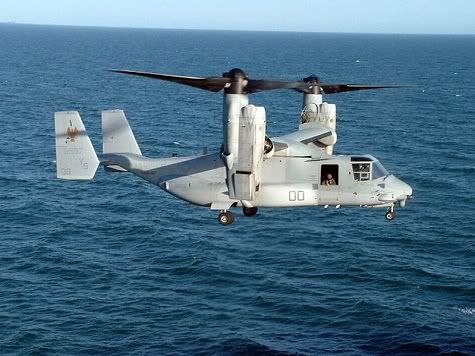
V-22 Sees Up To 100 Foreign Sales

V-22 Osprey

PARIS AIR SHOW: Flight hour costs have dropped while readiness rates have improved for the V-22, a rare feat indeed for a modern combat aircraft.

Critics have pointed to the V-22′s readiness rates and costs as yet another reason to curtail the program, but when I asked Marine Col. Greg Masiello, manager of the Joint Program Office, what their current maintenance costs are, he said they are down to $9,520 an hour at the same time they’ve substantially increased the plane’s readiness rates.

“In 2010 we have had a 28 percent increase in readiness; at the same time we’ve had a 19 percent decrease in maintenance costs, as measured by cost per flight hour,” an obviously pleased program manager replied when I asked him for the latest numbers. “I’m unaware of any other program that has demonstrated an increase in readiness while lowering flight hour costs.”

This news come fresh on the heels of the V-22 program landing an impressive commitment from the Pentagon for a $6.5 billion, five-year mulityear contract for 99 Ospreys. The average unit price for the V-22s ordered across that deal is $70 million, he told reporters here during a briefing at the Boeing chalet. While that isn’t, strictly speaking news (the redoubtable Rick Whittle reported that for us in February), he buried the information and we want to make sure you know.)

The other news from today’s briefing was that the US may sell as many as 100 Ospreys to other countries. Defense Secretary Chuck Hagel identified Israel as a buyer back in April. The United Arab Emirates are believed to be keenly interested, Japan may well buy some now that the Japanese public has seen the aircraft does not fall out of the sky. Masiello would not be drawn on specific countries but these are pretty obvious. Masiello showed photos of Ospreys landing on two different classes of Japanese ships last week, the JS Shimokita and the JS Hyuga. What did landing on these ships demonstrate? The V-22 doesn’t need ”a big flat deck” to operate from, he said.

The French might want V-22s for carriers like their Mistral, which trained with the Marines during Bold Alligator 2012. And Masiello said there might well be training done with the French carrier to demonstrate the plane’s capabilities and ensure the US could fly with the French and operate from the Mistral.

And the Osprey program has kept the Navy moving to try the V-22 as a Carrier On-Board Delivery (COD) aircraft. Currently, the Navy relies on ancient C-2A Greyhounds, twin-engine turboprops that haul cargo, mail and passengers between carriers and the shore. The first prototypes flew in 1964.

Masiello said the aircraft was flying last week from a carrier, the USS Harry Truman, as part of a formal Military Utility Assessment. “All the reports — not done yet — all are, so far so good,” the enthusiastic Marine told his audience. If the Navy goes for the aircraft that could mean another 30 to 50 V-22s for manufacturer Bell-Boeing, Masiello estimated when I pressed him. The next multi-year contact — number three — could handle much of such a Navy order, along with the foreign sales mentioned above.

Poster Image
Breaking Defense

Chủ Nhật, 26 tháng 5, 2013

Seoul plans to purchase US weapons worth $1b


Seoul has notified Washington of its intention to purchase weapons systems worth US$800 million (S$1 billion) to be mounted on its new fleet of warplanes should a US fighter be picked for its 8.3-trillion-won ($7.4 billion) acquisition project.

The Defence Security Cooperation Agency, which handles Washington's foreign military sales, revealed Seoul's request to buy high-tech arms such as Advanced Medium-Range Air-to-Air Missiles, GBU-12 laser-guided bombs and GBU-39 bunker busters.

Last month, Seoul made a separate request to purchase Lockheed Martin's F-35 stealth fighter or Boeing's F-15 Silent Eagle.

The Eurofighter Typhoon of the European Aeronautic Defence and Space Company is another candidate in the competition, through which Seoul seeks to purchase 60 jets to replace its aging F-4 and F-5 jets. The winner is expected to be announced next month.

Observers said the US products would be at an advantage in the contest given Seoul considers interoperability with US forces and alliance-related factors. But EADS has made attractive offers, such as investing $2 billion in Korea's project to develop indigenous fighters.

Asia One

Chủ Nhật, 12 tháng 5, 2013

US Navy’s liquid hydrogen drone flies for record 48 hours

The Ion Tiger, an experimental surveillance plane that uses a hydrogen fuel cell as its power source, flew for a record 26 hours using pressurized hydrogen back in 2009, but late last month it managed a full 48 hours and one minute thanks to a new cryogenic storage tank filled with liquid hydrogen.

A drone developed by the US Navy has broken its own endurance record by staying in the air for just over 48 hours. The 'Ion Tiger' used a new cryogenic tank for the liquid hydrogen fuel feeding its fuel cells to achieve the breakthrough.

Keeping a drone in the air as long as possible is a chief task for a UAV operator, especially in surveillance. One approach is to use fuel that packs a lot of energy for its volume, like hydrocarbons; drones like the MQ-9 Reaper can fly for 30 hours without landing for refueling.

But combustion engines that use hydrocarbons to keep an aircraft flying are noisy, hardly ideal for a spy drone. Ion Tiger, a surveillance drone developed by the Naval Research Laboratory (NRL), the Navy’s research branch, uses an electric engine, which is quieter and has a smaller heat signature compared to traditional drones.

A shortcoming with electric motors, however, is that onboard batteries are much less efficient than chemicals in packing energy, so drones using them can usually only operate for a handful of hours. But NRL’s aircraft uses hydrogen fuel cells to produce electricity, which improves the endurance trade-off.

"Liquid hydrogen coupled with fuel-cell technology has the potential to expand the utility of small unmanned systems by greatly increasing endurance while still affording all the benefits of electric propulsion," NRL principal investigator Dr. Karen Swider-Lyons said in a press release this week.


Ion Tiger set the record for fuel cell UAVs in 2009, when it flew for just over 26 hours using gaseous hydrogen stored in a tank at 5,000 psi. This was replaced in a mid-April test with a tank that stores cryogenic liquid fuel, which is about three times denser than the pressured gas used in the 2009 run.

NRL says their approach has additional logistic benefits, since liquid hydrogen can be produced from water on site rather than having to transport solid fuels in bulk.

Other methods of boosting drone endurance include recharging them in flight with land-based lasers and installing solar panels. A drone using the latter, the British QinetiQ Zephyr, currently holds the endurance record for drones. In 2010, it flew continuously for 14 days over the US Army's Yuma Proving Ground in Arizona.

RT/ The Verge/ YouTube