Hiển thị các bài đăng có nhãn Chinese expansionism. Hiển thị tất cả bài đăng
Thứ Hai, 23 tháng 12, 2013
In picture: Chinese dream to invade the South China Sea ?
Soldiers on China's aircraft carrier Liaoning queue forming the Chinese words that mean "Chinese Dream of powerful military" on their (soldiers') way to the South China Sea for combat capability tested, showing their ambitions in the Sea.
More: PLA deputy to NPC: Dream of powerful military and dream of strong country are connected
Thứ Sáu, 20 tháng 12, 2013
Hunting for U.S. arms tech, China taps legion of amateurs
Beijing “floods the zone with buyers” for smuggled American military gear, leading to a 50 percent spike in arms trafficking cases since 2010, Reuters has found.
By Duff Wilson and John Shiffman/ Reuters

VOICING REGRET: Lian Yang, above, spent nearly 11 months in prison after pleading guilty to conspiracy to violate U.S. arms trafficking laws. Today, he calls his attempt "wrong" but says the U.S. government "grossly exaggerated" what he did.
SEATTLE (Reuters) - In its quest to bypass embargoes and obtain the latest U.S. military technology, China isn't only relying on a cadre of carefully trained spies.
It's also enlisting a growing army of amateurs.
Their orders come indirectly from the Chinese government and take the form of shopping lists that are laundered through companies with ties to Beijing.
The recruits who buy the weapons and system components for those companies are scientists, students and businessmen, and they appear to be motivated more by profit than ideology. As one U.S. Homeland Security official put it, the Chinese "flood the zone with buyers" - a strategy that significantly complicates U.S. efforts to stop the flow of American armaments to China.
"When you have nation-states that go outside the normal intelligence agencies and open it up to any person … it just exponentially opens the door for bad guys," said Robert Anderson Jr, assistant director for counter-intelligence at the Federal Bureau of Investigation.
Today, investigations into arms trafficking linked to China have swelled to at least 350 active cases - up by more than 50 percent since 2010, according to a Reuters review of confidential U.S. government records. The total number is likely higher than 350 because the count does not include many cases that began as regulatory inquiries or investigations into other crimes. U.S. officials also say their China counter-proliferation case load is growing at a faster pace than investigations linked to any other nation.
About two-thirds of the cases prosecuted by U.S. officials since 2005 involved people of Chinese ancestry, a Reuters analysis of court records shows. That includes Chinese citizens living in China or residing legally inside the United States, and U.S. citizens with family ties to China.
China's defense ministry says Beijing's efforts to modernize its military are rooted in research, not thievery. "Some people always accuse China of stealing other countries' technology when China makes progress in weaponry development," it said in a statement to Reuters. "Such notions are baseless."
U.S. government agents say many past cases and active investigations demonstrate how individuals who have left China - and appear to hold little allegiance to the Chinese government - have become players in Beijing's effort to procure military components.
Such was the case of Lian Yang, a 49-year-old software engineer who once worked for Microsoft Corp and had family ties to an anti-government group in China. In March 2011, the father of two pleaded guilty to conspiracy to violate U.S. arms trafficking laws for buying radiation-hardened microchips and making plans to send them to China. Yang served nearly 11 months in prison and another four months under house arrest. He was released in March.
In interviews, Yang characterized his efforts as "stupid" and "wrong." But he said the U.S. government "grossly exaggerated" what he did.
Yang said a college friend in China had approached him about buying the microchips. But that friend, Yang said, was simply a businessman like himself, looking to obtain the components for another buyer - and ultimately, for the Chinese government.
A LOOK AT 280 CASES
Reuters reviewed confidential investigative records gathered by the FBI, including hours of secret recordings, transcripts and emails. They show Yang as an arms trafficking novice, motivated by money and casting about for others willing to help him for a cut of the profits.
In emails and transcripts from an FBI undercover operation, Yang spoke of the urgency to obtain the U.S.-made components for China's military and satellite programs.
"They're very firm, and they want it yesterday," Yang said on one FBI recording about his buyers in China. "They want it so badly. They have the funds."
On recordings, Yang told a family friend - who had turned government informant - that they could share in $1 million a year in profits. Later, as his plans shrank, he was working on a much smaller sale to net a few thousand dollars.
"That's your typical case, the kind you see almost every day," the FBI's Anderson said. "Here's a guy who's just trying to make a buck."
Reuters reviewed 280 arms export and embargo cases brought by the U.S. federal government during the past eight years. (The review didn't include cases involving Mexican gun smugglers, a crime that's distinct from those that jeopardize U.S. military forces). Of the 280 cases, 66 - almost one in four - involved China.
A Defense Department report to Congress this year, based on some of these investigations, said China supports its military procurement and modernization with "illicit approaches that involve violations of U.S. laws and export controls to obtain key national security technologies."
The cases reveal layers of buyers and sellers that connect to Beijing. In one recent case, investigative records contain the names of 31 Chinese companies - almost all of them state-controlled - that sought to buy smuggled military-grade communications gear. In another case, a Chinese procurement network used a series of five bank transfers between China and California to cloak a half-million dollar purchase of satellite components.
DRONE PARTS AND GYROSCOPES
About a third of the cases linked to China involved military aerospace technology, such as the radiation-hardened microchips. Arms traffickers have been caught in the last five years with military-grade gyroscopes and accelerometers, essential for China's space and missile programs; unmanned aerial vehicle or drone parts; and microwave amplifiers used for weapons guidance and radar jamming.
The individuals trying to obtain these components in the United States ranged from business people to professors, from citizens of China to permanent U.S. residents and American citizens. Many had access to technology that cannot legally be exported to China - or enough technical know-how to try to get it.
Among the Chinese citizens recently convicted:
•A missile expert working for a New Jersey defense contractor. He took company files, including design data for missiles, rockets and drones, to a technical conference in China.
•A Shanghai broker who tried to smuggle from New York thousands of pounds of high-grade carbon fiber, which can be used for military purposes.
•A Harvard-educated businessman who set up a company in Massachusetts that he used for years to smuggle millions of dollars worth of American-made electronic warfare, missile and satellite components to Shenzhen.
A handful of Americans also have been recently convicted. A man in a small New York town tried to smuggle $100,000 worth of carbon fiber to China. An export control manager at a Pennsylvania manufacturer falsified records that allowed dozens of sensitive communications devices to be shipped to China and other nations. He later explained to authorities that he had been "too busy" to obtain the proper licenses.
"None of these guys are hardened criminals - they are businessmen," said Craig Healy, a senior Homeland Security Investigations official who directs the U.S. government's counter-proliferation center. "But they give very little thought to the consequences, that the little widget they are selling could be used at some point to kill an American or allied soldier."
The United States imposed an embargo on arm sales to China after the 1989 Tiananmen Square massacre. Under the embargo, anything designed for police or military use has been banned for export to China; "dual-use" items - those that have both civilian and military applications - require U.S. government permission before they can be sent there.
Lian Yang's own shopping list had seven items the Chinese government wanted to buy in bulk for space and missile systems. Two items could be legal to export with U.S. government permission. Five - including the microchips - were totally restricted because of their importance to weapons systems.
"You can't operate missiles or satellites without radiation-hardened chips because the environment is so hostile in space that the electronics will be fried or disrupted," said James Lewis, an arms expert with the Washington-based Center for Strategic and International Studies. "Somebody in China sent out a tasking: get me those chips."
CHINESE BUYER
Yang had left China for the United States in 1988 and became a U.S. citizen in 1999. He sponsored his parents, too; his mother, he said in interviews with Reuters, had been persecuted by the Chinese government for her involvement in the spiritual movement Falun Gong.
Married and the father of two boys, Yang had been earning well over $100,000 a year as a senior software engineer for Microsoft before starting his own business in 2007. His wife ran a travel agency. They owned two houses in a Seattle suburb; one was paid off and occupied by his parents.
In 2009, about a year before the FBI began the sting operation that sent him to prison, Yang attended the wedding of his wife's friends. There, he posed for a photograph next to the groom's half-sister - former U.S. Secretary of State Condoleezza Rice. "She was very nice," Yang recalled.
At the time, Yang's wife was close to the bride and to the groom, Rice's half-brother Gregory S. Bailey. Yang's wife was the matron of honor at the wedding; one of their sons was the ring-bearer.
In the months that followed the ceremony, Yang and Bailey, himself an entrepreneur, worked together to sell water equipment and liquid crystal displays to companies in China - items that are legal to export.
"He represented himself as a person who had contacts," Bailey said in an interview. Both say these business efforts flopped.
Rice, now a professor at Stanford University, had nothing to do with the men's business efforts. The wedding "was the first and only time that she encountered Mr. Yang," said Rice's chief of staff, Georgia Godfrey. Rice, she added, "is not involved in or knowledgeable about his business affairs or those of Greg Bailey."
Shortly after the wedding, one of Yang's contacts in China began to give him lists of items in high demand: military components.
Precisely who was behind Yang's effort remains unclear. In court filings, federal officials say the military-grade microchips Yang sought to purchase were destined for China's satellite program. The FBI and prosecutors wouldn't elaborate. Yang said he couldn't discuss certain aspects of his activity until his probation ends in 2016.
According to a March 2010 email from Yang, the parts were meant for China Aerospace Science and Technology Corp, the state-owned satellite and missile maker. An official with China Aerospace's satellite subsidiary, China Spacesat Co Ltd, said he was unaware of the Yang case.
In a May 2010 e-mail message, Bailey told Yang that he could get some of the military-restricted microchips on Yang's shopping list from California-based Xilinx Inc. They were radiation-hardened versions that would be illegal to send to China. Even so, Bailey wrote in the email: "I will, if needed have my team purchase 87 Xilinx units, this is the number I have available, it will be 32 weeks for any additional Xilinx products."
A Xilinx spokeswoman declined to comment.
Bailey also wrote that the LCDs - which were legal to export to China - would have to be sold first.
Bailey told Reuters that he intended only to offer the LCDs and never planned to sell the military chips, describing his proposal as "disinformation" for Yang. "Was that wise?" he said. "Absolutely not, in retrospect. But I never had any intention of doing anything illegal or anything to hurt this country and never made any provision to do so."
In an email to Reuters this month, Bailey wrote that he "never was implicated or accused of anything," and that he "proactively and voluntarily assisted the FBI" in the Yang case. He wrote that the agents told him he was "a good and loyal American."
An FBI spokeswoman in Seattle declined to comment on Bailey.
'MONEY TRAIL'
Yang and Bailey had a falling out, and Yang pursued other partners. He reached out to a man he considered "a very close family friend." Unbeknownst to Yang, the man alerted the FBI.
As Yang presented his plans to try to buy military technology that China sought, his family friend wore a wire.

DUAL USE: Carbon fiber such as this cannot be exported to China without the permission of the U.S. government. That’s because it can be used for both civilian and military purposes.
They discussed a cover story. "The money trail is a problem," Yang told the friend. "It would be from Hong Kong. We can say…"
"Well, the money could be an investment," the friend suggested.
"Yeah, I mean, for R&D there's really no problem," Yang said.
The family friend, who had experience in international trade, played along. He told Yang that he had already approached two U.S. companies, pretending to want technology for Chinese civilian passenger jets. He said the companies told him that they don't sell to brokers and they don't sell to China.
The FBI recording captured Yang and the friend talking about setting up a Nevada front company that would claim to want the chips for research. Its purpose was, in part, to hide Yang's role - and his Chinese surname.
"When they see Chinese, they automatically suspect," Yang said, laughing.
If they succeeded, the profits could be enormous, Yang said; they could make a million dollars a year - 10 percent on $10 million in annual sales.
"That much, uh?" the friend replied. "Wow!"
To the buyers, money was no object, Yang said. But the items needed to be of military grade.
"Of course, when you have the military stuff, it's just simply better," Yang added.
"Yeah," the informant replied.
"It's simply better and more expensive."
"Sure, yeah."
"And they want the more expensive stuff."
AWAY ON BUSINESS
Andaluca is an upscale restaurant in downtown Seattle with subdued lighting and high-backed booths that are ideal for private conversation. Over dinner there in September 2010, Yang's family friend - the informant - introduced Yang to two associates. The men claimed to know people who could forge paperwork and get radiation-hardened microchips.
They were undercover FBI agents.
According to their secret recording, the agents drew out Yang on the ultimate buyers - the Chinese government - and the potential size of the deal.
"A huge amount of money," Yang said.
Using a standard undercover technique, the agents steered Yang to confirm that he understood what he was proposing to do was illegal. It's a requirement necessary to gain a conviction under U.S. arms trafficking laws.
If anything were to go wrong, one of the agents said, "We're all sitting in the same cell together. You know what I'm saying?"
"Oh," Yang replied.
"I'm not trying to be mean."
"Yeah, understand," Yang said.
Just before ordering dessert, Yang explained how he believed his effort was actually aiding the United States by helping the balance of trade. "My take on this is that we're doing a service to the country," he said. "Personally I know because I've been dealing with China for 10 years with Microsoft. Outsourcing. Buying hardware."
Then, they all got the cheesecake. Yang picked up the tab. "You're the guests," he said. "Appreciate that," an agent replied.
About three months later, on December 3, 2010, Yang gathered $20,000 in cash he had cobbled together from five banks. His China connections had not come up with upfront money after all. The cash, in addition to money Yang had already wired to an FBI front company, would cover the $80,000 price tag for a test buy of five of the microchips - a purchase that Yang thought would establish a business relationship.
U.S. agents say Yang had planned to cross the border to Canada later that day in a rental car. He had already bought a ticket from Vancouver to Beijing for the following day.
Yang met the undercover agents in Seattle. They gave him the chips. He handed them the money. Within minutes, Yang was arrested.
He was charged with conspiracy to violate the federal arms trafficking law. His lawyer negotiated a guilty plea for a reduced sentence.
Before he began his prison term, Yang said he told his young sons he would be away on business - in China.
(Edited by Blake Morrison.)
By Duff Wilson and John Shiffman/ Reuters
VOICING REGRET: Lian Yang, above, spent nearly 11 months in prison after pleading guilty to conspiracy to violate U.S. arms trafficking laws. Today, he calls his attempt "wrong" but says the U.S. government "grossly exaggerated" what he did.
SEATTLE (Reuters) - In its quest to bypass embargoes and obtain the latest U.S. military technology, China isn't only relying on a cadre of carefully trained spies.
It's also enlisting a growing army of amateurs.
Their orders come indirectly from the Chinese government and take the form of shopping lists that are laundered through companies with ties to Beijing.
The recruits who buy the weapons and system components for those companies are scientists, students and businessmen, and they appear to be motivated more by profit than ideology. As one U.S. Homeland Security official put it, the Chinese "flood the zone with buyers" - a strategy that significantly complicates U.S. efforts to stop the flow of American armaments to China.
"When you have nation-states that go outside the normal intelligence agencies and open it up to any person … it just exponentially opens the door for bad guys," said Robert Anderson Jr, assistant director for counter-intelligence at the Federal Bureau of Investigation.
Today, investigations into arms trafficking linked to China have swelled to at least 350 active cases - up by more than 50 percent since 2010, according to a Reuters review of confidential U.S. government records. The total number is likely higher than 350 because the count does not include many cases that began as regulatory inquiries or investigations into other crimes. U.S. officials also say their China counter-proliferation case load is growing at a faster pace than investigations linked to any other nation.
About two-thirds of the cases prosecuted by U.S. officials since 2005 involved people of Chinese ancestry, a Reuters analysis of court records shows. That includes Chinese citizens living in China or residing legally inside the United States, and U.S. citizens with family ties to China.
China's defense ministry says Beijing's efforts to modernize its military are rooted in research, not thievery. "Some people always accuse China of stealing other countries' technology when China makes progress in weaponry development," it said in a statement to Reuters. "Such notions are baseless."
U.S. government agents say many past cases and active investigations demonstrate how individuals who have left China - and appear to hold little allegiance to the Chinese government - have become players in Beijing's effort to procure military components.
Such was the case of Lian Yang, a 49-year-old software engineer who once worked for Microsoft Corp and had family ties to an anti-government group in China. In March 2011, the father of two pleaded guilty to conspiracy to violate U.S. arms trafficking laws for buying radiation-hardened microchips and making plans to send them to China. Yang served nearly 11 months in prison and another four months under house arrest. He was released in March.
In interviews, Yang characterized his efforts as "stupid" and "wrong." But he said the U.S. government "grossly exaggerated" what he did.
Yang said a college friend in China had approached him about buying the microchips. But that friend, Yang said, was simply a businessman like himself, looking to obtain the components for another buyer - and ultimately, for the Chinese government.
A LOOK AT 280 CASES
Reuters reviewed confidential investigative records gathered by the FBI, including hours of secret recordings, transcripts and emails. They show Yang as an arms trafficking novice, motivated by money and casting about for others willing to help him for a cut of the profits.
In emails and transcripts from an FBI undercover operation, Yang spoke of the urgency to obtain the U.S.-made components for China's military and satellite programs.
"They're very firm, and they want it yesterday," Yang said on one FBI recording about his buyers in China. "They want it so badly. They have the funds."
On recordings, Yang told a family friend - who had turned government informant - that they could share in $1 million a year in profits. Later, as his plans shrank, he was working on a much smaller sale to net a few thousand dollars.
"That's your typical case, the kind you see almost every day," the FBI's Anderson said. "Here's a guy who's just trying to make a buck."
Reuters reviewed 280 arms export and embargo cases brought by the U.S. federal government during the past eight years. (The review didn't include cases involving Mexican gun smugglers, a crime that's distinct from those that jeopardize U.S. military forces). Of the 280 cases, 66 - almost one in four - involved China.
A Defense Department report to Congress this year, based on some of these investigations, said China supports its military procurement and modernization with "illicit approaches that involve violations of U.S. laws and export controls to obtain key national security technologies."
The cases reveal layers of buyers and sellers that connect to Beijing. In one recent case, investigative records contain the names of 31 Chinese companies - almost all of them state-controlled - that sought to buy smuggled military-grade communications gear. In another case, a Chinese procurement network used a series of five bank transfers between China and California to cloak a half-million dollar purchase of satellite components.
DRONE PARTS AND GYROSCOPES
About a third of the cases linked to China involved military aerospace technology, such as the radiation-hardened microchips. Arms traffickers have been caught in the last five years with military-grade gyroscopes and accelerometers, essential for China's space and missile programs; unmanned aerial vehicle or drone parts; and microwave amplifiers used for weapons guidance and radar jamming.
The individuals trying to obtain these components in the United States ranged from business people to professors, from citizens of China to permanent U.S. residents and American citizens. Many had access to technology that cannot legally be exported to China - or enough technical know-how to try to get it.
Among the Chinese citizens recently convicted:
•A missile expert working for a New Jersey defense contractor. He took company files, including design data for missiles, rockets and drones, to a technical conference in China.
•A Shanghai broker who tried to smuggle from New York thousands of pounds of high-grade carbon fiber, which can be used for military purposes.
•A Harvard-educated businessman who set up a company in Massachusetts that he used for years to smuggle millions of dollars worth of American-made electronic warfare, missile and satellite components to Shenzhen.
A handful of Americans also have been recently convicted. A man in a small New York town tried to smuggle $100,000 worth of carbon fiber to China. An export control manager at a Pennsylvania manufacturer falsified records that allowed dozens of sensitive communications devices to be shipped to China and other nations. He later explained to authorities that he had been "too busy" to obtain the proper licenses.
"None of these guys are hardened criminals - they are businessmen," said Craig Healy, a senior Homeland Security Investigations official who directs the U.S. government's counter-proliferation center. "But they give very little thought to the consequences, that the little widget they are selling could be used at some point to kill an American or allied soldier."
The United States imposed an embargo on arm sales to China after the 1989 Tiananmen Square massacre. Under the embargo, anything designed for police or military use has been banned for export to China; "dual-use" items - those that have both civilian and military applications - require U.S. government permission before they can be sent there.
Lian Yang's own shopping list had seven items the Chinese government wanted to buy in bulk for space and missile systems. Two items could be legal to export with U.S. government permission. Five - including the microchips - were totally restricted because of their importance to weapons systems.
"You can't operate missiles or satellites without radiation-hardened chips because the environment is so hostile in space that the electronics will be fried or disrupted," said James Lewis, an arms expert with the Washington-based Center for Strategic and International Studies. "Somebody in China sent out a tasking: get me those chips."
CHINESE BUYER
Yang had left China for the United States in 1988 and became a U.S. citizen in 1999. He sponsored his parents, too; his mother, he said in interviews with Reuters, had been persecuted by the Chinese government for her involvement in the spiritual movement Falun Gong.
Married and the father of two boys, Yang had been earning well over $100,000 a year as a senior software engineer for Microsoft before starting his own business in 2007. His wife ran a travel agency. They owned two houses in a Seattle suburb; one was paid off and occupied by his parents.
In 2009, about a year before the FBI began the sting operation that sent him to prison, Yang attended the wedding of his wife's friends. There, he posed for a photograph next to the groom's half-sister - former U.S. Secretary of State Condoleezza Rice. "She was very nice," Yang recalled.
At the time, Yang's wife was close to the bride and to the groom, Rice's half-brother Gregory S. Bailey. Yang's wife was the matron of honor at the wedding; one of their sons was the ring-bearer.
In the months that followed the ceremony, Yang and Bailey, himself an entrepreneur, worked together to sell water equipment and liquid crystal displays to companies in China - items that are legal to export.
"He represented himself as a person who had contacts," Bailey said in an interview. Both say these business efforts flopped.
Rice, now a professor at Stanford University, had nothing to do with the men's business efforts. The wedding "was the first and only time that she encountered Mr. Yang," said Rice's chief of staff, Georgia Godfrey. Rice, she added, "is not involved in or knowledgeable about his business affairs or those of Greg Bailey."
Shortly after the wedding, one of Yang's contacts in China began to give him lists of items in high demand: military components.
Precisely who was behind Yang's effort remains unclear. In court filings, federal officials say the military-grade microchips Yang sought to purchase were destined for China's satellite program. The FBI and prosecutors wouldn't elaborate. Yang said he couldn't discuss certain aspects of his activity until his probation ends in 2016.
According to a March 2010 email from Yang, the parts were meant for China Aerospace Science and Technology Corp, the state-owned satellite and missile maker. An official with China Aerospace's satellite subsidiary, China Spacesat Co Ltd, said he was unaware of the Yang case.
In a May 2010 e-mail message, Bailey told Yang that he could get some of the military-restricted microchips on Yang's shopping list from California-based Xilinx Inc. They were radiation-hardened versions that would be illegal to send to China. Even so, Bailey wrote in the email: "I will, if needed have my team purchase 87 Xilinx units, this is the number I have available, it will be 32 weeks for any additional Xilinx products."
A Xilinx spokeswoman declined to comment.
Bailey also wrote that the LCDs - which were legal to export to China - would have to be sold first.
Bailey told Reuters that he intended only to offer the LCDs and never planned to sell the military chips, describing his proposal as "disinformation" for Yang. "Was that wise?" he said. "Absolutely not, in retrospect. But I never had any intention of doing anything illegal or anything to hurt this country and never made any provision to do so."
In an email to Reuters this month, Bailey wrote that he "never was implicated or accused of anything," and that he "proactively and voluntarily assisted the FBI" in the Yang case. He wrote that the agents told him he was "a good and loyal American."
An FBI spokeswoman in Seattle declined to comment on Bailey.
'MONEY TRAIL'
Yang and Bailey had a falling out, and Yang pursued other partners. He reached out to a man he considered "a very close family friend." Unbeknownst to Yang, the man alerted the FBI.
As Yang presented his plans to try to buy military technology that China sought, his family friend wore a wire.
DUAL USE: Carbon fiber such as this cannot be exported to China without the permission of the U.S. government. That’s because it can be used for both civilian and military purposes.
They discussed a cover story. "The money trail is a problem," Yang told the friend. "It would be from Hong Kong. We can say…"
"Well, the money could be an investment," the friend suggested.
"Yeah, I mean, for R&D there's really no problem," Yang said.
The family friend, who had experience in international trade, played along. He told Yang that he had already approached two U.S. companies, pretending to want technology for Chinese civilian passenger jets. He said the companies told him that they don't sell to brokers and they don't sell to China.
The FBI recording captured Yang and the friend talking about setting up a Nevada front company that would claim to want the chips for research. Its purpose was, in part, to hide Yang's role - and his Chinese surname.
"When they see Chinese, they automatically suspect," Yang said, laughing.
If they succeeded, the profits could be enormous, Yang said; they could make a million dollars a year - 10 percent on $10 million in annual sales.
"That much, uh?" the friend replied. "Wow!"
To the buyers, money was no object, Yang said. But the items needed to be of military grade.
"Of course, when you have the military stuff, it's just simply better," Yang added.
"Yeah," the informant replied.
"It's simply better and more expensive."
"Sure, yeah."
"And they want the more expensive stuff."
AWAY ON BUSINESS
Andaluca is an upscale restaurant in downtown Seattle with subdued lighting and high-backed booths that are ideal for private conversation. Over dinner there in September 2010, Yang's family friend - the informant - introduced Yang to two associates. The men claimed to know people who could forge paperwork and get radiation-hardened microchips.
They were undercover FBI agents.
According to their secret recording, the agents drew out Yang on the ultimate buyers - the Chinese government - and the potential size of the deal.
"A huge amount of money," Yang said.
Using a standard undercover technique, the agents steered Yang to confirm that he understood what he was proposing to do was illegal. It's a requirement necessary to gain a conviction under U.S. arms trafficking laws.
If anything were to go wrong, one of the agents said, "We're all sitting in the same cell together. You know what I'm saying?"
"Oh," Yang replied.
"I'm not trying to be mean."
"Yeah, understand," Yang said.
Just before ordering dessert, Yang explained how he believed his effort was actually aiding the United States by helping the balance of trade. "My take on this is that we're doing a service to the country," he said. "Personally I know because I've been dealing with China for 10 years with Microsoft. Outsourcing. Buying hardware."
Then, they all got the cheesecake. Yang picked up the tab. "You're the guests," he said. "Appreciate that," an agent replied.
About three months later, on December 3, 2010, Yang gathered $20,000 in cash he had cobbled together from five banks. His China connections had not come up with upfront money after all. The cash, in addition to money Yang had already wired to an FBI front company, would cover the $80,000 price tag for a test buy of five of the microchips - a purchase that Yang thought would establish a business relationship.
U.S. agents say Yang had planned to cross the border to Canada later that day in a rental car. He had already bought a ticket from Vancouver to Beijing for the following day.
Yang met the undercover agents in Seattle. They gave him the chips. He handed them the money. Within minutes, Yang was arrested.
He was charged with conspiracy to violate the federal arms trafficking law. His lawyer negotiated a guilty plea for a reduced sentence.
Before he began his prison term, Yang said he told his young sons he would be away on business - in China.
(Edited by Blake Morrison.)
Thứ Năm, 19 tháng 12, 2013
Prepare For War In The East China Sea – Analysis
What China is doing in the East China Sea is what it did in the Himalayas in 1962: Create and, indeed, push “facts on the ground” which compel the other side to back off, or undertake a confrontation which could lead to war.
By Manoj Joshi
On December 5, a Chinese naval vessel tried to force a U.S. warship to stop in international waters in the latest instance of the growing Chinese tendency to flex their muscles.
This incident comes hard on the heels of the situation in the East China Sea region, where Beijing had declared an Air Defence Identification Zone (ADIZ) on November 23 which included the Japanese-controlled, but disputed, Senkaku/Diayou islands.
Some alarming analysis suggests that the Chinese may not be above seeking a limited conflict in the region.
Incident
According to US officials, the guided missile cruiser USS Cowpens, was confronted by Chinese warships in the South China Sea near Beijing’s new aircraft carrier Liaoning.
What appears to have happened is that the US ship had been deputed to tail the Liaoning, which had been carrying out manoeuvres in the East China Sea as part of Beijing’s effort to brow-beat Japan over the Senkaku/Diayou islands.
A Chinese navy vessel hailed the Cowpens and ordered it to stop. The ship refused and continued on its course because it was in international waters.
Thereupon a Chinese tank-landing ship came directly into the path of Cowpens and stopped, forcing the American vessel to sharply change course.
The incident took place about 100 nautical miles from the Chinese coast. China’s Exclusive Economic Zone, which has been defined under the United Nations Convention on the Law of the Seas (UNCLOS) goes out 200 nautical miles into the sea.
The US has not ratified UNCLOS, which China, Japan, India and most of the world have, but it says that it generally observes its rules.
As part of these it insists on the unfettered movement of not just its merchant marine, but warships, in the EEZ.
However, China has strongly opposed this interpretation noting that naval vessels’ military aircraft by definition do not undertake “innocent passage.”
The Chinese have bridled at US intelligence and surveillance ships that keep track of Chinese maritime activity.
US intelligence-gathering ships like the USNS Impeccable and Victorious have faced Chinese harassment regularly over the past few years.
In this instance, there are some who believe that the Chinese may have deliberately staged the incident as part of a larger strategy against Japan and the US.
Two days after the Chinese announced their new ADIZ, the US sent two unarmed B-52 bombers to fly through the zone.
However, it has advised its civilian aircraft to observe the ADIZ and give prior notification of any flights they plan through the ADIZ.
Strategy
The Japanese have declared that they will not recognise the ADIZ and for their part, the Chinese have in recent days sent in their Su-30 and J-11 fighters, along with their KJ-2000 AWACS aircraft, to show that they intend to monitor the airspace they have declared as part of their ADIZ.
In 1981, when Deng Xiaoping began China’s opening to the world, he also enjoined the Chinese to follow what is called the 24 character strategy in its foreign and security policies: “Observe calmly; secure our position; cope with affairs calmly; hide our capabilities and bide our time; be good at maintaining a low profile; and never claim leadership.”
Conversations with Chinese thinktank officials reveal a certain candidness about Beijing’s changed global posture which, of course, has implications for India.
They say that the era of the 24 character strategy is over. Indeed, they acknowledge that, as of 2012, they have become more assertive.
Interests
However, observers say that the shift began at least five years before that in 2008 when the Chinese government ordered its marine service to begin patrolling the maritime areas claimed by China.
In 2009, it asserted its expansive South China Sea claims when it submitted a map to the UN along with the U-shaped Nine Dash line that comes down to the coast of Brunei.
In 2011, a Chinese ship cut the cable of a seismic survey ship. In 2012, it created a new administrative zone around the city of Sansha to have jurisdiction over the Spratly and Paracel islands.
This was also the year when the Chinese issued a new passport with the map including the ridiculous Nine Dash claim.
The Chinese say that their interests in the East China Sea are what bother them the most because of their proximity to the Chinese heartland.
The South China Sea, they insist, is not a problem area of the same dimension. Beijing’s unambiguous goal is to isolate Japan, divide the ASEAN and befuddle the United States.
The tough stance on the Senkaku/Diayou is part of this, and the recent tour of the ASEAN by Xi Jinping and Li Keqiang showed the extent to which the Chinese are willing to go to befriend the region, minus the Philippines.
Even that old and formidable adversary Vietnam is being wooed by Beijing.
As for the United States, its stand on supporting the regional nations is less than clear. It insists that it is neutral when it comes to the maritime disputes, but maintains that it will stand by its treaty allies like Japan and the Philippines in the event of a conflict.
The developments in the East China Sea have important implications for India because we, too, have a major border dispute with China and we have also seen a shift in Beijing’s border management policy since 2008.
China has been quick to say that its ADIZ only has implications for its maritime borders, but who is to say that such a maneuver could not be attempted against us?
Actually, what China is doing in the East China Sea is what it did in the Himalayas in 1962: Create and, indeed, push “facts on the ground” which compel the other side to back off, or undertake a confrontation which could lead to war.
India handled things badly then; hopefully the Japanese and the Americans will be more deft.
(The writer is a Distinguished Fellow at Observer Research Foundation, Delhi)
Courtesy : Daily Mail, UK, December 17, 2013
By Manoj Joshi
On December 5, a Chinese naval vessel tried to force a U.S. warship to stop in international waters in the latest instance of the growing Chinese tendency to flex their muscles.
This incident comes hard on the heels of the situation in the East China Sea region, where Beijing had declared an Air Defence Identification Zone (ADIZ) on November 23 which included the Japanese-controlled, but disputed, Senkaku/Diayou islands.
Some alarming analysis suggests that the Chinese may not be above seeking a limited conflict in the region.
Incident
According to US officials, the guided missile cruiser USS Cowpens, was confronted by Chinese warships in the South China Sea near Beijing’s new aircraft carrier Liaoning.
What appears to have happened is that the US ship had been deputed to tail the Liaoning, which had been carrying out manoeuvres in the East China Sea as part of Beijing’s effort to brow-beat Japan over the Senkaku/Diayou islands.
A Chinese navy vessel hailed the Cowpens and ordered it to stop. The ship refused and continued on its course because it was in international waters.
Thereupon a Chinese tank-landing ship came directly into the path of Cowpens and stopped, forcing the American vessel to sharply change course.
The incident took place about 100 nautical miles from the Chinese coast. China’s Exclusive Economic Zone, which has been defined under the United Nations Convention on the Law of the Seas (UNCLOS) goes out 200 nautical miles into the sea.
The US has not ratified UNCLOS, which China, Japan, India and most of the world have, but it says that it generally observes its rules.
As part of these it insists on the unfettered movement of not just its merchant marine, but warships, in the EEZ.
However, China has strongly opposed this interpretation noting that naval vessels’ military aircraft by definition do not undertake “innocent passage.”
The Chinese have bridled at US intelligence and surveillance ships that keep track of Chinese maritime activity.
US intelligence-gathering ships like the USNS Impeccable and Victorious have faced Chinese harassment regularly over the past few years.
In this instance, there are some who believe that the Chinese may have deliberately staged the incident as part of a larger strategy against Japan and the US.
Two days after the Chinese announced their new ADIZ, the US sent two unarmed B-52 bombers to fly through the zone.
However, it has advised its civilian aircraft to observe the ADIZ and give prior notification of any flights they plan through the ADIZ.
Strategy
The Japanese have declared that they will not recognise the ADIZ and for their part, the Chinese have in recent days sent in their Su-30 and J-11 fighters, along with their KJ-2000 AWACS aircraft, to show that they intend to monitor the airspace they have declared as part of their ADIZ.
In 1981, when Deng Xiaoping began China’s opening to the world, he also enjoined the Chinese to follow what is called the 24 character strategy in its foreign and security policies: “Observe calmly; secure our position; cope with affairs calmly; hide our capabilities and bide our time; be good at maintaining a low profile; and never claim leadership.”
Conversations with Chinese thinktank officials reveal a certain candidness about Beijing’s changed global posture which, of course, has implications for India.
They say that the era of the 24 character strategy is over. Indeed, they acknowledge that, as of 2012, they have become more assertive.
Interests
However, observers say that the shift began at least five years before that in 2008 when the Chinese government ordered its marine service to begin patrolling the maritime areas claimed by China.
In 2009, it asserted its expansive South China Sea claims when it submitted a map to the UN along with the U-shaped Nine Dash line that comes down to the coast of Brunei.
In 2011, a Chinese ship cut the cable of a seismic survey ship. In 2012, it created a new administrative zone around the city of Sansha to have jurisdiction over the Spratly and Paracel islands.
This was also the year when the Chinese issued a new passport with the map including the ridiculous Nine Dash claim.
The Chinese say that their interests in the East China Sea are what bother them the most because of their proximity to the Chinese heartland.
The South China Sea, they insist, is not a problem area of the same dimension. Beijing’s unambiguous goal is to isolate Japan, divide the ASEAN and befuddle the United States.
The tough stance on the Senkaku/Diayou is part of this, and the recent tour of the ASEAN by Xi Jinping and Li Keqiang showed the extent to which the Chinese are willing to go to befriend the region, minus the Philippines.
Even that old and formidable adversary Vietnam is being wooed by Beijing.
As for the United States, its stand on supporting the regional nations is less than clear. It insists that it is neutral when it comes to the maritime disputes, but maintains that it will stand by its treaty allies like Japan and the Philippines in the event of a conflict.
The developments in the East China Sea have important implications for India because we, too, have a major border dispute with China and we have also seen a shift in Beijing’s border management policy since 2008.
China has been quick to say that its ADIZ only has implications for its maritime borders, but who is to say that such a maneuver could not be attempted against us?
Actually, what China is doing in the East China Sea is what it did in the Himalayas in 1962: Create and, indeed, push “facts on the ground” which compel the other side to back off, or undertake a confrontation which could lead to war.
India handled things badly then; hopefully the Japanese and the Americans will be more deft.
(The writer is a Distinguished Fellow at Observer Research Foundation, Delhi)
Courtesy : Daily Mail, UK, December 17, 2013
Thứ Bảy, 14 tháng 12, 2013
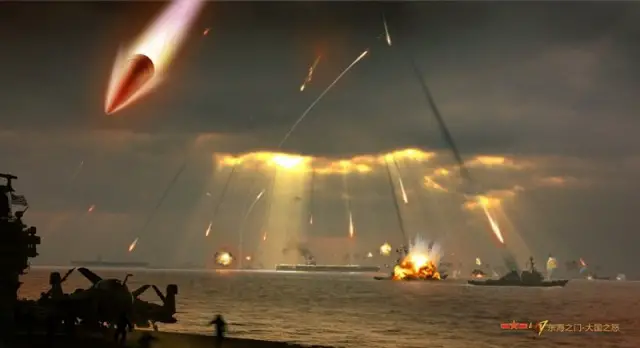
Electronic Countermeasures maybe only way to counter Chinese DF-21D Ballistic Missile
According to a report from Russian Military Analysis , the only way to defeat the DF-21D ballistic missile may be through electronic countermeasures. The Dong-Feng 21D, is People's Liberation Army Navy's supersonic anti-ship ballistic missile with a a top speed of Mach 10 and a range of 1,450 kilometers.
Russian Military Analysis report explains that air defense system can be used to intercept high-speed flying objectives, as the USS Lake Erie, a Ticonderoga-class guided-missile cruiser, successfully destroyed malfunctioning spy satellite USA-193 with a RIM-161 Standard Missile 3 about 247 km above the Pacific in 2008; however, the report also noted that Lake Erie had an abundance of information regarding the trajectory of the satellite.
Lacking sufficient knowledge about the launch point of the missile, the only way to defeat the DF-21D is through electronic countermeasures which would allow the United States Navy a chance to evade the attack by changing the ballistic trajectory of the missile. There remains no other way for a US aircraft carrier to defend itself from an attack by the DF-21D, the report said.
navyrecognition.com
Russian Military Analysis report explains that air defense system can be used to intercept high-speed flying objectives, as the USS Lake Erie, a Ticonderoga-class guided-missile cruiser, successfully destroyed malfunctioning spy satellite USA-193 with a RIM-161 Standard Missile 3 about 247 km above the Pacific in 2008; however, the report also noted that Lake Erie had an abundance of information regarding the trajectory of the satellite.
Lacking sufficient knowledge about the launch point of the missile, the only way to defeat the DF-21D is through electronic countermeasures which would allow the United States Navy a chance to evade the attack by changing the ballistic trajectory of the missile. There remains no other way for a US aircraft carrier to defend itself from an attack by the DF-21D, the report said.
navyrecognition.com
Thứ Ba, 10 tháng 12, 2013
Meet The Tiny Rock That Could Start World War III
Sunday morning, South Korea announced that it was extending its air defense zone to include a tiny reef off its coast. Now China, Japan, and South Korea’s flight zones overlap for the first time, upping military tensions in a region already rife with them.
Socotra Rock, known as Ieodo in Korea and Suyan Rock in China, is a submerged reef that houses a Korean research station. Both Korea and China claim it as part of their “exclusive economic zones,” (EEZ) a legal term for the maritime region in which the country has special development rights.
South Korea’s expansion of its air defense identification zone (ADIZ) to include Socotra is a direct response to China doing the same. An ADIZ denotes the area in which another country can’t fly its planes safely without identifying themselves, and, in late November, China expanded its zone to include Socotra. At the time, China’s play for Socotra was overshadowed by its move for the Senkaku-Diayou island chain, which Japan also claims. But South Korea’s counter has brought the simmering Socotra dispute to the fore.
After China’s move, South Korea military officials asked China to peacefully remove Socotra from its ADIZ, perhaps in exchange for taking China’s side in its dispute with Japan. But China refused, prompting Sunday’s escalation.
Many Koreans believe Socotra is critically important to their nation’s security. “Ieodo itself has a huge significance,” Koh Choong-suk president of the Ieodo Research Society, said. “Waters near it are part of key shipping routes through which some 90 percent of Korea’s inbound and outbound shipments pass.” Korean control over Socotra also limits China’s maneuvering room in the East China Sea, where the islands it disputes with Japan lie, and the reef is believed to house natural gas and mineral deposits.
The real danger in the overlapping Korean-Chinese ADIZ is accidental war. When another country’s aircraft, civilian or military, fly into a foreign ADIZ, they have to identify themselves or risk being fired on. Japanese planes that fly in the Senkaku-Diayou chain refuse to identify themselves beforehand to Beijing in protest of China’s claim, upping the chance that China might blow them out of the sky. If Korean or Chinese aircraft do the same in Socotra, it’ll increase the risk of a deadly accident. That could very well escalate to war between the Asian powers, a war that could pull in the United States.
“The issue of the air defense identification zone is making the already difficult regional situations even more difficult to deal with,” South Korean Foreign Minister Yun Byung-se said after China’s initial ADIZ announcement. “Things can take a dramatic turn for the worse if territorial conflicts and historical issues are merged with nationalism.”
Of course, a war between China and South Korea (perhaps aided by the United States and Japan) would be a catastrophe for all parties. Socotra is important, but not nearly important enough to pay the cost in blood and treasure necessary to wrest it from another party through force — to say nothing of the nuclear risk posed by conflict between an American ally and China.
Under these conditions, accidental war is unlikely. “Historians have demonstrated that most wars initially deemed ‘accidental,” University of Kentucky political scientist Robert Farley writes, “have in actuality resulted from deliberative state policy, even if the circumstances of the war were unplanned.” Accidental wars do happen, but they tend to occur in cases where there is poor communication between the warring nations and a lot to gain from decisive, rapid military action — conditions that do not hold in the Socotra dispute.
Regardless, the conflict over Socotra is yet another complication in the fraught, ever-shifting relations between South Korea, Japan, and China. According to John Delury, an assistant professor at Yonsei University whose research focuses on East Asian politics, relations between China and South Korea haven’t been this close in over 100 years. “The kerfuffle over the overlap between China’s new ADIZ and Korea’s old ADIZ should not distract too much attention from the deeper strategic shift taking shape,” he wrote three days before the Korean announcement. Delury sees as-of-yet improving relations between South Korea and China as part of a broader Chinese strategy to peacefully weaken the American-made alliance system that has set the terms of East Asian politics since the 50s.
South Korea’s initial attempt to deescalate the ADIZ situation through diplomacy fits Delury’s thesis, but China’s refusal to play ball doesn’t. “Now, the [Korean] government has no choice but to stand with the United States, Australia, and Japan in staunch opposition to the ADIZ,” Victor Cha, an expert on the Koreas at Georgetown and the Center for Strategic and International Studies, concludes. “Perhaps this was not Seoul’s first choice, but it is the smarter long-term strategic play. Cutting an individual ‘deal’ with China only further isolates the ROK from its allies and sets it up to be dominated by China.”
It’d also be a mistake to think of Korean-Chinese-Japanese relations as being governed solely by the dictates of power politics. There are economic reasons to think they’d avoid conflict; war is bad for business, after all. And don’t discount the power of historical grievances and ideology to shift a nation’s thinking. South Korea and Japan have been at loggerheads recently over another territorial dispute and the legacy of Japan’s colonial conquest of Korea in the early 20th century, tensions China has been cannily exploiting.
Socotra may be an opportunity for the two American allies to make up, but the only durable solution to the long-simmering tensions in the region is some kind of compromise between the three countries and the United States. Sheila Smith, a Japan expert at the Council on Foreign Relations, suggests that a formal “code of conduct,” a model pioneered elsewhere in Asia, could calm things down. Until something like that happens, though, expect continued rockiness over Socotra Rock.
Socotra Rock, known as Ieodo in Korea and Suyan Rock in China, is a submerged reef that houses a Korean research station. Both Korea and China claim it as part of their “exclusive economic zones,” (EEZ) a legal term for the maritime region in which the country has special development rights.
South Korea’s expansion of its air defense identification zone (ADIZ) to include Socotra is a direct response to China doing the same. An ADIZ denotes the area in which another country can’t fly its planes safely without identifying themselves, and, in late November, China expanded its zone to include Socotra. At the time, China’s play for Socotra was overshadowed by its move for the Senkaku-Diayou island chain, which Japan also claims. But South Korea’s counter has brought the simmering Socotra dispute to the fore.
After China’s move, South Korea military officials asked China to peacefully remove Socotra from its ADIZ, perhaps in exchange for taking China’s side in its dispute with Japan. But China refused, prompting Sunday’s escalation.
Many Koreans believe Socotra is critically important to their nation’s security. “Ieodo itself has a huge significance,” Koh Choong-suk president of the Ieodo Research Society, said. “Waters near it are part of key shipping routes through which some 90 percent of Korea’s inbound and outbound shipments pass.” Korean control over Socotra also limits China’s maneuvering room in the East China Sea, where the islands it disputes with Japan lie, and the reef is believed to house natural gas and mineral deposits.
The real danger in the overlapping Korean-Chinese ADIZ is accidental war. When another country’s aircraft, civilian or military, fly into a foreign ADIZ, they have to identify themselves or risk being fired on. Japanese planes that fly in the Senkaku-Diayou chain refuse to identify themselves beforehand to Beijing in protest of China’s claim, upping the chance that China might blow them out of the sky. If Korean or Chinese aircraft do the same in Socotra, it’ll increase the risk of a deadly accident. That could very well escalate to war between the Asian powers, a war that could pull in the United States.
“The issue of the air defense identification zone is making the already difficult regional situations even more difficult to deal with,” South Korean Foreign Minister Yun Byung-se said after China’s initial ADIZ announcement. “Things can take a dramatic turn for the worse if territorial conflicts and historical issues are merged with nationalism.”
Of course, a war between China and South Korea (perhaps aided by the United States and Japan) would be a catastrophe for all parties. Socotra is important, but not nearly important enough to pay the cost in blood and treasure necessary to wrest it from another party through force — to say nothing of the nuclear risk posed by conflict between an American ally and China.
Under these conditions, accidental war is unlikely. “Historians have demonstrated that most wars initially deemed ‘accidental,” University of Kentucky political scientist Robert Farley writes, “have in actuality resulted from deliberative state policy, even if the circumstances of the war were unplanned.” Accidental wars do happen, but they tend to occur in cases where there is poor communication between the warring nations and a lot to gain from decisive, rapid military action — conditions that do not hold in the Socotra dispute.
Regardless, the conflict over Socotra is yet another complication in the fraught, ever-shifting relations between South Korea, Japan, and China. According to John Delury, an assistant professor at Yonsei University whose research focuses on East Asian politics, relations between China and South Korea haven’t been this close in over 100 years. “The kerfuffle over the overlap between China’s new ADIZ and Korea’s old ADIZ should not distract too much attention from the deeper strategic shift taking shape,” he wrote three days before the Korean announcement. Delury sees as-of-yet improving relations between South Korea and China as part of a broader Chinese strategy to peacefully weaken the American-made alliance system that has set the terms of East Asian politics since the 50s.
South Korea’s initial attempt to deescalate the ADIZ situation through diplomacy fits Delury’s thesis, but China’s refusal to play ball doesn’t. “Now, the [Korean] government has no choice but to stand with the United States, Australia, and Japan in staunch opposition to the ADIZ,” Victor Cha, an expert on the Koreas at Georgetown and the Center for Strategic and International Studies, concludes. “Perhaps this was not Seoul’s first choice, but it is the smarter long-term strategic play. Cutting an individual ‘deal’ with China only further isolates the ROK from its allies and sets it up to be dominated by China.”
It’d also be a mistake to think of Korean-Chinese-Japanese relations as being governed solely by the dictates of power politics. There are economic reasons to think they’d avoid conflict; war is bad for business, after all. And don’t discount the power of historical grievances and ideology to shift a nation’s thinking. South Korea and Japan have been at loggerheads recently over another territorial dispute and the legacy of Japan’s colonial conquest of Korea in the early 20th century, tensions China has been cannily exploiting.
Socotra may be an opportunity for the two American allies to make up, but the only durable solution to the long-simmering tensions in the region is some kind of compromise between the three countries and the United States. Sheila Smith, a Japan expert at the Council on Foreign Relations, suggests that a formal “code of conduct,” a model pioneered elsewhere in Asia, could calm things down. Until something like that happens, though, expect continued rockiness over Socotra Rock.
Chủ Nhật, 8 tháng 12, 2013
Japan explores 3 war scenorios with China amid ADIZ concerns
Japan has responded to China's Nov. 23 announcement of its air defense indification zone (ADIZ) over the East China Sea by holding a television conference to discuss the possibility of dealing with China on three fronts — Taiwan, the Miyako waterway and the disputed Diaoyutai (Senkaku or Diaoyu) islands — within the next 10-15 years, according to the Toyko-based Sankei Shimbun.
Commanders from the Japan Air Self Defense (JASDF) Northern Air Defense Force, Central Air Defense Force, Southern Air Defense Force and Southwestern Composite Air Division were called up by the Air Defense Command HQ stationed at Yokota for the television conference on Dec. 5, the paper said.
During the conference, the JASDF said that from the beginning of this year, its F-15J fighters had conducted drills to test the capability of the Chinese radar system. The JASDF concluded that Chinese radar system is able to detect the movement of aircraft in high altitude only.
Commanders attending the conference pointed out that the Japanese early warning radar system in Kyoto prefecture — based in the western part of the nation — can cover the entire airspace over the disputed Diaoyutai islands, which Japan, China and Taiwan all lay claim to (called the Senkaku Islands in Japan and the Diaoyu Islands in China). It can also cover the Miyako waterway, which lies between the Japanese islands of Miyako and Okinawa, and is thus an advantage in a potential conflict against China and its military aircraft.
Realizing that this advantage will be lost if the disputed islands were to fall into Chinese hands, the meeting focused on three war scenarios. The first scenario examined the possibility that China may only attack the island chain. The second explored the possibility that China may launch an attack against both the Diaoyutai islands and Miyako waterway simultaneously, while in the third scenario, the Diaoyutai islands, Miyako waterway and Taiwan were all potential targets.
The meeting concluded that tensions and the risk of conflict between the two nation's military aircraft will increase in the future as China will now send fighters to regularly patrol its new ADIZ, the Sankei Shimbun said.
Want China Times
Liaoning and J-15 jets to conduct drills in South China Sea
China's first aircraft carrier, the Liaoning, has set sail from the Qingdao naval base in northern China's Shandong province and will reach the disputed South China Sea within months to conduct a range of military training exercises, our sister paper Want Daily reports.
The J-15 naval carrier-based fighter jets will also join in the military exercises and will conduct live-fire tests to enhance air defense anti-missile, anti-ship, anti-submarine capabilities in three areas.
The live-fire tests will begin next year in the South China Sea, testing the J-15 fighter's capability in air combat and anti-ship warfare missions, according to a report by Hong Kong's Phoenix New Media.
The J-15 fighters will also test their scrambling capabilities and perform nighttime drills in the next three to five months to ensure they possess the power to attack remote outposts and their 24-hour fighting capability, the report said.
In addition to the J-15, the aircraft-carrier fleet includes two destroyers, two cruisers and two frigates to match the Liaoning. The country's nuclear-powered submarines will also join the fleet in the training exercises.
Meanwhile, observers said the aircraft carrier will run exercises in different areas and open waters, and the Liaoning and J-15 jets will have to prove whether they are capable of operating in the hot temperatures and high humidity of the South China Sea.
A number of countries lay claim to islands in the region, notably the Spratly islands consisting of more than 750 reefs, islets, atolls, cays and islands. They are claimed in whole or in part by China, Malaysia, the Philippines, Brunei, Vietnam and Taiwan.
Want China Times
The J-15 naval carrier-based fighter jets will also join in the military exercises and will conduct live-fire tests to enhance air defense anti-missile, anti-ship, anti-submarine capabilities in three areas.
The live-fire tests will begin next year in the South China Sea, testing the J-15 fighter's capability in air combat and anti-ship warfare missions, according to a report by Hong Kong's Phoenix New Media.
The J-15 fighters will also test their scrambling capabilities and perform nighttime drills in the next three to five months to ensure they possess the power to attack remote outposts and their 24-hour fighting capability, the report said.
In addition to the J-15, the aircraft-carrier fleet includes two destroyers, two cruisers and two frigates to match the Liaoning. The country's nuclear-powered submarines will also join the fleet in the training exercises.
Meanwhile, observers said the aircraft carrier will run exercises in different areas and open waters, and the Liaoning and J-15 jets will have to prove whether they are capable of operating in the hot temperatures and high humidity of the South China Sea.
A number of countries lay claim to islands in the region, notably the Spratly islands consisting of more than 750 reefs, islets, atolls, cays and islands. They are claimed in whole or in part by China, Malaysia, the Philippines, Brunei, Vietnam and Taiwan.
Want China Times
Thứ Hai, 2 tháng 12, 2013
China’s Aggressive Expansionism Hits Archaeology
China Has Begun Asserting Ownership of Thousands of Shipwrecks in the South China Sea
By JEREMY PAGE

A replica of a treasure ship sailed by Zheng He about 600 years ago at a museum in Nanjing.
Underwater archaeologist Franck Goddio's team was exploring the wreckage of a 13th-century Chinese junk off the coast of the Philippines when it made an unwelcome discovery about China's maritime muscle in the 21st century.
As a twin-prop plane swooped overhead, a Chinese marine-surveillance vessel approached the team's Philippines-registered ship and began broadcasting instructions in English over a loudspeaker.
"They said this area belonged to the People's Republic of China, and they told us to scram," recalls one of the people on board last year.
By JEREMY PAGE
A replica of a treasure ship sailed by Zheng He about 600 years ago at a museum in Nanjing.
Underwater archaeologist Franck Goddio's team was exploring the wreckage of a 13th-century Chinese junk off the coast of the Philippines when it made an unwelcome discovery about China's maritime muscle in the 21st century.
As a twin-prop plane swooped overhead, a Chinese marine-surveillance vessel approached the team's Philippines-registered ship and began broadcasting instructions in English over a loudspeaker.
"They said this area belonged to the People's Republic of China, and they told us to scram," recalls one of the people on board last year.
"It was pretty scary."
Chinese officials confirm the incident took place but say the archaeologists' mission was illegal.

A boatman paddles away from the Sarangani, a ship on which archaeologists became embroiled in a standoff with China, in Manila Bay.
With territorial disputes escalating in the waters off China, the Chinese government has begun asserting ownership of thousands of shipwrecks within a vast U-shaped area that covers almost all of the South China Sea, which it says has been part of its territorial waters for centuries.
China has ordered its coast guard to prevent what it considers illegal archaeology in the waters it claims, and it is pouring money into a state-run marine-archaeology program.
A boatman paddles away from the Sarangani, a ship on which archaeologists became embroiled in a standoff with China, in Manila Bay.
With territorial disputes escalating in the waters off China, the Chinese government has begun asserting ownership of thousands of shipwrecks within a vast U-shaped area that covers almost all of the South China Sea, which it says has been part of its territorial waters for centuries.
China has ordered its coast guard to prevent what it considers illegal archaeology in the waters it claims, and it is pouring money into a state-run marine-archaeology program.
Chinese archaeologists are preparing their first comprehensive survey of undersea sites, including in disputed areas.
Chinese officials say their efforts will curb the theft and treasure hunting they say has destroyed numerous sites and flooded the global market with looted Chinese antiquities.

Mr. Goddio, a Frenchman who is one of the world's leading marine archaeologists, had worked in the area since the 1980s, excavating 15th-century Chinese junks, 16th-century Spanish galleons and 18th-century British merchant ships.

Mike Hatcher prepares to dive from his ship in the South China Sea in 1986. On the expedition he found the 'Nanking cargo,' a haul of Chinese porcelain and gold from the wreck of the Geldermalsen, an 18th-century Dutch East India Co. ship that raised more than $20 million at auction in Amsterdam.
"Marine archaeology is an exercise that demonstrates national sovereignty," Li Xiaojie, the vice minister of culture, was quoted as saying by state media in September 2012 as he examined porcelain retrieved from a wreck off the Paracels.
Chinese archaeologists say the survey encompassing other disputed areas will begin this year or next.
They also say they hope to support the government's efforts to re-establish China as a world maritime power, by focusing their research on the "Maritime Silk Road," which connected China by sea with India and Africa beginning in about the second century B.C.
China's five-year plan for 2011 to 2015 calls for the government to promote a seafaring heritage embodied by Zheng He, a eunuch admiral who sailed an armada of treasure ships as far as Africa about 600 years ago.

Only China has the resources to enforce its claims to wrecks in the area and to excavate them.
China did little to enforce those claims until March 2012, when the government announced its first-ever crackdown on illegal salvage and archaeological work in China's territorial waters.
The incident at the Scarborough Shoal occurred less than a month later.
China says the standoff stemmed from an incident that April when a Philippines navy ship detained some Chinese fishermen near the Scarborough Shoal.
Chinese officials say their efforts will curb the theft and treasure hunting they say has destroyed numerous sites and flooded the global market with looted Chinese antiquities.
There is a political dimension to China's plans.
Chinese archaeologists openly aspire to bolster their country's historical claims to the contested South China Sea, which overlap with those of Vietnam, Malaysia, Brunei, and the Philippines.
"We want to find more evidence that can prove Chinese people went there and lived there, historical evidence that can help prove China is the sovereign owner of the South China Sea," says Liu Shuguang, head of the Chinese government's Center of Underwater Cultural Heritage, set up in 2009 to oversee underwater archaeology in the country.
Tensions have been running high in the region over China's intensifying campaign to assert territorial claims, not only in the South China Sea, but in the East China Sea, which is contested by Japan.
"We want to find more evidence that can prove Chinese people went there and lived there, historical evidence that can help prove China is the sovereign owner of the South China Sea," says Liu Shuguang, head of the Chinese government's Center of Underwater Cultural Heritage, set up in 2009 to oversee underwater archaeology in the country.
Tensions have been running high in the region over China's intensifying campaign to assert territorial claims, not only in the South China Sea, but in the East China Sea, which is contested by Japan.
On Nov. 23, China proclaimed a new air-defense identification zone over Japanese Senkaku islands.
The South China Sea, one of the world's busiest trading routes, is littered with wrecks from the last two millennia, including Chinese junks, Indian and Arab dhows, Dutch and British trading schooners and World War II warships.
Chinese archaeologists say they have gathered coordinates for 70 shipwrecks in those waters but estimate there are at least 2,000, and possibly many more.

A team working with French underwater archaeologist Franck Goddio, shown in 2010, was exploring the wreckage of a 13th-century Chinese junk off the coast of the Philippines when a Chinese marine-surveillance vessel ordered them to leave the area.
Mr. Goddio, a Frenchman who is one of the world's leading marine archaeologists, had worked in the area since the 1980s, excavating 15th-century Chinese junks, 16th-century Spanish galleons and 18th-century British merchant ships.
In addition to the trip last year, his team had visited the cluster of reefs and rocks off the Philippines, called the Scarborough Shoal, in 2011.
Both expeditions were part of a joint research project with the National Museum of the Philippines, which collaborates with foreign archaeologists because of a shortage of state funding.
Different countries refer to the disputed islands by different names.
People involved in the project say it has no political or commercial agenda.
Different countries refer to the disputed islands by different names.
People involved in the project say it has no political or commercial agenda.
During last year's trip, they say, they were examining pieces of celadon, a form of green-glazed ceramic, from a wreck that long ago broke apart on the sharp coral.
Chinese officials see ulterior motives.
"The Philippines sent some French archaeologists to do what? To drag away this shipwreck," says Mr. Liu of China's Center of Underwater Cultural Heritage.
Chinese officials see ulterior motives.
"The Philippines sent some French archaeologists to do what? To drag away this shipwreck," says Mr. Liu of China's Center of Underwater Cultural Heritage.
"Because this was material evidence that Chinese people first found the Scarborough Shoal, they wanted to destroy evidence that was beneficial to China."
The archaeologists deny that.
Chinese archaeologists haven't started excavating sites at the Scarborough Shoal, but they have begun work on Chinese wrecks around the Paracel Islands, which lie about 200 miles from the coasts of China and Vietnam and are claimed by both countries.
China has controlled the islands since 1974, when it defeated Vietnam in a brief naval battle.
Mike Hatcher prepares to dive from his ship in the South China Sea in 1986. On the expedition he found the 'Nanking cargo,' a haul of Chinese porcelain and gold from the wreck of the Geldermalsen, an 18th-century Dutch East India Co. ship that raised more than $20 million at auction in Amsterdam.
"Marine archaeology is an exercise that demonstrates national sovereignty," Li Xiaojie, the vice minister of culture, was quoted as saying by state media in September 2012 as he examined porcelain retrieved from a wreck off the Paracels.
Chinese archaeologists say the survey encompassing other disputed areas will begin this year or next.
They also say they hope to support the government's efforts to re-establish China as a world maritime power, by focusing their research on the "Maritime Silk Road," which connected China by sea with India and Africa beginning in about the second century B.C.
China's five-year plan for 2011 to 2015 calls for the government to promote a seafaring heritage embodied by Zheng He, a eunuch admiral who sailed an armada of treasure ships as far as Africa about 600 years ago.
The admiral is celebrated in China as the face of an era when it projected power far beyond its shores.
Xi Jinping, China's new president, has repeatedly emphasized the importance of maritime power—at times invoking Zheng He—as part of a vision to reclaim China's world prominence.
Zhang Wei, one of China's first underwater archaeologists, says the nation is "extremely focused on being a great and strong maritime power," which he calls the "grand backdrop" to China's marine-archaeology program.
Xi Jinping, China's new president, has repeatedly emphasized the importance of maritime power—at times invoking Zheng He—as part of a vision to reclaim China's world prominence.
Zhang Wei, one of China's first underwater archaeologists, says the nation is "extremely focused on being a great and strong maritime power," which he calls the "grand backdrop" to China's marine-archaeology program.
The program was launched, he says, under the auspices of President Xi's father, who served as vice premier under Deng Xiaoping in the 1980s.

Two enameled globular teapots painted with peony and bamboo below a border of trellis-pattern; the porcelain survived the wreck and lasted more than two centuries under the sea so well because it was packed inside the tea, which in turn was in wooden chests.
Mr. Zhang says interest was kindled by commercial treasure hunters who operated in the South China Sea. Among the most famous was Mike Hatcher, a Briton whose haul of Chinese porcelain from the wreck of the Geldermalsen, an 18th-century Dutch East India Co. ship that sank in the South China Sea, raised more than $20 million at auction in Amsterdam in 1986.
Chinese leaders dispatched two officials to that auction to try to buy some of the items with cash, according to Mr. Zhang.
Mr. Zhang says interest was kindled by commercial treasure hunters who operated in the South China Sea. Among the most famous was Mike Hatcher, a Briton whose haul of Chinese porcelain from the wreck of the Geldermalsen, an 18th-century Dutch East India Co. ship that sank in the South China Sea, raised more than $20 million at auction in Amsterdam in 1986.
Chinese leaders dispatched two officials to that auction to try to buy some of the items with cash, according to Mr. Zhang.
"They only took about $30,000, and they couldn't buy a single thing," he says.
China's National Museum established its Underwater Archaeology Center the following year and appointed Mr. Zhang to head it—mainly, he says, because he was one of the few Chinese archaeologists who could swim.
The first big find in Chinese waters—a roughly 800-year-old merchant ship named the Nanhai One—was made in 1987 while a British salvage company was searching for a Dutch East India Co. wreck.
China's National Museum established its Underwater Archaeology Center the following year and appointed Mr. Zhang to head it—mainly, he says, because he was one of the few Chinese archaeologists who could swim.
The first big find in Chinese waters—a roughly 800-year-old merchant ship named the Nanhai One—was made in 1987 while a British salvage company was searching for a Dutch East India Co. wreck.
The British team was forced to withdraw after the Nanhai One was identified as a Chinese ship.
Since then, there has been almost no foreign participation in marine archaeology in China, according to Chinese and foreign archaeologists.
And only Chinese wrecks have been excavated in Chinese waters.
Chinese authorities, meanwhile, have trained more than 100 marine archaeologists, built at least three underwater-archaeology museums and invested millions of dollars in research.
On Thursday, they announced a new project to remove up to 80,000 artifacts from the Nanhai One, which was lifted off the seabed in 2007 and placed in a water tank in a museum.
Next year, China plans to launch a 184-foot ship designed for marine archaeology, the first of its kind in the country, according to state-media reports.
China also is funding joint projects in other countries' waters, focusing mostly on locating wrecks linked to Zheng He.
Next year, China plans to launch a 184-foot ship designed for marine archaeology, the first of its kind in the country, according to state-media reports.
China also is funding joint projects in other countries' waters, focusing mostly on locating wrecks linked to Zheng He.
Last year, Chinese archaeologists using sonar identified five wrecks they believe were part of his fleet in the Gulf of Oman and the Strait of Hormuz, according to Chinese state media.
One reason Chinese authorities are so interested in tracing Zheng He's travels is that he is said to have visited several rocks and islands in the South China Sea.
Chinese archaeologists work with porcelain artifacts from the Nanhai One shipwreck, which dated back to the Southern Song Dynasty (1127-1279), in a structure in Yangjiang, China, in 2009.
Foreign experts say they welcome China's new willingness to invest in underwater archaeology and relish the prospect of learning more about sites in China's waters.
But they are concerned that a political agenda might be driving China's choice of sites, its exclusion of foreign archaeologists and its relative lack of openness about its research.
"There's this strong sense of nationalism that flows through the Chinese program," says Jeffrey L. Adams, an anthropologist at the University of Minnesota who has written about Chinese archaeology.
Foreign archaeologists mostly agree that Chinese-built ships and cargo account for many of the sites in the South China Sea because of the international trade in Chinese porcelain and silk.
But many of the wrecks lie far from the Chinese mainland, around the reefs and rocks off the coast of Malaysia, Brunei and the Philippines, because ships used to hug those shores to help with navigation and avoid bad weather.
Even if a wreck isn't in a disputed area, tracing its national "ownership" is often complicated.
But they are concerned that a political agenda might be driving China's choice of sites, its exclusion of foreign archaeologists and its relative lack of openness about its research.
"There's this strong sense of nationalism that flows through the Chinese program," says Jeffrey L. Adams, an anthropologist at the University of Minnesota who has written about Chinese archaeology.
Foreign archaeologists mostly agree that Chinese-built ships and cargo account for many of the sites in the South China Sea because of the international trade in Chinese porcelain and silk.
But many of the wrecks lie far from the Chinese mainland, around the reefs and rocks off the coast of Malaysia, Brunei and the Philippines, because ships used to hug those shores to help with navigation and avoid bad weather.
Even if a wreck isn't in a disputed area, tracing its national "ownership" is often complicated.
A ship, its owner, its cargo and its crew all may have originated in different countries.
Internationally, the trend in recent years has been toward acknowledging "common heritage," pursuing joint excavation and sharing results among academics from different nations.
A 2001 Unesco convention on underwater cultural heritage encouraged states to cooperate when they had a shared interest in a site, but offered no guidance on jurisdiction and no mechanism for dealing with sites in disputed areas.
"If there's a disputed site, what we recommend is just get together and don't get into a fight over it," says Ulrike Guerin, who oversees protection of underwater cultural heritage at Unesco, the United Nations Educational, Scientific and Cultural Organization.
"If you look around the world now, the majority of projects are multinational ones."
None of the countries involved in the South China Sea disputes have ratified the Unesco convention.
Only China has the resources to enforce its claims to wrecks in the area and to excavate them.
China did little to enforce those claims until March 2012, when the government announced its first-ever crackdown on illegal salvage and archaeological work in China's territorial waters.
The incident at the Scarborough Shoal occurred less than a month later.
China says the standoff stemmed from an incident that April when a Philippines navy ship detained some Chinese fishermen near the Scarborough Shoal.
But Chinese officials also have made it clear they regarded Mr. Goddio's project as illegal.
The Chinese marine-surveillance ship that approached the archaeologists was one of three Chinese vessels that took turns monitoring them over the next week or so, according to two people on board the archaeologists' ship and accounts in Chinese state media.
A Philippines coast guard ship was sent to the area but kept its distance.
The Chinese marine-surveillance ship that approached the archaeologists was one of three Chinese vessels that took turns monitoring them over the next week or so, according to two people on board the archaeologists' ship and accounts in Chinese state media.
A Philippines coast guard ship was sent to the area but kept its distance.
A tense standoff ensued as Chinese and Filipino officials accused one another of violating territorial boundaries.
Eventually, on April 18, the archaeologists' ship was forced to leave, prompting a formal protest from the Philippines' government.
China has had effective control of the area since then.
The team abandoned its project. Mr. Goddio declined to comment.
Neither he nor the National Museum of the Philippines has a track record of using finds to justify territorial or ownership claims.
"We don't really care who owns the ship," says Sheldon Clyde B. Jago-on, the head of underwater archaeology at the National Museum of the Philippines.
"It's our shared heritage. It should be about collaboration. We care about the trade patterns, the trade routes, the cargo, the boat building."
Some experts say the overlap between politics and archaeology is neither surprising nor unique to China. Vietnam is expanding investment in its state-run archaeological program, and this year its Institute of Archaeology opened an underwater-archaeology department.
One of Vietnam's first projects has obvious political resonance—excavation of the site of a naval battle in which Vietnamese forces defeated a Chinese army in 938 A.D., bringing an end to centuries of Chinese rule over Vietnam.
Some experts say the overlap between politics and archaeology is neither surprising nor unique to China. Vietnam is expanding investment in its state-run archaeological program, and this year its Institute of Archaeology opened an underwater-archaeology department.
One of Vietnam's first projects has obvious political resonance—excavation of the site of a naval battle in which Vietnamese forces defeated a Chinese army in 938 A.D., bringing an end to centuries of Chinese rule over Vietnam.
That site is on a river inside Vietnam.
The Scarborough Shoal incident, by contrast, marked the first time a country in the region used force to stop another nation's underwater archaeological project, experts say.
"China has the largest navy and the ability to chase people off, and then follow up with archaeological work," says Mark Staniforth, a marine archaeologist at Australia's Monash University who is working with Vietnam's Institute of Archaeology.
The Scarborough Shoal incident, by contrast, marked the first time a country in the region used force to stop another nation's underwater archaeological project, experts say.
"China has the largest navy and the ability to chase people off, and then follow up with archaeological work," says Mark Staniforth, a marine archaeologist at Australia's Monash University who is working with Vietnam's Institute of Archaeology.
"There's no sense they want to cooperate or collaborate with anyone."
Đăng ký:
Bài đăng (Atom)