Hiển thị các bài đăng có nhãn Indian defense news. Hiển thị tất cả bài đăng

Thứ Hai, 16 tháng 12, 2013

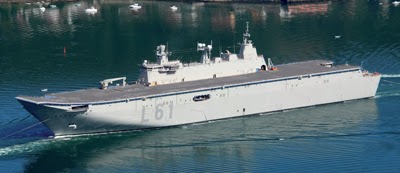
India to acquire the 20,000 tons amphibious assault ships

(Infodefensa.com) Madrid - The Indian Navy has opened the competition to acquire four amphibious assault ships of 20,000 tons each. The first step of this program valued at 2,600 million dollars (about 1,900 million), has been sending the relevant documentation to the local shipyards Larsen & Toubro (L & T), Pipavav Defence and Offshore Engineering , and ABG Shipyard , so they can compete in it.

This process is followed with great interest in Spain , since the domestic construction Navantia is associated with one of these local firms (L & T, specifically) to bid based on the ship design Juan Carlos I of the Spanish Armada . Pipavav Defence , for meanwhile, has partnered with French DCNS , construction of ships Mistral , and ABG Shipyard has an agreement with the U.S. Alion .

Thus, the Spanish design of this type of vessel will return to see the faces with the French design in an international competition. Currently, in addition to the units employed by their respective navies, the French model Mistral has been chosen by Russia to acquire at least two units, while Spain has manufactured two for Australia derived from his ship Juan carlos I.

In the case of India, only local companies are allowed to attend the competition, hence its association with Western companies, and none of them have experience in this type of vessel.

The company that makes the offer with the lowest price to build two ships and assign design to state-owned Hindustan Shipyard Ltd. (HSL) to build the other two.

A length of 215 meters maximum

Each vessel must not be more than 215 meters in length (the Juan Carlos I has the original 231 and Mistral , 199) nor more than 8 meters deep. They must have electric propulsion motors and a battery life of 45 days with a maximum sustained speed of not less than 20 knots.

Craft should be prepared to operate helicopters up to 35 tons, and its interior will have to be able to transport, each at least six tanks, twenty combat infantry vehicles and forty trucks. They will also operate both as hovercraft landing craft.

Also be trained to accommodate up to 1,430 people, distributed as follows: 60 officers, 470 sailors and 900 soldiers.

To his defense will include missile defense systems and torpedoes, decoys and both light machine guns and heavy.

Photos: Gines Soriano / Infodefensa.com, Navantia and DCNS

Thứ Ba, 10 tháng 12, 2013

India's Longest Range Ballistic Missile All Set for Undersea Launch

India is finally gearing up for the maiden test firing of its submarine launch of longest range and nuclear capable ballistic missile code-named K-4 from an underwater platform off the Vizag coast by end of next month. The missile flies in hypersonic speed and is the world’s best weapon in this class.

The much-awaited test which was scheduled for September was postponed due to technological developments. The indigenously developed 3,500-km range missile has been planned to be test launched from a pontoon (replica of a submarine) positioned nearly 50 feet under the sea surface.

The missile is the longer version of K-15, dubbed as B-05 missile which has been test fired at least 10 times. Though it has been designed to cover a distance of 3,500 kms, sources told The Express that this time the test would be conducted for a range of about 1,500 km.

The K-4 missile was developed very fast as many systems used in the missile were already perfected during the development of B-05 missile. The new missile will enable India to target China and Pakistan from its waters.

A defence scientist associated with the missile said some of its sub-systems had already been tested successfully earlier and the missile with full configuration was ready for its first launch. “We are leaving no stone unturned to make the mission successful. We want to achieve close to zero circular error probability (CEP) accuracy,” he said.

The K-4 is one of the most ambitious projects of the Defence Research Development Organisation (DRDO) and it was kept under wrap for years. Plans are also afoot to induct the B-05 missile, which has a strike range of nearly 700 kms, in the armed forces next year. This missile will also be test fired from the indigenously built India’s first submarine INS Arihant after it completes sea trials in 2014.

Defence sources said the K-4 missile is about 12 metre tall having a diameter of 1.3 metre and weighs around 17 tonne. It is capable of carrying a warhead of around 2 tonne and uses solid propellant.

Once inducted, the missile will not only complete India’s third leg of the nuclear deterrent, but also be the second strike weapon system in its much touted nuclear doctrine. It can target major Chinese cities even remaining away from the Chinese water. It could better be characterised as a hypersonic cruise missile, since it remains within the earth’s atmosphere. Making the K-4 even more survivable is its ability to manoeuvre, following a twisting path to the target which makes it very difficult to shoot it down.

The next missile in this series is K-5 which will have a strike range of nearly 5,000 km.

AGNI-III ON SCHEDULE

Range integration was conducted in the Integrated Test Range (ITR) off the Odisha coast for the proposed test firing of 3,500 km range nuclear capable ballistic missile Agni-III. The weapon is scheduled to be test fired from the Wheeler Island by the Strategic Forces Command (SFC) of the Indian Army on December 18. It is the second user trial of the indigenously built surface-to-surface missile. This test will follow one each developmental trial of 4,000-km range Agni-IV and 5,000-km range Agni-V missile next month.

New Indian Express