Thứ Tư, 28 tháng 2, 2018
Vietnamese Russian-made Frigate Gepard 3.9 Ly Thai To launches Kh-35 Uran-E missle
After the orders of the commanders, the fighters pressed the fire button, the Uran missile slowly escaped from the battleship launcher of 012 Ly Thai To. Just a few seconds after leaving the launch pad, the missile struck the target at sea.
Kh-35 Uranus-E has a maximum range of 130km, subsonic speed of 980km/h, equipped with advanced navigation system with independent radar ARGS-35E which has the ability to detect targets, Correctly align missiles without interference from the "mother ship". The 145kg warhead was rated as capable of sinking ships of 4,000-5,000 tons.
At present, the Brigade 162, Region 4 of Vietnam People's Navy fully owns 012 Ly Thai To and 011 Dinh Tien Hoang. We can independently deploy combat weapons without the assistance of Russian specialists.
* Video shows at the minute 0:25
Thứ Sáu, 5 tháng 1, 2018
American patrol ships delivered to Vietnam can be fitted with Russian missiles
Formerly it was the highest class patrol ship of the United States Coast Guard, engaged in the Vietnam War with the task of fire at sea. The ship is 115.2 m long, 6 m high, weighs more than 3,000 tons and the widest spot on the shelf is 13.1 m. Maximum speed is 29 knots (53.7 km / h). Standard visibility is about 17,779 km at 15 nautical mile (27.7 km / h) speed. It can accommodate a crew of up to 162 people including 19 commanders and a helicopter monitor on the deck.
During the service to the US Navy, the WHEC 722 was equipped with a 76mm main gun, two Orbital M242 Bushmaster and 20mm (CWS) ranged defense system.
When joining the Vietnam Coast Guard, the vessel will be code CSB-8020. It was delivered within the framework of the US-Vietnam agreement, effective on May 15th of 2017.
Vietnamese engineers and officers spent months researching, using, and mastering equipments with the help and guidance of officers from the US Coast Guard. Up to this point, the CSB-8020 is Vietnam's largest patrol boat in the South China Sea, enhancing the scope and capacity of Vietnamese law enforcement.
Through the sea exercises in December 2017, Vietnam also studied and acquired much experience of its neighbor nation Philippines, The country that upgraded the ship to a true warship with the addition of the Harpoon anti-ship cruise missile and fire-control radar. Jane's predicted that Vietnam might consider equipping the ship with the 3M24 Uranium-E anti-ship missile system with Garpun-Bal radars in the future.
Source: Viettimes.vn
Thứ Ba, 2 tháng 1, 2018
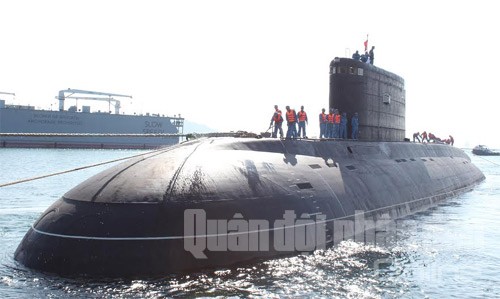
Vietnam Kilo class submarine launches Club-s missle in a fire test
Thứ Bảy, 4 tháng 1, 2014
HQ-182 Hanoi
Southeast Asian States Deploy Conventional Submarines
By Carl Thayer
January 03, 2014
On December 31, Vietnamese media reported the delivery of the first Russian Project 636 Varshavyanka-class (enhanced Kilo) conventional submarine to Cam Ranh Bay. The sub was transported from the port of St. Petersburg on the heavy lift vessel Rolldock Sea.
The submarine was accompanied by experts from Admiralty Shipyards in St. Petersburg who will undertake final work before the formal handover ceremonies. The submarine will be named HQ 182 Hanoi. The last of the remaining five Project 636 Varshavyanka-class submarines is expected to be delivered by 2016.
In late November, during the visit of Vietnam’s party Secretary General Nguyen Phu Trong to India, it was announced that India would provide training for up to 500 submarines as part of its defense cooperation program with Vietnam. Training will be conducted at the Indian Navy’s modern submarine training center INS Satavahana in Visakhapatnam. The Indian Navy has operated Russian Kilo-class submarines since the mid-1980s.
The arrival of HQ 182 Hanoi provides a timely reminder that regional navies are embarking on naval modernization programs that increasingly include the acquisition of conventional submarines.
As long ago as 1967 Indonesia became one of the first Southeast Asian countries to acquire an undersea capability when it took delivery of a batch of Soviet Whiskey-class submarines. These were later replaced in 1978 by two West German diesel submarines.
In 2012 Indonesia’s Defense Ministry announced it was planning to expand its submarine fleet to twelve by 2020. Twelve is the minimum number of submarines required to cover strategic choke points or maritime entry passages into the archipelago.
At present Indonesia has an order for three U-209 submarines that are being built in South Korea by Daewoo Shipbuilding and Marine Engineering in cooperation with PT PAL Indonesia. The U-209s are expected to be delivered between 2015 and 2016.
In addition, Indonesia is mulling two options. The first option is to buy and modify used Russian Kilo-class submarines. An Indonesian technical team headed by Navy Chief of Staff Admiral Marsetio will visit Russia this month to inspect the submarines and associated weaponry. It will report on the cost and feasibility of this option.
Indonesian sources report that the Kilo-option is attractive because the submarine can be armed with either the supersonic Yakhont or Klub-S cruise missiles. The latter can be fired underwater and strike surface targets up to 400 kilometers away.
Indonesia’s second option is to purchase new submarines from South Korea. This option is attractive because the new submarines are compatible with existing port infrastructure.
Press reports indicate that Indonesia’s new submarines will be berthed at the recently built Palu Naval Base in Central Sulawesi. These submarines would be able to operate in the deep waters around Indonesia’s eastern islands.
In late November Singapore announced that it had signed a contract for the purchase of two new Type 218SG conventional submarines from ThyssenKrupp Marine Systems in Germany. The sales contract included provisions for servicing and crew training in Germany.
Singapore’s submarines will be outfitted with the Air Independent Propulsion system and are expected to be delivered by 2020. The new submarines will replace four older Challenger-class submarines and will join the two refurbished Archer-class (formerly Swedish Västergötland-class) submarines to form Singapore’s undersea fleet.
Malaysia acquired two two Scorpène-class submarines from France following a contract signed in 2002. The two boats, RMN Tunku Abdul Rahman and RMN Tun Abdul Razak entered service in 2007 and 2009, respectively. They are based at Sepanggar, Sabah. In May 2012 Malaysia indicated that any further submarine acquisitions would depend on the availability of funding. That year Malaysia signed a contract for the purchase of a Submarine Escape and Rescue Service vessel to be built in Singapore.
In June 2013, Myanmar Army Chief Senior General Min Aung Hlaing entered into discussions with Russian officials for the purchase of two-Kilo class submarines. That same month it was reported that twenty officers and ratings began basic submarine familiarization and training in Pakistan at its Submarine Training Center PNS Bahadur. These two developments underscore reports that Myanmar intends to crease a submarine force by 2015.
In April 2011 Thailand entered the market for the purchase of two to six decommissioned German Type 206A diesel submarines for $220 million. Weighing in at 500 tonnes submerged displacement, they are among the world’s smallest attack submarines. A change of government in July 2011 and internal differences between the new Defense Minister and the Navy resulted in the expiration of Thailand’s options and the shelving of this project.
In October 2013 it was reported that the Royal Thai Navy will include the purchase of three submarines as part of its next ten-year procurement process. Meanwhile, Thailand has commenced construction of facilities for a submarine training center and base at the Sattahip Naval Base in Chon Buri. This base is expected to be completed in March this year and will be equipped with a Submarine Command Team Trainer.
Last year the Royal Thai Navy sent eighteen officers for a thirty-two week submarine training course in Germany and another ten officers for an eight-week training course in South Korea.
In the early years of the Aquino Administration in the Philippines, submarines were reportedly included on a Department of National Defense “wish list” for procurement under an armed forces modernization program. The acquisition of submarines appears has been quietly dropped.
Within the next five years to a decade, Southeast Asian waters, and the South China Sea in particular, will witness a marked rise in the deployment of conventional submarines by regional states. This will make the South China Sea even more congested.
The acquisition of submarine forces will add a fourth dimension to regional war-fighting capabilities – air, land, sea and sub-surface. Submarines will be able to engage in reconnaissance and intelligence gathering, mine laying, anti-ship warfare and long-range strikes.
There appears to have been very little discussion by naval chiefs among the members of the Association of Southeast Asian Nations (ASEAN) about the implications of this development. At the most basic level, few of the ASEAN countries are equipped to assist one of their submarines in distress. Singapore and Malaysia, however, are the exceptions. In late 2008 Singapore launched the MV Swift Rescue, a submarine support vessel equipped with two Deep Search and Rescue vessels.
Singapore has been at the forefront in promoting cooperation in submarine rescue among regional navies in the event of a misadventure. Agreements have been signed with Australia, Indonesia and Vietnam.
The Diplomat
Thứ Tư, 1 tháng 1, 2014
Vietnam's high speed missile boat fires anti-ship missiles
Thứ Sáu, 13 tháng 12, 2013
India To Train Vietnamese Sailors, Expand Ties
An Indian Kilo-class submarine will be used to train Vietnamese sailors in submarine warfare. (Sebastian D'Douza/Agence France-Presse)
NEW DELHI — India will train Vietnamese sailors in submarine warfare as part of its effort to reinforce defense ties with countries across the Asia-Pacific region.
The development is expected to disturb Beijing, analysts and officials said, and will be closely watched by Pakistan.
Vietnam has ordered six Kilo-class subs from the Russian Admiralty Shipyard in St. Petersburg to add to its of two South Korean-made Yugo-class midget submarines. India has operated Kilos since 1986.
Like India, Vietnam has fought with China and is fast emerging as an economic power in the region, said an Indian Navy official, who said New Delhi should aid Vietnam in any way it can.
“The Sino-Indian ties are poised in a very delicate phase with many ups and downs,” said Probal Ghosh, a senior fellow with the Observer Research Foundation. “This will definitely affect the ties, even though China is well aware that we are supporting Vietnam for strategic gains against China.
“There is a likelihood that it may prove to be the impetus for China to consider giving Pakistan a nuclear submarine,” Ghosh added. “Such a move will really up the ante and will affect India’s security calculus considerably.”
However, analysts agree that India should warm ties with Vietnam, despite Beijing’s response.
“It is important that we engage with Vietnam,” defense analyst Anil Jai Singh said. “It is an emerging country in the region; we have always had good relations with it and we must engage economically, politically and militarily to develop a strong bilateral relationship. We are doing this independent of the US, but they would not be averse to our growing relationship. If China gets disturbed, well, so be it.”
A diplomat from the Vietnamese Embassy here said defense cooperation is a pillar of strategic partnership between the two countries, which he said will increase further to include joint development of defense projects but declined to specify details.
India will train Vietnamese sailors to operate submarines and to engage in underwater warfare, said the Indian Navy source, adding that the training would take place on a Russian-made Kilo sub.
India has also decided to give a $100 million credit line to Vietnam to buy military equipment, including offshore patrol vessels, an Indian Defence Ministry source said, but a deal hasn’t been formalized.
The extension of military credit would be the first India has given to any country.
India and Vietnam are jointly exploring for oil in the Phu Kanh basin of the South China Sea, which Vietnam says is within its zone of influence, a claim China disputes.
Vietnam has been negotiating with India to acquire the supersonic anti-ship cruise missile BrahMos, which is built jointly here by India and Russia. No deal has been finalized to sell the missile, which has land and sea versions, with an air version under development.
Sale of the BrahMos is questionable because Russia has friendly relations with China, and there could be issues relating to international controls. The BrahMos’ 290-kilometer range could be extended beyond 300 kilometers, putting it under Missile Technology Control Regime restrictions.
“I think the restrictive regimes would preclude any such thing happening in the near future. India itself would consider such a possibility very carefully,” Singh said.
As their ties strengthen, “India could ... consider ... including Vietnam in the future network-centric warfare program,”defense analyst Nitin Mehta said.
By VIVEK RAGHUVANSHI, Defense News
Thứ Hai, 9 tháng 12, 2013
In pictures: Aircrafts of Vietnam People's Army
The Vietnam People's Air Force (Vietnamese: Không quân Nhân dân Việt Nam) is the air force of Vietnam. It is the successor of the former North Vietnamese Air Force and the absorbed Republic of Vietnam Air Force following the re-unification of Vietnam in 1975.
YouTube: The visiting to the Air Force 935 Regiment witnessing the super fighter Su-30MK2V
The Vietnam People's Air Force (VPAF) is one of three main branches in the Vietnam People's Army which is a part of the Ministry of Defence. The main mission of the VPAF is the defence the Vietnamese airspace and the provision of air cover for operations of the Vietnam People's Army.
More: Vietnam Airforce and Navy ready to take on the Chinese
Others: Ka-27, ka-25 (patrol); M-400, An-30 (Reconnaisance); Yak-52, Yak-130 (trainer); An-38, M-28, An-24, UH-1, Mi-8, Mi-17 (transport),...
Naval Air Force
Naval Air force - The newly-established 954 Air Force- naval brigade can perform the following tasks: military transport, reconnaissance, aerial, water-surface and on-the-ground observation, search and rescue at sea, on land and rescue and flood prevention.
Vietnam People's Navy prepared to build Naval Air Force to increase the capacity of coastal defense. On February 27, 2010, the General Staff (Vietnam People's Army) decides to build and make regular member the 954th Naval Air Force Regiment of Vietnamese Navy.
Vietnam has purchased three CASA C-212 Aviocar aircraft Series 400 professional beach patrol and tracking. The aircraft equipped with radar MSS 6000 and Naval Air Force will use for general patrol purposes. Vietnamese Navy received two Eurocopter EC225 Super Puma to offshore patrol and search and rescue missions.
Viking Air Company of Canada has contracted to sell to Vietnam six Seaplane DHC-6 Twin Otter Series 400 from 2012 to 2014. And 7 Kamov Ka-27 helicopters will be transferred to naval air force.
More pictures about VPA: http://worldmilitaryintel.blogspot.com/2013/05/vietnam-vietnam-capitalhanoi.html
Chủ Nhật, 8 tháng 12, 2013
Hà Nội Submarine, The First Kilo class Project 636 Varshavyanka of Vietnam
Hanoi submarine, the first improved Kilo class submarine in a series of six vessels of Project 636 Varshavyanka (NATO named Kilo) that Russia built on order of Vietnam, has been transferred to the Vietnam Navy coming to Cam Ranh port scheduled in January 2014.
The contract that Russia provides for Vietnam six Kilo submarines signed in 2009 including crew training as well as providing equipment, supplies and techniques. The training crew for Vietnam began in late July of 2013 in Saint Petersburg.
Combat capability of the Project 636 submarine was significantly increased by the use of anti-ship missiles 3M-54E1 Club-S that is supported by advanced electronic systems. With the effective range reaches 290 km and carrying 450 kg warheads, Project 636 allows fast attack, remote. To increase survival, it not need to dig into the detection and attack range of enemy ships or to overcome the region where has been the trap by enemy mines or torpedoes. In addition, the ship also has a mechanism for anti-aircraft missile launcher of 8 missiles Strela-3 ( SA-N-8 Gremlin, a maximum range of 6 km ) or 8 Igla missiles ( SA-N-10 Gimlet, shot range up to 5 km ).
The original design of the Kilo 636 submarines without arming missiles to destroy targets on land (sea-to-surface/ sea-to-ground missile). But Vietnam's Russian- built Kilo 636MV submarines are equipped with 3M-14E missiles for ground attack.
The Vietnam's Russian built Kilo class submarines are signed to export for 7 countries including China, India, Iran, Poland, Romania, Algeria and Vietnam. Vietnam's Kilo submarines will be installed cruise missiles for land attack with 3M-14E1 latest type, has a range of 290 km. The missiles are not approved to export to China by the Russian Ministry of Defence. Only 3 countries that Russia exported this missile to are India and Algeria.
It should be noted that the weapons on the Russian Kilo-636 is equipped with the review and requirement of customers. Because of the specific requirements so the price of Vietnam's Kilo Submarines is much higher than China's ones. Thus it can be stated that 3M-14E missiles equipped for Vietnam's Kilo Submarines are the requirement of Vietnam.
The steel punch
In the disputed islands issue in the South China Sea, China falls into a disadvantage in terms of geography, they try to switch weapons facilities near the disputed islands as possible. Instances of this is that China has built a giant military bases in Sanya (Hainan Island), priority is the most modern weapons and facilities. Besides strengthening forces on Woody Island in the Paracel Islands that Chinese invasions of Vietnam, China wants to turn Sanya and Paracel Islands into the place of rallying the Air Force and Navy when conflicts occur.
In this context, Vietnam called to equip itself with the weapons that can stop the Chinese forces in Hainan Island. And the 3M-14E missile, a range of 290 km, 400 kg warhead was chosen. The vessel for carrying this missile is the Kilo 636MV submarine which can reach and launch the steel punches to paralyze the enemy bases. With the lack of support from the Air Force as well as logistics resupply techniques, Chinese forces fighting in the South China Sea will fall into difficult situations.
Then Vietnam will use Air Force aircrafts including the Su-30MK2, Su-30MK2V, Su-27,... and Navy surface ships with submarines sorties from Central Coast aided by anti-aircraft and ground-to-sea missiles (S-300, K-300P Bastion-P, 4K44B Redut, Uran E,...) Vietnam will fully control the South China Sea.
http://petrotimes.vn/news/vn/bien-dong/thoi-su-bien-dong/tau-ngam-kilo-viet-nam-la-chan-phong-thu-bien.html
http://soha.vn/quan-su/trang-bi-ten-lua-doi-dat-cho-kilo-636-canh-cao-danh-thep-cua-viet-nam-20130613160430712.htm
Thứ Sáu, 6 tháng 12, 2013
Vietnam looking to purchase BrahMos cruise missiles
Vietnam is looking at India to supply the BrahMos missiles to meet its immediate requirement. Source: Boris Egorov / RIR
Vietnam formally requested India to supply the Indo-Russian BrahMos cruise missiles at a meeting in New Delhi, informed sources told RIR. The request was made when Vietnam Communist party general secretary Nguyen Phu Trong visited the Indian capital, the sources said, adding that the Southeast Asian country was looking at enhancing security cooperation with India.
Informal negotiations had been going between the countries for the joint Indo-Russian missiles that are being manufactured in India. Vietnam’s interest was renewed as a plan between Russia and the country to jointly produce a modified anti-ship missile is moving a slow pace, the sources told RIR. While Moscow and Hanoi to develop a joint missile analogous to Russia's Kh-35 Uran, using BrahMos as a model, Vietnam is looking at India to supply the missiles to meet its immediate requirement. It remains unclear whether India will be able to supply the missiles in the near future.
BrahMos officials declined to comment on the negotiations between India and Vietnam.
During Phu Trong’s visits, requests were also made to India for submarine training and for conversion training for Vietnamese pilots to fly Sukhoi-30 aircrafts. Sources told RIR that India would be ready to supply the missiles, as it was looking for international buyers and countries like Malaysia and Indonesia had already expressed interests. They added that New Delhi was also ready to provide training for Vietnamese pilots but were cautious about further military cooperation keeping the China factor in mind. Beijing has been viewing India’s growing presence in Vietnam with a degree of suspicion, the sources added. India and Vietnam have traditionally maintained friendly and cordial relations and leading analysts suggest that the countries could be at the forefront of a new kind of non-aligned movement.
BrahMos cruise missiles have been adopted by India's Army and the Navy’s surface ships. The Indian Air Force has also ordered a batch of land-based missiles. Work is also underway to adapt the missile to Su-30MKI planes used by the Indian Air Force. BrahMos is an acronym of the two rivers: Brahmaputra in India and Moskva in Russia.
Russia Beyond The Headlines
Thứ Sáu, 29 tháng 11, 2013
Molniya missile boat 1241.8/ Tarantul V of Vietnam People's Navy
Vietnam People’s Navy launched its sixth home-made Molniya-class missile corvettes in 2017.
“The ships are the assets of our people. All officers train hard to protect the vessels and defend the national flag,” Vietnam People’s Navy deputy commander Rear Admiral Hoang Hong Ha said during the ceremony on October 9, as quoted by Vietnamese news outlet Tuổi Trẻ.
Updated in March 1st, 2018:
Vietnam is expected to have a total of 12 Molniya-class missile corvettes designed by Russian JSC Almaz Central Marine Design Bureau. The first two were built in Russia by Vympel Shipyard JSC and delivered in 2007 and 2008.
The contract stipulated that the next 10 corvettes will be built in Vietnam by Ba Son Shipbuilding Company. Each of the ships costs approximately VND3 trillion (US$131.7 million).
The primary mission of these warships is destruction of enemy combat vessels, landing craft and enemy naval forces in both littoral waters and open seas. Secondary mission may include patrolling, rescue, anti-piracy, border protection and reconnaissance.
The Molniya-class missile corvettes feature AK-176M 76mm artillery gun, the Uran missile system comprising 16 missiles in four launch tubes, the AK-630M 30mm antiaircraft artillery system and 12 missiles for the Igla portable antiaircraft missile system.
Video Vietnam's Molniya missile corvettes test fire:
The combinations of 16 Uran-type anti-ship missiles, which are located on either side of the hull (8 on each side). Inside the missile complex is the subsonic Kh-35 Uran-E anti-ship missile with the range about 300km (Russian-made improved version for exporting).
Thứ Sáu, 5 tháng 7, 2013
Vietnam’s 2nd Russian-made sub completes sea trials
The submarine named Ho Chi Minh City and built by Admiralty Shipyards of St. Petersburg undertook two dives, reaching a depth of 190 meters on one of them, reported Interfax.
The Ho Chi Minh City set off for its sea trials on April 28, four months after being launched.
The training of the submarine’s Vietnamese crew will take place later this month.
According to Interfax’s sources, the third of the six submarines that Vietnam ordered from Russia, named after Vietnam’s port city of Hai Phong, will be launched at the end of this year, while the remaining three are still being built.
Vietnam signed a US$2 billion deal to buy six Kilo-class diesel-electric submarines during Prime Minister Nguyen Tan Dung’s visit to Moscow in December 2009, with Russia promising to deliver all of them by 2016. As part of the deal, Russia agreed to train the Vietnamese crew and supply Vietnam with necessary equipment.
The first sub, named after Vietnam’s capital city of Hanoi, was launched in August 2012.
It underwent 23 successful dives, according to an Interfax report in May.
The first two subs are scheduled to be handed over to Vietnam later this year.
Kilo-class subs, nicknamed “Black Holes” for their ability to prevent detection, are designed to carry out anti-submarine and anti-ship missions, general reconnaissance and patrols, according to a RIA Novosti report. They are thought to be among the world’s quietest diesel-electric powered subs.
Equipped with six 533-millimeter torpedo tubes, they can travel up to 9,600 kilometers without refueling; have a displacement capacity of 2,300 tons; and can reach depths of up to 350 meters.
Vietnam has said it has purchased the Kilo-class subs and other armaments exclusively for self-defense purposes.
The Voice of Russia quoted the country's military expert said that the first two Vietnam's Russian-made Kilo class submarines for Vietnam, Hanoi (HQ-181) and Ho Chi Minh City (HQ-182), will make its maiden voyage swimming sequences to Vietnam by way through Africa.
Thanhnien News
Thứ Ba, 25 tháng 6, 2013
Vietnam Maritime search aircraft sought including the Airbus Military C295
U.S. defense companies are already providing spare parts for some ex-U.S. military equipment, such as Bell UH-1H helicopters that are now in Vietnam's military fleet. When the U.S. withdrew from South Vietnam, it left behind some military equipment, including Bell UH-1H helicopters.
Defense Market Intelligence
Thứ Tư, 19 tháng 6, 2013
Vietnam’s Russian Restocking ( Updated 21 May 2013 )
May 21/13: SU-30s. A Tuoi Tre News article offers some revealing information, alongside the classic Stakhanovite paens.
“Living in rented houses, many of the [SU-30 maintenance] staff have to work as part time teachers in local schools to earn extra income for their families. They even use their own money to buy devices to test tools of their own invention before submitting ideas to leaders.”
... {click to expand +}
May 21/13: SU-30s. A Tuoi Tre News article offers some revealing information, alongside the classic Stakhanovite paens.
“Living in rented houses, many of the [SU-30 maintenance] staff have to work as part time teachers in local schools to earn extra income for their families. They even use their own money to buy devices to test tools of their own invention before submitting ideas to leaders.”
Needless to say, economic conflicts of interest among the maintenance staff for your nation’s premiere air asset offers all kinds of potential vulnerabilities.
May 17/13: SU-30s. A Tuoi Tre News article discussed the propensity of Vietnamese pilots to stay in the aircraft and try to land, even if the failure is very serious. Materiel worth more than people? That does seem to be part of the attitude, but if so, it’s a long-standing predisposition:
“For example, three-star colonel and pilot Dao Quoc Khang managed to save his Su-27 when its engines broke down just seconds after taking off…. in April last year, captain and chief of Air Strike Regiment 935 Nguyen Xuan Tuyen and flight head Nguyen Gia Nhan saved a Su-30MK2 while they were on a regular patrol over East Sea and its engines suddenly stopped working when it was 600km from the coast. “….We told ourselves in our minds that we are responsible for keeping the US$50 million asset of the State in one piece. It is made from the labor of citizens. And we must protect it at any price, even if that means our lives,” pilot Tuyen said.”
In fairness, ejecting 600 km from the coast is near-certain death, given Vietnam’s limited search and rescue resources. So the brave and selfless-sounding justification doesn’t actually change their decision, and is the sort of thing you’d expect in an article that quotes political commissars with a straight face. Or is the mentality in the pilot’s justification real? That’s the interesting question.
{^}In April 2009, reports surfaced that Vietnam had agreed in principle to a deal with Russia for 6 of its diesel-electric Kilo/ Project 636 Class fast attack submarines. There have been rumors that Vietnam owns 2 ex-Yugoslav mini-submarines for use in commando operations, but the Vietnamese People’s Navy doesn’t own any full size submarines that can take on enemy subs and ships. That’s about to change, thanks to a December 2009 contract.
Nor is that the only change in Vietnam’s military capabilities these days. China’s April 2009 display of naval might is only part of the mosaic influencing Vietnam’s decisions in these matters, as contracts for submarines – and far more – are being signed with its long-time Russian ally.
Vietnam’s New Military Buys: Considerations
China’s 2009 display of naval might certainly marks an increased shift toward “forward defense” farther from its borders, a policy that must eventually include China’s trade lifeline to Vietnam’s south, through the Straits of Malacca. It also underlined a growing gap between China’s increasingly advanced ships and high capacity hovercraft, and Vietnam’s fleet
of older Soviet and even American ships.
Ownership of the Spratly Islands remains very much in dispute, and Vietnam and China share a centuries-long history of mutual distrust and occupation. Recent punctuations of that animosity include the 1979 3rd Indochina War; this was followed by a significant skirmish in 1981, and a naval skirmish over the Spratly Islands in 1988. Today, Vietnamese protests over a Chinese bauxite mine in Vietnam, and media disobedience
over the Spratly Islands issue, serve as a reminder that the 1989 treaty has not changed the relationship’s underlying fundamentals.
China itself has adopted a strategy of building up a submarine force to counter a superior surface opponent (the US Navy). It is entirely logical for Vietnam to adopt a similar approach vis-a-vis China, especially given that China’s lifeline of raw materials and exported goods leading from and to Africa, the Middle East, Europe, and parts of Asia passes right by Vietnam’s doorstep.
Aside from Thyssen Krupp Marine’s U209 family of submarines, the Russian Kilo Class are the world’s most widely exported subs. They’re known for a level of quietness that’s significantly better than other Russian designs, and have been produced in the Project 877EKM , and the Project 636M “Improved Kilo”
variant that Vietnam is receiving. Countries operating or ordering these submarines include Russia, Algeria, China, India, Iran, Poland, and Romania.
There had been some speculation that Vietnam’s emphasis on shallow water operations, and proximity to the Straits of Malacca, might have made DCNS’ novel 885t, $200 million Andrasta Class of “pocket submarines” attractive. Instead, Vietnam appears to have opted for a more widely-deployable, higher capacity 3,000t submarine from its tried and true Russia partner. They can be armed with 533mm heavy torpedoes, mines, and/or the 3M54 Klub-S family of missiles.
The new submarines are the most important new Russian addition to Vietnam’s capabilities, but they are not alone. Stealthy Gepard Class light frigates will add surface warfare and patrol punch, alongside new Molniya/ Project 12418 missile-armed Fast Attack Craft to help modernize a fleet that’s mostly made up of aging Soviet FACs and captured American ships from the Vietnam War. In the air, Vietnam’s SU-27 air superiority fighters will be joined by new multi-role SU-30 planes from the same fighter family, strengthening air defenses and adding a long-range strike capability.
Contracts and Key Events
This section covers only Vietnamese contracts with Russia. As the “Additional Readings” section notes, Russia is not Vietnam’s exclusive arms provider – but it is the country’s most important defense relationship.
2012 – 2013
Kh-35 anti-ship missile partnership; Vietnam will need help with training and maintenance.
May 21/13: SU-30s. A Tuoi Tre News article offers some revealing information, alongside the classic Stakhanovite paens.
“Living in rented houses, many of the [SU-30 maintenance] staff have to work as part time teachers in local schools to earn extra income for their families. They even use their own money to buy devices to test tools of their own invention before submitting ideas to leaders.”
Needless to say, economic conflicts of interest among the maintenance staff for your nation’s premiere air asset offers all kinds of potential vulnerabilities.
May 17/13: SU-30s. A Tuoi Tre News article discussed the propensity of Vietnamese pilots to stay in the aircraft and try to land, even if the failure is very serious. Materiel worth more than people? That does seem to be part of the attitude, but if so, it’s a long-standing predisposition:
“For example, three-star colonel and pilot Dao Quoc Khang managed to save his Su-27 when its engines broke down just seconds after taking off…. in April last year, captain and chief of Air Strike Regiment 935 Nguyen Xuan Tuyen and flight head Nguyen Gia Nhan saved a Su-30MK2 while they were on a regular patrol over East Sea and its engines suddenly stopped working when it was 600km from the coast. “….We told ourselves in our minds that we are responsible for keeping the US$50 million asset of the State in one piece. It is made from the labor of citizens. And we must protect it at any price, even if that means our lives,” pilot Tuyen said.”
In fairness, ejecting 600 km from the coast is near-certain death, given Vietnam’s limited search and rescue resources. So the brave and selfless-sounding justification doesn’t actually change their decision, and is the sort of thing you’d expect in an article that quotes political commissars with a straight face. Or is the mentality in the pilot’s justification real? That’s the interesting question.
March 29/13: Submarines. Rubin design bureau general director Igor Vilnit pledges to deliver the 1st Project 636M Improved Kilo Class submarine to Vietnam “in 2013 as scheduled.” Odd. Earlier reports from RIA Novosti (vid. Aug 28/12) had the handover taking place at the end of 2012.
The first boat has been built by Admiralteiskie Verfi shipyard in St. Petersburg, Russia, and is undergoing sea trials. All 6 boats are due for delivery by 2016. What isn’t addressed in these reports is Vietnam’s recruiting, training, infrastructure, and maintenance preparations. As Vietnam’s Australian neighbors have discovered the hard way, neglect of any of these 4 “invisible” elements leads to an undeployable submarine force. Vietnam has the advantage of beginning with a proven, tested submarine design, but in all other areas, they’re building from a very low foundation. RIA Novosti .
Oct 26/12: SU-34s? Phun.vn cites a report from the mysterious site “Periscope 2,” wherein it’s suggested that Vietnam plans to replace its fleet of 50 or so aged SU-22 strike aircraft with SU-34s, and that export approval will be given immediately, once it’s requested. The report also suggests that Saab JAS-39 Gripens will replace the VPAF’s even older fleet of 150 or so MiG-21s, that L-159s may replace existing L-39 trainers alongside Vietnam’s reported Yak-130 options, and that Vietnam may be interested in C295-AEW planes.
All of the above are possible, and militarily reasonable choices. Even the L-159 could be reasonable, if bought second-hand as a dual role trainer and MiG-21 fill in, to give the VPAF a dual Russian & western fleet with appropriate weapon options. The thing is, “reasonable” doesn’t mean “likely”, and DID could find no other reports along these lines. Any of the non-trainer deals would be quite expensive, and Vietnam’s economy is a bit shaky these days . In addition, all of the non-Russian equipment would require export approval for American military items. We throw this item in for reader interest, with a strong caution concerning its reliability. Phun.vn
[in Vietnamese].
Aug 28/12: Submarines. Russia’s RIA Novosti reports that the Admiralteiskie Verfi shipyard in St. Petersburg has launched Vietnam’s 1st Project 636 diesel-electric submarine. The boat is due for handover to Vietnam by the end of 2012.
March 29/12: Sub training from India? Singapore’s Asia Times :
“For full-scale underwater warfare training, it appears Vietnam will turn to India. The two countries have been engaged in high-level military talks with special emphasis on maritime cooperation. Since the Indian navy also employs Kilo-class submarines, New Delhi would be well suited to train Vietnamese crews. China responded warily to this bilateral warming trend in both words and deeds when a Chinese warship reportedly confronted an Indian navy vessel leaving a Vietnamese port in August… Moscow will reportedly build a submarine base for Vietnam at strategic Cam Ranh Bay, a one-time American and later Soviet naval base…”
Feb 15/12: Kh-35. RIA Novosti reports that Vietnam will begin joint production of a modified SS-N-25 Switchblade/ Kh-35 Uran
subsonic anti-ship missile, whose base characteristics are similar to the American
- GM-84 Harpoon. The project is described as similar to joint Russian-Indian production of the PJ-10 BrahMos missile, which was derived from the supersonic SS-N-26 Yakhont.
The Kh-35 can be launched from Ka-27 naval helicopters, ships, or shore batteries, but hasn’t been integrated with Vietnam’s new SU-30MK model fighters, or its forthcoming Kilo Class submarines. Even so , this joint venture will give Vietnam assured low-cost production and support for an important element of naval deterrence in the South China Sea. The Kh-35 looks set to become Vietnam’s mainstay anti-ship missile for its navy, and a joint project also gives them a base to make changes. India undertook to integrate Brahmos with its Su-30MKI fighters, for example, and Vietnam may have similar plans for their modified Kh-35 project. Then, too, the urge to use locally-built weapons in new ships is deep-seated, even though Kilo Class submarines are already configured for 3M54 Klub family (SS-N-27) missiles. Time will tell what the Vietnamese plan to do with this shared technology.
KH-35 missile partnership
2009 – 2011
Vietnam orders 6 Improved Kilo Class subs, 12 SU-30MK2 fighters, 2 Gepard Class ASW frigates; 2 Gepard/ Dinh Tien Hoang Class surface warfare frigates delivered; Vietnam begins building Molniya FACs locally; China’s underwater neighborhood getting crowded.
Dec 7/11: ASW Frigates. Rosoboronexport and the Zelenodolsk Gorky Plant have finished shipping Vietnam’s 1st 2 Gepard Class frigates, and have just signed a contract for 2 more. Unlike the first set, however, the next 2 will concentrate on anti-submarine warfare, rather than surface attack missions.
Vietnam’s example may also be creating ripples in the region. Gorky Plant Deputy Director Sergei Rudenko adds that Vietnam’s neighbor Cambodia has expressed interest of its own in the Gepard Class. Interfax-AVN .
2 more Gepard Class frigates
Oct 25/11: FACs. Vietnam is beginning to get assembly kits and components for its Molniya/ Project 12418 missile-armed fast attack craft. They’re working under the technical supervision of the “Almaz” Central Maritime Design Bureau in St. Petersburg, and the OJSC Vympel shipbuilding plant. Russia has built 2 for Vietnam, and Vietnam is building its first 4 boats of class, with an option for 4 more. The ships are small, at just 550t full load, but they pack a very dangerous set of 4 Moskit/ SS-N-22 Sunburn supersonic anti-ship missiles, or 8 of the sub-sonic Kh-35E anti-ship missiles.
Deliveries of parts to Vietnam, which began in 2010 under a $30 million contract, will continue through 2016. ITAR-TASS (Google Translate).
Vietnam begins assembling FAC boats
Oct 20/11: Patrol boats. Vietnam signs acceptance certificates for the last 2 of 4 Project 10412 / Svetlyak Export Class patrol boats at Almaz Shipbuilding Firm. The 390t class was originally developed for the KGB’s border guards, mounting an AK-176M 76.2mm cannon, an AK-630 30mm gatling gun, and a mount for very short range SA-16/SA-18 anti-aircraft missiles.
The first 2 ships were delivered to Vietnam in 2002, and the 2 follow-on order ships were laid down in June 2009. Unfortunately, repeated issues with key components, including the Arsenal AK-176M gun mounts, delayed construction. The ships will be moved to St. Petersburg, and embarked on a transport ship for shipping to Vietnam. RusNavy .
March 5/11: Frigates. The Vietnamese Navy officially accepts the 1st Gepard class frigate from Russia, naming it the Dinh Tien Hoang, after the first Vietnamese emperor. Vietnam became the class’ 1st export order with a contract for 2 ships in December 2006, and the Dinh Tien Hoang was launched in August 2009. The 2nd frigate in the order was launched in March 2010, and has been in sea trials since August 2010.
The Gepard 3.9 ships are a combined diesel-turbine export version of Russia’s Project 11611 (Tartarstan) frigates, which serve in the Caspian fleet. The 102m/ 2,100t design sits in the grey area between small frigates and large corvettes, and despite their 5,000nm endurance, they’re best suited to local maritime patrol and interdiction. Their stealth-enhanced ship design and sub-sonic Kh-35E anti-ship missiles make them potentially dangerous adversaries in littoral regions, and other armament includes 76mm and 30mm guns, 533mm torpedoes, depth charges, and a 9K33M “OSA-M”/SS-N-4 missile system for air defense. This size and weapons array may not be much to get excited about, relative to other international frigate designs, but it will make them Vietnam’s most capable combat ships. March 2010 reports indicate that orders for 2 more could follow. DatViet report [Google translate] | AvWeek Ares
.
Gepard Class frigate accepted
March 27/10: RIA Novosti reports that Chinese admirals are beginning to grasp the implications of advanced diesel-electric attack submarines in the hands of several regional neighbors, located right near China’s shipping lifelines.
Vietnam’s Kilo Class, Malaysia’s Scorpene Class, and Singapore’s Vastergotland Class submarines are all on China’s Southeast Asian radar, while in the background, Indonesia continues to express its intent to buy Kilo Class submarines of its own. They eventually ended up buying a modern variant of the German U209.
March 25/10: Submarines. It’s good to be a good customer. Russian defense minister Anatoly Serdyukov says that Russia will help Vietnam build the submarine base it needs to house its new Kilos, provide a loan to help buy rescue and auxiliary vessels and planes for Vietnam’s navy, and build a ship repair yard. That yard would benefit the Russians, too, as it could service visiting Russian navy ships.
Vietnam’s geographic position could make its service yard attractive to other navies as well, giving other countries even more reason to focus on relations with the Southeast Asian nation. A good service yard could wind up being as important to Vietnam’s geo-political position as the submarines themselves. Associated Press | China’s Xinhua
.
March 23/10: Russia’s Voice covers growing ties between Russia and Vietnam, which is becoming one of Russia’s biggest arms customers:
“Vietnam backs multilateral cooperation with Russia especially in military defense, stated Vietnam’s president Nguyen Minh Triet during talks with Russia’s Defense Minister Anatoly Serdyukov in Hanoi. “Each of Russia’s victories is like our own, the president said, and we support Russia in the Georgian conflict.” The president said that the US decision not to deploy its ABMs in Eastern Europe is also a victory for Russia… Anatoly Serdyukov noted that Vietnam is Russia’s strategic partner and Russia is ready to train Vietnamese personnel at the Russian Defense Ministry’s academies.”
March 16/10: Frigates. Russia’s Zelenodolsk PKB shipyard launches Vietnam’s 2nd Project Gepard 3.9 light frigate into the River Volga. In May 2010, the warship will sail to St. Peterburg and then travel by sea to Vietnam for sea trials. The 1st ship in the order was launched in August 2009.
A separate report indicates that Vietnam could be preparing to order 2 more light frigates of this type. ITAR-TASS [in Russian] | ITAR-TASS Arms
[in Russian].
Feb 10/10: SU-30s. Interfax reports the signing of a formal contract between Russia and Vietnam for 12 SU-30MKK fighters, for delivery in 2011-2012, plus associated weapons, service, and support. The deal is reportedly worth $1 billion, and is signed the day after a Russian contract to build Vietnam’s first nuclear plant. Agence France Presse | AP
| RT
| Straits Times
.
Dec 15/09: Shortly after Vietnam makes its defense white paper public , reports indicate that it has ordered 6 Improved Kilo Class submarines and 12 SU-30MKK fighter jets from Russia, during a visit to Moscow by Prime Minister Nguyen Tan Dung.
Russia’s Interfax news agency quoted an unnamed Defense Ministry official on Dec 15/09, who said the submarines were improved “Project 636″ types, and gave the deal’s value at of $2 billion, with delivery taking place at a rate of 1 submarine per year. The Sukhoi Su-30MK2 fighter jet deal was valued at $600 million, and would raise Vietnam’s SU-27/SU-30 family fleet to 20 fighters.
Vietnam also invited Russia to help build its 1st nuclear power plant, and hopes to begin construction in 2014 and put it on line by 2020. The country has been growing its manufacturing capacity in recent years, partly at China’s expense, and needs to improve its electric grid in tandem. Vietnam’s Thanh Nien News | RIA Novosti
| Agence France Presse
| Associated Press
| BBC News
| China’s Xinhua
| Agence France Presse analysis
.
12 SU-30s & 6 Improved Kilo submarines
Dec 4/09: Russia’s RIA Novosti reports:
“According to the Vedomosti business daily, Moscow and Hanoi are close to sign deals on the purchase of six Kilo class diesel-electric submarines and 12 Su-30MK2 Flanker-C multirole fighters. The submarine contract, worth an estimated $1.8 billion, includes the construction of on-shore infrastructure and training of submarine crews and will be the second largest submarine contract concluded by Russia since the Soviet era after the 2002 deal on the delivery of eight subs to China.”
April 27/09: Initial media reports. The submarine deal’s value is reported to be around $1.8 billion, and the SSKs would be built at Admiralty Shipyards in St. Petersburg. In addition to submarines, the Vietnamese Navy order is said to include new heavyweight torpedoes and missiles (most likely Klub family ) to arm them.
Some of the Russian reports note that these 6 submarines were once planned for Venezuela, adding that Russia’s Rosoboronexport canceled the deal following Hugo Chavez’ meeting with US President Barrack Obama. That must be judged an extraordinarily thin public rationale for canceling a $1.5+ billion purchase. A sinking global oil market, and Venezuela’s growing economic dependence on its declining oil production for revenue, are far more likely reasons for any delay and/or shift. See: RIA Novosti | MosNews
| St. Petersburg Times
| Singapore Straits Times
| Defpro
.
Additional Readings
- Haze Grey – World Navies Today: Vietnam
- Naval Technology – SSK Kilo Class (Type 636) Attack Submarine, Russia
- Zelenodolsk Shipyard – Frigate of 11661 project “Gepard – 3.9″
- Air Force Technology – Su-30MK Multi-Role Two-Seater Fighter Aircraft, Russia
- Tuoi Tre News (May 21/13) – Caretakers of Sukhoi jet fighters in Vietnam
- Tuoi Tre News (May 17/13) – The ‘Air cobra’ of Vietnam’s air force
- The Diplomat (Nov 1/12) – Vietnam’s Underwater Anti-Access Fleet
- Aviation Week (March 30/12) – South China Sea Drives Regional Choices
- Reuters (Feb 10/12) – Vietnam seen courting Western arms deals
. Israel is also in this mix, and can leverage experience with nearby clients in India, Thailand, and Singapore.
- DID (Oct 30/11) – More than the Sum of Its Parts: Dutch SIGMA Ships for Vietnam?
- DID (May 5/10) – Vietnamese Navy Orders DHC-6 Twin-Otter 400s. The durable float planes are a clever choice for short-range maritime surveillance.
- Reuters (Dec 14/09) – U.S. eyes Vietnam, Libya arms sales
. The focus at this point is on “non-lethal” equipment, in Vietnam’s case, the focus is on maritime patrol aircraft, coastal radar systems, and English language training.