Thứ Năm, 27 tháng 6, 2013

Confrontation over the South China Sea 'doomed', China tells claimants

(Reuters) - Countries with territorial claims in the South China Sea that look for help from third parties will find their efforts "futile", China's Foreign Minister Wang Yi warned on Thursday, adding that the path of confrontation would be "doomed".

Beijing's assertion of sovereignty over a vast stretch of the South China Sea has set it directly against Vietnam and the Philippines, while Brunei, Taiwan and Malaysia also lay claim to other parts of the sea, making it Asia's biggest potential military troublespot.

At stake are potentially massive offshore oil reserves. The seas also lie on shipping lanes and fishing grounds.

Wang didn't name any third countries, but the United States is a close ally of Taiwan and the Philippines, and has good or improving relations with the other nations laying claim to all or part of the South China Sea.

"If certain claimant countries choose confrontation, that path will be doomed," Wang said after a speech at the annual Tsinghua World Peace Forum.

"If such countries try to reinforce their poorly grounded claims through the help of external forces, that will be futile and will eventually prove to be a strategic miscalculation not worth the effort."

The Philippine military said this week it had revived plans to build new air and naval bases at Subic Bay, a former U.S. naval base that American forces could use to counter China's creeping presence in the South China Sea.

Wang's comments came days before the minister is due to attend a meeting of foreign ministers of the Association of Southeast Asian Nations grouping in Brunei from Saturday to Tuesday.

The 10-member ASEAN hopes to reach a legally binding Code of Conduct to manage maritime conduct in disputed areas. For now a watered-down "Declaration of Conduct" is in place.

The path to a Code of Conduct will be slow and deliberate, Wang said, adding that the Declaration of Conduct was a commitment made by China and the 10 ASEAN countries and China would continue to abide by it.

"The right way is to fully implement the Declaration, and in this process, move forward with the Code in a gradual way," Wang said.

Reuters

Indian Air Force Wants Light Utility Helicopter Purchase Sped Up

NEW DELHI — The Indian Air Force (IAF) has asked the Ministry of Defense (MOD) to speed up procurement of light utility helicopters. The request comes in the wake of a deadly crash of a newly acquired Russian-made Mi-17 during a June 25 rescue mission in a region of the Himalayas that has been devastated by floods.

The request for accelerating the procurement of light utility helicopters (LUH) has been conveyed to the MOD, said sources in the IAF.

The IAF has been demanding replacement of its aging Cheetah and Chetak helicopters, which are mostly used for logistics in the upper reaches of northern India.

The $900 million LUH tender issued in 2009 — in which Kamov of Russia and Eurocopter of France are competing — remains undecided by MOD, which has given no reasons for the delay.

The LUH field trials have been completed.

An Indian Army official said the replacement of the Cheetah and Chetak helicopters, which ferry troops and rations to higher reaches of the Himalayas, is already delayed by over seven years.

A total of 384 helicopters are being procured for both the Indian Air Force and the Indian Army. Of these the current tender is for the purchase of 197 helicopters off the shelf while the remaining 187 would be manufactured in India, by state-owned Hindustan Aeronautics Ltd. (HAL) under joint partnership.

The helicopters will carry out multiple mission roles including reconnaissance and surveillance, direction of artillery fire, carrying small bodies of troops, nuclear, biological and chemical (NBC) monitoring, casualty evacuation, and airborne forward air control missions.

Defense News

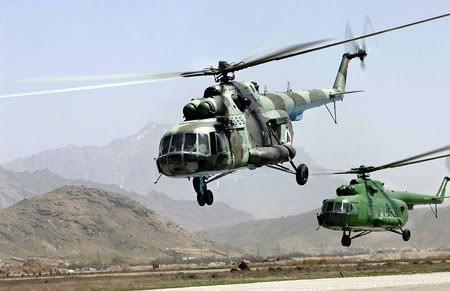
Screen captures of a video displaying Mil Mi-17 transport helicopter of the of the People's Liberation Army (PLA) armed with the HJ-10 (K/AKD10 / KD-10)anti-tank guided missile (ATGM). It is Chinese equivalent of the American AGM-114 Hellfire anti-tank guided missile (ATGM) used on the United States Army's AH-64 Apache attack helicopter.
CHINESE MI-17 HELICOPTERS ARMED WITH HJ-10 (AKD10) ANTI-TANK GUIDED MISSILE

HD compilation of J-20 flight tests


On 22 December 2010, the J-20 underwent high speed taxiing tests outside the Chengdu Aircraft Design Institute.

The J-20 made its first flight, lasting about 15 minutes, on 11 January 2011. A Chengdu J-10S served as the chase aircraft. China thus became the third nation in the world to "develop and test-fly a full-size stealth combat aircraft demonstrator", after the United States and Russia.

After the successful first flight, a ceremony was held. The test pilot of the J-20, Li Gang, Chief designer Yang Wei and General Li Andong (Deputy-Director of General Armaments Department, and Director of Science and Technology Commission of General Armaments Department of the PLA since 2000) attended the ceremony. The jet began making test flights again on 12 November after a month long break from flying.

A second test flight of an hour and twenty minutes took place on 17 April 2011. On 5 May 2011, a 55-minute test flight included retraction of the landing gear. In March 2012 a video was taken of the J-20 showing various maneuvers done in flight. On 10 May 2012, a second prototype was reported to have undergone low speed taxiing tests at an unspecified airport in Chengdu. The second aircraft began flight tests in May 2012.

In late October 2012, photographs of what believed to be a new prototype emerged. This aircraft features a different radome, speculated to house an AESA radar.

Pictures of J-20 testing its side weapon bays began to surface in late March 2013. Early pictures first revealed a missile launch rail being extended out of the right-side of the aircraft. Few days later, new photographs showed a mock up of an unidentified missile is installed on to the launcher.

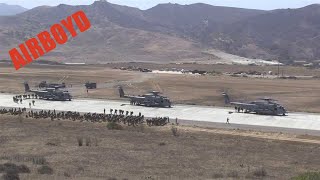
US Marine Air Assault Training Camp Pendleton: CH-53E, MV-22 Osprey,...


U.S. Marine Motion Imagery by Cpl. Jesse Witten, 3rd MAW Combat Camera.

U.S. Marine CH-53E Super Stallion helicopters and MV-22 Osprey aircraft from Marine Aircraft Group (MAG) 16, 3rd Marine Aircraft Wing, land on Marine Corp Base Camp Pendleton Calif., in order to air lift 2nd Battalion, 1st Marine Regiment, 1st Marine Division to Marine Corps Air Ground Combat Center Twentynine Palms on a air assault training exercise as part of Dawn Blitz 2013 on June 21, 2013.

The Marines are taking part in a air assault training exercise to Combat Center Twentynine Palms as part of a scenario-driven exercise for Dawn Blitz 2013 which test their ability to conduct complex operations essential for global crisis response.

Philippines, US in war games near China flashpoint reef

A US destroyer joined the Philippine Navy's flagship for war games that started Thursday close to a flashpoint area of the South China Sea, adding to tensions with China over rival territorial claims.

US destroyer USS Fitzgerald arrives at the former US naval base in Subic Bay, Olongapo City, north of Manila on June 27, 2013, to join the Cooperation Afloat Readiness and Training (CARAT) exercises close to a flashpoint area of the South China Sea.

A US destroyer joined the Philippine Navy’s flagship for war games that started Thursday close to a flashpoint area of the South China Sea, adding to tensions with China over rival territorial claims.
The exercises are a boost for the Philippines’ poorly equipped military as it struggles with perceived rising Chinese aggression, and follows repeated pleas to long time ally the United States for protection.

“The goal of these exercises is to further boost cooperation between the two armed forces and further streamline responses to counter-terrorism and maritime security,” deputy presidential spokeswoman Abigail Valte said.

The six-day exercises are an annual event but this year they were planned for the west coast of the Philippines’ main island of Luzon, close to Scarborough Shoal which China insists it owns.

US destroyer USS Fitzgerald arrives at the former US naval base in Subic Bay, Olongapo City, north of Manila on June 27, 2013. A US destroyer joined the Philippine Navy's flagship for war games that started Thursday close to a flashpoint area of the South China Sea, adding to tensions with China over rival territorial claims.

The shoal is a tiny set of rocks and islets in the South China Sea 230km east of Luzon and 1,200km from the nearest major Chinese landmass.

China claims nearly all of the strategically vital South China Sea, even waters close to the shores of its smaller neighbours.

The guided-missile destroyer USS Fitzgerald (DDG 62)
The guided-missile destroyer USS Fitzgerald (DDG 62) launching a missile.

Tensions between China and other claimants to the sea, particularly the Philippines and Vietnam, have escalated in recent years amid a series of Chinese political and military actions to assert its claims to the waters.

The Philippines says China has effectively occupied Scarborough Shoal, a rich fishing ground, for more than a year.

Manila says Chinese vessels now constantly patrol the waters around the shoal, forcing Filipino fishermen who have sailed there for generations to stay away.

Philippine Navy spokesman Lieutenant Commander Gregory Fabic said some of the Philippine-US exercises would be held between Luzon island and the shoal.

Specifically, Fabic said some of the drills would be 108km east of Scarborough Shoal in “sea lanes of communication within Philippine territory”.

Nevertheless, Fabic stressed the war games were not meant to provoke China.

“While the exercises will be between Scarborough Shoal and the main island of Luzon, the focus is inter-operability and not targeted against the Chinese,” Fabic said.

A US Navy officer is seen on the deck of the USS Milius DDG69, a multi-mission capable guided missile destroyer ship docked at the Manila south harbour. (AFP/Noel Celis)

Philippine Defence Secretary Voltaire Gazmin, in an unrelated meeting with visiting Japanese counterpart Itsunori Onodera in Manila, said the government was looking at more “high value, high impact” exercises with the United States.

Onodera and Gazmin agreed an increased US military presence in the region would serve to blunt China’s influence.

“Both sides agreed that the US presence is (a) very important public asset in East Asia,” Onodera said.
The Cooperation Afloat Readiness and Training (CARAT) exercises will involve three US Navy vessels, including the USS Fitzgerald, a guided missile destroyer, according to a Philippine Navy statement.

The Philippines will deploy its flagship, a former US coastguard cutter called the Gregorio del Pilar, as well as other navy and coastguard vessels.

About 500 US forces and another 500 Filipino troops will take part in the exercises, according to Fabic.

He said among the highlights was an exercise designed to intercept suspected enemy ships, board them and seize materials they may be carrying that could pose a danger to allies.

There will also be simulated counter-terrorism exercises, as well as training in disaster response and increasing proficiency in naval gunnery, he added.

Malaysia, Brunei and Taiwan also claim parts of the South China Sea, which is believed to sit on top vast deposits of fossil fuels, and the area has for decades been regarded as a potential trigger for major military conflict.

China has consistently reacted with anger at Philippine efforts in recent years to hold onto the territory claimed by both countries.

The Chinese embassy in Manila released a statement on Thursday cautioning the Philippines and the United states not to exacerbate tensions in the area with its exercises.

“We hope relevant sides should take actions that are beneficial for maintaining peace and stability in the region, not the other way around,” the statement said, citing a foreign ministry spokesman in Beijing.

Gulf News

Japan to take Phl's side in South China Sea dispute


File photo of Japan's Minister of Defense Itsunori Onodera at a Pentagon honor cordon last April. AARON HOSTUTLER
MANILA, Philippines - Japanese Defense Minister Itsunori Onodera on Thursday assured the Philippines that Japan will be on its side in defending disputed territories in the South China Sea.

Onodera, who is in a two-day visit in Manila, told Department of National Defense Secretary Voltaire Gazmin in a courtesy call that Japan will cooperate to resolve the sea row with China.

"We agreed that we will further cooperate in terms of defense of remote islands as well as the defense of territory, or territorial sea as well as protection of maritime interest ... We will cooperate with the Philippine side in this matter," Onodera said.

The Japanese official said that both countries are facing "common concerns" as China feuds with different states over territorial claims in overlapping waters.

"I also said that Japan(ese) side is very concerned that this kind of situation in South China Sea (as it) could affect the situation in East China Sea," he said.

Onodera also said that peaceful means over military might should remain paramount and that the rule of law must be considered in seeking arbitration.

"I would like to emphasize here that the current situation should not be changed with use of force ... I think this the concept that is agreed upon in international communities these days," he said.

Likewise, Onodera lauded the Philippines' action in seeking arbitration to resolve the matter.

“I have also learned about the Philippines’ efforts for the United Nations (UN) arbitration process in the principle that the Philippine side seeks to solve this problem based on the rule of law. Japan side is totally supporting these kinds of efforts,” he said.

He added that Japan's priority, meanwhile, is to keep and protect its own territorial space in sea or air more than to get involved in international matters.

Onodera visited U.S. naval base at Subic Bay before meeting with Gazmin, while Japanese Prime Minister Shinzo Abe intends to visit the country in July.

Japan claims that China had intruded into the Senkaku Islands, which China calls Diaoyu Islands.

The Philippines for its part, accuses China of intruding into various areas that are within its exclusive economic zone

Chinese intruders have strengthened their presence in the Panatag (Scarborough) Shoal off Zambales and Ayungin Shoal off Palawan.

They have also built structures in the Mischief Reef or Panganiban Reef, which is about 70 nautical miles from Palawan and Subi Reef, an islet 12 nautical miles southwest of Pag-asa Island in the same province.

The Philippines has been advocating a multilateral rules-based approach to settle the West Philippine Sea dispute. It has also

China, however, insists that the row be addressed through direct bilateral negotiations.

A report from the newspaper The Japan Times said the meeting between Onodera and Gazmin was meant “to keep China in check.”

The report also quoted an unnamed source as saying that Onodera and Gazmin would work out a “coordinated response” toward China.

Onodera clarified that their security efforts are not directed against a specific country.

“The Japanese government is not aiming at protecting from any specific nation but our stance is that we keep out territorial space, territorial air and sea space well-protected. This should be done according to the rule of law,” he said.

Last January, the Philippines challenged China’s territorial claim to most of the West Philippine Sea before an international tribunal of the UN.

China claims almost the entire West Philippine Sea and the East Sea. The area, delineated by a so-called nine-dash line, covers more than 100 islets, atolls and reefs.

The Philippines believes China’s nine-dash line, which outlined its claims over most of the sea, is illegal. China’s claims also overlap with those of the Philippines, Malaysia, Taiwan, Brunei and Vietnam.

Philstar

Russian Navy Pulls Personnel Out of Syria Base


(RIA Novosti)- Russia currently has no military personnel at its resupply facility in the Syrian port of Tartus, a senior diplomat said, though an expert affiliated with the Ministry of Defense downplayed it as a possible temporary measure.

“Currently, there is no one in Syria from the Russian Defense Ministry,” Deputy Foreign Minister Mikhail Bogdanov told the Al-Hayat international pan-Arabic newspaper.

“We never, at any time, had a real military base in Tartus… That center has no military or strategic significance. It never did and it doesn't now,” Bogdanov added, speaking in an interview that was first published last Friday in Arabic.

The naval maintenance center in Tartus, established in Soviet times, remains Russia’s last military foothold outside the former Soviet Union. The facility, used for the maintenance and resupply of Russian warships in the Mediterranean, had a staff of “several dozen,” Russian Foreign Minister Sergei Lavrov said in February.

The Russian Defense Ministry did not comment on Bogdanov’s statement. Spokespeople for the ministry and the Russian Navy could not be reached for comment Thursday.

An unnamed military official confirmed the story to Vedomosti business daily on Wednesday, saying that the Russian leadership was worried about the safety of the facility’s personnel, given the ongoing civil war in Syria. More than 90,000 people have been killed in the country since fighting broke out between government forces and rebels in March 2011, according to the latest UN figures.

Any incident involving Russian servicemen in Syria could also have unwanted political repercussions, the source said. Moscow has been providing diplomatic backing to embattled Syrian President Bashar Assad against pressure from Western powers and Gulf kingdoms.

The Russian Navy currently has a flotilla of 16 warships and auxiliary ships in the Mediterranean, but no Russian ships have called at Tartus in recent months, according to Russia’s General Staff.

The facility in Tartus only sees use on rare occasions when Russian warships call there, said Igor Korotchenko, editor-in-chief of the National Defense monthly Russian-language magazine and head of the Defense Ministry’s public council.

“I cannot confirm the pullout, but it probably means that there are simply no current plans to use the base in Tartus,” he told RIA Novosti on Thursday.

“They’ll likely redeploy when it’s needed. It’s just a technicality,” Korotchenko said.

RIA Novosti