Hiển thị các bài đăng có nhãn Philippine Military. Hiển thị tất cả bài đăng

Thứ Sáu, 28 tháng 6, 2013

US Trains Philippines On Drones Amid China Fears

CAVITE CITY, PHILIPPINES — US troops trained their Philippine counterparts how to use surveillance drones Friday, as Manila seeks to boost military ties with Washington and counter what it perceives as a rising security threat from China.

Filipino and American troops prepare to release a drone from a speedboat off Sangley Point in Cavite, as the two countries' joint naval exercises entered its second day Friday. AFP PHOTO

The naval exercises are part of annual training operations between the two defense partners, but they have come under closer scrutiny this year due to simmering tensions between Manila and Beijing over rival claims to the South China Sea.

At a naval base around 13 kilometers (eight miles) southwest of the capital Manila, US Navy SEALs taught Filipino soldiers how to use small unmanned aerial vehicles (UAVs), or drones, launching one from a boat at sea. It circled the base and landed in the water.

US maritime civil affairs officer Jeremy Eden said these were the smaller “Puma” drones used only for surveillance and not the more lethal, armed versions employed in Afghanistan.

“They (the Filipinos) are very interested and highly motivated to learn and if they acquire the systems, they will use them effectively,” Eden said.

The drones would be useful for the poorlyequipped Philippine military, which faces both internal insurgencies and potential external threats, said Lt. Jojit Fiscar, a senior coordinator of the naval exercises.

“This would be a very good instrument to use. This unmanned aerial vehicle can monitor the actual movement of the targets,” he said.

US and Philippine troops also practiced marksmanship and piloting small rubber boats that are frequently used by naval commandos.

Military officials from both sides stressed that the exercises had nothing to do with China’s claim to the South China Sea.

But Philippine Defense Secretary Voltaire Gazmin reiterated Friday that the Philippines was looking to give the United States greater access to its military bases, saying this was needed to respond to China’s threats.

“At this point in time, we cannot stand alone. We need allies. If we don’t do this, we will be bullied by bigger powers, and that is what is happening now: There is China, sitting on our territory,” Gazmin said.

“What are we going to do? Wait till they get into our garage?”

On Thursday, he said the Philippines wanted to give the United States and also Japan greater access to its military bases.

President Benigno Aquino’s spokeswoman, Abigail Valte, said separately that any increased US presence would comply with the Philippine constitution.

She also said China should not object. “Whatever we do within our territory... is perfectly within our rights.”

China claims nearly all of the strategically vital South China Sea, even waters close to the shores of its smaller neighbors.

Tensions between Beijing and other claimants to the sea, particularly the Philippines and Vietnam, have escalated in recent years amid a series of Chinese political and military actions to assert its claims to the waters.

Defense News

Thứ Năm, 27 tháng 6, 2013

Philippines, US in war games near China flashpoint reef

A US destroyer joined the Philippine Navy's flagship for war games that started Thursday close to a flashpoint area of the South China Sea, adding to tensions with China over rival territorial claims.

US destroyer USS Fitzgerald arrives at the former US naval base in Subic Bay, Olongapo City, north of Manila on June 27, 2013, to join the Cooperation Afloat Readiness and Training (CARAT) exercises close to a flashpoint area of the South China Sea.

A US destroyer joined the Philippine Navy’s flagship for war games that started Thursday close to a flashpoint area of the South China Sea, adding to tensions with China over rival territorial claims.
The exercises are a boost for the Philippines’ poorly equipped military as it struggles with perceived rising Chinese aggression, and follows repeated pleas to long time ally the United States for protection.

“The goal of these exercises is to further boost cooperation between the two armed forces and further streamline responses to counter-terrorism and maritime security,” deputy presidential spokeswoman Abigail Valte said.

The six-day exercises are an annual event but this year they were planned for the west coast of the Philippines’ main island of Luzon, close to Scarborough Shoal which China insists it owns.

US destroyer USS Fitzgerald arrives at the former US naval base in Subic Bay, Olongapo City, north of Manila on June 27, 2013. A US destroyer joined the Philippine Navy's flagship for war games that started Thursday close to a flashpoint area of the South China Sea, adding to tensions with China over rival territorial claims.

The shoal is a tiny set of rocks and islets in the South China Sea 230km east of Luzon and 1,200km from the nearest major Chinese landmass.

China claims nearly all of the strategically vital South China Sea, even waters close to the shores of its smaller neighbours.

The guided-missile destroyer USS Fitzgerald (DDG 62)
The guided-missile destroyer USS Fitzgerald (DDG 62) launching a missile.

Tensions between China and other claimants to the sea, particularly the Philippines and Vietnam, have escalated in recent years amid a series of Chinese political and military actions to assert its claims to the waters.

The Philippines says China has effectively occupied Scarborough Shoal, a rich fishing ground, for more than a year.

Manila says Chinese vessels now constantly patrol the waters around the shoal, forcing Filipino fishermen who have sailed there for generations to stay away.

Philippine Navy spokesman Lieutenant Commander Gregory Fabic said some of the Philippine-US exercises would be held between Luzon island and the shoal.

Specifically, Fabic said some of the drills would be 108km east of Scarborough Shoal in “sea lanes of communication within Philippine territory”.

Nevertheless, Fabic stressed the war games were not meant to provoke China.

“While the exercises will be between Scarborough Shoal and the main island of Luzon, the focus is inter-operability and not targeted against the Chinese,” Fabic said.

A US Navy officer is seen on the deck of the USS Milius DDG69, a multi-mission capable guided missile destroyer ship docked at the Manila south harbour. (AFP/Noel Celis)

Philippine Defence Secretary Voltaire Gazmin, in an unrelated meeting with visiting Japanese counterpart Itsunori Onodera in Manila, said the government was looking at more “high value, high impact” exercises with the United States.

Onodera and Gazmin agreed an increased US military presence in the region would serve to blunt China’s influence.

“Both sides agreed that the US presence is (a) very important public asset in East Asia,” Onodera said.
The Cooperation Afloat Readiness and Training (CARAT) exercises will involve three US Navy vessels, including the USS Fitzgerald, a guided missile destroyer, according to a Philippine Navy statement.

The Philippines will deploy its flagship, a former US coastguard cutter called the Gregorio del Pilar, as well as other navy and coastguard vessels.

About 500 US forces and another 500 Filipino troops will take part in the exercises, according to Fabic.

He said among the highlights was an exercise designed to intercept suspected enemy ships, board them and seize materials they may be carrying that could pose a danger to allies.

There will also be simulated counter-terrorism exercises, as well as training in disaster response and increasing proficiency in naval gunnery, he added.

Malaysia, Brunei and Taiwan also claim parts of the South China Sea, which is believed to sit on top vast deposits of fossil fuels, and the area has for decades been regarded as a potential trigger for major military conflict.

China has consistently reacted with anger at Philippine efforts in recent years to hold onto the territory claimed by both countries.

The Chinese embassy in Manila released a statement on Thursday cautioning the Philippines and the United states not to exacerbate tensions in the area with its exercises.

“We hope relevant sides should take actions that are beneficial for maintaining peace and stability in the region, not the other way around,” the statement said, citing a foreign ministry spokesman in Beijing.

Gulf News

Philippines Wants To Give US, Japan Access To Bases

MANILA — The Philippines said Thursday it was looking to give the United States and Japan greater access to its military bases as it seeks to counter what it perceives as a rising security threat from China.


The government is initially drafting a plan that would allow US forces to spend more time on Filipino bases, something that could be offered to Japan’s military later, Defence Secretary Voltaire Gazmin said.

“If and when there is agreement on the access, then there will be equipment coming in from the (United) States,” Gazmin told a joint news conference in Manila after meeting with visiting Japan Defense Minister Itsunori Onodera.

“Now as far as Japan is concerned, we do welcome other countries — particularly Japan since Japan is a strategic partner — in accordance with our existing protocols.”

President Benigno Aquino had already stated that the Philippines would welcome an increased US military presence, amid tense disputes with China over competing claims to parts of the South China Sea.

However, Gazmin’s comments indicated the Philippines was hoping to expand on the standard military exercises that the two nations’ armed forces regularly engage in.

“Modalities for the increased rotational presence are right now being examined. One modality is the conduct of high-value, high-impact exercise,” Gazmin said, without elaborating.

However, Gazmin emphasised the plan would not see any new bases or a permanent US presence in the Philippines.

The United States had tens of thousands of troops stationed in the Philippines, at the Clark Air Base and Subic Naval Base north of Manila, until the early 1990s.

The United States, a former colonial ruler of the Philippines, was forced to abandon the bases amid anti-US sentiment and a row over rent. The constitution now bans any permanent foreign bases in the Philippines.

However, the Clark and Subic facilities, now partly converted to business use, still host and service US military aircraft and warships on short-term exercises.

One of those began Thursday in waters between the Philippines’ main island of Luzon and a disputed shoal now occupied by China.

Several hundred US special operations troops have been rotating through the southern Philippines since early 2002 to train Filipino soldiers who are fighting Islamic militants.

Defense News

Thứ Hai, 27 tháng 5, 2013

Philippines set to acquire 21 Huey helicopters

UH-1 Huey Helicopter

MANILA, Philippines - The Department of National Defense (DND) will acquire 21 UH-1 helicopters through a negotiated procurement after the two public biddings for the air assets failed.

Defense Undersecretary Fernando Manalo said they need to fast-track the acquisition of the helicopters to beef up the Air Force’s security and disaster response capabilities.

“We cannot afford not to have additional helicopters for a long time. The rainy season is approaching. We need the helicopters for disaster response,” Manalo told The STAR over the weekend. “We also need them for our existing internal security operations.”

The government has allotted P1.2649 billion for 21 helicopters, which were originally intended to support election-related duties. However, the procurement of the air assets has been delayed due to failed biddings.

“The decision is to proceed with the procurement. Since there are two failed biddings, it will be through negotiated bid,” he said.

Manalo explained that under a negotiated bid, companies that signified interest to supply the equipment would be invited to submit a proposal. Other firms could also submit offers.

A team composed of representatives from the agency that would use the equipment would evaluate the proposals.

The first public bidding for the 21 helicopters was held last December.

The Defense System/Radom Israel and Rice Aircraft Services, Inc. participated in the bidding but both companies failed to meet the requirements set by the DND.

The second bidding was held last February and only one bidder - the US-based Rice Aircraft Services - was declared eligible to submit an offer.

The DND, however, declared that the company had failed to satisfy some financial requirements during the post-qualification phase.

“The problem lies on the technical and administrative matters on the part of Rice,” Manalo said.

“(Rice) did not meet (some requirements) based on the financial statements (it submitted). Through such documents, we can see a bidder’s financial capacity,” he added.

The DND requires bidders to submit financial documents to determine if they are capable of undertaking the project or supplying the needed equipment.

The Air Force requested for additional helicopters as early as 2011.

It only has 16 mission-capable UH-1 helicopters in its inventory, 51 units short of the ideal number of operational combat utility helicopters.

Philstar

Thứ Năm, 23 tháng 5, 2013

Philippines vowed to fight China “to the last man standing”


Manila: The Philippines vowed Thursday to fight China “to the last man standing”, as a Chinese warship patrolled around a remote reef occupied by a handful of Filipino marines in disputed waters.

In the latest flare-up over competing claims to parts of the South China Sea, the Philippines this week denounced the “provocative and illegal presence” of the warship and a fleet of Chinese fishing vessels near Second Thomas Shoal.

After China brushed off the protest and insisted it owned the tiny reef and islets that are home to rich fishing grounds, the Philippines on Thursday ramped up the rhetoric against its much more powerful rival.

“To the last soldier standing, we will fight for what is ours,” Defence Secretary Voltaire Gazmin told reporters when asked if the Philippines would bow to Chinese intimidation and pull its forces from the shoal.

However Gazmin said the Philippines was not intending to send any military reinforcements to the area, and there had been no confrontations between the two sides at the shoal since the Chinese vessels arrived early this month.

Second Thomas Shoal is one of nine Filipino-occupied islands or islets in the Spratly Islands chain.

It lies about 200 kilometres northwest of the Philippine island of Palawan, the nearest major landmass, and more than 1,000 kilometres from China’s Hainan island.

The shoal is guarded by a handful of Filipino marines, believed to number fewer than 10, aboard a World War II-era ship that was deliberately grounded there in the late 1990s to serve as a base.

China says it has sovereign rights over nearly all of the South China Sea, even waters far away from its main landmass and approaching the coasts of Southeast Asian countries.

The Philippines, Vietnam, Malaysia, Brunei and Taiwan also claim parts of the sea, and the area has for decades been regarded as a potential trigger for major military conflict in the region.

All claimants, except Brunei, have troops stationed on various islands and atolls in the Spratlys — the biggest archipelago in the sea — to assert their claims.

Regional tensions have escalated in recent years as China has taken more aggressive steps to assert its claims to the sea, which is believed to sit atop vast reserves of oil and gas worth billions of dollars.

China has established a new city to oversee the area and deployed navy vessels on wide-ranging patrols of the sea, with its ships reaching as far as 80 kilometres from Malaysia’s coast.

China last year also took control of Scarborough Shoal, another bountiful fishing area far closer to the Filipino landmass than China’s, after a stand-off between vessels from both countries ended with the Philippines retreating.

Second Thomas Shoal is about 40 kilometres east of Mischief Reef, a Philippine-claimed outcrop that China has occupied since 1995.

Second Thomas Shoal and Mischief Reef are within the Philippines’ internationally recognised exclusive economic zone.

“They should not be there. They do not have the right to be there,” foreign department spokesman Raul Hernandez told AFP via text message on Thursday when asked the Chinese presence at Second Thomas Shoal.

“No one should doubt the resolve of the Filipino people to defend what is ours in that area.”

President Benigno Aquino on Tuesday announced a planned $1.8-billion military upgrade to defend the country’s maritime territory against “bullies”.

But China’s announced defence budget of $115 billion this year is nearly 100 times more than that of the Philippines.

Gulf News
---------

'Asia tension could lead to conflict' - Foreign Affairs Sec del Rosario

TOKYO -- Foreign Affairs Secretary Albert del Rosario warned on Thursday that territorial rows in Asia are "causing considerable tension that could lead to conflict" as several countries face off with China over island claims.

Speaking at a Tokyo business conference, Del Rosario said China's "nine-dash line claim encompassing almost the entire South China Sea" is "excessive."

"In addition to the South China Sea, we have in Northeast Asia, home to Asia's biggest economic powerhouses, several disputes that have adversely affected relations between and among Japan, China and the Republic of Korea.

"The competing territorial and maritime disputes are causing considerable tension that could lead to conflict," he warned.

China is believed to be boosting its naval capability in the Pacific and has been criticized by neighbors for what is seen as an increasingly aggressive stance in the region, particularly in its multiple territorial disputes.

Chinese maritime surveillance vessels have been frequently spotted in the 12-nautical-mile zone off the Tokyo-controlled Senkaku islands, which China calls the Diaoyus, in the East China Sea since Tokyo nationalized three of the outcrops in September.

China says it has sovereign rights over nearly all of the South China Sea, even waters far away from its main landmass and approaching the coasts of Southeast Asian countries.

The Philippines, Vietnam, Malaysia, Brunei and Taiwan also claim parts of the sea, and the area has for decades been regarded as a potential trigger for major military conflict in the region.

All claimants, except Brunei, have troops stationed on various islands and atolls in the Spratlys -- the biggest archipelago in the sea -- to assert their claims.

Interkson

New Philippine Navy choppers to be delivered December

AW 109 Power helicopter
FORT SAN FELIPE, Cavite City - The Navy is expected to receive this December three new helicopters that are seen to boost its maritime security capabilities.

Navy chief Vice Adm. Jose Luis Alano said the three helicopters would constitute the first batch of air assets to be delivered by the supplier AugustaWestland S.P.A.

The government is acquiring a total five AW 109 Power helicopters from the Anglo-Italian firm for P1.3 billion.

“We are looking at the acquisition of naval helicopters. The initial batch will be arriving by December this year,” Alano said on the sidelines of the Navy’s anniversary celebration here.

“The helicopters (were acquired through) the proper procurement process,” he added.

In its website, AugustaWestland described the AW 109 as “a versatile aircraft that offers the highest level of benefits for government and military markets, combining optimum performance with cost-effectiveness.”

The helicopters can be used for maritime security, search and rescue and surface surveillance, among other operations.

The government and AugustaWestland signed the contract for the acquisition of the helicopters last December.

In a recent statement, Vincenzo Alaimo, AgustaWestland’s head of regional sales for Southeast Asia, said the AW 109 would “provide the Philippine Navy with an enhanced maritime operational capability.”

Meanwhile, Alano said they are looking forward to the arrival of a warship they acquired from United States (US) this August.

Alano said the acquisition of the BRP Ramon Alcaraz would provide them with the added capability to enforce Philippine maritime laws.

Officials previously expected the ship to arrive last January but the schedule was pushed back due to the need for repairs and personnel training. The government spent more than P600 million to acquire the vessel.

BRP Alcaraz was acquired from the US Coast Guard and was largely used for law enforcement, drug and migrant interdiction and search and rescue.

BRP Alcaraz can accommodate up to 180 personnel and was named after Commodore Ramon Alcaraz, a Navy officer who commanded a patrol boat during World War II.

It is the second vessel acquired by the Philippines from the US, the first one being BRP Gregorio del Pilar, which was commissioned in December 2011.

Philstar

Thứ Ba, 21 tháng 5, 2013

Philippine 'pivot' in the South China Sea

By Richard Javad Heydarian


MANILA - After three years of inconclusive bilateral negotiations with China and a year of precarious diplomatic brinkmanship under Cambodia's chairmanship of the Association of Southeast Asian Nations (ASEAN), the Philippines has sought new ways to resolve its territorial disputes in the South China Sea.

Despite earlier hopes that China's leadership transition would yield a constructive re-orientation in its territorial posturing, the Philippines has faced a progressively more assertive People's Liberation Army Navy (PLAN), which has recently stepped up its "surveillance" missions in the disputed waters.

From Manila's point of view, it is only a matter of time before Beijing's perceived encroachments escalate into a direct occupation of disputed features, including the hotly contested Scarborough Shoal, which almost sparked a direct military confrontation between the two sides in mid-2012. Benigno Aquino's administration also now faces a dramatic escalation in nationalistic sentiments, especially among highly vocal netizens.

Local media have kept those sentiments abuzz with live and sensationalist coverage of territorial disputes with China in the South China Sea. It was within this atmosphere of heightened popular nationalism that the followers of the Sultanate of Solo this year launched a ragtag invasion of remote territory in Malaysia in hope of rekindling historical claims to Sabah.

A cabinet reshuffle in the United States, meanwhile, has shown little signs of a major revitalization in Philippine-US military relations, with multiple crises in the Middle East occupying the attention of new Secretary of State John Kerry. That perceived inattention has sparked rumors that Manila is considering its own cabinet reshuffle, specifically to bring in figures who have stronger connections with their Chinese counterparts.

The Aquino administration has thus opted for a new strategy, anchored by a more muscular diplomacy directed at ASEAN and other international organizations. The aim is to rein in China's perceived assertiveness by building sufficient international pressure to give Manila leverage to restart negotiations towards a regional code of conduct, and/or strike a bilateral agreement with Beijing to ensure an element of sovereignty over disputed features within the Philippines' 200 nautical mile exclusive economic zone (EEZ).

Under this new strategy, the Aquino administration is no longer beholden to the illusion of unconditional US strategic commitment. The Barack Obama administration's "pivot" policy, unveiled at the 2010 ASEAN Regional Forum (ARF) Summit in Hanoi, inspired inflated hopes among allies such as the Philippines of direct American involvement in the South China Sea disputes. Three years of efforts led by Philippine Foreign Secretary Albert Del Rosario to deepen bilateral security relations have failed to build a sufficient deterrent against China.

Given America's outsized bilateral relations with China, prevarications on key provisions of the Philippine-US 1951 Mutual Defense Treaty (MDT), dwindling financial wiggle room in Washington, and growing strategic involvement in the Middle East's manifold crises, it has dawned on Manila's policy makers that outright reliance on the US is an impractical option. The Philippines is also no longer constrained by its earlier anticipation of Chinese self-restraint under new Chinese leader Xi Jinping's watch.

By resorting to the language of international law and freedom of navigation, Manila has placed wavering regional and global powers under the spotlight, making it increasingly difficult for ASEAN to shun the territorial disputes as a legitimate security concern in need of swift, decisive collective action. China's assertive behavior has provided additional impetus for greater diplomatic vigilance among others in the region who have nervously watched the maritime brinkmanship and diplomatic hiatus in the South China Sea.

Leading Filipino intellectuals and legislators such as Walden Bello have emphasized the need for a robust diplomatic strategy, with greater emphasis on regional solidarity and international law instead of an open-ended revitalization of security ties with the US. Cognizant of China's sensitivities to the US's presence in the region, many critics have pointed out the inherent contradiction in the Aquino administration's initial strategy, which combined the stick of re-alignment with the US with the carrot of a diplomatic charm offensive towards China.

That strategy obviously backfired, allowing China to use the pretext of a stronger US presence as justification for increased naval assertiveness. Meanwhile, some fellow ASEAN members came to see the Philippines as an overt extension of Washington's "pivot" to the region.

As a result, Manila's efforts to push for its version of a legally-binding code of conduct failed to resonate, while China was encouraged to use the full extent of its influence over allies such as Cambodia to blunt Manila's maneuvers within ASEAN. The result was a de facto collapse in regional diplomatic efforts to ease growing maritime tensions, with hawks in China pushing the envelope of brinkmanship.

Sense of urgency

Now focused on rallying the region behind its cause, and recognizing the downside of its initial strategy, the Aquino administration has tapped into the worries of others in the region over the dangerous escalation in maritime tensions. As a global artery for trade and energy transport, a large-scale direct confrontation in the South China Sea would adversely impact the entire region and beyond.

Under Brunei's chairmanship of ASEAN, Manila recognizes that it is dealing with a new regional dynamic. Unlike Cambodia, Brunei is a direct party to the South China Sea disputes, with the tiny kingdom determined to showcase its diplomatic ability as a credible arbiter. Alarmed by rising tensions among neighbors, ASEAN's founding members, notably Singapore, Malaysia, Indonesia, and Thailand, have also expressed their interest in building regional solidarity by re-starting negotiations for a code of conduct and preventing more diplomatic debacles.

Some observers have been surprised by Brunei's pro-active diplomacy considering its long-held tradition of subtle neutrality. Shortly before the ASEAN Summit held in April, Brunei's Sultan Bolkiah visited Aquino to express how he considered the diplomatic resolution of the disputes as a top priority under his watch. Manila, in turn, framed Bolkiah's statements as an endorsement of a code of conduct, putting an end to a year of diplomatic uncertainty under Cambodia's tenure as ASEAN's chairman.

Upon conclusion of the summit, Aquino held crucial bilateral talks with his Vietnamese counterpart, Prime Minister Nguyen Tan. Thereafter, Filipino officials announced that ASEAN's members had arrived at a consensus over the recognition of the ongoing maritime disputes as a "regional concern", portending a unified approach to establishing a binding code of conduct in the near future. Significantly, there was no dissenting response from Cambodia. Philippine media were quick to celebrate this as a sign of a diplomatic breakthrough.

Based on the statements of other participating diplomats, however, no "concrete agreement" to establish the necessary mechanisms, including the development of "guidelines", of a prospective code of conduct had been reached. Any move towards that will ultimately require China's consent, which to date has been absent.

In its exchanges with ASEAN members, China has made it clear in recent months that it will not relent on its "indisputable" and "inherent" sovereignty over the South China Sea. Without China's consent, ASEAN is unlikely to develop even a working agreement on the composition of a special group to draft elements of the code of conduct.

Despite its earlier token openness to ASEAN efforts under previous chairs, namely Vietnam (2010) and Indonesia (2011), to negotiate a code of conduct, Beijing continues to prefer a purely bilateral approach and staunchly opposes the internationalization of the issue. While sending an ever-larger flotilla of surveillance ships to assert its control over disputed waters, China has repeatedly dismissed Philippine efforts - backed by both the European Union and US - to resolve the disputes through international arbitration.

While Brunei has taken a more pro-active approach, it will likely try to avoid any direct confrontation with China, its major infrastructure and energy partner. Significantly, Sultan Bolkiah was invited to Beijing shortly before the ASEAN summit in Brunei. Movement on a code of conduct could fall victim to agenda overload, as Brunei gives emphasis to the establishment of an ASEAN Economic Community by 2015. While Manila has changed diplomatic tack, China's hardline position has so far held.

Richard Javad Heydarian is a Manila-based foreign affairs analyst focusing on the South China Sea and international security issues. He is a lecturer at Ateneo De Manila University's (ADMU) Department of Political Science, and the author of the upcoming book The Economics of the Arab Spring: How Globalization Failed the Arab World, Zed Books, 2014. He can be reached atjrheydarian@gmail.com.

(Copyright 2013 Asia Times Online (Holdings) Ltd. All rights reserved. Please contact us about sales, syndication and republishing)

Asia Times Online

Thứ Năm, 9 tháng 5, 2013

PH sea patrol checks out Chinese ships

The Philippine Navy on Thursday deployed three of its ships in the Kalayaan Group of Islands following reports that a Chinese navy frigate and two civilian ships were seen approaching a reef and a shoal in the area.

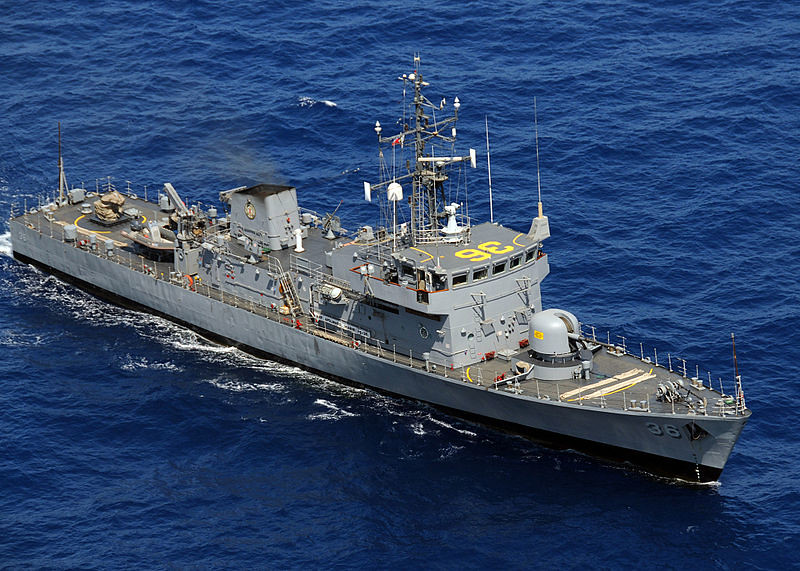
A highly-placed source said the Navy deployed the PN PS36, a Peacock Class offshore patrol, a frigate-type (PS 74) and a personnel carrier vessel (PS 71) to the Ayungin Reef and Hasahasa islet to monitor the presence of the Chinese vessels.

BRP Apolinario Mabini (PS-36)

The source said that the Chinese frigate has yet to arrive at the Ayungin Reef, while the two civilian ships were fast approaching the reefs.

Chinese vessels were also spotted near the Hasasa Reef, which is located near Ayungin.

“As of now they have not entered Ayungin Reef and Hasasa shoal but the three Navy vessels were dispatched to monitor the behavior of the Chinese in the West Philippine Sea,” the source said.

Ayungin Reef, also known as Second Thomas Reef, is adjacent to Mischief Reef or Panganiban Reef, 150 miles off Palawan and 620 miles Southeast of China.

The Ayungin Reef was occupied by the country in 1973.

The Hasahasa Shoal, is a tiny island located a few miles off Ayungin and is estimated to be 170 miles off Palawan.

Both Ayungin and Hasahasa are located within the country’s exclusive economic zone (EEZ), the 200-nautical mile boundary as defined by international sea law.

The source said that reports persist that the Chinese had started erecting structures in Ayungin, including metal and ropes to serve as markers.

On Tuesday, China Daily reported that China had sent a fishing flotilla of some 30 vessels which were dispatched to Spratly, parts of which are being contested by the Philippines, China, Taiwan, Brunie and Malaysia.

Meanwhile, an article in People’s Daily reported on Thursday that

China intends to double its offshore air patrols by 2015, based on a government report released on Wednesday.

China’s Ocean Development Report (2013), which was released by the China Institute for Marine Affairs under the State Oceanic Administration, emphasizes the importance of offshore air patrols to the country’s maritime law enforcement.

According to the report, by 2015 the country’s marine surveillance force will include fixed-wing aircraft with a range of more than 4,500 kilometers.

By 2020, a variety of aircraft with different ranges will be available for different purposes, according to the report.

China has undertaken regular patrols of the waters in the East China Sea since July 2006, and conducted regular patrols over the waters of the South China Sea since December 2007.

During the past year, Sino-Japanese relations have become increasingly strained because of Japan’s repeated provocations over the Diaoyu Islands in the East China Sea. The waters in the South China Sea remains troubled since a Philippine warship entered China’s territorial waters around Huangyan Island and harassed Chinese fishermen in April last year.

Besides offshore air patrols, the report estimates that the gross domestic product involving the country’s marine sectors will increase by 15 percent annually until 2030.

The GDP involving the marine sectors in 2012 increased 7.9 percent year-on-year to more than 5 trillion yuan ($814 billion), accounting for 9.6 percent of the country’s GDP.

Manila Standard
----------
Photo: SOUTH CHINA SEA (March 14, 2010) - Republic of the Philippines Navy ship BRP Apolinario Mabini (PS 36) steams in formation for a photography exercise as a part of exercise Balikatan 2010 (BK 10). Essex, commanded by Capt. Troy Hart, is part of the forward-deployed Essex Amphibious Ready Group and is participating in BK 10, an annual, bilateral exercise designed to improve interoperability between the U.S. and Republic of the Philippines. (U.S. Navy photo by Mass Communication Specialist 2nd Class Mark R. Alvarez/Released)

Wikipedia