Hiển thị các bài đăng có nhãn Naval Exercise. Hiển thị tất cả bài đăng

Thứ Sáu, 5 tháng 7, 2013

China deploys largest-ever single military force


China and Russia have begun their largest ever joint naval exercise in the Sea of Japan. It’s the Chinese navy’s single biggest deployment of military force in any joint foreign exercise.

The Chinese Navy has dispatched four guided missile destroyers, two guided missile frigates, a supply ship, and three ship-borne helicopters. There are nineteen warships and more than 10 aircraft and helicopters taking part in the maneuvers. China’s national defense ministry says the drills are not targeted at any third party, and the aim is to deepen cooperation between the two militaries.

The two navies will practice recapturing ships seized by pirates and search-and-rescue operations. There will also be a number of air defense, anti-submarine and anti-ship exercises. Operation "Joint Sea-2013" will run through to July 12th. Russia and China have regularly held joint naval drills since 2005, under the framework of the Shanghai Cooperation Organization.

Destroyer Shenyang (R) of the Chinese People's Liberation Army (PLA) Navy is anchored in Vladivostok, Russia, July 5, 2013. Chinese fleet consisting of seven naval vessels arrived in Vladivostok on Friday to participate in Sino-Russian joint naval drills scheduled for July 5 to 12 at the sea area and airspace of the Peter the Great Gulf in the Sea of Japan. (Xinhua/Wang Jingguo)
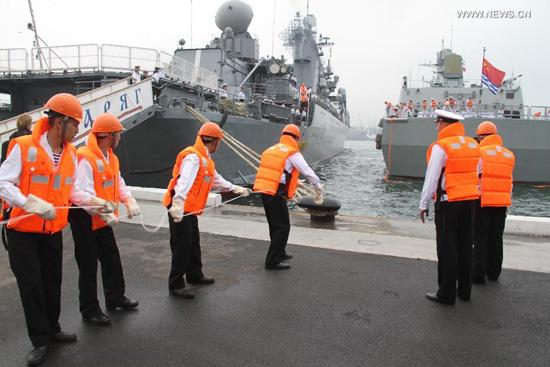


Destroyer Shenyang (R) of the Chinese People's Liberation Army (PLA) Navy is
anchored in Vladivostok, Russia, July 5, 2013. Chinese fleet consisting of
seven naval vessels arrived in Vladivostok on Friday to participate in
Sino-Russian joint naval drills scheduled for July 5 to 12 at the sea area
and airspace of the Peter the Great Gulf in the Sea of Japan. (Xinhua/Wang Jingguo)

CCTV

NATO chief downplays reports of US spying in Brussels -- Stars and Stripes

U.S. spy agency NSA hit with furloughs starting next week -- Reuters

France 'runs vast electronic spying operation using NSA-style methods' -- The Guardian

Britain's Army reserves to become cyber security and intelligence specialists - and receive more benefits -- The Independent

Flabby hackers, we want you: Britain eases physical standards for military ‘cyber-reservists’ -- AP

Preparing for cyberwarfare -- Michael Richardson, Japan Times

Russia to Lay Down 3rd Yasen Class Nuclear Sub on July 26 -- RIA Novosti

Russian Air Force to Get Su-30SM Fighter Jets in Bulk -- RIA Novosti

Russian Defense Minister Wants More Spending on R&D Units -- RIA Novosti

Coming Soon: India’s First Indigenous Aircraft Carrier -- Zachary Keck, The Diplomat

Orbital Blockade Imposed On Iran -- Strategy Page

Iran upgrades missile defense system -- UPI

Mexican generals accused of ties with drug cartel set free -- Reuters

Russia offering Su-30s to Ethiopia -- Defence Web

Philippines To Buy 2 Maestrale Frigates From Italy -- Defense News/AFP

Chinese Navy Ships Arrive in Russian Far East for Drills -- RIA Novosti

US Navy Boosts Arabian Gulf Patrol Craft Force -- Defense News

Positive trends greet Navy’s Asia deployments, but tensions at sea remain -- Stars and Stripes

Laser Could be New Eyes of the Military -- Military.com/NewsRx.com

Army IT Deal Tops $45 Billion in June Awards -- DoD Buzz

Military Sonar May Hurt Blue Whales -- Live Science

Grieving parents sue for answers from Air Force -- Air Force Times

Brace for similar sequester impact in 2014, Greenert says -- Stars and Stripes/Virginia Pilot

National Guard soldiers, airmen to be furloughed -- AP

Squeezing the Pentagon: The wrong way to cut America’s military budget -- The Economist

In the 1970s, the U.S. military struggled with morale -- Jim Michaels, USA TODAY

Thứ Bảy, 29 tháng 6, 2013

In pictures, U.S. and Philippine Conduct Joint Military Exercises

US navy soldiers and their Philippine counterparts operate two boats during a joint military exercises between the Philippines and the United States at the South China Sea, June 28, 2013. The Philippines and US Naval forces began joint military exercises codenamed Cooperation Afloat Readiness and Training (CARAT) at the South China Sea on June 27. (CNS Photo)

U.S. navy soldiers and their Philippine counterparts disembark from a speed boat after a surveillance operation training during a joint military exercises between the Philippines and the United States at the South China Sea, June 28, 2013. The Philippines and U.S. Naval forces began joint military exercises codenamed Cooperation Afloat Readiness and Training (CARAT) at the South China Sea on June 27 to enhance the capability of both sides through practical exercises and lectures. (Xinhua/Rouelle Umali)

A U.S. navy soldier (L) instructs his Philippine counterpart during a joint military exercises between the Philippines and the United States at the South China Sea, June 28, 2013. The Philippines and U.S. Naval forces began joint military exercises codenamed Cooperation Afloat Readiness and Training (CARAT) at the South China Sea on June 27 to enhance the capability of both sides through practical exercises and lectures. (Xinhua/Rouelle Umali)

U.S. navy soldiers and their Philippine counterparts launch an unmanned aerial vehicle (UAV) during a joint military exercises between the Philippines and the United States at the South China Sea, June 28, 2013. The Philippines and U.S. Naval forces began joint military exercises codenamed Cooperation Afloat Readiness and Training (CARAT) at the South China Sea on June 27 to enhance the capability of both sides through practical exercises and lectures. (Xinhua/Rouelle Umali)

U.S. navy soldiers and their Philippine counterparts operate a boat during a joint military exercises between the Philippines and the United States at the South China Sea, June 28, 2013. The Philippines and U.S. Naval forces began joint military exercises codenamed Cooperation Afloat Readiness and Training (CARAT) at the South China Sea on June 27 to enhance the capability of both sides through practical exercises and lectures. (Xinhua/Rouelle Umali)

U.S. navy soldiers and their Philippine counterparts disembark from a speed boat after a surveillance operation training during a joint military exercises between the Philippines and the United States at the South China Sea, June 28, 2013. The Philippines and U.S. Naval forces began joint military exercises codenamed Cooperation Afloat Readiness and Training (CARAT) at the South China Sea on June 27 to enhance the capability of both sides through practical exercises and lectures. (Xinhua/Rouelle Umali)

USS Fitzgerald, a guided-missile destroyer, docks in Subic’s Alava Pier yesterday for the Phl-US CARAT exercise. ERNIE PENAREDONDO

Iranian, Russian Navies to Launch Joint Naval Wargames in the Caspian Sea


The Russian and Iranian navies are planning to hold joint exercises in the Caspian Sea in the second half of this year, the Russian news agency Novosti reported. According to Nikolai Yakubovsky, deputy commander of Russia’s Caspian Flotilla, the exercise follows a previous one held in 2009. Caspian Flotilla commander Admiral Sergey Alekminsky confirmed few months ago that that the two navies could strengthen their collaboration in the future.

The Russian flotilla maintains a small force comprising two Gepard class frigates, three Tarantul class corvettes and several missile patrol boats. The Iranian Caspian fleet based at Bandar-e Anzali also maintains a small fleet of patrol boats and minesweepers. The fleet will get a major boost next year, as the domestically built Jamaran-2 frigate, recently launched at Bandar-e Anzali.

Yakubovsky made the announcement after a meeting with the commander of a group of Iranian guided-missile boats that were visiting the port of Astrakhan. Iranian navy representatives welcomed the opportunity to take part in the joint exercises, but declined to discuss the plans in more detail. In 2009, Russia and Iran held their first joint naval exercise in the Caspian, involving about 30 ships.

Defense Update

Photo: Iran's first domestically made Jamaran destroyer. These include a Mowj-1 class destroyer, launched in 2010, and Velayat, a Mowj-2 class destroyer, whose construction is 70 percent complete and will finish by the end of the current year, he said, according to Press TV.

The new projects also include Mowj and Sina-class destroyers and guided missile frigates, Zamini said.
The Iranian Navy floated out its first domestically built destroyer, Jamaran, in February 2010.

The 1,420-ton destroyer is equipped with modern radar systems and other electronic warfare capabilities. It has a top speed of up to 30 knots and a helipad. It also features highly advanced anti-aircraft, anti-surface and anti-subsurface systems.

Thứ Sáu, 28 tháng 6, 2013

US Trains Philippines On Drones Amid China Fears

CAVITE CITY, PHILIPPINES — US troops trained their Philippine counterparts how to use surveillance drones Friday, as Manila seeks to boost military ties with Washington and counter what it perceives as a rising security threat from China.

Filipino and American troops prepare to release a drone from a speedboat off Sangley Point in Cavite, as the two countries' joint naval exercises entered its second day Friday. AFP PHOTO

The naval exercises are part of annual training operations between the two defense partners, but they have come under closer scrutiny this year due to simmering tensions between Manila and Beijing over rival claims to the South China Sea.

At a naval base around 13 kilometers (eight miles) southwest of the capital Manila, US Navy SEALs taught Filipino soldiers how to use small unmanned aerial vehicles (UAVs), or drones, launching one from a boat at sea. It circled the base and landed in the water.

US maritime civil affairs officer Jeremy Eden said these were the smaller “Puma” drones used only for surveillance and not the more lethal, armed versions employed in Afghanistan.

“They (the Filipinos) are very interested and highly motivated to learn and if they acquire the systems, they will use them effectively,” Eden said.

The drones would be useful for the poorlyequipped Philippine military, which faces both internal insurgencies and potential external threats, said Lt. Jojit Fiscar, a senior coordinator of the naval exercises.

“This would be a very good instrument to use. This unmanned aerial vehicle can monitor the actual movement of the targets,” he said.

US and Philippine troops also practiced marksmanship and piloting small rubber boats that are frequently used by naval commandos.

Military officials from both sides stressed that the exercises had nothing to do with China’s claim to the South China Sea.

But Philippine Defense Secretary Voltaire Gazmin reiterated Friday that the Philippines was looking to give the United States greater access to its military bases, saying this was needed to respond to China’s threats.

“At this point in time, we cannot stand alone. We need allies. If we don’t do this, we will be bullied by bigger powers, and that is what is happening now: There is China, sitting on our territory,” Gazmin said.

“What are we going to do? Wait till they get into our garage?”

On Thursday, he said the Philippines wanted to give the United States and also Japan greater access to its military bases.

President Benigno Aquino’s spokeswoman, Abigail Valte, said separately that any increased US presence would comply with the Philippine constitution.

She also said China should not object. “Whatever we do within our territory... is perfectly within our rights.”

China claims nearly all of the strategically vital South China Sea, even waters close to the shores of its smaller neighbors.

Tensions between Beijing and other claimants to the sea, particularly the Philippines and Vietnam, have escalated in recent years amid a series of Chinese political and military actions to assert its claims to the waters.

Defense News

Thứ Năm, 27 tháng 6, 2013

Philippines, US in war games near China flashpoint reef

A US destroyer joined the Philippine Navy's flagship for war games that started Thursday close to a flashpoint area of the South China Sea, adding to tensions with China over rival territorial claims.

US destroyer USS Fitzgerald arrives at the former US naval base in Subic Bay, Olongapo City, north of Manila on June 27, 2013, to join the Cooperation Afloat Readiness and Training (CARAT) exercises close to a flashpoint area of the South China Sea.

A US destroyer joined the Philippine Navy’s flagship for war games that started Thursday close to a flashpoint area of the South China Sea, adding to tensions with China over rival territorial claims.
The exercises are a boost for the Philippines’ poorly equipped military as it struggles with perceived rising Chinese aggression, and follows repeated pleas to long time ally the United States for protection.

“The goal of these exercises is to further boost cooperation between the two armed forces and further streamline responses to counter-terrorism and maritime security,” deputy presidential spokeswoman Abigail Valte said.

The six-day exercises are an annual event but this year they were planned for the west coast of the Philippines’ main island of Luzon, close to Scarborough Shoal which China insists it owns.

US destroyer USS Fitzgerald arrives at the former US naval base in Subic Bay, Olongapo City, north of Manila on June 27, 2013. A US destroyer joined the Philippine Navy's flagship for war games that started Thursday close to a flashpoint area of the South China Sea, adding to tensions with China over rival territorial claims.

The shoal is a tiny set of rocks and islets in the South China Sea 230km east of Luzon and 1,200km from the nearest major Chinese landmass.

China claims nearly all of the strategically vital South China Sea, even waters close to the shores of its smaller neighbours.

The guided-missile destroyer USS Fitzgerald (DDG 62)
The guided-missile destroyer USS Fitzgerald (DDG 62) launching a missile.

Tensions between China and other claimants to the sea, particularly the Philippines and Vietnam, have escalated in recent years amid a series of Chinese political and military actions to assert its claims to the waters.

The Philippines says China has effectively occupied Scarborough Shoal, a rich fishing ground, for more than a year.

Manila says Chinese vessels now constantly patrol the waters around the shoal, forcing Filipino fishermen who have sailed there for generations to stay away.

Philippine Navy spokesman Lieutenant Commander Gregory Fabic said some of the Philippine-US exercises would be held between Luzon island and the shoal.

Specifically, Fabic said some of the drills would be 108km east of Scarborough Shoal in “sea lanes of communication within Philippine territory”.

Nevertheless, Fabic stressed the war games were not meant to provoke China.

“While the exercises will be between Scarborough Shoal and the main island of Luzon, the focus is inter-operability and not targeted against the Chinese,” Fabic said.

A US Navy officer is seen on the deck of the USS Milius DDG69, a multi-mission capable guided missile destroyer ship docked at the Manila south harbour. (AFP/Noel Celis)

Philippine Defence Secretary Voltaire Gazmin, in an unrelated meeting with visiting Japanese counterpart Itsunori Onodera in Manila, said the government was looking at more “high value, high impact” exercises with the United States.

Onodera and Gazmin agreed an increased US military presence in the region would serve to blunt China’s influence.

“Both sides agreed that the US presence is (a) very important public asset in East Asia,” Onodera said.
The Cooperation Afloat Readiness and Training (CARAT) exercises will involve three US Navy vessels, including the USS Fitzgerald, a guided missile destroyer, according to a Philippine Navy statement.

The Philippines will deploy its flagship, a former US coastguard cutter called the Gregorio del Pilar, as well as other navy and coastguard vessels.

About 500 US forces and another 500 Filipino troops will take part in the exercises, according to Fabic.

He said among the highlights was an exercise designed to intercept suspected enemy ships, board them and seize materials they may be carrying that could pose a danger to allies.

There will also be simulated counter-terrorism exercises, as well as training in disaster response and increasing proficiency in naval gunnery, he added.

Malaysia, Brunei and Taiwan also claim parts of the South China Sea, which is believed to sit on top vast deposits of fossil fuels, and the area has for decades been regarded as a potential trigger for major military conflict.

China has consistently reacted with anger at Philippine efforts in recent years to hold onto the territory claimed by both countries.

The Chinese embassy in Manila released a statement on Thursday cautioning the Philippines and the United states not to exacerbate tensions in the area with its exercises.

“We hope relevant sides should take actions that are beneficial for maintaining peace and stability in the region, not the other way around,” the statement said, citing a foreign ministry spokesman in Beijing.

Gulf News

Thứ Ba, 25 tháng 6, 2013

US Marine Corps and Japanese Forces Storm Ashore ... Together

WASHINGTON — At some point between June 11 and June 28, a US Marine Corps MV-22 Osprey will, for the first time, land on the deck of a Japan Maritime Self-Defense Force ship as part of a major amphibious exercise between the US, Japan and regional allies.

Japanese SDF LCAC hovercrafts. A Japan Self-Defense Force Landing Craft approaches the shore of San Clemente Island, Calif., during exercise Dawn Blitz. (US Navy)
A Japan Self-Defense Force Landing Craft approaches the shore of San Clemente Island, Calif., during exercise Dawn Blitz. (US Navy)

Known as Dawn Blitz 2013, the amphibious assault war game off the southern California coast involves about 1,000 Japanese soldiers, three Japanese warships and assorted attack and cargo helicopters, which will team with the 1st Marine Expeditionary Brigade (MEB) and the US Navy’s Expeditionary Strike Group 3. The Marines also are bringing three squadrons of Osprey tilt-rotor aircraft and a handful of F/A-18 fighter jets to the scrum.

Canada and New Zealand each sent company-size elements to take part in the exercise, with observers from Australia, Mexico, Chile, Colombia and Peru in attendance as well.

So much representation from Canada and Latin American partners might seem out of synch with a Pacific-based amphibious scenario. But Brig. Gen. John Broadmeadow, commander of the 1st MEB, told reporters June 13 that partnerships like this are likely to become the norm.

“We are hitting a lot of [US Southern Command’s] objectives” in the exercise, he said. “This isn’t a one-way partnership between us and the Japanese; this is a broad coalition that looks at our pivot to the Pacific from a more global perspective, and that our South American partners are as important in that coalition as our traditional Pacific partners.”

US forces assigned to Southern Command, or SOUTHCOM, cover the Caribbean Sea and Latin America south of Mexico.

The Marine Corps is using the exercise as another way to get “back to the sea” after 12 years of fighting in the deserts and mountains of the Middle East, while imparting its knowledge of amphibious operations to partner nations that lack that capability.

“If you want to use the sea as a maneuver space and gain a positional advantage … that type of graduate-level amphib work takes years to develop,” Broadmeadow said.

For the first time, Japanese troops will plan and conduct ship-to-shore assaults both in partnership with Marine units and alone, while taking part in land operations with their Canadian and New Zealand counterparts.

Broadmeadow cautioned that the scenarios are not meant to represent any current threat from North Korea or any other specific hot spot.

As for the Osprey operations, the Japanese asked to see the MV-22 used in a humanitarian scenario, in which casualties are brought from shore to ship. So the birds will take off from shore before settling on the flight decks of the Japanese ships Shimokita and Hyuga.

Like every other DoD activity, the exercise has been bitten by budgetary concerns.

“We haven’t put the numbers of ships into the exercise as we originally envisioned,” Broadmeadow admitted. But he said he is still confident that the event is big enough and dynamic enough to benefit partner nations and his Marines.

Defense News

This is a video of LCAC unloading a tank.

Thứ Hai, 24 tháng 6, 2013

Australia, Japan and US Naval Forces Conduct ASW Exercises

Australia, Japan and US Naval Forces Conduct ASW Exercises

Australia, Japan and U.S. Naval forces flexed the Anti-Submarine Warfare (ASW) aspects of exercise Pacific Bond 2013 near the Marianas Island chain, June 23.

“This ASW exercise is a building block toward acquiring the ability to seamlessly integrate on common initiatives to promote security and prosperity in the Western Pacific,” said Lt. j.g. Joshua Foote, Destroyer Squadron 15′s assistant plans officer.

“We will not only have improved our individual tactical proficiency, but we will also gain an increased understanding of how our each of us achieves success in difficult tactical situations through the particular skills each ally brings to the table.”

The three navies integrated their skills to detect, track and defeat an adversary submarine in a variety of scenarios over the course of two days. They also conducted events to develop proficiency in other warfare areas such as air defense and surface warfare.

“My challenge was to generate an anti-submarine warfare team on board a ship that was predominantly an air defence frigate,” said Lt. Cmdr. Jonathan Bannister, HMAS Sydney’s torpedo and anti-submarine officer. “We are proud of the way [our] Sailors rose to the challenge and pulled out all stops to get involved, to learn and to do whatever it took to achieve ASW competency for the patrol.”

Tri-lateral exercises like Pacific Bond are outlined to improve interoperability and readiness among navies.

“Another important aspect of this ASW exercise is working with our allies to strengthen our bonds, enhance maritime interoperability, and demonstrate our cooperative commitment to security, stability, and freedom of the seas in the Western Pacific,” said Foote.

Pacific Bond is a multi-national naval exercise designed to advance participating nations’ military-to-military coordination and capacity to plan and execute tactical operations in a multi-warfare environment.

Participating units from U.S. Navy are the guided missile destroyers USS Preble (DDG 88) and USS Chung-Hoon (DDG 93); members of the forward deployed Destroyer Squadron (DESRON) 15; one P-3C aircraft; one submarine; Royal Australian Navy guided-missile frigate HMAS Sydney’s (FFG 03) and Japan Maritime Self-Defense Force ship, JS Murasame (DD 101).

Map DataMap data ©2013 Google, ZENRIN Imagery ©2013 TerraMetrics - Terms of Use
Map Data
Map data ©2013 Google, ZENRIN Imagery ©2013 TerraMetrics
Traffic
Map
Satellite


Naval Today