Hiển thị các bài đăng có nhãn China Military Video. Hiển thị tất cả bài đăng

Thứ Hai, 8 tháng 1, 2018

Video: China shows its military muscle in winter exercises


China has launched its first military exercise in 2018 ordered by Chinese President Xi Jinping.

A series of winter exercises are being deployed across the Chinese mainland after Xi Jinping ordered total military maneuvers on January 3, 2018.

The exercises begin on January 3, in which Chinese armed forces conduct exercises to enhance the feasibility of the war and win any war.

This exercise included the winter realm firearms, amphibious assault drills, aerial maneuvers, missiles, and armed police departments.

Thứ Tư, 3 tháng 7, 2013

China sends 7 naval vessels for Joint Sea 2013 drill


China has sent a fleet of seven naval vessels to participate in Sino-Russian joint naval drills. The fleet consists of four destroyers, two escort vessels and a supply ship.

Four missile destroyers will join the Sino-Russian military exercise in Peter the Great Bay.

The Shenyang, is a new generation of guided missile destroyers, which are independently developed by China. It was launched in December 2004 and began service under the PLA Navy North Sea Fleet in 2006. The Shenyang, is designed mainly to provide air defense for a fleet against air attack. And it also retains reasonable anti-surface and anti-submarine capability.

The Shijiazhuang, launched in January 2007, is the same model as the Shenyang. It has a full displacement of 6-thousand 6-hundred tons. The ship was equipped with advanced anti-missile air defense and anti-ship missile systems. The ship is capable of detecting and attacking long-range targets.

As the main force of South Sea fleet, the Wuhan, has a full displacement of 7-thousand 5-hundred tons.

This class features a stealthy hull and significantly improved air defense systems. It successfully completed the escort mission off waters of Somalia in 2008 and 2011.

The Lanzhou, is a class of destroyer independently designed and developed by China. Its displacement capability is 7-thousand tons. It features an active electronically scanned array radar system with four statically-mounted antennas for 360-degree coverage.

The four missile destroyers will be escorted by the Yantai and the Yancheng vessels. They will also be accompanied by a large comprehensive supply ship, the Hongzehu.

Thứ Năm, 27 tháng 6, 2013

HD compilation of J-20 flight tests


On 22 December 2010, the J-20 underwent high speed taxiing tests outside the Chengdu Aircraft Design Institute.

The J-20 made its first flight, lasting about 15 minutes, on 11 January 2011. A Chengdu J-10S served as the chase aircraft. China thus became the third nation in the world to "develop and test-fly a full-size stealth combat aircraft demonstrator", after the United States and Russia.

After the successful first flight, a ceremony was held. The test pilot of the J-20, Li Gang, Chief designer Yang Wei and General Li Andong (Deputy-Director of General Armaments Department, and Director of Science and Technology Commission of General Armaments Department of the PLA since 2000) attended the ceremony. The jet began making test flights again on 12 November after a month long break from flying.

A second test flight of an hour and twenty minutes took place on 17 April 2011. On 5 May 2011, a 55-minute test flight included retraction of the landing gear. In March 2012 a video was taken of the J-20 showing various maneuvers done in flight. On 10 May 2012, a second prototype was reported to have undergone low speed taxiing tests at an unspecified airport in Chengdu. The second aircraft began flight tests in May 2012.

In late October 2012, photographs of what believed to be a new prototype emerged. This aircraft features a different radome, speculated to house an AESA radar.

Pictures of J-20 testing its side weapon bays began to surface in late March 2013. Early pictures first revealed a missile launch rail being extended out of the right-side of the aircraft. Few days later, new photographs showed a mock up of an unidentified missile is installed on to the launcher.

Thứ Bảy, 15 tháng 6, 2013

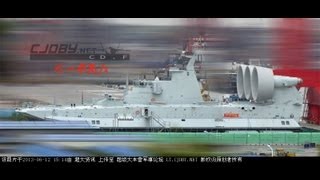
China takes delivery of its first Zubr-class LCAC


China takes delivery of its first Zubr-class LCAC
China takes delivery of First Zubr Hovercraft earlier this month, with the next to be delivered within the year. The remaining two will be built in China with the help of Ukrainian shipbuilders.

--> China’s Amphibious Game Changer?

Thứ Ba, 11 tháng 6, 2013

China successfully launches Shenzhou-10 spacecraft


China successfully launches Shenzhou-10 spacecraft
China successfully launched its fifth manned spacecraft on Tuesday afternoon, announced Zhang Youxia, chief commander of China's manned space program.

Shenzhou-10, atop an upgraded Long March-2F carrier rocket, blasted off from the Jiuquan Satellite Launch Center in northwest China late Tuesday afternoon and entered its designated orbit minutes later.

Three astronauts, two male and one female, are aboard the spacecraft.

A see-off ceremony was held at the center hours before the launch. Chinese President Xi Jinping, who just returned from his visit to the United States, attended the ceremony and extended good wishes to the three astronauts.

"The mission's members carry a space dream of the Chinese nation, and represent the lofty aspirations of the Chinese people to explore space," said Xi who watched the launch process in Jiuquan.

In its 15-day journey, the spacecraft will dock with the orbiting space lab Tiangong-1 twice, once through automatic operation and the other manual, and a lecture will for the first time be given on board of the assembled orbiter to a group of students on the ground.

This mission aims to further test technologies of docking and supporting astronauts' stay in space, as well as use new technologies related to the construction of a space station, according to Wu Ping, China's manned space program spokeswoman, at a press conference on Monday.

The Tiangong-1 space lab has been in orbit for about 620 days and about three months are left before the designated end of its service.

The module is considered the first step for China to operate a permanent space station around 2020 and make it the world's third country to do so.

There are risks that the conditions of some components on the Tiangong-1 might not be at their best since the module is near the end of its service and has gone through four docking tests, Wu said.

Nie Haisheng, commander of the three-member crew and second time space traveler, said this mission will be longer, with more experiments to be conducted, than his previous mission in 2006.

"It will be a new challenge with greater risks," Nie told the media on Monday.

However, he looked forwards to entering the space lab module. "My colleagues and I will work at a home for Chinese in the space," he said.

CNTV

Video Of Chinese Aircraft Carrier Liaoning CV 16 Setting Sail

Video Of Chinese Aircraft Carrier Liaoning CV 16 Set Sail for a traning mission. Liaoning CV 16  deploys Shenyang J-15 Flying Shark navalized J-11B fighter jet.