Thứ Tư, 3 tháng 7, 2013

China sends 7 naval vessels for Joint Sea 2013 drill


China has sent a fleet of seven naval vessels to participate in Sino-Russian joint naval drills. The fleet consists of four destroyers, two escort vessels and a supply ship.

Four missile destroyers will join the Sino-Russian military exercise in Peter the Great Bay.

The Shenyang, is a new generation of guided missile destroyers, which are independently developed by China. It was launched in December 2004 and began service under the PLA Navy North Sea Fleet in 2006. The Shenyang, is designed mainly to provide air defense for a fleet against air attack. And it also retains reasonable anti-surface and anti-submarine capability.

The Shijiazhuang, launched in January 2007, is the same model as the Shenyang. It has a full displacement of 6-thousand 6-hundred tons. The ship was equipped with advanced anti-missile air defense and anti-ship missile systems. The ship is capable of detecting and attacking long-range targets.

As the main force of South Sea fleet, the Wuhan, has a full displacement of 7-thousand 5-hundred tons.

This class features a stealthy hull and significantly improved air defense systems. It successfully completed the escort mission off waters of Somalia in 2008 and 2011.

The Lanzhou, is a class of destroyer independently designed and developed by China. Its displacement capability is 7-thousand tons. It features an active electronically scanned array radar system with four statically-mounted antennas for 360-degree coverage.

The four missile destroyers will be escorted by the Yantai and the Yancheng vessels. They will also be accompanied by a large comprehensive supply ship, the Hongzehu.

Two new-type frigates of PLA Hong Kong Garrison commissioned

HONG KONG, July 2 (ChinaMil) -- The Hong Kong Garrison of the Chinese People's Liberation Army (PLA) held the commissioning, naming and flag-granting ceremony for the Huizhou frigate and the Qinzhou frigate at 10:00 on the morning of July 1, 2013 at the Stonecutters Island naval port in Hong Kong, marking that the two new-type frigates are formally commissioned.


The newly-commissioned Huizhou frigate and the Qinzhou frigate with the hull numbers of 596 and 597 respectively are China's independently designed, developed and produced new-generation light guided-missile frigate integrated with many types of weapons and equipment, possessing good stealth performance and strong electromagnetic compatibility, according to the briefing.

The two frigates will be mainly responsible for tasks including patrolling, defense, naval escort and operation against sea targets after their commissioning. In addition, they will gradually replace the guided-missile escort boats now in service, becoming the main combat equipment of the PLA Hong Kong Garrison for maritime defense.

After the ceremony, the two frigates were open to the Hong Kong residents for the first time and a total of 13,000 Hong Kong residents boarded the frigates for visit.

People Daily

Why Pentagon Must Embrace Transformation, This Time

Military transformation boasts several fathers, including Andy Marshall (Yoda) of the Pentagon’s Office of Net Assessment, Andy Krepinevich of the Center for Strategic and Budgetary Assessments (a Marshall acolyte) and the late Vice Adm. Art Cebrowski of the Office of Force Transformation (OFT), but relatively few children. The OFT built the M80 Stiletto (pictured above) and some in the Pentagon believe the combination of UAVs, satellite targeting and data fusion cobbled together over the last decade comprise an accidental transformational capability. Rob Holzer, a former colleague of mine who went on to work for the one Pentagon office charged with pushing transformation forward in the face of a very unfriendly (or to be kind, cautious) military, argues it’s time for the US defense enterprise to finally and truly embrace transformation. The Editor.

M80 Stiletto. Designed for swarming, riverine, littoral ops.

The U.S. military must quickly come to grips with the inescapable fact that fundamental changes to the entire defense structure are looming — just as similar changes loomed little more than a decade ago before the events of 9/11 upended the strategic landscape. These changes could be far more disruptive than the reforms initially planned during former-Defense Secretary Donald Rumsfeld’s tenure and may be even more critical to long-term U.S. national security interests than the “Accidental Transformation” brought about during the protracted and irregular warfare in Iraq and Afghanistan.

Facing the dire prospect of long-term budgetary austerity at home, while at the same time confronting strategic uncertainty and growing risks abroad, the U.S. military must embrace the process of fundamental change that was derailed by the decade of war. In a word, that process is called transformation.

While the concept of transformation became distorted so that it often simultaneously meant everything and nothing — and most damaging — was too closely associated with former-Defense Secretary Donald Rumsfeld’s tenure at the Pentagon — the fundamentals of the concept hold even more import for the U.S. military today.

Transformation’s previous application was stymied since its implementation took place in an ad hoc fashion in response to urgent issues arising from battlefields in Iraq and Afghanistan. This “Accidental Transformation” still achieved notable breakthroughs in terms of exponential use of unmanned systems; robots; greater reliance on human factors in irregular warfare, and development of integrated warfighting networks and expanded use of network analytics to gain insights into terrorist organizations. Today however, transformation writ-large is a strategic imperative that the department ignores at its own peril.

At its core, transformation is about instilling a process of continual change in the U.S. military. It is about creating “maneuver space” so that dramatically new ideas and concepts can be prototyped and experimented with by the operational forces. This is not modernization or selected enhancements to existing programs. It is not about “things” so much as identifying a set of “big ideas” that will in turn yield leap-ahead technologies and capabilities. These ideas will then inject significant changes in current military organizational culture and doctrine. It is also about empowering junior officers to challenge the status quo and enabling them to pursue new ideas and concepts. That is where the true value of transformation as a strategy can take root.

Transformation is not about definitions, doctrine or master plans. It is not about compiling lists of programs to axe, although undeniably some weapon systems will have to go in order to free-up funding to invest in what capabilities come next. There is no magical end point that yields a transformed military. Instead the entire defense establishment must adopt a transformation strategy so it can fundamentally re-think and re-position itself to confront a host of adversaries adapting and innovating at rates much faster and much more dynamically than our institutions have grown accustomed to understanding.

Marginal change in defense will no longer suffice given the giant laundry list of strategic challenges facing the Defense Department in coming years. Glancing at a cursory list of global issues looming just over the horizon reveal the stark magnitude of the range of festering problems with which the U.S. military must deal. These extend from coping with rapidly rising powers like China, India and Brazil, to feeling its way through the aftershocks of the Arab Spring (including today’s widening proxy war in Syria), to responding to more frequent natural disasters and population migrations. Intertwined across all of these international issues are the twin problems of increasingly sophisticated military capabilities (ballistic missiles, precision munitions, cyber, WMD?) in the hands of more second tier states and non-state actors. In short, while state-on-state conflict may be in decline, mayhem across the globe is poised to explode.

The current Strategic Choices and Management Review (SCMR) directed by Defense Secretary Chuck Hagel and the upcoming congressionally-mandated Quadrennial Defense Review provide robust, near-term opportunities to begin implementing transformational change across the entire defense establishment. Transformation and not marginal changes will produce the agile, flexible, lean and technologically advanced force that defense leaders continue to call for. If as Secretary Hagel says “everything is on the table,” then the development of a comprehensive Transformation agenda calling for significant change and restructuring should be the output of these strategic reviews.

The likely imposition of another $1 trillion in cuts to Pentagon spending over the next decade, via sequestration, only bolsters the immediate need to dramatically transform defense. Now is the time to rethink defense for the 21st Century and shed the leaden vestiges of Industrial Age military organization, process and procurement.

If we are truly facing a historic fiscal correction, one that leaders like JCS Chairman Gen. Martin Dempsey say will last for five to seven years — or even longer — then only a bold strategy of transformation will yield the degree of change required to meet this unsettling future. Dempsey has urgently called for undertaking “unpopular but unavoidable institutional reforms” that include shedding excess equipment and bases, reforming how weapons and services are procured and reducing redundancy across the military services. That sounds a lot like the same strategic objectives that transformation advocates strove to implement back in 2000-2001.

Today’s strategic challenges are not unlike those that prevailed prior to the tragic events of September 11, 2001. When then-presidential candidate George W. Bush delivered his “Period of Consequences” speech at The Citadel in September 1999, he called the transformation of the U.S. military a massive, but important undertaking, since the Department was still too organized to meet Cold War threats and not Information Age battles. In an eerie echo of today’s oft-heard mantra, Bush also cited the need to create forces that were smaller, more agile and less cumbersome that currently in existence. Marginal improvements were to be avoided and new technologies and strategies would be emphasized.

To help guide the magnitude of the changes being considered, the Bush Administration created the Office of Force Transformation within the Pentagon which reported directly to Secretary Rumsfeld. The Secretary tapped the visionary admiral, Art Cebrowski, to lead this new entity. As president of the Naval War College, Cebrowski had articulated for the Navy a concept called Network Centric Warfare. The emphasis was on the NETWORK rather than the CENTRIC part (which many critics failed to fully comprehend) with the net result being a networked force was a much more effective force.

With OFT, Cebrowski argued that the Defense Department was entering a new era of military competition, driven by information-age dynamics, which called for fundamental changes in how the U.S. military was organized, trained and equipped. The future was about “the small, the fast and the many,” to quote Cebrowski, and generating these new capabilities would necessarily come by dispensing with those capabilities that were “fewer, larger and slower.”

However, the prolonged campaigns in Iraq and Afghanistan—and the focus they rightly demanded—sapped the energy from Transformation’s agenda and it brought it to a bureaucratic halt. This is not to imply that significant tactical and operational innovation did not take place—it most certainly did in the form of new types of units, great gains in ISR, irregular warfare doctrine, the advancement of SOF and much deeper cultural knowledge and understanding. But these achievements were not of the scale or magnitude once considered part of the Transformation agenda.

Cebrowski’s argument holds even more value given the stark choices confronting the Pentagon today and seems to reflect what current defense leaders are seeking to implement in light of both an uncertain strategic environment and an austere budget climate. Secretary Hagel’s exhortation that the department can’t continue “tweaking or chipping away” current capabilities, processes or organization but instead must tackle the harder issue of creating entirely new entities for the 21st Century is entirely within the transformation agenda.

Change is always hard. The future is always uncertain. But now is the time to press ahead with the transformational change that the department has put off for far too long. We can’t afford to wait another decade for transformation. The time is now.

Robert Holzer is senior national security manager for Gryphon Technologies TeamBlue and former director of outreach for the Pentagon’s now shuttered Office of Force Transformation.

Rivals play down China's overture in South China Sea

(Reuters) - Philippine Foreign Minister Albert del Rosario walked into a regional security forum this week to hear his Chinese counterpart Wang Yi reel off a list of complaints against Manila for stirring tensions over the South China Sea.

Taiwan navy soldiers run to a S-70C helicopter after it landed on a Taiwan naval Lafayette-class frigate during a joint military drill outside a navy base in Kaohsiung port, southern Taiwan May 16, 2013. Credit: Reuters/Pichi Chuang

Del Rosario was not scheduled to speak, but after hearing Wang's speech at Sunday's closed-door meeting in the kingdom of Brunei, he raised his hand and proceeded to rebut China's allegations one by one, according to Philippine diplomats. The Singapore foreign minister called it "testy exchanges".

The departure from the usual diplomatic niceties that mark such multilateral gatherings was the latest display of animosity over competing claims in the oil-rich South China Sea, one of Asia's most dangerous military flashpoints.

Despite rare progress towards easing tensions between China and Southeast Asian nations at the Brunei meeting, a binding agreement remains a distant prospect, with Beijing seen in no rush to limit a growing naval reach that is alarming neighbors such as Vietnam and the Philippines.

"My response was simply that the core issue is that China has taken the position that they have indisputable sovereignty over nearly the entire South China Sea," Del Rosario told reporters later. "Since that is a grossly excessive claim, we need to settle this in accordance with international law. So I asked everyone to support that."

China's agreement later that day to hold talks with Southeast Asia on maritime rules appeared to mark a new chapter in efforts to resolve the dispute. After years of resisting efforts by the 10-member Association of Southeast Asian Nations (ASEAN) to start talks on the proposed Code of Conduct, China said it would host talks between senior officials in September.

The code however would not touch on countries' territorial claims but would set "rules of the road" for actions by ships, aiming to minimize the risk of a misstep that could lead to conflict.

The talks to be held in China are relatively low-level and were carefully described in the joint ASEAN-China statement on Sunday as "consultations" rather than "negotiations" - an important nuance that signals that no real progress is likely.

China also succeeded in securing ASEAN's agreement to involve a board of experts such as academics and former diplomats - so-called "eminent persons" - in guiding the process. ASEAN countries had previously been against this, amid concerns it will result in further delays.

A senior U.S. administration official who attended the Brunei meeting said the new talks were welcome, but by no means a breakthrough.

"It's not enough to simply promise some form of talks in the run-up to a multilateral meeting as a way of abating criticism and creating the appearance of progress," the official said.

"There has to be a full-fledged effort to try to work out in practical terms what a mechanism or set of mechanisms would be (to lower tensions)."

GROWING MILITARISATION

Friction over the South China Sea, one of the world's most important waterways, has surged as China uses its growing naval might to more forcefully assert its vast claims over the oil and gas rich sea, raising fears of a military clash. Four ASEAN nations, including Vietnam and the Philippines, have overlapping claims with China.

Washington, an ally of the Philippines and also Vietnam, has not taken sides, but Secretary of State John Kerry reiterated in Brunei its strategic interest in freedom of navigation through the busy sea and desire to see a Code of Conduct signed quickly.

Those risks have risen in recent weeks as three Chinese ships have converged just 5 nautical miles from a small reef where the Philippines maintains a small military force.

China has condemned the Philippine presence at the Second Thomas Shoal as an "illegal occupation", even though the reef is within Manila's 200-nautical mile economic exclusion zone.

The encroachment is part of China's strategy of sending ships to far-flung parts of the sea to protect fishing fleets and press its sovereignty claims, which Manila condemned this week as causing "increasing militarization."

Las month, Chinese state media warned that a "counterstrike" against the Philippines was inevitable if it continued to provoke Beijing in the South China Sea.

The Philippines has one of the least equipped militaries in Asia, but is pursuing a $1.8 billion modernisation program and has revived plans to build new air and naval bases at Subic, just 124 miles from one of the contentious areas on the South China Sea.

Philippine President Benigno Aquino, who retires in 2016, said last week: "Rest assured that before I step down from office, guarding our skies are new and modern equipment like lead-in fighters, long-range patrol aircraft, close air support aircraft, light-lift fixed-wing aircraft, medium-lift aircraft, attack helicopters, combat utility helicopters and air defense radars."

On Sunday, Beijing complaints against Manila included: the Philippines' decision this year to appeal for U.N. arbitration over maritime claims without informing China and its joint military exercises last week with the United States near a disputed shoal.

Wang also condemned the Philippines for grounding an old navy ship in the Second Thomas Shoal to claim the area.

China and the Philippines accuse each other of violating the Declaration of Conduct, a non-binding confidence-building agreement on maritime conduct signed by China and ASEAN in 2002. Such differences could be another obstacle to agreeing a more comprehensive pact as China has stressed that countries must first show good faith by abiding by the DoC.

Still, the Philippines appeared to welcome the progress at the Brunei meeting, even if it was scant.

"It's more than a chit-chat," Evan Garcia, the Philippines' deputy foreign secretary told reporters. "We have to start the process."

Thailand's foreign minister described Sunday's agreement as "very significant", but most other ASEAN ministers gave it a more cautious welcome.

"The quality of the process is as important as the result. We want to make sure that we (use) every possible opportunity for as much consultation as possible," said Marty Natalegawa, Indonesia's foreign minister.

"Breakthrough makes it sound very dramatic."

Russia Hands Over New Stealth Frigate to India

Russia has delivered the last in a series of three frigates built for the Indian Navy, state-run arms exporter Rosoboronexport said.

Trikand missile frigate

The Trikand missile frigate was handed over to the Indian crew at the Yantar shipyard in the Baltic exclave of Kaliningrad on Monday.

“During the ceremony, the Russian and Indian officials signed an acceptance act, and an Indian navy flag was hoisted on the ship,” Rosoboronexport said in a statement.

Russia and India signed a $1.6 billion contract on the construction of three modified Krivak III class (also known as Talwar class) guided missile frigates for India in 2006.

The first frigate, INS Teg, joined the Indian Navy on April 27, 2012, while the second, INS Tarkash, arrived at the port of Mumbai in India on December 30, 2012.

The frigates are each armed with eight BrahMos supersonic cruise missiles, jointly developed by Russia and India.

They are also equipped with a 100-mm gun, a Shtil surface-to-air missile system, two Kashtan air-defense gun/missile systems, two twin 533-mm torpedo launchers and an antisubmarine warfare (ASW) helicopter.
Russia built three Talwar class frigates for India - INS Talwar (Sword), INS Trishul (Trident), and INS Tabar (Axe) under a previous contract.

RIA Novosti

Philippine AF eyes Gripen as Next Generation of Fighter Planes for its Modernization

MANILA, (PNA) -– The Swedish-made supersonic Gripen plane is emerging as the next generation of jet fighter aircraft being considered by the Philippine Air Force (PAF) for its long-overdue modernization program.

JAS-39 Gripen
JAS-39 Gripen (photo : SaabGroup)

A random interview conducted by Philippines News Agency on Tuesday indicated that PAF pilots prefer the Gripen jet-fighters to other types (of fighter planes) because of its lower cost, yet armed with sophisticated latest stand-off long-range anti-ship weapons and air-to-air missiles.

These are highly accurate weapons that can be unleashed even if the target is 80 kilometers away.

The air-to-air missiles can be fired beyond visual range of the pilot.

Gripen has a top speed of 1,552 miles per hour.

Gripen jet-fighter plane in flight the PAF is eyeing to acquire for its modernization. (Photo courtesy of SAAB)

Representatives from Gripen were in Manila last month to participate in the annual PAF symposium held at the Mall of Asia in suburban Pasay City. They said they would be happy to sell to the Philippines the multi-role Gripen fighter jets.

Gripen is manufactured by SAAB.

In its brochure distributed to the press, SAAB says that Gripen is cost-effective, new generation multi-role aircraft in the market.

The multi-role Gripen fighter aircraft costs US$ 60 million apiece while other similar planes cost as much as US$ 80 each or more.

Thailand has already purchased 12 Gripen jet-fighters while Malaysia is planning to buy the aircraft.

Aside from Sweden Air Force which bought over 200 Gripens, other countries that have Gripen in their arsenals are South Africa 26, Hungary 14, Czech Republic 14.

The United Kingdom also bought some Gripen planes but there was no mention as to the number of units it acquired from Sweden.

Gripen can take-off and land in short runways, cost-effective, tailor-made and top-of-the-line aircraft comparable to the world’s best.

“Gripen represents the ultimate in operational efficiency capable of fulfilling a range of roles, either alone or as part of a wider defense network,” SAAB said.

It also says that Gripen is “the world’s most agile fighter for close combat.

SAAB has incorporated a state-of-the art weapon system as Gripen has look-down/shoot-down capability in air combat in engaging aircraft, missiles, and even the smallest, low-flying targets.

Gripen is also difficult to match in any air combat situation.

The government is also considering the acquisition of the Korean-made jet-trainer plane that can also be used as an interim fighter aircraft.

It may be recalled that shortly after World War II up to the ‘70s, PAF was second to none in Southeast Asia in terms of air power.

But PAF has degenerated into weakling Air Force after it had phased out its fighter aircraft such as the F-86 Sabre jets, F-8 Crusaders and the F-5 “Freedom Fighters” without any replacement to date, exposing Philippine airspace unguarded since 2005 when the last of the F-5 jets were retired for good without replacement.

As a consequence intruding foreign aircraft enter Philippine airspace without being intercepted.

Lt. Gen. Lauro Catalino dela Cruz, PAF commanding general, has been calling for the modernization of the Air Force to meet the security needs of the country.

Seeing the predicament of the Air Force, President Benigno S. Aquino III on Monday vowed to provide the PAF with jet fighters, radars and other modern equipment before he steps down from office in 2016.

“I assure you that before I step down from office, our skies will be guarded by modern air assets,” the President said in a speech during the 66th PAF anniversary at Clark in Pampanga.

The President said the amount of P75 billion has been appropriated for the implementation of the New Modernization Act of the Armed Forces of the Philippines (AFP) for the next five years.

PNA

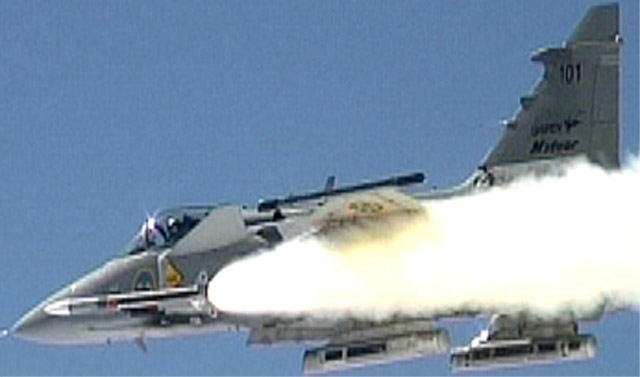
Gripen First Combat Fighter to Fire Meteor Missile

In cooperation with the Swedish Defence Materiel Administration (FMV), defence and security company Saab has successfully conducted the first test firing of the version of the Meteor radar-controlled air-to-air missile, developed for mass production.

Gripen is thus the first combat fighter system in the world with the capability to fire this version of the Meteor, which has been developed for Gripen, Eurofighter and Rafale.

At the end of June, the first two Meteor missiles in mass production configuration were fired for the first time from Gripen at a remote-controlled target. 
The test firing demonstrated separation from the aircraft and the link function between the aircraft and missile, as well as the missile's ability to lock in on the target. The test firing was also used to verify the command support that has been developed for the pilot.

“Testing has been completed as planned and we've now taken yet another important step in work with integration and development of Gripen C/D,” said Michael Östergren, FMV's project manager for the Meteor.

“I'm impressed with the results that we've jointly accomplished and it instills considerable confidence in continued work with integrating the Meteor on Gripen,” he added.

The Meteor is a BVRAAM (Beyond Visual Range Air-to-Air Missile) developed to enable engagement of airborne targets at long distances. The missile is the result of a European collaborative project involving Sweden, France, Italy, Spain, Germany and Great Britain.
Great Britainhas responsibility for contracts and work is led by UK’s defence procurement and support organisation - Defence Equipment and Support (DE&S).

“Once again it’s clear that Gripen is the leading combat fighter system with great opportunities for fast and cost-efficient continuous integration of new capabilities, such as weapons and sensors, thanks to our efficient way of working and Gripen’s innovative design. Gripen with the Saab PS05 radar and the Meteor missile represent the absolute best in the world when it comes to air defense,” said Lennart Sindahl, Head of Saab's business area Aeronautics.

The test team included representatives from Saab, FMV and British MBDA. During the autumn, additional tests will be conducted so that delivery of the new capabilities can be made during 2014.