Hiển thị các bài đăng có nhãn Aircrafts. Hiển thị tất cả bài đăng

Thứ Sáu, 5 tháng 7, 2013

Su-35 Capable of “Previously Unheard-of Manoeuvrability”- Test Pilot Bogdan

Sergey Bogdan, Hero of Russia and Sukhoi test pilot, who flew the Su-35 at the Paris Air Show, talks to Ogomyok about the aircraft and the state of aviation engineering in Russia.

The display sequence you flew in the Su-35 left the impression that the aircraft is weightless: it can stop in mid-air and descend in circles, sailing like a leaf on the wind. Is this fighter as easy to fly as it would appear from down below?

I love the Su-35, not least because I had the pleasure of being the first pilot to take it into the air. Its control system is awesome. In fighters of previous generations, as the aircraft loses airspeed its controllability often deteriorates, causing it to stall into a spin or inducing wing flow separation.

With the Su-35 you can forget about such problems. This aircraft can halt to a stop and slide down tail-first while fully responding to the pilot attitude inputs. The Su-35 is capable of previously unheard-of manoeuvrability.
Did you manage to fully demonstrate the fighter's potential at Le Bourget?
The Su-35's primary characteristics are impossible to demonstrate at an air show for obvious reasons. A fighter's primary advantage lies in its combat performance. Here are some figures for you: the Su-35 exceeds any other fourth-generation fighter in operational effectiveness by 40 percent. For a number of parameters it is 10 percent better than the [existing] fifth-generation fighters. The air forces of Malaysia and India regularly stage exercises involving Russian-made combat jets; our aircraft invariably come on top in all air-to-air combat scenarios.

Do you have gifted apprentices among test pilots?
There was a period when Russian military flying schools, including the most famed of them such as the Kacha and Borisoglebsk schools for pilots (I am a graduate of the latter), massively cut back on their cadet intake and dramatically reduced the flying hours. Making a truly high-class pilot requires some seven years of on-the-job training after graduation. It is also important to have a pool of flying officers to choose from because modern aircraft designs require talented pilots at the controls. 

As the commander of the Sukhoi's flight testing service I have been blessed with brilliant students. We have seven active pilots on the team; six of them are already current on the [T-50] fifth-generation fighter. The seventh has fallen behind somewhat owing to frequent field trips but he will catch up soon. Each of these men is capable of flying the sequence I demonstrated at Le Bourget.
Your flying career began in the 1990s, a very difficult period for Russia's economy. How did you manage to stay on in this trade?
I was plain lucky; I got enrolled with the test pilot school, which offered intensive flying despite the overall problems of the Russian Air Force. The workload was quite high: sometimes I would get to fly five different types in just one 6- to 7-hour shift. I still remember how difficult it was for me to do my first carrier landing, with the flight deck heaving and rolling under me.

In your opinion, which sectors of Russian aviation engineering require special attention?
Our fighter aviation is currently in top shape. It would be great if we could keep it at present level while stimulating the development of new aircraft designs. Our greatest concern is commercial aviation. When I see an Airbus A380 for example I wish this aircraft had been designed in Russia. We need to establish a presence in this critical niche because achievements in commercial aircraft construction are essential to a country's image in the international arena. 

Indrus

Thứ Tư, 3 tháng 7, 2013

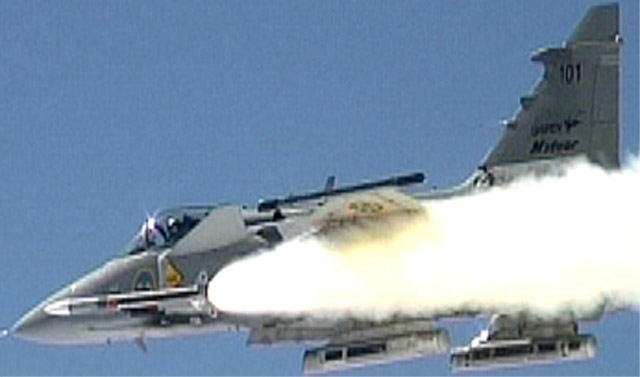
Gripen First Combat Fighter to Fire Meteor Missile

In cooperation with the Swedish Defence Materiel Administration (FMV), defence and security company Saab has successfully conducted the first test firing of the version of the Meteor radar-controlled air-to-air missile, developed for mass production.

Gripen is thus the first combat fighter system in the world with the capability to fire this version of the Meteor, which has been developed for Gripen, Eurofighter and Rafale.

At the end of June, the first two Meteor missiles in mass production configuration were fired for the first time from Gripen at a remote-controlled target. 
The test firing demonstrated separation from the aircraft and the link function between the aircraft and missile, as well as the missile's ability to lock in on the target. The test firing was also used to verify the command support that has been developed for the pilot.

“Testing has been completed as planned and we've now taken yet another important step in work with integration and development of Gripen C/D,” said Michael Östergren, FMV's project manager for the Meteor.

“I'm impressed with the results that we've jointly accomplished and it instills considerable confidence in continued work with integrating the Meteor on Gripen,” he added.

The Meteor is a BVRAAM (Beyond Visual Range Air-to-Air Missile) developed to enable engagement of airborne targets at long distances. The missile is the result of a European collaborative project involving Sweden, France, Italy, Spain, Germany and Great Britain.
Great Britainhas responsibility for contracts and work is led by UK’s defence procurement and support organisation - Defence Equipment and Support (DE&S).

“Once again it’s clear that Gripen is the leading combat fighter system with great opportunities for fast and cost-efficient continuous integration of new capabilities, such as weapons and sensors, thanks to our efficient way of working and Gripen’s innovative design. Gripen with the Saab PS05 radar and the Meteor missile represent the absolute best in the world when it comes to air defense,” said Lennart Sindahl, Head of Saab's business area Aeronautics.

The test team included representatives from Saab, FMV and British MBDA. During the autumn, additional tests will be conducted so that delivery of the new capabilities can be made during 2014.

Thứ Năm, 20 tháng 6, 2013

After 2 Years, BAE 'Close to Sealing Typhoons Deal'


Britain's BAE Systems, Europe's biggest defense company, reportedly expects to wrap up a price deal with Saudi Arabia for 72 Eurofighter Typhoon combat jets after two years of tortuous negotiations.

But with the Muslim holy month of Ramadan, during which the Arab world pretty much shuts down, beginning in early July, BAE may have to wait until August for a conclusion.

Another factor is the Saudi monarchy's human rights record, which has been criticized by British lawmakers in recent months amid hefty and persistent media coverage of allegations of corruption in Riyadh.

In May, the British newspaper The Guardian published documents released by Britain's court of appeal concerning allegations two Saudi princes were involved with a London company that allegedly facilitated money laundering for Hezbollah in Lebanon, an Iranian-backed movement designated a terrorist organization by the United States.

The two princes, who deny the allegations linking them to a sworn enemy of the Saudi monarchy, had sought to obtain a court ruling of sovereign immunity that would have blocked publication of the documents.

In another case, a prominent member of the Saudi royal family is at the center of a U.S. criminal investigation into whether Barclays, a leading British bank, made improper payments in the kingdom, apparently involving a son of King Abdullah.

The Saudis agreed to buy 72 Typhoons in 2007 with a reputed price tag of $8.6 billion.

BAE was secretive about the price details and admitted in December 2012 the delays in completing negotiations on the so-called Salaam Program were depressing its year-end earnings.

The first 24 were delivered in 2012 and 48 more were supposed to be assembled in Saudi Arabia, which is striving to develop a defense industry of its own.
But Riyadh decided to continue having the Typhoons assembled at BAE's facility in the United Kingdom and to upgrade the last 24 aircraft it ordered with the latest technology.

This altered the pricing process, and made the contract more valuable.

But BAE's expectations the Saudis would sign up to the price changes as well as the general inflation in prices the project had already absorbed were soon dashed.

That came hard on the heels of the October collapse of a proposed $40 billion merger with EADS, the Franco-German builder of the Airbus and Europe's aerospace giant.

British Prime Minister David Cameron, who has aggressively pushed British arms exports, visited Riyadh in November 2012 to press the Saudis to finalize the 2007 Typhoon deal.

There have been reports the kingdom is interested in buying 48- to 72 more Tranche 3 Typhoons, a deal that would be worth $7.3 billion to $11.2 billion.

The Eurofighter consortium comprises BAE, EADS and Finmeccanica of Italy, but BAE takes the lead in marketing in the gulf where Britain was the dominant power until 1972 when it reduced its military presence east of the Suez.

However, the Saudis are committed to buying 84 Boeing F-15S Eagles and dozens of helicopters from Boeing and Sikorsky Aircraft, a division of United Technologies Corp., for $33.4 billion as part of a massive U.S. arms package to counter Iran.

BAE concluded a $4.07 billion contract with the Persian Gulf sultanate of Oman in December to buy 12 Typhoons and eight Hawk advanced jet trainers starting in 2017.

That deal got BAE out of the hole, helping to safeguard some 6,000 jobs in the United Kingdom after the EADS merger plan fell through, largely because of German opposition, that would have sheltered the defense titan from the effects of shrinking defense budgets in the United States and Europe.

Meantime, the negotiations with the Saudis dragged on and BAE's delivery rate of the Typhoons slowed to nearly zero, with only two of the jets reaching in the kingdom in more than a year.

Deliveries are now back on track, raising expectations of a conclusion to the complex pricing problem.

There are plans to establish a maintenance and upgrade facility in Saudi Arabia, but BAE executives have their eyes on the ultimate prize: that the kingdom will double its Typhoon order.

UPI

Pogosyan sees market for 200 Su-35s


The mighty Sukhoi Su-35 lancing through the Le Bourget sky this week is just the beginning of the type's international exposure, according to Mikhail Pogosyan.

The head of Sukhoi's parent company, United Aircraft, is forecasting 200 sales of the type, split 50:50 between domestic and export. There are 48 currently on order so far by the Russian military and Pogosyan is eyeing 100 export sales, which should come from existing customers of Sukhoi or MiG jets.

Overall, UAC - the holding company umbrella under which the former Soviet fixed-wing aircraft industry has been consolidated - has stacked up an orderbook worth €25 billion ($33 billion), for 740 aircraft. About one-third of those orders are for civil types, including the Sukhoi Superjet 100, which made its Western-livery debut in the colours of Mexico's Interjet at Paris on Tuesday.
But while three years ago UAC's output was 95% military, today that figure is down to 85% - and Pogosyan expects civil-side growth will see it turning out equal numbers of military and civil aircraft by 2025. This year's output will be 70 military and 40 civil aircraft.

"Civil aircraft production rates have tripled in the last year alone," he says.

Last year's revenue of €4.5 billion was twice that in 2007, and Pogosyan expects sales to reach €7.5 billion in 2015 with the production of 200 aircraft, before doubling, to €15 billion in 2020.

UAC's consolidation of the Russian industry is continuing, with forthcoming mergers of Tupolev and KAPO, and of NAZ Sokol and MiG, says Pogosyan.

Flight Global

Thứ Ba, 18 tháng 6, 2013

Alenia Unveils New Trainer Aircraft

PARIS — Italy’s Alenia Aermacchi presented a new basic-advanced jet trainer on Tuesday — the M-345 HET — that it claims will cost less than a turbo prop to buy and cost the same to run.

Aermacchi's M-345 High Efficiency Trainer
Alenia Aermacchi's M-345 High Efficiency Trainer at the Paris Air Show. (Alenia Aermacchi)

The presentation at the Paris Air Show coincided with the signing by CEO Giuseppe Giordo of a letter of intent with Italy’s procurement chief to jointly develop the trainer, with a possible entry into service with the Italian Air Force between 2017 and 2020.

The M-345 represents an upgrade to its planned, but never built, M-311 trainer, which in turn was a development of the S-211, sold to the Philippines. The new upgrade, which is dubbed the High Efficiency Trainer (HET) and will have a new engine, was on display at the Paris Air Show.

The new aircraft will fly with a 1,600-kilogram thrust engine, a heads-up display and embedded tactical training simulation.

The aircraft is being developed to replace the Italian Air Force’s MB-339 jet trainer, and to serve as the lead up to Alenia Aermacchi’s M-346 trainer, which the Air Force has already acquired.

Giordo said development would cost less than US $100 million and take two years. “There is a limited amount of money and we must respect the schedule,” he said.

Apart from being designed to replaced the MB-339, the M-345 HET will be pitched at air forces replacing first generation Hawks, the Alpha Jet and the L-39 Albatros, a spokesman said.

“Air forces are tending to replace these aircraft with turboprops, but we believe the M-345 will be cheaper and offer the same operating costs,” he said.

Giordo said he predicted a global market of 200 aircraft.

The spokesman also claimed the new, low cost jet could find favor with the French Air Force as it seeks to create a two-tier training system.

“This is perfect for France’s possible need for a trainer, which they they have said could be a turbo prop, in a two-tier system,” he said.

Separately, Giordo said Alenia Aermacchi is not interested in building basic, screener trainers. “We believe such a product must be very lost cost, less than €150,000 (US $200,000), and Alenia Aermacchi cannot afford to produce such a product,” he said. ■

Alenia Aermacchi's M-345 High Efficiency Trainer

Defense News

Thứ Hai, 17 tháng 6, 2013

Paris Air Show 2013: Amazing aircraft aerobatics high above France

A Fouga Magister airplane is performing at the Paris Air Show 2013 at Le Bourget, France, 17 June 2013. France is celebrating its 50th International Paris Air Show, which will take place form 17 to 23 June 2013.

A French Rafale fighter airplane is performing at the Paris Air Show 2013 at Le Bourget, France, 17 June 2013. France is celebrating its 50th International Paris Air Show, which will take place form 17 to 23 June 2013.

An Airbus A 380 (L) aircraft flies over Le Bourget airport on June 17, 2013 on the opening day of the International Paris Air show.

Two French 'Tigre' helicopters fly over Le Bourget airport on June 17, 2013, north of Paris, on the opening day of the International Paris Air show which will be held until June 23, 2013.

A Russian Airplane ANTOHOB 70 is performing at the Paris Air Show 2013 at Le Bourget, France, 17 June 2013. France is celebrating its 50th International Paris Air Show, which will takes from 17 to 23 June 2013.

An Airbus A400M military aircraft followed by Alphajet planes from the Patrouille de France (France's Patrol) are seen during a flying display, during the opening of the 50th Paris Air Show, at the Le Bourget airport near Paris June 17, 2013. The Paris Air Show runs from June 17 to 23.

An accrobatic plane performs over Le Bourget airport on June 17, 2013 on the opening day of the International Paris Air show.

Russian air force Sukhoi su-139 fighters take off during a performance at the presentation Paris Air Show in le Bourget, North of Paris, Sunday, June 16, 2013. The Paris Air Show will open on June 17 at Le Bourget.

France's A400M, Airbus Military paratroopers performs during the presentation Paris Air Show in le Bourget, North of Paris, Sunday, June 16, 2013. The Paris Air Show will open on June 17 at Le Bourget.

The Russian-made Sukhoi SU-35 military jet lands after its preparation flying display at Le Bourget on June 16, 2013 on the eve of the opening of the International Paris Air show.

A Boeing 787 Dreamliner flies during a preparation routine at Le Bourget on June 14, 2013. The Paris Air show will open on June 17, 2013.

A Sukhoi SU-35 fighter takes off during a flying display, one day before the 50th Paris Air Show, at the Le Bourget airport near Paris, June 16, 2013. The Paris Air Show runs from June 17 to 23.

A Sukhoi Su-35 fighter with special vectored thrust jet engines takes part in a flying display, two days before the Paris Air Show, at the Le Bourget airport near Paris, June 15, 2013. The Paris Air Show runs from June 17 to 23.

An Air India Airlines Boeing 787 dreamliner takes part in a flying display during the 50th Paris Air Show at the Le Bourget airport near Paris, June 14, 2013. The Paris Air Show runs from June 17 to 23.

French Prime Minister Jean-Marc Ayrault (C), Defence minister Jean-Yves Le Drian (R) and National Assembly speaker Claude Bartolone attend airplanes demonstrations at the opening of the 50th Paris Air Show, at the Le Bourget airport near Paris, June 17, 2013.

NY Daily News

Russia to Display Yak-130 Combat Trainer at Paris Air Show


(RIA Novosti) - Russia will display its Yakovlev Yak-130 Mitten combat trainer, Sukhoi Su-35 Flanker-E multirole fighter and Kamov Ka-52 Hokum B attack helicopter at the Paris Air Show, the Federal Service for Military and Technical Cooperation reported Monday.

Sukhoi Su-35 multirole fighter

The Paris Air Show is an international event taking place every odd year at Le Bourget Airport in the French capital Paris. This year, it will be held June 17-23.

Kamov Ka-52 Hokum B attack helicopter

The Russian delegation to the show will be led by the head of the Federal Service for Military and Technical Cooperation, Alexander Fomin.


Yak-130 is an advanced pilot training aircraft, able to replicate characteristics of Russian 4+ generation fighters, as well as the Sukhoi T-50 fifth generation fighter. Combat training suite on the Yak-130 includes simulated and real firing systems with air-to-air and air-to-surface missiles, bomb dropping, gun firing and on-board self-protection systems.

RIA Novosti

Thứ Ba, 11 tháng 6, 2013

F-35 Launches First Air To Air Missile; Concurrency Costs Plunge $500 Million

The F-35A launched the AMRAAM missile on Wednesday (it can take the Pentagon a while to clear even good news for release)

WASHINGTON: It’s been a tough week for critics of the F-35. Concurrency costs dropped an impressive half billion dollars — note to Winslow Wheeler — and the Air Force version launched an air to air missile for the first time.

The F-35A launched the AMRAAM missile on Wednesday (it can take the Pentagon a while to clear even good news for release).


Here’s how a statement described the event this afternoon:

“This is the first launch where the F-35 and AIM-120 demonstrated a successful launch-to-eject communications sequence and fired the rocket motor after launch – paving the way for targeted launches later this year in support of Block 2B fleet release capability,” the Joint Program Office said.

Block 2B refers to the software that will allow the plane to fly and fight with many of its weapons, though not all.

You can read the report and enjoy its graph — clearly designed for economists and engineers — here: F-35 Concurrency Costs RTC_May 2013.

As the report notes, the Pentagon and Lockheed Martin are monitoring concurrency costs closely. In the sixth Low Rate Initial Production (LRIP 6) contract the Pentagon pushed Lockheed to bear the pain equally with the Defense Department on all changes “discovered prior to beginning of production” of that lot. The goal is to “”encourage” Lockheed to work on concurrency changes into production as quickly as possible “to avoid cost sharing.” that will continue through the rest of the program, the report says.

Our friend Winslow Wheeler, offered a different perspective.

“DOD now claims that the added unit costs of fixes to concurrency screw ups is now $500 million less than was predicted earlier, even if those costs are unknown and will remain so until the end of initial OT&E in 2019 and operational flying thereafter,” he said in an email. “If Congress tries to take this $500 million out of the program without also removing airplanes, watch ‘em howl.”

Here is a breakdown of the 36 planes included in LRIP 6:

United States

18 F-35A CTOL for the U.S. Air Force

6 F-35B STOVL for the U.S. Marine Corps

o7 F-35C CV for the U.S. Navy

International

3 F-35A CTOL for Italy

2 F-35A CTOL for Australia

F-35 Concurrency Costs RTC_May 2013

China will buy more than 24 Su-35 fighters from Russia: source

China has sent a delegation to Moscow following the purchase of 24 Su-35BM fighters from Russia last year for an estimated US$1.5 billion, reports the Russian Military News Network.

A Russian Su-35 fighter. (Internet photo)

The Chinese delegation is currently visiting the Russian capital to discuss details concerning the Su-35 contract with various Russian organizations including Russia's state-run arms exporter Rosoboronexport, the United Aircraft Corporation and Sukhoi Company.

Sources within Rosoboronexport told the network that China will in fact purchase more than the reported 24 Su-35 fighters. However, neither Rosoboronexport nor Sukhoi Company — Russia's largest aircraft holding company — have released official statements confirming the sales.

Vyacheslav Dzirkaln, the deputy director of Russia's Federal Service for Military and Technical Cooperation, said that an official contract has already been signed early this year for Russia to provide the aircraft to China. Dzirkaln also added that China has yet to receive permission to produce its own version of the fighter.

Military sources said that the Su-35 is the best fighter currently available and while the Chinese delegation discusses the details of the contract with their Russian counterparts, it is believed that the political decision to sell more of the aircraft to Beijing had already been made, the Russian Military News Network said.

Want China Times

Thứ Hai, 10 tháng 6, 2013

Lockheed Offers to Upgrade T-50 with Air Refueling Technology

The Korea Aerospace Industries (KAI) said Thursday that it is in talks with Lockheed Martin for the transfer of in-flight refueling technology for the T-50 Golden Eagle.

The US Air Force released a set of requirements to replace T-38 trainer : sufficient endurance for visual range dog-fighting; make dry contact with an aerial refueling tanker; and have radars, data-links, radar-warning receivers, situational awareness displays and a full glass-cockpit. (photo : kaskus militer)

KAI, which developed the supersonic trainer with the U.S. defense firm, said the move is aimed at winning a U.S. Air Force contract to replace the long-serving Northrop T-38C Talon with new trainers.

“To win the $10 billion U.S. Air Force deal, we need to meet its requirements for a next-generation trainer. That means that upgrades are necessary for the T-50,” a KAI official said.

“The most important of these is in-flight refueling. We are discussing the issue plus the sharing of the $10 million cost with Lockheed Martin.”

The U.S. Air Force released a set of requirements for its prospective jet trainer project, procurement of which will commence next year and finish in 2016.

It might need as many as 350 aircraft to replace the T-38s, which is used for pilot training and an introduction to basic fighter techniques.

Included in the key requirements are sufficient endurance for visual range dog-fighting; make dry contact with an aerial refueling tanker; and have radars, data-links, radar-warning receivers, situational awareness displays and a full glass-cockpit.

Among them, air-to-air refueling is one of the most important functions as it enables aircraft to remain airborne longer.

It also allows fighters to take off with a greater payload, because they can carry less fuel during takeoff and top up once airborne.

KAI is desperate to win the contract, which it believes will pave the way for more deals overseas; and Lockheed Martin also sees the T-50 as well-suited to meet the requirements.

In a roundtable meeting between President Park Geun-hye and U.S. business representatives in Washington last week, Lockheed Martin Chairman Marillyn Hewson promised to promote the T-50.

“As Lockheed Martin invested in the production of the T-50, the company said that it will help KAI win the U.S. Air Force’s trainer procurement project,” Park’s senior secretary for economic affairs Cho Won-dong told reporters after the meeting.

KAI started to make the advanced trainer in the late 1990s with its maiden flight taking place in 2002. It entered active service with the Korean Air Force in the mid-2000s.

The company’s attempts to export the T-50 have been to little avail excluding a small sale to Indonesia.

Lockheed Martin paid some $300 million of the development costs, approximately 17 percent of the total. If KAI exports the T-50, the U.S. firm will receive royalty payments on each plane sold.

Plus, if the T-50 is chosen, it will be manufactured in the U.S. That means that Lockheed Martin will take charge of providing a substantial proportion of major components.

Korea Times

Thứ Bảy, 8 tháng 6, 2013

Mikoyan Gurevich MiG-21 Fishbed: Its Main Variant and Offspring

The famous Mig-21 Fishbed has been around since 1950′s with the Soviet Russia studying the swept wing concept through the production of Ye-1 and Ye-2 prototypes. Nevertheless, they turn to the delta wing concept which happens to be a winning design that resulted 11,496 Fishbeds being used by 66 operators around the globe not including 2,400 Chengdu J-7 Airguard, a Chinese made Mig-21 operated by 15 nations across the world.

Mig Ye-2

Mig Ye-2

CU2771 Mikoyan-Gurevich MiG-21PF

Being one of the most numerous and widely operated jet fighter means that the Fishbed has been in action in almost all conflicts around the world including the Vietnam War, the Arab-Israel War, the Iran-Iraq War, the Gulf War and many more.

Throughout its 60 years of history it has spawned several main variants as well as designs being derived from the aircraft. Later production of the J-7 resulted the introduction of double delta wing fighter just like the F-7PG operated by the Pakistani AF. China has also further developed the Shenyang J-8 Finback (including J-8II) and the Nanchang J-12 which is based on the Mig-21/J-7 design.

F-7PG with double delta wing

F-7PG Airgurad with double delta wing

J-8 Finback

J-8 Finback

J-8B (II) Finback

J-8B (II) Finback

Nanchang J-12

Nanchang J-12

Its future carrier based advance trainer the Guizhou FTC-2000/ JL-9 is being developed from a two seat version of the JJ-7/Mig-21U Mongol trainer. A further development of the J-7, thanks to a brief cooperation between Chengdu and Grumman led to the Super 7 project. Despite Grumman withdrawal, the Super 7 project pressed on and became the FC-1/ JF-17 Thunder fighters which are currently in service with the Pakistani AF.

JJ-7 Mongol

JJ-7 Mongol

JF-17 Thunder

JF-17 Thunder

JL-9

Guizhou JL-9

India is also one of the operators of the Mig-21 Fishbed. In fact, the Hindustan Aeronautics Ltd (HAL) has been producing the Mig-21 FL/M/Bis/Bison under license since 1966, an experience which led to the indigenous HAL Tejas LCA project.

HAL Tejas LCA

HAL Tejas LCA

The Soviet has also come up with unique variant of the Mig-21. The Mig-21 Analog for example is an instrumental test variant which contributed to the Soviet’s Super Sonic Transport (SST) program. As a result of the program, a copy of the famed Concorde jetliner known as the Tupolev Tu-144 Concordski was rolled out.

Mig-21 Analog

Mig-21 Analog

The Mig 1.44 prototype is also thought to be based from Mig-21.

E-8_111


http://malaysiaflyingherald.wordpress.com/2013/06/07/mikoyan-gurevich-mig-21-fishbed-its-main-variant-and-offspring/

Thứ Sáu, 7 tháng 6, 2013

F-35A completes 1st in-flight missile launch

EDWARDS AIR FORCE BASE, Calif. (AFNS) -- An F-35A conventional takeoff and landing aircraft completed the first in-flight missile launch of an AIM-120 over the Point Mugu Sea Test Range, June 5.

An F-35A conventional takeoff and landing aircraft completed the first in-flight missile launch of an AIM-120 over the Point Mugu Sea Test Range, June 5

It was the first launch where the F-35 and AIM-120 demonstrated a successful launch-to-eject communications sequence and fired the rocket motor after launch -- paving the way for targeted launches in support of the Block 2B fleet release capability later this year.

The Air Force F-35A variant has seen significant development in training and operations recently including the beginning of pilot training at Eglin Air Force Base, Fla., the delivery of the first operational test aircraft to Edwards and Nellis Air Force Base, Nev., the first operational aerial refueling and the completion of high angle of attack testing.

"It's a testament to the entire military-industry test team," said Lt. Col. George "Boxer" Schwartz, F-35 Integrated Test Force director, who also piloted the flight. "They've worked thousands and thousands of hours to get to the point where we are today. It's fantastic to see that it's all paid off. We're rolling into a lot of additional weapons work in the coming months to put that expanded capability on the aircraft."

The F-35A 5th Generation fighter is designed to carry a payload of up to 18,000 pounds using 10 weapon stations. The F-35A features four internal weapon stations located in two weapon bays to maximize stealth capability. The CTOL aircraft can also utilize an additional three external weapon stations per wing if required.

The U.S. Air Force has established an F-35A initial operating capability target date of December 2016. By this date, the Air Force will have fielded an operational squadron with at least 12 aircraft along with Airmen trained and equipped to conduct basic close air support, interdiction and limited suppression, and destruction of enemy air defense operations in a contested environment.

Moving into the active phase of weapons test is another large step toward delivering Block 2B software capability that will enable initial combat deployment.

"We've spent years working on the design of the aircraft, and many months ensuring that weapons could be contained within the aircraft and dropped as designed," said Charlie Wagner, F-35 weapons director. "This event is the result of tremendous effort and collaboration in the F-35 Enterprise, and marks a turning point in F-35 capabilities; the AIM-120 launch is one small but critical increment toward proving combat capability,"

The 5th generation F-35 Lightning II combines advanced stealth with fighter speed and agility, fully fused sensor information, network-enabled operations and advanced sustainment. Three distinct variants of the F-35 will replace the A-10 and F-16 for the U.S. Air Force, the F/A-18 for the U.S. Navy, the F/A-18 and AV-8B Harrier for the U.S. Marine Corps, and a variety of fighters for other countries.

(Courtesy F-35 Program Office)

US Air Force

Thứ Bảy, 25 tháng 5, 2013

American Weapons Packages For South Korean Fighter Aircraft Revealed

F-15 Silent Eagle

As obligated to do, the Defense Security Cooperation Agency (DSCA) has notified the United States Congress of a possible Foreign Military Sale to South Korea.

The two weapons packages are associated with Boeing's F-15 Silent Eagle and Lockheed Martin F-35, both are which are competing to win South Korea's competition for 60 new fighter aircraft.

In the case of the F-15 Silent Eagle, the package consists of:
  • 274 AIM-120C-7 Advanced Medium Range Air-to-Air Missiles (AMRAAM)
  • 6 AIM-120C-7 AMRAAM Guidance Sections 
  • 362 Joint Direct Attack Munition (JDAM) Tail Kits, BLU-109/KMU-557C/B (GBU-31) w/SAASM/AJ 
  • 780 JDAM Tail Kits, MK-82/BLU-111 KMU572C/B (GBU-38) w/SAASM/AJ 
  • 6 MK-82 Filled, Inert Bombs 
  • 170 JDAM Tail Kits, MK-84/BLU-117 KMU-556C/B (GBU-31) w/SAASM/AJ
  • 1312 FMU-152A/B Fuzes (FZU-63 Initiator) 
  • 542 GBU-39/B Small Diameter Bombs 
  • 170 BLU-117 2000LB General Purpose Bombs 
  • 362 BLU-109 2000LB Penetrators 
  • 4 BLU-109 Inert Bombs 
  • 154 AIM-9X-2 (Blk II) Tactical Missiles w/DSU-41 
  • 33 CATM AIM-9X-2 (Blk II) Captive Air Training Missiles 
  • 7 AIM-9X-2 (Blk II) C ATM Guidance Units 
  • 14 AIM-9X-2 (Blk II) Tactical Guidance Units
The package for the F-35 consists of:
  • 274 AIM-120C-7 Advanced Medium Range Air-to-Air Missiles (AMRAAM) 
  • 6 AIM-120C-7 AMRAAM Guidance Sections 
  • 530 Joint Direct Attack Munition (JDAM) Tail Kits, BLU-109/KMU-557C/B (GBU-31) w/SAASM/AJ 
  • 4 JDAM BLU-109 Load Build Trainers 
  • 6 MK-82 Filled Inert Bombs 
  • 4 BLU-109 Inert Bombs 
  • 1312 FMU-152A/B Fuzes (FZU-63 Initiator) 
  • 542 GBU-39/B Small Diameter Bombs 
  • 530 BLU-109 2000LB Penetrators 
  • 780 GBU-12 Bombs 
  • 4 GBU-12 Dummy Trainers 
  • 154 AIM-9X-2 (Blk II) Tactical Missiles w/DSU-41 
  • 33 AIM-9X-2 (Blk II) Captive Air Training Missiles (CATM) 
  • 7 AIM-9X-2 (Blk II) CATM Guidance Units 
  • 14 AIM 9X- 2 (Blk II) Tactical Guidance Units
The package for the F-15 is worth $823 million and for the F-35 is worth $793 million. The price in both cases includes:
  • containers
  • missile support and test equipment
  • provisioning, 
  • spare and repair parts
  • support equipment
  • personnel training and training equipment
  • technical documentation
  • engineering and technical support
  • other related elements of program support

The F-15 and F-35 are competing against the Eurofighter Typhoon in South Korea, which is expected to select which of the 3 is the winner as early as June of 2013.


http://www.dsca.mil/pressreleases/36-b/2013/Korea_13-22.pdf

http://www.dsca.mil/pressreleases/36-b/2013/Korea_13-24.pdf

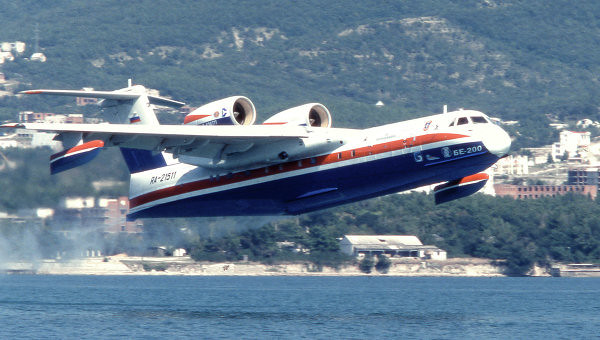
Russian Military Orders 6 Be-200 Amphibious Planes


MOSCOW, May 24 (RIA Novosti) – The Russian Defense Ministry has signed a contract with the Beriev Aircraft Company for the purchase of six Beriev Be-200 amphibious planes, Russia’s United Aircraft Corporation (UAC) said on Friday.

“The contract is worth 8.4 billion rubles [$268 million],” UAC said in a statement.

“The first two planes will be basic Be-200ChS models, while the following four will be the Be-200PS version without firefighting equipment,” the statement said.

It is the first purchase of Be-200 planes by the Russian military.

The Defense Ministry may order eight more planes in the future, according to UAC.

Be-200 is the world's largest multipurpose amphibious aircraft, designed for firefighting, search and rescue, maritime patrol, cargo and passenger transportation.

The plane can carry 12 tons of water or 7.5 tons of cargo, or up to 72 passengers.

At least five Be-200ChS firefighting planes are currently in service with the Russian Emergencies Ministry.


RIA Novosti