Hiển thị các bài đăng có nhãn Indian Navy. Hiển thị tất cả bài đăng

Thứ Hai, 8 tháng 7, 2013

Indian Navy set to launch aircraft carrier in next five years


India will be operating two new aircraft carriers within the next five years, if all goes according to plan.

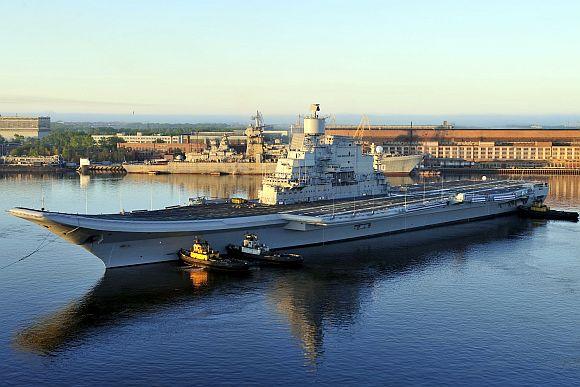
After much delay, the Indigenous Aircraft Carrier (IAC), being built in Cochin, is ready for its launch on August 12. At the same time, the second carrier, INS Vikramaditya, will be undergoing extensive final sea trials in Russia.

While Vikramaditya should join the navy in early 2014, the aircraft carrier would take another three years. The 40,000-tonne aircraft carrier will cross a major development milestone when the ship would be launched by defence minister A.K. Antony, marking the end of the first phase of construction.

INS Vikramaditya
INS Vikramaditya

The launch would mean that the ship would be out of dry dock after completion of work related to fitting all underwater equipment like engines, gear box, shafting and diesel alternators. The construction of the complex warship was undertaken in two phases. The first phase, with a hiked budget of around Rs.3,000 crore, was originally scheduled to end in 2011 but delays in procuring good quality steel and an accident involving gear boxes unsettled the timeline.

Price negotiations for the second phase are underway and it is estimated to cost around the same. The final ship is not expected to be more than `8,000 crore making it probably the cheapest aircraft carrier in the world. Sources in the shipyard said some of the work from phase-II has already started and it is estimated that in two years the ship would be 90 per cent complete.

The navy for long has hoped to operate two carrier battle groups. An aircraft carrier moves with around six to the ship is only ready from the front to the rear with its full length complete and sealed. The Cochin shipyard was specially prepared for construction of big ships. Goliath cranes were provided at the shipyard to pick up large blocks for modular construction.

Despite the delays, the construction of an indigenous carrier is a major boost to country's ship-building capabilities. At the moment, 46 of 47 new naval warships are being built in domestic shipyards. Stealth frigate INS Trikand, which was commissioned in Russia, was the last ship ordered from abroad. Now only the delivery of INS Vikramaditya is awaited.


http://indiatoday.intoday.in/story/indian-navy-set-to-launch-aircraft-carrier-indigenous-aircraft-carrier/1/287400.html

Thứ Tư, 3 tháng 7, 2013

Russia Hands Over New Stealth Frigate to India

Russia has delivered the last in a series of three frigates built for the Indian Navy, state-run arms exporter Rosoboronexport said.

Trikand missile frigate

The Trikand missile frigate was handed over to the Indian crew at the Yantar shipyard in the Baltic exclave of Kaliningrad on Monday.

“During the ceremony, the Russian and Indian officials signed an acceptance act, and an Indian navy flag was hoisted on the ship,” Rosoboronexport said in a statement.

Russia and India signed a $1.6 billion contract on the construction of three modified Krivak III class (also known as Talwar class) guided missile frigates for India in 2006.

The first frigate, INS Teg, joined the Indian Navy on April 27, 2012, while the second, INS Tarkash, arrived at the port of Mumbai in India on December 30, 2012.

The frigates are each armed with eight BrahMos supersonic cruise missiles, jointly developed by Russia and India.

They are also equipped with a 100-mm gun, a Shtil surface-to-air missile system, two Kashtan air-defense gun/missile systems, two twin 533-mm torpedo launchers and an antisubmarine warfare (ASW) helicopter.
Russia built three Talwar class frigates for India - INS Talwar (Sword), INS Trishul (Trident), and INS Tabar (Axe) under a previous contract.

RIA Novosti

Thứ Hai, 1 tháng 7, 2013

India inducts new power-packed stealth frigate INS Trikand

NEW DELHI: In tune with its operational drive to turn "stealthy" because surprise and deception are crucial in modern-day warfare, the Navy inducted its latest guided-missile stealth frigate INS Trikand on Saturday.

Guided-missile stealth frigate INS Trikand

INS Trikand is the last of the six stealth frigates ordered from Russia. The Navy had earlier inducted three 4,000-tonne Talwar-class stealth frigates ( Talwar, Trishul and Tabar) from Russia in 2003-2004.

Then, impressed by the punch the frigates packed, India ordered another three (Teg, Tarkash and Trikand) under a $1.15 billion contract inked in 2006.

On Saturday, Navy vice chief Vice admiral R K Dhowan commissioned INS Trikand at a ceremony at Kaliningrad in Russia, which was also attended by the Indian ambassador Ajai Malhotra and other top Indian and Russian officials.

"Her sister ships INS Teg and INS Tarkash were commissioned last year and are now undertaking operations as part of the Western Fleet," said an officer. INS Trikand carries a state-of-the-art combat suite, which includes the supersonic 290-km BrahMos missile system, Shtil advanced surface-to-air missiles, an upgraded A-190 medium range gun, an electro-optical 30-mm close-in weapon system, anti-submarine weapons such as torpedoes and rockets and an advanced electronic warfare system.

"The weapons and sensors are integrated through a combat management system 'Trebovanie-M', which enables the ship to simultaneously neutralise multiple surface, sub-surface and air threats," said the officer.

The ship also incorporates "innovative" features to reduce its radar, magnetic and acoustic "signatures" to ensure it is relatively difficult to detect by enemy radars. Powered by four gas turbines, the frigate is capable of speeds in excess of 30 knots. "The ship, commanded by Captain Ajay Kochhar with a crew of 300 officers and sailors, can also carry an integrated Kamov-31 helicopter suited for airborne early warning roles," he said.

India, of course, is also building its own stealth frigates. Three Shivalik-class frigates, built at Mazagon Docks (MDL), have already been inducted by the Navy. Then, there is an over Rs 50,000 crore plan on the anvil to construct seven advanced stealth frigates, with all weapon and missile systems under the hull for a lower radar "signature", in a programme called Project-17A.

The project will be shared between MDL at Mumbai and Garden Reach Shipbuilders and Engineers (GRSE) at Kolkata.

The Times Of India

Thứ Bảy, 22 tháng 6, 2013

Indian Navy releases RfI for ASW protection system

The Indian Navy is seeking to procure an integrated anti-submarine defensive suite (IADS) from an Indian vendor, according to a request for information (RfI) issued by the navy's Directorate of Staff Requirements.

The IADS is envisaged to be a fully integrated system with a towed array sonar, anti-torpedo decoy system and associated fire control system.

The RfI's publication suggests that an earlier tender for a similar towed array sonar has been cancelled. It states the system should be capable of simultaneous active and passive operations in both littoral and deep waters to detect submarines and the automatic detection of torpedoes while searching, classifying and tracking submarine contacts in a 360° azimuth.

Jane's

Thứ Hai, 17 tháng 6, 2013

Indian Navy plans unmanned aircraft to tackle piracy

KOCHI: The Indian Navy is mooting deployment of unmanned surface and sub-surface vehicles to strengthen its anti-piracy operations. The Navy has submitted its qualitative requirements for a ship-track-and-trail vehicle to the Vizag-based Naval Science and Technological Laboratory ( NSTL) for "tackling non-state threats and players".

GULL 36 Seaplane UAV
For illustration. GULL 36 Seaplane UAV

GULL 36 Seaplane UAV begins English Channel flights

The move is to develop an unmanned vehicle that can be deployed from a naval ship to recce waters in an operational area for suspicious movement and presence of hostile elements. "Navy's idea is to develop an unmanned seaplane type of vehicle. They want it to do aerial as well as sea-surface surveillance," a senior defence source told TOI.

The naval staff qualitative requirement (NSQR), a mandatory expression of interest that precedes any defence development or procurement programme, wants the vehicle to have an endurance of eight hours. "Two types are being designed. One will be a smaller version weighing 1.5 tonne and the second one weighing five tonne. The latter obviously will be able to carry more payload for reconnaissance,'' sources said.

The Indian Navy's initiative is based on the success of unmanned operations of US and Israeli navies. "These vehicles can direct the ship to the exact area where pirates wait for an assault. This would add power to the first strike capability," sources said.

Times of India

Thứ Năm, 30 tháng 5, 2013

Indian Navy eyes high-tech options for future aircraft carriers

General Atomics briefs navy on magnetic catapult that launches unmanned fighters

INS VIKRAMADITYA

The Indian Navy --- one of just nine navies that operate aircraft carriers --- is thinking high-tech in planning its second indigenous aircraft carrier, INS Vishal. The admirals are deciding whether INS Vishal, still only a concept, should launch aircraft from its deck using a technology so advanced that it is not yet in service anywhere: the Electro-Magnetic Aircraft Launch System (EMALS).

Getting a fully loaded combat aircraft airborne off a short, 200-metre-long deck is a key challenge in aircraft carrier operations. The INS Viraat, currently India’s only aircraft carrier, uses Short Take Off and Vertical Landing (STOVL) since its Harrier “jump-jets” take off and land almost like helicopters. INS Vikramaditya, which Russia will deliver this year, uses Short Take Off But Arrested Recovery (STOBAR). The Vikramaditya’s MiG-29K fighters will fly off an inclined ramp called a “ski-jump”; and land with the help of arrester wires laid across the deck, which snag on a hook on the fighter’s tail, literally dragging it to a halt. This system will also be used on the first indigenous aircraft carrier, INS Vikrant, which Cochin Shipyard plans to deliver by 2017.

But INS Vishal, which will follow the Vikrant, might employ a third technique that India has never used --- Catapult Assisted Take Off But Arrested Recovery, or CATOBAR. Perfected by the US Navy since World War II, this has a steam-driven piston system along the flight deck “catapulting” the aircraft to 200 kilometres per hour, fast enough to get airborne. With greater steam pressure, significantly heavier aircraft can be launched. US Navy carriers launch the E-2D Hawkeye, a lumbering Airborne Early Warning (AEW) aircraft that scans airspace over hundreds of kilometres.

EMALS, the new-generation catapult that the Indian Navy is evaluating, uses a powerful electro-magnetic field instead of steam. Developed by General Atomics, America’s largest privately held defence contractor, EMALS has been chosen by the US Department of Defence for its new-generation aircraft carriers. The first EMALS-equipped carrier, the USS Gerald R Ford, will enter service by 2016.

In Delhi Last Thursday, General Atomics briefed thirty Indian Navy captains and admirals on EMALS. Scott Forney III, the senior General Atomics official who conducted the briefing, told Business Standard that tight US controls over this guarded technology required special permission from Washington for sharing technical details of EMALS with India.

Senior Indian naval planners tell Business Standard that INS Vikrant, India’s next 40,000 tonne aircraft carrier, will use STOBAR to operate its complement of MiG-29K and Tejas light fighters. But Vikrant’s successor, the 65,000 tonne INS Vishal could well be a CATOBAR carrier that launches larger and more diverse aircraft.

“While current fighters like the MiG-29K can operate with STOBAR systems, our options will increase with CATOBAR. We could operate heavier fighters, AEW aircraft and, crucially, UCAVs (unmanned combat air vehicles). A UCAV would require a CATOBAR system for launch,” says one admiral.

The navy is closely following UCAV development in India and abroad. On May 14, the X-47B UCAV that Northrop Grumman is developing for the US Navy became the first UCAV to be catapulted off an aircraft carrier, the USS George HW Bush.

Naval planners believe that, with INS Vishal likely to enter service in the early 2020s, they should plan on operating UCAVs from that carrier, as well as an AEW aircraft, and medium and light fighters.

“We could greatly expand our mission envelope with UCAVs, using the pilotless aircraft for high risk reconnaissance and SEAD (suppression of enemy air defences). Mid-air refueling would let us keep UCAVs on mission for 24-36 hours continuously, since pilot fatigue would not be a factor,” says a naval planner.

General Atomics has emphasized the EMALS’ ability to launch multiple aircraft. It has told the navy that EMALS causes less wear and tear on carrier-launched aircraft since electric power can be delivered more accurately than steam. It also launches aircraft quicker; requires less personnel to operate; and its high acceleration allows launches in still conditions, when STOBAR aircraft carriers must sail at 20-30 knots to generate “wind-over-deck,” needed to create the lift required for take off.

“We have completed 134 test launches across five classes of aircraft, including the F-35C Joint Strike Fighter; the F/A-18E Super Hornet; the C-2A Greyhound (delivery aircraft); the T-45 Goshawk trainer; and the E-2D Advanced Hawkeye,” Forney briefed the navy.

While the navy is impressed by the EMALS’ capabilities, there is apprehension that buying it may prove difficult. It would be a “single-vendor” procurement of a system that is untested in operational service, making it hard to validate General Atomics’ claim of being cheaper in the long term.

But industry watchers point out that cutting-edge equipment like EMALS is what New Delhi wants from US-India defense relations. “The EMALS enhances India’s strategic capability. If New Delhi deems this a priority for collaboration, the US might well sanction the release of this technology,” says Manohar Thyagaraj, of the Observer Research Foundation.

Business Standar

Japan mulls export to India of SDF search-and-rescue aircraft

Japan and India have agreed to establish a joint working group to explore prospects of exporting to India a costly search-and-rescue aircraft developed by the Defense Ministry.

The agreement was reached in May 29 talks between Prime Minister Shinzo Abe and visiting Indian Prime Minister Manmohan Singh.

Indian Navy officials began expressing interest in the US-2 short takeoff and landing, search-and-rescue amphibian aircraft a few years ago.

If future discussions proceed as Japanese officials hope, it would be the first instance of an export of defense equipment used by the Self-Defense Forces that had been converted for civilian use.

The US-2 is produced by ShinMaywa Industries Ltd., which is based in Hyogo Prefecture. The aircraft has a range of about 4,500 kilometers and its amphibious landing capabilities make it suited for search-and-rescue operations.

Government officials are seeking to export the aircraft to reduce the procurement costs for each aircraft. Mass production could dramatically lower production costs for each aircraft.

Indian government officials have begun discussions on whether to purchase the aircraft.

However, because the US-2 carries sensitive communications equipment and other equipment, there were concerns that exporting the aircraft would violate Japan's three principles banning the export of weapons.

Government officials have concluded that if the equipment in question were removed beforehand, the aircraft itself would not constitute a weapon and the three principles would not be violated.

A major problem with the US-2 is its high cost. The aircraft costs about 11 billion yen ($108 million), much higher than similar competing aircraft.

According to government sources, India has not yet decided whether to purchase the US-2.


THE ASAHI SHIMBUN

Thứ Hai, 27 tháng 5, 2013

Indian warships equipped with ship killer missiles sailing to south China sea

Two of the three Indian warships to visit Southeast Asian countries (Malaysia, Philippines, Vietnam) is equipped with "ship killer" supersonic Klub and BrahMos missiles.


According to The News Strait Times, Indian Navy sends 4 warships to south China sea in order to perform a series of operations with the Southeast Asian countries, (coming to Vietnam scheduled beginning on May 29).


The warships on the go including: the stealth destroyer INS Satpura, INS Rajput class destroyers Ranvija; INS Kirch corvette and INS Shakti supplier ship. In particular, INS Satpura and INS Kirch departs from Singapore after attending the maritime exhibition IMDEX 2013 (in picture). Two remaining INS Ranvijay and INS Shakti depart from India.

The stealth destroyer INS Satpura is the second largest ship among the 4 ships. Accordingly, INS Satpura stretch of water is 6,800 tons full load, 142.5 m long, 16.9 m wide. The ship is operated by a crew team of up to 257 people (35 officers).

The INS Satpura equipped with modern weapons: 8 anti-ship cruise missiles, supersonic Klub (more than 200 km range) missiles, medium-range air defense systems (30km range) Shtil-1, low-level air defense system Barak and AK-630; 76mm gunboat. The ship can carry 2 anti-submarine helicopters.

The INS Kirch Corvette (Kora class) stretch of water is 1,400 tons, 91.1 m long, 134 person crew.

The INS Kirch equipped with 16 supersonic Kh-35 Uran-E cruise missiles, Strela-2M low-to-air missiles, AK-630 anti-aircraft artillery and 76.2 mm gunboats. Weapons configuring of INS Kirch is equivalent of Vietnam's Project 12418 Molniya.

The INS Ranvijay (D55) destroyer of Rajput class stretch of water is 4,974 tons, 147m long, the ship crew of 320 personnel. This is one of the large ship of the older generation of Indian Navy.

This 3 warships are logistics supported by INS Shakti (A57) which stretch of water is up to 27,550 tons, 175 meters long. The ship is capable of carrying 15,500 tons of liquid (water, fuel ships and aircraft) and 500 tons of dry cargo (food, ammunition).

Article and all photos are copyright of Soha News

Chủ Nhật, 26 tháng 5, 2013

Indian warships makes port calls in South-East Asian nations

KUALA LUMPUR: Four Indian front line warships on an operational deployment to the South China Sea and the Western Pacific has made port calls in Malaysia, Vietnam, Philippines, seeking to strengthen bilateral maritime ties.


Indian INS Satpura (F48) is a Shivalik Class 17A Stealth Frigates (Project 17 class)multi-role frigates of  the Indian Navy

The vessels including India's newly inducted stealth frigate INS Satpura, along with Rajput class destroyer INS Ranvijay, corvette INS Kirch and replenishment vessel INS Shakti, collectively carrying more than 800 crew members, are led by Rear Admiral Ajit Kumar.

The battleships will be on a five-day visit to Malaysia. Kumar said that he was looking forward to enhancing ties with the Malaysian armed forces.

He said a passage exercise (PASSEX) has been planned with the Malaysian Navy and added it would contribute towards furthering peace and maritime security in the region.

"The spectrum of this exercise encompasses both conventional war time drills and cooperative military action against unconventional threats in the maritime domain," he told reporters at Port Klang.

However, he said the most important exercise during the visit was to foster closer ties and friendship between Malaysia and India.

"There might be times when both countries may have to work together, hence such port calls would strengthen this purpose," he added.

The vessels will head to Vietnam next and then make a final port call to the Philippines.

Earlier, a deal signed by the Oil and Natural Gas Corp (ONGC) and Vietnam in October last year to explore the oil and gas block in the disputed waters was a cause of tiff between India and China, with Beijing protesting as it lays claim over entire South China Sea.

The Economy Times

Indian Naval manpower to be doubled in next 15 years


NEW DELHI (PTI): Expanding its combat assets by inducting several new platforms including nuclear submarines, fighter planes and aircraft carriers, the Navy has decided to almost double the size of its manpower in next 15 years.

The Navy has also decided to give B.Tech degrees to its officers to handle the high end technology being inducted into the force and the first batch of its officers with these degrees will pass out from the Indian Naval Academy (INA) in Kerala tomorrow.

"The present strength of Navy today is over one lakh personnel including 8,700 officers, 50,000 sailors and 43,000 civilians. In next 15 years, we plan to increase the numbers to 1.80 lakh with 10,600 officers, 85,000 sailors and 75,000 civilian work force," Navy's Human Resources in-charge Rear Admiral Sachin Ghormade said.

He was briefing the media on Navy's plans to upgrade the educational standards of its young officers at the INA in Ezhimalla in Kerala.

Asked if the size of the fleet would also be doubled, he said, "The manpower perspective plan and the maritime capabilities perspective plan have been gelled together for the purpose."

Under the maritime capabilities perspective plan, the Navy caters for the increase in the size of its fleet including warships, submarines, aircraft carriers, fighter aircraft and other war-fighting equipment.

In the near future, the Navy has plans of inducting around 20 maritime reconnaissance aircraft, over 12 conventional diesel-electric submarines, around three new nuclear submarines, three aircraft carriers and a large number of warships and fighter aircraft including the Russian MiG-29s and the Light Combat Aircraft (LCA).

Brahmand

Thứ Năm, 23 tháng 5, 2013

BrahMos supersonic missile successfully test fired off Goa coast

Panaji: India today successfully test fired the 290-km range BrahMos supersonic cruise missile from the Navy's latest guided missile frigate INS Tarkash off the coast of Goa.

The missile performed the high-level 'C' manoeuvre in the pre-determined flight path and successfully hit the target.

The missile was launched from the Russian-built warship at 11:00 am, BrahMos Aerospace chief A Sivathanu Pillai said.

"The launch was carried out by the Navy as part of Acceptance Test Firing (ATF) of the ship," he said.

INS Tarkash, which is an advanced Talwar Class frigate, was commissioned on November 9, last year.

The warship, along with two other frigates of the class INS Teg and INS Trikand, have been built as part of an over Rs. 8,000-crore contract signed between India and Russia in July 2006.

INS Teg was commissioned on April 27, 2012 and the commissioning of INS Trikand is expected soon.

The weapons suite of INS Tarkash includes surface-to-air and surface-to-surface missile systems, 100 mm medium-range gun, close-in weapon system, torpedo tubes and anti-submarine rockets.

All the three ships will be equipped with 8 vertical- launched BrahMos missile systems as the prime strike weapon.

The new missile frigates are designed to accomplish a wide range of maritime missions, primarily hunting down and destroying large surface ships and submarines.

BrahMos officials said the vertical launch configuration of the supersonic missile enhances the stealth capabilities of the ship as the missiles are under the deck and not exposed.

Jointly developed by India and Russia, the BrahMos is capable of carrying a conventional warhead of 300 kg. The missile can cruise at a maximum speed of 2.8 Mach (or 2.8 times the speed of sound).

India is readying several different versions of the missile which includes land attack, anti-ship and submarine-launched versions.

NDTV

Chủ Nhật, 12 tháng 5, 2013

Indian indigenous aircraft carrier to be launched in August

PANAJI: Indian Navy's indigenously-built aircraft carrier would be launched on August 12 this year, while INS Vikramaditya (purchased from Russia) will arrive before the end of 2013, Union Defence Minister A K Antony said here today.

"INS Vikramaditya is going to be a reality, as promised the ship would be delivered before the end of this year," Antony told reporters after the commissioning of fighter aircraft MiG29K into Navy at INS Hansa here.

"While on one side Vikramaditya is coming this year, on August 12 we are going to launch indigenous aircraft carrier at Cochin," he said, without elaborating further.

Asserting that the country was giving a thrust to modernisation of defence forces, Antony said, "Navy modernisation is one area where we are going fast-paced now.

"Almost all the navies of important countries want close cooperation with the Indian Navy," he said, adding that "Indian Navy is well-prepared, most modern and (one of) the most capable navies of the world.

"(Over) Last many years, there has been well-planned induction wherein we are replacing old platforms and adding new ones," he said.

Economic Times

Thứ Bảy, 11 tháng 5, 2013

India to commission its first supersonic naval fighter squadron of MiG-29K jets

NEW DELHI: India on Saturday will commission its first-ever squadron of naval supersonic fighters, the MiG-29K "air superiority" jets, which will eventually operate from the decks of aircraft carrier INS Vikramaditya ( Admiral Gorshkov) as well as the indigenous aircraft carrier (IAC).

Defence minister AK Antony will do the honours at the ceremony at the naval airbase INS Hansa in Goa, which will also mark the diamond jubilee celebrations of the fleet's "air arm" of the force. While celebrations are certainly in order, it also underlines the lack of long-term strategic planning and timely decision-making in the country.

The MiG-29Ks — the first 16 of the 45 fighters ordered from Russia for over $2 billion will constitute the INSAS 303 "Black Panthers" squadron — began arriving in India a couple of years ago but the 44,570-tonne Gorshkov will be ready for delivery only by end-2013 after being refurbished in Russia for $2.33 billion.

Similarly, the 40,000-tonne IAC being built at Cochin Shipyard will not be handed over to the Navy anytime before 2018, derailing the force's long-standing ambition to operate two full-fledged carrier battle groups (CBGs) by 2015. The 65,000-tonne IAC-II, in turn, remains merely on the drawing board as of now.

As earlier reported by TOI, India's only solitary carrier, the 54-year-old INS Viraat, is currently out of action while undergoing yet another life-extension refit. Moreover, it has only 11 Sea Harrier jump-jets left to operate from its deck, with no replacement of the fighters possible.

All this when the recent Pentagon report on China's growing military might holds Beijing is pursuing a robust carrier building programme after inducting its first carrier, the, the 65,000-tonne Liaoning, in September last year. "China is likely to build multiple aircraft carriers over the next decade," it said.

China, of course, will take some years to master the highly-complex art of operating its J-15 fighters from a moving airfield on the high seas and then transforming the entire package into a potent offensive weapons platform. India, in contrast, has been in the business of operating "flattops" for five decades now, commissioning as it did its first carrier INS Vikrant with SeaHawk jets way back in 1961.

It has long been realized that CBGs prowling on the high seas project power like nothing else on the globe. It's no wonder that as part of its impending pivot towards Asia-Pacific, the US plans to deploy at least six of its 11 CBGs — each American carrier is over 94,000 tonne and capable of handling 80-90 fighters — in the region. Asia-Pacific has emerged as the new strategic theatre for rivalry between US and China, with India too jostling for space with the latter in the Indian Ocean region.

However, India will be able to deploy two potent CBGs only after 2018 when INS Vikramaditya and IAC are able to operate together. This, however, does not detract from the sheer capabilities of the MiG-29Ks. With mid-air refuelling and an extended combat radius of operations as well as BVR (beyond visual range) and guided anti-ship missiles, MiG-29Ks will provide a "four-fold capability jump" over the Sea Harriers, say officers.

The MiG-29Ks, with a range of 1,300km and a service ceiling of 58,000-feet, are capable of STOBAR (short takeoff but arrested recovery) operations. They are armed with R-73 and RVV-AE guided air-to-air missiles, Kh-35E anti-ship missiles, KAB 500KR/OD TV guided bombs and S-8KOM rockets.

India Times

Thứ Sáu, 3 tháng 5, 2013

India receives retrofited sub INS Sindhurakshak

India's Russian-built submarine Sindhurakshak arrived at its home port Mumbai after an overhaul including structural hull upgrades at the Zvezdochka shipyard.

MUMBAI, May 3 (UPI) -- India's Russian-built submarine the INS Sindhurakshak arrived at its home port Mumbai after an overhaul including structural hull upgrades at the Zvezdochka shipyard.

The Sindhurakshak -- a Russian Type 877EKM submarine, Sindhughosh class for the Indian navy -- was constructed in Admiralteiskie Verfi shipyard in St. Petersburg in 1997.

It's one of 10 Kilo class submarines constructed in Russia's shipyards for the Indian navy from 1985-2000, a report by TV-Novosti said in January.

Zvezdochka shipyard, in Severodvinsk, near Archangel on Russia's western Arctic Ocean coast, signed the retrofit deal in June 2010 and the submarine arrived the following August.

The overhaul and retrofit for the 2,300-ton vessel reportedly cost around $80 million, TV-Novosti said.

Work included overhaul of hull structures, installation of upgraded electronic warfare and weapons control systems, the mounting of Indian-made sonar USHUS and installation of CCS-MK radio communication systems.

The submarine was handed over to the Indian navy in Severodvinsk Jan. 26 -- India's Republic Day -- and immediately left for Mumbai, a report by Russia and Indian Report said.

The Sindhurakshak is armed with the latest export variant of the Russian-made submarine-specific Club-S multi-role cruise missile system capable of hitting targets more than 150 miles away, the RIR report said.

The Club-S, which has an 880-pound warhead, has improved effectiveness because of its active radar seeker system, the Args 14e designed by Radar MMS of St. Petersburg, a technical report by Defense Update said in 2006.

The Args system radar system kicks in around 12 miles from the missile's target to improve accuracy.

A Club-S can be launched from standard torpedo tubes at a depth of up to 130 feet, Defense Update said. It cruises towards the target initially at 70 feet above seal level and drops down to around 25 feet on final approach.

The Kilo class vessels can travel at around a maximum 20 mph at a depth of around 900 feet.

Zvezdochka also has modernized India's Kilo class submarines Sinduvir, Sindhuratna, Sindugosh and Sinduvijay submarines since 1997.

The shipyard expects to receive its next retrofit contract from India in 2014 or 2015, RIR said. It also will repair and upgrade the Sindukirti Kilo class submarine at the vessel's base in Visakhapatnam in the Indian state of Andhra Pradesh.

Meanwhile, India's Scorpene submarine project could face an 18-month delivery delay after the pullout of consultants from Spanish shipbuilding partner Navantia.

Mazagon Dock Ltd., the government shipbuilder in Mumbai where the vessels are being made, informed the navy that the project would be delayed by another 18 months to the end of 2016, a report by India's Times News Network said last month.

Delivery was expected sometime in 2015.

The Scorpene is a diesel-electric attack submarine with additional air-independent propulsion jointly developed by the French shipbuilder DCN -- now DCNS -- and Spain's Navantia.

The submarines were ordered in 2005 under a technology transfer agreement.

UPI

Thứ Sáu, 19 tháng 4, 2013

Russia to help India build 4 Project 15B guided-missile destroyers

The shaft lines for the Indian Navy’s Project 15B destroyers will be produced by the Baltic Shipyard.


The Baltic Shipyard will produce four sets of shaft lines for India's newest torpedo-boat destroyers under Project 15B, which will be built at shipyards in Mumbai from 2018 to 2024, a source in the Russian defence industry told Interfax.

The shafts are expected to be ready by 2017, Baltic Shipyard said on its website: “Under the terms of the contract concluded between Baltic Shipyard LLC, Rosoboronexport, and the foreign customer, Baltic Shipyard is to produce four sets of shaft lines by the year 2017.”

The statement notes that the first contracts for such machine parts were fulfilled by the enterprise in the early 1990s, while shafts for the predecessor Project 15A were made in 2007-2009.

The source in the Russian defence industry clarified that the shaft lines were for four Project 15B destroyers, currently being built for the Indian Navy at the shipyards of Mazagon Dock Limited (MDL) in Mumbai. Engineers of Northern Design Bureau (St Petersburg) had been involved in designing the blueprint of the destroyer, according to the source.


Baltic Shipyard is to produce four sets of shaft lines by the year 2017. Source: RIA Novosti

Indian Defence Minister A K Antony previously stated that his ministry had signed a contract with MDL in January 2011 for the construction of four new Project 15B destroyers. The ships are due to be built sequentially in June 2018, 2020, 2022, and 2024.

Three ships of the Project 15A guided-missile destroyers are being constructed in the MDL. The four Project 15B destroyers are essentially upgraded Project 15A ships, with changes in the superstructure that will improve stealth and include better sound and infrared suppression systems. The displacement of each Project 15B ship will be about 8,000 tonnes and they will operate two helicopters.

The Project 15B ships will be armed with the Nirbhay land attack cruise missile, which has a 1,000 km range, the hypersonic Brahmos-2 anti-ship cruise missile, with a 300 km range and Extended Range Surface to Air Missile also known as Barak 8ER, which has a 120 km range.


First published in Russian in VPK.