Hiển thị các bài đăng có nhãn US Drones. Hiển thị tất cả bài đăng

Thứ Tư, 5 tháng 6, 2013

The Global Armed Drone Race Is On

By Keir Simmons and Gil Aegerter, NBC News

Editor's note: A clarification has been made to this article.
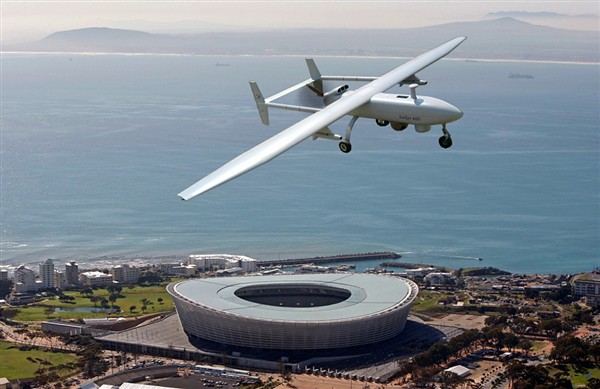
A Seeker 400 drone, manufactured by South African company Denel Dynamics, flies over Cape Town Stadium.

On a sprawling complex just outside Pretoria, South Africa, a government-owned arms manufacturer is preparing to test an armed drone that it hopes to begin selling soon to governments around the world.

The company, Denel Dynamics, says the armed version of the Seeker 400, which will carry two laser-guided missiles, will enable so-called opportunistic targeting at a range of up to about 155 miles.

“These are not combat systems, they are foremost reconnaissance systems,” Sello Ntsihlele, executive manager of UAV systems for Denel, told NBC News. He added: “(But if) you speak to any general, show him the capability, he will tell you, ‘I want to have munitions.’”

The company’s move is but one signal that the era when only a small club of countries possessed weaponized drones is drawing to a close.

Critics say the coming proliferation of the lethal remote-controlled flying machines will forever change the face of counterterrorism operations and, eventually, warfare itself – and not for the better.
“The U.S. has set a moral precedent,” said Jenifer Gibson of the human rights group Reprieve. "A state can declare someone a terrorist and just go out and kill them."

Reprieve campaigns against what it calls illegal drone strikes.

Supporters of military drones argue that they are an essential tool against terrorists hiding in remote areas and that their ability to strike with precision minimizes civilian casualties. Reprieve rejects the notion that drones are precision weapons and claims many civilians have been killed.

Who has drones — and who wants them

Only three countries are known to currently operate armed unmanned aerial vehicles, or UAVs, as drones are technically known -- the U.S., the U.K. and Israel -- according to a recent report by the think tank RUSI. The report suggested there are only currently around 1,000 armed drones worldwide.

But China also is believed to have developed weaponized drones; the U.S. has said it would arm drones operated by Italy; and France and Germany also have decided to acquire them, according to arms trade experts and published reports.

And according to Peter Singer, director of the Center for 21st Century Security and Intelligence at the Brookings Institute, at least 26 countries have surveillance drones of a size or type that have been or could be armed, and roughly 20 countries are trying to either develop or acquire weaponized drones.

So far, the United States is the only country known to have transferred armed drone technology -- and solely to Britain, which flies U.S.-built Predators in Afghanistan.

U.S. sales of drones, armed and unarmed, "are considered on a case-by-case basis, consistent with U.S. law, regulation and policy, as well as our international commitments, including under the multilateral nonproliferation regimes," a Pentagon spokesman said in an email to NBC News. A State Department spokesman declined to comment on the record.

U.S. reluctance to share its cutting-edge military drone technology outside a few trusted NATO partners like Britain and Italy is viewed as an opportunity by arms manufacturers like Denel Dynamics.

The company aims to be among the first suppliers of armed drones to market, if tests of the armed versions of the Seeker 400 -- expected to begin in “a month or two” and last up to six months, according to Ntsihlele -- are successful. South Africa would have to purchase the armed drones first before the company would begin marketing them elsewhere, but if that happens Denel sees opportunities for growth elsewhere, particularly in “Africa and the Middle East,” he said.

Ntsihlele declined to say how much the armed Seeker 400 will cost, but said it will be far cheaper than the Predator and Reaper, the armed drones used for anti-terrorism operations by the U.S. military in Afghanistan, Pakistan, Somalia and Yemen, which cost approximately $20 million and $56.5 million apiece, respectively. And unlike those UAVs, it would not require satellite technology, being controlled instead through “line of sight” communications. That limits its range but makes it potentially available to nations without sophisticated space-based guidance systems.

The drone market

President Barack Obama, in a speech last Thursday, said he would impose new limits on drone strikes against foreign terrorists in an attempt to reduce civilian casualties to near zero and ensure that only enemies who pose a “continuing, imminent threat” to the United States are targeted.

"What we are trying to do with our (anti-terror) strategy is turn it back over to the host country and local forces," the New York Times quoted the Pentagon's top counterterrorism official Michael Sheehan as saying. "That is the future."

The sale of armed drones to other governments raises similarly thorny issues though.

The military use of armed drones in the Middle East and Afghanistan has brought more countries and companies into the market for such weapons. Here are some of the un-crewed aerial vehicles that are known to carry weapons or that might be adapted to carry them.
--> Slideshow: Armed drones around the world
There are no international treaties restricting sales of armed drones, only voluntary controls on exports. Beyond sanctions and embargoes governed by the Security Council, the United Nations does not regulate arms and arms-technology sales, although the Arms Trade Treaty approved in April by the General Assembly may change that if it is eventually ratified by enough nations.

In Denel’s case, Ntsihlele indicated that the South African government would limit sales only to governments that would be “accountable and responsible” and agree to “opportunistic” use of the weapons on justified targets. “That target could be a pirate, or could be a terrorist,” he said.

The company also provided this statement to NBC News: “All of our activities ... take place within the framework of decisions taken by international organs such as the United Nations, the policies of the South African government and the regulatory prescripts imposed by the National Conventional Arms Control Committee and the Directorate Conventional Arms Control,” referring to two South African government organizations.

Assuming it gets its product to market, Denel is expected to quickly encounter plenty of competition.
“To the extent that the U.S. backs off the armed drone business, it allows countries like China, in particular, to say they’ll fill the marketplace,” said Dennis Gormley, who teaches intelligence and military issues at the University of Pittsburgh’s Graduate School of Public and International Affairs.

China already has shown an armed drone resembling a smaller Reaper at an air show last fall, and photos surfaced on Chinese websites earlier this month showing what appeared to be an unmanned combat aerial vehicle known as the Lijan, or “Sharp Sword.” The Lijan closely resembles the U.S. Navy’s remote-controlled X-47B drone, which recently launched from an aircraft carrier for the first time.

Israel will also be a marketplace competitor. It is a leader in armed drones and is already considered the biggest exporter of unarmed drone technology.

Turkey also has developed a reconnaissance drone, the Anka, for spying on Kurdish insurgents. Last summer, the Turkish Defense Industry Executive Committee said that TAI, the company that builds the Anka, was starting research and development on an armed variant, the Anka +A.
Turkey had been intensely interested in buying armed drones from the U.S., said William Hartung, director of the arms and security project at the Center for International Policy. So far, the U.S. has resisted selling it such technology, despite its NATO membership, he said.

Iran also has made unsubstantiated claims to have armed drones.

Terrorism concerns

The spread of armed drone technology to volatile regions like the Middle East inevitably stirs concern that terrorists could obtain the airborne weapons. So far, the Lebanese militia group Hezbollah, considered a terrorist organization by the U.S., is the only group believed to possess the UAVS. It has flown several unarmed drones containing explosives over Israel and, in one case, apparently used an armed drone to attack an Israeli ship, according to published reports.

Yemeni tribesmen stand on the rubble of a building in the village of Azan that was destroyed by a U.S. drone air strike on Oct. 14, 2011. Tribal elders say that suspected al Qaeda militants Abdulrahman al-Awlaki, the son of slain U.S.-born cleric Anwar al-Awlaki, and six others were killed in the attack.
The possibility of using small drones as attack platforms was driven home by a video posted on YouTube in December by an anonymous group called Dangerous Information. It showed a small electric-powered drone equipped with a GoPro video camera and paintball gun, first flying through a neighborhood, then attacking human-figure targets in a field.

The development of smaller drones has been accompanied by new smaller munitions that don’t require the Predator’s 450-pound payload capacity. Denel’s Seeker 400, for example, will have a payload half that, according to a company brochure, but still be capable of carrying two laser-guided missiles.

“There is the development of smaller and smaller weapons, some of them specifically for UAVs,” said Philip Finnegan, director of corporate analysis for the Teal Group, which conducts market analysis in the aerospace and defense industry. “So they’ll be able to use smaller platforms.”

While armed drones appear certain to be added to more countries’ arsenals in the near future, analysts say they expect the military sector will remain a relatively small piece of the overall drone market for some time to come. A big reason for that is the restrained growth in defense budgets worldwide and cuts by the U.S. military in spending on drones, which also affect research and development.

“There is short-term pressure on the industry. … It’s a combination of budgetary pressure and the withdrawals from Iraq and Afghanistan,” Finnegan said. “Longer term, the U.S. remains heavily committed to advanced UAV technology.”

And sales to smaller nations are likely to be slow due to the fact that even with prices falling, armed drones remain prohibitively expensive, Denel’s Ntsihele said, recounting conversations with prospective buyers.

"When they get to know the product, they get shocked,” he said.

Keir Simmons is a correspondent in NBC News' London bureau; Gil Aegerter is an NBC News staff writer in Redmond, Wash.; NBC News' Marc Smith and Robert Windrem also contributed reporting to this article.

NBC News

Thứ Sáu, 31 tháng 5, 2013

In pictures, U.S. Navy MQ-4C Triton UAV takes off

On May 22nd the first production model of the U.S. Navy MQ-4C Triton UAV took off and began its flight testing. This first flight lasted 80 minutes and the UAV went as high as 6,100 meters (20,000 feet). Previously the navy had just been using two air force MQ-4Bs modified to Triton specs for testing. The naval patrol version of the U.S. Air Force RQ-4 Global Hawk is called the MQ-4C Triton and BAMS (Broad Area Maritime Surveillance). The navy version has additional protection against salt damage and a set of sensors optimized for monitoring water rather than land.
On May 22nd, 2013 the first production model of the U.S. Navy MQ-4C Triton UAV took off and began its flight testing. This first flight lasted 80 minutes and the UAV went as high as 6,100 meters (20,000 feet). Previously the navy had just been using two air force MQ-4Bs modified to Triton specs for testing. The naval patrol version of the U.S. Air Force RQ-4 Global Hawk is called the MQ-4C Triton and BAMS (Broad Area Maritime Surveillance). The navy version has additional protection against salt damage and a set of sensors optimized for monitoring water rather than land.

Earlier this year the navy began forming its first Triton UAV squadron. Called VUP (Unmanned Patrol Squadron) 19 it will be in service by October on the east coast of the United States, where it will handle operations over the Atlantic. A second squadron will enter service next year on the west coast to cover the Pacific. The navy plans to buy 68 Tritons and 117 P-8As jet aircraft to replace prop driven 250 P-3Cs. This replacement program is supposed to be complete in about a decade. The new surveillance aircraft provide more information over a wider area and do it more quickly.

The Triton has already been in service on an experimental basis using the modified RQ-4Bs. Last year, two years after extensive tests in the Middle East, the Triton began operating with a carrier task force at sea. Circling above the task force at 22,500 meters (70,000 feet), Triton monitored sea traffic off the Iranian coast and the Straits of Hormuz. Anything suspicious is checked out by carrier, land based aircraft, or nearby warships. The Triton aircraft can fly a 24 hour sortie every three days. The first production Triton was delivered in late 2012 and now is in the air.

In 2009, the first year of Triton testing consisted of 60 flights and over 1,000 hours in the air. The flights were over land and sea areas, even though the UAV sensors are designed mainly to perform maritime reconnaissance. Air Force Global Hawk maintenance personnel assisted the navy in tending to the navy RQ-4 while it was on the ground and for landings and takeoffs. The UAV was operated by navy personnel back in the United States at Patuxent River Naval Air Station. A year earlier the navy began training four of its personnel (three P-3 pilots and one civilian) to operate RQ-4s. The four navy operator trainees were in an accelerated course (four months instead of five) and were available to help fly U.S. Air Force RQ-4s before the navy RQ-4s test model became operational in 2009.

The manned P-3 replacement (the P-8A) is expected to complement Triton. Although the Boeing 737 based P-8A is a two engine jet, compared to the four engine turboprop P-3C it is replacing, it is a more capable plane. The P-8A has 23 percent more floor space than the P-3 and is larger (an 18 percent longer wingspan) and heavier (83 tons versus 61). Most other characteristics are the same. Both can stay in the air about ten hours per sortie. Speed however is different. Cruise speed for the 737 is 910 kilometers an hour, versus 590 for the propeller driven P-3. This makes it possible for the P-8A to get to a patrol area faster, which is a major advantage when chasing down subs spotted by sonar arrays or satellites. However, the P-3 can carry more weapons (9 tons versus 5.6). This is less of a factor as the weapons (torpedoes, missiles, mines, sonobouys) are more effective, and often lighter, today and that trend continues. Both carry the same size crew, of 10-11 pilots and equipment operators. Both aircraft carry search radar and various other sensors. While the Triton can stay in the air longer, the P-8A carries weapons and is more effective at finding, and destroying, submarines (and even surface ships lacking long-range air defense systems).

The 737 has, like the P-3, been equipped with bomb hard points on the wings for torpedoes or missiles. The B-737 is a more modern design and has been used successfully since the 1960s by commercial aviation. Navy aviators are confident that it will be as reliable as the P-3. (The P-3 was based on the Electra civilian airliner that first flew in 1954. Although only 170 were built, plus 600 P-3s, about 20 Electras are still in service.) The Boeing 737 first flew in 1965, and over 5,000 have been built. The P-8A will be the first 737 designed with a bomb bay and four wing racks for weapons.

The Navy is buying a modified version of the B model of the RQ-4 for over $60 million each. This version is larger (wingspan is 5 meters/15 feet larger, at 42.2 meters/131 feet, and it's nine percent longer at 15.5 meters/48 feet) than the A model and can carry more equipment. To support that, there's a new generator that produces 150 percent more electrical power. The RQ-4 has a range of over 22,000 kilometers and a cruising speed of 650 kilometers an hour.


The first three RQ-4Bs entered service in 2006. At 13 tons the Global Hawk is the size of a commuter airliner (like the Embraer ERJ 145) but costs nearly twice as much. Global Hawk can be equipped with much more powerful and expensive sensors, which more than double the cost of the aircraft. These "spy satellite quality" sensors (especially AESA radar) are usually worth the expense because they enable the UAV, flying at over 20,000 meters (62,000 feet), to get a sharp picture of all the territory it can see from that altitude. The B version is supposed to be a lot more reliable. Early A models tended to fail and crash at the rate of once every thousand flight hours.

The maritime RQ-4 is seen as the ultimate replacement for all manned maritime patrol aircraft, at least once it is equipped with more anti-submarine sensors and weapons. The P-8A will probably be the last manned naval search aircraft. Some countries are using satellite communications to put the sensor operators who staff manned patrol aircraft on the ground. Some nations propose sending aircraft like the P-3 or P-8 aloft with just their flight crews, having all the other gear operated from the ground. This enables the aircraft to stay in the air longer and carry more gear.

Article: Strategy Page/ Photos: Xinhua News

Thứ Ba, 28 tháng 5, 2013

Pentagon plans use of Indian Port Blair as possible site in case of offensive against China

Port Blair might not be anything more than a vacation spot for most Indians, but a new Pentagon-commissioned report seeks to turn it into something radically different: a base for American drones.

In possibly the first reference to the use of Indian territory for the US military in recent times, the paper, put together by the RAND Corporation, suggests that the capital of the Andaman and Nicobar Islands could be ideally suited as a base for American drones in the event of an offensive against China.

The paper, titled 'Overseas Basing of US Military Forces', was commissioned by the Pentagon on the instructions of the US Congress and looks into the presence of the American military at various bases and locations across the globe.

As part of this assessment, the researchers at RAND looked into large-scale operations against potential adversaries, including Iran, North Korea and China.

Under this scenario, the paper suggests significant changes in the Indo-Pacific region.

"The Navy and the Marine Corps would also increase the number of combat forces that are stationed on US territories in the Pacific, in particular in Hawaii and Guam, while seeking to retain more marines in Okinawa than currently agreed," the paper says.

It adds that the US should seek to increase the presence of troops at bases in Australia. It then goes on to refers to the use of Indian territory to look over the strategically important Straits of Malacca, which carries about a quarter of all oil that is transported.

"The Navy would strive to station a detachment of broad area maritime surveillance UAVs (unmanned aerial vehicles or drones) at Port Blair airport in the Andaman Islands, to increase surveillance over the Strait of Malacca," the paper said.

James Brown, a Military Fellow at the Lowy Institute's International Security Program and Project Coordinator of the MacArthur Foundation Asia Security Project, points out that this is a possibly unprecedented suggestion - particularly because of its China focus.

"While there is no doubt that the Andaman Islands are strategic real estate, this is the first time I have seen anyone float the thought bubble that the US might be able to operate maritime surveillance assets from Indian territory," Brown wrote in a post examining the paper.

"At first glance it seems incredibly unlikely, but the US and Indian navies have been steadily increasing their cooperation since 2006... In the event of Chinese aggression, it is not inconceivable that India might permit the US to operate maritime surveillance platforms from its Andaman Islands territory."


Enlarge the map

An ideal hub for drones

- A new Pentagon-commissioned report, put together by the RAND Corporation, suggests that Port Blair could be ideally suited as a base for American drones in the event of an offensive against China

- The paper was commissioned by the Pentagon on the instructions of the US Congress and looks into the presence of the American military at various bases and locations across the globe

- As part of this assessment, the researchers at RAND looked into large-scale operations against potential adversaries, including Iran, North Korea and China

- The paper said the Navy would strive to station a detachment of broad area maritime surveillance UAVs (unmanned aerial vehicles or drones) at Port Blair airport to increase surveillance over the Strait of Malacca, which carries about a quarter of all oil that is transported

India Today

Thứ Năm, 23 tháng 5, 2013

Northrop Grumman, U.S. Navy Complete Triton Unmanned Aircraft's First Flight


PALMDALE, Calif. – May 22, 2013 – The Northrop Grumman Corporation (NYSE:NOC)-built MQ-4C Triton high-altitude unmanned aircraft successfully completed its first flight today from the company's manufacturing facility in Palmdale.

A photo accompanying this release can be found at http://media.globenewswire.com/noc/mediagallery.html?pkgid=18898.

Triton is specially designed to fly surveillance missions up to 24 hours at altitudes of more than 10 miles – allowing coverage out to 2,000 nautical miles. The advanced suite of sensors can detect and automatically classify different types of ships.

"First flight represents a critical step in maturing Triton's systems before operationally supporting the Navy's maritime surveillance mission around the world," said Capt. James Hoke, Triton program manager with Naval Air Systems Command. "Replacing our aging surveillance aircraft with a system like Triton will allow us to monitor ocean areas significantly larger with greater persistence."

A Navy and Northrop Grumman flight test team conducted about a 1.5-hour flight that started at 7:10 a.m. from Palmdale.

Northrop Grumman is the prime contractor to the Navy's MQ-4C Triton Broad Area Maritime Surveillance program.

"Triton is the most advanced intelligence, surveillance and reconnaissance [ISR] unmanned aircraft system ever designed for use across vast ocean areas and coastal regions," said Mike Mackey, Northrop Grumman Triton UAS deputy program director. "Through a cooperative effort with the Navy and our industry partners, we successfully demonstrated the flight control systems that allow Triton to operate autonomously. We couldn't be prouder of the entire team for this achievement."

Additional flight tests will take place from Palmdale to mature the system before being flown to the main flight test facility at Naval Air Station Patuxent River, Md., later this year.

In 2008, Northrop Grumman was awarded a systems development and demonstration contract to build two aircraft and test them in preparation for operational missions.

The Navy's program of record calls for 68 Tritons to be built.

Triton carries a variety of ISR sensor payloads that allow military commanders to gather high-resolution imagery, use radar to detect targets, and provide airborne communications and information sharing capabilities to military units across long distances.

At 130.9 feet, Triton has a wingspan larger than the world's most common commercial airliner, the Boeing 737. Combined with an efficient engine and other aerodynamic design features, Triton can fly 11,500 miles without refueling.

Northrop Grumman's Triton industry team includes Aurora Flight Sciences, BAE Systems, Curtis-Wright Corporation, L3 Communications, Raytheon, Rolls-Royce, Sierra Nevada Corporation and Vought Aircraft Industries.

Northrop Grumman is a leading global security company providing innovative systems, products and solutions in unmanned systems, cyber, C4ISR, and logistics and modernization to government and commercial customers worldwide. Please visit www.northropgrumman.com for more information.

Northop Grumman

Thứ Tư, 15 tháng 5, 2013

US Navy catapults drone from aircraft carrier

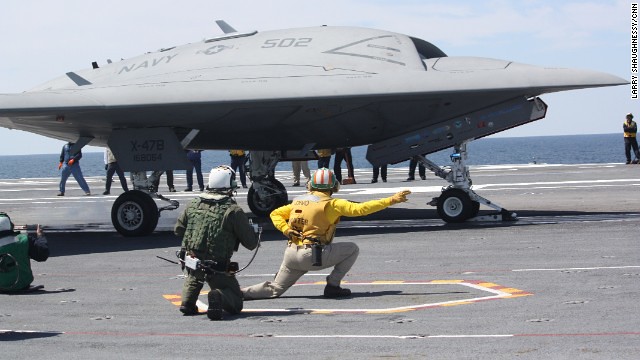
(CNN) -- The U.S. Navy has pulled off what the service's "air boss" called "a watershed event," launching a drone from an aircraft carrier.


The X-47B Unmanned Combat Air System (UCAS) demonstrator completed a catapult launch from the USS George H.W. Bush off the coast of Virginia Tuesday morning.

"Today we saw a small, but significant pixel in the future picture of our Navy as we begin integration of unmanned systems into arguably the most complex warfighting environment that exists today: the flight deck of a nuclear-powered aircraft carrier," the "air boss," Vice Adm. David Buss, commander of Naval Air Forces, said in a statement.

The drone landed at Naval Air Station Patuxent River, Maryland, after a 65-minute flight around Chesapeake Bay, the Navy said.

"The flight today demonstrated that the X-47B is capable of operation from a carrier, hand-off from one mission control station to another, flight through the national airspace, and recovery at another location without degradation in safety or precision," Matt Funk, the lead engineer for the UCAS program, said in statement.
The next milestone will be landing the craft back on the carrier as the flight deck pitches in the open sea, something onboard pilots consider one of the most difficult things they do. That may come sometime this summer, the Navy statement said.

Chủ Nhật, 12 tháng 5, 2013

US Navy’s liquid hydrogen drone flies for record 48 hours

The Ion Tiger, an experimental surveillance plane that uses a hydrogen fuel cell as its power source, flew for a record 26 hours using pressurized hydrogen back in 2009, but late last month it managed a full 48 hours and one minute thanks to a new cryogenic storage tank filled with liquid hydrogen.

A drone developed by the US Navy has broken its own endurance record by staying in the air for just over 48 hours. The 'Ion Tiger' used a new cryogenic tank for the liquid hydrogen fuel feeding its fuel cells to achieve the breakthrough.

Keeping a drone in the air as long as possible is a chief task for a UAV operator, especially in surveillance. One approach is to use fuel that packs a lot of energy for its volume, like hydrocarbons; drones like the MQ-9 Reaper can fly for 30 hours without landing for refueling.

But combustion engines that use hydrocarbons to keep an aircraft flying are noisy, hardly ideal for a spy drone. Ion Tiger, a surveillance drone developed by the Naval Research Laboratory (NRL), the Navy’s research branch, uses an electric engine, which is quieter and has a smaller heat signature compared to traditional drones.

A shortcoming with electric motors, however, is that onboard batteries are much less efficient than chemicals in packing energy, so drones using them can usually only operate for a handful of hours. But NRL’s aircraft uses hydrogen fuel cells to produce electricity, which improves the endurance trade-off.

"Liquid hydrogen coupled with fuel-cell technology has the potential to expand the utility of small unmanned systems by greatly increasing endurance while still affording all the benefits of electric propulsion," NRL principal investigator Dr. Karen Swider-Lyons said in a press release this week.


Ion Tiger set the record for fuel cell UAVs in 2009, when it flew for just over 26 hours using gaseous hydrogen stored in a tank at 5,000 psi. This was replaced in a mid-April test with a tank that stores cryogenic liquid fuel, which is about three times denser than the pressured gas used in the 2009 run.

NRL says their approach has additional logistic benefits, since liquid hydrogen can be produced from water on site rather than having to transport solid fuels in bulk.

Other methods of boosting drone endurance include recharging them in flight with land-based lasers and installing solar panels. A drone using the latter, the British QinetiQ Zephyr, currently holds the endurance record for drones. In 2010, it flew continuously for 14 days over the US Army's Yuma Proving Ground in Arizona.

RT/ The Verge/ YouTube