Thứ Năm, 28 tháng 3, 2013

North Korea’s latest military video fails Propaganda Filmmaking 101 on just about every count


North Korea’s latest propaganda film, A Short, Three-Day War, is a scatter-shot attempt at narrative persuasion that may well say as much about the sad state of that country’s filmmaking industry (if there is one) as it does about its military preparedness.

The four-minute fantasy presents a sequence of images (many of them close-ups of cannons firing) held together by an off-screen narrator who spins a yarn of an upcoming “surprise” attack that will result in the northern peninsula state dominating its southern neighbor. Some 250,000 ballistic missiles will be launched along with 1,000 surface-to-surface rockets “like a shower from the heavens.” And 50,000 Special Forces infantrymen will manage to take 150,000 Americans living in South Korea prisoner. And that’s just day one of the three-day war.

The history of propaganda films is composed of a venerable list of directors—Sergei Eisenstein, Leni Riefenstahl and Frank Capra among them—who marshaled an arsenal of cinematic devices to achieve their hearts-and-minds-winning purposes: sophisticated montage, historical recreation, camera-in-the-trenches documentary work, to name a few. For cinema, like no other medium, has a unique ability to construct an impression of the world, false though it may be, that stirs people to action.

Sadly, the latest North Korean entry fails Propaganda Filmmaking 101 on just about every count. The images are apparently cribbed from motley sources such that, at its most fundamental level, the film fails to construct any coherent or convincing reality. The repeated close-ups of exploding guns have no visual context. Are they even North Korean? Who knows?

What few shots we get of marauding North Korean soldiers would seem to be lifted (did the North Korean government pay for the rights?) from some ancient fiction film. And the visual effects—cheesy dissolves, tacky composites, and even a 1980s-era saw-tooth transition effect—would indicate that North Korean aesthetics are roughly 20 to 25 years behind the rest of the world.

What is most telling about the film, though, is its subject. This is not a missive focused on the enemy. It is not a documentary laying bare the truth of an evil and soulless capitalist American society. Nor is it a film taking its audience into some happy vision of reunified Korean bliss.

This is a film for North Koreans about North Korea.

It spins a fantasy of North Korean military might. It is the cinematic (the word is generous) equivalent of a military parade where tanks and guns and rockets and missiles are flaunted in endless succession in desperate hopes of conveying to North Koreans the truth of who they are: a mighty and fearless state.

But the film is about as convincing as the would-be missiles showcased last April at a lavish military pageant in Pyongyang. Just as those fakes were nothing more than a mishmash of liquid-fuel and solid-fuel components, so too is the latest North Korean propaganda a hodgepodge of images and effects. Worse, it’s a dismal disservice to the fine cinematic tradition of propaganda filmmaking.

Quartz

The Chinese Navy Has a Problem

Debates over China’s anti-access system of systems and its desire to pierce the successive Pacific Island chains often overlook the fact that China faces a very basic set of maritime problems. The PRC draws its most important resources from across an ocean that it cannot control, and exports most of its finished goods to overseas partners who similarly lay beyond the reach of the People's Liberation Army Navy (PLAN). Whether or not the PLAN can deter or defeat the U.S. Navy (USN) in China’s littoral, the organization’s true test lies in its ability to secure the PRC’s critical lines of communication.

The concept of the Sea Control Ship builds on the World War II experience of escort carriers; small, slow aircraft carriers with air wings focused on anti-submarine missions. The Royal Navy and the United States Navy pioneered development of these ships, designed to cover the gaps in anti-submarine warfare (ASW) air coverage over the Atlantic. Escort carriers were remarkably successful in forcing German U-boats to remain submerged, or destroying them outright.

The United States played with the concept (espoused most vigorously by Admiral Elmo Zumwalt) during the Cold War without ever embracing it outright, although it did convert several old Essex class carriers to perform anti-submarine duties. The USN also experimented with converting USS Guam (an Iwo Jima class LPH) to sea control duties, although the experience was not widely regarded as a success. Nevertheless, healthy debate in the Navy continued into the late 1970s and 1980s.

In practice, the USN did not need to construct dedicated Sea Control Ships, because so many U.S. allies operated (and continue to operate) small carriers that perform basic sea control missions. Ranging from the Colossus class carriers distributed across the world at the end of World War II, to the Spanish Dedalo, to the modern Hyuga class Helicopter Destroyer, the USN could and can depend on allies to conduct escort missions. The USN could also rely on access to airbases worldwide in order to support land-based sea control aviation.

China has none of these advantages. No Chinese ally is likely to devote treasure to the construction of sea control ships in the near future (Pakistan might be the best long term bet), and China lacks access to good bases for counter-sea aviation. For sea control beyond China’s littoral, the PLAN has few, if any, good options.

In a structurally similar position to China (although much less dependent on foreign trade), the Soviet Navy started with what amounted to Sea Control Ships, in the form of the Moskva class helicopter carriers and the Kiev class “heavy aviation cruisers.” Although these ships weren’t designed specifically with commerce protection in mind, they were specialized for anti-submarine warfare, with allowance for air superiority and surface warfare in the Kiev class. Moreover, Soviet naval aviation evolved over time, with new platforms benefitting from experiences earned with older vessels.

China has been determined to leap several stages, with consequences for training that are already becoming apparent. But perhaps more importantly, by skipping ahead the PLAN has left itself bereft of the kind of low cost, medium size platforms that can support sea control operations at a distance from home. The lack of these sea control platforms (or suitable alternatives) will leave the PLAN at a serious disadvantage when and if it needs to protect lines of communication in unfriendly environments. Liaoning can only operate in one place at a time, and only for a limited time period. The PLAN might have been better served by adopting the more evolutionary Soviet approach to naval aviation.

The Diplomat

France says Malaysia can build jets if it buys Rafale

France dangled Tuesday the possibility of manufacturing its Rafale fighter plane in Malaysia if the nation selected the aircraft as its new combat jet.

"We are considering an assembly line in Malaysia," said Eric Trappier, chief executive of the Rafale's builder Dassault Aviation, in a telephone interview from the Langkawi air show in northern Malaysia.

Malaysia is looking to buy 18 combat fighters to replace its ageing Russian Mig-29s, with the Eurofighter, Boeing's F-18 and Saab's Gripen also in the running.

The multi-role Rafale, which entered service in the French military in 2001, can carry out air-ground or air-sea attacks, reconnaissance, aerial interception or nuclear strike missions.

France is keen to make its first foreign sale of the Rafale, which has struggled to find buyers, to support a project that has cost tens of billions of euros.

India has selected the Rafale, with most of the 126 fighter jets they plan to buy expected to be built there if the final contract is signed this year as hoped.

Malaysia is keen for its local companies to be involved in the manufacturing, and Trappier said that Dassault has spent considerable effort in lining up local suppliers should the Rafale be selected.

Dassault has already signed deals with Malaysian companies CTRM, Zetro Aerospace and Sapura, he noted.

Two Rafales were at the Langkawi air show to provide demonstration flights.

Expatica

Report: China Ramping Up Armed, Unarmed Drone Development

China has deployed unarmed reconnaissance and ocean surveillance drones in Northeast Asia near Japan, the Senkaku islands and along China’s southern coast, the Washington Times reports.

Citing U.S. intelligence officials, Bill Gertz writes China could also send drones to the South China Sea.

One drone, the China’s CH-4 drone, appears to be a copy of the General Atomics-made Predator and is armed with missiles similar to the Hellfires launched from the Predator, according to Gertz.
Other intelligence reports are indicating that China is also developing an unmanned combat aerial vehicle that is intended to be stealth.

Gertz reports China’s drone to be identical to Northrop Grumman‘s X-47B drone, which was recently tested on a U.S. aircraft carrier, and could be able to reach Guam.

Thứ Tư, 27 tháng 3, 2013

Indian Navy's third Anti Submarine warfare corvette


The third Anti Submarine Warfare (ASW) Corvette for the Indian Navy (IN) designed under Project-28 (P-28) by the Navy's Directorate of Naval Design, being built by one of India's leading shipbuilders, Garden Reach Shipbuilders and Engineers Ltd (GRSE), was launched on Tuesday.

Named after an island - Kiltan - in the Lakshwadeep archipelago of India, the ASW Corvette was launched by Chitra Joshi from GRSE mainyard in the presence of Chief of the Naval Staff, Admiral DK Joshi, Chairman and Managing Director, GRSE, Rear Admiral (Retd) A K Verma and other officials from the Ministry of Defence, Armed Forces and West Bengal administration.

With nearly 90 per cent indigenisation content aimed to be achieved in the manufacturing of the ship, the efforts made by Indian Navy and Defence Shipyards towards the national goal of indigenisation and self-reliance got a major impetus with this latest ASW Corvette launch.

The Indian Navy also got closer to acquiring the ASW platforms that will stealthily seek and destroy lurking enemy submarines as the first GRSE built ASW Corvette, Kamorta, is expected to be delivered to IN this year.

The remaining three ships, according to GRSE, will be delivered by 2016. The fourth ASW Corvette will be launched in 2014, GRSE CMD Rear Admiral Verma stated.

Lauding efforts of GRSE in detail designing of the ship, the Navy Chief singled out its technological landmark, as being the first ship in the country built with a composite superstructure.

The superstructure made of carbon fibre composite material has been successfully integrated with the main hull of the ship.

Besides reducing the top weight, it will provide improved stealth features and reduce life cycle maintenance costs.

The ship's hull form is highly efficient with excellent sea-keeping and manoeuvrability characteristics having an overall length of 109 metres.

The ship can cut through the sea at a very high speed of 25 Knots. Hull of the ship is built with warship grade high tensile indigenous steel.

The ship's advanced stealth features will make her less susceptible to detection and help in effective deployment of soft kill measures.

The ships will be fitted with complete indigenous state-of-the-art weapons and sensors, including a medium range gun, torpedo tube launchers, rocket launchers and close-in weapon system.

These ships are also equipped with a Bow mounted Sonar and are capable of deploying a helicopter, adding considerable punch to the ship's anti-submarine capability.

These ships also feature an advanced Integrated Platform Management System for controlling and co-ordinating the propulsion, auxiliary and power generation equipment.

The new P-28 ASW corvettes also mark many firsts including introduction of the 'rail-less helo traversing system' to handle a helicopter on board the ship, foldable hangar door, use of indigenous DMR 249A steel and carbon fibre reinforced plastic (CFRP) superstructure integrated with the steel hull of the ship.


The Economic Times

Flares, gunshots, and fires, oh my: The latest South China Sea accusations fly

Vietnam accused China of firing on a fishing boat near the Paracel Islands, something China denies. China claims territorial rights over the entire south China sea, but several nations dispute this.


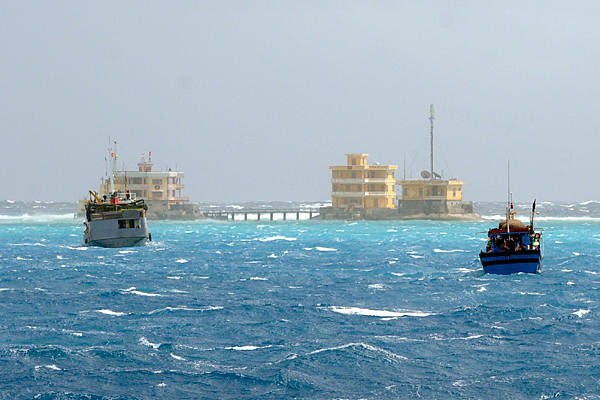
Vietnamese fishing boats are seen near Da Tay island in the Spratly archipelago in January.
Quang Le/Reuters

China has denied Hanoi's accusations that it fired upon a Vietnamese fishing boat last week near the Paracel Islands as "sheer fabrication," and claims that its patrol vessel only fired flares and did not damage the boat.

Beijing said yesterday that despite Vietnamese accusations that the fishing vessel was fired upon and its cabin "burned down" during a confrontation last week near the Paracels, which both China and Vietnam lay claim to, the Chinese patrol vessel's actions were "necessary and legitimate," reports state newspaper the China Daily.

Chinese Foreign Ministry spokesman Hong Lei told reporters that China has indisputable sovereignty over the Xisha Islands [the Chinese name for the Paracels] and their adjacent waters, and the Vietnamese fishing boat entered the waters for "illegal fishing operations".

"According to confirmation by relevant parties, no harm was done to the Vietnamese ship at that time and place," Hong said.

An unnamed Chinese navy official goes further, Chinese state news agency Xinhua reports, calling the Vietnamese description of events a "sheer fabrication" that "revealed the ulterior motives of the relevant Vietnamese authorities."

Staff aboard the Chinese patrolling vessel tried repeatedly to persuade and demand the Vietnamese boats to leave by whistle blowing, shouting and handflag guiding, but all failed.

Then the Chinese vessel fired into the sky two warning signal shells, which burned out and extinguished in the air.

There is no such things [sic] that Chinese vessel fired with weapons or the Vietnamese boats caught fire, said the official.

This is just the latest event in an ongoing dispute between Vietnam and China over islands in the south China sea. China claims to have historical territorial rights over the entire sea, but Vietnam, Japan, the Philippines, Taiwan, and several other nations each lay claim to various islands within the region – including the Paracels and the Spratleys, which Vietnam claims.

HANOI, Vietnam (AFP)- Activists in Hanoi lay flowers and chant anti-China slogans at a protest marking the anniversary of a battle over the contested Spratly Islands in which 64 Vietnamese soldiers died.

The Vietnamese government publicized the issue on Monday, saying that the Chinese vessel illegally chased and fired upon the Vietnamese vessel as it fished in what Thanh Nien News called its "traditional fishing grounds" in the Hoang Sa Archipelago, the Vietnamese name for the Paracels.

"This is an extremely serious issue, violating Vietnam's sovereignty over Hoang Sa Archipelago, threatening the lives and damaging properties of Vietnamese fishermen," [Foreign ministry spokesman Luong Thanh Nghi] said.

"This has seriously violated international laws and agreements on basic principles in solving sea issues between Vietnam and China, and is counter to the Declaration of Parties in the [South China] Sea (DOC)."

Radio Free Asia reports that Pham Quang Thanh, the captain of the fishing boat, said that "When we saw the vessel from afar, we left right away. But after about 30 to 40 minutes, they were already right behind us."

“I tried to head east to get away, but they were close to us, and they started shooting at us,” Thanh said.

Thanh then ran inside the boat’s cabin, he said.

“I heard four explosions and found that the boat’s cabin was on fire, and I called everybody to put out the fire with sea water.”

His Chinese attackers had meanwhile left, eventually halting about five or six nautical miles away, he said.

“They just left. They didn’t show any willingness to help, or even to stop to check on us. They wanted to destroy us.”


Sailor Pham sits in his damaged fishing boat, which was allegedly attacked by Chinese boats in the disputed south China sea

Citing an earlier news report, Thanh Nien News describes a similar scene, but names the ship captain as Bui Van Phai, who said his boat collided with the Chinese vessel before the chase began.

----------


Europe Editor

Arthur Bright is the Europe Editor at The Christian Science Monitor.  He has worked for the Monitor in various capacities since 2004, including as the Online News Editor and a regular contributor to the Monitor's Terrorism & Security blog.  He is also a licensed Massachusetts attorney.


The Christian Science Mornitor

Chinese action against Vietnamese fisherman was 'legitimate'


Sailor Pham sits in his damaged fishing boat, which was allegedly attacked by Chinese boats in the disputed South China Sea

The action taken by Chinese authorities regarding a Vietnamese boat "illegally fishing" last week in the waters off "China's Islands" in the south China sea was "necessary and legitimate", Beijing said on Tuesday.

Chinese Foreign Ministry spokesman Hong Lei told reporters that China has "indisputable sovereignty" over the so-called "Xisha Islands" and their adjacent waters, and the Vietnamese fishing boat entered the waters for "illegal fishing operations".

"According to confirmation by relevant parties, no harm was done to the Vietnamese ship at that time and place," Hong said.

Vietnam claimed on Monday that a Vietnamese boat was "chased and fired at" by an unknown number of Chinese ships, and "its cabin was burned down" in the waters on March 20, according to Vietnamese Foreign Ministry spokesman Luong Thanh Nghi.

The fishing boat came from Vietnam's Quang Ngai province.

Hanoi urged Beijing to investigate and "compensate Vietnamese fishermen for their loss" in a statement on the ministry's website.

The statement did not say how many Chinese ships or what kind of vessels were involved, and Hanoi has not conceded that the fishing operation was illegal.

"China urges the Vietnamese to take effective measures to improve education and management of its fishermen and stop illegal operations," Hong said.

Wu Shicun, director of the National Institute for South China Sea Studies, said China's "Xisha Islands" are not within the scope of a territorial dispute, and Vietnam's hype about the confrontation is meant to aggravate the regional situation.

China has exercised restraint on the issue, but "Vietnam has planned to bluff the international community by playing the role of victim, and it is actually trying to justify its illegal claim over the islands", Wu warned.

As for the Vietnamese ship, it was not the first time it was caught illegally fishing, as previous media reports showed that it was among the two Vietnam-registered fishing ships that were driven out of China's territorial waters by a China Marine Surveillance fleet on March 13.

The two ships were driven out of the waters by the patrol ships Haijian 262 and Haijian 263, Xinhua News Agency reported.

Similar cases of illegal fishing were reported in recent years, and Beijing had previously sent warnings to Hanoi on acts by Vietnamese fishermen.

On March 4, 2012, Chinese authorities investigated and punished two Vietnamese fishing boats and 21 Vietnamese fishermen for illegally fishing in waters off the "Xisha Islands".

Li Guoqiang, deputy director of the Center for Chinese Borderland History and Geography at the Chinese Academy of Social Sciences, said the waters off the "Xisha Islands" have seen a growing number of illegal operations by Vietnamese fishermen, and Hanoi's policies and attitudes have been widely viewed as contributing to the incidents.

"Vietnam should be aware of the impact on bilateral ties with China," Li warned.

Relations between the two nations soured after Vietnam's National Assembly passed a "Vietnamese Law of the Sea" in June, claiming China's "Xisha and Nansha Islands" in the south China sea as being "within Vietnam's sovereignty and jurisdiction".

Asia One