Hiển thị các bài đăng có nhãn China-Japan. Hiển thị tất cả bài đăng

Chủ Nhật, 5 tháng 5, 2013

China-Japan Island Dispute Could Become Flashpoint

How The China-Japan Dispute Over A Few Islands Can Quickly Escalate Into The Next Big War

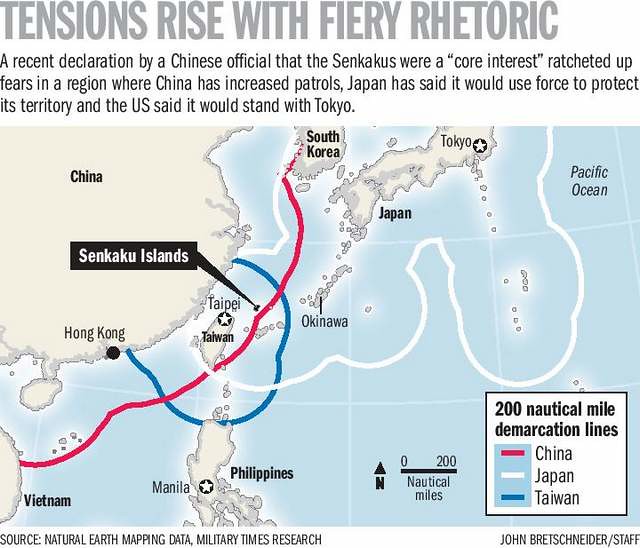
TAIPEI — While North Korea has garnered attention as Asia’s top hotspot, experts worry that the real problem is between Beijing and Tokyo over the Japanese-controlled Senkaku Islands, which China calls the Diaoyu Islands.

Over the past month, rhetoric has soared between new nationalistic leaders in China and Japan as each deploys hardware to the region.

China’s increased ship and air patrols to the islands have prompted an unprecedented response from Japan: Keep out or we will use force to keep you out. Japanese Defense Minister Itsunori Onodera said, “Japan is determined to protect its land, water and air.”

And to help its key ally, America’s top military leaders have told Beijing that if the shooting starts, Washington is treaty- and duty-bound to back Tokyo.

That, in turn, has prompted China to declare the islands a “core interest” in a bid to force Tokyo and Washington to back down, a move that’s unlikely to work.

“I think the potential calculated escalation is high,” said Wallace “Chip” Gregson, former assistant defense secretary for Asian and Pacific security affairs under President Barack Obama. “China seems to feel it is in their interests to keep tensions high, and Japan’s tough response meets with political approval across the country. The potential for miscalculation is always there with so many ships and airplanes confronting each other.

“I think China takes US obligations seriously, and they are working to drive a wedge between the US and Japan. I don’t think they expected a strong response from Japan, but now that national prestige is involved in each country, they are stuck,” Gregson said.

US Defense Secretary Chuck Hagel’s reaffirmation of US sup-port for Japan came last week after Chinese Foreign Ministry spokeswoman Hua Chunying told a Japanese reporter April 26 that the “Diaoyu Islands are about sovereignty and territorial integrity. Of course, it’s China’s core interest.”

The “core interest” declaration rattled Tokyo and Washington. The phrase is usually reserved for sensitive Chinese territorial concerns. In March 2010, Chinese officials began declaring the South China Sea as a “core interest” on par with its claims over Taiwan, Tibet and Xinjiang.

Hua’s statement was deleted from the official transcript issued by China’s Foreign Ministry.

“It is on the tape,” said Bonnie Glaser, senior adviser for Asia at the Center for Strategic and International Studies. “However, when the transcript was issued, that sentence was deleted. The transcript remains the official account. Obviously, someone believed it should not have been said.”

“China is cautious in using the term ‘core interest,’ ” said Su Xiaohui, strategic studies research fellow, China Institute of Inter­national Peace, Beijing. “The reason is that when we define something as a ‘core interest,’ it means that it is not negotiable and China will defend it with all our might.”

A Chinese Foreign Ministry source echoed Su’s comments by saying Hua’s comments were a “signal to the world that the Chinese government attaches more importance to this sovereignty issue and is willing to defend its sovereignty. Whatever it takes.”

Su said China’s definition is not important.

“The reality is that it is difficult for China to step back. It is not only a problem between China and Japan. It is related to the US position, the South China Sea issue, etc. If we failed in dealing with the problem appropriately, the spillover effect would be disastrous.”

China has been ramping up tensions near the islands for the past 16 months. The most recent incident occurred April 23 when eight Chinese marine surveillance ships entered the 12-nautical-mile ter­ritorial zone off the islands.

Hua’s statement was both “surprising” and “expected,” said Jingdong Yuan, a China security specialist at the Centre for International Security Studies, University of Sydney. There is a possibility China has a new policy regarding territorial disputes.

“China would keep the status quo if one challenges it; otherwise, it will now seek to set a new benchmark or redefine the status quo, as it has been doing with regard to Senkaku,” Jingdong said.

There were relatively few intrusions into the vicinity of the island group before September 2012; now it has become a matter of fact where China is “basically demonstrating its de facto, at the minimum, co-administration while ever more loudly claiming its sovereign rights to these islands,” Jingdong said.

Zhuang Jianzhong, vice director of the Center for National Strategy Studies, Shanghai Jiao Tong University, had a different take on the Hua comment. Zhuang said the Diaoyu Islands dispute is different from Taiwan, Tibet and Xinjiang.

“Though it touches upon sovereignty and territorial disputes, the importance of this issue in the sense of a core interest is less than the previous ones,” he said. China is willing to discuss the island dispute with Japan, whereas there is no room for negotiation on the “other three.”

Defensenews

Thứ Bảy, 4 tháng 5, 2013

China's Territorial Ambition

Amid U.S. weakness, Beijing expands its regional claims.

Eight Chinese ships entered the territorial waters of the Japanese-controlled Senkaku Islands on a single day last week, while 40 Chinese military planes flew nearby. China's state-run Xinhua news agency reported this as a response to Japanese nationalists trying to land on the disputed islands, though the Japanese Coast Guard prevented that. The next day, Xinhua claimed that the State Oceanic Administration "thwarted" the violation of Chinese sovereignty.

A week earlier and more than 4,000 kilometers away, the Indian military discovered that Chinese soldiers had camped 19 kilometers within Indian-controlled territory. The Indians recently reinforced positions in the area with bunkers, and in three "flag meetings" of local commanders the Chinese demanded that they be removed before they will pull back. In the meantime the Chinese are building a new road into the area.

These incidents are part of a wider pattern. In territorial disputes, Chinese forces are growing more assertive and using any excuse to change the status quo in their favor.

Last month Chinese began sending tourist charters to disputed islands in the South China Sea. On March 20, Chinese patrol boats set fire, perhaps inadvertently, to a Vietnamese fishing boat in the disputed area. Two days later, four Chinese navy ships conducted exercises around the James Shoal, rocks that are claimed by Malaysia and China. The rocks lie 80 kilometers off the Malaysian coast, and 1,800 kilometers from the Chinese mainland.


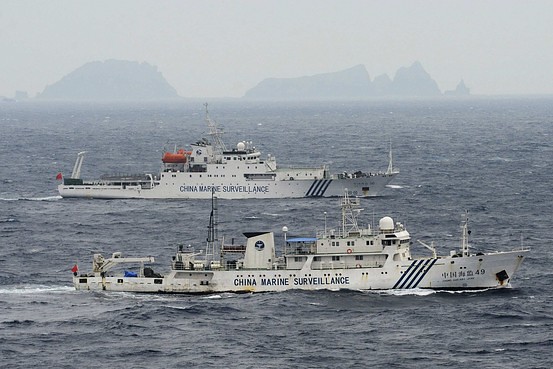
An aerial photo shows Chinese marine surveillance ships Haijian No. 49 (front) and Haijian No.50 cruising in the East China Sea.

After Tokyo recently revealed that it was forced to scramble fighters 306 times last year in response to Chinese planes approaching its airspace, the Chinese response was to blame Japan for raising tensions. Beijing always justifies its provocations as defending its sovereignty, which makes rational talks impossible.

All of this has sparked renewed debate over what is going on behind the high walls of Zhongnanhai, the leadership compound in Beijing. Sydney Morning Herald reporter John Garnaut recently wrote that Xi Jinping, installed as Communist Party supremo last year, is consolidating power the same way Deng Xiaoping did in 1979, when the Peoples Liberation Army was ordered to invade Vietnam. Conflict is a handy way to enforce discipline and allow the new leader to promote his own generals.

That theory may have some truth to it, but China's assertiveness predates Mr. Xi's elevation. The policy shift became apparent in 2009, when officials first referred to the South China Sea as a "core interest." Beijing began to revive dormant disputes with several of its neighbors at the same time. This led some China watchers to declare that Deng Xiaoping's maxim that the country should "hide our capabilities and bide our time" had been discarded.

The real significance of the year 2009 may not lie in China, however. The global financial crisis hurt the U.S. economy and undermined Chinese reformers who argued that China still had lessons to learn from America. It also cut global demand for Chinese products and caused a spike in unemployment, making a greater reliance on nationalism politically tempting.

There was also the inauguration of Barack Obama, a President determined to bring U.S. forces home from two wars and avoid other foreign entanglements. Beijing has taken advantage of superpower retreats in its neighborhood in the past. After the U.S. pullout from South Vietnam in 1973, the PLA invaded the Vietnamese-controlled Paracel Islands the following year. After the Soviets drew down their forces at Vietnam's Cam Ranh Bay naval base in 1984 and the U.S. left the Clark and Subic Bay bases in the Philippines in 1991, the PLA occupied nearby islands in the South China Sea.

In the long run Beijing usually does what it says it is going to do, although the execution may be concealed with deception. It also reads the words and actions of its adversaries carefully, and it will exploit weakness. Despite its rhetoric about a U.S. pivot to the Western Pacific, the Obama Administration continues to signal a lack of resolve to aid allies and prevent China from intimidating other countries in the region. Beijing's assertiveness is the result.

WSJ

Thứ Năm, 18 tháng 4, 2013

2012 saw record 306 Japan fighter scrambles against Chinese aircraft

Japan scrambled fighter jets 306 times in response to intruding Chinese aircraft in fiscal 2012 through March, a record high, the Defense Ministry’s Joint Staff said Wednesday.

Japan Coast Guard F-15

It is the first time scrambles against Chinese planes have surpassed those against Russian aircraft. For fiscal 2012, scrambles against Russian aircraft totaled 248, an increase by one incident from the previous fiscal year.

Scrambles by Air Self-Defense Force jets against Chinese aircraft rose due to heightened tensions over the Japanese-administered Senkaku Islands in the East China Sea following Tokyo’s effective nationalization last September of the islet chain.

Japan has been prompted to scramble planes amid China’s increased military activities. China claims the islands, which it calls Diaoyu, and has in recent years pressed its claim, leading to bilateral friction.

The latest figure is almost double the previous record for scrambles against Chinese aircraft, at 156, and marks the highest level since the office began announcing figures by country in fiscal 2001.

Scrambling jets is an action taken in emergency situations by a country to intercept foreign aircraft looking to intrude into the country’s airspace.

Last December, a Chinese aircraft entered Japanese airspace over the Senkakus in the first such intrusion.

Since then, the ministry has bolstered the operations of its Airborne Warning and Control Systems planes as well as E-2C airborne early warning planes.

The ministry said it will keep close tabs on China’s actions.

Many of the Chinese aircraft were fighters, but the specific models are hard to determine just by looking at them, ministry officials said.

The number of times Japanese fighters scrambled in response to Chinese planes increased every three months from last April, first from 15 times rising to 54 times, then 91 times and ultimately 146 times.

Since one of China’s State Oceanic Administration airplanes entered Japanese airspace on Dec. 13, this kind of aircraft has approached to within about 100 km from the airspace over the Senkakus on eight occasions.

Buoyed by the rise in responses to Chinese aircraft, the total number of scrambles by Japan came to 567, marking the first time in 22 years the figure has surpassed 500.

The ministry has compiled statistics on scrambles from fiscal 1958. It was in fiscal 1984 at the peak of the Cold War when the greatest number of scrambles — 944 — occurred.


Japan Times

Thứ Năm, 28 tháng 3, 2013

Report: China Ramping Up Armed, Unarmed Drone Development

China has deployed unarmed reconnaissance and ocean surveillance drones in Northeast Asia near Japan, the Senkaku islands and along China’s southern coast, the Washington Times reports.

Citing U.S. intelligence officials, Bill Gertz writes China could also send drones to the South China Sea.

One drone, the China’s CH-4 drone, appears to be a copy of the General Atomics-made Predator and is armed with missiles similar to the Hellfires launched from the Predator, according to Gertz.
Other intelligence reports are indicating that China is also developing an unmanned combat aerial vehicle that is intended to be stealth.

Gertz reports China’s drone to be identical to Northrop Grumman‘s X-47B drone, which was recently tested on a U.S. aircraft carrier, and could be able to reach Guam.

Thứ Năm, 28 tháng 2, 2013

Japan scrambles fighter jets to intercept China plane

Japan scrambles fighter jets to intercept China plane
Tokyo: Japan today scrambled fighter jets to head off a Chinese government plane flying towards disputed islands in the East China Sea, the defence ministry said.

It said the Y-12 propeller plane did not enter airspace around the Tokyo-controlled islands known as the Senkakus, which Beijing claims as the Diaoyus.

The aircraft headed back towards China after Japan's military planes became airborne, defence officials said, declining to give further details.

The incident came as three Chinese government ships sailed into territorial waters around the islands, Japan's coastguard said.

The three marine surveillance ships entered the 12-nautical-mile territorial zone off Uotsuri island shortly after 7:00 am local time, the coastguard said in a statement.

It said the trio left the zone after just over two hours. Today's moves were the latest in a series by Chinese government ships since Tokyo nationalised three islands in the chain last September, reigniting the dispute.

They also came the day Japanese Prime Minister Shinzo Abe, speaking about the islands dispute, cited British former premier Margaret Thatcher and her thoughts on a 1982 war with Argentina over the Falkland Islands.

NDTV

Thứ Sáu, 25 tháng 1, 2013

Japan ASDF jets scrambled 160 times against China planes

Jan 25, 2013- The Air Self-Defense Force scrambled fighter jets 160 times against Chinese aircraft approaching Japanese airspace in the nine months between April and December, surpassing the record high 156 scrambles made in all of fiscal 2011, the Defense Ministry, which started disclosing such data by country in 2001, said Thursday.


In the nine months, ASDF fighter jets were scrambled 349 times in total, up 14 from the same period in fiscal 2011, the ministry’s Joint Staff Office said.

Although most scrambles were against Russian aircraft, numbering 180, the increase was mostly due to a rise in Chinese intrusions, according to the ministry data.

The majority of Chinese aircraft flew over the East China Sea around the Nansei Islands, which include the disputed, Japan-controlled Senkaku islets, according to the ministry.

“When compared with the same period last fiscal year, it was a slight increase. But (regarding scrambles against) Chinese (planes), the number is getting high,” Gen. Shigeru Iwasaki, head of the Self-Defense Forces, told media outlets in Tokyo.

The increase is due to increasing Chinese military activities in recent years, Iwasaki said, adding the surge cannot be simply linked to the mounting tensions over the Senkaku Islands. China claims the islets, which it calls Diaoyu.

Since a Chinese government aircraft intruded into Japanese airspace for the first time over the Senkakus on Dec. 13, the ministry has been on alert, dispatching E-2C early warning aircraft and airborne early warning and control system aircraft to Okinawa to monitor intrusions as quickly as possible.

The Japan times

Thứ Bảy, 19 tháng 1, 2013

Japan defends right to fire warning shots as territory dispute with China heats up

Jan 20, 2013- TOKYO – Japan says it may fire warning shots and take other measures to keep foreign aircraft from violating its airspace in the latest verbal blast between Tokyo and Beijing that raises concerns that a dispute over hotly contested islands could spin out of control.


Japanese officials made the comments after Chinese fighters tailed its warplanes near the islands recently. The incident is believed to be the first scrambling of Chinese fighters since the tensions began to rise last spring.

According to Chinese media, a pair of J-10 fighters was scrambled after Japanese F-15s began tailing a Chinese surveillance plane near the disputed islands in the East China Sea. China has complained the surveillance flight did not violate Japanese airspace and the F-15s were harassing it.

Foxnews

Thứ Hai, 14 tháng 1, 2013

Japan drill to test response to theoretical attack

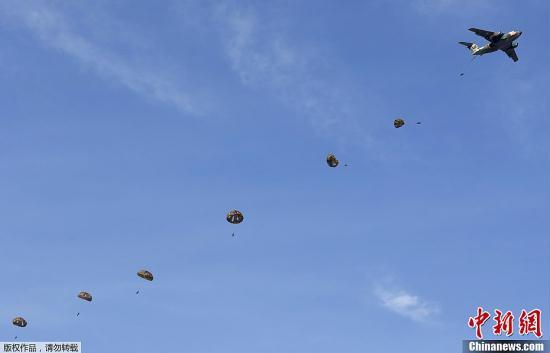
Jan. 14, 2013- For the first time, the First Airborne Brigade of Japan’s Ground Self-Defense Force has conducted a drill, simulating the retaking of an outlying Japanese islands under attack.


The drill was held at a training ground in Chiba prefecture, on the outskirts of Tokyo. Japan’s Defence Minister has called on the military to improve security to defend Japan. Around 20 aircraft and 33 vehicles took part in the drill.


The Japanese government plans to request an increase of 1.1 billion US dollars in military spending, the first such increase in a decade.


A move by the Japanese government to buy China’s Diaoyu Islands from private Japanese owners in September sparked protests in China that led to the damage of Japanese-owned factories around the country.


Thứ Sáu, 28 tháng 12, 2012

Chinese document refutes China's claim to Senkakus

Dec 28, 2012- A Japanese media organization reports that China recognized the Senkaku Islands as part of Japan's Ryukyu Islands in a 1950 diplomatic document.

Jiji Press ran the story on Thursday, after reportedly obtaining a copy of the document.

The report says the document is a draft outline on territorial issues for a peace treaty with Japan and was produced by the Chinese government in May of 1950.

In the document, the Chinese government reportedly refers to the islands in the East China Sea as the Senkaku Islands, instead of calling them Diaoyu, as it does today.

The Jiji article says the document contains descriptions recognizing the islands as part of what is now Japan's Okinawa Prefecture.

The document reportedly states that China needs to consider whether or not the islands should be incorporated into Taiwan.

China's foreign ministry spokesperson Hua Chunying said on Thursday that the Chinese government is not aware of the report. But she added that China's claims to sovereignty over the islands have sufficient historical and legal grounds.

China contends that the islands are part of Taiwan and has consistently referred to them as Diaoyu.

But the Jiji report casts doubt on this contention.