Thứ Ba, 10 tháng 12, 2013
S. Korea: North Korea Engaged in 'Reign of Terror'
SEOUL — South Korea has called the recently announced political purges at the top of North Korea's leadership a “reign of terror” that could further destabilize their already shaky relations. Meanwhile, North Korean media continue to attack the uncle of leader Kim Jong Un who was very publicly removed from power.
South Korea's President Park Geun-hye at a Tuesday Cabinet meeting said North Korea's massive purges appear aimed at consolidating leader Kim Jong Un's power.
North Korea on Monday confirmed earlier reports that Jang Song Thaek, the uncle of Kim Jong Un and assumed second in command had been abruptly removed from power over disloyal and corrupt behavior.
South Korea's spy agency broke the story last week and said two of Jang's assistants were executed in public in November. It said authorities are going after his followers.
President Park said the dismissals and executions amounted to a “reign of terror” with potentially destabilizing effects.
She says North-South Korea relations could become more unstable from now on. At a time like this, she says, it is the duty of the state, as well as the political parties that represent the people, to firmly protect the South Korean people's security and liberal democracy.
Jang was labeled as leading a self-indulgent, “capitalist” lifestyle that included drug use, womanizing, and gambling. North Korea's state media published photographs and accounts of Jang being arrested at a Korean Workers Party meeting by uniformed officers.
The official Rodong Sinmun newspaper on Tuesday quoted North Korean citizens saying Jang and his supporters should be put to death. The newspaper urged unity and loyalty under Kim Jong Un vowing to never forgive traitors.
Jung Sung-jang, a researcher at Seoul's Sejong Institute, says it is unlikely that Jang’s purging will impact North Korean policy in any dramatic way. But he says it will definitely stiffen the dynamics within the country, which could prompt Pyongyang to temporarily adopt a more stringent stance.
Jang was also accused of selling off North Korea's resources at a cheap price, an apparent reference to China which buys most of its exports. He was in charge of negotiating Chinese investment in special economic zones.
Some Western political analysts say Jang may have been removed because Pyongyang believed he became too close to Beijing.
But Professor of Korean history at Kookmin University Andrei Lankov argues Jang's role in the bilateral relationship was not so clear and ties with Beijing are not likely to be affected.
“He is not a China hand. He is not a person who has close, personal connections in China, a good understanding of how China works and so on. I would say that probably it will not change much or maybe will not change anything because Chinese will be equally eager to talk to a new face,” he said.
Beijing's state run Global Times newspaper Tuesday said China should help bring about Kim Jong-Un's visit as soon as possible for the benefit of friendly ties and long-term stability.
The 30-year-old Kim Jong Un's neglecting to visit China since coming to power two years ago, and a third nuclear test in March, were widely viewed as a snub.
The editorial noted balancing friendship with Pyongyang while opposing its nuclear weapons is a test for China's diplomacy. Beijing is trying to revive the long-stalled six-nation talks it hosts on denuclearizing North Korea.
Japan, South Korea, and the United States are refusing to negotiate until North Korea demonstrates it is serious about giving up its nuclear programs.
VOA Seoul producer Youmi Kim contributed to this report.
China Adopts Board-Game Strategy to Blunt U.S. Pivot to Asia
The foreign policy strategy emerging from China’s new leadership may include a series of incremental steps calibrated to blunt U.S. influence across Asia and sow doubt about America’s commitment to its allies in the region.
Potential next steps following last month’s imposition of an air defense zone over the East China Sea in the face of U.S. condemnation include more vigorously challenging aircraft that enter the area, imposing a similar zone over disputed territory in the South China Sea and asserting naval control over islands also claimed by other nations.
“Such actions, if they occur, will cause greater worries in the region and increase calls for the U.S. to strengthen its military, diplomatic and economic presence,” said Bonnie Glaser, a senior Asia adviser at the Center for Strategic and International Studies in Washington. “The risk is of greater U.S.-China strategic competition.”
A year into his term as head of the Communist Party, President Xi Jinping is taking measures to bolster his nation’s standing in the region and counter an increased U.S. military deployment to Asia. The strategy features such steps as the air-zone declaration that fall short of direct confrontation yet in time alter spheres of geographic influence, according to Douglas Paal, director of the Asia Program at the Carnegie Endowment for International Peace in Washington.
Classic Game
“China is playing the classic game of weiqi, wherein it slowly expands influence through steps that are not a threshold to violence and do not trigger a forcible response,” Paal said, referring to the strategic board game known as Go in English. “Next steps are likely in the South China Sea, but this will be delayed as China builds out its radar and intercept infrastructure.”
Since Xi took over, Japan has accused Chinese ships of locking fire-control radar on its vessels and China dispatched ships and aircraft near islands claimed by both sides. The Chinese navy last month deployed its Liaoning aircraft carrier to the South China Sea, parts of which are also claimed by the Philippines and Vietnam.
The air defense zone that China announced Nov. 23 and which also drew criticism from Japan and South Korea as it covered islands they claim, gives it a strategic advantage, Li Jei, a senior captain at the China Ocean Research Center, wrote Dec. 6 in the state-run Global Times newspaper. The zone gives America and Japan “no option but to face the reality, negotiate with us, giving us favorable strategic circumstances,” Li wrote.
Sending Message
China’s actions are aimed at sending a message to the U.S. that it’s serious about challenging an Asian order in which America has been the dominant power for 40 years, said Hugh White, a professor of strategic studies at Australian National University in Canberra.
“They’re saying to America that we’re so serious about this that we’re prepared to take the risks of being provocative, in order to persuade you to take seriously that we want to change the order,” said White, author of the book “The China Choice: Why America Should Share Power.”
The increased use of naval vessels and aircraft heightens the danger of an accident or misstep that could escalate out of control. During a visit to the region last week, Vice President Joe Biden called on all sides to take practical steps to “lower the temperature.”
Using Force
At the same time, the U.S. pivot “will certainly generate a lot of suspicion and worry in China,” said Dong Wang, director of the Center for Northeast Asian Strategic Studies at Peking University in Beijing.
“Each and every one of the things China has done has been in response to what it perceives as a provocation,” Dong said, citing Japan’s decision to buy some of the islands disputed with China last year. “China is not making provocations on its own initiative.”
Japanese Prime Minister Shinzo Abe said in October he wouldn’t allow China to alter the situation around disputed islands by force. He approved a plan to shoot down any drones that enter Japan’s airspace, while a Chinese defense ministry spokesman responded that the shooting down of a drone would prompt retaliation.
“Things move much faster in the air than they do on the water and it looks like the kind of cat-and-mouse games really are transferring from the water now,” said Benjamin Charlton, Asia-Pacific analyst at Oxford Analytica, a strategic consulting firm based in Oxford, England. “That inherently raises the risk of miscalculation.”
Taken Steps
While China has taken steps to expand its air and naval footprint, the U.S. has sent more surveillance aircraft to Japan and is stationing anti-missile interceptors on Guam as part of the rebalancing strategy that President Barack Obama detailed in 2011. The U.S. is also shifting 2,500 Marines to the Australian city of Darwin from Okinawa, Japan.
Biden made it clear on a trip to China last week that the U.S. won’t reverse its rebalancing policy. “We are and will remain a Pacific power diplomatically, economically, and militarily,” he said in a Dec. 5 speech in Beijing.
For its part, China hasn’t neglected the diplomatic front in its battle to curtail U.S. influence. With Obama distracted by tensions in the Middle East and domestic politics, China has sought to fill the vacuum and boost ties with its South East Asian neighbors, some of whom have conflicts with it over islands in the South China Sea.
Canceled Trip
A day after Obama announced in October he had canceled an Asian tour due to the government shutdown at home, China signed agreements to boost economic cooperation and defense ties with Malaysia. And while Obama sent Secretary of State John Kerry to the region in his stead, Xi went to the Asia-Pacific Economic Cooperation summit in Bali, where he described the region as “a big family.”
“We will have to see what the U.S. will do to shore up the idea that they are in Asia to stay,” said Roderick MacFarquhar, professor emeritus of Chinese politics at Harvard University in Cambridge, Massachusetts. “That they’re not going to quit the stage and leave it to China, and that they’re not going to desert their friends and allies.”
To contact Bloomberg News staff for this story: Henry Sanderson in Beijing at hsanderson@bloomberg.net; Indira A.R. Lakshmanan in Washington at ilakshmanan@bloomberg.net
To contact the editor responsible for this story: Rosalind Mathieson at rmathieson3@bloomberg.net
Potential next steps following last month’s imposition of an air defense zone over the East China Sea in the face of U.S. condemnation include more vigorously challenging aircraft that enter the area, imposing a similar zone over disputed territory in the South China Sea and asserting naval control over islands also claimed by other nations.
“Such actions, if they occur, will cause greater worries in the region and increase calls for the U.S. to strengthen its military, diplomatic and economic presence,” said Bonnie Glaser, a senior Asia adviser at the Center for Strategic and International Studies in Washington. “The risk is of greater U.S.-China strategic competition.”
A year into his term as head of the Communist Party, President Xi Jinping is taking measures to bolster his nation’s standing in the region and counter an increased U.S. military deployment to Asia. The strategy features such steps as the air-zone declaration that fall short of direct confrontation yet in time alter spheres of geographic influence, according to Douglas Paal, director of the Asia Program at the Carnegie Endowment for International Peace in Washington.
Classic Game
“China is playing the classic game of weiqi, wherein it slowly expands influence through steps that are not a threshold to violence and do not trigger a forcible response,” Paal said, referring to the strategic board game known as Go in English. “Next steps are likely in the South China Sea, but this will be delayed as China builds out its radar and intercept infrastructure.”
Since Xi took over, Japan has accused Chinese ships of locking fire-control radar on its vessels and China dispatched ships and aircraft near islands claimed by both sides. The Chinese navy last month deployed its Liaoning aircraft carrier to the South China Sea, parts of which are also claimed by the Philippines and Vietnam.
The air defense zone that China announced Nov. 23 and which also drew criticism from Japan and South Korea as it covered islands they claim, gives it a strategic advantage, Li Jei, a senior captain at the China Ocean Research Center, wrote Dec. 6 in the state-run Global Times newspaper. The zone gives America and Japan “no option but to face the reality, negotiate with us, giving us favorable strategic circumstances,” Li wrote.
Sending Message
China’s actions are aimed at sending a message to the U.S. that it’s serious about challenging an Asian order in which America has been the dominant power for 40 years, said Hugh White, a professor of strategic studies at Australian National University in Canberra.
“They’re saying to America that we’re so serious about this that we’re prepared to take the risks of being provocative, in order to persuade you to take seriously that we want to change the order,” said White, author of the book “The China Choice: Why America Should Share Power.”
The increased use of naval vessels and aircraft heightens the danger of an accident or misstep that could escalate out of control. During a visit to the region last week, Vice President Joe Biden called on all sides to take practical steps to “lower the temperature.”
Using Force
At the same time, the U.S. pivot “will certainly generate a lot of suspicion and worry in China,” said Dong Wang, director of the Center for Northeast Asian Strategic Studies at Peking University in Beijing.
“Each and every one of the things China has done has been in response to what it perceives as a provocation,” Dong said, citing Japan’s decision to buy some of the islands disputed with China last year. “China is not making provocations on its own initiative.”
Japanese Prime Minister Shinzo Abe said in October he wouldn’t allow China to alter the situation around disputed islands by force. He approved a plan to shoot down any drones that enter Japan’s airspace, while a Chinese defense ministry spokesman responded that the shooting down of a drone would prompt retaliation.
“Things move much faster in the air than they do on the water and it looks like the kind of cat-and-mouse games really are transferring from the water now,” said Benjamin Charlton, Asia-Pacific analyst at Oxford Analytica, a strategic consulting firm based in Oxford, England. “That inherently raises the risk of miscalculation.”
Taken Steps
While China has taken steps to expand its air and naval footprint, the U.S. has sent more surveillance aircraft to Japan and is stationing anti-missile interceptors on Guam as part of the rebalancing strategy that President Barack Obama detailed in 2011. The U.S. is also shifting 2,500 Marines to the Australian city of Darwin from Okinawa, Japan.
Biden made it clear on a trip to China last week that the U.S. won’t reverse its rebalancing policy. “We are and will remain a Pacific power diplomatically, economically, and militarily,” he said in a Dec. 5 speech in Beijing.
For its part, China hasn’t neglected the diplomatic front in its battle to curtail U.S. influence. With Obama distracted by tensions in the Middle East and domestic politics, China has sought to fill the vacuum and boost ties with its South East Asian neighbors, some of whom have conflicts with it over islands in the South China Sea.
Canceled Trip
A day after Obama announced in October he had canceled an Asian tour due to the government shutdown at home, China signed agreements to boost economic cooperation and defense ties with Malaysia. And while Obama sent Secretary of State John Kerry to the region in his stead, Xi went to the Asia-Pacific Economic Cooperation summit in Bali, where he described the region as “a big family.”
“We will have to see what the U.S. will do to shore up the idea that they are in Asia to stay,” said Roderick MacFarquhar, professor emeritus of Chinese politics at Harvard University in Cambridge, Massachusetts. “That they’re not going to quit the stage and leave it to China, and that they’re not going to desert their friends and allies.”
To contact Bloomberg News staff for this story: Henry Sanderson in Beijing at hsanderson@bloomberg.net; Indira A.R. Lakshmanan in Washington at ilakshmanan@bloomberg.net
To contact the editor responsible for this story: Rosalind Mathieson at rmathieson3@bloomberg.net
Meet The Tiny Rock That Could Start World War III
Sunday morning, South Korea announced that it was extending its air defense zone to include a tiny reef off its coast. Now China, Japan, and South Korea’s flight zones overlap for the first time, upping military tensions in a region already rife with them.
Socotra Rock, known as Ieodo in Korea and Suyan Rock in China, is a submerged reef that houses a Korean research station. Both Korea and China claim it as part of their “exclusive economic zones,” (EEZ) a legal term for the maritime region in which the country has special development rights.
South Korea’s expansion of its air defense identification zone (ADIZ) to include Socotra is a direct response to China doing the same. An ADIZ denotes the area in which another country can’t fly its planes safely without identifying themselves, and, in late November, China expanded its zone to include Socotra. At the time, China’s play for Socotra was overshadowed by its move for the Senkaku-Diayou island chain, which Japan also claims. But South Korea’s counter has brought the simmering Socotra dispute to the fore.
After China’s move, South Korea military officials asked China to peacefully remove Socotra from its ADIZ, perhaps in exchange for taking China’s side in its dispute with Japan. But China refused, prompting Sunday’s escalation.
Many Koreans believe Socotra is critically important to their nation’s security. “Ieodo itself has a huge significance,” Koh Choong-suk president of the Ieodo Research Society, said. “Waters near it are part of key shipping routes through which some 90 percent of Korea’s inbound and outbound shipments pass.” Korean control over Socotra also limits China’s maneuvering room in the East China Sea, where the islands it disputes with Japan lie, and the reef is believed to house natural gas and mineral deposits.
The real danger in the overlapping Korean-Chinese ADIZ is accidental war. When another country’s aircraft, civilian or military, fly into a foreign ADIZ, they have to identify themselves or risk being fired on. Japanese planes that fly in the Senkaku-Diayou chain refuse to identify themselves beforehand to Beijing in protest of China’s claim, upping the chance that China might blow them out of the sky. If Korean or Chinese aircraft do the same in Socotra, it’ll increase the risk of a deadly accident. That could very well escalate to war between the Asian powers, a war that could pull in the United States.
“The issue of the air defense identification zone is making the already difficult regional situations even more difficult to deal with,” South Korean Foreign Minister Yun Byung-se said after China’s initial ADIZ announcement. “Things can take a dramatic turn for the worse if territorial conflicts and historical issues are merged with nationalism.”
Of course, a war between China and South Korea (perhaps aided by the United States and Japan) would be a catastrophe for all parties. Socotra is important, but not nearly important enough to pay the cost in blood and treasure necessary to wrest it from another party through force — to say nothing of the nuclear risk posed by conflict between an American ally and China.
Under these conditions, accidental war is unlikely. “Historians have demonstrated that most wars initially deemed ‘accidental,” University of Kentucky political scientist Robert Farley writes, “have in actuality resulted from deliberative state policy, even if the circumstances of the war were unplanned.” Accidental wars do happen, but they tend to occur in cases where there is poor communication between the warring nations and a lot to gain from decisive, rapid military action — conditions that do not hold in the Socotra dispute.
Regardless, the conflict over Socotra is yet another complication in the fraught, ever-shifting relations between South Korea, Japan, and China. According to John Delury, an assistant professor at Yonsei University whose research focuses on East Asian politics, relations between China and South Korea haven’t been this close in over 100 years. “The kerfuffle over the overlap between China’s new ADIZ and Korea’s old ADIZ should not distract too much attention from the deeper strategic shift taking shape,” he wrote three days before the Korean announcement. Delury sees as-of-yet improving relations between South Korea and China as part of a broader Chinese strategy to peacefully weaken the American-made alliance system that has set the terms of East Asian politics since the 50s.
South Korea’s initial attempt to deescalate the ADIZ situation through diplomacy fits Delury’s thesis, but China’s refusal to play ball doesn’t. “Now, the [Korean] government has no choice but to stand with the United States, Australia, and Japan in staunch opposition to the ADIZ,” Victor Cha, an expert on the Koreas at Georgetown and the Center for Strategic and International Studies, concludes. “Perhaps this was not Seoul’s first choice, but it is the smarter long-term strategic play. Cutting an individual ‘deal’ with China only further isolates the ROK from its allies and sets it up to be dominated by China.”
It’d also be a mistake to think of Korean-Chinese-Japanese relations as being governed solely by the dictates of power politics. There are economic reasons to think they’d avoid conflict; war is bad for business, after all. And don’t discount the power of historical grievances and ideology to shift a nation’s thinking. South Korea and Japan have been at loggerheads recently over another territorial dispute and the legacy of Japan’s colonial conquest of Korea in the early 20th century, tensions China has been cannily exploiting.
Socotra may be an opportunity for the two American allies to make up, but the only durable solution to the long-simmering tensions in the region is some kind of compromise between the three countries and the United States. Sheila Smith, a Japan expert at the Council on Foreign Relations, suggests that a formal “code of conduct,” a model pioneered elsewhere in Asia, could calm things down. Until something like that happens, though, expect continued rockiness over Socotra Rock.
Socotra Rock, known as Ieodo in Korea and Suyan Rock in China, is a submerged reef that houses a Korean research station. Both Korea and China claim it as part of their “exclusive economic zones,” (EEZ) a legal term for the maritime region in which the country has special development rights.
South Korea’s expansion of its air defense identification zone (ADIZ) to include Socotra is a direct response to China doing the same. An ADIZ denotes the area in which another country can’t fly its planes safely without identifying themselves, and, in late November, China expanded its zone to include Socotra. At the time, China’s play for Socotra was overshadowed by its move for the Senkaku-Diayou island chain, which Japan also claims. But South Korea’s counter has brought the simmering Socotra dispute to the fore.
After China’s move, South Korea military officials asked China to peacefully remove Socotra from its ADIZ, perhaps in exchange for taking China’s side in its dispute with Japan. But China refused, prompting Sunday’s escalation.
Many Koreans believe Socotra is critically important to their nation’s security. “Ieodo itself has a huge significance,” Koh Choong-suk president of the Ieodo Research Society, said. “Waters near it are part of key shipping routes through which some 90 percent of Korea’s inbound and outbound shipments pass.” Korean control over Socotra also limits China’s maneuvering room in the East China Sea, where the islands it disputes with Japan lie, and the reef is believed to house natural gas and mineral deposits.
The real danger in the overlapping Korean-Chinese ADIZ is accidental war. When another country’s aircraft, civilian or military, fly into a foreign ADIZ, they have to identify themselves or risk being fired on. Japanese planes that fly in the Senkaku-Diayou chain refuse to identify themselves beforehand to Beijing in protest of China’s claim, upping the chance that China might blow them out of the sky. If Korean or Chinese aircraft do the same in Socotra, it’ll increase the risk of a deadly accident. That could very well escalate to war between the Asian powers, a war that could pull in the United States.
“The issue of the air defense identification zone is making the already difficult regional situations even more difficult to deal with,” South Korean Foreign Minister Yun Byung-se said after China’s initial ADIZ announcement. “Things can take a dramatic turn for the worse if territorial conflicts and historical issues are merged with nationalism.”
Of course, a war between China and South Korea (perhaps aided by the United States and Japan) would be a catastrophe for all parties. Socotra is important, but not nearly important enough to pay the cost in blood and treasure necessary to wrest it from another party through force — to say nothing of the nuclear risk posed by conflict between an American ally and China.
Under these conditions, accidental war is unlikely. “Historians have demonstrated that most wars initially deemed ‘accidental,” University of Kentucky political scientist Robert Farley writes, “have in actuality resulted from deliberative state policy, even if the circumstances of the war were unplanned.” Accidental wars do happen, but they tend to occur in cases where there is poor communication between the warring nations and a lot to gain from decisive, rapid military action — conditions that do not hold in the Socotra dispute.
Regardless, the conflict over Socotra is yet another complication in the fraught, ever-shifting relations between South Korea, Japan, and China. According to John Delury, an assistant professor at Yonsei University whose research focuses on East Asian politics, relations between China and South Korea haven’t been this close in over 100 years. “The kerfuffle over the overlap between China’s new ADIZ and Korea’s old ADIZ should not distract too much attention from the deeper strategic shift taking shape,” he wrote three days before the Korean announcement. Delury sees as-of-yet improving relations between South Korea and China as part of a broader Chinese strategy to peacefully weaken the American-made alliance system that has set the terms of East Asian politics since the 50s.
South Korea’s initial attempt to deescalate the ADIZ situation through diplomacy fits Delury’s thesis, but China’s refusal to play ball doesn’t. “Now, the [Korean] government has no choice but to stand with the United States, Australia, and Japan in staunch opposition to the ADIZ,” Victor Cha, an expert on the Koreas at Georgetown and the Center for Strategic and International Studies, concludes. “Perhaps this was not Seoul’s first choice, but it is the smarter long-term strategic play. Cutting an individual ‘deal’ with China only further isolates the ROK from its allies and sets it up to be dominated by China.”
It’d also be a mistake to think of Korean-Chinese-Japanese relations as being governed solely by the dictates of power politics. There are economic reasons to think they’d avoid conflict; war is bad for business, after all. And don’t discount the power of historical grievances and ideology to shift a nation’s thinking. South Korea and Japan have been at loggerheads recently over another territorial dispute and the legacy of Japan’s colonial conquest of Korea in the early 20th century, tensions China has been cannily exploiting.
Socotra may be an opportunity for the two American allies to make up, but the only durable solution to the long-simmering tensions in the region is some kind of compromise between the three countries and the United States. Sheila Smith, a Japan expert at the Council on Foreign Relations, suggests that a formal “code of conduct,” a model pioneered elsewhere in Asia, could calm things down. Until something like that happens, though, expect continued rockiness over Socotra Rock.
India's Longest Range Ballistic Missile All Set for Undersea Launch
India is finally gearing up for the maiden test firing of its submarine launch of longest range and nuclear capable ballistic missile code-named K-4 from an underwater platform off the Vizag coast by end of next month. The missile flies in hypersonic speed and is the world’s best weapon in this class.
The much-awaited test which was scheduled for September was postponed due to technological developments. The indigenously developed 3,500-km range missile has been planned to be test launched from a pontoon (replica of a submarine) positioned nearly 50 feet under the sea surface.
The missile is the longer version of K-15, dubbed as B-05 missile which has been test fired at least 10 times. Though it has been designed to cover a distance of 3,500 kms, sources told The Express that this time the test would be conducted for a range of about 1,500 km.
The K-4 missile was developed very fast as many systems used in the missile were already perfected during the development of B-05 missile. The new missile will enable India to target China and Pakistan from its waters.
A defence scientist associated with the missile said some of its sub-systems had already been tested successfully earlier and the missile with full configuration was ready for its first launch. “We are leaving no stone unturned to make the mission successful. We want to achieve close to zero circular error probability (CEP) accuracy,” he said.
The K-4 is one of the most ambitious projects of the Defence Research Development Organisation (DRDO) and it was kept under wrap for years. Plans are also afoot to induct the B-05 missile, which has a strike range of nearly 700 kms, in the armed forces next year. This missile will also be test fired from the indigenously built India’s first submarine INS Arihant after it completes sea trials in 2014.
Defence sources said the K-4 missile is about 12 metre tall having a diameter of 1.3 metre and weighs around 17 tonne. It is capable of carrying a warhead of around 2 tonne and uses solid propellant.
Once inducted, the missile will not only complete India’s third leg of the nuclear deterrent, but also be the second strike weapon system in its much touted nuclear doctrine. It can target major Chinese cities even remaining away from the Chinese water. It could better be characterised as a hypersonic cruise missile, since it remains within the earth’s atmosphere. Making the K-4 even more survivable is its ability to manoeuvre, following a twisting path to the target which makes it very difficult to shoot it down.
The next missile in this series is K-5 which will have a strike range of nearly 5,000 km.
AGNI-III ON SCHEDULE
Range integration was conducted in the Integrated Test Range (ITR) off the Odisha coast for the proposed test firing of 3,500 km range nuclear capable ballistic missile Agni-III. The weapon is scheduled to be test fired from the Wheeler Island by the Strategic Forces Command (SFC) of the Indian Army on December 18. It is the second user trial of the indigenously built surface-to-surface missile. This test will follow one each developmental trial of 4,000-km range Agni-IV and 5,000-km range Agni-V missile next month.
New Indian Express
The much-awaited test which was scheduled for September was postponed due to technological developments. The indigenously developed 3,500-km range missile has been planned to be test launched from a pontoon (replica of a submarine) positioned nearly 50 feet under the sea surface.
The missile is the longer version of K-15, dubbed as B-05 missile which has been test fired at least 10 times. Though it has been designed to cover a distance of 3,500 kms, sources told The Express that this time the test would be conducted for a range of about 1,500 km.
The K-4 missile was developed very fast as many systems used in the missile were already perfected during the development of B-05 missile. The new missile will enable India to target China and Pakistan from its waters.
A defence scientist associated with the missile said some of its sub-systems had already been tested successfully earlier and the missile with full configuration was ready for its first launch. “We are leaving no stone unturned to make the mission successful. We want to achieve close to zero circular error probability (CEP) accuracy,” he said.
The K-4 is one of the most ambitious projects of the Defence Research Development Organisation (DRDO) and it was kept under wrap for years. Plans are also afoot to induct the B-05 missile, which has a strike range of nearly 700 kms, in the armed forces next year. This missile will also be test fired from the indigenously built India’s first submarine INS Arihant after it completes sea trials in 2014.
Defence sources said the K-4 missile is about 12 metre tall having a diameter of 1.3 metre and weighs around 17 tonne. It is capable of carrying a warhead of around 2 tonne and uses solid propellant.
Once inducted, the missile will not only complete India’s third leg of the nuclear deterrent, but also be the second strike weapon system in its much touted nuclear doctrine. It can target major Chinese cities even remaining away from the Chinese water. It could better be characterised as a hypersonic cruise missile, since it remains within the earth’s atmosphere. Making the K-4 even more survivable is its ability to manoeuvre, following a twisting path to the target which makes it very difficult to shoot it down.
The next missile in this series is K-5 which will have a strike range of nearly 5,000 km.
AGNI-III ON SCHEDULE
Range integration was conducted in the Integrated Test Range (ITR) off the Odisha coast for the proposed test firing of 3,500 km range nuclear capable ballistic missile Agni-III. The weapon is scheduled to be test fired from the Wheeler Island by the Strategic Forces Command (SFC) of the Indian Army on December 18. It is the second user trial of the indigenously built surface-to-surface missile. This test will follow one each developmental trial of 4,000-km range Agni-IV and 5,000-km range Agni-V missile next month.
New Indian Express
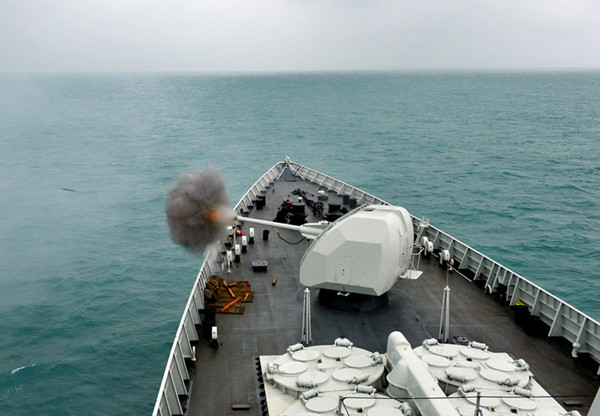
Navy destroyer Haikou returns to duty after refit

The PLA navy destroyer Haikou has undertaken more than 30 missions since the vessel was commissioned in 2005. Provided to China Daily
The destroyer Haikou, one of the most advanced warships in the People's Liberation Army navy, will be ready for duty this month after a 10-month maintenance period.
The Type 052C-class destroyer underwent the routine maintenance period scheduled for every 10 years of the ship's life, with work conducted at a military port in Guangdong province, according to authorities.
Construction on the ship started in 2002, and in 2005, it entered service in the South Sea Fleet, based in Guangdong province.
The maintenance included checking major components of the ship and repainting the main internal and external areas, said Li Hui, the ship's captain.
The ship's sailors and officers worked hard to ensure the combat readiness of the ship after maintenance was completed.
Wang Dong, a technician working on the Haikou, said many sailors worked in the shipyard that performed the maintenance and learned repair skills there that may be useful at sea. The idea was to prepare sailors to make emergency repairs when necessary, reducing the chances of the ship being out of action for long periods at sea.
Over the 10-month maintenance, the Haikou's crew continued to take part in various training operations. More than 100 sailors and officers participated in different missions, such as a joint Chinese-Russian military drill in July, Li said.
"The ship is ready for any mission now that the repair work is finished," Li said.
The ship's crew of 277, 16 of whom are women, receives training that simulates "real combat" environments, according to the ship's publicity officer.
The Haikou spends 280 days a year in "voyage training" at sea. Since it was commissioned in 2005, the ship has undertaken more than 30 missions, said Wu Chao, a publicity official for the PLA navy.
The Haikou is a successful example of PLA navy's performance at sea and combat capabilities, Wu said.
The Haikou participated in the first and 10th of the warships escort tours, each time accompanied by another destroyer and a supply ship. So far, the PLA navy has escorted 5,200 ships through the dangerous Somali waters.
In February 2009, the Haikou was dispatched to receive the Chinese commercial ship, the Tianyu No 8 after its release by Somali pirates. The ship had been hijacked and held by pirates for more than 80 days.
When it was released, it was running very low on supplies.
The Haikou's officers and soldiers donated food and clothes to help the commercial ship's crew after their release.
More importantly, the destroyer provided 60 tons of fuel as well as other supplies for the Tianyu No 8, despite difficulties posed by bad weather in the area.
As word of the PLA navy's safe and effective escorts spread in the area, more foreign ships, including those from Singapore, Cyprus and Greece, applied to join the Chinese escort fleets.
To meet their requests, the Haikou selected sailors who could speak fluent English to liaise with their partner ships. It set up a 24-hour bilingual signal channel and maintained contact with commercial ships from China and other countries by e-mail and fax.
The Haikou's contribution won the appreciation of foreign ships and international associations. In November 2009, the Haikou was awarded the Certificates for Exceptional Services Rendered to Shipping and Mankind by the International Maritime Organization.
ecns
Taiwan thinking of building its own submarines
Taiwan is evaluating the feasibility of building submarines on its own with technical assistance from the United States, according to a local newspaper.
The U.S. government approved the sale of eight diesel-powered submarines to Taiwan in 2001, but no progress has been made on the project since then.
Frustrated by the country's inability to procure submarines, Taiwan's military has gradually changed its attitude from "waiting for U.S. approval" to considering building submarines on its own with U.S. technological support, the United Daily News (UDN) said in a special report Monday.
The shift became even more evident after Yen Ming became defense minister and Adm. Chen Yung-kang took over the helm of the Navy Command Headquarters, according to the paper.
The following are excerpts from the UDN special report on the submarine-related issues:
Both the military and local shipbuilding community are assessing the feasibility of building conventional diesel-powered submarines at home instead of procuring them from the U.S.
A shipbuilding industry association is scheduled to come up with a comprehensive assessment report by June 2014.
Sources familiar with the Navy's submarine procurement project cited several reasons why the potential deal with the United States has remained stalemated.
First, the U.S. asked Taiwan to pay a contract design fee of more than NT$10 billion (US$338.36 million) even before the type of submarine to be sold to Taiwan was determined.
Partisan wrangling over the issue at the time prompted Taiwan's Legislature to balk at making the upfront payment.
A more critical obstacle to progress lies in the U.S. Navy's reluctance to build diesel-electric submarines at a U.S. shipyard because it fears that Congress would ask it to buy the conventional submarines to save money if an American shipyard had the capability to build such a ship.
Acting on the instructions of Defense Minister Yen, the Navy sponsored a closed-door seminar at the Armed Forces Club in Taipei in late November to discuss the feasibility of building submarines in Taiwan.
Adm. Chen chaired the meeting, which was attended by representatives from government agencies as well as academia and the private sector.
All participants reportedly agreed to list "building submarines locally" as an option.
Military and shipbuilding industry executives admitted that Taiwan still cannot build torpedoes, sonar, propulsion systems, combat systems and submarine periscope lenses.
Taiwan also needs to upgrade its blueprint design technology, they said.
Against this backdrop, they said Taiwan should seek U.S. technology transfer in those fields if it wants to build submarines at home.
A model used in Taiwan's building of Ching-kuo indigenous defense fighters (IDFs) in the past could be applied to the submarine building project, they said. U.S.-based General Dynamics had helped with IDF design. (Dec. 9, 2013).
focustaiwan.tw
The U.S. government approved the sale of eight diesel-powered submarines to Taiwan in 2001, but no progress has been made on the project since then.
Frustrated by the country's inability to procure submarines, Taiwan's military has gradually changed its attitude from "waiting for U.S. approval" to considering building submarines on its own with U.S. technological support, the United Daily News (UDN) said in a special report Monday.
The shift became even more evident after Yen Ming became defense minister and Adm. Chen Yung-kang took over the helm of the Navy Command Headquarters, according to the paper.
The following are excerpts from the UDN special report on the submarine-related issues:
Both the military and local shipbuilding community are assessing the feasibility of building conventional diesel-powered submarines at home instead of procuring them from the U.S.
A shipbuilding industry association is scheduled to come up with a comprehensive assessment report by June 2014.
Sources familiar with the Navy's submarine procurement project cited several reasons why the potential deal with the United States has remained stalemated.
First, the U.S. asked Taiwan to pay a contract design fee of more than NT$10 billion (US$338.36 million) even before the type of submarine to be sold to Taiwan was determined.
Partisan wrangling over the issue at the time prompted Taiwan's Legislature to balk at making the upfront payment.
A more critical obstacle to progress lies in the U.S. Navy's reluctance to build diesel-electric submarines at a U.S. shipyard because it fears that Congress would ask it to buy the conventional submarines to save money if an American shipyard had the capability to build such a ship.
Acting on the instructions of Defense Minister Yen, the Navy sponsored a closed-door seminar at the Armed Forces Club in Taipei in late November to discuss the feasibility of building submarines in Taiwan.
Adm. Chen chaired the meeting, which was attended by representatives from government agencies as well as academia and the private sector.
All participants reportedly agreed to list "building submarines locally" as an option.
Military and shipbuilding industry executives admitted that Taiwan still cannot build torpedoes, sonar, propulsion systems, combat systems and submarine periscope lenses.
Taiwan also needs to upgrade its blueprint design technology, they said.
Against this backdrop, they said Taiwan should seek U.S. technology transfer in those fields if it wants to build submarines at home.
A model used in Taiwan's building of Ching-kuo indigenous defense fighters (IDFs) in the past could be applied to the submarine building project, they said. U.S.-based General Dynamics had helped with IDF design. (Dec. 9, 2013).
focustaiwan.tw
Đăng ký:
Bài đăng (Atom)