Hiển thị các bài đăng có nhãn India-China. Hiển thị tất cả bài đăng

Thứ Bảy, 15 tháng 6, 2013

India Adding 40,000 Mountain Troops at China Border

NEW DELHI — Shortly after new Chinese Prime Minister Li Keqiang visited here, India has decided to proceed with a plan to add more than 40,000 troops in the form of a mountain corps to bolster its strength on the Chinese border.

Indian soldiers keep watch at Bumla pass at the India-China border. India plans to develop a mountain corps to boost its presence in the area. (Agence France-Presse)

The Ministry of Defence prepared the plan two years ago and has awaited consideration by the Ministry of Finance, which has given approval. Now, it must be cleared by the Cabinet Committee on Security, an MoD source said.

About US $12 billion will be spent to raise the additional troops, and the new corps is expected to be functioning within 10 years, an Army official said. Additional weapons and equipment will be purchased.

“The elite mountain corps will be able to fill this gap in preparedness, thereby adding to the conventional stability in the medium to long term, though in the short term it may be perceived as destabilizing,” defense analyst Rahul Bhonsle said.

Last month, China’s Li visited New Delhi, his first foreign visit after taking office, amid reports that Chinese troops had intruded into Indian territory. The issue was discussed during a meeting with Indian Prime Minister Manmohan Singh, though the point was passed off as “an incident,” an Indian External Affairs Ministry source said.

“The raising of additional troops to be deployed along the border with China is bound to raise tempers in Beijing,” the source said.

Analysts here, however, are unanimous that India and China can ill afford to go to war in the immediate future as both are building themselves economically.

“Given the track record of handling their military and diplomatic showdown ... China and India are not likely to go to war anytime soon,” said Swaran Singh, professor for diplomacy and disarmament at Jawaharlal Nehru Univer­sity. “It’s not a strong possibility even in their medium-term trajectories. It is not in their interest and the interest of the international community, which will ensure it does not occur.

“The strongest incentive against war is their historic chance to achieve their peaceful rise followed by greater recognition and participation in world decision-making bodies.”

But Bhonsle said New Delhi must manage the issue carefully.

“India will certainly have to make extensive efforts to manage concerns that may be raised by China; [otherwise], the move will prove counterproductive and will only lead to increases in force levels on both the sides,” he said. “Confidence-building measures on the boundary and greater transparency in raising the force, including the fact that it is being positioned in the interior, should assuage Beijing.”

The Army official welcomed the new, because the service is operating at only 60 percent of its required capability level.

As the troops will be deployed in hilly terrain, new purchases will include light tanks, specialized vehicles, light artillery guns and advanced infantry equipment.

The Army also will buyammunition and small arms, hand-held thermal imagers, UAVs, aerostat-based radar, portable missiles, air-defense artillery and lightweight radar.

The service will establish network-centric warfare systems for the elite troops, including advanced C4ISR equip­ment, and information warfare systems, Army sources said.

On the composition of the weapons required, Bhonsle said, “the weapons and equipment will include the whole gamut from reconnaissance, surveillance and target acquisition, firepower, tactical and logistics mobility including helicopters, communications and so on. Five years for forming up and almost eight to 10 years for full-spectrum effectiveness may be reasonable to assume.”

The 4,057-kilometer Line of Actual Control is India’s current border with China. The eastern sector, bordering the states of Sikkim and Arunachal Pradesh, is the most contentious, where China claims 90,000 square kilometers of territory that India occupies.

Defense News

Thứ Hai, 6 tháng 5, 2013

Tensions between China's Generals and the Civilian Leadership due to Ladakh stand-off

Fresh signs of tension between China’s military and the new Beijing regime are peering through a surprising backdoor. President Xi Jinping was thought to be closer to the generals than his predecessors but may now be involved in a backstage showdown with them over policy towards India, the other huge military power in Asia.

by BRIJ KHINDARIA, Foreign Affairs Columnist

China India flag graphic via shutterstock.com

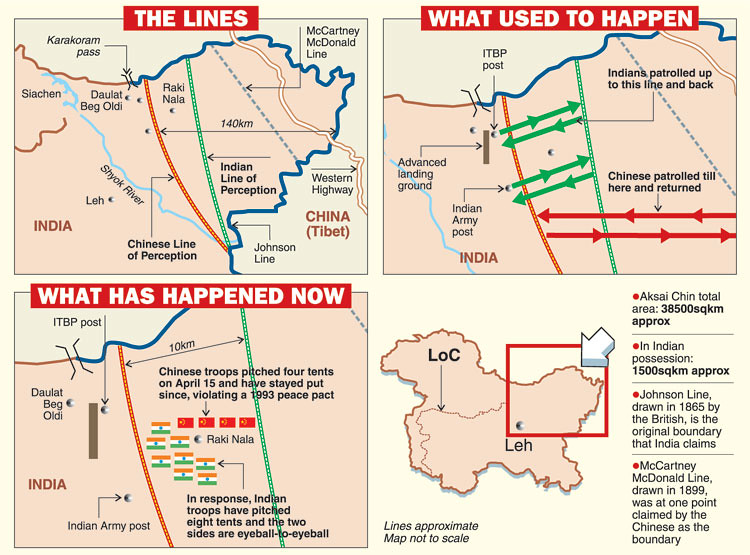
To underline India’s importance for Xi’s foreign policy, China’s new premier Li Keqiang plans to visit Delhi later this month, making India his first foreign trip since Xi and Li took power in March. But the atmosphere has been soured by the most serious Indian accusations in 25 years that Chinese soldiers have established military encampments six miles inside India in the Depseng valley of Ladakh. Incursions are common in the desolate and poorly delineated border but have never been this deep. The Chinese military has caused furor by claiming that territory so far away from the perceived border belongs to China.

Li’s visit was designed as a very positive move between two nuclear-armed giants that fought a war in 1962 and continue to have unresolved tensions along almost the entire length of their border. It was also meant to extend a friendly hand to Delhi, which has started to lean towards the US after decades of non-alignment. Alongside economic deals, goals included talking down Delhi’s fears of China’s growing military power and softening its belief that Beijing’s grip on Tibet is destroying Tibetan culture.

The Indian army noticed the Depseng valley camps about two weeks ago, causing uproar in parliament and the media although the foreign minister tried to play them down as spots of “acne” that can be treated “by simply applying an ointment.” Beijing says the dispute should be settled through negotiations but has not admitted that the soldiers are on Indian territory.
The disturbing and surprising element is that the incursions occurred just weeks before Li’s planned visit. The timing might mean that China’s generals are trying to force Xi’s hand because they do not want more trade and business expansion with India without concessions on the border. In the past five years, China has become India’s largest trading partner opening up opportunities for friendship.

The attempt now may be to use the sweeteners of economic partnership to get Delhi to swallow the bitter pill of Chinese claims to territory in the Ladakh region. The area is vital for India because it touches Pakistan, a bitter enemy and friend of China’s military that helped it to acquire the nuclear bomb and continues to be a major weapons supplier.

The Chinese military’s usual method is to push the envelope to evaluate the other side’s reactions. It is sending a signal to Delhi that the dragon is nearby to dissuade further leaning towards Washington, Beijing’s chief rival in a potential US-China cold war. The incursions may also be a signal to avoid leaning towards India’s largest weapons supplier, Russia, and instead build an independent relationship with Beijing but on terms favorable to the Chinese military’s perceptions. This is hard for Delhi because trust between the two countries falls far short of the friendship required for the Indian people not to feel threatened by Chinese power.

Currently, Indian nationalists are baying for a strong riposte to the incursions that might cause Li to cancel his visit. Some have accused the Indian prime minister and army of cowardice. Others note that India cannot successfully halt China in a border war because its supply lines are primitive compared to the four lane highways and airstrips near the border on the other side. They want a huge and sustained Indian military build up to face China in the future.

Apparently, China’s generals want to move quickly to pressure India before the military balance between the two countries becomes more equal and Indian can afford to react forcefully. However, it seems clear that Xi wants to focus on China’s economic problems rather than getting involved in a spat on India’s borders. A prolonged shootout may cause Washington and Europe to look on Beijing with renewed apprehension and trigger the US-China cold war that everyone wants to avoid.

Therefore, most hope that a visit to Beijing by the Indian foreign minister next week will defuse the situation. That should not be difficult since India wants only that the tents be dismantled. Whether that happens depends on Xi being able to stare down his generals.

Themoderatevoice

Chủ Nhật, 5 tháng 5, 2013

India - China military stand-off ends, Diplomatic tensions continue

Indian media reported on May 5th, China made ​​a surprise withdrawal from the disputed area Daulat Beg Oldi (DBO) in Ladakh, where they penetrated and pitched tents 19km deep inside the Indian territory over 2 weeks ago.


China-India face-off ends as armies withdraw from Ladakh

After a tense face-off for a couple of weeks, Chinese troops have decided to withdraw from Indian territory in Depsang plains in northern Ladakh. This will pave the way for foreign minister Salman Khurshid's visit to Beijing on May 9 and the Chinese premier's India visit on May 20.

While the official line is that both armies have withdrawn to their previous positions, its unclear why the Indian army would have to move back since it is very much within Indian territory. In fact, in his statement to a parliament committee, the ministry of defence had clarified that Chinese troops had come 19km inside Indian territory.

Both sides held the fourth and fifth flag meetings between local commanders over the weekend, amid the faint possibility of a resolution to the continuing troop standoff in the Depsang Bulge area in the coming days, which would make it possible for the visit to go on. The first three flag meetings, on April 18, 23 and 30, at Spanggur Gap between the Daulat Beg Oldi and Chushul sectors had failed to break the deadlock.

It is unclear whether India made any concessions to the Chinese or whether the withdrawal was unconditional. The Indian government had been reluctant to take a strong line with the Chinese for what was a national security scare. It is only under intense public and political pressure that the UPA government finally took a hard line.

Did India make a deal?

The Chinese had been insisting that India dismantle its security and monitoring posts built in Chumar and other areas. India had resisted this because Chumar is considered to have strategic significance, particularly since Indian soldiers can monitor troop movements across the Line of Actual Control from there.

Before the news of the troops withdrawing was announced, some sources had said India might agree to remove some of the structures as "a face saver" to enable the Chinese troops to withdraw to their pre-April 15 positions. Analysts said if the Indian government had indeed agreed to make a deal with the Chinese, this kind of incursion would be repeated over and over again.

The Chinese intransigence had created a political problem with memories of the 1962 war and India's humiliating defeat by China playing in everyone's minds. Both the ruling Congress party and the opposition had asked for Khurshid's visit to be cancelled after Chinese troops refused to withdraw despite three flag meetings with the Indian side.

The Chinese action caught India by surprise in mid-April. The Indian government tried hard to rationalize the incursion, with the Prime Minister Manmohan Singh describing it as "localized problem" and Khurshid as mere "acne". The Indian reaction was seen to be late, inadequate and appeared to be glossing over the importance of the Chinese action.

The government has been trying to preserve the forthcoming visit of the Chinese Premier Li Keqiang scheduled for May 20. But political pressure and growing public opinion has hardened the government's stand in recent days, with government leaders saying the Chinese visit could be cancelled if their troops did not withdraw.


Border row high on bilateral agenda with China now


Chinese troops at Daulat Beg Oldi sector of Ladakh holding banner during the stand-off that reads: "You've crossed the border, please go back." (PTI photo)

NEW DELHI: Though the Chinese troops' withdrawal ended the stand-off in Ladakh, the Sino-Indian boundary dispute will loom larger in the upcoming bilateral engagement during Chinese Premier Li Keqiang's visit than it would ordinarily have.

According to intelligence sources, prior to the withdrawal, the Chinese were assured by the Indian side that their concerns over the Indian border fortifications that have come up in Chumar, as well as the recent strengthening of infrastructure "too close to the LoC", would be taken up soon at the highest level.

"This may possibly mean that the boundary issue may figure more prominently in Li's upcoming visit to India on May 20," a senior government official told TOI.

Incidentally, the assessment in the security establishment has been that the Chinese incursion, some 19 km into what India perceives as its side of the Line of Actual Control (LAC), was essentially to flag the border demarcation issue and force India to move beyond brushing aside each incursion as a "difference of perception between India and China over LAC."

The Chinese troops' unprecedented act of pitching tents and staying put for days together at the point of incursion, rather than following the laid down border protocol of retreating soon after Indian border troops raise a banner, was possibly to make a point that it was time that the border row was addressed.

The timing was perfect, coming as it did just ahead of Li's visit. In fact, the flagging of concerns over the border fortifications at the earlier flag meetings, the ITBP believes, may have been an after-thought and meant to prolong the stand-off until closer to the Chinese premier's visit.

With the troops finally agreeing to retreat, India expects the tents to be pulled down on Sunday night, resulting in an all-clear by Monday morning. But as officials pointed out, the Chinese appear to have already achieved the purpose behind their latest border provocation: to make the border issue a prominent item on the agenda for Li's visit.

Times of India

China’s India Land Grab - Border Tensions Continue To Escalate

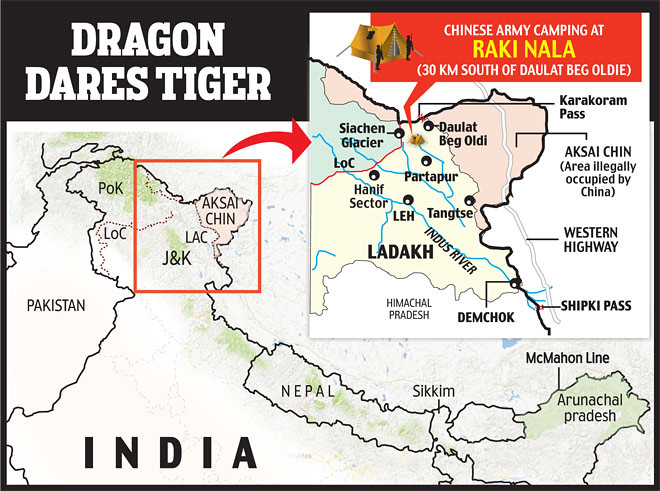
NEW DELHI – Stoking tensions with Japan, Vietnam, and the Philippines over islands in the South and East China Seas has not prevented an increasingly assertive China from opening yet another front by staging a military incursion across the disputed, forbidding Himalayan frontier. On the night of April 15, a People’s Liberation Army (PLA) platoon stealthily intruded near the China-India-Pakistan tri-junction, established a camp 19 kilometers (12 miles) inside Indian-controlled territory, and presented India’s government with the potential loss of a strategically vital 750-square-kilometer high-altitude plateau.

China’s India Land Grab - Border Tensions Continue To Escalate

A stunned India, already reeling under a crippling domestic political crisis, has groped for an effective response to China’s land-grab – the largest and most strategic real estate China has seized since it began pursuing a more muscular policy toward its neighbors. Whether China intends to stay put by building permanent structures for its troops on the plateau’s icy heights, or plans to withdraw after having extracted humiliating military concessions from India, remains an open – and in some ways a moot – question.

CommentsView/Create comment on this paragraphThe fact is that, with its “peaceful rise” giving way to an increasingly sharp-elbowed approach to its neighbors, China has broadened its “core interests” – which brook no compromise – and territorial claims, while showing a growing readiness to take risks to achieve its goals. For example, China has not only escalated its challenge to Japan’s decades-old control of the Senkaku (Diaoyu) Islands, but is also facing off against the Philippines since taking effective control of Scarborough Shoal last year.

CommentsView/Create comment on this paragraphWhat makes the Himalayan incursion a powerful symbol of China’s aggressive new stance in Asia is that its intruding troops have set up camp in an area that extends beyond the “line of actual control” (LAC) that China itself unilaterally drew when it defeated India in the 1962 Chinese-initiated border war. While China’s navy and a part of its air force focus on supporting revanchist territorial and maritime claims in the South and East China Seas, its army has been active in the mountainous borderlands with India, trying to alter the LAC bit by bit.

CommentsView/Create comment on this paragraphOne of the novel methods that the PLA has employed is to bring ethnic Han pastoralists to the valleys along the LAC and give them cover to range across it, in the process driving Indian herdsmen from their traditional pasturelands. But the latest crisis was sparked by China’s use of direct military means in a strategic border area close to the Karakoram Pass linking China to India.

CommentsView/Create comment on this paragraphBecause the LAC has not been mutually clarified – China reneged on a 2001 promise to exchange maps with India – China claims that PLA troops are merely camping on “Chinese land.” Yet, in a replay of its old strategy of furtively encroaching on disputed land and then presenting itself as the conciliator, China now counsels “patience” and “negotiations” to help resolve the latest “issue.”

CommentsView/Create comment on this paragraphChina is clearly seeking to exploit India’s political disarray to alter the reality on the ground. A paralyzed and rudderless Indian government initially blacked out reporting on the incursion, lest it come under public pressure to mount a robust response. Its first public statement came only after China issued a bland denial of the intrusion in response to Indian media reports quoting army sources.

CommentsView/Create comment on this paragraphTo add to India’s woes, Salman Khurshid, the country’s bungling foreign minister, initially made light of the deepest Chinese incursion in more than a quarter-century. The garrulous minister called the intrusion just “one little spot” of acne on the otherwise “beautiful face” of the bilateral relationship – a mere blemish that could be treated with “an ointment.” Those inept comments fatally undercut the government’s summoning of the Chinese ambassador to demand a return to the status quo ante.

CommentsView/Create comment on this paragraphWith Prime Minister Manmohan Singh’s corruption-tainted government tottering on the brink of collapse, there has been no official explanation of how India was caught napping in a militarily critical area where, in the recent past, China had made repeated attempts to encroach on Indian land. In fact, the government inexplicably replaced regular army troops with border police in 2010 to patrol the mountain-ringed plateau into which the PLA has now intruded. Known as Depsang, the plateau lies astride an ancient silk route connecting Yarkand in Xinjiang to India’s Ladakh region through the Karakoram Pass.

CommentsView/Create comment on this paragraphIndia, with a military staging post and airstrip just south of the Karakoram Pass, has the capacity to cut off the highway linking China with its “all-weather ally,” Pakistan. The PLA intrusion, by threatening that Indian base, may have been intended to foreclose India’s ability to choke off supplies to Chinese troops and workers in Pakistan’s Gilgit-Baltistan region, where China has expanded its military footprint and strategic projects. To guard those projects, several thousand Chinese troops reportedly have been deployed in the rebellious, predominantly Shia region, which is closed to the outside world.

CommentsView/Create comment on this paragraphFor India, the Chinese incursion also threatens its access to the 6,300-meter-high Siachen Glacier, to the west of Depsang. Pakistan claims the Indian-controlled glacier, which, strategically wedged between the Pakistani- and Chinese-held parts of Kashmir, served as the world’s highest and coldest battleground (and one of the bloodiest) from the mid-1980’s until a cease-fire took effect in 2003.

CommentsView/Create comment on this paragraphIndia’s nonmilitary options to force a Chinese withdrawal from Depsang range from diplomatic (suspension of all official visits or reconsideration of its recognition of Tibet as part of China) to economic (an informal boycott of Chinese goods, just as China has hurt Japan through a nonofficial boycott of Japanese-made products). A possible military response could involve the Indian army establishing a camp of its own on Chinese territory elsewhere that China’s leaders regard as highly strategic.

CommentsView/Create comment on this paragraphBut, before it can exercise any option credibly, India needs a stable government. Until then, China will continue to press its claims by whatever means – fair or foul – it deems advantageous.

Project-Syndicate

Thứ Sáu, 26 tháng 4, 2013

Chinese troops have erected tents 19km inside Indian territory: Govt

NEW DELHI: The government on Friday told a parliamentary committee that Chinese troops have pitched tents 19km deep inside the Indian territory in Ladakh region of Jammu and Kashmir and that efforts are underway to ensure that the status quo is maintained.


Indian Army patrols reported on April 16 the presence of Chinese People's Liberation Army in Depsang, pitching tents 19km inside the LAC

Defence secretary Shashi Kant Sharma and some other senior officials informed the parliamentary standing committee on defence that India has deployed forces to "keep a close watch on the border", sources told .

Sharma and other officials appeared before the committee after BJP members Mukhtar Abbas Naqvi and Prakash Javadekar wanted to know the actual ground situation in Depsang sector of Ladakh where the Chinese incursion took place in Daulat Beg Oldie area a week ago.

The meeting of the committee was cut short as members were dissatisfied with the insufficient information provided by the officials and they were asked to report back at the next meeting on May 30 with appropriate and exact details of the situation.

The officials told the committee that Indian Army patrols reported on April 16 the presence of Chinese People's Liberation Army in Depsang, pitching tents 19km inside the LAC, the sources said.

They told the panel that as per the established mechanisms, the issue has been taken up at the level of flag meetings and through diplomatic channels to maintain status quo and resolve the issue through existing mechanisms.

The defence ministry officials told the committee that China disputes the international boundary with India and there is no commonly delineated LAC between the two countries.

They said there are a few areas along the border where India and China have differing perceptions of the LAC, the sources said.

Incidents of transgression due to differences in the perception of LAC are taken up with the Chinese side through established mechanisms such as border personnel meetings, flag meetings, hotlines and diplomatic channels, the officials told the panel.

The agenda for today's was welfare of armed forces personnel but the issue related to incursion in Ladakh was added after Naqvi and Javadekar demanded to get the clear picture of the situation and on how the government is handling it.

Naqvi and Javadekar wrote to standing committee chairman Raj Babbar on THursday, saying the situation in Ladakh is "very serious" but the government is not taking it seriously.


Times of India

Thứ Tư, 24 tháng 4, 2013

Flag meet between India, China military commanders fails to end stand-off in Ladakh

The face-off between the Indian Army and the People's Liberation Army (PLA) of China continued on the Line of Actual Control (LAC) as a flag meeting between the local commanders held on Tuesday failed to resolve the differences.


China rejected India's contention that its troops had breached the sanctity of the LAC by setting up a tented post at Raki Nala, 30 km south of Daulat Beg Oldi in north Ladakh. The PLA, in fact, claimed that the Indian armymen were on an "aggressive patrol".

As of now, the two sides will hold on to their positions. The only consolation for India is that China has decided not to escalate the tension. The army is now looking at government-togovernment-level interaction to resolve the issue.

The foreign ministry has conveyed its objection to China. "We have asked the Chinese side to maintain the status quo in this sector (of the western border)," said Syed Akbaruddin, official spokesperson in the ministry of external affairs.


"We see this as a ‘face-to-face' situation between border personnel of two sides due to differences on their alignment of the LAC," the official said. Face-to-face situation is referred to the 2005 protocol for implementing confidence building measures (CBMs) in military field along the LAC.

Army chief's visit Army chief general Bikram Singh was on a scheduled visit to Nagrota, the headquarters of 16 corps, which guards the Line of Control in Jammu and Kashmir.

The army chief met northern army commander Lt-General K.T. Parnaik, who heads the army in Jammu and Kashmir region.

Senior officers of the two armies have met twice since April 15, when a platoon of PLA set up a tented camp 10 km inside the Indian territory. The first flag meet on April 18 at Chishul in eastern Ladakh, too, failed to resolve the deadlock between the two countries.

Before the flag meeting, banner drills were also carried out, asking the Chinese troops to vacate the position. "This is our area, you are violating the LAC, go back," read the Indian banner. The banner drill is being practiced since 2005 to resolve misunderstandings about unmarked boundary.

Sources said the unusual aspect of the present stand-off is the refusal by the PLA to budge. In the past, the Chinese patrol used to leave the area after seeing the Indian banner.

The PLA's stand is also confusing as a number of high-level exchanges are lined up in the coming months to strengthen military ties. Defence minister A.K. Antony is scheduled to visit China sometime in June and an army delegation is preparing to leave for Beijing to discuss revival of military exercise "hand-inhand" after a gap of five years.

The Indian Army has described the situation as a "face-off" and moved troops from Ladakh Scouts into the area. The Indian soldiers have also pitched tents around 150 meters from the PLA platoon's post, comprising around 50 men. Foreign secretary Ranjan Mathai had summoned the Chinese ambassador to South Block.

Gautam Bambawale, joint secretary in MEA, who is heading the India-China joint working mechanism to deal with issues on the boundary from the Indian side, spoke to his counterpart in Beijing last week, stressing the need to resolve the row.

However, the Chinese have been adamant on their stand. Chinese foreign ministry spokesperson Hua Chunying said on Monday that China's troops have been abiding by the agreement between the two countries. "Our troops are patrolling on the Chinese side of the LAC and have never trespassed the LAC," Lua said.

-With inputs from Saurabh Shukla

India Today

Thứ Ba, 26 tháng 3, 2013

India readies hi-tech naval base to keep eye on China

INS Chakra As She Arrived In India
NEW DELHI: Slowly but steadily, India's new futuristic naval base is beginning to take concrete shape on the eastern seaboard. The strategic base, with an eye firmly on China, will eventually even have underground pens or bunkers to protect nuclear submarines both from spy satellites and enemy air attacks.

Sources said a flurry of discussions and meetings have been held in the PMO and defence ministry over the last couple of months to firm up "expansion plans'' for a base located near Rambilli called "Project Varsha" on the Andhra coast — just about 50 km from the Eastern Naval Command headquarters at Visakhapatnam — over the coming decade.

Though it's still very early days for Project Varsha, some bill it as an answer to China's massive underground nuclear submarine base at Yalong on the southernmost tip of Hainan Island, which houses its new Shang-class SSNs (nuclear-powered attack submarines) and the Jin-class SSBNs (nuclear-powered submarines with long-range nuclear missiles).

Although land acquisitions and incremental development work on the base under the secretive project kicked off a few years ago, it is set to take off in a major way with the construction of tunnels, jetties, depots, workshops and accommodation. "Further land acquisitions for the sprawling base to be spread over 20 sq km are now underway, with long-term budget allocations also being planned,'' said a source.

The endeavour dovetails into the overall policy to bolster force-levels on the eastern seaboard, with new warships, aircraft and spy drones as well as forward-operating (FOBs) and operational turnaround (OTR) bases, to counter China's expanding footprint in the entire Indian Ocean Region (IOR).

Naval assets to protect India's long coastline and keep watch over the crucial trade corridors in the Indian Ocean are essential to Indian interests. The strategic value of force projection beyond the Andaman islands is seen in terms of deterrence as well given the aggressive military Chinese expansion. India's own SSBN programme is also poised to turn the corner soon with sea trials of the 6,000-tonne INS Arihant slated to begin off Visakhapatnam. INS Arihant and its three "follow-on'' SSBNs, which will complete India's elusive nuclear weapon triad since they will be armed with the `K' series of submarine-launched ballistic missiles, as well as other frontline warships will be housed at the new base.

The Navy plans to operate at least three SSBNs and six SSNs in the long run for effective nuclear deterrence. Moreover, after inducting the 8,140-tonne INS Chakra submarine on a 10-year lease from Russia last year, India is now negotiating the lease of another such nuclear-powered Akula-II class submarine, as was earlier reported by TOI.

Project Varsha's ambitious scale in the years ahead will rival the expansive "Project Seabird'' under which the Karwar naval base has come up in coastal Karnataka to give India both strategic depth and operational flexibility on the western seaboard against Pakistan. While Karwar will decongest the over-crowded Mumbai port, the new base will do the same for Vizag on the east.

Karwar can currently base 11 major warships and 10 yard-craft after completion of its Phase-I at a cost of Rs 2,629 crore. The Cabinet Committee on Security (CCS) had last year approved Rs 13,000 crore for its expansion under Phase-IIA to ensure it can berth 32 major warships and submarines by 2018-19.

Karwar will be the home base for aircraft carrier INS Vikramaditya, the 44,570-tonne Admiral Gorshkov being refitted in Russia for $2.33 billion, as well as the six French Scorpene submarines being built at Mazagon Docks for Rs 23,562 crore.

The Times of India

Thứ Sáu, 22 tháng 3, 2013

India watchful of implications of China's military profile: Report

NEW DELHI: India is "conscious and watchful" of the implications of China's military profile and is taking neccesary measures to develop capabilities to counter any adverse impact on its security, Defence Ministry said on Wednesday.

In its annual report, the Ministry also said the security situation in Pakistan is a cause of concern due to continuing activities of terrorist organisations on its territory and territories under its control.

"India remains conscious and watchful of the implications of China's military profile in the immediate and extended neighbourhood. India is also taking requisite capabilities to counter any adverse impact on its security," the report for 2012-13 said.

It said India feels that there is "adequate space" for both the countries to rise peacefully and coexist in harmony.

On Pakistan, the report said that existence of terror camps inside Pakistan and across the Line of Control (LoC) "continue to demonstrate Pakistan's attitude and approach towards terrorists organisations."

The Ministry said it feels that "such organisations pose a danger to Pakistan's own social and political fabric."

"The ambush of Indian troops on January 8 by Pakistan Border Action Team and the heinous killing of two Indian soldiers during this attack have been strongly taken up with Pakistan," the report said.

On the internal security situation in the country, the report said the security forces are effectively tackling the infilitration attempts by terrorists from Pakistan in Jammu and Kashmir.

"The security situation in the northeastern region has continued to improve while activities of certain insurgent groups engaged in building up capabilities are being closely monitored," it said.

http://articles.economictimes.indiatimes.com/2013-03-20/news/37872756_1_military-profile-security-situation-security-forces

Thứ Hai, 18 tháng 3, 2013

China's nuclear powered aircraft carrier programme rings alarm bells in India

A China's nuclear powered aircraft carrier programme
China's plans of building a nuclear powered aircraft carrier using reactors of existing submarines has led to alarm bells ringing as the warships could be used to patrol the Indian Ocean, which is 2,500 km from its coast.

So is China flexing its muscles in India's strategic space and what should India's response be?

A clumsily worded sentence on the website of China's Shipbuilding Industry Corporation sparked off a firestorm on the internet that the Chinese military's biggest shipyard was going to build a nuclear powered aircraft carrier with reactors probably based on its existing submarine reactors. Within days, the words were off the website, but it tied in with Indian naval assessments that China was planning a permanent and sustainable strategic thrust into the Indian Ocean 2,500 miles away from its coast and through which bulk of its energy supplies pass.

Preparations had been obvious since 2008 when a submarine base began operations on Hainan Island on the South China Sea, close to the Malacca Straits. In recent months, speculation about China pressing the Maldives to allow a submarine base has intensified. Then there is the Chinese airfield project in Hambantota in Sri Lanka and recently Pakistan's Gwadar Port was dredged to a depth of 14 metre to allow large vessels to dock.

Retired Rear Admiral Raja Menon said, "These are potential places, but whether they become bases, that's a big leap, because that means accepting Indian hostility to giving a base to China. From that point of view the best bet would be Gwadar because they already face anti-Indian opinion."

Dr Sreekanth Kondapalli, Chinese Navy analyst, said, "Being a regional local navy and power, India has huge territorial advantage by being closer to the IOR, yet India cannot claim ownership to the region because it is the third largest ocean with open navigation principles."

Naval strategists say India should build its own nuclear powered aircraft carrier and counter China in the east and south China seas. It should also form alliances with the Japanese and Korean navies with the aim being to tie down large elements of the Chinese navy.

That apart, a maritime dialogue between the two navies covering the Indian Ocean and South China Sea, would be a useful confidence building measure. But China is reluctant, while it does not see the Indian Ocean as India's Ocean, its recent actions have clearly demonstrated that the SCS is China's own.

ibn live

Thứ Hai, 4 tháng 3, 2013

India's nuclear-powered submarine rattles China

India recently test-fired a submarine-launched ballistic missile capable of carrying a nuclear warhead – something that is of serious concern not only to New Delhi’s arch-rival Pakistan, but also to China, according to report from Joseph Farah’s G2 Bulletin.

China recently has been concerned about India’s efforts to expand its influence in the East and South China Seas, where Beijing has asserted exclusive jurisdiction especially over maritime resources. Beijing is upset with India over its assistance to Vietnam in off-shore oil exploration.

At the same time, New Delhi has been equally concerned about China’s expansion into the Indian Ocean. Beijing strategists see the Indian nuclear ballistic missile submarine capability as threatening its access to the Indian Ocean through the Malacca Strait, where 25 percent of global trade takes place.

At the same time, India could use its future ballistic missile submarine force to block Chinese oil imports through the Strait, thereby causing major disruptions in the Chinese economy.

In response to this future prospect, China has set up a network of forward-deployed naval bases to protect its oil shipping lanes to the Middle East. Some of these facilities will be in the Indian Ocean, which New Delhi sees as a plan by Beijing to surround it.

However, New Delhi’s deployment of these SLBMs could complicate that strategy and actually position Indian submarines off of China’s shores, resulting in the threat to China of a ballistic missile attack.

India’s ability to launch a ballistic missile submarine will ensure that neither China nor Pakistan will be able to destroy New Delhi’s nuclear capability in a first strike. With the ability to launch a ballistic missile from a submarine, it completes New Delhi’s nuclear triad – launching a nuclear attack from land, sea or air.


The missiles will be placed on India’s Arihant nuclear submarine. It will be outfitted with four launch silos designed to hold 12 of the new missiles that have a range from 700 kilometers to 3,500 kilometers.

The Arihant is expected to be operational this year, with three more planned for construction and put into operation by 2025.

Sources say that this reflects a new Indian strategic direction to make the Indian Ocean its own area of influence in competition with the Pakistanis.

WDN

Thứ Tư, 27 tháng 2, 2013

India ready to induct BrahMos cruise missile into Air Force by 2014

NEW DELHI, Feb. 26 (Xinhua) -- India will be ready to induct BrahMos supersonic cruise missile into its Air Force by the end of next year, a top official has said.

"The program for induction of BrahMos supersonic cruise missile with a speed of Mach 3 into the Indian Air Force will be ready by the end of 2014. BrahMos will be upgraded to a hypersonic cruise missile with a speed of Mach 7 by 2017," Sivathanu Pillai, the chief executive of BrahMos Aerospace Private Limited, was quoted by the local media as saying in the southern state of Tamil Nadu Monday.

He added, "While Europe, the U.S. and China are in the process of developing such missiles, efforts are under way in India to make Mach 8 possible."

The land-launched and ship-launched versions of BrahMos, the world's fastest cruise missile in operation, are already in service. BrahMos is named after two rivers, the Brahmaputra in India and the Moskva in Russia.

The BrahMos Aerospace Private Limited is a joint venture between the state-owned Defense Research and Development Organization and NPO Mashinostroyenia (NPOM) of Russia.