Thứ Sáu, 5 tháng 7, 2013

China deploys largest-ever single military force


China and Russia have begun their largest ever joint naval exercise in the Sea of Japan. It’s the Chinese navy’s single biggest deployment of military force in any joint foreign exercise.

The Chinese Navy has dispatched four guided missile destroyers, two guided missile frigates, a supply ship, and three ship-borne helicopters. There are nineteen warships and more than 10 aircraft and helicopters taking part in the maneuvers. China’s national defense ministry says the drills are not targeted at any third party, and the aim is to deepen cooperation between the two militaries.

The two navies will practice recapturing ships seized by pirates and search-and-rescue operations. There will also be a number of air defense, anti-submarine and anti-ship exercises. Operation "Joint Sea-2013" will run through to July 12th. Russia and China have regularly held joint naval drills since 2005, under the framework of the Shanghai Cooperation Organization.

Destroyer Shenyang (R) of the Chinese People's Liberation Army (PLA) Navy is anchored in Vladivostok, Russia, July 5, 2013. Chinese fleet consisting of seven naval vessels arrived in Vladivostok on Friday to participate in Sino-Russian joint naval drills scheduled for July 5 to 12 at the sea area and airspace of the Peter the Great Gulf in the Sea of Japan. (Xinhua/Wang Jingguo)
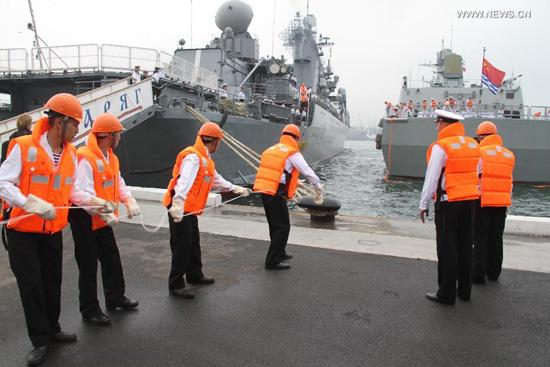


Destroyer Shenyang (R) of the Chinese People's Liberation Army (PLA) Navy is
anchored in Vladivostok, Russia, July 5, 2013. Chinese fleet consisting of
seven naval vessels arrived in Vladivostok on Friday to participate in
Sino-Russian joint naval drills scheduled for July 5 to 12 at the sea area
and airspace of the Peter the Great Gulf in the Sea of Japan. (Xinhua/Wang Jingguo)

CCTV

NATO chief downplays reports of US spying in Brussels -- Stars and Stripes

U.S. spy agency NSA hit with furloughs starting next week -- Reuters

France 'runs vast electronic spying operation using NSA-style methods' -- The Guardian

Britain's Army reserves to become cyber security and intelligence specialists - and receive more benefits -- The Independent

Flabby hackers, we want you: Britain eases physical standards for military ‘cyber-reservists’ -- AP

Preparing for cyberwarfare -- Michael Richardson, Japan Times

Russia to Lay Down 3rd Yasen Class Nuclear Sub on July 26 -- RIA Novosti

Russian Air Force to Get Su-30SM Fighter Jets in Bulk -- RIA Novosti

Russian Defense Minister Wants More Spending on R&D Units -- RIA Novosti

Coming Soon: India’s First Indigenous Aircraft Carrier -- Zachary Keck, The Diplomat

Orbital Blockade Imposed On Iran -- Strategy Page

Iran upgrades missile defense system -- UPI

Mexican generals accused of ties with drug cartel set free -- Reuters

Russia offering Su-30s to Ethiopia -- Defence Web

Philippines To Buy 2 Maestrale Frigates From Italy -- Defense News/AFP

Chinese Navy Ships Arrive in Russian Far East for Drills -- RIA Novosti

US Navy Boosts Arabian Gulf Patrol Craft Force -- Defense News

Positive trends greet Navy’s Asia deployments, but tensions at sea remain -- Stars and Stripes

Laser Could be New Eyes of the Military -- Military.com/NewsRx.com

Army IT Deal Tops $45 Billion in June Awards -- DoD Buzz

Military Sonar May Hurt Blue Whales -- Live Science

Grieving parents sue for answers from Air Force -- Air Force Times

Brace for similar sequester impact in 2014, Greenert says -- Stars and Stripes/Virginia Pilot

National Guard soldiers, airmen to be furloughed -- AP

Squeezing the Pentagon: The wrong way to cut America’s military budget -- The Economist

In the 1970s, the U.S. military struggled with morale -- Jim Michaels, USA TODAY

Vietnam’s 2nd Russian-made sub completes sea trials

The second Kilo-class submarine Vietnam agreed to buy from Russia has completed its sea trials and been returned to the shipyard where it was built, Russian news agency Interfax reported Tuesday.

Kilo class submarine
Kilo class Submarine

The submarine named Ho Chi Minh City and built by Admiralty Shipyards of St. Petersburg undertook two dives, reaching a depth of 190 meters on one of them, reported Interfax.

The Ho Chi Minh City set off for its sea trials on April 28, four months after being launched.

The training of the submarine’s Vietnamese crew will take place later this month.

According to Interfax’s sources, the third of the six submarines that Vietnam ordered from Russia, named after Vietnam’s port city of Hai Phong, will be launched at the end of this year, while the remaining three are still being built.

Vietnam signed a US$2 billion deal to buy six Kilo-class diesel-electric submarines during Prime Minister Nguyen Tan Dung’s visit to Moscow in December 2009, with Russia promising to deliver all of them by 2016. As part of the deal, Russia agreed to train the Vietnamese crew and supply Vietnam with necessary equipment.

The first sub, named after Vietnam’s capital city of Hanoi, was launched in August 2012.

It underwent 23 successful dives, according to an Interfax report in May.

The first two subs are scheduled to be handed over to Vietnam later this year.

Kilo-class subs, nicknamed “Black Holes” for their ability to prevent detection, are designed to carry out anti-submarine and anti-ship missions, general reconnaissance and patrols, according to a RIA Novosti report. They are thought to be among the world’s quietest diesel-electric powered subs.

Equipped with six 533-millimeter torpedo tubes, they can travel up to 9,600 kilometers without refueling; have a displacement capacity of 2,300 tons; and can reach depths of up to 350 meters.

Vietnam has said it has purchased the Kilo-class subs and other armaments exclusively for self-defense purposes.

The Voice of Russia quoted the country's military expert said that the first two Vietnam's Russian-made Kilo class submarines for Vietnam, Hanoi (HQ-181) and Ho Chi Minh City (HQ-182), will make its maiden voyage swimming sequences to Vietnam by way through Africa.

Thanhnien News

Russian Air Force to Get Su-30SM Fighter Jets in Bulk


Sukhoi Su-30SM multirole fighter jets will be delivered to the Russian Air Force as fully equipped squadrons, rather than “piecemeal,” deputy commander Colonel Sergei Kobylash said Thursday.

The Su-30SM is the latest development of the twin-seat Su-30 jet fighter family, a derivative of the long-serving single-seat Sukhoi Su-27, one of the air force's most important warplanes.

The new aircraft has better radar and communications capabilities, an improved friend-or-foe system, a new ejection seat and new weapons. It also has thrust-vectoring engine nozzles, providing super-maneuverability at low airspeeds.

The first contract between the Defense Ministry and Irkut Corporation for 30 Su-30SMs was signed in March last year. The Russian Air Force received the first two Su-30SM aircraft in November. In mid-December, a new contract was signed for an additional 30 jets by 2016.


RIA Novosti

Thứ Tư, 3 tháng 7, 2013

Navy Pivots Training to Match Pacific Transition

The U.S. Navy’s multi-national exercises in the Pacific theater are growing in size and taking on new dimensions due to the U.S. military’s overall strategic re-balance or “pivot” to the region, service officials explained.

Air-Sea Battle
US Navy's Air-Sea Battle Illustration

Although many of the multi-national exercises currently underway have been growing in recent years, the U.S. military’s strategic focus on the area is having a profound impact upon training activities there, Navy officials acknowledge.

The Navy’s Pacific pivot means that the service will base as much as 60-percent of its fleet in the region, work to strengthen ties with regional partners and place up to four Littoral Combat Ship vessels on rotational deployments through Singapore.

The ongoing Cooperation Afloat Readiness and Training, or CARAT, exercise, now in its 19th year, has been steadily growing larger over the years and taking on a broader scope of activities. CARAT is a nine-country series of bilateral exercises between the U.S. and Bangladesh, Brunei, Cambodia, Indonesia, Malaysia, Singapore, the Philippines, Thailand, and East Timor, Navy officials said.

The exercise is designed to enhance maritime security skills and interoperability among participating forces through a series of joint exercises which include communications activities, aircraft monitoring drills and visit, board, search and seizure drills, among other things.

In particular, the presence of the LCS allows for joint collaborative activities in shallow water previously not possible in these kinds of exercises. The recently-completed CARAT Malaysia marked the LCS’ first time participating in this series of bilateral naval exercises, Navy officials indicated.

CARAT Malaysia included the USS Freedom, an LCS, as well as the guided-missile destroyer USS Curtis Wilbur, the amphibious dock landing ship USS Tortuga, and the rescue and salvage ship USNS Safeguard, said Lt. Anthony Falvo, spokesman, U.S. Pacific Fleet.

“The Pacific re-balance is allowing us to do things we have not been able to do in the past. Some of our allies were looking for something a little more compatible with what they had. The LCS allows us to better train and adapt to our partner navies who have been operating smaller, shallow-draft platforms for years,” said Falvo.

Unlike the deep draft known to accompany some of the U.S. Navy’s larger ships, the LCS can more readily and easily interoperate in shallow water with ships from allied navies such as the Philippines, Malaysia, Thailand and others, Falvo explained.

“The LCS is opening a whole new world for the U.S. Pacific Fleet, as it allows the U.S. Navy access to ports and waters that have been hard for us to access previously due to deep-draft platforms and ships. With her shallow draft, the LCS platform allows us the ability to engage potential shore-based threats from as little as 13 feet of water,” Falvo added.

The CARAT drills, happening now with the Philippine Navy and the USS Fitzgerald along with some other ships, also help the U.S. establish and refine operations with partner nations. Being able to operate and address threats close to shore — in close coordination with regional allies – is a key part of the Navy’s pacific re-balance or emphasis.

The Pacific fleet is also participating in its 8th annual so-called Pacific Partnership humanitarian exercise, a multi-national disaster relief exercise designed to increase capabilities in the region for countries such as Bangladesh, Indonesia, the Philippines and East Timor, among others.

Pacific Partnership has also grown in scope and size. The exercise included eight partner nations and eight NGOs in 2006, and last year’s mission included 13 partner nations, 28 NGOs, four U.S. agencies and a joint effort across the Department of Defense, Falvo said.

Also, Pacific Partnership 2013 will be the first mission where our partner nations lead individual phases, he explained.

“Australia will lead in Papua New Guinea, New Zealand will lead in both Kiribati and Solomon Islands, while the United States leads in Samoa, Tonga, and the Marshall Islands. Sharing of lead responsibilities and logistical resourcing among partner nations will keep this mission sustainable in light of future fiscal challenges,” he added.

DoD Buzz

'Working On Interceptor Against 5,000-km Range Enemy Missile': DRDO Chief

With Defence Minister AK Antony in China, the first by a Defence Minister in seven years, new facts about the direction India's nuclear missile programme is taking could send out an unprecedented message. In details revealed for the first time in an exclusive interview to me for Headlines Today, the new chief of the Defence R&D Organisation (DRDO) Dr Avinash Chander has revealed that one of his key mandates as the head of the country's military research comple
x, is to drastically reduce the time India will take for a potential nuclear counter-strike.

Unlike China, India has been typically timid about its strategic programmes. The DRDO chief's revelations make for a rare, bold message about the goings on within the country's most advanced weapons laboratories.

"In the second strike capability, the most important thing is how fast we can react. We are working on cannisterised systems that can launch from anywhere at anytime," said Dr Chander. "We are making much more agile, fast-reacting, stable missiles so response can be within minutes." India has a no first use policy for nuclear weapons, and its current response time for a retaliatory strike is classified. The DRDO chief's task is to whittle it down by a substantial degree to provide the Strategic Forces Command (SFC) with a literally 'anywhere-anytime' ability.

Dr Chander, formerly director with the Advanced Systems Laboratory (ASL) in Hyderabad and renowned as the spearhead of the Agni family of missiles, was made chief of the DRDO last month.

India's current land-based nuclear weapon delivery systems include the 1,250-km range Agni-I, 2,000-km range Agni-II and 3,500-km range Agni-III. The DRDO chief has expressed confidence that 2 of India's two most ambitious nuclear missiles under test, the 4,000-km range Agni-IV and 6,000+ km range Agni-V, will both be inducted into the strategic arsenal within two years.

"We'll induct the Agni IV and V inducted in the next two years. It's the first time we will be inducting strategic missiles with such long ranges together. Agni III, IV and V are going to be the thrust areas. They give us the reach which we need, and are our highest priority now. Within two years we have to make sure that it happens," said Dr Chander.

Currently, the ASL is steeped in researching futuristic missile technologies. "In the future, the country will require much more precise warheads which are able to counter anti-ballistic missile defences. A manoeuvring warhead is going to be a key challenge. That's the next strategic capability which will become essential. That in turn will be followed by multiple warheads, with decoys, warheads, and other combination," said Dr Chander.

Asked about whether India needed an inter-continental ballistic missile (ICBM), with ranges in excess of 10,000-km like China's DF-31 and other in-development weapons, Dr Chander said his missile laboratories could develop and deploy an ICBM in as little as three-five years. "As we see today, we don't find the need for ranges more than 5,000-6,000 km. The technology building blocks required to build a longer range missile already exist. We are in a position to activate any such system at very short notice," said Dr Chander.

Asked about how India's missile programme squared off against China's, he said, "Comparisons are odious, always difficult, and many times taken out of context. If you see at the capability level, our missiles, radars are comparable with the Chinese and other friends around us."

On India's ballistic missile defence (BMD) system, Dr Chander said, "Ballistic missile defence capabilities of our adversaries will also grow in the years to come. As far as our BMD is concerned, we are now poised for take-off. We've done a lot of tests, need to do perhaps a few more tests. With that, we will be ready to intercept missiles upto a range of 2,000km. That system we will be able to start deploying. At the same time, our effort to develop a system to intercept missiles with a range of 5,000km is underway. Testing of those missiles is one of the limitations we have by virtue of the geometry of the country. We are working on the development of new ranges, so we can fire for a longer distance."
Livefirst

Philippines To Buy 2 Maestrale Frigates From Italy

MANILA — The Philippines is set to buy two Maestrale-class frigates from Italy, a defense official said Wednesday, as the Asian nation races to upgrade its military amid mounting territorial disputes with China.

A Maestrale-class frigate (photo grabbed from Marina Militare [Italian Navy]
A Maestrale-class frigate (photo grabbed from Marina Militare [Italian Navy] (Click on Image to Enlarge)

The frigates, along with 12 FA-50 fighter aircraft, are the most significant items on the government’s 75 billion peso (US $1.7 billion) military modernization budget over the next five years, Defense Undersecretary Fernando Manalo said.

“We are modernizing not because we want to go to war with China,” he told a news conference.

He said the government had a sworn obligation to defend the “West Philippine Sea,” using the government’s preferred term for Philippine-claimed areas in the South China Sea.

“We are not saying that this is part of our preparations to assert our sovereignty in the West Philippine Sea. What we are saying is that we cannot just give them up.”

The frigates would add to two refurbished Hamilton-class cutters formerly used by the US Coast Guard that the Philippines acquired from its US ally to upgrade its aging navy fleet, which includes some vessels that first saw action in World War II.

Manalo said the navy had already decided to acquire two new Maestrale-class frigates instead of buying used ones from the Italian navy, and had budgeted 18 billion pesos for them.

The Philippines could be ready to tender by the end of the year, he added.

Meanwhile, the government had alloted 18.9 billion pesos to acquire the fighter aircraft, which are built by South Korea, he added.

The modernization budget also provides for building or improving facilities to berth and provide maintenance to the vessels on the military’s shopping list, Manalo said.

President Benigno Aquino vowed Monday to rebuild the air force by 2016.

The Philippines, which has one of the weakest military forces in the region, retired the last of its US-designed F-5 fighters in 2005.

Defense News

Taiwan Air Force forms an Anti-Submarine Air Group

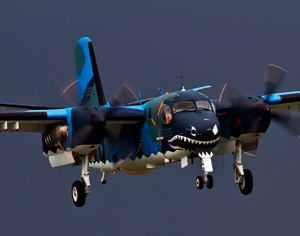
S2T Super Tracker of the Republic of China (ROC) Naval Aviation group.

Taiwan’s Ministry of National Defense announced the establishment of an Air Force anti-submarine group, maintained by eleven S-2T Turbo Tracker anti-submarine planes transferred from the Navy. The announcement was made by Chief of the General Staff Gen. Yen Ming during a commissioning ceremony at an air force base in Pingtung County, southern Taiwan. The main missions of the anti-submarine group will include countering the threat of submarine attack by opposing forces. The Turbo Trackers were originally built by the Grumman company (now Northrop Grumman).

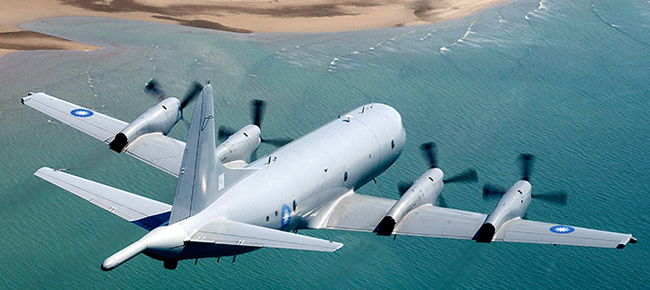
The commissioning of the new group was made in advance of the delivery of 12 P-2C Orions, the first is expected to be delivered from US Navy surplus by the end of 2013 and the entire delivery is expected to complete in 2014. The delivery of the P-3C was approved by the U.S. government in 2007, under a US$1.96 billion foreign military sale program.

Upgrades to the aircraft involved installation of new mission system avionics and service life extension kits to extend the operational life for 15,000 additional flight hours. Lockheed will also install complimentary navigation message ECP to update RINU-G and control display unit software for a message set. The Harpoon Block 2 missile requires the new message set for precision targeting. Other elements of the package include upgrades to the ALR-97/electronic support measures and ALR-95 system, as well as an upgrading of Mode 4 software to Mode-T.


Taiwan is about to receive 12 refurbished P-3C from the US, under a US$1.96 billion foreign military sale program signed in 2007. Photo: Lockheed Martin

Defense Update