Thứ Hai, 22 tháng 4, 2013

China’s Defence White Paper 2013 – Analysis

China issued its eighth bi-annual Defence White Paper entitled: ‘The Diversified Employment of China’s Armed Forces’, on April 16, 2013. The last White Paper, pertaining to 2010, was published in 2011. China’s Defence White Paper, 2013, is a 47-page document with five sections and 3 short appendices listing: joint exercises and training with foreign armed forces from 2011-2012; participation of China’s armed forces in international disaster relief and rescue (2011-2012); and China’s participation in UN peacekeeping operations (2011-2012).

The Defence White Paper, 2013, makes it apparent that the Asia-Pacific region currently dominates Chinese military thinking. This Defence White Paper is at once an expression of the Chinese leadership’s self-confidence and its confidence in the capabilities of its armed forces. After the ritual assertion that China will “not seek hegemony, behave in a hegemonic manner or engage in military expansion” and brief token acknowledgement of the importance of international cooperation, it states clearly that the military build-up and modernization will continue. There is discernible emphasis on expanding the capabilities and operational reach of the People’s Liberation Army Navy (PLAN) and PLA Air Force (PLAAF) together with increased investment in domestic R&D to upgrade the indigenous defence industry.

China started to fall in line with international practice on matters relating to military transparency since 1998, when it first began to publish Defence White Papers. Issued with the twin objectives of meeting international demands for a degree of transparency with regard to its defence modernization programme as well as wanting to stay engaged with the international community, China has, of late, also begun using the Defence White Papers to publicise its national objectives and world view, albeit in a very cautious way. In this, it follows the practice of other nations.

Though they avoid specifics, China’s Defence White Papers nevertheless do offer an insight into the broad thinking of senior echelons of the Chinese political and military leadership associated with matters of national defence. Unlike Western documents that also focus more on detail and specific capabilities, China’s Defence White Papers gloss over specifics and reveal few details of expenditure or weapons acquisitions or manufacture. China’s record of transparency in these matters remains opaque, though there has been slight incremental improvement over the years. As could be expected in a country where the armed forces are subordinate to the ruling political party, namely the Chinese Communist Party(CCP), China’s Defence White Papers blend political thinking with the broad plans for the armed forces. The leadership’s thinking on a range of issues including: the future plans and role of the armed forces; anticipated areas of conflict; levels of suspicion of other countries; areas of China’s interest; and the extent of military cooperation with foreign nations, are discernible in the present Defence White Paper, 2013. China too uses the Defence White Papers as instruments of politics and diplomacy.

China’s world view outlined in the latest Defence White Paper clearly highlights its preoccupation with the developments in the Asia-Pacific region, especially the role of the US, and identifies potential anticipated threats to China’s ambitions. In the initial two paragraphs of its first Section captioned: ‘New Situation, New Challenges and New Missions’, the Defence White Paper singles out the Asia-Pacific region as having become“an increasingly significant stage for world economic development and strategic interaction between major powers”. Hinting at Beijing’s concern about US interference it says “The US is adjusting its Asia-Pacific security strategy, and the regional landscape is undergoing profound changes”. A blunt, yet thinly veiled, comment follows in the very next paragraph with the assertion that “Some country has strengthened its Asia-Pacific military alliances, expanded its military presence in the region, and frequently makes the situation there tenser.” The implied reference to the US is unmistakable.

The next sentence in the same paragraph makes specific mention of Japan as one among “some neighbouring countries” that are taking actions to exacerbate the situation and cites its “making trouble over the issue of the Diaoyu islands” as example. Affirming that the threat from the “three forces” of terrorism, separatism and extremism is increasing, this White Paper in language almost identical to that used in the Defence White Paper of 2010, describes “Taiwan independence separatist forces” as “still the biggest threat to the peaceful development of cross-Straits relations”. Security risks to China’s overseas interests, it concludes, are on the rise.

Clarifying the role of the armed forces as “to win local wars under the conditions of informationisation”, it listed among the tasks for the armed forces the containing of “separatist forces”, safeguarding border, coastal and territorial air security, and “protecting national maritime rights and interests” and “national security interests in outer space and cyber space”. Significant are the independent references to the armed forces providing “reliable support for China’s interests overseas” and “firmly safeguarding China’s core national interests”. These “core national interests” are neither defined nor elaborated.

Of particular concern to China’s neighbours with unresolved, or overlapping, territorial claims are the portions relating to the PLAN and PLAAF in the section on ‘Building and Development of China’s Armed Forces’. The PLAN, it affirmed, will accelerate its pace of modernization and develop advanced submarines, destroyers and frigates and develop blue-water capabilities of conducting mobile operations. It described the development of an aircraft carrier as having a “profound impact on building a strong PLAN and safeguarding maritime security”. Interestingly, the release of this Defence White Paper coincided with the official disclosure the same day — incidentally also PLA Navy Day — that China’s new aircraft carrier ‘Liaoning’ would go on a long voyage on the high seas later this year. Separate reports suggest it could sail from its present berth at Qingdao’s military dock within about 3 months up to Okinawa or Guam.

The PLAAF, it said, is developing advanced weaponry and equipment such as new-generation fighters, new-type ground-to-air missiles and radar systems, improving its early warning command and communications networks and “raising its strategic early warning, strategic deterrence and long distance air strike capabilities”. There is no mention of the 3-phase R&D effort underway to indigenously develop advanced jet enginesfor the PLAAF, disclosed in mid-March 2013 and for which a huge budgetary allocation has already been made.

A novel feature of China’s Defence White Paper this year is the disclosure of troop strengths of the PLAA, PLAN and PLAAF. It was accompanied by a sketchy outline of the deployment of their formations and, in the case of the PLAA, the identifying numbers of the Combined Armies located in each of the seven Military Regions(MR), which the Defence White Paper called Military Area Commands (MAC). The PLAA’s troop strength was disclosed as 850,000. Listing the MRs in order of seniority, it disclosed the following Combined Army deployments: Shenyang (16th, 39th, and 40th); Beijing (27th, 38th, and 65th); Lanzhou (21stand 47th); Jinan (20th, 26th, and 54th); Nanjing (1st, 12th and 31st); Guangzhou (41st and 42nd); and Chengdu (13th and 14th). The disclosure in the White Paper 2013, confirms the deployments estimated by foreign analysts.

The total strength of the PLAN was stated to be 235,000, while that of the PLAAF was declared to be 398,000 with an Air Command at each of the MRs. This official revelation of troop strengths has helped correct international estimates that were in use till now. These estimates placed the PLAN’s total strength as ranging between 255,000 and 290,000 with that of the PLAAF ranging between 300,000 and 330,000. China’s Defence White Paper 2013, now shows that estimates for the PLAN were low while those for the PLAAF were high. China’s strategic missile force, or the PLA Second Artillery Force (PLASAF), continues to stay shrouded in secrecy and no details of its strength or deployments have been disclosed.

A close reading of this Defence White Paper reveals certain possible policy level statements. Specifically, these pertain to the use of missiles and nuclear weapons. It described China’s strategic missile force, namely the PLA Second Artillery (PLASAF), as a “core force for China’s strategic deterrence”. It disclosed that the PLASAF will use nuclear missiles to launch a counter-attack either independently or in conjunction with “the nuclear forces of other services”. It added that the PLASAF’s conventional missile force can shift “instantly” from peacetime to wartime readiness “and conduct conventional medium- and long-range precision strikes”. Absent in the White Paper were the routine references to non-first use of nuclear weapons by China, though while referring to the PLASAF’s role the terms “strategic deterrence” and “nuclear counterattacks” were repeatedly used. The assertion that the PLASAF will use its nuclear missiles in conjunction with those of other services makes clear that all the services of the PLA are operationally nuclear capable. That the PLASAF will engage in conventional conflict is made clear in the White Paper, which raises the risk of miscalculation by the adversary.

As in the Defence White Paper, 2011, which used the acronym for the first time, this White Paper also refers to the PLA’s ground forces as the PLAA. There has, however, been scattered mention of the PLAA in China’s official media through 2012.The Defence White Paper 2013, similarly placed the PLAA, or PLA Army, first followed by the PLAN, PLAAF, PLASAF and the People’s Armed Police Force (PAPF). Details of the role and functions of the PAPF, militia and border militia, and the Hongkong and Macao garrisons are additions in this year’s White Paper.

Repeated usage of the acronyms PLAA, PLAN, PLAAF and PLASAF indicatesthat these services are increasingly acquiring independent identities and coming out from under the dominance and control of the PLAA or the PLA’s ground forces. The composition of the new Central Military Commission reinforces this view. The moves would be part of the leaderships’effort to professionalise the armed forces, inculcate ‘service pride’ in each service and encourage each of them to generate their own doctrines, or theories, of war and battle plans.

Nevertheless as the large number of PLAA personnel present among the Delegates and Deputies to the 18th Party Congress and 12th NPC reveals, the status and influence of the PLA ground forces remains unaffected, though they have probably dropped more to the level of‘primus inter pares’. Furthermore, the Military Region Commanders are all from the ground forces and the PLAAF and PLAN personnel are placed under their command. PLA General Departments too continue to be staffed mainly by personnel from the ground services and they are the ones who plan, formulate and issue central directives.

China’s Defence White Paper 2013, touched on the other roles of the armed forces including Military Operations other than War (MOOTW), joint exercises and training with foreign forces and international disaster relief. It dwelt at some length on the contribution of the Chinese armed forces to international peacekeeping where Africa came into focus.

Finally, this Defence White Paper contained two references to India in one paragraph and in the same context. This was in the context of the observation that “since January 2012, independent deployers such as China, India and Japan have strengthened their convoy coordination”.

Views expressed are personal.

By IPCS

Jayadeva Ranade
Member of the National Security Advisory Board (NSAB) and
Distinguished Fellow, Institute of Peace and Conflict Studies.
Email: jayvins1@gmail.com

Vietnam, US hold naval exchange activities

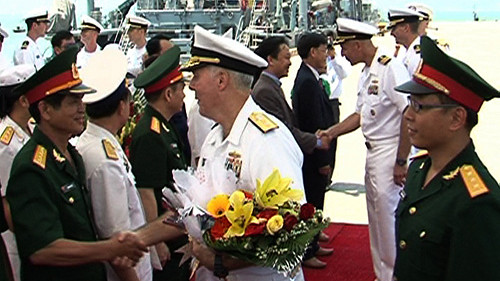
The US Navy has begun non-combat naval exchange activities with the Vietnam People’s Navy after two US naval vessels landed at Tien Sa Port in the central city of Da Nang on April 21.


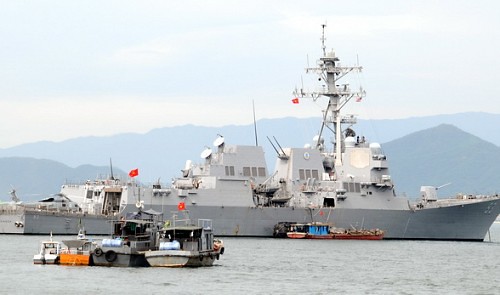
The guided missile destroyer USS Chung-Hoon landed at Tien Sa Port in Da Nang On April 21, 2013

Representing the US naval delegation at the welcoming ceremony at the port on Sunday were Commander of the Logistics Group Western Pacific Rear Admiral Tom Carney, the delegation head, Commander of the Maritime Staff Element Captain Paul Schlise, the Captains of USS Chung-Hoon and USNS Salvor, and U.S. Consulate General Deputy Principal Officer Robert Ogburn.


U.S. units participating in the naval exchange activities include the guided missile destroyer USS Chung-Hoon and the rescue and salvage ship USNS Salvor, which are manned by sailors fromthe Logistics Group Western Pacific and the Maritime Staff Element, as well as Marines and medical trainers from the III Marine Expeditionary Force, a mobile diving and salvage detachment, and the 7th Fleet Band Orient Express.

The destroyer, which has a loading capacity of 9,496 tons and can travel at 30 nautical miles per hour, also carries two LAMPS MK III MH-60 B/R helicopters with Penguin/Hellfire missiles and MK 46/MK 50 torpedoes.

The five-day exchange will comprise of non-combatant events and skills exchanges in many areas, including navigation and maintenance.


Speaking at the reception, Commander Rear Admiral Tom Carney said he expected the collaboration with the Vietnam People’s Navy will help implement many exchange activities between the two sides.

In addition, ship tours, band concerts, community relations events, and U.S.-Vietnamese Navy sporting events are also arranged.

During their stay, Rear Admiral Tom Carney, Maritime Staff Element Captain Paul Schlise, and the Captains of USS Chung-Hoon and USNS Salvor will pay a courtesy call to leaders of the municipal People’s Committee and Naval Zone 3.

This is the third consecutive time that naval exchanges have been conducted between Vietnam and the US, Carney said, adding that the two US vessels will leave Da Nang on April 25.

Thứ Bảy, 20 tháng 4, 2013

China establishes surveillance system covering 4,406 islands, including disputed Spratlys

BEIJING - China has established a national island surveillance and monitoring system and completed airborne remote-sensing surveillance of what it claims to be its 4,406 islands, according to the Ministry of Land and Resources (MLR).


A Philippines protester burns a Chinese flag

The national system is mainly built on aerial surveillance, with satellites, unmanned planes, and cruisers as auxiliary instruments, the MLR said in its annual land resources report issued Saturday.

Since a national plan on island protection and exploration came into effect in last April, south China's Zhejiang, Fujian, Guangdong provinces, and Guangxi Zhuang Autonomous Region have passed their own provincial-level scheme, with Liaoning, Hebei, Shandong, Jiangsu, and Hainan completing their draft plan, the ministry said.

Last year, China completed an island name survey, including on-site investigation on part of the atolls in the three island groups known as Sansha in the South China Sea which covers the disputed island groups of Spratlys, Paracels, and Macclesfield. The Philippines and Vietnam also claim sovereignty over these islands.

The country also released the standard names and geographical coordinates of the Diaoyu Island and its affiliated islands in the East China Sea, as well as other geographical entities in their surrounding waters last year, according to the MLR report. China Diaoyu is also being claimed by Japan.

Interaksyon

Indonesian Navy Selects NAUTIS Class A FMB Simulators for SIGMA Class Corvette Bridge Training

For training of its Sigma Class Corvette bridge personnel, the Indonesian Navy and Ministry of Defence selected VSTEP to supply two Class A NAUTIS Full Mission Bridge (FMB) Simulators for its Kobangdikal marine training facility in Surabaya.


Nautis VSTEP full mission bridge simulator (all photos : Nautis)

The Indonesian Navy is currently modernizing its fleet to more effectively combat maritime crime and piracy. Beginning 2012, the Indonesian Navy added several Sigma Class Corvettes to its active fleet. To allow realistic training of the Sigma Class bridge personnel, the Navy ordered two NAUTIS Full Mission Bridge Simulators, each with a 270 degree field of view projected on a cylindrical screen. The simulator bridges match the actual SIGMA Class Corvette bridge, allowing efficient and true-to-life bridge operations and navigation training. The Indonesian Navy also ordered five custom built ports, and customised navigation screens. VSTEP cooperated with local development and implementation partners, to increase the local content.


The NAUTIS FMB simulators have been delivered by maritime simulator developer VSTEP in cooperation with its Indonesian partner Terravision. The Kobangdikal Marine Facility in Surabaya counts as one of the most important development, training and education facilities of the Indonesian Navy. In addition to the two Class A NAUTIS FMB Simulators, two NAUTIS Instructor Stations and two NAUTIS Desktop Training Simulators have also been installed at the premises.

About NAUTIS
NAUTIS is a new generation of advanced DNV certified maritime training simulators for the civilian & military maritime industry. The NAUTIS range of maritime training simulators is developed by VSTEP and offers an affordable alternative for training maritime officers and crews. With a full range of simulators, from desktop trainer to full mission bridge simulator, VSTEP delivers high quality cost-effective simulator solutions fulfilling the training requirements of nautical colleges, naval academies, maritime training centres and individual ship owners in compliance to the latest STCW requirements. www.nautissim.com

About TerraVision
Terravision is a system integrator company which focuses in system implementation and integration and technical support of various system technology to Indonesian market which utilizes satellite network and data, high performance database with user friendly application.
www.terravision-indonesia.com

About VSTEP
VSTEP is a leading International developer of simulators and virtual training software. VSTEP creates 3D virtual training applications and simulators that allow people to build their skills in a practical and cost effective way. VSTEP has several core product lines, focusing on virtual incident training for first responders (RescueSim), maritime training solutions for the civilian & military maritime industry (NAUTIS) and training simulators to prepare camera operators to identify suspect human behavior before a crime or terrorist attack takes place (EyeObserve). www.vstepsimulation.com

(Nautis)

South Korea has been Chosen to Build Thai Navy Frigate

The Royal Thai Navy has chosen a South Korean naval ship manufacturer to build a new frigate that will cost about 13 billion baht.


DSME DW-3000H frigates - length : 114m, width 13.8m, displacement 3.000 ton, top speed of 28 knots, main gun 76 mm, 8 tubes ESSM anti-air missiles in vertical launch version, 20mm CIWS, 30mm cannon (MSI DS30), torpedo tubes, stealth mast will be at Thales I-Mast 400/I-Mast 500 (all photos : Defense Studies)

An RTN selection committee announced on Friday it had chosen Daewoo Shipbuilding and Marine Engineering to manufacture the frigate, a navy source said.

The company was one of the last two South Korean firms to enter the final round of the bid organised by the RTN panel.

The other three foreign firms ousted from the previous rounds were from Spain, Italy and China.

RTN chief of staff Chakchai Phucharoenyot, who chaired the panel, said Daewoo Shipbuilding and Marine Engineering was selected because it had proposed specifications for the frigate that were in line with the navy's demands.

The navy also asked the company to manufacture a Combat Management System (CMS) which can be allied to the systems installed in the frigates HTMS Naresuan and HTMS Taksin, he said.

The frigate, which will be the first South Korean-manufactured navy ship in Thailand, is expected to be commissioned in two years' time, Adm Chakchai said.

The new frigate will have a displacement of between 3,000 and 4,000 tonnes.

The cabinet earlier approved the RTN's procurement of two frigates with a budget of 30 billion baht. The frigates will be considered for manufacturing one by one.

According to the navy source, the RTN preferred European frigates but they were too expensive.

Meanwhile, a Defence Ministry source revealed that Defence Minister Sukumpol Suwanatat will lead military top brass on a visit to Russia between Tuesday and next Monday to bolster military ties.

Thai delegates will inspect the armaments industry in Russia, the source said.

Bangkok Post

Thêm tính năng tự động tải bài đăng cũ hơn khi cuộn xuống cuối trang chủ blogger/ blogspot

Một lợi thế của tính năng này là người xem blog sẽ có xu hướng cuộn xuống liên tục, điều này giúp cải thiện lượt xem blog.

Tất cả chỉ là 1 cú nhấp chuột vào thanh trượt và kéo xuống hoặc người xem blog của bạn cuộn xuống cho đến khi nào họ mõi tay, việc còn lại do những đoạn mã đảm đương, các bài đăng cũ hơn sẽ tự động hiển thị cho đến khi nào họ cuộn tới bài đăng cuối cùng.

Tính năng này không ảnh hưởng đến tốc độ tải blog về trình duyệt. Ví dụ: Bạn đặt số bài đăng trên trang chủ là 4 thì trình duyệt chỉ tải về 4 bài đăng. Khi người xem cuộn xuống đến hết bài thứ 4 thì tính năng mới được kích hoạt để tải thêm các bài đăng cũ hơn.


Google phát triển tính năng này dùng cho Tumblr blog, được gọi là Infinite Scrolling ( Cuộn vô hạn ).

Cám ơn blogger Muthu Kannan đã phát triển tính năng này cho Blogger. Thủ thuật này được đăng trên manki's weblog

Cách thực hiện:

Thêm đoạn mã dưới đây vào 1 tiện ích HTML (HTML widget):

<!--Start of Infinite Scrolling shared by Mastermind XXI-->
<script type='text/javascript' src='//ajax.googleapis.com/ajax/libs/jquery/1.6.1/jquery.min.js'></script>
<script type='text/javascript' src='//manki-scripts.googlecode.com/files/blogger-infinite-scrolling-1.6.js'></script>
<!--End of Infinite Scrolling shared by Mastermind XXI-->

Để trống tiêu đề tiện ích. Sau khi Lưu tiện ích xong, kéo nó xuống dưới các tiện ích khác, sau đó nhấp vào Lưu sắp xếp.

Chú ý: Tính năng này chạy tốt trên các mẫu/ template do Blogger.com cung cấp. Các mẫu không phải do Blogger.com cung cấp thì tùy thuộc vào mã nguồn của mẫu có tương thích hay không.

China deploys anti-ship missile off Taiwan

(FT) China has deployed near Taiwan a powerful missile designed to take out US aircraft carriers as Beijing strengthens its ability to prevent US forces from aiding Taiwan during potential conflict.


Chinese DF-21D anti-ship ballistic missile

The deployment of the DF-21D anti-ship ballistic missile comes as China’s army develops greater long-range and offensive capabilities. Those advances pose a challenge to US forces as Washington looks to build up its military presence in east Asia to balance out China’s rising might.

The DF-21D missile is a particular worry for Taiwan as it relies on US forces to back it up against threats from the mainland, which has not renounced the use of force to take the island it regards as part of its territory.

The missile limits the US’s ability to send aircraft carriers into the strait unchallenged to support Taipei, as it did in 1996 when China conducted missile tests in the strait during the run-up to the island’s first democratic election. Taiwan itself has no aircraft carriers.

News of the missile’s deployment came in written testimony to the head of intelligence for the Pentagon, Lieutenant General Michael Flynn, delivered to a Senate committee on Thursday.

Chinese and US military sources have been saying since late 2010 that China has been planning to deploy the missile, but the testimony marks the first time a concrete deployment has been revealed in connection with a particular location. US military officials have said previously that the US lacks a tested way to defend its aircraft carriers against the missile.

That increases the pressure on Taiwan to strengthen its own ability to deter threats from the mainland and illustrates how, despite a reduction in tensions engineered by Taiwan’s president, China’s military continues to prepare for the possibility of conflict. --> MORE


MILITARY AND INTELLIGENCE NEWS BRIEFS

U.S. Analysts Dismiss China’s Military Report -- DoD Buzz

North Korea reiterates it will not give up nuclear arms -- Reuters

Pre-teen North Koreans trained as soldiers -- FOX News/AP

North Korea Hackers Get Caught -- Strategy Page

Russian woman joins army so she can be with boyfriend -- UPI

Ukraine's Parliament OKs Foreign Military Drills -- RIA Novosti

China Takes Baby Steps On Military Transparency; Blots Copybook Whining About Pacific Pivot -- Aol Defense

Russia says U.S. must do more to address missile shield concerns -- Reuters

EU Defense Ministers Mull Conundrum of How to Deploy EU Battlegroups -- Defense News

British Tory MPs prepare to attack Coalition over Army cuts -- The Telegraph

Venezuelan military pledges allegiance to new president -- Xinhuanet

Kuwait to Buy C-17 Globemaster III -- Defence Talk

Pentagon reaches deal on $10 billion arms sale to Middle East allies -- Washington Post

Chuck Hagel to finalise £6.5billion arms deal on Israel visit -- The Telegraph

Hagel’s First Middle East Trip to Seal Historic Arms Deal -- US Department Of Defense

Israel to buy new missiles, refueling planes from US -- YNet News

Patriot missiles to be deployed along Jordan-Syria border -- Times of Israel

Pentagon, NATO allies witness missile defense test in skies over Central New York -- Syracuse.com

U.S. Navy Assesses Osprey For Carrier Onboard Delivery Mission -- Aviation Week

Northrop’s SABR Gives F-16 Pilots the Big Picture -- Defence Talk/Northrup Grumman

F-35 Costs Driving Away Buyers -- Strategy Page

Sequestration Threatens Embassy Security Additions -- DoD Buzz

Clapper: Sequester cuts could leave US intel blind to next attack -- The Hill

U.N. Chief In Unprecedented Visit to Pentagon -- Defense News

U.S. Air Force cadets win cyber war game with NSA hackers -- Reuters

Pentagon Weighs Refurbishing or Replacing Ballistic Missiles -- Nextgov

The Single Most Expensive Piece Of Military Equipment Ever Has Reached A Massive Milestone -- Business Insider

Lockdown in Boston Similar to WMD Response Plans -- Global Security Newswire

How This Photo of the Boston Marathon Gives the FBI a Bounty of Data -- Danger Room