Thứ Năm, 25 tháng 4, 2013

How will China React to Gazprom Prospecting in Vietnamese Waters?

It is hardly a secret that Beijing’s claims to nearly all of the South China Sea’s waters have elicited concern from Southeast Asian nations.

Now Russia’s state-owned natural gas giant Gazprom is upping the ante by announcing that it intends to start gas production off Vietnam’s coast in June. Gazprom Deputy CEO Vitaly Markelov told Gazprom magazine, “It is planned to build 16 exploitation wells to develop the deposits. Currently, the project is at the deposit development infrastructure stage. Work continues on building the fourth exploitation well at the WHP-MT1 extracting platform (the Moc Tinh deposit). Gas extraction is expected to start in June 2013.”


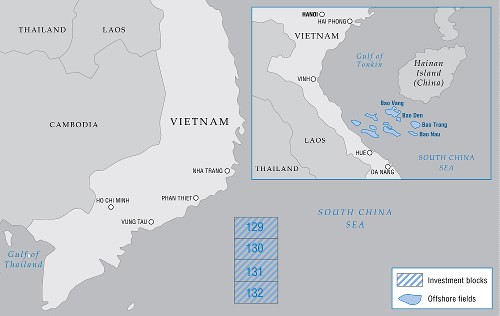
Exploratory drilling and seismic surveys by Gazprom in Vietnam (extended block No.112) and location of blocks Nos.129–132

Last year Gazprom received stakes in developing Blocks 05-2 and 05-3 in the southeastern part of the South China Sea. Gazprom has since opened two gas condensate fields in the Moc Tinh (05-3) and Hai Tchach (05-2 and 05-3) blocs, with reserves estimated at 55.6 billion cubic meters of gas and 25 million tons of gas condensate. The deposits are located 189.8 miles from Vietnam’s Vung Tau coastal area. The Nam Con Son underwater gas pipeline is in close proximity to the blocs, which are at depths of 330- 450 feet.

Note the distance offshore of the concessions. According to the Third United Nations Convention on the Law of the Sea (UNCLOS), which came into force in November 1994, UNCLOS recognized 12 nautical miles as normal for territorial seas and waters while UNCLOS Part V, Article 55 defined an “exclusive economic zone” (EEZ) for countries with maritime frontiers as extending 200 nautical miles from a nation’s coastline.

Not surprisingly, Vietnam has voiced vociferous opposition to Beijing’s South China Sea claims.

The U.S. government’s Energy Information Agency has waded into the dispute over the potential riches at stake as in its updated “South China Sea” brief, issued on 7 February, after noting, “The South China Sea is a critical world trade route and a potential source of hydrocarbons, particularly natural gas, with competing claims of ownership over the sea and its resources,” goes on to add, “EIA estimates the South China Sea contains approximately 11 billion barrels of oil and 190 trillion cubic feet of natural gas in proved and probable reserves.”

The U.S. Geological Survey has far higher estimates, calculating that the South China Sea may contain roughly 28 billion barrels of oil, while the Chinese government calculates that the South China Sea region contains nearly 200 billion barrels of oil. No one knows for sure, especially as the Chinese Navy harasses and chases off foreign survey vessels.

A bit of history here.

In 1974, during the Vietnam War, the Chinese military drove South Vietnamese troops out of the Paracel Islands, which were claimed by Beijing, Hanoi and Taiwan. Five years later, in February 1979 a brief Sino–Vietnamese war erupted on the border between the two ostensibly Communist powers. Also known as the Third Indochina War, China launched the offensive in response to Vietnam's invasion and occupation of Cambodia in 1978, which ended the murderous reign of the Chinese-backed Khmer Rouge. Both sides lost thousands of troops, and relations between the two have remained coolly formal ever since.

Which brings up the question – why is Gazprom seeking to fish for hydrocarbons in such troubled waters?

By. John C.K. Daly of Oilprice.com

Taiwan plans to set up naval frigates at Ba Binh Island of Vietnam

Taiwan's Ministry of National Defense will assess whether an offshore terminal for naval frigates should be set up on Itu Aba/ Taiping Island (known as Ba Binh Island, Đảo Ba Bình, Việt Nam) in the East Vietnam Sea, Taiwan Deputy Minister of National Defense Andrew Yang said at a legislative hearing yesterday.


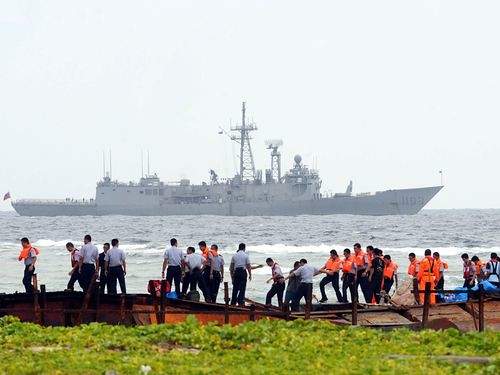
Taiwanese coast guards on Tuesday held live-fire drills on Taiping Island in the East Vietnam Sea (the south China sea)

Local media reported earlier this month that the Coast Guard Administration (CGA), which is responsible for the island’s security, is hoping to build an offshore terminal at the island to accommodate frigates of up to 2,000 tonnes.

It also wants to extend the island’s airport runway, the reports said.

During a hearing of the Legislative Yuan’s Foreign Affairs and National Defense Committee, Chinese Nationalist Party (KMT) Legislator Lin Yu-fang followed up on the reports with Yang, whose ministry provides personnel training for the defense of the island.


Taiwan Coast Guard officers move goods shipped at the dock of Ba Binh Island (CNA file photo)


Lin asked whether the ministry had brought up the idea with the CGA of having the wharf accommodate naval frigates or 500 tonne to 1,000 tonne stealth missile boats, to which Yang replied that no discussions had been held.

“We will make a thorough assessment before consulting with the CGA on the issue,” Yang said.

The CGA set aside NT$19 million (US$638,220) in its budget this year to finance initial planning of the pier reconstruction project, Lin said.

Yang also told Lin that the ministry’s “South China Sea task force” has been renamed the “West Pacific task force,” but he did not explain the reason behind the change.

Ba Binh Island, with an area of 0.49km2, lies about 1,600km southwest of Kaohsiung and is the biggest island in the disputed Spratly Islands chain.

The South China Sea region, thought to be rich in oil deposits and marine biodiversity, is claimed either entirely or in part by Taiwan, Brunei, China, Malaysia, Vietnam and the Philippines.

The CGA confirmed on Monday that its personnel stationed on Taiping Island recently conducted a live-fire drill to help safeguard the country’s sovereignty over the area.

Ambiguity afloat in South China Sea

HANOI - The United States' indecisive ''pivot'' to the Asia-Pacific has created a situation of strategic ambiguity in the South China Sea. While regional countries believe that Washington will implement the policy, including its promise to base 60% of its naval assets to the region by 2020, it remains unclear how the shift will impact on the region's escalating maritime disputes.


China's south sea fleet in a military drill in the south China sea.

There are rising regional perceptions that the US intends to fortify its presence only to the degree that it does not upset China, especially with a new, untested leadership under Xi Jinping now at the helm in Beijing. Some believe the US has shied from its earlier strong declaration at the July 2010 Association of Southeast Asian Nations Regional Forum (ARF), where Washington's then top diplomat, Hillary Clinton, said the US had a ''national interest'' in freedom of navigation in the South China Sea.

The strategic ambiguity and questions of political will have pushed claimants in the disputes, particularly the Philippines and Vietnam, to strengthen their alliances with other regional powers, including Australia, India and Japan. Some analysts believe the overlapping and somewhat competitive alliances could further destabilize the area as China begins to feel a sense of encirclement from what it views as outside actors in the disputes. Others have hedged their recent warming trends towards the US.

The strategic hedging has been driven by questions about the US's fiscal ability to implement its ''pivot'' policy in a strategically meaningful and sustainable way. With significant planned military budget cuts in Washington, US regional allies and partners now wonder whether the US will be able to keep pace with China's rising defense spending, including significant funds to bolster its naval capabilities.

Proponents of the US's capabilities point towards its new ''AirSea Battle'' operational concept, which posits that the US Navy can do more with less through the emerging paradigm of ''the many, the cheap, and the unmanned''. The Australian Strategic Policy Institute blog argued in a recent entry that ''a combination of forward deployed troops and 'offshore balancing' (for example, the ability to strike from safe distances) will allow the US to sustain a powerful presence in Asia to deter major power war.''

Following that analysis, the redeployment of some of the US's 290 major naval combatants has begun, including the forward deployment of littoral combat ships to Singapore. Washington's expanding strategic ties with Vietnam and the delivery of a second US warship (though deprived of weapons and advanced communications systems) to the Philippines had raised expectations among claimants that the US aimed to materially tilt the area's balance of power.

However, the moves raised tensions with China, which remains firmly opposed to any activity or effort to internationalize the maritime disputes. Some regional analysts believe that the US, which has maintained it does not aim to ''contain'' China and hopes it will emerge as a ''responsible'' power in the region, intends to scale back its ''pivot'' policy to avoid the risk of irking China

''Washington is creating expectations that its military presence will stabilize the situation ... but if the US does not act when a crisis occurs it might create a mistaken impression that the US is not reliable,'' said former ambassador J Stapleton Roy, director of the Kissinger Institute on China and the United States, during a conference organized by Asia Society in New York in mid-March.

Unclear commitment
Despite Washington's 1951 Mutual Defense Treaty with the Philippines, the US had made clear during recent stand-offs in contested waters between Manila and Beijing that its primary interest is conflict avoidance. While the treaty guarantees mutual defense over sovereign territory, it is not clear that the US would come to the Philippines' aid in a clash over disputed areas such as the contested Scarborough Shoal in the South China Sea.

Manila recently challenged China's territorial claims through the international arbitration tribunal under the 1982 United Nations Convention on the Law of the Sea (UNCLOS), a move the US supported. While Philippine authorities branded the appeal to arbitration a ''friendly act'', China's foreign ministry spokesman said Manila's statement of claim ''was historically and legally incorrect and contained unacceptable accusations against China''.

Some believe Manila's move to internationalize the issue will undermine regional efforts through ASEAN to mediate the disputes and has motivated China to consolidate and expand its presence in contested waters during the three to four years it will likely take the tribunal to reach a decision. The tribunal lacks the authority to enforce its rulings and analysts believe that China will refuse to abide by any decision that goes against its claims.

''It remains an open question what impact the Philippines' legal claim will have on the Association of Southeast Asian Nations [ASEAN] and its efforts to implement confidence building measures with China under the Declaration of Conduct of Parties in the South China Sea and negotiate a legally binding Code of Conduct in the South China Sea,'' Carlyle Thayer, a professor at the University of New South Wales Australian Defense Force Academy, wrote in a recent research paper.

Beijing has been accused by its rivals of taking an inflexible position on the disputes, including through its wide-reaching nine-dash map that effectively assumes sovereignty over the entire South China Sea. In recent months, China has fortified its claims through more maritime patrols, signaling to some a hardening of Beijing's position in response to the perceived threat of foreign involvement in the theater, including the US's promised ''pivot''.

''I do not think anti-China sentiment can work as a bond for regional countries,'' said Soeya Yoshihide, professor of political science and international relations at the Faculty of Law at Japan's Keio University. ''Southeast Asian countries are worried about rising China, but they are not ready to take a confrontational approach. It is important to work with China jointly rather than confronting it.''

China is ''waiting for them to back down and to say sorry, then they will come'' to the negotiating table, said Soeya, noting that official dialogue has bogged down in the wake of recent confrontations and events. ''China will not change its attitude.''

There is the added complication that not all ASEAN states welcome a greater US military presence to counterbalance China. Indonesia, which has played a mediating role between China and ASEAN claimants such as Brunei, Malaysia, the Philippines and Vietnam, is believed to prefer diplomacy over US-driven balance of power politics in the region. While some ASEAN states see a role for India and Japan in the South China Sea, others fear their involvement will further destabilize the situation.

Growing perceptions of a weakened US commitment have factored into recent strategic decision-making among claimant states. While the Philippines with its move to international arbitration has openly confronted China, Vietnam has taken a more guarded tack. Despite the sympathy and support the European Union and other countries recently offered Vietnam for its South China Sea claims under UNCLOS, there is no indication Hanoi plans to follow Manila's lead by filing a case to the tribunal.

Despite recent economic, political and military rapprochements with Washington, Vietnamese authorities continue to look more towards ASEAN's multilateral channels to accomplish a peaceful solution to the disputes. That preference has been reflected old guard Communist Party members' resistance to opening strategic ports to US naval vessels in deference to China.

With or without a US ''pivot'', Beijing is less inclined than previously to accept multilateral dialogue, through ASEAN or elsewhere, to resolve its maritime disputes. Instead, it seems China is bent on consolidating its position to preempt greater future foreign involvement in the South China Sea. By deploying more naval patrols in contested areas, China has reinforced its claims and strengthened its strategic advantage. While the US's strategic aims remain ambiguous, China's seem increasingly clear.

Roberto Tofani is a freelance journalist and analyst covering Southeast Asia. He is also the co-founder of PlanetNext (www.planetnext.net), an association of journalists committed to the concept of "information for change".

(Copyright 2013 Asia Times Online (Holdings) Ltd. All rights reserved. Please contact us about sales, syndication and republishing.)
Thứ Tư, 24 tháng 4, 2013

Flag meet between India, China military commanders fails to end stand-off in Ladakh

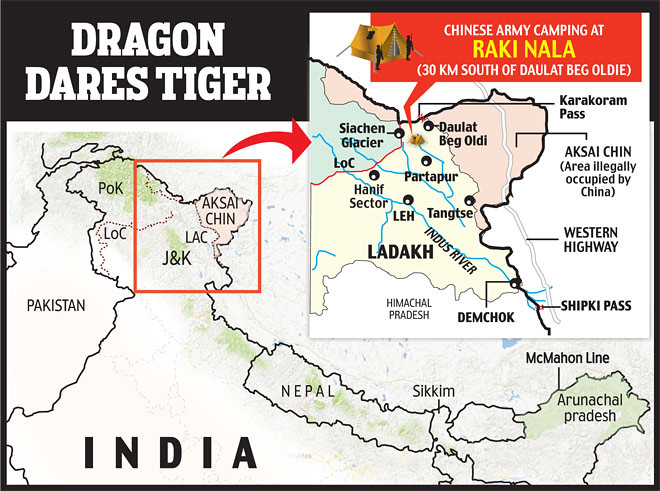
The face-off between the Indian Army and the People's Liberation Army (PLA) of China continued on the Line of Actual Control (LAC) as a flag meeting between the local commanders held on Tuesday failed to resolve the differences.


China rejected India's contention that its troops had breached the sanctity of the LAC by setting up a tented post at Raki Nala, 30 km south of Daulat Beg Oldi in north Ladakh. The PLA, in fact, claimed that the Indian armymen were on an "aggressive patrol".

As of now, the two sides will hold on to their positions. The only consolation for India is that China has decided not to escalate the tension. The army is now looking at government-togovernment-level interaction to resolve the issue.

The foreign ministry has conveyed its objection to China. "We have asked the Chinese side to maintain the status quo in this sector (of the western border)," said Syed Akbaruddin, official spokesperson in the ministry of external affairs.


"We see this as a ‘face-to-face' situation between border personnel of two sides due to differences on their alignment of the LAC," the official said. Face-to-face situation is referred to the 2005 protocol for implementing confidence building measures (CBMs) in military field along the LAC.

Army chief's visit Army chief general Bikram Singh was on a scheduled visit to Nagrota, the headquarters of 16 corps, which guards the Line of Control in Jammu and Kashmir.

The army chief met northern army commander Lt-General K.T. Parnaik, who heads the army in Jammu and Kashmir region.

Senior officers of the two armies have met twice since April 15, when a platoon of PLA set up a tented camp 10 km inside the Indian territory. The first flag meet on April 18 at Chishul in eastern Ladakh, too, failed to resolve the deadlock between the two countries.

Before the flag meeting, banner drills were also carried out, asking the Chinese troops to vacate the position. "This is our area, you are violating the LAC, go back," read the Indian banner. The banner drill is being practiced since 2005 to resolve misunderstandings about unmarked boundary.

Sources said the unusual aspect of the present stand-off is the refusal by the PLA to budge. In the past, the Chinese patrol used to leave the area after seeing the Indian banner.

The PLA's stand is also confusing as a number of high-level exchanges are lined up in the coming months to strengthen military ties. Defence minister A.K. Antony is scheduled to visit China sometime in June and an army delegation is preparing to leave for Beijing to discuss revival of military exercise "hand-inhand" after a gap of five years.

The Indian Army has described the situation as a "face-off" and moved troops from Ladakh Scouts into the area. The Indian soldiers have also pitched tents around 150 meters from the PLA platoon's post, comprising around 50 men. Foreign secretary Ranjan Mathai had summoned the Chinese ambassador to South Block.

Gautam Bambawale, joint secretary in MEA, who is heading the India-China joint working mechanism to deal with issues on the boundary from the Indian side, spoke to his counterpart in Beijing last week, stressing the need to resolve the row.

However, the Chinese have been adamant on their stand. Chinese foreign ministry spokesperson Hua Chunying said on Monday that China's troops have been abiding by the agreement between the two countries. "Our troops are patrolling on the Chinese side of the LAC and have never trespassed the LAC," Lua said.

-With inputs from Saurabh Shukla

India Today

Russia ready to negotiate with India on MiG-35 fighters, top Russian official said.

New Delhi: Russia is keen that India buys its MiG-35 fighter aircraft, a top Russian official said.


The Russian Aircraft Corporation MiG (RAC MiG) has proposed to India to consider the possibility of concluding a contract on the supply of the MiG-35 multipurpose fighter jet, RAC MiG Director General Sergei Korotkov told Itar-Tass in an interview.

"Despite the fact that we lost the tender for the supply of 126 multipurpose fighters to the Indian Air Force, the RAC MiG fulfilled all the requirements set the tender committee," Korotkov said. "The aircraft has demonstrated good results, sometimes even exceeding expectations."


According to him, the corporation hopes that "India will consider the possibility of concluding a contract on the supply of the MiG-35 fighters."

"And we will have the opportunity to implement it," he said. "Within this bundle of knowledge that India received during this tender, I would like the MiG-35 issue to be continued against the background of our common history and 50 years of partnership."

According to preliminary information, the winner of the tender for the supply of fighter aircraft to the Indian Air Force was the French Dassault Rafale. However, neither party has announced the official timeframe of the contract conclusion.

"This year the next batch of four aircraft will be delivered," said the head of the MiG Aircraft Corporation.

He also took part in the celebrations to mark the 50th anniversary of the start of the Soviet MiG-21 fighters' deliveries to the Indian Air Force.

The agreement on the supply of the MiG-21 planes to India was signed in 1962, and the deliveries began a year later. In 1967, the Indian company Hindustan Aeronautics Limited (HAL) handed over to the Indian Air Force the first MiG-21 fighter that was built here under the USSR license.


IANS

China builds second aircraft carrier

Navy has a single carrier, the Russian-built Liaoning, and says another larger vessel is under construction


China's first aircraft carrier, the Soviet-era Liaoning. Photograph: Str/AFP/Getty Images

China will build a second, larger aircraft carrier capable of carrying more fighter jets, the official Xinhua news service has reported, quoting a senior officer with the People's Liberation Army (PLA) Navy.

The report comes after Chinese officials denied foreign media reports in September 2012 that China was building a second carrier in Shanghai.

"China will have more than one aircraft carrier ... The next aircraft carrier we need will be larger and carry more fighters," Xinhua quoted Song Xue, deputy chief of staff of the PLA Navy, as saying at a ceremony with foreign military attaches.

Song said foreign media reports saying the carrier was being built in Shanghai were inaccurate but did not elaborate, according to the report.

China currently has one aircraft carrier, the Liaoning, which it bought from the Russians and refitted. Considered by military experts to be decades behind US carrier technology, it was officially said to have been bought to serve as a floating casino but was turned to military use.

China is also building up other forms of military hardware, including a stealth fighter jet believed to be capable of landing on a carrier, drone aircraft and nuclear submarines.

China is alone among the original nuclear weapons states to be expanding its nuclear forces, according to a report by the US-China Economic and Security Review Commission.

Song said the PLA Navy was building a naval aviation force for the Liaoning and there would be at least two aviation regiments on one carrier, including fighters, reconnaissance aircraft, anti-submarine aircraft, electronic countermeasure (ECM) planes and rotary-wing aircraft, the report said.

Chinese officials have said the Liaoning will be used primarily for training purposes.

The Guardian

Video Evidence Of Syrian Chemical Attacks


A woman is treated for what appears to be breathing difficulties at a clinic in the north of Aleppo

A video posted on the Facebook page of a British-trained doctor appears to show victims of a Syrian regime assault on Aleppo foaming at the mouth and showing symptoms consistent with a chemical weapons attack.

Experts believe that chemical weapons may have been dropped on Kurdish residents of Aleppo's Sheikh Massoud region during an attack which saw two babies and a woman killed earlier this month.

It is thought that the April 13 assault may have been in revenge for residents' decision to defect to support the rebels.


Read more