Hiển thị các bài đăng có nhãn US-China. Hiển thị tất cả bài đăng

Chủ Nhật, 2 tháng 6, 2013

Maritime Game-Changer Revealed at Shangri-La Dialogue

="The
For years, China has criticized the surveillance activities of U.S. naval vessels in its 200 nautical mile exclusive economic zone. Now China has begun, in however small a way, to do the same thing off Guam and Hawaii. And, somewhat counter-intuitively, this may prove to be in the interests of peace, stability and security right across Indo-Pacific Asia.

The revelation came on June 1, at the maritime security session of the Shangri-La Dialogue, Asia’s leading informal defense gathering.

It is common knowledge that China has long resented and pushed back against the presence of American surveillance ships and aircraft off its coast. China considers this bad for its national interest – after all, the Americans are presumably collecting data on Chinese military activities, among other things. China also presumably sees the ongoing presence as an insult to its national pride, a reminder of a history of humiliation by foreign powers.

Thus it was striking to hear a Chinese military officer reveal in an open discussion at this conference on Saturday that China had “thought of reciprocating” by “sending ships and planes to the US EEZ”. He then went further and announced that China had in fact done so “a few times”, although not on a daily basis (unlike the U.S. presence off China).

This is big news, as it is the first time China has confirmed what the Pentagon claimed last month in a low-key way in its annual report on Chinese military power. Buried on page 39 was the following gem:

“the PLA Navy has begun to conduct military activities within the Exclusive Economic Zones (EEZs) of other nations, without the permission of those coastal states. Of note, the United States has observed over the past year several instances of Chinese naval activities in the EEZs around Guam and Hawaii … While the United States considers the PLA Navy activities in its EEZ to be lawful, the activity undercuts China’s decades-old position that similar foreign military activities in China’s EEZ are unlawful.”

It certainly does. And the Commander of U.S. Pacific Command, Admiral Samuel Locklear, who was present when the Chinese officer made the revelation, has now confirmed to the media that such Chinese operations are occurring.

To be absolutely fair and accurate, the Chinese officer did not say explicitly whether the Chinese ships (and/or aircraft) were actively collecting intelligence, or whether they were just venturing near U.S. territory to make a political point. But it would seem odd that they would forgo the opportunity to conduct surveillance. And he did say “reciprocating”.

Why is this revelation so strategically and diplomatically important? A few reasons. First, it amounts to a sign of a Chinese realization that its interpretation of the UN Convention of the Law of the Sea is not in its long-term interests. That interpretation has been that freedom of navigation does not include the right to conduct surveillance in another country’s EEZ. Most countries, including the United States, consider such surveillance to be a peaceful activity allowed under the convention. (To be clear, all including America agree that peacetime intelligence-gathering within the 12 nautical mile limit of anyone else’s territorial waters is a big no-no.)

As China’s economic and strategic interests, and naval capabilities, extend ever further from its shores, it seems that some within the Chinese security establishment are anticipating future benefit from their own country having the legal right to gather intelligence in other countries’ EEZs. After all, if they had continued their old policy, perhaps a third of the world’s maritime space would have been barred to their operational activity, at least in legal terms.

But for now, if China is indeed conducting the occasional surveillance foray in America’s EEZ, then it is technically in breach of its own interpretation of sea law.

Moreover, if China is admitting that it is starting to compete with America at its own game, then this could be read as an acknowledgement that the U.S. Navy is not going to be persuaded to give up its surveillance in East Asian waters. Incidents like the harassment of the USNS Impeccable in 2009 were generally believed to have been part of a campaign to push the Americans back. It is fair to speculate that China now recognizes that that campaign has failed and that it needs to try a new tack.

This may well explain why China seems less intent than a few years ago on pursuing risky encounters with American ships and planes – incidents that could conceivably have escalated to confrontation, even conflict. In accepting Chinese visits to its own EEZ, the United States is showing that this kind of “reciprocity” is normal, and far preferable to a heightened risk of war.

All of this may also help explain why maritime risk-reduction talks and military-military dialogues between China and the United States seem to be making progress. If China really is beginning to experiment with voyages by its spy-ships to America’s Pacific islands, perhaps that will turn out to be good news for everyone.

An earlier version of this post appeared on the Lowy Institute blog The Interpreter, http://www.lowyinterpreter.org/post/2013/06/01/Is-China-reciprocating-US-maritime-surveillance.aspx, which broke the story.

Thứ Bảy, 1 tháng 6, 2013

Admiral: 'Something Very Wrong' About Obama's China Policies

The Obama Administration and Pentagon officials continue to shrug off concerns over a new report by the Defense Science Board that revealed Chinese hackers have accessed over two dozen major U.S. weapons systems.

“They [China] are building an F-35 in Beijing from what they got,” a senior U.S. official told NBC News flippantly.

Pentagon press secretary George Little downplayed the security breach as well.

“Suggestions that cyber intrusions have somehow led to the erosion of our capabilities or technological edge are incorrect,” said Little.

Despite the Obama Administration’s best efforts to mute the report’s findings, military experts like retired admiral and former commander in chief of the U.S. Pacific Fleet James A. Lyons, Jr. and Asian affairs author Gordon G. Chang say the Administration’s China policy is alarmingly misguided.

“There is something very wrong at the core of the Obama administration's and the Pentagon's China policies,” wrote Chang and Lyons in the Los Angeles Times.

For example, Chang and Lyons say that the Obama Administration’s unprecedented decision to invite China’s navy to participate in the 2014 Rim of the Pacific (RIMPAC) naval exercise held off Hawaii is a major unforced error.

“While the Chinese plan to dominate their waters and eventually ours, we are helping them increase their effectiveness with invitations to RIMPAC and other exercises,” wrote Chang and Lyons. “As Beijing’s behavior has become more troubling, the Pentagon has clung to the hope that military-to-military relations will somehow relieve tensions with the Chinese.”

Others warn that China’s participation in the RIMPAC exercises could, itself, represent an opportunity for further Chinese espionage.

The Pentagon, however, says its invitation for China to participate in RIMPAC represents no such threat.

"The U.S. Navy has operational security safeguards to protect U.S. technology and tactics, techniques and procedures from disclosure," said Pentagon spokeswoman Lieutenant Colonel Catherine Wilkinson.
Wilkinson’s assurances were delivered before the Defense Science Board’s recent report detailing Chinese hacking of information on U.S. weapons.

Among the many weapons systems compromised were: details of the Patriot missile system; the Terminal High Altitude Area Defense (THAAD); the Navy’s Aegis ballistic-missile defense system; the F/A-18 fighter jet, the V-2 Osprey; the Black Hawk helicopter; the Navy’s new Littoral Combat Ship; and the most expensive weapons system ever devised, the F-35 Joint Strike Fighter, whose projected cost is $1.4 trillion.

Obama press secretary Jay Carney says the Administration has "been clear in our concern about cyber-security, and our concern about the fact that there have been cyber-intrusions emanating from China."
The Obama Administration’s “concern” over Chinese cyber-espionage, however, was not front and center in Tuesday talks between White House National Security Adviser Tom Donilon and Chinese military officials at the Chinese Defense Ministry.

Indeed, according to Reuters, the topic of Chinese cyber attacks never came up.

Breitbart

Thứ Sáu, 31 tháng 5, 2013

America's China mistake: China plots to "kill" US

As Beijing becomes more bellicose, Washington clings to the hope that military-to-military relations will somehow relieve tensions. They won't.

China's Navy conducts occupying islands exercise

By Gordon G. Chang and James A. Lyons Jr

This spring, China's navy accepted the Pentagon's invitation to participate in the 2014 Rim of the Pacific — RIMPAC — naval exercise to be held off Hawaii. This will be the first time China takes part in the biennial event.

Our allies should signal their intent to withdraw from the exercise if China participates. Failing that, the invitation should be withdrawn. RIMPAC is for allies and friends, not nations planning to eventually wage war on the United States. Russia sent ships in 2012, but while its senior officers may occasionally utter unfriendly words, they are not actively planning to fight the United States. Analyst Robert Sutter was surely correct when he wrote in 2005 that "China is the only large power in the world preparing to shoot Americans."

That assessment, unfortunately, remains true today. Beijing is configuring its forces — especially its navy — to fight ours. For instance, China has deployed along its southern coast its DF-21D, a two-stage solid-fuel missile that can be guided by satellite signals. The missile is dubbed the "carrier killer" because it can be configured to explode in midair, raining down sharp metal on a deck crowded with planes, ordinance, fuel and sailors. Its apparent intent is to drive U.S. forces out of East Asia.

A pattern of aggressive Chinese tactics also points in that direction. Especially troubling is the harassment in international waters of unarmed U.S. Navy reconnaissance vessels for more than a decade, most notably the blocking of the Impeccable in the South China Sea in 2009. And there was the 2001 downing of a Navy EP-3 and the surfacing of a Song-class attack submarine in the middle of the Kitty Hawk strike group near Okinawa in 2006.

Since then, we have been hearing bold war talk in the Chinese capital, from new leader Xi Jinping to senior officers and colonels who say they relish combat — a "hand-to-hand fight with the U.S.," as one of them put it in 2010.

Why do China's officers want to go to war? There is an unfortunate confluence of factors. First, there is a new Chinese confidence bordering on arrogance. Beijing leaders, especially since 2008, have been riding high. They saw economic turmoil around the world and thought the century was theirs to dominate. The U.S. and the rest of the West, they believed, were in terminal decline.

The Chinese military also has gained substantial influence in the last year, perhaps becoming the most powerful faction in the Communist Party. Beginning as early as 2003, senior officers of the People's Liberation Army were drawn into civilian power struggles as Hu Jintao, then the new leader, sought their support in his effort to shove aside Jiang Zemin, his wily predecessor who sought to linger in the limelight. Last year, the civilian infighting intensified as the so-called Fifth Generation leadership, under the command of Xi, took over from Hu's Fourth. Like a decade ago, feuding civilians sought the support of the generals and admirals, making them arbiters in the party's increasingly rough game of politics.

The result of discord among civilian leaders has been a partial remilitarization of politics and policy. Senior officers are now acting independently of civilian officials, are openly criticizing them and are making pronouncements in areas once considered the exclusive province of diplomats.

The remilitarization has had consequences. As Huang Jing of Singapore's Lee Kuan Yew School of Public Policy said: "China's military spending is growing so fast that it has overtaken strategy. The young officers are taking control of strategy, and it is like young officers in Japan in the 1930s. They are thinking what they can do, not what they should do."

What do China's admirals want? They are supporting their nation's territorial ambitions to close off the South China Sea to others. This brings them into conflict with nations surrounding that critical body of water and pits them against the U.S. If there has been any consistent U.S. foreign policy over the course of two centuries, it has been the defense of freedom of navigation.

According to a white paper it issued in April, China is building a navy capable of operating in the ocean's deep water, and has 235,000 officers and sailors. Its navy last year commissioned its first aircraft carrier, and it is reportedly building two more. China has about a dozen fewer submarines than the U.S., but the U.S. has global responsibilities. The Chinese, therefore, can concentrate their boats in waters close to their shores, giving them tactical and operating advantages.

While the Chinese plan to dominate their waters and eventually ours, we are helping them increase their effectiveness with invitations to RIMPAC and other exercises and by including them in joint operations like the one directed against Somali piracy. The U.S. Navy at the same time is continuing to reduce its fleet, currently at 283 deployable ships. As Beijing's behavior has become more troubling, the Pentagon has clung to the hope that military-to-military relations will somehow relieve tensions with the Chinese.

Yet as Ronald Reagan taught us, the nature of regimes matter. We are now helping an incurably aggressive state develop its military — to our peril. There is something very wrong at the core of the Obama administration's and the Pentagon's China policies.

Gordon G. Chang, a writer on Asian affairs, is the author of "The Coming Collapse of China." Twitter: @GordonGChang. James A. Lyons Jr., a retired admiral, was commander in chief of the U.S. Pacific Fleet from 1985 to 1987.

LA Times

The idea for changing the article title by dantri.com.vn

Thứ Ba, 28 tháng 5, 2013

US official calls for stronger military ties with China


A senior US official has called for stronger military ties with China, despite growing tensions on a number of issues. The visit was to help lay the groundwork for a summit of the two countries’ presidents next month.

US National Security Advisor Tom Donilon wrapped up his two-day visit to the Chinese capital on Tuesday by calling for increased cooperation in what he described as "non-traditional" military activities.
"An essential part of building a new model for relations between great powers is ensuring we have a healthy, stable and reliable military to military relationship," Donilon told reporters after meeting leading Chinese military officer, General Fan Changlong in Beijing.

Donilon suggested that bilateral cooperation in peacekeeping, disaster relief or anti-piracy operations could benefit both countries.

Fan, who is the deputy chairman of China's Central Military Commission, called for "a new type of major power relations."

Neither Donilon nor Fan mentioned any of the issues that have been sources of tension between the two countries, such as a series of cyber attacks that US officials have blamed on China or North Korea's nuclear weapons program.

On Monday, Donilon had met with Chinese President Xi Jinping, who said that relations between the two countries were at "an important stage connecting the past and the future."

Donilon's visit to Beijing was meant to help lay the groundwork for a summit meeting on June 7-8, when US President Barack Obama is to host President Xi in southern California. Neither side has provided details of what the two leaders plan to discuss. This will be their first meeting since President Xi took office back in March.

(AFP, AP, Reuters)

American Impotence: Confidential report lists U.S. weapons system designs compromised by Chinese cyberspies

Chinese cyber-espionage and cyber-sabotage could impose severe consequences for U.S. forces engaged in combat.

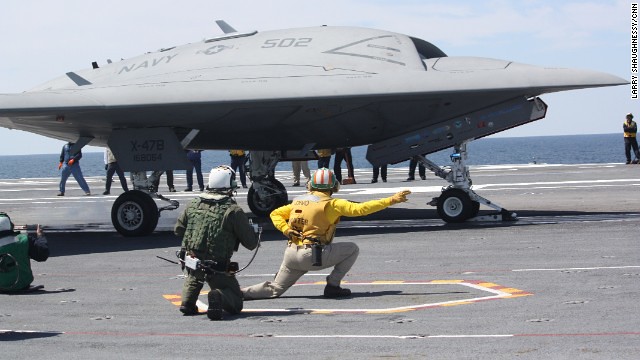
U.S. Navy’s new drone is tested at sea aboard an aircraft carrier.

Designs for many of the nation’s most sensitive advanced weapons systems have been compromised by Chinese hackers, according to a report prepared for the Pentagon and to officials from government and the defense industry.

Among more than two dozen major weapons systems whose designs were breached were programs critical to U.S. missile defenses and combat aircraft and ships, according to a previously undisclosed section of a confidential report prepared for Pentagon leaders by the Defense Science Board.

Experts warn that the electronic intrusions gave China access to advanced technology that could accelerate the development of its weapons systems and weaken the U.S. military advantage in a future conflict.

The Defense Science Board, a senior advisory group made up of government and civilian experts, did not accuse the Chinese of stealing the designs.

But senior military and industry officials with knowledge of the breaches said the vast majority were part of a widening Chinese campaign of espionage against U.S. defense contractors and government agencies.

The significance and extent of the targets help explain why the Obama administration has escalated its warnings to the Chinese government to stop what Washington sees as rampant cyber­theft.

In January, the advisory panel warned in the public version of its report that the Pentagon is unprepared to counter a full-scale cyber-conflict.

The list of compromised weapons designs is contained in a confidential version, and it was provided to The Washington Post.

Some of the weapons form the backbone of the Pentagon’s regional missile defense for Asia, Europe and the Persian Gulf.

The designs included those for the advanced Patriot missile system, known as PAC-3; an Army system for shooting down ballistic missiles, known as the Terminal High Altitude Area Defense, or THAAD; and the Navy’s Aegis ballistic-missile defense system.

Also identified in the report are vital combat aircraft and ships, including the F/A-18 fighter jet, the V-22 Osprey, the Black Hawk helicopter and the Navy’s new Littoral Combat Ship, which is designed to patrol waters close to shore.


Also on the list is the most expensive weapons system ever built — the F-35 Joint Strike Fighter, which is on track to cost about $1.4 trillion.

The 2007 hack of that project was reported previously.

China, which is pursuing a comprehensive long-term strategy to modernize its military, is investing in ways to overcome the U.S. military advantage — and cyber-espionage is seen as a key tool in that effort, the Pentagon noted this month in a report to Congress on China.

For the first time, the Pentagon specifically named the Chinese government and military as the culprit behind intrusions into government and other computer systems.

As the threat from Chinese cyber-espionage has grown, the administration has become more public with its concerns.

In a speech in March, Thomas Donilon, the national security adviser to President Obama, urged China to control its cyber-activity.

In its public criticism, the administration has avoided identifying the specific targets of hacking.
But U.S. officials said several examples were raised privately with senior Chinese government representatives in a four-hour meeting a year ago.

The officials, who spoke on the condition of anonymity to describe a closed meeting, said senior U.S. defense and diplomatic officials presented the Chinese with case studies detailing the evidence of major intrusions into U.S. companies, including defense contractors.

In addition, a recent classified National Intelligence Estimate on economic cyber-espionage concluded that China was by far the most active country in stealing intellectual property from U.S. companies.
Obama is expected to raise the issue when he meets with Chinese President Xi Jinping next month in California.

A spokesman for the Pentagon declined to discuss the list from the science board’s report.
But the spokesman, who was not authorized to speak on the record, said in an e-mail, “The Department of Defense has growing concerns about the global threat to economic and national security from persistent cyber-intrusions aimed at the theft of intellectual property, trade secrets and commercial data, which threatens the competitive edge of U.S. businesses like those in the Defense Industrial Base.”

The confidential list of compromised weapons system designs and technologies represents the clearest look at what the Chinese are suspected of targeting.

When the list was read to independent defense experts, they said they were shocked by the extent of the cyber-espionage and the potential for compromising U.S. defenses.
“That’s staggering,” said Mark Stokes, executive director of the Project 2049 Institute, a think tank that focuses on Asia security issues.

“These are all very critical weapons systems, critical to our national security. When I hear this in totality, it’s breathtaking.”

The experts said the cybertheft creates three major problems.

- First, access to advanced U.S. designs gives China an immediate operational edge that could be exploited in a conflict.

- Second, it accelerates China’s acquisition of advanced military technology and saves billions in development costs.

- And third, the U.S. designs can be used to benefit China’s own defense industry.

There are long-standing suspicions that China’s theft of designs for the F-35 fighter allowed Beijing to develop its version much faster.

“You’ve seen significant improvements in Chinese military capabilities through their willingness to spend, their acquisitions of advanced Russian weapons, and from their cyber-espionage campaign,” said James A. Lewis, a cyber-policy expert at the Center for Strategic and International Studies.

“Ten years ago, I used to call the PLA [People’s Liberation Army] the world’s largest open-air military museum. I can’t say that now.”

The public version of the science board report noted that such cyber-espionage and cyber-sabotage could impose “severe consequences for U.S. forces engaged in combat.”

Those consequences could include severed communication links critical to the operation of U.S. forces.
Data corruption could misdirect U.S. operations.

Weapons could fail to operate as intended.

Planes, satellites or drones could crash, the report said.

In other words, Stokes said, “if they have a better sense of a THAAD design or PAC-3 design, then that increases the potential of their ballistic missiles being able to penetrate our or our allies’ missile defenses.”

Winslow T. Wheeler, director of the Straus Military Reform Project at the Project on Government Oversight, made a similar point.

“If they got into the combat systems, it enables them to understand it to be able to jam it or otherwise disable it,” he said.

“If they’ve got into the basic algorithms for the missile and how they behave, somebody better get out a clean piece of paper and start to design all over again.”

The list did not describe the extent or timing of the penetrations.

Nor did it say whether the theft occurred through the computer networks of the U.S. government, defense contractors or subcontractors.

Privately, U.S. officials say that senior Pentagon officials are frustrated by the scale of cybertheft from defense contractors, who routinely handle sensitive classified data.

The officials said concerns have been expressed by Gen. Martin Dempsey, chairman of the Joint Chiefs of Staff, and Adm. James A. Winnefeld Jr., the vice chairman, as well as Gen. Keith Alexander, director of the National Security Agency.

“In many cases, they don’t know they’ve been hacked until the FBI comes knocking on their door,” said a senior military official who was not authorized to speak on the record.

“This is billions of dollars of combat advantage for China. They’ve just saved themselves 25 years of research and development. It’s nuts.”

In an attempt to combat the problem, the Pentagon launched a pilot program two years ago to help the defense industry shore up its computer defenses, allowing the companies to use classified threat data from the National Security Agency to screen their networks for malware.

The Chinese began to focus on subcontractors, and now the government is in the process of expanding the sharing of threat data to more defense contractors and other industries.

An effort to change defense contracting rules to require companies to secure their networks or risk losing Pentagon business stalled last year.

But the 2013 Defense Authorization Act has a provision that requires defense contractors holding classified clearances to report intrusions into their networks and allow access to government investigators to analyze the breach.

The systems on the science board’s list are built by a variety of top defense contractors, including Boeing, Lockheed Martin, Raytheon and Northrop Grumman.

None of the companies would comment about whether their systems have been breached.

But Northrop Grumman spokes­man Randy Belote acknowledged the company “is experiencing greater numbers of attempts to penetrate its computer networks” and said the firm is “vigilant” about protecting its networks.

A Lockheed Martin official said the firm is “spending more time helping deal with attacks on the supply chain” of partners, subcontractors and suppliers than dealing with attacks directly against the company.

“For now, our defenses are strong enough to counter the threat, and many attackers know that, so they go after suppliers. But of course they are always trying to develop new ways to attack.”

The Defense Science Board report also listed broad technologies that have been compromised, such as drone video systems, nanotechnology, tactical data links and electronic warfare systems — all areas where the Pentagon and Chinese military are investing heavily.

“Put all that together — the design compromises and the technology theft — and it’s pretty significant,” Stokes said.

By Ellen Nakashima

Thứ Hai, 27 tháng 5, 2013

In pictures, US Aircraft Carrier "menaces" China's ships in the south China sea

(Infonet.vn) As China and Philippines tensions in the disputed South China Sea at the Second Thomas Reef, the U.S. aircraft carrier USS Nimitz conducted military drills in the area, making China nervous.


Black Knights 154 taking off from The USS Nimitz

On 21 to 23 May 2013, USS Nimitz had rehearsal time for aircraft taking-off and landing, military drills and supplies in the South China Sea close to the Philippines, the purpose of this exercise was to protect maritime security, support islands defending.

Chinese media said that the U.S. has the "menace" of Chinese ships operating in waters near the Spratly Islands.


Preparing for the exercises

On May 15, USS Nimitz (CVN 68) of the U.S. Navy 7th Fleet has coordinated joint exercises with fleets of Korea and Japan in the East China Sea. After the completion of this exercise, the journey of the USS Nimitz quite mysterious.


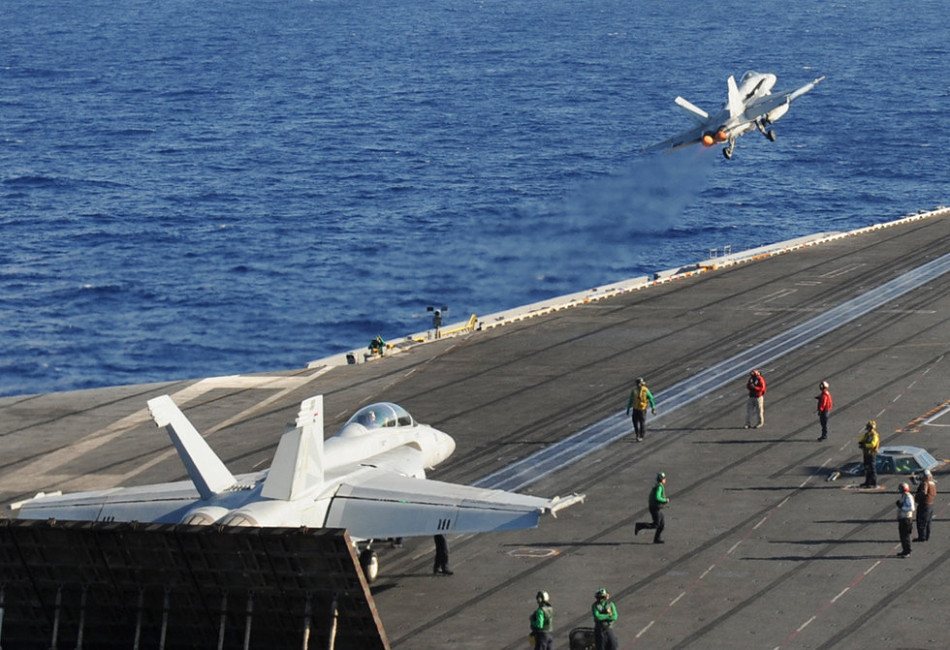
F/A-18 regularly taking off


On May 22, on the website of the U.S. Navy published a picture showing U.S. Ambassador in Singapore David Adelman presented on USS Nimitz with the notes "East Sea, the aircraft carrier". That means after finishing exercises with South Korea and Japan, U.S. Nimitz was sent to the South China Sea.


MH-60S Sea Hawk landing on the USS Nimitz

In addition, U.S. Navy photos showed that E-2C aircraft took off from the aircraft carrier Nimitz, conducted performance rehearsal. Shortly thereafter, the U.S. Navy website posted two pictures that F/A-18 fighter jets taking off from the aircraft carrier, and also note that the USS Nimitz in the South China Sea.


Practice with M240 gun

Chinese media analysis that U.S. military is rarely revealed clearly position of USS Nimitz. "Global Times" quoted a Chinese source said: "Americans generally do not want to reveal to others the U.S. military ships' position, particularly in the South China Sea. Moreover, the Philippines and Taiwan are stressed about the Taiwanese fishermen shot dead, China and the Philippines tense at the Second Thomas Reef, then this action can be understood as the U.S. threatened the Chinese ship in the disputed area with the Philippines ".


The aircraft carrier USS Nimitz (CVN 68) and the Military Sealift Command fast combat support ship USNS Rainier (T-AOE 7) transit alongside each other to conduct a replenishment-at-sea.

"Global Times" newspaper analysis, the USS Nimitz exercises in the South China Sea this time shows that Americans want to "enhance naval cooperation with Southeast Asian countries, the determination to protect the interests of the allies ". On the other hand, this also has a direct relationship to the outcome of the current in the South China Sea.


Sailors assigned to Helicopter Maritime Strike Squadron (HSM) 75 perform helicopter maintenance on the flight deck of the aircraft carrier USS Nimitz (CVN 68).

The newspaper quoted an analyst saying, "This carrier has been operating in the area known as the West Philippine Sea, as in this area, reconnaissance aircraft E-2C regularly take off, one of the practice, on the other hand is spying activities of Chinese and Taiwanese vessels in these waters. According to available information, the U.S. ship shall protect shipping vessels and assist in the air and on the sea for defending the islands, attacking against ships, this is clearly expressed intent of the US to protect the Phiippines. "

Infonet.vn

Infonet.vn is a portal of Vietnam's Ministry of Information and Communications

Thứ Năm, 23 tháng 5, 2013

From opera to exercises, U.S. and China deepen military ties

(Reuters) - Even as the United States accuses China of military espionage and worries about Beijing's more strident posture in the Asia-Pacific region, the ties between the armed forces of the two nations have been getting closer.

Musicians from the military bands of China's People's Liberation Army and the U.S. Army take photos during a rehearsal for their joint concert at the National Centre for the Performing Arts in Beijing, in this October 29, 2012 file photo. Credit: Reuters/China Daily/Files

Direct contact between China's People's Liberation Army (PLA) and some of its potential adversaries has increased dramatically in the last two years.

The first major public sign of the thaw was a joint concert by the U.S. Army band and its Chinese counterpart in 2011 at Washington's Kennedy Center where a female U.S. sergeant and a well-known male Chinese singer in a PLA uniform belted out a duet in Italian from the opera La Traviata.

On a more serious note, China hosted U.S. officers in the city of Nanjing this month to discuss countering pirates, and the United States has invited China to attend the Rim of the Pacific major naval exercises next year.

The increased contact aims to lessen the risk of accidental conflict between nuclear powers as their militaries each learn how the other works and cooperate on uncontroversial issues like disaster prevention and disease control.

The amiable spirit in these areas does not mean China and the United States are any less wary of each other on thorny subjects like allegations of Chinese cyber-spying, the possibility of an arms race in space, and the U.S. military's "pivot" to Asia with a build-up of its forces in the Pacific.

Some discussions have been remarkably blunt - with Chinese officials sometimes telling U.S. counterparts that Washington should quit the entire western Pacific and cede influence there to Beijing

Still, U.S. Air Force Major General Michael Keltz has seen a big change. When he first met with senior Chinese officials in late 2011, the atmosphere was stilted at best. Keltz says they stuck firmly to their prearranged "talking points", sometimes literally reading from pieces of paper.

"There has been a considerable improvement in both volume and quantity (of meetings and exchanges)," says Keltz, head of policy and planning for the U.S. Pacific Command - a role that includes explaining U.S. military thinking to Chinese officials.

Now, Chinese officers are less likely to stall routine conversations with their American opposite numbers by berating them for what they see as anti-China policies such as U.S. support for Taiwan.

After decades of relative isolation, greater military engagement with the outside world is at the heart of Beijing's increasingly assertive military strategy. China's military budget has grown by double digits almost every year for the past decade and it now fields its own aircraft carrier and is testing Stealth fighters.

China has become the largest contributor of U.N. peacekeepers of any of the permanent five Security Council members.

"The Chinese army is now getting much more involved globally," PLA Major-General Chao Liu, China's former defense attaché to India and now commander of U.N. peacekeepers in Cyprus, told Reuters earlier this year. "The differences (with the rest of the world) will become less, I think."

For the United States, there are clear advantages to learning more about a possible foe while at the same time drawing China further into the global system.

Increased contact with China's military gives the United States a chance to explain its new strategic focus on Asia which Beijing fears is a containment strategy to check China's economic and military rise.

The U.S. Pacific Command alone has some 40 exchanges with China planned for this year including talks on military medicine - particularly preparedness for a pandemic outbreak of a disease - and planning for joint maritime search and rescue operations.

And it goes beyond the U.S. to its Western allies. Australia has conducted its own joint exercises with China and is discussing more. European states are stepping up their own links and visits and NATO is considering much closer liaison, perhaps over areas such as peacekeeping in Africa.

While some Western officials complain that Chinese warships operating alongside international forces in anti-piracy patrols off Somalia have spent at least as much time spying on foreign warships as hunting pirates, their presence there is broadly welcomed.

STILL SPYING

More informal links are increasingly embraced. Retired Western officers in particular are setting up loose networks and visits, sometimes bringing along serving personnel.

Communication is helped by the increasing value the Chinese military puts on Western experience and English language skills. Zhang Zheng, the commander of China's first aircraft carrier, speaks perfect English and studied at Britain's Joint Command and Staff College.

Officers and diplomats say Chinese officials are more willing to share personal email addresses and indulge in private conversations in ways unthinkable only a decade ago.

"We have more tools for contact and cooperation than ever before," says Air Vice Marshal Michael Harwood, British defense attaché to Washington until 2012. "If I was advising a young officer today, I would tell him or her to learn as much about Chinese culture and make as many contacts there as they can."

None of this, though, has diminished military tensions on some major points of disagreement.

U.S. officials say they believe China is preparing a missile test to build its capability to knock down U.S. satellites. And last year, a series of maritime border disputes brought friction between China and U.S. allies such as Japan and the Philippines.

The most persistent bone of contention is cybersecurity.

The Pentagon earlier this month charged China with widespread espionage to acquire technology to fuel its military modernization, accusing Beijing for the first time of trying to break into U.S. defense computer networks. China issued a firm denial.

Espionage is a major concern for the West. Before allowing Chinese personnel access to any facility in the recent exchanges, the United States and others generally conduct a "risk assessment" and security experts will often sweep afterwards for bugs.

Foreign powers are also wary of giving Chinese officers too much access to their training schools and military colleges, complaining Beijing almost never reciprocates by allowing Western nations access to its elite establishments.

While U.S. law specifically prohibits providing China some forms of direct military training, European nations have fewer restrictions and, some officials say, must be careful.

"We don't want to be training China in carrier strike (operations)," said one Western official on condition of anonymity. "I think we can agree on that."

COMMERCIAL INTERESTS

Foreign experts say some elements in the PLA, having pulled out of many of their industrial interests in the last decade, have found stealing and selling intellectual property to be a lucrative earner.

"Stopping it is going to be difficult because it means them stopping something that makes them money," said James Lewis, a former U.S. foreign service officer now a senior fellow at the Center for Strategic and International Studies heavily involved in cyber talks with China.

After years of officially sanctioned discussions on cybersecurity between U.S. and Chinese think tanks, the door to more serious talks may also be quietly opening. For the first time this year, the two countries will officially discuss cybersecurity as part of a wider formal strategic dialogue.

In a shift toward cooperation with China, the top U.S. general in charge of cybersecurity, General Keith Alexander, told the Reuters Cybersecurity Summit in Washington last week that he or his successor would be willing to meet his Chinese counterpart when the time was right.

Sometimes, though, the United States prefers publicly challenging China to quiet diplomacy.

U.S. Chief of Naval Operations Admiral Jonathan Greenert said Washington took a decision to complain more in public this year about hacking by China after crossing what he called "the threshold of frustration".

Since doing so, some current and former officials say the level of Chinese hacking has declined slightly.

Some discussions between the two countries' militaries can be tense, particularly around U.S. "strategic rebalancing" plans such as strengthening military ties to countries like Japan and Australia and eventually increasing to 60 percent the number of its Navy ships devoted to the Pacific.

U.S. Pacific Command's Keltz says Chinese officials told him the Pacific should simply be divided in two, with America dominating one half and China the other.

"That is fundamentally not what the United States is going to do and it's not what most of the other countries in the region want us to do," he said. "I think (Chinese officials) are beginning to understand that."

(Additional reporting By David Alexander; Editing by Alistair Bell and Claudia Parsons)

Photo: Musicians from the military bands of China's People's Liberation Army and the U.S. Army take photos during a rehearsal for their joint concert at the National Centre for the Performing Arts in Beijing, in this October 29, 2012 file photo.
Credit: Reuters/China Daily/Files


http://www.reuters.com/article/2013/05/22/us-usa-china-military-analysis-idUSBRE94L0X920130522

Thứ Hai, 13 tháng 5, 2013

Why China and the US won’t go to war over the South China Sea

China’s increasing assertiveness in the South China Sea is challenging US primacy in the Asia Pacific.

Author: Carlyle A. Thayer,
UNSW Canberra
Even before Washington announced its official policy of rebalancing its force posture to the Asia Pacific, the United States had undertaken steps to strengthen its military posture by deploying more nuclear attack submarines to the region and negotiating arrangements with Australia to rotate Marines through Darwin.Since then, the United States has deployed Combat Littoral Ships to Singapore and is negotiating new arrangements for greater military access to the Philippines.

But these developments do not presage armed conflict between China and the United States. The People’s Liberation Army Navy has been circumspect in its involvement in South China Sea territorial disputes, and the United States has been careful to avoid being entrapped by regional allies in their territorial disputes with China. Armed conflict between China and the United States in the South China Sea appears unlikely.

Another, more probable, scenario is that both countries will find a modus vivendi enabling them to collaborate to maintain security in the South China Sea. The Obama administration has repeatedly emphasised that its policy of rebalancing to Asia is not directed at containing China. For example, Admiral Samuel J. Locklear III, Commander of the US Pacific Command, recently stated, ‘there has also been criticism that the Rebalance is a strategy of containment. This is not the case … it is a strategy of collaboration and cooperation’.

However, a review of past US–China military-to-military interaction indicates that an agreement to jointly manage security in the South China Sea is unlikely because of continuing strategic mistrust between the two countries. This is also because the currents of regionalism are growing stronger.

As such, a third scenario is more likely than the previous two: that China and the United States will maintain a relationship of cooperation and friction. In this scenario, both countries work separately to secure their interests through multilateral institutions such as the East Asia Summit, the ASEAN Defence Ministers’ Meeting Plus and the Enlarged ASEAN Maritime Forum. But they also continue to engage each other on points of mutual interest. The Pentagon has consistently sought to keep channels of communication open with China through three established bilateral mechanisms: Defense Consultative Talks, the Military Maritime Consultative Agreement (MMCA), and the Defense Policy Coordination Talks.

On the one hand, these multilateral mechanisms reveal very little about US–China military relations. Military-to-military contacts between the two countries have gone through repeated cycles of cooperation and suspension, meaning that it has not been possible to isolate purely military-to-military contacts from their political and strategic settings.

On the other hand, the channels have accomplished the following: continuing exchange visits by high-level defence officials; regular Defense Consultation Talks; continuing working-level discussions under the MMCA; agreement on the ‘7-point consensus’; and no serious naval incidents since the 2009 USNS Impeccable affair. They have also helped to ensure continuing exchange visits by senior military officers; the initiation of a Strategic Security Dialogue as part of the ministerial-level Strategic & Economic Dialogue process; agreement to hold meetings between coast guards; and agreement on a new working group to draft principles to establish a framework for military-to-military cooperation.

So the bottom line is that, despite ongoing frictions in their relationship, the United States and China will continue engaging with each other. Both sides understand that military-to-military contacts are a critical component of bilateral engagement. Without such interaction there is a risk that mistrust between the two militaries could spill over and have a major negative impact on bilateral relations in general. But strategic mistrust will probably persist in the absence of greater transparency in military-to-military relations. In sum, Sino-American relations in the South China Sea are more likely to be characterised by cooperation and friction than a modus vivendi of collaboration or, a worst-case scenario, armed conflict.

Carlyle A. Thayer is Emeritus Professor at the University of New South Wales, Australian Defence Force Academy, Canberra. The ideas in this paper were first presented at the Annual Conference of the Association for Asian Studies held at San Diego, 22 March 2013.

East Asia Forum

Thứ Sáu, 10 tháng 5, 2013

The technology China wants in order to catch up with Western militaries


The Pentagon's latest report on the capabilities of the Chinese military mentions an important aspect to its buildup: China's efforts to develop advanced technologies that have both civil and military use. This means that China is trying to acquire tech that can be used to drive modern aerospace, computing, and transportation industries -- as well as 21st-century military equipment.

How does it get this information? Everything from outright cyber theft to old-fashioned espionage to legitimate business partnerships.

As the report says:

"The Chinese utilize a large, well-organized network to facilitate collection of sensitive information and export-controlled technology from U.S. defense sources. Many of the organizations composing China's military-industrial complex have both military and civilian research and development functions. This network of government-affiliated companies and research institutes often enables the PLA to access sensitive and dual-use technologies or knowledgeable experts under the guise of civilian research and development.

The enterprises and institutes accomplish this through technology conferences and symposia, legitimate contracts and joint commercial ventures, partnerships with foreign firms, and joint development of specific technologies. In the case of key national security technologies,
controlled equipment, and other materials not readily obtainable through commercial means or academia, China has utilized its intelligence services and employed other illicit approaches that involve violations of U.S. laws and export controls"

Here's a look at a handful of interesting cases of Chinese efforts to get a hold of technology -- both military and civilian -- that could help its military catch up with its Western counterparts.

First up is China's biggest chunk of modern military hardware, its sole aircraft carrier, the Liaoning. Chinese investors bought the Soviet-built ship -- sans engines, electronics, or weapons -- from Ukraine in 2001 with the stated purpose of turning it into a floating gambling den. We all know how that worked out. Instead of becoming a casino (or luxury hotel like the former Soviet carrier Kiev) Liaoning was commissioned into the PLA Navy last year and it'll serve as China's starter carrier, a floating lab where the navy can master carrier operations before it commissions at least two more carriers in the next decade or so. These ships -- and a crop of modern destroyers and other ships -- are meant to help China project power throughout the Western Pacific.


Then, there's its development of stealthy jets that strongly resemble (on the outside, at least) U.S.-made F-22 Raptors and F-35 Joint Strike Fighters. Remember, Chinese hackers reportedly broke into the networks of defense contractors working on the F-35 (including Lockheed Martin, maker of both the F-35 and F-22). In an interesting coincidence, China revealed its J-20 stealth jet in late 2010 boasting a nose section that looks a lot like the F-22's, right down to parts of the canopy design and what might be a 3-D heads up display. Then, last year, China unveiled its second stealthy fighter, the J-31 (below). That plane bears a way-too-close-for-comfort resemblance to the F-22 and the F-35. (Last year, a U.S. Air Force official pointed out that the F-35's computerized maintenance system containing tons of information about the jet had to be redesigned after it was found to be vulnerable to hackers.)


In September 2012, the United States convicted Sixing Liu, a Chinese citizen working for a U.S. defense contractor, of bringing electronic files containing "details on the performance and design of" guidance systems for missiles, rocket target-designators, and even UAVS, the Pentagon's latest report points out. The document also recounts that two Taiwanese nationals were charged in March 2012 with planning to get their hands on "sensitive U.S. defense technology" and passing it to China. The pair, Hui Sheng Shen and Huan Ling Chang, were allegedly going to take pictures of the technology, delete the images from their cameras, and then bring the memory cards back to China where the images would be recovered.


The DOD report also lists the case of aircraft engine-maker, Pratt & Whitney Canada (a subsidiary of U.S. defense giant United Technologies Corporation) illegally giving engine control software to China for use in its latest attack helicopter, the Z-10. UTC and two subsidiaries ended up having to pay a $50 million fine and had some of its export license privileges suspended temporarily as part of a settlement deal with U.S. authorities.


Then there's the case of U.S. defense giant General Electric's partnership with China's state-owned aviation firm COMAC -- a program aimed at developing digital avionics for China's first domestically made jetliner, the COMAC 919 (shown below). GE came under fire from Virginia congressman Randy Forbes, who claimed the technology used to develop next-generation airliner avionics was inked to the same technology used in the U.S. Air Force's premier fighter, the F-22. Forbes worried that sharing information on even a civilian version of these avionics would allow China to develop them for military use. The deal remains on, but given the news we've heard in the last year or so about Chinese hackers, one hopes that GE is being extra vigilant in protecting its most sensitive information.


The predecessor of the avionics deal is GE's partnership with AVIC (COMAC's parent firm) to develop modern jet engines in China. It might seem like decades-old technology, but building jet engines, especially those used in 21st-century fighter jets, are one of the toughest engineering challenges in aviation. AVIC has partnered with GE in an attempt to develop engines capable of powering large aircraft: from civilian jetliners to military transports, radar planes to bombers. As U.S. Naval War College professor Andrew Erickson has said, these joint ventures could "give the Chinese aerospace industry a 100 piece puzzle with 90 of the pieces already assembled. Enough is left out so that the exporting companies can comply with the letter of the export control laws, but in reality, a rising military power is potentially being given relatively low-cost recipes for building the jet engines needed to power key military power projection platforms."


http://killerapps.foreignpolicy.com/posts/2013/05/09/the_technology_china_wants_in_order_to_catch_up_with_western_militaries

Thứ Năm, 9 tháng 5, 2013

China News: 4 Ways How China's Military Stacks Up Against the U.S.


When Defense Secretary Robert Gates says that China "could threaten America's primary means of projecting power and helping allies in the Pacific," and Admiral Robert Willard, former head of U.S. Pacific Command, notes that it "has exceeded most of our intelligence estimates of their military capability and capacity every year," there is cause for concern. Could China's military be growing at such a rate that the United States, saddled as it is by the Global War on Terror and economic depression, find itself falling back?

Fortunately, there is not yet cause for concern. Though China has been working hard to generate a flexible, lean, capable military, it still has a very long way to go before it can hope to challenge the United States. It takes more than numbers and a good economy to enable an effective fighting force.

Here's a blow-by-blow analysis of China's military capacities vis-à-vis the United States:

1. Soldiers:


In terms of raw manpower, China's 2.2 million bests the United States' 1.4 (not counting roughly 700,000 defense contractors). However, the quality differs significantly. The United States' forces have been deployed regularly since the Gulf War, while the People's Liberation Army have not seen combat since the 1970s. Similarly China's One-Child Policy might be a potential issue. Single-child families are more likely to dote upon their child; they are averse to heavy physical training and even suffer with basic skills such as laundry. As Drew Thompson notes, "If too much hand-holding is required for these recruits, the PLA could well find itself all suited up for modern warfare — but without the soldiers ready to fight it." The United States will be suffering similar difficulties; a Mission: Readiness report has found that "75% of young people between the ages of 17 and 24 would be unable to enlist in the U.S. armed forces because they are physically unfit, have failed to graduate high school or have criminal records."

2. Air Power:


The United States possesses three times the number of airplanes than China, which is still working on developing its own stealth fighters. Its greatest weakness lies in its engine industry; its new J-20 stealth fighter (designed to be a competitor to the F-22 or F-35) is still relying on Russian engines or weaker domestic models. China is offsetting this weakness by acquiring a small number of Su-35s and an undisclosed number of engines from Russia. The J-20 will likely not be operating until 2017 and it is not known how long before it is produced in sufficient numbers. It must also be noted that it takes more than stealth to make a lethal fighter. It must also possess dependable anti-air and anti-ground munitions, functional radar, electronic integration with other systems, and be mechanically reliable and resilient. For now, China makes up for its lack of a powerful air force by possessing one of the largest and most high-tech surface to air missile systems in the world.

3. Navy:


As before, the Chinese navy cannot compare to the U.S. Navy, not just in numbers but also in training. The United States has 10 aircraft carriers in service, while China's sole carrier (purchased from Russia) is currently being used for training and evaluation purposes. It will be many years before it is able to operate as an effective part of a carrier force capable of long-distance deployments and combat operations. China is set to develop its own homegrown carrier force, with a domestic carrier potentially nearing completion by 2015. China is developing its nuclear submarine force, however, with nuclear submarines armed with ballistic missiles capable of hitting targets 7400km away. China is focusing on blue-water deployments, with the deployment of two warships and a supply vessel to anti-piracy missions off the Eastern coast of Africa in 2008, but these are still a far cry from the global patrols maintained by the United States. For now, China's most dangerous naval capabilities lie in its anti-ship ballistic and cruise missiles, which provide a significant deterrent to American carriers.

4. The whole picture:


China is growing rapidly, both economically and militarily. It is training its troops for a variety of different missions, while at the same time developing air and naval assets to allow it to become a global power. However, such developments will take decades. China needs time to build not just the technology for modern warfare, but also to develop the necessary proficiency for its forces to deploy these systems effectively. In the meantime, it has developed capable deterrents, using anti-air and anti-ship missiles to negate the United States' strengths. The United States still has a significant lead on China, boasting the most technologically advanced and experienced military. China must first develop global capabilities, engage in foreign deployments, and expose its soldiers to combat before it can hope to challenge the United States.

Policy

Thứ Hai, 22 tháng 4, 2013

China's "carrier killer" can be destroyed by US Navy, CRS specialist

(Tien Phong Online) - The report of the Congressional Research Service (CRS) said the China's new anti-ship ballistic missile DF-21D can be destroyed and not really be "the game changer".


Despite the ominous warnings from U.S. defense analysts that the country is facing the risk of losing its aircraft carriers by Chinese ballistic missiles.

However, by Ronald O'Rourke, a CRS specialist for U.S. Navy combat-operation, China's new anti-ship ballistic missile DF-21D (said to be a "U.S. aircraft carrier killer") may be destroyed by implementing measures combined activeness and passiveness.

According to the report, "China Naval Modernization: Implications for U.S. Navy Capabilities," by the end of March, 2013, O'Rourke said that the attack chain of Chinese ballistic missiles is not impossible to be intercepted.

At some stages in the series of Chinese ballistic missile attacks, the proactive measures that can be taken to intercept. These phases include: When a ship (aircraft carrier) is detected, the data is transmitted to the Chinese missile launchers, missiles to be launch, Chinese missile warheads find targets.

O'Rourke provides some concrete measures proposed to deal with the DF-21D as follows:

First, the U.S. Navy could do more to control electromagnetic radiation or using deception signals.

Second, the U.S. Navy could use the electric system to disable or interfere the enemies's reconnaissance systems and find maritime long-range targets, to destroy China ballistic missiles in various stages of flight, diversionary , snare Chinese ballistic missiles as they approach the target that has been identified.

The choice solution to destroy China's ballistic missiles in flight include: Development versions of SM-3 BMD ballistic missile interceptor. The U.S. Navy should boost perchasing missile interceptor SM-3 Block IIA missile to replace the SM-2 Block IV.

Other options include: Developing and deploying supersonic electromagnetic rail guns, promote the development and deployment of electron laser intensity weapons (shipboard high-power free electron lasers), solid-state lasers on the battleships.

The Chinese ballistic missile will be intercepted as accessing the targets of determining if U.S. warships are equipped with electronic warfare system or systems to create smoke cloud to jamming navigation radar of Chinese ballistic missiles.

O'Rourke said that the Congress should consider whether the Flight III version of the DDG-51 destroyer, Arleigh Burke class that U.S. Navy plans to purchase in 2016.


DDG-51 Arleigh Burke class destroyers, of the most powerful surface combatant class in naval history.

According to the CRS expert, DDG-51 will have the ability to anti-air warfare (AAW) and ballistic missile defense (BMD) in order to implement the task for AMDR (Air and Missile Defense Radar) to face Chinese anti-ship ballistic missiles.

DDG-51 Flight III Destroyer is enhanced AAW and BMD capability from the present Flight IIA DDG-51.

DDG-51 Flight IIA is equipped with new version of AMDR, take a size of 12-14 feet. With this size, the new radar is more sensitivity than the SPY-1 radar equipped in the DDG-51 Flight IIA destroyer.

Video: US Navy tests 'game-changing' supersonic electromagnetic rail gun


Source: Tien Phong

Thứ Sáu, 19 tháng 4, 2013

U.S. Analysts Dismiss China’s Military Report

China this week revealed new details about the size of its military in a report that U.S.-based analysts largely dismissed for its omissions on defense spending, weapons systems and strategic ambitions.

The document, posted April 16 on People’s Daily Online, the English-version website of the state-run newspaper, for the first time included a headcount of People’s Liberation Army by service. There are 850,000 troops in the army, 235,000 in the navy and 398,000 in the air force, it states, for a total of 1.48 million.

The report, “The Diversified Employment of China’s Armed Forces,” didn’t include a similar tally for the PLA’s Second Artillery Force, the more secretive unit that oversees nuclear weapons and ballistic missiles, or its civilian workforce. China has previously said its military has 2.3 million members.

“These are basically a few meager bones they’re throwing our way,” Patrick Cronin, senior director of the Asia-Pacific Security Program at the Center for a New American Security in Washington, said of the manpower numbers. “There’s almost no really serious issue on PLA defense that this paper deals with adequately.”

The report, which is published about every two years, lacks basic information about China’s defense budget, developmental weapons programs such as the J-20 stealth fighter jet and reasoning for maritime expansion, Cronin said. The Defense Department in a 2012 report estimated China’s annual military-related expenditures at $120 billion to $180 billion.

“China prefers to gain leverage and power by ensuring that there is a degree of deception and lack of transparency,” Cronin said. Hopefully, upcoming discussions between Chinese and U.S. military officials will yield deeper insights, he said.

U.S. Army Gen. Martin Dempsey, chairman of the Joint Chiefs of Staff, on April 19 left for a weeklong trip to Asia. While he plans to visit South Korea and Japan, he will spend most of his time in China, meeting with his Chinese counterpart, Gen. Fang Fenghui, and possibly President Xi Jinping.

Topics likely to be discussed include China’s alliance with North Korea, which has recently threatened nuclear attacks against South Korea and its allies, as well as the U.S. strategic shift away from the ground wars of the past decade and toward threats in the Asia-Pacific region.

China’s military report references the changing U.S. posture with concern. “Some country has strengthened its Asia-Pacific military alliances, expanded its military presence in the region, and frequently makes the situation there tenser,” it states, in a not-so-subtle reference to the U.S.

The tone of the document isn’t as optimistic as the previous one, according to Bonnie Glaser, senior adviser for Asia at the Center for Strategic and International Studies in Washington. The lack of information about military spending was “somewhat disappointing,” she said.

“It would have been more significant if they had released the budget for each of the services, not just the number of people in them,” she said. “We don’t know how they allocate money to each of the services, or for procurement or any of these issues.”

Arguably the most noteworthy part of the the report is a section that seems to indicate the Chinese air force has the responsibility over the army, navy and police force of providing territorial air defense, according to Roger Cliff, a senior fellow at the Center for Strategic and Budgetary Assessments in Washington.

“It would suggest they’ve been able to break down the organizational walls, the bureaucratic barriers, that would start to truly enable joint operations, at least in the air defense, which has been a longstanding weakness of the PLA,” he said, though he cautioned, “I’m not sure if what they wrote is actually true.”

dodbuzz

Thứ Hai, 15 tháng 4, 2013

China points finger at US on regional tensions

(AFP) China’s defence ministry said on Tuesday that “some countries” are increasing tension in Asia and the Pacific, in thinly veiled criticism of US efforts to ramp up its military presence and alliances in the region.


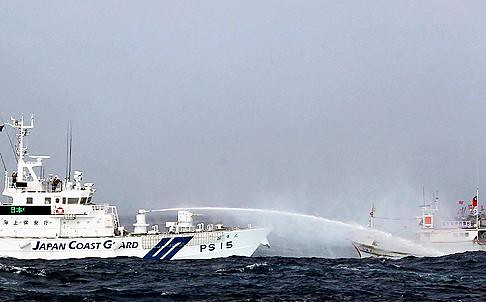
A Japan Coast Guard ship shoots water at a Taiwanese boat exchange in disputed waters in September. Photo: EPA

China is uneasy with what the United States has called the “rebalancing” of forces as the United States winds down the war in Afghanistan and pays renewed attention to the Asia-Pacific region.

China says the policy has emboldened Japan, the Philippines and Vietnam in longstanding territorial disputes.

China faces “multiple and complicated security threats” despite its growing influence, the Ministry of National Defence said in an annual white paper, adding that the US strategy meant “profound changes” for the region.

“There are some countries which are strengthening their Asia Pacific military alliances, expanding their military presence in the region and frequently make the situation there tenser,” the ministry said in the paper.

“On the issues concerning China’s territorial sovereignty and maritime rights and interests, some neighbouring countries are taking actions that complicate or exacerbate the situation, and Japan is making trouble over the Diaoyu Islands issue,” it said.

The dispute with Japan over the uninhabited islands, which Japan calls Senkaku, has escalated in recent months to the point where China and Japan have scrambled fighter jets while patrol ships shadow each other.

On Tuesday, three Chinese government ships entered the territorial waters of the dispute islands, Japan’s coastguard said.

The three surveillance ships were navigating in the 12-nautical-mile zone around the islands as of 9.20am, the coastguard said.

Chinese government ships have frequently spent time around the disputed island chain since Tokyo nationalised three of the isles last September.

The waters around the islands in the East China Sea are rich fishing grounds and have potentially huge oil and gas reserves.

Vietnam, Taiwan, Brunei, Malaysia and the Philippines also have conflicting claims with Beijing in parts of the South China Sea, including the Spratly Islands. China lays claim to almost the whole of the sea, which is criss-crossed by crucial shipping lanes.

The US shift comes as China boosts military spending and builds submarines, surface ships and anti-ship ballistic missiles as part of its naval modernisation, and has tested emerging technology aimed at destroying missiles in mid-air.

China has repeatedly said the world has nothing to fear from its military spending which is needed for legitimate defensive purposes, and that the sums spent pale in comparison with US defence expenditure.

“Major powers are vigorously developing new and more sophisticated military technologies so as to ensure that they can maintain strategic superiority in international competition in such areas as outer space and cyber space,” the ministry said.

Additional reporting by Agence France-Presse (AFP)

Thứ Sáu, 15 tháng 3, 2013

A U.S. Naval Blockade of China?

Once upon a time, not so long ago, there was much debate about whether war between major powers in Asia was even imaginable. It is a disturbing sign of how much the strategic environment has deteriorated that analysts are now starting to write publicly about how such a war might be fought.

There is a growing literature on the U.S. concept of Air-Sea Battle, including the question of whether its use of conventional strikes against targets on the Chinese mainland would lead to wider escalation. Presumably this has struck a chord in the Chinese security debate – raising questions about the efficacy of an anti-access strategy against U.S. maritime forces – and perhaps that was the point.

Now there's another emerging theme in American open-source speculation about how a U.S.-China conflict could unfold – a naval blockade.

In one recent article, Sean Mirski sets forth what he sees as the elements of a potentially successful U.S.-led blockade strategy to impose huge economic costs on China in a hypothetical future confrontation or war.

Of course, a recognition of China's massive seaborne oil-supply vulnerabilities has influenced Beijing's defense, energy and foreign policies for a decade. Whether or not the U.S. Navy has serious plans for the possibility of blockading China, through the Malacca Strait and other chokepoints, there are presumably those in the Chinese security establishment who assume it does.

But a reading of this new offering to the debate suggests that maybe the Chinese don't need to worry so much.

In theory, the United States could inflict grievous harm on China in a conflict. After all, regardless of the changing conventional balance, America has overwhelming nuclear superiority. In practice, such crude measures of force are unlikely to count so much. The critical questions are about how much risk, cost and self-harm the United States, China, Japan and any other possible belligerents might be willing to incur in a prospective Asian maritime conflict.

Air-Sea Battle and its associated Joint Operational Access Concept are explicitly about risk, and a recognition that the U.S. would need to be willing to sustain some substantial military losses in a conflict. That leaves unanswered the overriding political question – how much risk is too much?

Likewise with the blockade idea. Mirski acknowledges that any attempt to strangle the Chinese economy as a conflict strategy would be "deeply embedded in the mire of global politics" and would exact great costs on the United States and other participants. And those participants, he argues, would need to include India and Japan, along with collaboration from Russia in refusing to provide emergency energy relief overland.

Where his analysis on this score is far from complete is the question of how far Washington and its allies would be willing to go in damaging the global economy – and their own economies – in order to prevail against China by using blockade as a principal weapon of war.

This leads to an even bigger question. If a reliance on nuclear deterrence against China is disproportionate or simply not credible, if conventional Air-Sea Battle is based on uncertain judgments about risk and political will, and if a blockade would be prone to global economic and diplomatic blowback, then what are the arrows that really count in America's strategic quiver in a contested Asia?

By Rory Medcalf

Thứ Năm, 31 tháng 1, 2013

China continues cyberwar campaign, hacks the The New York Times

Feb 1, 2013- China has yet again been caught with its hand in the Western cookie jar. This time, it seems the Chinese military have hacked The New York Times, as an act of retaliation following a damning story published by The Times’ about China’s premier, Wen Jiabao. This follows on from Chinese hacks of Silicon Valley in 2010, and “hundreds” of other organizations and military contractors over the last few years.


The hack, which led to the complete infiltration of The Times’ network and numerous email accounts, started back in September when David Barboza was finishing a story about Wen Jiabao’s relatives accumulating billions of dollars through corrupt business dealings. The hackers set up three backdoors within The Times’ network, most likely using spear phishing (malware-laden email that is specifically targeted at certain users to maximize the chance that they open it). From here the hackers identified the domain controller, grabbed every user’s account name and password hash, cracked the hashes, and then had full access to just about everything on The Times’ network.

As an interesting aside, The Times uses Symantec’s suite of antimalware software — and yet over the course of three months, Symantec only successfully identified one piece of malware, out of 45 installed by the hackers. Mandiant, the security firm hired by The Times to root out the hackers, says that the malware was custom-made for the job, which is probably why Symantec couldn’t identify it.

Fortunately it seems like the hackers were only interested in information pertaining to the Wen Jiabao story – specifically, the names of people who provided information to Barboza. ”They could have wreaked havoc on our systems,” says Marc Frons, The Times’s chief information officer. “But that was not what they were after.” The Times says that, somehow, there’s “no evidence that sensitive e-mails or files from the reporting of our articles about the Wen family were accessed, downloaded or copied.” No customer data was stolen, either. It seems like The Times got away fairly unscathed, if a little humbled.

China, for what it’s worth, is denying any involvement, stating that “Chinese laws clearly forbid hacking attacks,” and “Cyberattacks have a transnational and anonymous nature; under such circumstances accusing the Chinese military of launching attacks through the web without irrefutable proof is unprofessional and baseless.” Mandiant insists that the attack is consistent with “A.P.T. Number 12,” a group of hackers that have previously been traced back to Chinese universities by Mandiant, AT&T, and the FBI. Without some kind of paper trail, it’s of course impossible to confirm that the Chinese government actually ordered the hackers to attack the NYT.

At this point, though, “transnational and anonymous” or not, it does seem fairly certain that China — as a nation — is engaging in cyberwarfare with the West, or those who seek to impugn the infallibility of its leadership. There has been a steady stream of reports from security firms of Chinese cyberattacks dating back into the mid-2000s, and they nearly always follow on from newspaper exposés, or target dissidents or activists. Remember, this is a nation where freedom of speech and the press doesn’t really exist, and where the flow of information is strictly controlled via the Great Firewall and other government-mandated means.

China’s industrial espionage on Silicon Valley and other Western companies rich in intellectual property is obviously in a different vein, but still with the same goal ultimately in mind: Chinese supremacy.

Extremetech

Chủ Nhật, 6 tháng 1, 2013

Expanding US military presence, alliances in Asia aimed at China

Jan 7, 2013- Washington is stepping up its military deployments, war games and alliances in the Asia-Pacific region, including with Tokyo where recent elections brought back into power the Liberal Democratic Party led by Shinzo Abe, who calls for taking a tougher line against China and remilitarizing Japan.

The Pentagon has begun a five-year program to deploy stealth, radar-evading warplanes to bases within striking range of China. This includes Air Force F-22s and B-2s and Marine Corps F-35s, reports Wired.com.


The U.S. Army is also ramping up exercises in the Pacific with “as many as 15,000 soldiers to train in places such as South Korea, Japan, India, New Zealand and Australia,” reported the Army Times Dec. 12. “And that’s just the beginning.”

Among exercises in the works are Balikatan, involving about 2,850 U.S. soldiers in the Philippines in April; and Gema Bhakti, to be conducted for the first time with the Indonesian Joint Forces in June. The Army is also seeking to undertake a battalion-sized field exercise in Bangladesh and is conducting “land force talks with Vietnam,” the Times reported.

As part of long-term efforts to counter the economic and military rise of China, Washington has been exploiting mounting tensions between Beijing and other governments in the region over territorial claims to islands and waters in the South China Sea, which is believed to hold vast reserves of oil and gas.

Both Beijing and Tokyo claim control of the uninhabited islands known as Senkaku in Japan and Diaoyu in China. In a provocative move, the Japanese government in September bought the islands from their private owners.

After a small Chinese propeller plane flew near the island Dec. 13, the Japanese military dispatched eight F-15 fighter planes to the area. They arrived after the plane had already left the islands’ territorial airspace.

The Chinese plane “wasn’t a military aircraft,” reported the Wall Street Journal. “Warned by a Japanese patrol ship not to enter Japan’s airspace, it replied, ‘This is Chinese airspace,’ Japan’s coast guard said.”

U.S.-Japan military ties

In August the U.S. and Japanese governments signed an agreement to deploy drones to monitor Chinese activity in the East China Sea. The following month Tokyo and Washington agreed to deploy a second major advanced missile defense radar on Japanese territory.
With another planned to be placed in the Philippines, it will be possible to track ballistic missiles launched from North Korea and large parts of China.

In November, Washington and Tokyo conducted a 12-day joint military exercise involving some 37,000 Japanese and 10,000 U.S. military personnel, according to Japan’s Defense Ministry.

These actions build upon a new U.S.-Japan bilateral defense-cooperation agreement signed in April that “calls for strengthening ‘interoperability’ between U.S. and Japanese forces, and building permanent training facilities on Guam and in the nearby Northern Mariana Islands,” reported the Journal. “Such facilities will mark the first permanent post for the Japanese military within U.S. territory since World War II.”

At the same time, the presence of 26,000 U.S. troops in Okinawa remains unpopular among many working people in Japan. The Pentagon imposed a curfew for all U.S. soldiers in Japan after two U.S. Navy sailors were arrested and charged by Japanese authorities with raping and robbing an Okinawan woman outside the Kadena Air Base in October.

In the Dec. 16 parliamentary elections, the Liberal Democratic Party beat the ruling Democratic Party of Japan. While its popular vote was only 30 percent, the LDP won 294 out of 480 seats, up from 118 in the 2009 vote.

The Liberal Democrats ruled Japan for nearly half a century until being defeated by the Democratic Party of Japan in the last election.

LDP leader Abe was named prime minister Dec. 26, a post he resigned from six years ago after serving a one-year stint. Abe campaigned for a more nationalist foreign policy, increasing military spending and vowing to rewrite Japan’s constitution, which was imposed on the country under U.S. occupation after World War II and limits Tokyo’s use of its armed forces abroad.

Japan’s Self Defense Forces, however, are among the world’s largest armed forces, with annual military spending ranking sixth in the world last year—in Asia second only to China—according to the Stockholm International Peace Research Institute.

Washington is also increasing its military presence in the Philippines, with more U.S. troops and increased stopovers by U.S. warships for training and exercises, reports Agence France-Presse. A rotating force of 600 U.S. special forces has been stationed in the southern Philippines since 2002.

Philippine Foreign Minister Albert del Rosario has also called for use of Japanese armed forces in the Pacific region, despite the fact that the country was occupied by Tokyo during World War II.

In addition to Tokyo, the governments of the Philippines, Brunei, Malaysia, Taiwan and Vietnam are involved in territorial disputes with Beijing in the South China Sea.

China claims sovereignty over all land inside the South China Sea, including more than 40 islands. In June Beijing set up a new national prefecture headquartered in the Paracel Islands, which Hanoi also lays claim to. The following month China’s Central Military Commission announced it would deploy a garrison of soldiers to guard the islands in the area.

In another development, the Barack Obama administration is planning to sell four Global Hawk surveillance drones to Seoul, the first sale of this aircraft in the Asia-Pacific region, reports al-Jazeera.

This proposal comes less than two weeks after the Democratic People’s Republic of Korea launched a satellite into orbit Dec. 12, which the White House condemned as “a highly provocative act.”

BY BRIAN WILLIAMS (The Militant)