The F-35B Lightning II landed aboard the amphibious assault ship Wasp on March 5, the first time the aircraft has deployed aboard a U.S. Navy ship in the Indo-Pacific.
Pilots with the "Green Knights" of Marine Fighter Attack Squadron 121, assigned under the Okinawa-based 31st Marine Expeditionary Unit, are scheduled to conduct a series of qualification flights on Wasp over a multi-day period. (MC3 Michael Molina/Navy)
Assigned to the 31st Marine Expeditionary Unit based in Okinawa, Japan, the F-35B will aid the Expeditionary Strike Group in a routine patrol to strengthen regional alliances and provide rapid-response capabilities.
“Pairing F-35B Lightning IIs with the Wasp represents one of the most significant leaps in war-fighting capability for the Navy-Marine Corps team in our lifetime,” said Rear Adm. Brad Cooper, commander, Expeditionary Strike Group 7, according to a press release.
An F-35B lands on the flight deck of the amphibious assault ship USS Wasp (LHD 1) as part of a routine patrol in the Indo-Pacific region. (U.S. Navy photo by Mass Communication Specialist 3rd Class Michael Molina/Released)
Its arrival supports the UP-Gunned ESG concept, which is aimed at integrating multi-mission surface combatants and F-35Bs into amphibious operations to provide lethality and survivability to three-ship amphibious ready groups.
The guided-missile destroyers Dewey and Sterett are scheduled to assist the Wasp Expeditionary Strike Group on operations and training.
Navy Should Delay Next Carrier Amid Troubles, GAO Audit Says
The gallery deck to flight deck bridge assembly is moved into place on the Gerald R. Ford aircraft carrier in October 2012. The Navy estimates the vessel’s total cost, to include one-time engineering, detailed design and construction already has climbed about 18 percent in four years to $12.3 billion, according to Defense Department data. Source: Huntington Ingalls via Bloomberg
The U.S. Navy should delay the award of a multibillion-dollar contract to Huntington Ingalls Industries Inc. (HII) to build the second aircraft carrier in a new class as the first one faces failings from its radar to the gear that launches planes, congressional investigators said.
“Technical, design and construction challenges” with the first carrier, the USS Gerald R. Ford, have caused “significant cost increases and reduce the likelihood that a fully functional ship will be delivered on time,” the Government Accountability Office said in a draft report obtained by Bloomberg News.
The Ford, already the most expensive warship ever built, is projected to cost $12.8 billion, 22 percent more than estimated five years ago. The report raises questions about the future of U.S. seapower in a time of reduced defense budgets and about whether new carriers are affordable as they assume greater importance in the Pentagon’s strategy to project U.S. power in the Asia-Pacific region.
Delays and “reliability deficiencies” with the flattop’s new dual-mission radar, electromagnetic launch system and arresting gear for aircraft mean that the Ford “will likely face operational limitations that extend past commissioning” in March 2016 and “into initial deployments,” the agency said.
The GAO, the investigative arm of Congress, said that’s reason enough to delay the contract that’s scheduled to be issued this year for the second ship, the USS John F. Kennedy.
‘Repeating Mistakes’ “It will be important to avoid repeating mistakes” in the contract for the Kennedy, the GAO said. “Staying within budget” will require the Navy to reduce “significant risk mainly by completing land-based testing for critical technologies before negotiating a contract” with Newport News, Virginia-based Huntington Ingalls.
Beci Brenton, a company spokeswoman, said in a telephone interview that “it would not be appropriate to comment on a draft report.”
Naval Sea Systems Command spokeswoman Colleen O’Rourke said in a statement that “as the Navy is currently working with the GAO on this report, it would be inappropriate to comment on any draft findings at this time. When the report is finalized, it will include Navy comments.”
The Navy remains committed to the Ford-class carrier as a needed capability, said a Navy official who declined to be identified before the GAO releases its final report. The Navy is confident that the first vessel will be delivered on schedule and that lessons learned from building it will be applied to reduce the cost of the second ship, the official said.
Shipbuilding Plan Huntington Ingalls rose 2.3 percent to $56.59 at the close in New York and has climbed 31 percent this year.
The Navy is grappling with how to pay for a shipbuilding plan that anticipates $43 billion for three carriers in the Ford class, as well as $34 billion for 52 Littoral Combat Ships and a 12-vessel nuclear submarine fleet to replace the Ohio-class submarine.
While the GAO said that the Navy and Huntington Ingalls are taking steps to control costs for the Ford, most increases occur after a vessel is 60 percent complete and key systems are installed and integrated. The Ford is now 56 percent complete.
Even the current $12.8 billion estimate is “optimistic because it assumes the shipbuilder will maintain its current level of performance throughout the remainder of construction,” the GAO said.
Carrier Numbers The Pentagon’s independent cost-estimating office, the Congressional Budget Office and a Navy-commissioned panel project final costs as high as $14.2 billion, the GAO said.
The draft report also raises questions about how many aircraft carriers the nation will have ready this decade. Congress has given the service temporary relief from the requirement to have 11 fully capable aircraft carriers. There are now 10 after deactivation of the USS Enterprise, and the Ford is supposed to bring that back to 11 by March 2016.
“As it now stands, the Navy will not be positioned to deliver a fully capable ship at the time,” the GAO said.
“Reliability shortfalls facing key Ford-class systems cloud the Navy’s ability to forecast when, or if” the carrier will meet the aircraft sortie rates and reduced manning requirements that distinguish it from the older Nimitz class, the GAO said.
O’Rourke, the Naval Sea Systems Command spokeswoman, wouldn’t comment on the specific value of the potential detailed design and construction contract to Huntington Ingalls for the Kennedy that the GAO said is due in September.
General Atomics, Raytheon The largest share of the cost increase for the Ford, 38 percent, stemmed from technologies delivered by the Navy, including the radar, launch system and arresting gear, according to the GAO.
The electromagnetic launch system made by San Diego-based General Atomics has increased to $742.6 million, up 134 percent since 2008, the GAO said. The cost of arresting gear also made by the company increased 125 percent to $169 million.
Raytheon Co. (RTN)’s dual-band radar has increased 140 percent to $484 million, according to data cited by the GAO. Twenty-seven percent of the cost growth was pegged to shipbuilder design issues and another 27 percent to construction, both attributed to Huntington Ingalls.
Huntington Ingalls is building the Ford under a $4.9 billion detailed design contract that covers the shipbuilder’s portion of constructing the vessel. It doesn’t cover other costs, such as the nuclear reactor to power the ship and other government-furnished equipment.
Forecasting Overrun The GAO said its analysis indicates that Huntington Ingalls “was forecasting an overrun at contract completion of over $913 million” that it said stemmed from “the shipbuilder not accomplishing work as planned.”
Huntington’s Brenton said in an e-mail in May that, “as the first new design carrier beginning construction in more than 40 years,” the Ford “is designed to provide increased capability and reduced total ownership cost by about $4 billion compared to Nimitz-class carriers.”
“For this first-of-class ship, construction commenced in parallel with design completion based on earlier decisions at Department of Defense,” she said. “Ongoing design during the construction process caused delay and inefficiencies in procurement, manufacturing, and assembly.”
June 15, 2013: Production has begun for the American RQ-21A Integrator UAV. The U.S. Navy and Marines, as well as the Dutch Navy, have ordered the 55 kg (121 pound) UAV, which has a 4.9 meter (16 foot) wingspan and can fly as high as 4,500 meters (15,000 feet) at a cruise speed of 100 kilometers an hour. RQ-21A can stay in the air up to 24 hours and can carry a payload of 23 kg (50 pounds). It uses the same takeoff and landing equipment as the Scan Eagle. RQ-21A also uses many of the Scan Eagle sensors, in addition to new ones that were too heavy for Scan Eagle. The additional weight of the RQ-21A makes it more stable in bad weather or windy conditions.
The marines have ordered 32 systems (with five UAVs each), while the navy is getting four, and the Dutch are getting five systems (which include ground controllers and maintenance gear). The first RQ-21As are expected to enter service next year.
Scan Eagle weighs 19 kg (40 pounds), has a 3.2 meter (ten foot) wingspan, and uses day and night video cameras. On ships it uses a catapult for launch and is landed via a wing hook that catches a rope hanging from a 16 meter (fifty foot) pole. This was recently replaced with the more compact CLRE (Compact Launch and Recovery System). On land Scan Eagle can land on any flat, solid surface.
The Scan Eagle can stay in the air for up to 15 hours per flight and fly as high as 5 kilometers (16,000 feet). Scan Eagles cruising speed is 110 kilometers an hour and can operate at least a hundred kilometers from the ground controller. Scan Eagle carries an optical system that is stabilized to keep the cameras focused on an object while the UAV moves. Scan Eagle has been flying for over a decade now and has been in military service since 2005.
On the UAV Integrator (above), its twin-booms are designed to carry miniature munitions.
USS George H. W. Bush (CVN 77) conducted the first aircraft carrier-borne end-to-end at-sea test of the Surface Ship Torpedo Defense (SSTD) System, the Navy announced, June 6.
The SSTD System combines the passive detection capability of the Torpedo Warning System that not only finds torpedoes, but also classifies and tracks them, with the hard-kill capability of the Countermeasure Anti-Torpedo, an encapsulated miniature torpedo. The at-sea tests were conducted May 15-19.
The Countermeasure Anti-Torpedo is being developed by the Pennsylvania State University Applied Research Laboratory (PSU-ARL). It is designed to locate, home in on and destroy hostile torpedoes. Over the four-day testing period, Bush engaged seven torpedo-like targets with seven Countermeasure Anti-Torpedoes. Designed to validate the end-to-end of the system, the testing proved successful.
“These tests are a culmination of a very focused effort by the Navy including the program office, Bush’s crew, Norfolk Naval Shipyard and our academic and industrial partners. With all seven of our shots doing what they are designed and built to do, it validates our work and significantly enhances our current capabilities,” said Capt. Moises DelToro, the Undersea Defensive Warfare Systems program manager.
This first end-to-end test of the SSTD System achieved several firsts: the first Torpedo Warning System detection of targets from a carrier, the first automatic detection and automatic targeting of an incoming torpedo target from a ship, the first launch of Countermeasure Anti-Torpedo from a carrier and the first end to end Torpedo Warning System and Countermeasure Anti-Torpedo system detection-to-engage at-sea test.
“It is gratifying to have these tests go so well,” said Rear Adm. David Johnson, program executive officer, Submarines, whose portfolio includes the Undersea Defensive Warfare Systems Program Office. “The engineering involved to detect a hostile torpedo, process its direction, speed, depth, and then engage it with a carrier-launched Countermeasure Anti-Torpedo is impressive. I am confident that the fleet will be pleased with the results.”
Given the complexity of the system, the program office is taking an incremental approach to the development and acquisition of the Surface Ship Torpedo Defense System.
“What is currently aboard Bush is an engineering development model, or EDM, that is a fully-functioning system, but not the final configuration or production model,” DelToro said. “We’re learning from the Bush to improve the system so we can provide the most robust and cost-effective hard-kill anti-torpedo capability possible.”
The Navy currently plans to equip all aircraft carriers and other high-value units with the Surface Ship Torpedo Defense system by 2035.
The secretary of the Navy announced Thursday that Billings will be one of five U.S. cities to have new ships or vessels named after them.
Secretary Ray Mabus called Mayor Tom Hanel to break the news, then issued a statement later in the day.
The USS Billings will be a littoral combat ship or LCS, "littoral" referring to coastal or intertidal waters.
"A fast, agile surface combatant, the LCS provides the required war fighting capabilities and operational flexibility to execute focused missions close to the shore such as mine warfare, anti-submarine warfare and surface warfare," the release from Mabus' office said.
The ship will be the first to bear the city's name, the release said, and it will be constructed by Lockheed Martin and Marinette Marine in Marinette, Wis. The ship will be 378 feet long, have a beam of 57.4 feet and travel at speeds in excess of 40 knots.
Another LCS will be named after Tulsa, Okla., and three joint high-speed transport vessels, designated by USNS rather than USS, will be named after Bismarck, N.D.; Yuma, Ariz.; and Burlington, Vt.
"It is my privilege as secretary of the Navy to name these ships after five great American cities," Mabus said. "Several cities will be represented for the first time in the Navy fleet, establishing a new connection and tradition that forms a bond between a city's residents and the sailors and Marines who serve in its namesake ship. For decades to come, these ships will sail in the fleet, building partnerships and projecting power around the world."
Hanel said Mabus told him that the USS Billings would be ready for commissioning in 2019.
It was reported that the U.S. P-3C anti-submarine aircraft circled for a long time in Kunming empty ship, ship personnel were tense, but fortunately only a false alarm. Kunming ship is equipped with Hsiung Feng II anti-ship missiles and seventy-six cannon, and another self-installation of short quadruple sea Cong tree missiles. Source: Taiwan's "ETTV"
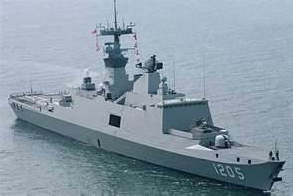
World Wide Web Roundup media reports, Taiwan's navy hull number 1205 Kangding level (Lafayette) frigates "Kunming ship", on March 25 in the Spratlys' Taiping Island neighborhood in South China Sea, was the U.S. military a P -3C anti-submarine aircraft flying at low altitude, circling, reconnaissance up to twice as long. At that time all shipboard personnel into combat position, and upon inspection that the U.S. military machine and enmity and confirmed a false alarm.
According to Taiwan's "Liberty Times" reported that the completion of Kunming ship the same day after the Taiping Island transportation and supply, leaving less than 100 nautical miles Taiping Island high seas encounters U.S. P-3C anti-submarine aircraft. The sources said at the time P-3C anti-submarine aircraft from the past to be clearly visible on the tail of the Navy "NAVY" lettering and military insignia.
to know that the P-3C's start back to Kunming-ship starboard stern fly, then looked back to bow on the left, and finally back to the ship stern to starboard and disappeared the air. As happened suddenly, Kunming ship immediately electromagnetic wave emission controls, while the P-3C for route tracing, confirmed that the U.S. military machine, not only to enhance the combat readiness alert and open-to-air radar.
In this regard, the Taiwan Navy Command, confirmed that a country through the P-3 aircraft Kunming ship, but stressed that is not hovering at a distance of five nautical miles away warships, without any unusual behavior. A general then wonder that in the past warships on the high seas have encountered a "friends" military reconnaissance, but flew directly, never seen such a low hover fly is also very rare, rather unusual.
It is reported that Taiwan warships in the South China Sea fishing protection is not the first "coincidence" the U.S. military. Taiwan Navy hull number 1805 Kidd-class "horse fair ship", on the 16th morning break Taiwan temporary enforcement line at latitude 20 degrees on the way, found that the U.S. military top secret naval "observation Island No." follow up to 2,3 hours before leave. Observation Island No. specifically responsible for tracking ballistic missile tests around the world.
Disclaimer copyright works without the global network Huanqiu.com written authorization is forbidden and offenders will be held liable.
As had been expected, the United States Navy has awarded two contracts for DDG 51 Arleigh Burke class destroyers. A total of $6.1 billion was awarded in two contracts for nine destroyers with an option for a tenth.
Huntington Ingall received a ten year contract to build five destroyers in a contract worth $3.33 billion. One destroyer is to be build every year from FY 2013 through FY 2017.
General Dynamics received a $2.84 billion contract to build four destroyers with an option for one more, which the US Navy expects to exercise. In that case, the value of the contract is worth $3.53 billion. One destroyer will be build in FY 2013 and one each in FY 2015 through FY 2017.
First Commissioned in 1991, the Arleigh Burke class has gone through several versions, each resulting in increased capability and displacement. The first 28 ships were Flight I and Flight II ships (DDG 51 through DDG 78).
The current version of the Arleigh Burke is the Flight IIA starting with DDG 79, the USS Oscar Austin. Some specifications of the Flight IIA are:
Length: 509 ft (155.29 m)
Beam: 59 ft (18 m)
Displacement: 9496 long tons (9648.4 metric tons)
Speed: in excess of 30 knots
Crew: 276
Propulsion consists of four General Electric LM 2500-30 gas turbines with two shafts and 100000 total shaft horsepower.
The Flight IIA features several improvements over its predecessors, including:
The addition of the Kingfisher mine-avoidance capability
A pair of helicopter hangars with the ability to deploy two Lamps MK III MH-60 helicopters
Blast-hardened bulkheads.
The first Flight IIA ship was commissioned in August 2000.
The Arleigh Burke class is fitted with the MK 41 Vertical Launch System with up to 96 cells. Armament includes:
RIM-66 Surface-to-Air Standard Missiles (SM-2MR)
RIM-162 Evolved Sea Sparrow Missiles (ESSM)
RUM-139 Vertical Launch ASROC (VLA)
BGM-109 Tomahawk land attack cruise missiles
MK-46 torpedoes (from two triple tube mounts)
Phalanx Close In Weapon System (CIWS)
MK 45 5-inch Gun
The MH-60 helicopters can be armed with Penguin or Hellfire missiles and MK 46/MK 50 torpedoes.
The United States Navy has announced that the next Arleigh Burke class destroyers are to be named the USS Paul Ignatius (DDG 117) and USS Daniel Inouye (DDg 118).
Paul Ignatius served as Secretary of The Navy and as Assistant Secretary of Defense under President Lyndon Johnson. Daniel Inouye was a US Senator and a recipient of the Medal of Honor for his actions during World War II.
The first Arleight Burke destroyer was commissioned in 1991 and there are a total of 62 ships in service (DDG 51 through DDG 112). Of these, 21 are Flight I and the remaining belonging to Flight II.
The Arleigh Burke class has been constantly upgraded and modernized, but also progressively grown larger in size with each flight. This has created some problems, including excessive levels of stress to the hull.
Construction was to have ended with 62 units, but has since been restarted due to issues with the successor, the Zumwalt class. A new Flight III will be constructed, which is now in the final design phase.
Only three Zumwalt class ships will be acquired and additional Flight II hulls will be build with elements of the Flight III gradually incorporated. The first Flight III may be commissioned in 2023.
Four Arleigh Burke Flight II hulls have now been contracted for and the US Navy may announce the addition of up to 10 hulls as early as next month in June 2013.
The Arleigh Burke class has never been exported, although Saudi Arabia has expressed interest. The four Kongo class and two improved Atago class destroyer in the Japanese Navy as based on the Arleigh Burke design.
The three KDX-III or Sejong The Great class destroyers in the South Korean Navy are also based on the Arleigh Burke design. The ships differ widely, including displacement, configuration and weapons fitted.
However, they all share the same Mk 41 Vertical Launch System, which uses the SM-2 as its main weapon for air defense. All also come with the Aegis System, including the phased array radars laid out in a similar manner.
BATH, Maine – On Thursday, May 23, General Dynamics Bath Iron Works celebrated the keel laying of Michael Monsoor (DDG 1001), the second ship in the planned three-ship Zumwalt class of guided-missile destroyers.
The ship is named for Petty Officer Second Class Michael Monsoor, a U.S. Navy SEAL who was killed in Ramadi, Iraq, in 2006. Monsoor was on a joint SEAL-Iraqi Army team operating from a rooftop when an insurgent threw a grenade at them. Monsoor jumped on the grenade, covering it and saving three fellow SEALS and eight Iraqi Army soldiers. Monsoor posthumously received the Medal of Honor from President George W. Bush on April 8, 2008. He was also awarded the Bronze Star and the Silver Star for his service in Iraq.
Michael Monsoor’s parents, Sally and George Monsoor, authenticated the keel at Bath Iron Works on May 23. Sally Monsoor is the ship’s sponsor. A special steel plate containing the initials of Sally and George Monsoor was prepared for the ceremony. The two authenticated the laying of the keel by striking welding arcs onto the steel plate, assisted by David Brown, a 35-year Bath Iron Works welder.
“Thank you from the Monsoor family for your hospitality and your spirit here at the shipyard,” said Sally Monsoor. “I can't wait to come back here with my children and grandchildren.”
The keel unit is the 4,400-ton, heavily outfitted mid-forebody section of the ship, which was moved from the shipyard’s Ultra Hall construction facility earlier in the month onto the building ways.
Brent West, DDG 1000 program manager for Bath Iron Works, hosted the ceremony and welcomed the audience of several hundred Bath Iron Works employees, Navy personnel and representatives of other major subcontractors in the program.
“This is a special day, as it marks a milestone in the construction of a ship, a tradition that goes back to the earliest days of shipbuilding – an event that’s been done for hundreds of years in this region, and for more than 120 years here at Bath Iron Works,” said West. “Over the next two years, we will continue to build the Michael Monsoor with knowledge and expertise honed over the decades. We look forward to future visits with Mr. and Mrs. Monsoor, as we progress toward delivering a ship that is worthy of the name of Michael Monsoor.”
CAPT James Downey, the Navy’s DDG 1000 Class program manager, spoke about Petty Officer Monsoor’s sacrifice and encouraged those present to “build this ship for Mike.”
The DDG-1000 Zumwalt-class destroyer is the U.S. Navy’s next-generation, guided-missile naval destroyer, leading the way for a new generation of advanced multi-mission surface combat ships. The ships will feature a low radar profile, an integrated power system and a total ship computing environment infrastructure. Armed with an array of weapons, the Zumwalt-class destroyers will provide offensive, distributed and precision fires in support of forces ashore. Bath Iron Works is the lead designer and builder for the program which employs approximately 5,300 people.
More information about General Dynamics Bath Iron Works, a subsidiary of General Dynamics (NYSE: GD), can be found at www.gdbiw.com.
More information about General Dynamics is available at www.gd.com.
The US Navy’s first littoral combat ship USS Freedom arrived in Singapore on May 16, to begin its eight-month deployment in Southeast Asia. It was welcomed by US Ambassador to Singapore David Adelman and the RRSN’s fleet commander Timothy Lo.
The warship with its 91 crew members arrived at Changi Naval Base afer a month-long sea journey from San Diego on March 1. Also embarked on the 115m- long vessel is the MH-60 Seahawk naval helicopter.
USS Freedom’s arrival in Singapore comes two years after Singapore and the US announced the deployment to this part of the world at the Shangri-La Dialogue in Singapore. Up to four littoral combat ships can be deployed here.
While in Singapore, it will refuel and restock before heading out to sea for training. Comprehensive maintenance checks will also be done after Freedom’s longest period out at sea since it was commissioned in 2008.
The Navy successfully tested its short range ballistic missile last week, destroying a complex moving target that soared over the Pacific Ocean on Wednesday, May 15.
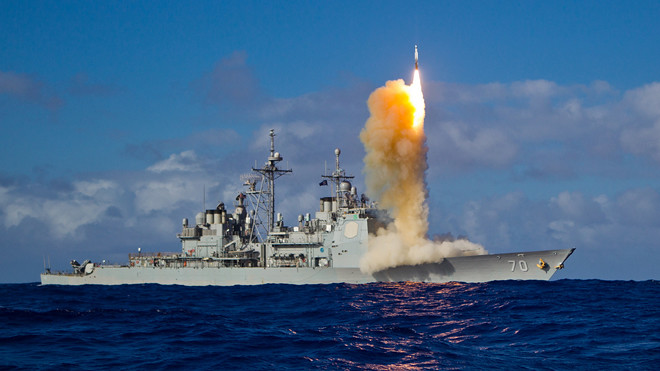
May 16, 2013: A Standard Missile 3 (SM-3) Block 1B interceptor is launched from the USS LAKE ERIE (CG 70) during a Missile Defense Agency and U.S. Navy test in the mid-Pacific. (U.S. MISSILE DEFENSE AGENCY)
An exclusive video released to FoxNews.com shows the missile screaming from the USS Lake Erie into the skies, where it destroyed an incoming missile target through sheer kinetic force. Raytheon, the manufacturer of the SM-3 Block 1B missile, labeled it a success.
“This test scenario was designed to challenge the discrimination capabilities of the SM-3 Block IB,” said Dr. Mitch Stevison, Raytheon SM-3 program director. “What we learned from this mission gives me great confidence in the missile’s production readiness.”
The test, code-named Stellar Hecate after a Greek goddess of magic, marks the 23rd successful intercept for the SM-3 program. And it seems President Obama agreed with the missile’s readiness: On Tuesday, production is set to begin on a batch of missiles at the company’s new Redstone Missile Integration Facility in Huntsville, Ala., that will be deployed out to U.S. Navy ships.
Raytheon has spent decades perfecting this class of missile, the company said.
"Because we've been perfecting this technology for 60 years, we've seen it expand from defending ships to defending continents,” said Dr. Taylor Lawrence, president of Raytheon Missile Systems. “As we look back on all that has been accomplished in the last six decades, we can't help but recognize that what was impossible yesterday, is possible today."
One of the biggest threats facing the U.S. Navy today is a new anti-ship ballistic missile recently fielded by China.
Officially designated the "DF-21D," American military men have another name for it: the Carrier-Killer. Weighing in at a massive 15 tons, the two-stage, solid fuel missile is 35 feet tall and nearly five feet across. With a range rumored to extend as far as 1200 miles, the DF-21D is designed to keep American aircraft carriers at a safe distance (from Taiwan) in the event hostilities ever break out, and to deny access to seas within striking distance of the Chinese mainland.
But in the ever changing arms race of tit meets tat, on Tuesday, Raytheon turned the tables on China and announced test results that could make the DF-21D irrelevant. Raytheon's solution is the RIM-162 ESSM "Evolved SeaSparrow," an improvement on the basic SeaSparrow air defense missile developed by Raytheon and General Dynamics. Its mission is to shoot down high-diving, supersonic missiles like the DF-21D.
"That's a hit!"
On Tuesday, Raytheon confirmed that in a weapons test at sea, the Evolved SeaSparrow successfully made "skin-to-skin" contact with a DF-21D surrogate, proving its ability to shoot down kill the Carrier Killer.
The company's next move will be to step up marketing of the air-defense missile to the U.S. Navy, and to our allies abroad -- and Raytheon's wasting no time in doing so. In the same announcement in which it explained the intercept results yesterday, Raytheon's vice president for missile systems' naval and area mission defense, Rick Nelson, called the Evolved SeaSparrow "truly an international missile."
Hint, hint
Whether Taiwan, Japan, South Korea, and other U.S. allies in the region will take the hint remains to be seen.
But when you consider that the missiles cost less than $1 million apiece -- yet are capable of protecting vital naval warships worth upwards of $1 billion (and anywhere as high as $13 billion for a Ford-class nuclear aircraft carrier), you have to assume a lot of countries are going to consider this product a very economical form of "insurance" against DF-21D "risk."
Already, Raytheon has sold more than 2,000 Evolved SeaSparrows.
I think that after this week's test results, Raytheon's going to sell a heckuvalot more, with very beneficial results for its revenue stream, its bottom line, and its investors.
Having gone unchallenged for decades, and facing budget cuts, the U.S. Navy is in danger of losing its capability to challenge the PLA in its near seas.
The Chinese navy's surface forces are on the march. Destroyers, frigates, corvettes, fast-attack craft, and, most recently, the newly commissioned aircraft carrier comprise the surface fleet. Over the past two decades, the People's Liberation Army Navy (PLA Navy) has put to sea four Sovremenny-class guided-missile destroyers procured from Russia, along with ten new classes of indigenously built destroyers and frigates. Some of the latter ship types have entered serial production, adding mass to the fleet. This is an impressive feat by any standard.
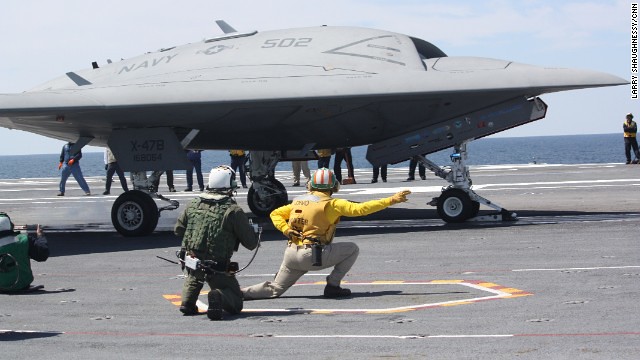
(CNN) -- The U.S. Navy has pulled off what the service's "air boss" called "a watershed event," launching a drone from an aircraft carrier.
The X-47B Unmanned Combat Air System (UCAS) demonstrator completed a catapult launch from the USS George H.W. Bush off the coast of Virginia Tuesday morning.
"Today we saw a small, but significant pixel in the future picture of our Navy as we begin integration of unmanned systems into arguably the most complex warfighting environment that exists today: the flight deck of a nuclear-powered aircraft carrier," the "air boss," Vice Adm. David Buss, commander of Naval Air Forces, said in a statement.
The drone landed at Naval Air Station Patuxent River, Maryland, after a 65-minute flight around Chesapeake Bay, the Navy said.
"The flight today demonstrated that the X-47B is capable of operation from a carrier, hand-off from one mission control station to another, flight through the national airspace, and recovery at another location without degradation in safety or precision," Matt Funk, the lead engineer for the UCAS program, said in statement. The next milestone will be landing the craft back on the carrier as the flight deck pitches in the open sea, something onboard pilots consider one of the most difficult things they do. That may come sometime this summer, the Navy statement said.
The nuclear-powered aircraft carrier USS Nimitz was seen in Busan, South Korea, on May 11, 2013, and it was scheduled to join the South Korea-U.S. joint naval drills.
Photo taken on May 11, 2013 shows the nuclear-powered aircraft carrier USS Nimitz in Busan, South Korea. The USS Nimitz arrived here Saturday to join the South Korea-U.S. joint naval drills. (Xinhua/Park Jin-hee)
A local resident looks at the nuclear-powered aircraft carrier USS Nimitz in Busan, South Korea, on May 11, 2013. The USS Nimitz arrived here Saturday to join the South Korea-U.S. joint naval drills. (Xinhua/Park Jin-hee)
Photo taken on May 11, 2013 shows the nuclear-powered aircraft carrier USS Nimitz in Busan, South Korea. The USS Nimitz arrived here Saturday to join the South Korea-U.S. joint naval drills. (Xinhua/Park Jin-hee)
A U.S. navy soldier stands on the nuclear-powered aircraft carrier USS Nimitz in Busan, South Korea, on May 11, 2013. The USS Nimitz arrived here Saturday to join the South Korea-U.S. joint naval drills. (Xinhua/Park Jin-hee)
The U.S. and Japan have agreed to deploy state-of-the-art strategic weapons in Japan in a bid to build an early warning system against North Korean missiles. U.S. Defense Secretary Chuck Hagel and his Japanese counterpart Itsunori Onodera announced the decision in a joint press conference in Washington on Monday.
"Today, we made progress on plans to deploy a second TPY-2 radar to Japan, which will help protect both of our nations from the threat of North Korean ballistic missiles,” Hagel told reporters.
The TPY-2 radar will be positioned in Kyoto following one already placed at a Japanese Air Force base in Tsugaru, Aomori Prefecture in 2006.
Using 2.5-3.75 cm wavelength, far shorter than other radars, the TPY-2 radar can identify ballistic missiles within a radius of 4,000 km.
FTI-01, held on October 25 2012, involved two TPY-2 radars, one as a forward-based X-band radar and one as a THAAD fire control radar, located on different islands of the Kwajalein Atoll. (Image source: Missile Defense Agency)
According to Hagel, the U.S. also agreed to deploy in Japan a second squadron of MV-22 Ospreys, the vertical takeoff and landing cargo transport aircraft. It will be deployed in Iwakuni, Yamaguchi Prefecture this summer and then transferred to Futenma Base in Okinawa, Onodera said.
The two defense chiefs also agreed that the U.S.-Japan Security Consultative Committee consisting of defense and foreign ministers will meet this year to speed up revision of the guidelines for bilateral defense cooperation in the face of China's military buildup.
May 1, 2013: The U.S. Navy has successfully tested the powered (ER for extended range) version of the AGM-154 JSOW (Joint Stand Off Weapon) glide bomb.
The AGM-154 JSOW is a long range GPS guided glide bomb. The F-35 can accommodate two AGM-154 bombs internally in addition to two air to air missiles. In a mission to disable enemy air defenses, some F-35's would carry the JSOW while others would provide escort with a full load of air to air missiles.
Earlier problems with the fuel system were fixed and this enabled the small jet engine to propel a JSOW nearly 500 kilometers. Normally, JSOW is unpowered but able to glide for up to 22-130 kilometers (depending on the altitude it is dropped from).
The powered version (JSOW-ER) has been in development for six years and has been delayed by technical problems and a shortage of customers.
JSOW entered service in the late 1990s, and Australia, Canada, Greece, Finland, Poland, Singapore, Turkey, and the Netherlands have bought small quantities. The U.S. Navy and Air Force have bought over a thousand and used 400 in the Balkans, Iraq, and Afghanistan.
The JSOW is becoming a popular, if specialized, smart bomb, even though it has had little use in combat. JSOW is basically a smart bomb with wings. That enables it to glide up to 130 kilometers from the aircraft dropping it. Range is about 22 kilometers if dropped from low altitude. JSOW also contains more elaborate fins and software that enables it to follow a specific route. Like the wingless JDAM smart bomb, JSOW uses GPS and inertial guidance (as a backup) to find its target. Like JDAM, JSOW will hit within 10 meters (31 feet) of its aiming point. JSOW can also attack moving ships.
There are three versions of JSOW. AGM-154A carries 145 bomblets that attack personnel and vehicles. AGM-154B contains six SADARM bomblets that seek out and destroy armored vehicles in an area 300 by 600 meters. This one costs $490,000 each. The AGM-154C carries a 361 kg (794 pound) warhead that can penetrate concrete or earth before detonating the high explosives it carries. This model contains a video link that allows for hitting very small targets (like going through a window). The C1 version is able to hit moving targets.
Each JSOW weighs 500-618 kg (1,100-1,500 pounds), depending on type. Not a lot of JSOWs have been bought because there is not a lot of demand for them. The purpose of a standoff weapon is to keep the aircraft away from enemy anti-aircraft defenses (mainly missiles). Some JSOW have been used in Iraq (between 1999 and 2003) and Afghanistan (2001). But in most cases, the much cheaper JDAM (about $26,000 each) does the job just as well. But against a better equipped foe, like China, Syria, Iran, or North Korea, JSOW would be more useful, and that’s why JSOW remains in production and development continued on JSOW ER.
A US warship designed to fight in coastal areas arrived Thursday in Singapore for its Southeast Asian deployment, underlining President Barack Obama's new strategic focus on Asia.
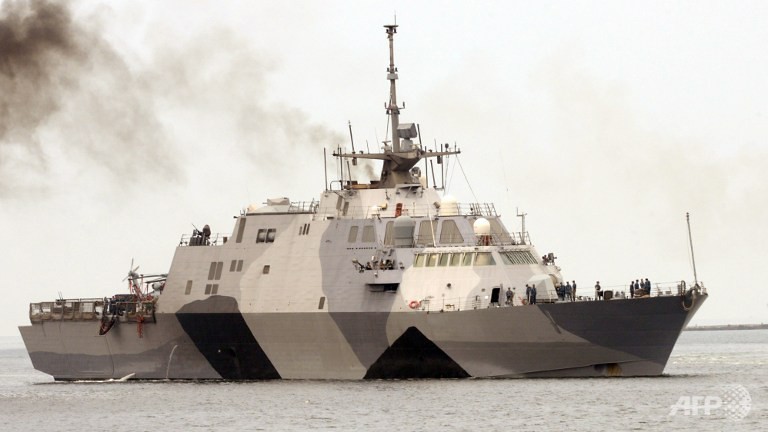
The USS Freedom (LCS-1). (AFP PHOTO / Jay DIRECTO)
SINGAPORE: A US warship designed to fight in coastal areas arrived Thursday in Singapore for its Southeast Asian deployment, underlining President Barack Obama's new strategic focus on Asia.
The deployment of the USS Freedom comes at a time of heightened tensions on the Korean Peninsula and as China publicly flexes its naval muscle in the South China Sea, where it has competing territorial claims with some Southeast Asian states.
US Navy officials said the Freedom, a new class of vessel called the littoral combat ship (LCS), sailed into Changi Naval Base at around 11:00 am (0300 GMT) in Singapore, a long-standing US ally that assists in logistics and exercises for forces in Southeast Asia.
The ship, the US Navy's first LCS which is designed to fight close to the shore, will be deployed for the next eight months in the region, where it will participate in naval exercises and visit other ports.
Regional security expert Ian Storey said the Freedom's deployment signals Washington's commitment to ensuring freedom of navigation in the region, which hosts some of the world's busiest shipping lanes.
"The forward deployment of these ships is part the US pivot, rebalancing away from Iraq and Afghanistan and towards Asia," said Storey, a senior fellow at the Institute of Southeast Asian Studies in Singapore.
"It demonstrates to US allies and friends that it is committed to maintaining a strong presence in the region to ensure stability. In naval terms, it also underpins the US' commitment to ensuring freedom of navigation," he told AFP.
US Defence Secretary Leon Panetta announced last year that Washington will shift the bulk of its naval fleet to the Pacific by 2020 as part of a new strategic focus on Asia, where China is an emerging power.
China is embroiled in a maritime dispute with four Southeast Asian countries -- Brunei, Malaysia, the Philippines and Vietnam -- over territorial claims in the South China Sea.
Beijing claims nearly the entire sea, including areas much nearer to the other claimants. Manila and Hanoi have been the most vocal in criticising China over alleged heavy-handedness in enforcing its claims.
While not a claimant, Washington has said it has an interest in the area to ensure freedom of navigation.
"We plan on spending most of our time here in Southeast Asia. This will be Freedom's neighbourhood for the next eight months," said US Navy Commander Timothy Wilke, the ship's commanding officer.
"We are eager to get out and about, work with other regional navies and share best practices during exercises, port visits and maritime security operations."
Singapore has agreed to the rotational deployment of up to four LCS. This means the vessels will not be permanently based in the country and crews will live aboard during ship visits.
Euan Graham, a maritime security expert at the S Rajaratnam School of International Studies in Singapore, said Beijing "is obviously cautious about any enhancement of the US military presence around the South China Sea".
But he added that China also understands that Freedom's presence is "not a major step-change in the naval balance in the region".
China however would be keen to learn about the performance of the ship, a versatile vessel that can be used for surface warfare as well as to hunt for mines and submarines and is suitable to maritime regions like Southeast Asia, Graham said.
He said the timing of Freedom's deployment also counters perceptions that US budget cuts would "undermine the sustainability of the US forward presence" in Asia.
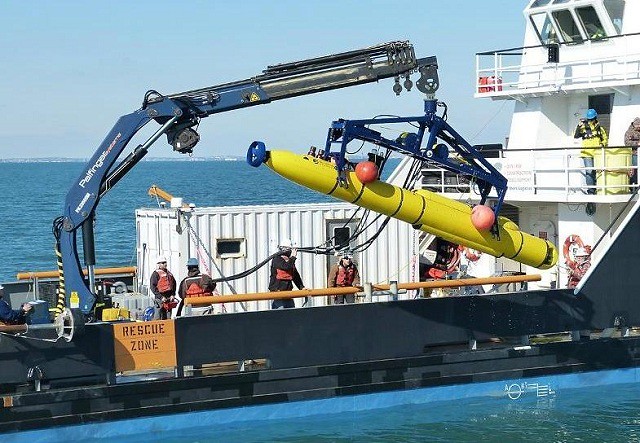
(Navy Recognition)- Bluefin Robotics, a leading provider of Unmanned Underwater Vehicles (UUVs), announced that the company has successfully completed deep-water testing of a specialized UUV for the Defense Advanced Research Projects Agency (DARPA). The system was developed under a Phase II subcontract from Applied Physical Sciences Corp. (APS) for the Deep Sea Operations (DSOP) Program. DSOP is part of DARPA’s Distributed Agile Submarine Hunting program (DASH), which aims to develop affordable distributed technology to address Anti-Submarine Warfare (ASW) surveillance needs over large, operationally relevant areas.
In February, Bluefin mobilized a Boston Harbor Cruises’ vessel, the Scarlett Isabella, at their dock in Quincy, Massachusetts and transited for over 48 hours towards the testing site. While severe weather brought on by Storm Q forced the team to adjust logistics plans, they were able to successfully conduct six days of operational testing including two 4,450-meter dives totaling 11 hours.
Testing of the system provided Bluefin an opportunity to vet several new vehicle capabilities for their modular UUVs including an extended operational depth rating, an advanced pressure vessel design, a new power system, a newly available high-powered acoustics transducer system, and a transportable docking head launch and recovery system.
“I am proud to have a team, partners, and vendors that step up to solve subsea challenges,” said David P. Kelly, President and CEO of Bluefin Robotics. “We are looking forward to tackling the next set of challenges posed by the DARPA Program and applying our hard-won experiences to others.”
Phase III of the contract was awarded in early March and will fund the full integration of the deep-sea sonar into the vehicle, as well as fund the production of a second system with sonar to support networked operations.
WASHINGTON (AFP) - The United States has deployed a sophisticated radar off the coast of Japan capable of tracking North Korean missiles and has sent a second destroyer to the region, officials said Tuesday.
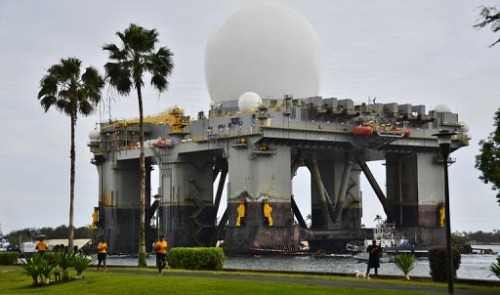
This March 22, 2013 handout image provided by the US Navy shows the Sea-based, X-band Radar (SBX 1).
The Sea-Based X-Band Radar (SBX), which resembles an enormous balloon mounted on a large oil rig, is designed to track ballistic missiles and feed data to a separate command that can fire interceptors.
Pentagon spokesman George Little stressed the deployment of the SBX system had already been scheduled and was not related to the ongoing tensions surrounding North Korea.
"The SBX is undergoing scheduled sea trials. Decisions about further deployments have not been made at this point," Little said.
"It's incorrect to tie the SBX at this point to what's happening on the Korean Peninsula right now."
Earlier, US officials confirmed that the anti-missile destroyer USS John McCain has been deployed to the region. The Pentagon at first said that a similar type of destroyer, the USS Fitzgerald, had been deployed.
Later on Tuesday Little said the USS Decatur anti-missile destroyer had also been sent to the Pacific region.
"It's arrived at a predetermined location in the Western Pacific to perform a missile defense mission," he said, stressing that reports saying US ships would be based off the North Korean coast were "incorrect."
"Those assets also help protect our own interests, our own troops in the region and other allies, to include Japan," he said.
"Our response, and the mix of assets we have supplied to our responses, is prudent, logical and measured."
"Let me be very clear that the United States' position is that we want peace and stability on the Korean Peninsula."
In recent days the United States has sent its most sophisticated weapons to the region in a display of gunboat diplomacy.
The United States previously took the unusual step of announcing test bombing by nuclear-capable state-of-the-art B-2 bombers.
It has also deployed F-22 Raptor stealth fighters to South Korea as part of a US-South Korean military exercise -- dubbed "Foal Eagle" -- which is scheduled to last until April 30.
The Korean peninsula has been caught in a cycle of escalating tensions since the North's February nuclear test, which followed a long-range rocket launch in December.
Subsequent UN sanctions and annual South Korea-US military exercises have been used by Pyongyang to justify a wave of increasingly dire threats against Seoul and Washington, including warnings of missile strikes and nuclear war.


_class_guided_missile_Destroyer_USS_Shoup_(DDG_86).jpg)
_transits_the_western_Pacific_Ocean.jpg "Arleigh Burke class destroyers are to be named the USS Paul Ignatius (DDG 117) and USS Daniel Inouye (DDg 118).")