Hiển thị các bài đăng có nhãn US-Japan. Hiển thị tất cả bài đăng

Thứ Ba, 25 tháng 6, 2013

US Marine Corps and Japanese Forces Storm Ashore ... Together

WASHINGTON — At some point between June 11 and June 28, a US Marine Corps MV-22 Osprey will, for the first time, land on the deck of a Japan Maritime Self-Defense Force ship as part of a major amphibious exercise between the US, Japan and regional allies.

Japanese SDF LCAC hovercrafts. A Japan Self-Defense Force Landing Craft approaches the shore of San Clemente Island, Calif., during exercise Dawn Blitz. (US Navy)
A Japan Self-Defense Force Landing Craft approaches the shore of San Clemente Island, Calif., during exercise Dawn Blitz. (US Navy)

Known as Dawn Blitz 2013, the amphibious assault war game off the southern California coast involves about 1,000 Japanese soldiers, three Japanese warships and assorted attack and cargo helicopters, which will team with the 1st Marine Expeditionary Brigade (MEB) and the US Navy’s Expeditionary Strike Group 3. The Marines also are bringing three squadrons of Osprey tilt-rotor aircraft and a handful of F/A-18 fighter jets to the scrum.

Canada and New Zealand each sent company-size elements to take part in the exercise, with observers from Australia, Mexico, Chile, Colombia and Peru in attendance as well.

So much representation from Canada and Latin American partners might seem out of synch with a Pacific-based amphibious scenario. But Brig. Gen. John Broadmeadow, commander of the 1st MEB, told reporters June 13 that partnerships like this are likely to become the norm.

“We are hitting a lot of [US Southern Command’s] objectives” in the exercise, he said. “This isn’t a one-way partnership between us and the Japanese; this is a broad coalition that looks at our pivot to the Pacific from a more global perspective, and that our South American partners are as important in that coalition as our traditional Pacific partners.”

US forces assigned to Southern Command, or SOUTHCOM, cover the Caribbean Sea and Latin America south of Mexico.

The Marine Corps is using the exercise as another way to get “back to the sea” after 12 years of fighting in the deserts and mountains of the Middle East, while imparting its knowledge of amphibious operations to partner nations that lack that capability.

“If you want to use the sea as a maneuver space and gain a positional advantage … that type of graduate-level amphib work takes years to develop,” Broadmeadow said.

For the first time, Japanese troops will plan and conduct ship-to-shore assaults both in partnership with Marine units and alone, while taking part in land operations with their Canadian and New Zealand counterparts.

Broadmeadow cautioned that the scenarios are not meant to represent any current threat from North Korea or any other specific hot spot.

As for the Osprey operations, the Japanese asked to see the MV-22 used in a humanitarian scenario, in which casualties are brought from shore to ship. So the birds will take off from shore before settling on the flight decks of the Japanese ships Shimokita and Hyuga.

Like every other DoD activity, the exercise has been bitten by budgetary concerns.

“We haven’t put the numbers of ships into the exercise as we originally envisioned,” Broadmeadow admitted. But he said he is still confident that the event is big enough and dynamic enough to benefit partner nations and his Marines.

Defense News

This is a video of LCAC unloading a tank.

Thứ Sáu, 21 tháng 6, 2013

Lockheed, Mitsubishi Sign F-35 FACO Deal

WASHINGTON — Lockheed Martin has signed an agreement with Japan’s Mitsubishi Heavy Industries Ltd. to begin work on a final assembly and check out (FACO) facility for Japanese F-35 Joint Strike Fighters.

The contract was announced by Steve O’Bryan, Lockheed’s vice president in charge of the F-35 program, at this week’s Paris Air Show.

While declining to give contract figures for the deal, Eric Schnaible, Lockheed’s spokesman for Japanese F-35 issues, said Lockheed hopes to replace the contract, which runs through the end of 2013, with a five-year deal sometime by mid-October.

“We are committed to maintaining our successful long-term partnership with Japanese industry as we mature the Japan F-35 program,” Schnaible said. “Over time, we believe Japanese industry will become a key provider in the F-35 supply chain for both production and sustainment.”

The Pentagon’s Joint Program Office declined to comment on the news, noting FACO decisions are made between Lockheed and the host country.

While this contract is a major step towards getting the FACO up and running, it will be some time before locally assembled F-35s take off. The first four aircraft will be produced at Lockheed’s Forth Worth, Texas, assembly line for a 2016 delivery.

The remaining 38 will be assembled at the Japanese facility. Plans currently call for the FACO to produce parts for Japanese planes only, in accordance with Japan’s long-held ban on weapon exports. However, there has been speculation in Japanese media that the government of Prime Minister Shinzo Abe may experiment with the exportation of Japanese-design parts for F-35s around the world.

Japan’s FACO will be the second international facility for the F-35. Italy’s FACO at Cameri Air Force Base is set to open next month.

Defense News

Thứ Hai, 10 tháng 6, 2013

Japanese defense forces landed in the U.S.


This is the first time that the Japanese Self Defense Forces conduct joint exercises bring name "Dawn Blitz" in foreign country.

The "Dawn Blitz" exercise officially hold June 11, is expected to last 2 weeks in order to improve the ability to coordinate joint action between the two armies, U.S. - Japan.

Notice of the exercise, said the U.S. sent forces marines, while Japan's Self-Defense Forces with 3 ships, 1,000 troops and four combat helicopters.

On May 31, the soldiers of Japan with warships reached the southern coast of California, USA.

Thứ Ba, 4 tháng 6, 2013

U.S., Japan to send large scale "gift" to Chinese President

US and Japan have prepared available "gift" for Chinese president Xi Jinping with the large scale military drill which China has requested to postpone.

US troops engaged in joint US-Japan amphibious assault training
US troops engaged in joint US-Japan amphibious assault training in May 2012

On June 7-8, in California, Chinese President Xi Jinping will hold talk with U.S. President Barack Obama. Also on June 10, at the request of Tokyo, paratroopers of the U.S. and Japan will practice landings on the islands which were assumed occupation. The scenario of the exercise is to deploy the American- Japanese "shield" to offensive against "sword" of China. Japan is very interested in protecting the Senkaku Islands in the East China Sea. China is strengthening the activities of patrol boats and naval forces in the waters around the islands. The islands are under Japanese control, but China is considered the country's territory.

Japan will participate at an “unprecedented” level in a large-scale U.S.-led military exercise in California later this month, as it seeks to further strengthen coordination with its main ally and its ability to mount an amphibious assault aimed at capturing isolated island territory.

The move is likely to anger China considering the ongoing tensions between Tokyo and Beijing over disputed islands in the East China Sea, a dispute that has shaken both economic and political ties. It also shortly after leaders from the U.S and China meet for a high-stakes bilateral summit later this week, where territorial issues are expected to be part of the discussions.

Japan’s Self-Defense Forces will take part for the first time in the periodic multi-nation exercise to be held in California from mid-June. In the exercise, troops will engage in amphibious assault training with U.S. marines intended to enhance their island-capturing and other capabilities.

Experts say the joint-exercise represents a departure in scale from previous drills involving only Japanese ground troops working with U.S. marines.

Japan has sent three warships, 730 Maritime Self-Defense Force troops, 250 ground troops and seven combat helicopters to take part in the amphibious war drill with the U.S. Marines off Camp Pendleton, California. The Dawn Blitz 2013 exercise will also involve five personnel from the Air Self-Defense Force.

A public affairs official at the SDF’s Joint Staff Office said this will be the first time ground troops will operate from Japanese warships in a drill so far from Japan. The SDF will be participating from June 10 to June 26, he said.

“The exercise is aimed at improving the integrated operation capabilities of the SDF and maintaining and improving bilateral capabilities with the U.S. military,” the spokesman said.

Col. Grant Newsham, U.S. Marine liaison officer with the GSDF, described the joint training as “historic.”

In a smaller exercise last September, a 40-person GSDF platoon sailed to Guam to receive training on amphibious military tactics from U.S. Marines.

“Now, eight months later we have three MSDF vessels, two of them amphibious ships, with 250 GSDF troops with their equipment and helicopters aboard, sailing across the Pacific Ocean to southern California to train with each other and with the U.S. Marines and U.S. Navy in a much more complex amphibious exercise. This is unprecedented,” Col. Newsham said. He added that troops will practice combat skills useful for defending Japanese territory.

But experts say Japan’s participation could trigger a backlash from China as Tokyo strengthens its capability to protect isolated islands. Ties between the two nations have soured over the ownership of a set of islands in the East China Sea that the Japanese call the Senkaku and China calls the Diaoyu.

U.S. President Barack Obama and his Chinese counterpart Xi Jinping will also be engaging in a two-day informal “shirtsleeves summit” in California starting Friday, where the two are expected to discuss contentious issues including North Korea, cyber-security and maritime disputes in Asia. While the meeting will allow the two to focus on establishing personal rapport, it remains to be seen how Beijing would react to the military exercise.

Tetsuo Kotani, a maritime security specialist at The Japan Institute of International Affairs, said the exercise was “the first step” for Japan to assume its own amphibious landing capabilities, and China would be concerned of such developments.

“Beijing will likely ask Japan not to engage in activities that could exacerbate regional tensions,” he said. “It’s wary of the deepening security alliance between Japan and the United States.”

Canada and New Zealand will also take part in the exercise.

Kienthuc.net.vn/ WSJ

Thứ Năm, 2 tháng 5, 2013

U.S. to Deploy Strategic Weapons in Japan

The U.S. and Japan have agreed to deploy state-of-the-art strategic weapons in Japan in a bid to build an early warning system against North Korean missiles. U.S. Defense Secretary Chuck Hagel and his Japanese counterpart Itsunori Onodera announced the decision in a joint press conference in Washington on Monday.

"Today, we made progress on plans to deploy a second TPY-2 radar to Japan, which will help protect both of our nations from the threat of North Korean ballistic missiles,” Hagel told reporters.

The TPY-2 radar will be positioned in Kyoto following one already placed at a Japanese Air Force base in Tsugaru, Aomori Prefecture in 2006.

Using 2.5-3.75 cm wavelength, far shorter than other radars, the TPY-2 radar can identify ballistic missiles within a radius of 4,000 km.


FTI-01, held on October 25 2012, involved two TPY-2 radars, one as a forward-based X-band radar and one as a THAAD fire control radar, located on different islands of the Kwajalein Atoll. (Image source: Missile Defense Agency)

According to Hagel, the U.S. also agreed to deploy in Japan a second squadron of MV-22 Ospreys, the vertical takeoff and landing cargo transport aircraft. It will be deployed in Iwakuni, Yamaguchi Prefecture this summer and then transferred to Futenma Base in Okinawa, Onodera said.

The two defense chiefs also agreed that the U.S.-Japan Security Consultative Committee consisting of defense and foreign ministers will meet this year to speed up revision of the guidelines for bilateral defense cooperation in the face of China's military buildup.

ChosunIlbo

Chủ Nhật, 31 tháng 3, 2013

12 Ospreys headed to Japan in July, bound for Futenma

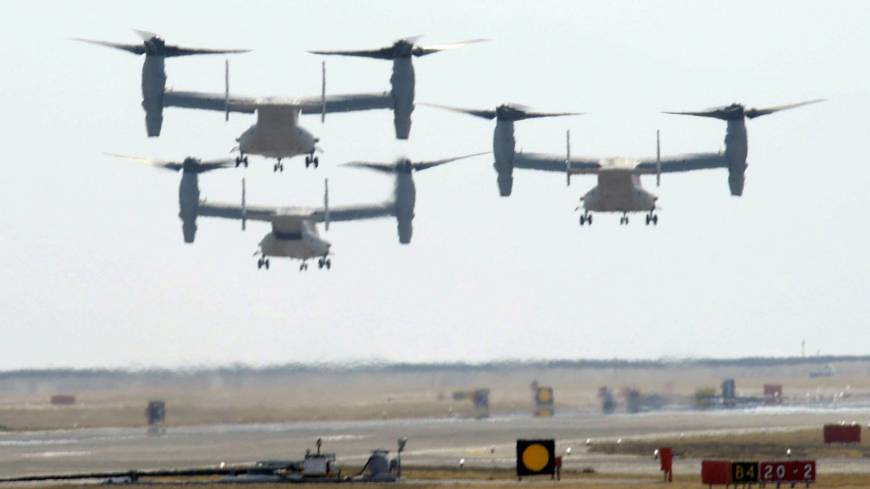
Japan and the United States are arranging to ship a second batch of 12 MV-22 Osprey aircraft in July, likely to a Marine Corps base in the Chugoku region before their deployment in Okinawa, sources close to bilateral relations revealed Saturday.

Hybrid transport: Three Osprey MV-22 transport aircraft depart U.S. Marine Corps Air Station Iwakuni in Yamaguchi Prefecture on March 8. | KYODO

As with the first group of 12 tilt-rotor MV-22s that arrived last year, the new aircraft are likely to be stationed temporarily at U.S. Marine Corps Air Station Iwakuni, Yamaguchi Prefecture, and then transported to the U.S. Futenma base on Okinawa Island after undergoing test flights and maintenance, the sources said.

Tokyo and Washington will expedite talks on when to move the hybrid transport planes to U.S. Marine Corps Air Station Futenma in the city of Ginowan. The Marine Corps plans to deploy a total of 24 Ospreys at the facility by 2014 to replace aging CH-46 Sea Knight transport helicopters.

The first batch of MV-22s arrived at Iwakuni last July and remained grounded for around two months while Tokyo reviewed U.S. investigations into two overseas crashes that year involving Ospreys to determine whether they were fit to fly in Japan. In spite of persistent local concerns about the aircraft’s safety record, the 12 Ospreys, which take off and land vertically, were deployed at the Futenma air station last October.

The U.S. government proposed shipping the second batch directly to Okinawa but Tokyo expressed reluctance, fearing the move would further roil local sentiment against the deployment, according to the sources.

Washington then agreed to first send the Ospreys to the Iwakuni base, they said. Like the first batch, the aircraft are expected to be shipped from California.


CCTV/ Japan Times