Hiển thị các bài đăng có nhãn UAV. Hiển thị tất cả bài đăng

Thứ Tư, 26 tháng 6, 2013

Unmanned Aerial Vehicle (UAV) Market (2013 - 2018)

In today’s context UAV’s play an important role in varied missions such as military attacks, border surveillance, mapping, surveying, weather determination and regional law enforcements. This technology has grown at a rapid pace and production companies present across the globe, as the country want to showcase their military strength in order to wade off potential attacks. Civilian usage of UAV operations have still not started at a pace can be expected as the local regulations apprehended the usage. Also, misunderstanding over the lack of safety and privacy of citizens has hindered their operational capabilities.

UAV’s have developed from radio controlled model airplanes to urbane aircraft that today play a unique role in many public missions and also have the potential to do so for many civil missions as well. Special airworthiness certificates will be obtaining to civilian operators for experimental purposes, which unfortunately exclude operations for compensation or hire.

According to industry estimates, UAS operations will increase manifold in a variety of key military and civil areas. About 50 U.S. companies, universities, and government organizations in the U.S. are developing over 150 different unmanned aircraft designs. From an operational, infrastructure and safety perspective, this presents a number of challenges due to the diversity of aircraft, control stations, levels of autonomy, and communications methods. UAV’s width is of a wide spectrum of size, endurance, and performance characteristics, often different from manned aircraft.
Sophisticated navigation and communications technologies were not available few years back, and increases in armed forces telecommunications satellite bandwidth have made remote operation of UAV’s more realistic. The wars fought in Iraq and Afghanistan has also increased the demand for UAV’s, as identification of and strikes against targets hiding among civilian populations required persistent surveillance. Manned systems could accomplish many if not all of the same goals. 

But unmanned systems reduce the risk to our war fighters by providing a sophisticated stand-off capability that supports intelligence, command and control, targeting, and weapons delivery. These systems also improve situational alertness and reduce many of the poignant hazards inherent in air and ground combat, thus decreasing the likelihood of causing civilian noncombatant casualties. UAVs have gained favor as ways to reduce risk to combat troops have been established, the cost of hardware and the reaction time in a surgical strike and to conduct missions in areas that can be difficult to access or otherwise considered too high-risk for manned aircraft or personnel on the ground.
Key Take-Aways

  • The global UAV market size can be expected to grow to $8,351.11 million by 2018.
  • (HALE/MALE/SUAV) Market has the highest business potential throughout the study period.
  • USA and Israel will be the maximum revenue generator, among the countries manufacturing UAV’s.
  • SPUAV (Solar Powered Unmanned Aerial Vehicle) will be one of the major technological advances in the near future.
  • ”We believe the UAV market in EU will take off and grow rapidly in the coming years from now. Major obstacle may be, if national regulations become too complicated.”  Ola Fristrom, Managing Director, SmartPlanes AB.
  • General Atomics Aeronautical Sytems is the leader in UAV market with 18.78% of the market share.

Thứ Tư, 19 tháng 6, 2013

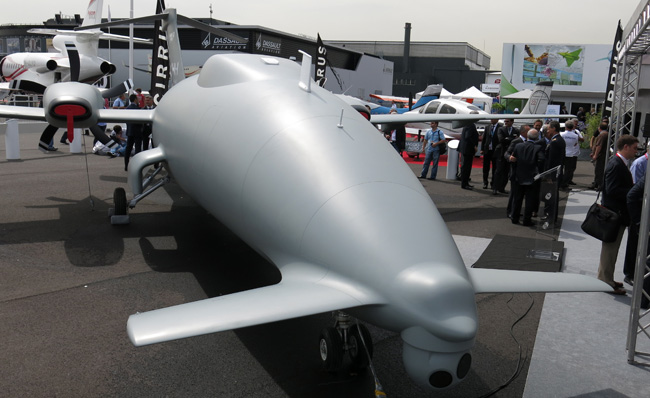
Piaggio Aero Unveils Hammerhead P-11HH Unmanned MALE Aircraft

Piaggio Aero Industries unveiled at the 2013 Paris Air Show today, the Piaggio Aero P.1HH “HammerHead”- Unmanned Aerial System (UAS). The P.1HH HammerHead technological demonstrator was designed and built in less than one year and it has already successfully completed low speed taxi tests. Defense-Update reports.

Piaggio Aero claims its new drone will offer an unmatched combination of range, wide operative speeds, fast climb gradient, high operational ceiling and the capability to carry a variety of payloads, providing end users with a powerful yet flexible defense system that outperforms other MALE Systems.

Piaggio Aero claims its new drone will offer an unmatched combination of range, wide operative speeds, fast climb gradient, high operational ceiling and the capability to carry a variety of payloads, providing end users with a powerful yet flexible defense system that outperforms other MALE Systems.

The unmanned variant is longer tan the Avanti II and is using a modified airframe, longer wings with high aspect ratio, and various installations of mission payloads, satellite links and line-of-site payloads. The Hammerhead is bound to become the largest UAS in Europe.

The design of the P.1HH HammerHead aims to be a unique ISR platform, able to climb up to 45.000 feet, loitering quietly at low speed (135 KTAS) with an endurance of up to 16 flight hours and capable of deploying at very high speed – up to 395 KTAS – to targets. Its capabilities include being able to host several payload combinations and to perform multiple missions: aerial, land, coastal, maritime and offshore security, COMINT/ELINT, electronic warfare as well as other roles.

A larger version is available to members

Selex ES was assigned the responsibility for the P.1HH’s Mission System, delivering effective and flexible scenario planning, simulation and concepts of operations (CONOPS). Selex ES also provides the datalink and ground control system.

The drone will support 16 hours mission on station, with a payload weight of 500 lbs. with less fuel, the aircraft will be able to carry 200 pound payloads and fly up to a ceiling of 45,000 ft. The aircraft is developed in partnership between Avatnti and Selex ES was first announced during the IDEX 2013 show in Au Dhabi this year. Since then the first aircraft has performed taxi tests, in preparation for flight testing.


Defense-Updates

Thứ Ba, 18 tháng 6, 2013

British MoD Inks Deal for Boeing ScanEagles

PARIS — Boeing has secured Britain’s Royal Navy as the latest customer for its ScanEagle unmanned air vehicle. The British want the machine to improve detection of fast-moving targets like the high speed attack craft operated by the Iranians.

ScanEagle

The British inked a deal with Boeing Defence UK last week for a contractor-owned, contractor-operated service onboard a small number of Royal Navy warships and Royal Fleet Auxiliary support vessels, the Defence Ministry has confirmed.

The ScanEagle service is an urgent operational requirement normally paid for from a special Treasury reserve fund. The value of the deal is unknown.

A spokesman for the MoD said they had been in negotiations with a contractor to meet the requirement and would make an announcement soon.

A contract bidders notice issued by the MoD this year said the service would end March 2015. There are options to extend beyond that date.

The bidders notice said they wanted a system that could loiter for up to eight hours at an operating range of up to 40 kilometers and be able to track fast-moving targets.

The UAV could be a first line of defense against the threat posed by high speed swarming attack craft used by the Iranian military or be used in an anti-piracy role.

The British MoD has already conducted sea trials with the ScanEagle for demonstration purposes.

The British originally sought a contractor to meet the requirement last year, but abandoned the contest saying none of the bidders had met requirements. The requirements were modified and competition reopened.

Thales UK, Lockheed Martin, QinetiQ and EADS Cassidian were also invited to bid.

Cassidian, a leading contender the first time around with the AAI Aerosonde machine, did not bid in the latest competition. It is not known who else submitted proposals.

The US, Dutch and other navies already operate the Boeing Insitu developed ScanEagle machines. ■

Defense News

Thứ Hai, 17 tháng 6, 2013

Camcopter S-100 growing experience sea board on L´Adroit

Since the OPV (Offshore Patrol Vessel) L´Adroit was officially made available to the French Navy in October 2011, the CAMCOPTER® S-100 Unmanned Air System (UAS) was able to prove its highly efficient maritime capability repeatedly.

Camcopter S-100 blogspot

The Gowind Class L’Adroit, build by DCNS, has been designed to operate, amongst other capabilities, a UAS, and by installing the appropriate cabling and supporting equipment during build, has been fitted out to operate the maritime proven CAMCOPTER® S-100 from day one. The French Defense Procurement Agency (DGA) purchased a S-100 and qualified its integration aboard L’Adroit in the frame of an experimentation ordered by the French Navy.

At the moment the French Navy is the only European Navy capable of operating a UAS VTOL from a surface ship. Embarked on board the OPV L’Adroit, the CAMCOPTER® S-100 has been operating in the Indian Ocean and Asia. Thanks to S-100, the French Navy has been able to evaluate the contribution of UAS during missions assigned to L’Adroit (preventing illegal practices at sea like terrorism, drug trafficking, illegal fishing and illegal immigration, ensuring maritime safety). Over 120 flight hours and 190 take-offs were conducted since the beginning of 2012, with much more to come in the next two years.

The tight integration achieved by DCNS between the ship and the S-100 provides highquality information, alerts and decision aids at any time. This project is unique in Europe and helps the French Navy to understand the movements and actions by potential threats at sea, expanding the area of influence and providing high-definition observation and surveillance in real-time.

Schiebel has taken the experience and knowledge gained from this exciting opportunity of operating the CAMCOPTER®S-100 from OPV L’Adroit, and is now working with world class sensor manufacturers to integrate maritime radar, Electronic Support Measures (ESM) and EO/IR sensors into the S-100 system. This will for the first time, provide maritime commanders with an organic, persistent, ISR capability unparalleled for a UAS in this class.


sAS News

Thứ Bảy, 15 tháng 6, 2013

China Set To Grab UAV Market While US Restricts Sales

China UAV

PARIS: Psst. Hey mister. Wanna buy a UAV? China’s got drones for shooting, drones for intelligence, surveillance and reconnaissance, and drones for target practice. Cheap prices and no arms export restrictions.

And China may grab a significant share of the international market for just those reasons, according to a new report by the U.S-China Economic and Security Review Commission. Breaking Defense obtained a copy of the report: China’s Military Unmanned Aerial Vehicle Industry

The irony would be, of course, that the United States has largely created that demand by demonstrating the utility of drones (UAVs, Remotely Piloted Aircraft — RPAs — pick your term) in Afghanistan, Pakistan, Yemen, Iraq and other locales over the last decade.

Here’s what the report’s author, Kimberly Hsu, concludes:

“Surging domestic and international market demand for UAVs, from both military and civilian customers, will continue to buoy growth of the Chinese industry. Chinese defense firms do not face the same export restrictions as top UAV-exporting countries, such as the United States and Israel. As a result, China could become a key UAV proliferator, particularly to developing countries.”

Currently, the great majority of Chinese drones are tactical, but Hsu says that “in the long term, China’s continued interest and progression in strategic-level UAVs appear poised to position China as a leader in the high-end UAV market.” A major reason is that China is not a member of either the Missile Technology Control Regime (MTCR) or the looser but broader Wassenaar Arrangement. “In the absence of competition from more sophisticated U.S. or Israeli alternatives, China could become a key proliferator to non-members of the MTCR or Wassenaar,” she concludes.

Just what drones is China building? Well, the report notes there isn’t much information available about the PLA’s efforts. Hsu says that China, “probably is developing and operating UAVs for electronic warfare (EW).” These would “probably would focus on jamming tactical communications and global positioning system (GPS), but could provide a range of other capabilities, including false target generation against enemy Airborne Warning and Control Systems (AWACS)/Airborne Early Warning (AEW) and power grid attack.”

On top of that, several Chinese government owned defense firms are also developing killer drones in the vein of our Predator or Reaper. “It is not clear if China intends to use UCAVs in an air-to-air or an air-to-ground role,” Hsu writes.

In addition to state-owned enterprises, several of China’s top engineering universities are working on drones.

On the civilian side, China has already demonstrated use of indigenous drones for earthquake relief efforts after the May 2008 and April 2013 earthquakes in Sichuan province, according to the report. And the rough Chinese equivalent of the Coast Guard and harbor police “are integrating UAVs into their operations.

All in all, China’s policy of not participating in what it would doubtless call hegemonic restrictions on its actions — MTCR, Wassenaar — coupled with its willingness to sell to pretty much anybody who can buy their weapons, places it in a prime position to benefit, just as Europe benefited from America’s decision to sharply restrict satellite sales and their components to foreign countries.

Breaking Defense

Thứ Tư, 5 tháng 6, 2013

The Global Armed Drone Race Is On

By Keir Simmons and Gil Aegerter, NBC News

Editor's note: A clarification has been made to this article.

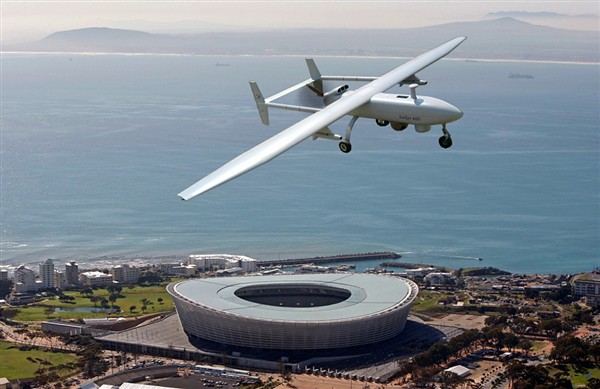
A Seeker 400 drone, manufactured by South African company Denel Dynamics, flies over Cape Town Stadium.

On a sprawling complex just outside Pretoria, South Africa, a government-owned arms manufacturer is preparing to test an armed drone that it hopes to begin selling soon to governments around the world.

The company, Denel Dynamics, says the armed version of the Seeker 400, which will carry two laser-guided missiles, will enable so-called opportunistic targeting at a range of up to about 155 miles.

“These are not combat systems, they are foremost reconnaissance systems,” Sello Ntsihlele, executive manager of UAV systems for Denel, told NBC News. He added: “(But if) you speak to any general, show him the capability, he will tell you, ‘I want to have munitions.’”

The company’s move is but one signal that the era when only a small club of countries possessed weaponized drones is drawing to a close.

Critics say the coming proliferation of the lethal remote-controlled flying machines will forever change the face of counterterrorism operations and, eventually, warfare itself – and not for the better.
“The U.S. has set a moral precedent,” said Jenifer Gibson of the human rights group Reprieve. "A state can declare someone a terrorist and just go out and kill them."

Reprieve campaigns against what it calls illegal drone strikes.

Supporters of military drones argue that they are an essential tool against terrorists hiding in remote areas and that their ability to strike with precision minimizes civilian casualties. Reprieve rejects the notion that drones are precision weapons and claims many civilians have been killed.

Who has drones — and who wants them

Only three countries are known to currently operate armed unmanned aerial vehicles, or UAVs, as drones are technically known -- the U.S., the U.K. and Israel -- according to a recent report by the think tank RUSI. The report suggested there are only currently around 1,000 armed drones worldwide.

But China also is believed to have developed weaponized drones; the U.S. has said it would arm drones operated by Italy; and France and Germany also have decided to acquire them, according to arms trade experts and published reports.

And according to Peter Singer, director of the Center for 21st Century Security and Intelligence at the Brookings Institute, at least 26 countries have surveillance drones of a size or type that have been or could be armed, and roughly 20 countries are trying to either develop or acquire weaponized drones.

So far, the United States is the only country known to have transferred armed drone technology -- and solely to Britain, which flies U.S.-built Predators in Afghanistan.

U.S. sales of drones, armed and unarmed, "are considered on a case-by-case basis, consistent with U.S. law, regulation and policy, as well as our international commitments, including under the multilateral nonproliferation regimes," a Pentagon spokesman said in an email to NBC News. A State Department spokesman declined to comment on the record.

U.S. reluctance to share its cutting-edge military drone technology outside a few trusted NATO partners like Britain and Italy is viewed as an opportunity by arms manufacturers like Denel Dynamics.

The company aims to be among the first suppliers of armed drones to market, if tests of the armed versions of the Seeker 400 -- expected to begin in “a month or two” and last up to six months, according to Ntsihlele -- are successful. South Africa would have to purchase the armed drones first before the company would begin marketing them elsewhere, but if that happens Denel sees opportunities for growth elsewhere, particularly in “Africa and the Middle East,” he said.

Ntsihlele declined to say how much the armed Seeker 400 will cost, but said it will be far cheaper than the Predator and Reaper, the armed drones used for anti-terrorism operations by the U.S. military in Afghanistan, Pakistan, Somalia and Yemen, which cost approximately $20 million and $56.5 million apiece, respectively. And unlike those UAVs, it would not require satellite technology, being controlled instead through “line of sight” communications. That limits its range but makes it potentially available to nations without sophisticated space-based guidance systems.

The drone market

President Barack Obama, in a speech last Thursday, said he would impose new limits on drone strikes against foreign terrorists in an attempt to reduce civilian casualties to near zero and ensure that only enemies who pose a “continuing, imminent threat” to the United States are targeted.

"What we are trying to do with our (anti-terror) strategy is turn it back over to the host country and local forces," the New York Times quoted the Pentagon's top counterterrorism official Michael Sheehan as saying. "That is the future."

The sale of armed drones to other governments raises similarly thorny issues though.

The military use of armed drones in the Middle East and Afghanistan has brought more countries and companies into the market for such weapons. Here are some of the un-crewed aerial vehicles that are known to carry weapons or that might be adapted to carry them.
--> Slideshow: Armed drones around the world
There are no international treaties restricting sales of armed drones, only voluntary controls on exports. Beyond sanctions and embargoes governed by the Security Council, the United Nations does not regulate arms and arms-technology sales, although the Arms Trade Treaty approved in April by the General Assembly may change that if it is eventually ratified by enough nations.

In Denel’s case, Ntsihlele indicated that the South African government would limit sales only to governments that would be “accountable and responsible” and agree to “opportunistic” use of the weapons on justified targets. “That target could be a pirate, or could be a terrorist,” he said.

The company also provided this statement to NBC News: “All of our activities ... take place within the framework of decisions taken by international organs such as the United Nations, the policies of the South African government and the regulatory prescripts imposed by the National Conventional Arms Control Committee and the Directorate Conventional Arms Control,” referring to two South African government organizations.

Assuming it gets its product to market, Denel is expected to quickly encounter plenty of competition.
“To the extent that the U.S. backs off the armed drone business, it allows countries like China, in particular, to say they’ll fill the marketplace,” said Dennis Gormley, who teaches intelligence and military issues at the University of Pittsburgh’s Graduate School of Public and International Affairs.

China already has shown an armed drone resembling a smaller Reaper at an air show last fall, and photos surfaced on Chinese websites earlier this month showing what appeared to be an unmanned combat aerial vehicle known as the Lijan, or “Sharp Sword.” The Lijan closely resembles the U.S. Navy’s remote-controlled X-47B drone, which recently launched from an aircraft carrier for the first time.

Israel will also be a marketplace competitor. It is a leader in armed drones and is already considered the biggest exporter of unarmed drone technology.

Turkey also has developed a reconnaissance drone, the Anka, for spying on Kurdish insurgents. Last summer, the Turkish Defense Industry Executive Committee said that TAI, the company that builds the Anka, was starting research and development on an armed variant, the Anka +A.
Turkey had been intensely interested in buying armed drones from the U.S., said William Hartung, director of the arms and security project at the Center for International Policy. So far, the U.S. has resisted selling it such technology, despite its NATO membership, he said.

Iran also has made unsubstantiated claims to have armed drones.

Terrorism concerns

The spread of armed drone technology to volatile regions like the Middle East inevitably stirs concern that terrorists could obtain the airborne weapons. So far, the Lebanese militia group Hezbollah, considered a terrorist organization by the U.S., is the only group believed to possess the UAVS. It has flown several unarmed drones containing explosives over Israel and, in one case, apparently used an armed drone to attack an Israeli ship, according to published reports.

Yemeni tribesmen stand on the rubble of a building in the village of Azan that was destroyed by a U.S. drone air strike on Oct. 14, 2011. Tribal elders say that suspected al Qaeda militants Abdulrahman al-Awlaki, the son of slain U.S.-born cleric Anwar al-Awlaki, and six others were killed in the attack.
The possibility of using small drones as attack platforms was driven home by a video posted on YouTube in December by an anonymous group called Dangerous Information. It showed a small electric-powered drone equipped with a GoPro video camera and paintball gun, first flying through a neighborhood, then attacking human-figure targets in a field.

The development of smaller drones has been accompanied by new smaller munitions that don’t require the Predator’s 450-pound payload capacity. Denel’s Seeker 400, for example, will have a payload half that, according to a company brochure, but still be capable of carrying two laser-guided missiles.

“There is the development of smaller and smaller weapons, some of them specifically for UAVs,” said Philip Finnegan, director of corporate analysis for the Teal Group, which conducts market analysis in the aerospace and defense industry. “So they’ll be able to use smaller platforms.”

While armed drones appear certain to be added to more countries’ arsenals in the near future, analysts say they expect the military sector will remain a relatively small piece of the overall drone market for some time to come. A big reason for that is the restrained growth in defense budgets worldwide and cuts by the U.S. military in spending on drones, which also affect research and development.

“There is short-term pressure on the industry. … It’s a combination of budgetary pressure and the withdrawals from Iraq and Afghanistan,” Finnegan said. “Longer term, the U.S. remains heavily committed to advanced UAV technology.”

And sales to smaller nations are likely to be slow due to the fact that even with prices falling, armed drones remain prohibitively expensive, Denel’s Ntsihele said, recounting conversations with prospective buyers.

"When they get to know the product, they get shocked,” he said.

Keir Simmons is a correspondent in NBC News' London bureau; Gil Aegerter is an NBC News staff writer in Redmond, Wash.; NBC News' Marc Smith and Robert Windrem also contributed reporting to this article.

NBC News

Thứ Sáu, 31 tháng 5, 2013

In pictures, U.S. Navy MQ-4C Triton UAV takes off

On May 22nd the first production model of the U.S. Navy MQ-4C Triton UAV took off and began its flight testing. This first flight lasted 80 minutes and the UAV went as high as 6,100 meters (20,000 feet). Previously the navy had just been using two air force MQ-4Bs modified to Triton specs for testing. The naval patrol version of the U.S. Air Force RQ-4 Global Hawk is called the MQ-4C Triton and BAMS (Broad Area Maritime Surveillance). The navy version has additional protection against salt damage and a set of sensors optimized for monitoring water rather than land.
On May 22nd, 2013 the first production model of the U.S. Navy MQ-4C Triton UAV took off and began its flight testing. This first flight lasted 80 minutes and the UAV went as high as 6,100 meters (20,000 feet). Previously the navy had just been using two air force MQ-4Bs modified to Triton specs for testing. The naval patrol version of the U.S. Air Force RQ-4 Global Hawk is called the MQ-4C Triton and BAMS (Broad Area Maritime Surveillance). The navy version has additional protection against salt damage and a set of sensors optimized for monitoring water rather than land.

Earlier this year the navy began forming its first Triton UAV squadron. Called VUP (Unmanned Patrol Squadron) 19 it will be in service by October on the east coast of the United States, where it will handle operations over the Atlantic. A second squadron will enter service next year on the west coast to cover the Pacific. The navy plans to buy 68 Tritons and 117 P-8As jet aircraft to replace prop driven 250 P-3Cs. This replacement program is supposed to be complete in about a decade. The new surveillance aircraft provide more information over a wider area and do it more quickly.

The Triton has already been in service on an experimental basis using the modified RQ-4Bs. Last year, two years after extensive tests in the Middle East, the Triton began operating with a carrier task force at sea. Circling above the task force at 22,500 meters (70,000 feet), Triton monitored sea traffic off the Iranian coast and the Straits of Hormuz. Anything suspicious is checked out by carrier, land based aircraft, or nearby warships. The Triton aircraft can fly a 24 hour sortie every three days. The first production Triton was delivered in late 2012 and now is in the air.

In 2009, the first year of Triton testing consisted of 60 flights and over 1,000 hours in the air. The flights were over land and sea areas, even though the UAV sensors are designed mainly to perform maritime reconnaissance. Air Force Global Hawk maintenance personnel assisted the navy in tending to the navy RQ-4 while it was on the ground and for landings and takeoffs. The UAV was operated by navy personnel back in the United States at Patuxent River Naval Air Station. A year earlier the navy began training four of its personnel (three P-3 pilots and one civilian) to operate RQ-4s. The four navy operator trainees were in an accelerated course (four months instead of five) and were available to help fly U.S. Air Force RQ-4s before the navy RQ-4s test model became operational in 2009.

The manned P-3 replacement (the P-8A) is expected to complement Triton. Although the Boeing 737 based P-8A is a two engine jet, compared to the four engine turboprop P-3C it is replacing, it is a more capable plane. The P-8A has 23 percent more floor space than the P-3 and is larger (an 18 percent longer wingspan) and heavier (83 tons versus 61). Most other characteristics are the same. Both can stay in the air about ten hours per sortie. Speed however is different. Cruise speed for the 737 is 910 kilometers an hour, versus 590 for the propeller driven P-3. This makes it possible for the P-8A to get to a patrol area faster, which is a major advantage when chasing down subs spotted by sonar arrays or satellites. However, the P-3 can carry more weapons (9 tons versus 5.6). This is less of a factor as the weapons (torpedoes, missiles, mines, sonobouys) are more effective, and often lighter, today and that trend continues. Both carry the same size crew, of 10-11 pilots and equipment operators. Both aircraft carry search radar and various other sensors. While the Triton can stay in the air longer, the P-8A carries weapons and is more effective at finding, and destroying, submarines (and even surface ships lacking long-range air defense systems).

The 737 has, like the P-3, been equipped with bomb hard points on the wings for torpedoes or missiles. The B-737 is a more modern design and has been used successfully since the 1960s by commercial aviation. Navy aviators are confident that it will be as reliable as the P-3. (The P-3 was based on the Electra civilian airliner that first flew in 1954. Although only 170 were built, plus 600 P-3s, about 20 Electras are still in service.) The Boeing 737 first flew in 1965, and over 5,000 have been built. The P-8A will be the first 737 designed with a bomb bay and four wing racks for weapons.

The Navy is buying a modified version of the B model of the RQ-4 for over $60 million each. This version is larger (wingspan is 5 meters/15 feet larger, at 42.2 meters/131 feet, and it's nine percent longer at 15.5 meters/48 feet) than the A model and can carry more equipment. To support that, there's a new generator that produces 150 percent more electrical power. The RQ-4 has a range of over 22,000 kilometers and a cruising speed of 650 kilometers an hour.


The first three RQ-4Bs entered service in 2006. At 13 tons the Global Hawk is the size of a commuter airliner (like the Embraer ERJ 145) but costs nearly twice as much. Global Hawk can be equipped with much more powerful and expensive sensors, which more than double the cost of the aircraft. These "spy satellite quality" sensors (especially AESA radar) are usually worth the expense because they enable the UAV, flying at over 20,000 meters (62,000 feet), to get a sharp picture of all the territory it can see from that altitude. The B version is supposed to be a lot more reliable. Early A models tended to fail and crash at the rate of once every thousand flight hours.

The maritime RQ-4 is seen as the ultimate replacement for all manned maritime patrol aircraft, at least once it is equipped with more anti-submarine sensors and weapons. The P-8A will probably be the last manned naval search aircraft. Some countries are using satellite communications to put the sensor operators who staff manned patrol aircraft on the ground. Some nations propose sending aircraft like the P-3 or P-8 aloft with just their flight crews, having all the other gear operated from the ground. This enables the aircraft to stay in the air longer and carry more gear.

Article: Strategy Page/ Photos: Xinhua News

Thứ Bảy, 18 tháng 5, 2013

Belarus To Supply Vietnam With Grif UAV?

Belarus plans to deliver to Vietnam its unmanned aircraft systems following the meeting between the countries’ two Prime Ministers recently. Nevertheless, the type of the UAV was not revealed. Belarus has been producing the Grif-1 TUAV, a similar UAV which has been showcased in Malaysia during the recent LIMA 2013.


The Grif-1, the new Grif-K has been wholly designed and developed by the business. The aircraft features a new, lighter composite body replacing the aluminium structure of the Grif-1.

The Grif-K made its maiden flight on 26 February 2012 and since then it has undergone a number of test flights.It has a range of 100km and an endurance of 6-7 hours. With an average speed of 120km/h, this gives the UAV a significant amount of time on station.

The aircraft can be remotely operated from a GCS, but also has a built in autopilot with a Belarusian designed chip that rather uniquely allows the waypoint navigation to be taken from the GLONASS, GPS or Galileo satellite positioning systems.

The UAV can carry a 25kg payload. The on-board power of up to 1000W allows the Grif-K to accept a wide variety of payloads including EO/IR pods and laser designation systems. It measures 3.5m in length and is 1.15m high. It has a wingspan of 5.7m and a maximum take-off weight of 120kg. Its maximum operational speed is 165km/h with a ceiling of around 3,500m.


Grif-1 UAV

Nevertheless, Vietnam has already embarked on its own UAV program plus several understandings with other countries namely Russia and Sweden for joint development of their respective UAVs.

Thứ Sáu, 17 tháng 5, 2013

Belarus will Supply Vietnam Unmanned Aircraft Systems

TSAMTO. Belarus plans to deliver to Vietnam unmanned aircraft systems. The Prime Minister of Belarus Mikhail Myasnikovich at a meeting with Vietnamese Prime Minister Nguyen Tan Dung, BelTA informs.


Grif-1 UAV from Belarus (photo : Vitaly Kuzmin)

According to Mikhail Myasnikovich, "We very much hope associate with scientific and technical cooperation. Here and unmanned aircraft systems, the contracts for which we sign as part of your visit, and future joint projects in the field of bio-and information technologies, as well as in medicine "- BELTA.

Type procured Vietnam UAVs are not reported.

Earlier, in January this year, the agency BelTA reported on the organization of the production of UAVs by the National Academy of Sciences. The company engaged in the production of Belarusian drone was created Physical-Technical Institute of the NAS of Belarus.

Unmanned aerial vehicles planned to create custom melokoseriynymi parties. As of January of this year, according to the learned, had produced about 10 ready copies. In the future, drones planned to supply the markets of other countries.Among the potential customers has been called Vietnam.

It should be noted that Vietnam has already implemented in the work on the UAV in three areas: personal development, as well as programs with Russia and Sweden.

Arms Strade
-------

Vietnam, Belarus to step up military and technical cooperation

MINSK, 17 May (BelTA) - Vietnam and Belarus will step up military and technical cooperation. The agreement was reached at the 13th meeting of the joint Belarusian-Vietnamese commission on military and technical cooperation in Minsk on 16 May, BelTA learned from the State Military Industrial Committee of Belarus.

Noting the high potential of military and technical cooperation, Belarus and Vietnam confirmed mutual interest in intensifying this cooperation and raising it to a new level. To accomplish this, the Belarusian side proposed the Vietnamese partners to develop new forms of cooperation in order to more fully exploit the opportunities of both defense enterprises of Belarus and those of its partners in the military and technical cooperation,” said the committee.

In particular, time is ripe to switch over from export/import operations to the transfer of technology for the manufacture of military products, use of innovative technologies and R&D products, and setting up joint manufactures.

“The two states have been taking steps to bolster cooperation in the military and technical sector. The two countries have capabilities for that and mutual interest: from maintenance and modernization of armament and military hardware to joint production of new military goods,” the State Military Industrial Committee said.

The commission focused its attention on the issues regarding training for Vietnamese specialists, including at the Military Academy of Belarus.

The Belarusian delegation was headed by acting First Deputy Chairman of the State Military Industrial Committee, Chairman of the Belarusian part of the commission Igor Bykov. The Vietnamese delegation was led by Deputy Minister of the National Defense of Vietnam, head of the Vietnamese part of the commission Colonel-General Truong Quang Khanh.

Belarusian Telegraph Agency

Chủ Nhật, 12 tháng 5, 2013

First Chinese "stealth" drone 'ready' for test flight

The Chinese military is making preparations for the inaugural flight test of its newly designed unmanned combat vehicle, bringing the Asian powerhouse into the stealth technology race, Chinese media report.

China’s first unmanned aerial vehicle (UAV), known as the Lijian ('sharp sword'), is designed jointly by the Hongdu Aviation Industry Group and Shenyang Aviation Corporation. The project was launched in 2009 and the drone's first ground test was conducted on December 13 last year.

The Lijian, which makes China the third country to possess stealth drone capabilities, is now ready for flight testing, China Aviation News reported on Friday.


Li Jian, the Dark Sword UAV ( look an awfully lot like X-47)

The Chinese UAV is designed for use by the PLA Air Force and Navy Air Force for combat missions, China Aviation News reported. It may also be used for tracking and reconnaissance along China’s lengthy and occasionally contentious border.

Beijing’s ambitious efforts at developing its drone capabilities have not escaped the attention of Taiwan, which has quarreled with Beijing in the past over questions of sovereignty and national identity.

“Taiwan should be concerned about China’s development of large numbers of sophisticated military UAVs,” Ian Easton, a research fellow at the Project 2049 Institute, told the Taipei Times.

China’s stealth drone is third such unmanned combat vehicle in existence, after the X-47 designed by the United States, and the nEUROn, a collaborative effort of various EU companies.

The nEUROn was launched in 2005 following an order by the French Defense Procurement Agency. The program is a collaborative effort between French, Italian, Swedish, Spanish, Greek and Swiss defense companies.

The US Pentagon’s X-47 stealth drone, designed by Northrop Grumman, began as part of DARPA's J-UCAS program, and is now part of the US Navy's UCAS-D (Unmanned Combat Air System Demonstration) program. The X-47 is still undergoing flight testing.

The unveiling of the prototype places the People’s Republic of China ahead of several nations in the development of stealth drone technology.

India, Iran, Israel, Italy, Sweden and Russia also have their own stealth UAV programs.

Does China have a stealth drone?
(Foreign Policy)

Article: RT | Pictures: Kienthuc.net.vn/ Google Blogspot

Thứ Năm, 9 tháng 5, 2013

Iran unveils indigenous stealth reconnaissance, combat drone

Iran has unveiled its latest indigenous unmanned aerial vehicle (UAV), a reconnaissance and combat drone dubbed Hamaseh.


Iran unveils a new indigenous stealth reconnaissance-combat drone dubbed Hamaseh on May 9, 2013.


The drone was unveiled on Thursday during a ceremony attended by Iranian Defense Minister Brigadier General Ahmad Vahidi.

“This drone has been built by defense industry experts and is simultaneously capable of surveillance, reconnaissance and missile and rocket attacks,” Vahidi said on the sidelines of the ceremony.

“This aircraft with its stealth quality can avoid detection by the enemy,” he added.

High altitude and long flight range are two other distinguishing features of the new Iranian UAV.

Iran has made important breakthroughs in its defense sector in recent years and attained self-sufficiency in producing important military equipment and systems.

The new UAV looks like a smaller version of the Israeli’s IAI Heron TP MALE UAV based on its distictive satellite uplink bulge as well as the belly mounted radome.


IAI Heron TP


In August 2010, Iran unveiled its first indigenous long-range drone, Karrar, which is capable of carrying out bombing missions against ground targets, flying long distances at a high speed, and gathering information.


Karrar UCAV

Shahed 129, characterized by a 24-hour nonstop flight capability, was another indigenously produced drone introduced in September 2012.


The Shahed 129 MALE UAV

On December 17, 2012, Commander of the Islamic Revolution Guards Corps (IRGC) Navy Rear Admiral Ali Fadavi said Iran had launched the production line of the ScanEagle drones, adding that the IRGC naval and aerospace divisions were employing the UAVs.


The reverse engineered ScanEagle UAV

MRS/HMV

Thứ Bảy, 4 tháng 5, 2013

Vietnam unveils new locally-made UAV

Scientists at the Vietnam Academy of Science and Technology successfully tested Vietnam’s first unmanned aircraft (UAV) on May 3 in Hanoi.

The UAV tested were three out of five models created by the Institute of Space Technology over the last five years.

Vietnam unveils new locally-made UAV

All the five prototypes, coded AV.UAV.MS1; AV.UAV.S1; AV.UAV.S2; AV.UAV.S3; and AV.UAV.S4; have their own technical specifications, are domestically made with professional cameras for both day and nighttime use, fitted with scientific devices, and possess programmed flying routes.

The biggest prototype of 170 kg can fly at 180 kph within a radius of 100 km and at an elevation of 3,000 meters, continuously for six hours.

The UAV can take off from the runway, the top of cars, on the move launchers or launch by hand.

All the UAV’s are the result of research conducted in unmanned aerial vehicles for scientific research purposes, led by Dr. Pham Ngoc Lang.

After the experiment launch, the Institute of Space Technology will perfect these models for mass production to serve research purposes as well as for professional use.


To view the offical clip on Vietnam Television VTV, click Here

-->Vietnam successfully tests research drones (VNA)

China emerges as new force in drone warfare

Determined to kill or capture a murderous Mekong River drug lord, China's security forces considered a tactic they'd never tried before: calling a drone strike on his remote hideaway deep in the hills of Myanmar.


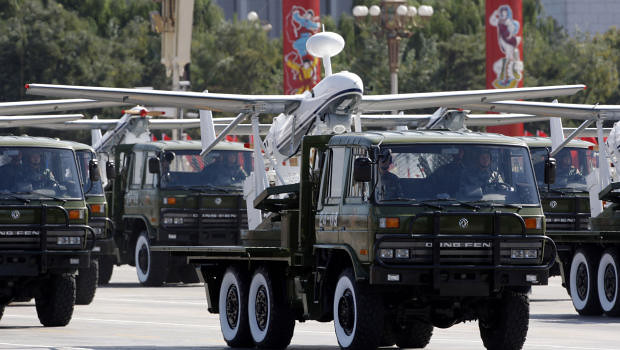
A truck loaded with the Chinese-made ASN-207 drone aircraft takes part in a military parade marking China's 60th anniversary, held near Tiananmen Square in Beijing, China, Oct. 1, 2009. / AP PHOTO/VINCENT THIAN, FILE

The attack didn't happen — the man was later captured and brought to China for trial — but the fact that authorities were considering such an option cast new light on China's unmanned aerial vehicle program, which has been quietly percolating for years and now appears to be moving into overdrive.

Chinese aerospace firms have developed dozens of drones, known also as unmanned aerial vehicles, or UAVs. Many have appeared at air shows and military parades, including some that bear an uncanny resemblance to the Predator, Global Hawk and Reaper models used with deadly effect by the U.S. Air Force and CIA. Analysts say that although China still trails the U.S. and Israel, the industry leaders, its technology is maturing rapidly and on the cusp of widespread use for surveillance and combat strikes.

"My sense is that China is moving into large-scale deployments of UAVs," said Ian Easton, co-author of a recent report on Chinese drones for the Project 2049 Institute security think tank.

China's move into large-scale drone deployment displays its military's growing sophistication and could challenge U.S. military dominance in the Asia-Pacific. It also could elevate the threat to neighbors with territorial disputes with Beijing, including Vietnam, Japan, India and the Philippines. China says its drones are capable of carrying bombs and missiles as well as conducting reconnaissance, potentially turning them into offensive weapons in a border conflict.

China's increased use of drones also adds to concerns about the lack of internationally recognized standards for drone attacks. The United States has widely employed drones as a means of eliminating terror suspects in Pakistan and the Arabian Peninsula.

"China is following the precedent set by the U.S. The thinking is that, `If the U.S. can do it, so can we. They're a big country with security interests and so are we'," said Siemon Wezeman, a senior fellow at the arms transfers program at the Stockholm International Peace Research Institute in Sweden, or SIPRI.

"The justification for an attack would be that Beijing too has a responsibility for the safety of its citizens. There needs to be agreement on what the limits are," he said.

Though China claims its military posture is entirely defensive, its navy and civilian maritime services have engaged in repeated standoffs with ships from other nations in the South China and East China seas. India, meanwhile, says Chinese troops have set up camp almost 20 kilometers (12 miles) into Indian-claimed territory.

It isn't yet known exactly what China's latest drones are capable of, because, like most Chinese equipment, they remain untested in battle.

The military and associated aerospace firms have offered little information, although in an interview last month with the official Xinhua News Agency, Yang Baikui, chief designer at plane maker COSIC, said Chinese drones were closing the gap but still needed to progress in half a dozen major areas, from airframe design to digital linkups.

Executives at COSIC and drone makers ASN, Avic, and the 611 Institute declined to be interviewed by The Associated Press, citing their military links. The Defense Ministry's latest report on the status of the military released in mid-April made no mention of drones, and spokesman Yang Yujun made only the barest acknowledgement of their existence in response to a question.

"Drones are a new high-tech form of weaponry employed and used by many militaries around the world," Yang said. "China's armed forces are developing weaponry and equipment for the purpose of upholding territorial integrity, national security and world peace. It will pose no threat to any country."

Drones are already patrolling China's borders, and a navy drone was deployed to the western province of Sichuan to provide aerial surveillance following last month's deadly earthquake there.

They may also soon be appearing over China's maritime claims, including Japanese-controlled East China Sea islands that China considers its own. That could sharpen tensions in an area where Chinese and Japanese patrol boats already confront each other on a regular basis and Japan frequently scrambles fighters to tail Chinese manned aircraft.

Retired Maj. Gen. Peng Guoqian told state media in January that drones were already being used to photograph and conduct surveillance over the islands, called Diaoyu by China and Senkaku by Japan.

The Pentagon says Chinese drones could boost the effectiveness of long-range radar in monitoring activity and locating targets in the western Pacific far from the Chinese coast. Their missions could include guiding home an anti-ship ballistic missile known in military circles as a "carrier killer," the Pentagon said in its 2012 report on China's military.

Reports about the search for notorious river bandit Naw Kham, wanted for the 2011 murders of 13 Chinese sailors, offer some clues about China's plans for drones.

The head of the Chinese Public Security Ministry's anti-narcotics bureau, Liu Yuejin, was quoted by state media as saying a plan had been floated to target Naw Kham's fortified camp with a drone loaded with 20 kilograms of TNT. The type of drone wasn't mentioned.

The plan was dropped by higher-ups in favor of taking Naw Kham alive, but the revelation served as a statement of Chinese intentions and capabilities.

China began developing drones in the 1960s and is believed to have used them for reconnaissance during its brief 1979 invasion of Vietnam. The program was aided by the adaptation of foreign civilian or dual-use UAVs for military purposes, then took a leap forward with the purchase of Harpy drones from Israel. Later, U.S. opposition to Israeli upgrades on the Harpys spurred China to build its own version.

China's gains are aided by the industry's relatively low costs and short production schedule and boosted by the assembly of the country's homebuilt Beidou navigation satellite system and improved high-speed data links.

China's military is expected to field hundreds, if not thousands, of drones, although the overall size of the fleet is difficult to estimate and the U.S. will ultimately have many more.

Chinese UAVs range from simple propeller-driven models to the high-concept, stealthy Dark Sword, featuring a joined wing and tail assembly similar to the U.S. Avenger.

More than 90 percent of the Chinese drones now in service are variants on the simpler ASN-209 surveillance drone seen in navy drills and which are now being produced under license by Egypt.

Others include the Wing Loong, or Pterodactyl, which bears a striking resemblance to the U.S. Reaper and carries a brace of missiles. Chinese media reports and air show staff say it has been exported to countries in the Middle East and Central Asia, possibly the United Arab Emirates and Uzbekistan, at just a fraction of the Reaper's price tag of $30 million each.

Military officials in the UAE and Uzbekistan declined to comment on the reports.

Another combat drone being offered for export, the CH-4, has space for four missiles and is said to be able to fly continuously for 30 hours.

Even more ambitious is the Xiang Long BZK-005, similar to the U.S. Global Hawk. It has a reported 6,437-kilometer (4,000-mile) range and is roughly the size of a medium-size fighter jet. Deployment may be some time off, however, and a 2011 crash points to rumored problems with the guidance system.

Further developments could see China competing with world's two major drone producers, the United States and Israel, for markets in close ally Pakistan, Myanmar and other developing nations. Customers might even include Russia, which is the world's No. 2 arms exporter but has had little success making UAVs.

There are some indications China may already be exporting know-how to Pakistan, given design similarities between Chinese drones and Pakistan's Shahpar UAV, said Huw Williams, an expert on drones at Jane's Defence Weekly. However, Williams said China will likely struggle to find customers for its larger drones, given limited demand and the large number of countries developing such systems of their own.

"They're very interested in getting into this market," SIPRI's Wezeman said. "Another few years and they will have caught up."

© 2013 The Associated Press. All Rights Reserved. This material may not be published, broadcast, rewritten, or redistributed.

Thứ Sáu, 19 tháng 4, 2013

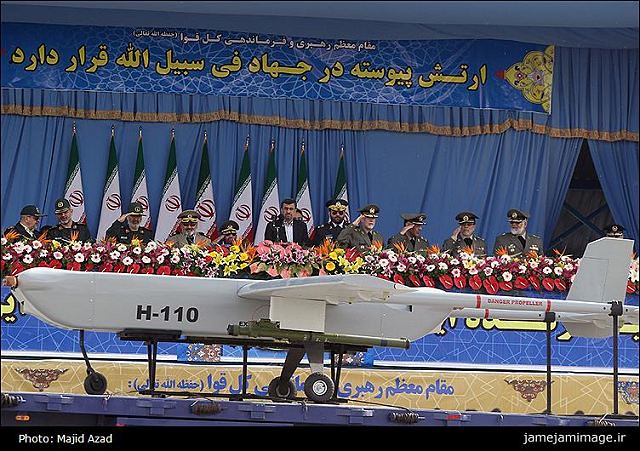
Iran unveils new drone Sarir H-110 armed with air-to-air missiles during military parade in Tehran.

The Iranian Air Defense Force displayed a new Unmanned Aerial Vehicle (UAV) on the occasion of the National Army Day. The new drone, named Sarir (Throne) H-110 , was showcased in the military parades underway at the mausoleum of the Founder of the Islamic Republic, the Late Imam Khomeini, in Southern Tehran.


The new Iranian-made Sarir H-110 was unveiled during a military parade in Tehran

The drone, named Sarir (Throne) H110, carries cameras and air- to-air missiles, said Commander of Iran's Khatam al-Anbia Air Defense Base Brigadier General Farzad Esmaili.

Tens of Sarir H110 have so far been produced and Iran has started mass production of this model, said Esmaili, according to semi-official Fars news agency.

The Islamic republic also showcased a number of its home-made missiles. The air-to-surface missiles of Qased, Fakour and Qader as well as surface-to-surface missile of Zelzal were displayed in the parade.

Advanced radar systems and missile launching pads, which are the military hardware, were also displayed by Iranian Army Thursday.

Addressing the ceremony to mark the event, Iranian President Mahmoud Ahmadinejad hailed the "might" and achievements of the army in the past few years, said the Iranians will maintain security of the Persian Gulf through a collective work of regional states.

Army Recognition

Thứ Bảy, 30 tháng 3, 2013

China stepping up drone deployment: Dirty Secrets

China’s military is expanding its unmanned aerial vehicle forces with a new Predator-like armed drone and a new unmanned combat aircraft amid growing tensions with neighbors in Asia, according to United States intelligence officials.

China's unmanned aerial vehicle forces with a new Predator-like armed drone


New unarmed drone deployments include the recent stationing of reconnaissance and ocean surveillance drones in Northeast Asia near Japan and the Senkaku islands and along China’s southern coast. Drones also are planned for the South China Sea where China has been encroaching on international waters and bullying nations of that region in asserting control over international waters, said officials familiar with intelligence reports.

“Unmanned aerial vehicles are emerging as critical enablers for PLA long range precision strike operations,” said Mark Stokes, a former military intelligence official now with the Project 2049 Institute. “A general operational PLA requirement appears to be persistent surveillance of fixed and moving targets out to 3,000 kilometers of Chinese shores.”

Japan, meanwhile, is developing and purchasing military drone capabilities to counter what it regards as Chinese aggression and Beijing’s growing military capabilities as Tokyo’s dispute with China over the Senkaku islands intensifies, the officials said.

After Chinese aircraft intruded into Japanese airspace over the Senkakus undetected late last year, Tokyo stepped up efforts to seek drone capabilities. The efforts include building an indigenous missile-tracking drone and high-altitude U.S. drones.

So far, unlike Beijing, Tokyo asserts its drone will be unarmed, the officials said.

“China has started deploying UAVs for reconnaissance and oceanic surveillance purposes in the vicinity of disputed maritime territories, such as the Senkaku Islands,” said one military source.

Of particular concern to U.S. intelligence agencies are two new missile-equipped drones known as the CH-4 and Yi Long. The aircraft were shown off along with six other military drones at a major Chinese arms show last November in Zhuhai.

Photos of the drones reveal the designs appear to be copied from the U.S. Predator armed drone that has been leading the Obama administration’s war on al Qaeda in Pakistan and elsewhere. Photos of the CH-4 show it armed with Blue Arrow-7 anti-tank missiles that appear similar in size to the U.S. Hellfire fired from Predators.

Even more of a concern, according to the officials, are intelligence reports from Asia indicating that China is well along in building a large stealth unmanned combat aerial vehicle (UCAV)—an upiloted jet—that was revealed recently in an online Chinese military video.

The drone combat jet is nearly identical in shape to the experimental batwing-shaped U.S. Air Force X-47B currently under development. The X-47B was tested on an aircraft carrier in December.

The Chinese UCAV is expected to have enough range to reach the U.S. island of Guam, some 1,800 miles from the Chinese coast and the hub of the Pentagon’s shift to Asia, officials said.

Video and photos of the Chinese UCAV were posted on Chinese military enthusiast Internet sites recently. Also, a model of the drone combat jet was on display at Zhuhai. The aircraft is being built by the China Shenyang Aerospace Institute and could be deployed on China’s new aircraft carrier, officials said.

Richard Fisher, a China military analyst with the International Assessment and Strategy Center, said the first prototype flying wing UCAV was completed at China’s Hongdu Aircraft Corp in mid-December. The drone weighs 10 to 14 tons and could be carrier based.

“This means that the U.S. attempt to ‘outrange’ an emergent PLA anti-access systems, like the DF-21D anti-ship ballistic missile, could soon be outflanked by a new PLA carrier-based UCAV,” Fisher said.
Japan, alarmed at fierce Chinese reaction to its efforts to solve the Senkakus dispute by nationalizing several of the uninhabited but oil-rich islands last year, is bolstering its military forces with both missile-detecting and maritime surveillance with drones.

Japanese Defense Ministry officials, quoted in press reports, have called the purchase of several long-range U.S. Global Hawk surveillance drones an urgent priority.

Tokyo is seeking up to three Global Hawks by 2015 but could speed up purchases in response to what it regards as growing Chinese aggressiveness toward Japan over the Senkakus.

The U.S. military currently has Global Hawks deployed at Guam.

The Japanese do not plan to develop armed drones and plan to limit initial purchases to the Global Hawk, which fly nearly 60,000 feet for extended missions. It is able to track vessels using sensors and radar.

Japan also is developing an unmanned drone aircraft that will be used to detect North Korean nuclear missile attacks and to counter the Chinese military buildup, the officials said.

The anti-missile drone program is being developed over the next four years with the first drone deployed by 2020. It will use infrared sensors designed to detect missiles shortly after launch.

China’s drone program is believed to have benefitted from its aggressive economic and cyber espionage operations against the United States. Those efforts have included breaking into both government and defense industry networks and stealing valuable drone technology.

Officials also said China’s drone program is receiving a boost from an unlikely source: Taiwan.

The largest Chinese drone production center is being built at Wuhan in Hubei province, site of a joint construction project by China’s Wuhan Visiontek Inc. and Taiwan’s Carbon-Based Technology, Inc.
Officials said China launched a crash program to develop military drones beginning around 2007. Beijing is planning a range of unmanned aircraft capabilities, including high-altitude, long-endurance drones, integrated air and sea warfare drones, sea-based drones and UCAVs.

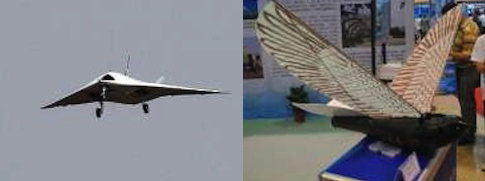
More than 60 drones were on display in Beijing last June, including a drone helicopter, and a drone with simulated birds’ wings.

Additionally, officials have said drone bases are being set up in the South China Sea to monitor Scarborough reef, which is claimed by Philippines and China; Macclesfield Bank; the Paracel Islands; and the Spratly Islands. China also is using drone to monitor the Socotra Reef claimed by South Korea.
A report made public March 11 by the Project 2049 Institute on Chinese drones estimated that China has more than 280 military drones.

“The PLA has developed one of the largest and most organizationally complex UAV programs in the world,” the report stated.

For the immediate future, the Chinese drones are monitoring disputed maritime and land boundaries that are likely to “increase tensions” since other states in the region lack the same capabilities.
“Like any new capability, UAVs may encourage the inexperienced to overreach and engage in risk taking,” the report said. “There could be a sense that because human pilot lives are not at stake, operators can push farther than they otherwise might.”

An isolated UAV attack during a crisis also could lead to a major conflict. “In the future, PRC decision-makers might feel compelled to order ‘plausibly deniable’ UAV attacks as a means of sending a political signal only to inadvertently wind up escalating tensions,” the report said.

Over the long term, Chinese drones will support the expansion of Chinese military operational areas by pushing the ability to hit targets further into the western Pacific. The report said China likely will use its UAV force for targeting and guidance of the DF-21D anti-ship ballistic missile designed to strike U.S. aircraft carriers more than a thousand miles from China’s coast.

“While the potential for a large scale conflict in the region currently appears low, the lack of adequate preparation for worst case scenarios could encourage and invite adventurous adversary behavior, ultimately increasing risks to peace and stability,” the report stated.

U.S. intelligence agencies reported earlier this month that China plans to build 11 drone bases along its coastline by 2015, with each base deploying at least one unmanned aircraft.

The People’s Liberation Army currently has two drone bases in northeast Liaoning province. A third base was disclosed further south at Lianyungang, Jiangsu Province, also on the Bohai Sea.

The bases were announced in August by the State Oceanic Administration, which has been used as a proxy by the Chinese military to lay claim to international waters and islands as part of a strategy of pushing Chinese maritime control hundreds and eventually thousands of miles from the coast through what Beijing calls its two Asian island chain strategy. The island chains stretch from Northeast Asia through Southeast Asia.

The two bases in the Bohai Sea are located at Yingkou and Dalian to provide surveillance of the Bohai and Yellow Seas.

China called U.S. aircraft carrier exercises held in the Yellow Sea three years ago “a threat to China” even though the carrier maneuvers were carried out in international waters.

The maritime surveillance drones provide high-definition remote imagery and will be used by China to respond to emergencies in the region and also to identify what China claims are illegal resource extraction from undersea gas and oil deposits.

U.S. officials regard recent highlighting of attack drones as a sign that Beijing remains intent on taking control of the Senkakus.

The increased use of drones by both China and Japan is expected to increase tensions over the Senkakus, the officials said.

According to Fisher, China is also exporting two of its armed drones, the Yi Long and CH-3, to the United Arab Emirates and Pakistan.

The UAE government purchased the Yi Long, and a smaller CH-3 was sold to Pakistan and repackaged by Islamabad as the Shahpar.

Fisher said he is concerned China will sell the new and larger CH-4 to Iran.
“Because it is not connected to the Aviation Industries Corporation (AVIC) which wants to do business in the United States, the CH-4 stands a better chance of being sold to Iran,” he told the Free Beacon.
“China’s willingness to sell UCAV technology to terrorist-linked states means that terrorists may soon have another deadly tool with which to attack the United States.”

Data from The Washington Times

Thứ Ba, 26 tháng 3, 2013

China stepping up drone deployment


China's CH-4 armed drone disclosed for the first time in November / Source: Reuben Johnson
China’s military is expanding its unmanned aerial vehicle forces with a new Predator-like armed drone and a new unmanned combat aircraft amid growing tensions with neighbors in Asia, according to U.S. intelligence officials.

New unarmed drone deployments include the recent stationing of reconnaissance and ocean surveillance drones in Northeast Asia near Japan and the Senkaku islands and along China’s southern coast. Drones also are planned for the South China Sea where China has been encroaching on international waters and bullying nations of that region in asserting control over international waters, said officials familiar with intelligence reports.

“Unmanned aerial vehicles are emerging as critical enablers for PLA long range precision strike operations,” said Mark Stokes, a former military intelligence official now with the Project 2049 Institute. “A general operational PLA requirement appears to be persistent surveillance of fixed and moving targets out to 3,000 kilometers of Chinese shores.”

Japan, meanwhile, is developing and purchasing military drone capabilities to counter what it regards as Chinese aggression and Beijing’s growing military capabilities as Tokyo’s dispute with China over the Senkaku islands intensifies, the officials said.

After Chinese aircraft intruded into Japanese airspace over the Senkakus undetected late last year, Tokyo stepped up efforts to seek drone capabilities. The efforts include building an indigenous missile-tracking drone and high-altitude U.S. drones.

So far, unlike Beijing, Tokyo asserts its drone will be unarmed, the officials said.

“China has started deploying UAVs for reconnaissance and oceanic surveillance purposes in the vicinity of disputed maritime territories, such as the Senkaku Islands,” said one military source.

Of particular concern to U.S. intelligence agencies are two new missile-equipped drones known as the CH-4 and Yi Long. The aircraft were shown off along with six other military drones at a major Chinese arms show last November in Zhuhai.

Photos of the drones reveal the designs appear to be copied from the U.S. Predator armed drone that has been leading the Obama administration’s war on al Qaeda in Pakistan and elsewhere. Photos of the CH-4 show it armed with Blue Arrow-7 anti-tank missiles that appear similar in size to the U.S. Hellfire fired from Predators.

Even more of a concern, according to the officials, are intelligence reports from Asia indicating that China is well along in building a large stealth unmanned combat aerial vehicle (UCAV)—an upiloted jet—that was revealed recently in an online Chinese military video.

The drone combat jet is nearly identical in shape to the experimental batwing-shaped U.S. Air Force X-47B currently under development. The X-47B was tested on an aircraft carrier in December.

The Chinese UCAV is expected to have enough range to reach the U.S. island of Guam, some 1,800 miles from the Chinese coast and the hub of the Pentagon’s shift to Asia, officials said.

Video and photos of the Chinese UCAV were posted on Chinese military enthusiast Internet sites recently. Also, a model of the drone combat jet was on display at Zhuhai. The aircraft is being built by the China Shenyang Aerospace Institute and could be deployed on China’s new aircraft carrier, officials said.

Richard Fisher, a China military analyst with the International Assessment and Strategy Center, said the first prototype flying wing UCAV was completed at China’s Hongdu Aircraft Corp in mid-December. The drone weighs 10 to 14 tons and could be carrier based.

“This means that the U.S. attempt to ‘outrange’ an emergent PLA anti-access systems, like the DF-21D anti-ship ballistic missile, could soon be outflanked by a new PLA carrier-based UCAV,” Fisher said.

Japan, alarmed at fierce Chinese reaction to its efforts to solve the Senkakus dispute by nationalizing several of the uninhabited but oil-rich islands last year, is bolstering its military forces with both missile-detecting and maritime surveillance with drones.

Japanese Defense Ministry officials, quoted in press reports, have called the purchase of several long-range U.S. Global Hawk surveillance drones an urgent priority.

Tokyo is seeking up to three Global Hawks by 2015 but could speed up purchases in response to what it regards as growing Chinese aggressiveness toward Japan over the Senkakus.

The U.S. military currently has Global Hawks deployed at Guam.

The Japanese do not plan to develop armed drones and plan to limit initial purchases to the Global Hawk, which fly nearly 60,000 feet for extended missions. It is able to track vessels using sensors and radar.

Japan also is developing an unmanned drone aircraft that will be used to detect North Korean nuclear missile attacks and to counter the Chinese military buildup, the officials said.

The anti-missile drone program is being developed over the next four years with the first drone deployed by 2020. It will use infrared sensors designed to detect missiles shortly after launch.

China’s drone program is believed to have benefitted from its aggressive economic and cyber espionage operations against the United States. Those efforts have included breaking into both government and defense industry networks and stealing valuable drone technology.

Officials also said China’s drone program is receiving a boost from an unlikely source: Taiwan.

The largest Chinese drone production center is being built at Wuhan in Hubei province, site of a joint construction project by China’s Wuhan Visiontek Inc. and Taiwan’s Carbon-Based Technology, Inc.

Officials said China launched a crash program to develop military drones beginning around 2007. Beijing is planning a range of unmanned aircraft capabilities, including high-altitude, long-endurance drones, integrated air and sea warfare drones, sea-based drones and UCAVs.


China’s new UCAV, a small bird-like drone shown during a recent military show at Zhuhai / Source: Chinese Internet

More than 60 drones were on display in Beijing last June, including a drone helicopter, and a drone with simulated birds’ wings.

Additionally, officials have said drone bases are being set up in the South China Sea to monitor Scarborough reef, which is claimed by Philippines and China; Macclesfield Bank; the Paracel Islands; and the Spratly Islands. China also is using drone to monitor the Socotra Reef claimed by South Korea.

A report made public March 11 by the Project 2049 Institute on Chinese drones estimated that China has more than 280 military drones.

“The PLA has developed one of the largest and most organizationally complex UAV programs in the world,” the report stated.

For the immediate future, the Chinese drones are monitoring disputed maritime and land boundaries that are likely to “increase tensions” since other states in the region lack the same capabilities.

“Like any new capability, UAVs may encourage the inexperienced to overreach and engage in risk taking,” the report said. “There could be a sense that because human pilot lives are not at stake, operators can push farther than they otherwise might.”

An isolated UAV attack during a crisis also could lead to a major conflict. “In the future, PRC decision-makers might feel compelled to order ‘plausibly deniable’ UAV attacks as a means of sending a political signal only to inadvertently wind up escalating tensions,” the report said.

Over the long term, Chinese drones will support the expansion of Chinese military operational areas by pushing the ability to hit targets further into the western Pacific. The report said China likely will use its UAV force for targeting and guidance of the DF-21D anti-ship ballistic missile designed to strike U.S. aircraft carriers more than a thousand miles from China’s coast.

“While the potential for a large scale conflict in the region currently appears low, the lack of adequate preparation for worst case scenarios could encourage and invite adventurous adversary behavior, ultimately increasing risks to peace and stability,” the report stated.

U.S. intelligence agencies reported earlier this month that China plans to build 11 drone bases along its coastline by 2015, with each base deploying at least one unmanned aircraft.

The People’s Liberation Army currently has two drone bases in northeast Liaoning province. A third base was disclosed further south at Lianyungang, Jiangsu Province, also on the Bohai Sea.

The bases were announced in August by the State Oceanic Administration, which has been used as a proxy by the Chinese military to lay claim to international waters and islands as part of a strategy of pushing Chinese maritime control hundreds and eventually thousands of miles from the coast through what Beijing calls its two Asian island chain strategy. The island chains stretch from Northeast Asia through Southeast Asia.

The two bases in the Bohai Sea are located at Yingkou and Dalian to provide surveillance of the Bohai and Yellow Seas.

China called U.S. aircraft carrier exercises held in the Yellow Sea three years ago “a threat to China” even though the carrier maneuvers were carried out in international waters.

The maritime surveillance drones provide high-definition remote imagery and will be used by China to respond to emergencies in the region and also to identify what China claims are illegal resource extraction from undersea gas and oil deposits.

U.S. officials regard recent highlighting of attack drones as a sign that Beijing remains intent on taking control of the Senkakus.

The increased use of drones by both China and Japan is expected to increase tensions over the Senkakus, the officials said.

According to Fisher, China is also exporting two of its armed drones, the Yi Long and CH-3, to the United Arab Emirates and Pakistan.

The UAE government purchased the Yi Long, and a smaller CH-3 was sold to Pakistan and repackaged by Islamabad as the Shahpar.

Fisher said he is concerned China will sell the new and larger CH-4 to Iran.

“Because it is not connected to the Aviation Industries Corporation (AVIC) which wants to do business in the United States, the CH-4 stands a better chance of being sold to Iran,” he told the Free Beacon.

“China’s willingness to sell UCAV technology to terrorist-linked states means that terrorists may soon have another deadly tool with which to attack the United States.”

Free Beacon

Thứ Năm, 21 tháng 3, 2013

N. Korea conducts UAV trainng exercise

N. Korea conducts UAV trainng exercise
Illustrative image
North Korean hereditary dictator Kim Jong-un oversaw attack drills carried out by Pyongyang’s “superprecision drone planes,” according to state media Wednesday. Experts have a caveat to the report: North Korea has no remotely piloted drone aircraft.

Mr. Kim, the third generation of his family to lead the crumbling and hermetic communist state, “guided a drill of superprecision drone planes assaulting targets and a firing drill of self-propelled flak rockets destroying ‘enemy’ cruise missile coming in [to] attack [at] low altitude,” according to Korea Central News Agency.

N. Korea conducts UAV trainng exercise
“Despite what’s claimed in the KCNA story, there’s never been any evidence [North Korea] has operational drones,” tweeted Steve Herman, Voice of America’s North Asia bureau chief, a few minutes after the agency’s report.
In February last year, citing unnamed intelligence sources, South Korea’s Yonhap news agency reported that North Korea had bought U.S.-made MQM-107 Streaker target drones from a Middle Eastern country and was seeking to develop them into an unmanned attack aircraft program.

But commentators at the time pointed out that the Streaker was 1970’s-era pre-programmable flight technology completely unlike modern, remotely piloted unmanned aerial vehicles (UAVs).

“At the very best, North Korea now possesses a very unwieldy, inaccurate, subsonic cruise missile, in limited numbers, that is slightly better equipped technology-wise than a German WWII-era V-1 Buzz Bomb,” wrote Asia Security Watch analyst Craig Scanlan.


KCNA said the drones, which were not pictured in the report, “after making long-range flight as planned … headed toward ‘enemy positions’ and stormed the targets, destroying them with accuracy.”

Mr. Kim, who was pictured watching the exercise through binoculars, “said that the planes are very fast and have high target discerning ability,” KCNA reported, adding that the drones had been “assigned the flight route and time with targets in South Korea in mind.”

The drone exercise was followed by a demonstration of North Korean self-propelled anti-aircraft batteries, which successfully destroyed “a target disguised as Tomahawk cruise missile of the enemy,” according to the agency.

“An outburst of fire with roaring blast flew toward the missile, destroying it at a single shot,” the agency reported.

“When the drills turn into a battle, the enemies will be made to drink a bitter cup, unable to raise their heads,” Mr. Kim said, “stressing the need to destroy the enemies without mercy so that not a single man can survive to sign a document of surrender.”