June 5, 2013: The U.S. Department of Defense recently received a report (from the Defense Science Board) detailing what was known about how much military and commercial technical data had been stolen by Chinese Internet (and more conventional) espionage efforts. The details of the report were kept secret, but the conclusion was that most major American weapons systems had been plundered, in addition to a lot of non-defense technology. It’s not just the United States that is being hit but most nations with anything worth stealing. Many of these nations are noticing that China is the source of most of this espionage and few are content to remain silent any longer.
It’s no secret that Chinese intelligence collecting efforts in the last decade have been spectacularly successful. As the rest of the world comes to realize the extent of this success there is a building desire for retaliation. What form that payback will take remains to be seen. Collecting information, both military and commercial, often means breaking laws and hacking back at the suspected attackers will involve even more felonies. China has broken a lot of laws. Technically, China has committed acts of war because of the degree to which it penetrated military networks and carried off highly secret material. The U.S., and many other victims, has been warning China there will be consequences. As the extent of Chinese espionage becomes known and understood, the call for “consequences” becomes louder.
China has tried hard to conceal its espionage efforts. Not just denying anything and everything connected to its hacking and conventional spying but also taking precautions. But as their success continued year after year, they became sloppy. At the same time, the victims became more adept at detecting Chinese efforts and tracing them back to specific Chinese government organizations or non-government hackers inside China.
Undeterred, China has sought to keep its espionage effort going and even expanded operations. For example, during the last five years China has opened National Intelligence Colleges in many major universities. In effect, each of these is an "Espionage Department" where, each year, several hundred carefully selected applicants are accepted in each school, to be trained as spies and intelligence operatives. China has found that espionage is an enormously profitable way to steal military and commercial secrets and rewards those who have talent and make a career of it. The Internet based operations, however, are only one part of China’s espionage efforts.
While Chinese Cyber War operations in this area get a lot of publicity, the more conventional spying brings in a lot of stuff that is not reachable on the Internet. One indicator of this effort is the fact that American counter-intelligence efforts are snagging more Chinese spies. This may be due to increased spying effort by China, rather than more success by the FBI and CIA. All this espionage, in all its forms, has played a large part in turning China into one of the mightiest industrial and military powers on the planet. China is having a hard time hiding the source of the new technologies they are incorporating into their weapons and commercial products. Many of the victims had a hard time accepting the fact that the oh-so-eager (to export) Chinese were robbing their best customers of intellectual property on a grand scale.
China has been getting away with something the Soviet Union never accomplished; stealing Western technology, then using it to move ahead of the West. The Soviets lacked the many essential supporting industries found in the West (largely founded and run by entrepreneurs) and was never able to get all the many pieces needed to match Western technical accomplishments. Soviet copies of American computers, for example, were crude, less reliable, and less powerful. It was the same situation with their jet fighters, tanks, and warships.
China gets around this by making it seemingly profitable for Western firms to set up factories in China, where Chinese managers and workers can be taught how to make things right. At the same time, China allows thousands of their best students to go to the United States to study. While many of these students will stay in America, where there are better jobs and more opportunities, some will come back to China and bring American business and technical skills with them. Finally, China energetically uses the "thousand grains of sand" approach to espionage. This involves China trying to get all Chinese going overseas, and those of Chinese ancestry living outside the motherland, to spy for China, if only a tiny bit.
This approach to espionage is nothing new. Other nations have used similar systems for centuries. What is unusual is the scale of the Chinese effort and that makes a difference. Supporting it all is a Chinese intelligence bureaucracy back home that is huge, with nearly 100,000 people working just to keep track of the many Chinese overseas and what they could, or should, be trying to grab for the motherland. This is where many of the graduates of the National Intelligence College program will work.
It begins when Chinese intelligence officials examine who is going overseas and for what purpose. Chinese citizens cannot leave the country, legally, without the state security organizations being notified. The intel people are not being asked to give permission. They are being alerted in case they want to have a talk with students, tourists, or business people before they leave the country. Interviews are often held when these people come back as well.
Those who might be coming in contact with useful information are asked to remember what they saw or bring back souvenirs (legal or otherwise). Over 100,000 Chinese students go off to foreign universities each year. Even more go abroad as tourists or on business. Most of these people were not asked to actually act as spies but simply to share, with Chinese government officials (who are not always identified as intelligence personnel), whatever information they obtained. The more ambitious of these people are getting caught and prosecuted. But the majority are quite casual and individually bring back relatively little and are almost impossible to catch.
Like the Russians, the Chinese are also employing the traditional methods, using people with diplomatic immunity to recruit spies, and offering cash, or whatever, to get people to sell them information. This is still effective and when combined with the "thousand grains of sand" methods, brings in a lot of secrets. The final ingredient is a shadowy venture capital operation, sometimes called Project 863, that offers money for Chinese entrepreneurs who will turn the stolen technology into something real. No questions asked. If you can get back to China with the secrets, you are home free and potentially very rich.
But there are some legal problems. When the Chinese steal some technology, and produce something that the Western victims can prove was stolen (via patents and prior use of the technology), legal action can make it impossible, or very difficult, to sell anything using the stolen tech outside of China. For that reason, the Chinese like to steal military technology. This kind of stuff rarely leaves China. And in some cases, like manufacturing technology, there's an advantage to not selling it outside of China. Because China is still a communist dictatorship, the courts do as they are told, and they are rarely told to honor foreign patent claims.
But increasingly, Chinese firms are boldly using their stolen technology, daring foreign firms to try and use Chinese courts to get justice. Instead, the foreign firms are trying to muster support from their governments for lawsuits outside China. Naturally, the Chinese government will howl and insist that it’s all a plot to oppress China. This has worked for a long time, but many of the victims are now telling China that this conflict is being taken to a new, and more dangerous, level.
Strategy Page
Hiển thị các bài đăng có nhãn Global Armed Drones. Hiển thị tất cả bài đăng
Thứ Năm, 6 tháng 6, 2013
Thứ Tư, 5 tháng 6, 2013
The Global Armed Drone Race Is On
By Keir Simmons and Gil Aegerter, NBC News
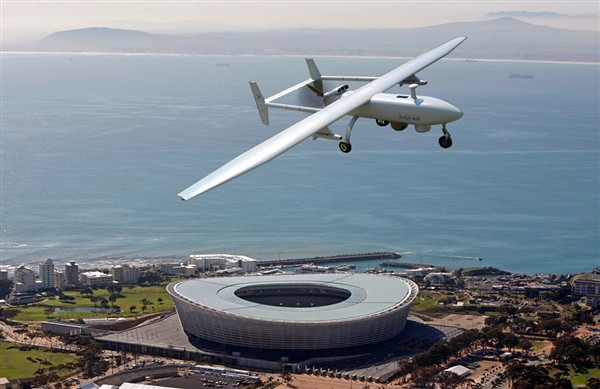
Editor's note: A clarification has been made to this article.A Seeker 400 drone, manufactured by South African company Denel Dynamics, flies over Cape Town Stadium.
On a sprawling complex just outside Pretoria, South Africa, a government-owned arms manufacturer is preparing to test an armed drone that it hopes to begin selling soon to governments around the world.
The company, Denel Dynamics, says the armed version of the Seeker 400, which will carry two laser-guided missiles, will enable so-called opportunistic targeting at a range of up to about 155 miles.
“These are not combat systems, they are foremost reconnaissance systems,” Sello Ntsihlele, executive manager of UAV systems for Denel, told NBC News. He added: “(But if) you speak to any general, show him the capability, he will tell you, ‘I want to have munitions.’”
The company’s move is but one signal that the era when only a small club of countries possessed weaponized drones is drawing to a close.
Critics say the coming proliferation of the lethal remote-controlled flying machines will forever change the face of counterterrorism operations and, eventually, warfare itself – and not for the better.
“The U.S. has set a moral precedent,” said Jenifer Gibson of the human rights group Reprieve. "A state can declare someone a terrorist and just go out and kill them."
Reprieve campaigns against what it calls illegal drone strikes.
Supporters of military drones argue that they are an essential tool against terrorists hiding in remote areas and that their ability to strike with precision minimizes civilian casualties. Reprieve rejects the notion that drones are precision weapons and claims many civilians have been killed.
Who has drones — and who wants them
Only three countries are known to currently operate armed unmanned aerial vehicles, or UAVs, as drones are technically known -- the U.S., the U.K. and Israel -- according to a recent report by the think tank RUSI. The report suggested there are only currently around 1,000 armed drones worldwide.
But China also is believed to have developed weaponized drones; the U.S. has said it would arm drones operated by Italy; and France and Germany also have decided to acquire them, according to arms trade experts and published reports.
And according to Peter Singer, director of the Center for 21st Century Security and Intelligence at the Brookings Institute, at least 26 countries have surveillance drones of a size or type that have been or could be armed, and roughly 20 countries are trying to either develop or acquire weaponized drones.
So far, the United States is the only country known to have transferred armed drone technology -- and solely to Britain, which flies U.S.-built Predators in Afghanistan.
U.S. sales of drones, armed and unarmed, "are considered on a case-by-case basis, consistent with U.S. law, regulation and policy, as well as our international commitments, including under the multilateral nonproliferation regimes," a Pentagon spokesman said in an email to NBC News. A State Department spokesman declined to comment on the record.
U.S. reluctance to share its cutting-edge military drone technology outside a few trusted NATO partners like Britain and Italy is viewed as an opportunity by arms manufacturers like Denel Dynamics.
The company aims to be among the first suppliers of armed drones to market, if tests of the armed versions of the Seeker 400 -- expected to begin in “a month or two” and last up to six months, according to Ntsihlele -- are successful. South Africa would have to purchase the armed drones first before the company would begin marketing them elsewhere, but if that happens Denel sees opportunities for growth elsewhere, particularly in “Africa and the Middle East,” he said.
Ntsihlele declined to say how much the armed Seeker 400 will cost, but said it will be far cheaper than the Predator and Reaper, the armed drones used for anti-terrorism operations by the U.S. military in Afghanistan, Pakistan, Somalia and Yemen, which cost approximately $20 million and $56.5 million apiece, respectively. And unlike those UAVs, it would not require satellite technology, being controlled instead through “line of sight” communications. That limits its range but makes it potentially available to nations without sophisticated space-based guidance systems.
The drone market
President Barack Obama, in a speech last Thursday, said he would impose new limits on drone strikes against foreign terrorists in an attempt to reduce civilian casualties to near zero and ensure that only enemies who pose a “continuing, imminent threat” to the United States are targeted.
"What we are trying to do with our (anti-terror) strategy is turn it back over to the host country and local forces," the New York Times quoted the Pentagon's top counterterrorism official Michael Sheehan as saying. "That is the future."
The sale of armed drones to other governments raises similarly thorny issues though.
| The military use of armed drones in the Middle East and Afghanistan has brought more countries and companies into the market for such weapons. Here are some of the un-crewed aerial vehicles that are known to carry weapons or that might be adapted to carry them. --> Slideshow: Armed drones around the world |
In Denel’s case, Ntsihlele indicated that the South African government would limit sales only to governments that would be “accountable and responsible” and agree to “opportunistic” use of the weapons on justified targets. “That target could be a pirate, or could be a terrorist,” he said.
The company also provided this statement to NBC News: “All of our activities ... take place within the framework of decisions taken by international organs such as the United Nations, the policies of the South African government and the regulatory prescripts imposed by the National Conventional Arms Control Committee and the Directorate Conventional Arms Control,” referring to two South African government organizations.
Assuming it gets its product to market, Denel is expected to quickly encounter plenty of competition.
“To the extent that the U.S. backs off the armed drone business, it allows countries like China, in particular, to say they’ll fill the marketplace,” said Dennis Gormley, who teaches intelligence and military issues at the University of Pittsburgh’s Graduate School of Public and International Affairs.
China already has shown an armed drone resembling a smaller Reaper at an air show last fall, and photos surfaced on Chinese websites earlier this month showing what appeared to be an unmanned combat aerial vehicle known as the Lijan, or “Sharp Sword.” The Lijan closely resembles the U.S. Navy’s remote-controlled X-47B drone, which recently launched from an aircraft carrier for the first time.
Israel will also be a marketplace competitor. It is a leader in armed drones and is already considered the biggest exporter of unarmed drone technology.
Turkey also has developed a reconnaissance drone, the Anka, for spying on Kurdish insurgents. Last summer, the Turkish Defense Industry Executive Committee said that TAI, the company that builds the Anka, was starting research and development on an armed variant, the Anka +A.
Turkey had been intensely interested in buying armed drones from the U.S., said William Hartung, director of the arms and security project at the Center for International Policy. So far, the U.S. has resisted selling it such technology, despite its NATO membership, he said.
Iran also has made unsubstantiated claims to have armed drones.
Terrorism concerns
The spread of armed drone technology to volatile regions like the Middle East inevitably stirs concern that terrorists could obtain the airborne weapons. So far, the Lebanese militia group Hezbollah, considered a terrorist organization by the U.S., is the only group believed to possess the UAVS. It has flown several unarmed drones containing explosives over Israel and, in one case, apparently used an armed drone to attack an Israeli ship, according to published reports.
| Yemeni tribesmen stand on the rubble of a building in the village of Azan that was destroyed by a U.S. drone air strike on Oct. 14, 2011. Tribal elders say that suspected al Qaeda militants Abdulrahman al-Awlaki, the son of slain U.S.-born cleric Anwar al-Awlaki, and six others were killed in the attack. |
The development of smaller drones has been accompanied by new smaller munitions that don’t require the Predator’s 450-pound payload capacity. Denel’s Seeker 400, for example, will have a payload half that, according to a company brochure, but still be capable of carrying two laser-guided missiles.
“There is the development of smaller and smaller weapons, some of them specifically for UAVs,” said Philip Finnegan, director of corporate analysis for the Teal Group, which conducts market analysis in the aerospace and defense industry. “So they’ll be able to use smaller platforms.”
While armed drones appear certain to be added to more countries’ arsenals in the near future, analysts say they expect the military sector will remain a relatively small piece of the overall drone market for some time to come. A big reason for that is the restrained growth in defense budgets worldwide and cuts by the U.S. military in spending on drones, which also affect research and development.
“There is short-term pressure on the industry. … It’s a combination of budgetary pressure and the withdrawals from Iraq and Afghanistan,” Finnegan said. “Longer term, the U.S. remains heavily committed to advanced UAV technology.”
And sales to smaller nations are likely to be slow due to the fact that even with prices falling, armed drones remain prohibitively expensive, Denel’s Ntsihele said, recounting conversations with prospective buyers.
"When they get to know the product, they get shocked,” he said.
Keir Simmons is a correspondent in NBC News' London bureau; Gil Aegerter is an NBC News staff writer in Redmond, Wash.; NBC News' Marc Smith and Robert Windrem also contributed reporting to this article.
NBC News
Đăng ký:
Bài đăng (Atom)