Hiển thị các bài đăng có nhãn Russian Navy. Hiển thị tất cả bài đăng

Chủ Nhật, 7 tháng 7, 2013

Russian Navy to Receive 36 Warships in 2013


The Russian Navy will receive 36 warships in 2013, an unprecedented number in Russia’s history, Navy Deputy Commander-in-Chief, Vice Admiral Alexander Fedotenkov said on Sunday.

“During this year, 36 combat ships, fast attack crafts and support vessels will join the Russian Navy. This has never happened before,” Fedotenkov said at the International Maritime Defense Show in St. Petersburg.

Russian Navy warships are now performing missions in all areas of the World Ocean, with over 60 combat ships currently at sea, he said.

Defense Minister Sergei Shoigu said in March the Russian Navy would receive 24 submarines and 54 warships of various classes by 2020.

“As a result of the implementation of the state rearmament program to 2020, the navy should receive eight nuclear-powered strategic submarines, 16 multirole submarines and 54 warships of various classes,” Shoigu said.

The eight strategic missile boats include three Borey and five Borey-A class vessels (SSBN) armed with Bulava ballistic missiles.

The 16 multi-purpose submarines include eight Graney class nuclear-powered attack submarines (SSN) and improved Kilo and Lada class diesel-electric (SSK) boats.

In addition to submarines, the navy will receive Admiral Gorshkov class frigates and Steregushchy class corvettes, Buyan class corvettes and Ivan Gren Class large landing ships.

Russian President Vladimir Putin said last year that the procurement of new warships and submarines for the Navy would be a priority over the next decade. The Russian government has allocated five trillion rubles ($166 bln) or a quarter of the entire armament procurement budget until 2020 for this purpose.

RIA Novosti

Thứ Ba, 4 tháng 6, 2013

Russia's New Nuclear Sub in Sea Trials

Russia’s Project 885 Yasen-class attack submarine, the Severodvinsk, has embarked on its latest series of official tests in the White Sea, the manufacturer said Monday.

Russia’s Project 885 Yasen-class attack submarine

Sevmash shipyard spokeswoman Yekaterina Pilikina said the tests had started several days ago, without providing details on their time frame or scope.

The shipyard had earlier said the submarine would continue tests that had started in 2011. The Severodvinsk has spent a total of 137 days at sea.

The submarine, whose construction began in 1993, is due to be delivered to the Navy later this year. It was to have been handed over by the end of 2012.

The Severodvinsk carried out a series of cruise-missile test-firings in November, including the test-launch of a supersonic cruise missile at a land target.


The multirole attack submarine has a submerged displacement of 13,800 tons, length of 119 meters, speed of 31 knots, and can dive to 600 meters. It has a crew of 90, including 32 officers.

It is armed with 3M55 Oniks (SS-N-26) and 3M54 (SS-N-27) Kalibr cruise missiles, torpedoes and mines.

RIA Novosti

Chủ Nhật, 2 tháng 6, 2013

Russian Nuclear Submarines To Patrol Southern Seas

It is planned that by 2018, the Russian Navy will have eight Borei vessels, which will form the core of the country’s strategic submarine fleet.
Russia is planning to deploy nuclear ballistic missile submarines to the southern seas for the first time since a 20-year break that followed the collapse of the USSR, sources told Russian media.

Starting from 2014, Russia is going to expand its strategic submarine patrol area of the World Ocean, a source in the Russian General Staff told Itar-Tass agency. The statement comes as the Russian Northern Fleet – the country’s most powerful – is celebrating the 80th anniversary since its foundation in 1933.

Once the nuclear-powered Borei-class submarines are put into service, the Russian Navy “will not only continue the patrolling of the Arctic, Atlantic and Pacific Oceans,” but also return to the regions in the southern hemisphere which were patrolled by Soviet subs until the dissolution of the USSR in the 90s.

“This would serve to solve the tasks of strategic nuclear deterrence not only across the North Pole but also the South Pole,” the source pointed.

Former Chief of Naval Staff, Admiral Viktor Kravchenko, said that if there is a necessity to launch missiles across the South Pole, “it is technically possible” to do so.

Russia’s first and head Borei submarine, the Yury Dolgoruky, was put into service in January this year. By the end of 2013, the Russian Navy will receive two more vessels of the class, the Aleksandr Nevsky and the Vladimir Monomakh, which are currently undergoing sea trials.

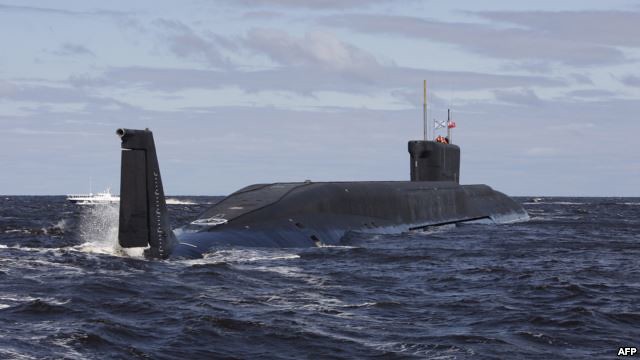
A Borei-class undersea boat is a state-of-the-art 170-meter long vessel which is capable of carrying 16 Bulava SLBMs, has a crew of 107, including 55 officers, can dive to a depth of 450 meters and has a submerged speed of about 29 knots (54 km/h). The sub can spend up to three months in autonomous navigation and, thanks to the latest achievements in the reduction of noise, it is almost silent compared to previous generations of submarines.

Construction of the first missile carrier – the Yury Dolgoruky – is approximately estimated at around US$770 million, while other submarines of the class are believed to cost less.

It is planned that by 2018, the Russian Navy will have eight Borei vessels, which will form the core of the country’s strategic submarine fleet.

Apart from Boreis, the Navy will receive seven Yasen-class nuclear powered multipurpose attack submarines. The design is comparable to the US Seawolf class submarine in terms of purpose and characteristics. The first ship of the series, Severodvinsk, was launched in 2010 and will be put into service by the end of 2013, Russia’s Deputy Defense Minister Yuri Borisov said earlier.

Eurasia Review

Thứ Bảy, 25 tháng 5, 2013

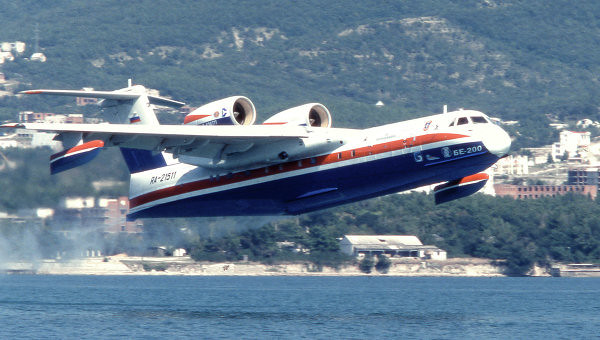
Russian Military Orders 6 Be-200 Amphibious Planes


MOSCOW, May 24 (RIA Novosti) – The Russian Defense Ministry has signed a contract with the Beriev Aircraft Company for the purchase of six Beriev Be-200 amphibious planes, Russia’s United Aircraft Corporation (UAC) said on Friday.

“The contract is worth 8.4 billion rubles [$268 million],” UAC said in a statement.

“The first two planes will be basic Be-200ChS models, while the following four will be the Be-200PS version without firefighting equipment,” the statement said.

It is the first purchase of Be-200 planes by the Russian military.

The Defense Ministry may order eight more planes in the future, according to UAC.

Be-200 is the world's largest multipurpose amphibious aircraft, designed for firefighting, search and rescue, maritime patrol, cargo and passenger transportation.

The plane can carry 12 tons of water or 7.5 tons of cargo, or up to 72 passengers.

At least five Be-200ChS firefighting planes are currently in service with the Russian Emergencies Ministry.


RIA Novosti

Thứ Năm, 2 tháng 5, 2013

In a First, a Russian Warship Docks in Israel

In a First, a Russian Warship Docks in Israel

Russia’s large landing ship Azov entered the Israeli port of Haifa on Wednesday, marking the first time a Russian warship calls at an Israeli port.

Azov will stay in Haifa until Friday to resupply and allow the crew to rest, a spokesman for the Russian Navy said.

City residents will also be allowed on board for a guided tour and treated to performances by the Black Sea Fleet orchestra reinforced by marines.

Azov is part of Russia’s task force in the Mediterranean, which is due to perform exercises off the coast of war-torn Syria, Captain Alexei Komarov, who heads the landing ship unit of the Black Sea Fleet, told journalists in Haifa.

He did not give a date for the exercises, but said the task force is prepared to evacuate Russian citizens from Syria, though no such order was given so far.

Russia currently has six ships in the Mediterranean, including the Azov, which made frequent trips to the region before, calling at the Russian resupply base in the Syrian city of Tartus.

Another six ships of the Pacific Fleet are on the way to the Mediterranean and expected to join the task force later this month.

Various expert estimates put the Russian diaspora in Syria at anywhere between 5,000 and 100,000, the majority of them women who married into Syrian families. Russia evacuated 77 of its citizens by bus in January.


RIA Novosti

Thứ Ba, 16 tháng 4, 2013

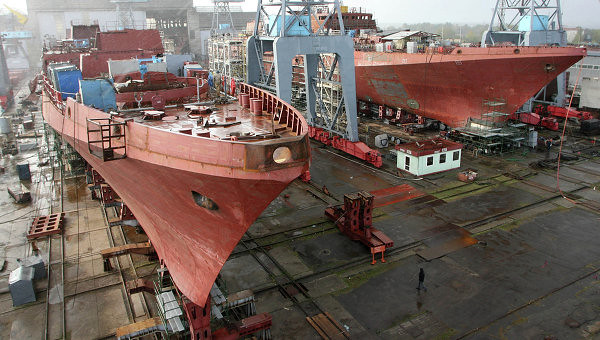
Russia to Lay Keel for 4th Project 11356 Frigate

MOSCOW, April 15 (RIA Novosti) – The Russian Navy’s fourth Project 11356 frigate will have its keel laid on Thursday, the Yantar shipyard said on Monday.


The start of construction work on the Admiral Butakov frigate was postponed in October 2012.
The Kaliningrad-based shipyard is to build a total of six Project 11356 frigates under a contract with the Defense Ministry.

The lead warship in the series, the Admiral Grigorovich, was laid down in December 2010, the second, the Admiral Essen, in July 2011 and the third, the Admiral Makarov, in February 2012.

The shipyard is to hand over the six warships to the Navy between 2014 and 2016.

Project 11356 frigates are designed for anti-ship and anti-submarine warfare on the high seas, and for anti-aircraft operations, both independently and as an escort ship. The vessels are armed with strike anti-ship and surface-to-air missiles, gun mounts, torpedoes and bombs, according to navaltoday.com.

RIA

Chủ Nhật, 14 tháng 4, 2013

New Russian Submarines To Carry 16 ICBMs

The Russian Navy's new Borei-955 class submarines will each carry 16 Bulava intercontinental ballistic missiles (ICBM).

Of the eight planned new Borei submarines, only the
Of the eight planned new Borei submarines, only the "Yury Dolgoruky" has been commissioned.

Russian media reported on April 13 that original designs called for the new submarines to carry 20 ICBMs but technicians said the additional ICBMs would require extending the hull by 10 meters and making other modifications that would hamper the vessel's maneuverability.

News agency Interfax cited an unnamed source in the Russian defense industry as saying: "16 missiles are enough to deliver a nuclear strike. What is more important is to be able to clandestinely reach an attack position and launch missiles on designated targets."

Of the eight planned new Borei submarines, only the "Yury Dolgoruky" has been commissioned and the "Aleksandr Nevsky," after delays, is due to be transferred to the fleet next year.

RFERL