
Thứ Hai, 8 tháng 7, 2013
Japanese LCAC Amphibious Landing on Red Beach during Dawn Blitz

Japan warns of toughening security climate in east Asia

TOKYO (Reuters) – Japan faces increasingly serious threats to its security from China and North Korea, a defence ministry report said on Tuesday, as ruling politicians call for the military to beef up its ability to respond to such threats.

“There are various issues and destabilising factors in the security environment surrounding Japan, some of which are becoming increasingly tangible, acute and serious,” the annual defence white paper said.
“China has attempted to change the status quo by force based on its own assertion, which is incompatible with the existing order of international law.”
China and Japan have been locked in a dispute over rival claims to a group of tiny East China Sea islets.
Patrol ships from both countries routinely shadow each other near the islands, raising concerns that an unintended collision or other incident could lead to a broader clash.
“Some of China’s activities involve its intrusion into Japan’s territorial waters, its violation of Japan’s territorial airspace and even dangerous actions that could cause a contingency, and are extremely regrettable,” the paper said.
Defence Minister Itsunori Onodera said in February that a Chinese naval vessel had locked its fire control radar on a Japanese destroyer. Directing such radar at a target can be considered a step away from actual firing.
China denied the warship had locked its radar on the Japanese vessel. But the white paper said Beijing’s assertion was “inconsistent with the facts”.
Abe returned to power for a rare second term after his ruling bloc won a general election late last year, promising to revive the economy and strengthen Japan’s defences. He also wants to revise the post-World War Two pacifist constitution to legitimise the military, although winning support for contentious revisions is likely to take time.
Japan is already bolstering its islands’ defence and this year raised its defence budget for the first time in 11 years.
The military is conducting joint drills with the United States, its main security ally, and fortifying defences against missile attacks, while the government is reviewing its mid-term defence policy.
BALANCE OF POWER
Japan plans to draw up a new defence plan by December, and Abe’s Liberal Democratic Party (LDP) last month submitted to the government recommendations that included looking into acquiring the capability to attack enemy targets.
Japan has long maintained that it has the right to strike enemy targets when an intention to attack Japan is clear, the threat is imminent and there are no other options.
But any sign that Japan is moving to obtain such capabilities could upset China and South Korea, where resentment against Japan’s wartime aggression and colonisation runs deep.
The LDP also recommended that, in order to boost the defence of remote islands, the military should set up an amphibious Marines division equipped with tilt-rotor aircraft like the V-22 Osprey.
“The balance of power will be lost if we don’t start considering striking back when attacked,” said Osaka University professor Kazuya Sakamoto, who sits on a panel advising Abe on security policies.
“If we don’t have weapons that reach an enemy, Japan cannot defend itself. It cannot maintain deterrence.”
Such moves, Sakamoto added, should not unnerve China, with its arsenal of nuclear weapons.
Abe, whose LDP is expected to cement its grip on power in this month’s upper house election, also wants to revise an interpretation of the constitution that bans using the right of collective self-defence, or aiding an ally under attack.
A panel set up during Abe’s first 2006-7 term recommended that the ban be lifted in certain cases, such as intercepting ballistic missiles bound for the United States. A new committee of advisers is expected to reach similar conclusions.
North Korea launched a missile in December, stepping up the threat that the isolated, impoverished state poses to rivals. In February, it conducted a third nuclear test, which moved Pyongyang closer to developing long-range nuclear missiles.
“The launch of a missile … showed that North Korea has advanced its technologies to extend the range and improve the accuracy of ballistic missiles,” the white paper said.
The report added that if North Korea develops ballistic missiles based on technologies tested in December, they could reach the central and western parts of the U.S. mainland.
Japan’s defence spending has fallen 5 percent in the past decade even after this year’s small gain. China saw its defence budget quadruple during the same period, the white paper said.
Euro News
Japan vows to help Philippines defend its remote islands

Japanese Defence Minister Itsunori Onodera said China's contentious claim to nearly all of the South China Sea and its territorial dispute with Japan in the East China Sea were discussed during top-level talks in Manila.
"We agreed that we will further co-operate in terms of the defence of remote islands... the defence of territorial seas as well as protection of maritime interests," Onodera told a joint news conference.
"We face a very similar situation in the East China Sea of Japan. The Japan side is very concerned that this kind of situation in the South China Sea could affect the situation in the East China Sea," he said, speaking through an interpreter.
Philippine Defence Secretary Voltaire Gazmin welcomed Japan's offer of support for its poorly resourced military.
"We have agreed to continue our exchanges of information, exchanges of technology to help each other to make our defence relations stronger," Gazmin said.
Neither side offered specifics but Philippine Foreign Affairs Secretary Albert del Rosario said in February his country was expecting to get 10 new Japanese patrol boats within 18 months.
The Japanese military brutally occupied the Philippines during World War II, but the two countries have since grown closer due to trade and investment, and more recently, through China's assertiveness.
Del Rosario told the Financial Times newspaper in December that a rearmed Japan would help the region counter-balance China.
Onodera and Gazmin also on Thursday welcomed an increased military presence in Asia by their mutual ally, the United States.
However Onodera said Japan was intent on avoiding conflict with China.
"I would also like to emphasise here that the current situation should not be changed with the use of force but should be done through the rule of law," Onodera said.
China claims most of the South China Seam including waters close to its neighbours' coasts.
The Philippines, Brunei, Malaysia, Vietnam and Taiwan also have competing claims.
The Philippines has complained of increased Chinese "bullying" in the contested waters in recent years, and infuriated China by appealing to allies Japan and the United States for help.
The Philippines says China last year occupied an atoll well within the Filipino exclusive economic zone.
Tensions between China and Japan have also escalated over competing claims to the Japanese-held Senkaku islands, which Beijing calls the Diaoyus, in the East China Sea.
Interaksyon
Rebalancing and Indonesia
US Pacific Presence Will Force Jakarta To Choose

As announced by then-US Defense Secretary Leon Panetta last year, the military dimension of the US rebalancing, or pivot, to Asia will likely influence the region’s geostrategic landscape.
More US forces, including 60 percent of naval assets, will be transferred into the Pacific theater with rotational deployments in Australia, Singapore, Guam and Hawaii. This is in conjunction with China’s expanding military power as a potential US adversary.
As the military focus of US rebalancing is going to be on the maritime domain, Indonesia’s strategic calculus could become more complicated. Three of the world’s critical maritime choke points — the straits of Malacca, Sunda and Lombok — are in the archipelago. While the Strait of Malacca is partially administered by Singapore and Malaysia, the Sunda and Lombok straits lie entirely within Indonesian waters and sea lanes.
Soon, these waterways will be transited more frequently by US forces rotating between the Indian and Pacific oceans, now called the “Indo-Pacific,” particularly to Australia. More pressure will be felt as the Indian and Chinese navies increase their presence in the Indo-Pacific through these choke points to protect their commercial interests and energy security.
India’s trade with East Asia amounts to more than 30 percent of its total. Meanwhile, apart from being Africa’s largest trading partner, China also imports about 80 percent of its oil from the Middle East and Africa. Combined with Southeast Asia’s own maritime force modernization, this could lead to a saturation of regional waters.
A higher concentration of foreign maritime forces along the choke points could increase the risk of incidents at sea. Either by purpose or chance, foreign maritime forces could exploit the situation to conduct intelligence, surveillance and reconnaissance (ISR) activities against opposing forces. During wartime, these choke points could become more contested.
As an alternative to the Air-Sea Battle concept, the US strategic discourse has mooted the possibility of “offshore control” to interdict an adversary’s shipping. Interdicting such shipping would be more feasible along these narrow choke points than on the open ocean.
These rather daunting scenarios would not bode well for Indonesia as a coastal state. Refusing to draw a wedge between Washington and Beijing, the last thing Jakarta wants is a Sino-US conflict being waged on its turf. At the moment, Jakarta seems to enjoy playing with both sides and exploiting the situation to its own advantage.
The US has helped Indonesia build surveillance systems along the straits of Malacca and Makassar, while China has proposed similar systems along the straits of Karimata, Sunda and Lombok. Washington also has agreed to resume full military cooperation with Jakarta, including selling lethal arms, once considered taboo by the US Congress.
With Beijing, Jakarta has started unprecedented maritime cooperation in naval armaments, shipbuilding and oceanography, in addition to economic assistance.
But this situation cannot last indefinitely. Being at the crossroads of the Indo-Pacific, the archipelago could be caught in the crossfire should the Sino-American relationship deteriorate into armed confrontation. Jakarta then could face three difficult choices.
■Jakarta could tacitly align with the US. This would entail military support for Indonesia in return for increased US military access to Indonesian waters. Indonesia’s role, if any, would be limited to ISR activities in coalition with US forces.
However, increased US military access and presence in Indonesian waters could prod China’s People’s Liberation Army Navy (PLAN) to expand operations into the archipelago, especially submarine operations. But mounting effective anti-submarine warfare against the PLAN would be challenging, as the archipelago hosts many deep straits and channels for submarines to slip through.
■Jakarta could enter Beijing’s maritime orbit. Apart from being its largest trading partner, Beijing has become an alternative as Jakarta’s “all-weather” defense partner. Returning the favor would mean acquiescence to Beijing’s demands, including keeping relations with Washington and its allies at arm’s length.
This could prompt the US and allied forces to conduct intrusive maritime operations within Indonesian waters, but an Indonesian response to this breach of sovereignty could trigger inadvertent confrontation.
■Jakarta is neutral. But Indonesia’s limited military capacity could be thinly stretched to strictly implement the 1994 San Remo Manual on Armed Conflicts at Sea, which forbids hostile actions between belligerent forces in neutral waters. Failure to implement these provisions could cost Jakarta its neutralist credibility. But remaining idle would put Indonesian assets and property at risk of collateral damage.
Jakarta is not alone in this predicament, but it is in the nation’s interest to ponder these choices sooner rather than later. Choosing “the least bad” option would at least keep it strategically engaged in the big power game. And most important, this could help Jakarta adjust its geostrategic planning early on.
Ristian Atriandi Supriyanto is a research analyst with the Maritime Security Program at the S. Rajaratnam School of International Studies, Nanyang Technological University, Singapore.
Defense News
US and the Philippines Conducted Exercise at Scarborough Shoal
Philippine and U.S. forces has conducted their annual joint naval exercise, including drills near Scarborough Shoal in the South China Sea, which is claimed by Manila and Beijing.
The six-day exercises which began on June 27 until July 2 have been held every year since 1995, with more than 600 personnel from the US Navy and around 200 from the Philippine Navy and Coast Guard taking part this year.

Capt. Ruel Saonoy, the Philippine head of the exercise, said China should not feel alarmed, adding the drills “send the message to our neighbors that our (US and Philippines) navies share common interests in keeping our seas and littorals open for safe commerce.”
Philippine Navy spokesman Gregory Gerald Fabic said the plan to hold this year’s drills in the shoal area was made five years ago, long before fresh tensions between China and the Philippines erupted last year.

The Philippines says China has effectively occupied the Scarborough Shoal, a rich fishing area, as well as areas of the South China Sea close to the shores of its smaller neighbors.
Chinese maritime vessels have been maintaining a presence in the shoal area following a confrontation with the Philippine Navy in April last year.
The situation escalated when the Philippine Navy was about to apprehend Chinese fishermen caught in possession of endangered marine species when Chinese maritime personnel intervened.
Reacting to the announcement of the drills, Chinese Foreign Ministry spokeswoman Hua Chunying said Wednesday in Beijing, “We think relevant sides should take actions that are beneficial for maintaining peace and stability in the region, (and not create tension).”
The Philippine officials said some of the drills will be held in the coastal waters of Pangasinan, La Union and Zambales in the western part of main Luzon island, close to Scarborough Shoal.
The drills are aimed at enhancing the two countries’ naval operations “through subject matter lectures and practical exercises focusing on communication, naval gunnery, at-sea operations, maritime interdiction, humanitarian assistance and disaster response operations,” an official statement by the Philippine Navy said.
Scarborough Shoal, which is about 124 nautical miles from Zambales province, was a popular fishing ground for Filipino, Chinese, Taiwanese and Vietnamese fishermen until last year’s standoff, which triggered an influx of Chinese surveillance ships threatening non-Chinese fishermen.
In January, the Philippines brought the territorial disputes with China, which also include areas around the Spratly islands located south of Scarborough Shoal, before the United Nations.
Malaysia Flying Herald
Indian Navy set to launch aircraft carrier in next five years

India will be operating two new aircraft carriers within the next five years, if all goes according to plan.
After much delay, the Indigenous Aircraft Carrier (IAC), being built in Cochin, is ready for its launch on August 12. At the same time, the second carrier, INS Vikramaditya, will be undergoing extensive final sea trials in Russia.
While Vikramaditya should join the navy in early 2014, the aircraft carrier would take another three years. The 40,000-tonne aircraft carrier will cross a major development milestone when the ship would be launched by defence minister A.K. Antony, marking the end of the first phase of construction.
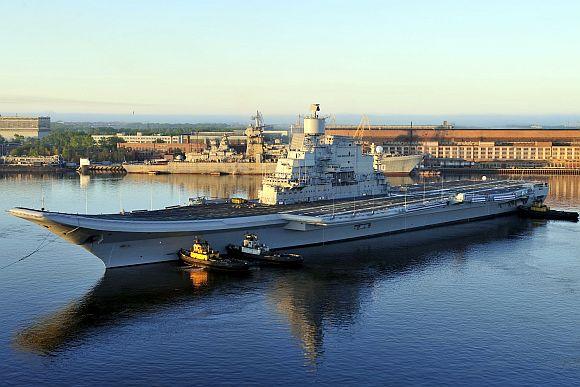
INS Vikramaditya
The launch would mean that the ship would be out of dry dock after completion of work related to fitting all underwater equipment like engines, gear box, shafting and diesel alternators. The construction of the complex warship was undertaken in two phases. The first phase, with a hiked budget of around Rs.3,000 crore, was originally scheduled to end in 2011 but delays in procuring good quality steel and an accident involving gear boxes unsettled the timeline.
Price negotiations for the second phase are underway and it is estimated to cost around the same. The final ship is not expected to be more than `8,000 crore making it probably the cheapest aircraft carrier in the world. Sources in the shipyard said some of the work from phase-II has already started and it is estimated that in two years the ship would be 90 per cent complete.
The navy for long has hoped to operate two carrier battle groups. An aircraft carrier moves with around six to the ship is only ready from the front to the rear with its full length complete and sealed. The Cochin shipyard was specially prepared for construction of big ships. Goliath cranes were provided at the shipyard to pick up large blocks for modular construction.
Despite the delays, the construction of an indigenous carrier is a major boost to country's ship-building capabilities. At the moment, 46 of 47 new naval warships are being built in domestic shipyards. Stealth frigate INS Trikand, which was commissioned in Russia, was the last ship ordered from abroad. Now only the delivery of INS Vikramaditya is awaited.
http://indiatoday.intoday.in/story/indian-navy-set-to-launch-aircraft-carrier-indigenous-aircraft-carrier/1/287400.html
‘China won’t abandon Panatag Shoal’

MANILA, Philippines - Despite the reported departure of Chinese vessels from Panatag (Scarborough) Shoal off Zambales, China will still not give up its claim over the area, a defense expert said yesterday.
“China will not abandon Panatag Shoal after exerting efforts to establish control of the area despite international pressure against it,” Rommel Banlaoi, vice president of the Philippine Association of Chinese Studies, told The STAR.
He said that leaving Panatag Shoal will run counter to China’s current strategy of maintaining control and influence in maritime areas that China considers an integral part of its sovereign territories.
The STAR reported on Thursday that Chinese vessels had left the Philippine-owned shoal, located 124 nautical miles from Zambales.
A senior security official said the latest maritime and aerial monitoring has not detected any sign of the Chinese ships within the immediate vicinity of Panatag or within its 75-nautical mile radius. The Chinese intruders reportedly left the area last Tuesday.
Defense Secretary Voltaire Gazmin confirmed last Friday that the Chinese ships had left the shoal due to bad weather.
“I guess this is really what they do during inclement weather,” Gazmin said.
The defense chief, however, declined to comment when asked if the government has measures to bar the Chinese intruders from returning to the shoal.
Banlaoi, however, said the Philippines could only address the issue through negotiation.
“The Philippines cannot prevent China from establishing full control of Panatag Shoal except through amicable agreement and mutual understanding,” he said.
Sources said the Chinese ships that have intruded into Ayungin Shoal, an area located 105.77 nautical miles from Palawan, have also been pulled.
Both Ayungin and Panatag Shoals are well within the Philippines’ exclusive economic zone.
Chinese occupation of Panatag Shoal started on April 10, 2012, when surveillance vessels from Beijing prevented the Philippine Navy from arresting Chinese fishermen who were caught gathering endangered marine species.
The presence of Chinese intruders had displaced local fishermen who could not go near the shoal for fear of being bullied.
The Philippines has also decried the incursion of Chinese vessels in Ayungin Shoal last May, calling it a provocative act and a violation of international law.
China claims virtually the entire West Philippine Sea while the Philippines, Malaysia, Vietnam, Brunei and Taiwan have overlapping claims in the area.
Beijing has been shoring up its maritime presence in the region, raising concerns among other claimant countries.
It has built structures in Mischief Reef or Panganiban Reef – about 70 nautical miles from Palawan and Subi Reef – an islet 12 nautical miles southwest of the Philipine-occupied Pag-asa Island in the disputed Spratlys.
Philstar
Đăng ký:
Bài đăng (Atom)