Thứ Năm, 2 tháng 5, 2013
Inside the Ring: Russia builds up, U.S. down
Washington Times: As the Obama administration prepares to launch a new round of strategic nuclear missile cuts, Russia’s strategic nuclear forces are undergoing a major modernization, according to U.S. officials.
Russia's military announced last month that as part of the nuclear buildup, Moscow later this year will deploy the first of its new intercontinental ballistic missiles called the Yars-M.
Details of the missile are being kept secret, but it has been described as a fifth-generation strategic nuclear system that Russian officials say will be able to penetrate U.S. missile defenses using a new type of fuel that requires a shorter burn time for booster engines.
The solid-fueled, road-mobile ICBM was tested a year ago, and it is said to have an increased payload capacity for a warhead weighing up to 1.5 tons. The range is 6,835 miles. Like earlier mobile missiles known as SS-29s and SS-27s, the new ICBM is expected to have up to 10 multiple, independently targetable warheads.
Retired Russian strategic forces commander Col. Gen. Viktor Yesin has said the Yars-M “is one of the military technological measures that the Russian military-political leadership has devised in response to the development of a global missile-defense system by the Americans.”
Last year, a Russian official explained the new missile’s fuel and anti-missile defense capabilities in an interview with Moskovski Komsomolets. The strategic nuclear weapons specialist said the high-tech fuel “allows for the reduction of the working time of the engines during the boost phase of flight, when it [the missile] is most vulnerable to detection by defensive means.”
“As a result, we achieve the most complex part of the rocket boost so fast that the enemy does not have time to calculate its trajectory and, therefore, cannot destroy it,” the official said. “That is, we can say that our ability to overcome missile defense will be significantly increased.”
Russia also announced last month that it has launched a new research-and-development program for a modernized rail-mobile ICBM. Russia’s Deputy Defense Minister Yuri Borisov told RIA Novosti April 23 that work on this rail-based missile is in the early stages and could be deployed by 2020.
Russia, during the Soviet era, was the first to deploy a rail-mobile nuclear missile system known as the SS-24.
The rail-based missile is being developed by Russia’s Moscow Institute of Thermal, which also is building the new Bulava submarine-launched ballistic missiles, as well as existing land-based Topol ICBMs.
The rail-mobile ICBMs were prohibited under earlier versions of the U.S.-Russia START treaties. However, the 2010 New START treaty did not prohibit rail-mobile basing of missiles, and Moscow is taking advantage of the omission.
In addition to the new strategic missiles, Russia is building a new strategic bomber that is expected to be deployed by 2020.
By comparison, President Obama is expected to announced soon that he will seek a new round of talks with Russia aimed at cutting U.S. nuclear forces even further than the 1,550 deployed warheads under the 2020 New START treaty.
The cuts are expected to be justified under a Pentagon strategic review that was completed months ago but withheld from release. That report is expected to suggest that U.S. warhead levels could be cut to as few as 1,000, causing critics to say the administration is undermining U.S. deterrence and the ability to extend the nuclear umbrella to European and Asian allies.
Rep. Mike Rogers, Alabama Republican and chairman of the House Armed Services subcommittee on strategic forces, said in a recent speech that the administration is short between $1 billion and $1.6 billion that was promised in 2010 for nuclear modernization.
Among nuclear programs in trouble are a new strategic submarine, life extension programs for B-61, W-76 and W-88 nuclear warheads and a long-range standoff nuclear cruise missile. A needed plutonium facility in New Mexico was also canceled, Mr. Rogers said.
The Pentagon also postponed a test launch of a Minuteman III ICBM last month over concerns that it might be misconstrued as an attack on North Korea, which threatened nuclear missile attacks on the United States.
“I find this deeply concerning, given the sorry state of the nuclear modernization commitments made during the last round,” Mr. Rogers said of plans for additional nuclear cuts.
The Pentagon also has signaled a further lack of resolve toward its nuclear modernization program by ordering an environmental impact study of shutting down an entire land-based nuclear-missile wing.
“New START doesn’t require shutting down a missile wing, and I have heard no explanation for this requested study,” Mr. Rogers said.
N. Korea provocation alert
U.S. intelligence agencies are stepping up monitoring North Korean’s military and missile activities now that the annual U.S.-South Korean joint military exercises have ended.
The increased surveillance comes amid new worries that North Korea will conduct some type of military provocation during the visit to the United States next week by South Korean President Park Geun-hye.
Mrs. Park arrives Monday on her first visit as president.
Officials tell Inside the Ring there are continuing signs that North Korea is moving some of its mobile missiles and could possibly conduct a test launch of the new intermediate-range Musudan missile, with an expected range of about 2,500 miles — enough to hit targets at the U.S. island of Guam.
Also, intelligence imagery revealed some type of activity at North Korea’s nuclear testing facility that could be an indication of a fourth underground nuclear blast. “It could just be maintenance” on the site in the northeastern part of the country, one official said.
A key worry is that the North Koreans, who engaged in a new round of saber-rattling last month and then appeared to calm down, are now ready to take some type of action that would upset the Park visit.
The new South Korea president is said to be ready to engage North Korea in talks, if Pyongyang dials back its hostile rhetoric and threats.
U.S. officials said there are subtle signs that China recently pressed North Korea’s government not to conduct a military provocation, like the Musudan test.
Chinese envoy Wu Dawei, considered a hard-line, pro-North Korea official, recently met State Department officials. Sources familiar with the talks said Mr. Wu did not present the same Chinese policy line toward North Korea as he has in the past.
China deploys DF-21D
Army Lt. Gen. Michael T. Flynn revealed last month that China has deployed its new mobile DF-21D anti-ship ballistic missile. He told the Senate Armed Services Committee in prepared remarks that the unique aircraft carrier-killing ballistic missile is now fielded opposite Taiwan among 1,200 ballistic missiles aimed at the U.S. ally.
Describing China’s nuclear forces, Gen. Flynn said the Chinese military is “augmenting the over 1,200 conventional short-range ballistic missiles deployed opposite Taiwan with a limited, but growing number, of conventionally armed, medium-range ballistic missiles, including the DF-21D anti-ship ballistic missile.”
It was the first time a senior official confirmed that the missile is deployed.
China’s Gen. Chen Bingde said in July 2011 that the DF-21D was “still in the research stage.”
The DF-21D is part of what the Pentagon calls the Chinese military’s anti-access and area-denial weapons, along with anti-satellite missiles and lasers, submarines and missile defenses.
The weapons prompted the new military concept called Air Sea Battle that seeks to better coordinate Navy and Air Force systems in Asia to deter and, if needed, defeat China in a future conflict.
Washington Times
China's first training base for carrier-born aircrafts
Chinese naval officials working at a land-based training facility for carrier-capable jets have taken some time to explain how their training works.
Pilots at the testing facility are practicing on China's home-developed J-15 fighter jets.
The jets have been designed specifically to take off and land on the Liaoning, China's first aircraft carrier.
But before the pilots get a chance to practice on the Liaoning, they have to train at the land-based facility, the exact location of which hasn't been officially disclosed.
Every pilot will have to pass a series of tests at the site before they'll be cleared for test training at sea.
The training center is set up to mimick what it will be like to land on the aircraft carrier, including landing using arresting cables.
Landing and taking off from an aircraft carrier is much different for a pilot than it is from a land-based airport.
As such, over 27-hundred flights took off and landed at the land-based test site before any flight testing first began on the Liaoning.
Tian Wei is a squadron leader at the training base. He says they've made up 10 different manuals to help the pilots through the nuances of learning how to operate their jets at sea.
"The follow-up training is very crucial. For example, a manufacturer makes a gun and shows you how to load the bullets and how to shoot. However, it requires a lot of practice if you want to hit the target, and hit it with accuracy. As such, we drafted a program and manual for our pilots to follow."
The training staff at the facility aren't taking any chances before letting the pilots test on the Liaoning.
The testing facility has been made more difficult to land on than it will be on the Liaoning.
There is only one arresting cable across the landing zone.
The aircraft carrier has 4 cables which the pilots can hit to allow them to stop.
Zhou Chunshan is the deputy commander of the training base.
"Land-based training is mostly focused on landing practice. Landing is the most difficult thing for a pilot to do on an aircraft carrier, so accuracy and consistency is the most important thing for our pilots. We record their landings and map how well they are progressing."
Authorities running the land-based training base say they are hoping to make improvements on the field to give their pilots more practice and training with simulated aircraft carrier take-offs as well.
Global Times
Pilots at the testing facility are practicing on China's home-developed J-15 fighter jets.
The jets have been designed specifically to take off and land on the Liaoning, China's first aircraft carrier.
But before the pilots get a chance to practice on the Liaoning, they have to train at the land-based facility, the exact location of which hasn't been officially disclosed.
Every pilot will have to pass a series of tests at the site before they'll be cleared for test training at sea.
The training center is set up to mimick what it will be like to land on the aircraft carrier, including landing using arresting cables.
Landing and taking off from an aircraft carrier is much different for a pilot than it is from a land-based airport.
As such, over 27-hundred flights took off and landed at the land-based test site before any flight testing first began on the Liaoning.
Tian Wei is a squadron leader at the training base. He says they've made up 10 different manuals to help the pilots through the nuances of learning how to operate their jets at sea.
"The follow-up training is very crucial. For example, a manufacturer makes a gun and shows you how to load the bullets and how to shoot. However, it requires a lot of practice if you want to hit the target, and hit it with accuracy. As such, we drafted a program and manual for our pilots to follow."
The training staff at the facility aren't taking any chances before letting the pilots test on the Liaoning.
The testing facility has been made more difficult to land on than it will be on the Liaoning.
There is only one arresting cable across the landing zone.
The aircraft carrier has 4 cables which the pilots can hit to allow them to stop.
Zhou Chunshan is the deputy commander of the training base.
"Land-based training is mostly focused on landing practice. Landing is the most difficult thing for a pilot to do on an aircraft carrier, so accuracy and consistency is the most important thing for our pilots. We record their landings and map how well they are progressing."
Authorities running the land-based training base say they are hoping to make improvements on the field to give their pilots more practice and training with simulated aircraft carrier take-offs as well.
Global Times
Video: Su-30MK2 patrol the Spratlys
TPO - For the Anniversary of Liberation of Saigon (30 April 1975- 2013), the multirole fighters Su-30MK2 of Vietnam People's Air Force flew over the Spratly Islands in the East Vietnam Sea (the south China sea) to patrol the waters around the islands.
Tien Phong
Tien Phong
Thứ Tư, 1 tháng 5, 2013
Astrium is set to deliver Vietnam’s first Earth observation satellite
Astrium, the European leader in space technologies, is the prime contractor for the VNREDSat-1, the first Vietnamese Earth observation satellite, scheduled for launch on a Vega rocket from the Guiana Space Centre in Kourou on 03 May.
Astrium received the order for the VNREDSat-1 programme from the Vietnam Academy of Science and Technology (VAST) in July 2010, under an agreement signed in 2009 between the French and Vietnamese Governments. Under this contract, Astrium is responsible for the development, construction and launch of the VNREDSat-1 optical satellite, capable of taking images of the Earth with a resolution of 2.5 metres. In Vietnam, Astrium was also prime contractor for the design and construction of the satellite ground control segment and the satellite image receiving and processing stations. The company was also responsible for training the 15 Vietnamese engineers who will operate the satellite.
“VNREDSat-1 is another of Astrium Satellites’ export successes,” said Eric Béranger, CEO of Astrium Satellites. “This new satellite is further proof that our teams are among the best in the world; aside from their technological expertise and exemplary cost management, they also provide excellent customer support spanning from system design to in-situ operator training. We intend to continue in this vein, further boosting our competitiveness and consolidating our position as the world’s leading exporter of Earth observation satellites.”
Astrium
The Vietnamese satellite VNREDSat-1, built by Astrium, is scheduled for launch from Kourou on 03 May. Astrium also built the satellite ground control segment and the image receiving and processing stations in Vietnam.(photos : hanoimoi) (Photo: http://www.astrium.eads.net/en/programme/vnredsat-1.html) |
Astrium received the order for the VNREDSat-1 programme from the Vietnam Academy of Science and Technology (VAST) in July 2010, under an agreement signed in 2009 between the French and Vietnamese Governments. Under this contract, Astrium is responsible for the development, construction and launch of the VNREDSat-1 optical satellite, capable of taking images of the Earth with a resolution of 2.5 metres. In Vietnam, Astrium was also prime contractor for the design and construction of the satellite ground control segment and the satellite image receiving and processing stations. The company was also responsible for training the 15 Vietnamese engineers who will operate the satellite.
“VNREDSat-1 is another of Astrium Satellites’ export successes,” said Eric Béranger, CEO of Astrium Satellites. “This new satellite is further proof that our teams are among the best in the world; aside from their technological expertise and exemplary cost management, they also provide excellent customer support spanning from system design to in-situ operator training. We intend to continue in this vein, further boosting our competitiveness and consolidating our position as the world’s leading exporter of Earth observation satellites.”
Astrium
Singapore's most advanced submarines declared battle-ready
The last of Singapore's most advanced submarines was declared battle-ready on Tuesday, sharpening the capabilities of the Republic of Singapore Navy (RSN) in underwater warfare.

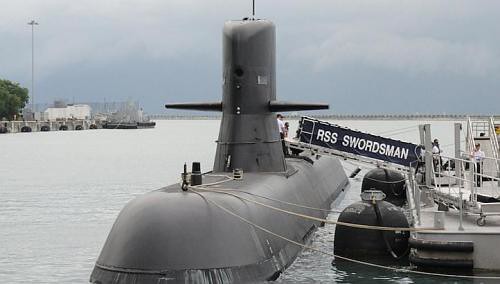
The last of Singapore's most advanced submarines was declared battle-ready on Tuesday, April 30, 2013, sharpening the capabilities of the Republic of Singapore Navy (RSN) in underwater warfare. -- FILE PHOTO: MINDEF
The RSS Swordsman was commissioned, following more than two years of tests and torpedo-firing exercises in Sweden and in the warmer and more corrosive waters here. The 60.5m diesel-electric vessel arrived in Singapore in last December. This is the second Archer-class vessel to be added to the RSN's 171 Squadron, after the first, RSS Archer, was declared operational in 2011. The submarine squadron also comprises four ageing Challenger-class submarines.
Deputy Prime Minister and Minister for Finance Tharman Shanmugaratnam, who officiated the ceremony, presented the commissioning warrant to the Commanding Officer of RSS Swordsman, Lieutenant Colonel (LTC) Loh Mun Heng.
With RSS Swordsman joining her sister ship RSS Archer - commissioned in December 2011 - in active service, Mr Tharman pointed out that the RSN had crossed a new milestone in its submarine development and was now capable of conducting more complex maritime operations.
"RSS Swordsman, her sister boat RSS Archer and our Challenger-class submarines form part of an integrated warfighting system - together with our stealth frigates, naval helicopters, missile corvettes and mine-countermeasure vessels - a force that safeguards Singapore's maritime interests and protects our territorial integrity."
Acquired from the Royal Swedish Navy in 2005 and launched in Sweden in 2010, RSS Swordsman went through extensive sea trials in Sweden before she returned to Singapore on 31 Dec 2012.
The submarine, which will operate under the RSN's 171 Squadron with RSS Archer, has been refurbished for operations in local conditions. The ship also boasts upgraded combat and sensor suites and the addition of an Air Independent Propulsion system for greater stealth, extended reach and expanded operational capabilities.
LTC Loh elaborated on how his crew prepared the submarine to be combat-ready in just four months: "Upon our return to Singapore, we validated our submarine to operate safely in our local conditions, ran (through) all our systems and participated in exercises with the frigate and naval helicopter, integrating as part of the fleet." The exercises included combined anti-submarine warfare, submarine rescue and torpedo exercises.
According to LTC Loh, the RSS Swordsman crew also benefited from the experiences of the crew of the RSS Archer. He explained: "Besides the crew from (RSS) Archer passing down lessons learnt to us, half of my crew are also from the Challenger-class submarines, and when we brought over our experiences, we were able to quicken our learning process."
For the crew, the commissioning of their submarine signalled the beginning of their journey as operators of a warship. As LTC Loh put it: "Operationalisation doesn't have an end-state...we will continue to hone our skills."
Minister for Defence Dr Ng Eng Hen, Minister for Transport Lui Tuck Yew, Senior Parliamentary Secretary for Defence Dr Mohamed Maliki Bin Osman, Chief of Defence Force Major-General Ng Chee Meng and Chief of Navy Rear-Admiral (RADM) Ng Chee Peng were also present at the ceremony, with other senior officers from the Singapore Armed Forces.
The Strait Times / mindef.gov.sg.
The last of Singapore's most advanced submarines was declared battle-ready on Tuesday, April 30, 2013, sharpening the capabilities of the Republic of Singapore Navy (RSN) in underwater warfare. -- FILE PHOTO: MINDEF
The RSS Swordsman was commissioned, following more than two years of tests and torpedo-firing exercises in Sweden and in the warmer and more corrosive waters here. The 60.5m diesel-electric vessel arrived in Singapore in last December. This is the second Archer-class vessel to be added to the RSN's 171 Squadron, after the first, RSS Archer, was declared operational in 2011. The submarine squadron also comprises four ageing Challenger-class submarines.
Deputy Prime Minister and Minister for Finance Tharman Shanmugaratnam, who officiated the ceremony, presented the commissioning warrant to the Commanding Officer of RSS Swordsman, Lieutenant Colonel (LTC) Loh Mun Heng.
With RSS Swordsman joining her sister ship RSS Archer - commissioned in December 2011 - in active service, Mr Tharman pointed out that the RSN had crossed a new milestone in its submarine development and was now capable of conducting more complex maritime operations.
"RSS Swordsman, her sister boat RSS Archer and our Challenger-class submarines form part of an integrated warfighting system - together with our stealth frigates, naval helicopters, missile corvettes and mine-countermeasure vessels - a force that safeguards Singapore's maritime interests and protects our territorial integrity."
Acquired from the Royal Swedish Navy in 2005 and launched in Sweden in 2010, RSS Swordsman went through extensive sea trials in Sweden before she returned to Singapore on 31 Dec 2012.
The submarine, which will operate under the RSN's 171 Squadron with RSS Archer, has been refurbished for operations in local conditions. The ship also boasts upgraded combat and sensor suites and the addition of an Air Independent Propulsion system for greater stealth, extended reach and expanded operational capabilities.
LTC Loh elaborated on how his crew prepared the submarine to be combat-ready in just four months: "Upon our return to Singapore, we validated our submarine to operate safely in our local conditions, ran (through) all our systems and participated in exercises with the frigate and naval helicopter, integrating as part of the fleet." The exercises included combined anti-submarine warfare, submarine rescue and torpedo exercises.
According to LTC Loh, the RSS Swordsman crew also benefited from the experiences of the crew of the RSS Archer. He explained: "Besides the crew from (RSS) Archer passing down lessons learnt to us, half of my crew are also from the Challenger-class submarines, and when we brought over our experiences, we were able to quicken our learning process."
For the crew, the commissioning of their submarine signalled the beginning of their journey as operators of a warship. As LTC Loh put it: "Operationalisation doesn't have an end-state...we will continue to hone our skills."
Minister for Defence Dr Ng Eng Hen, Minister for Transport Lui Tuck Yew, Senior Parliamentary Secretary for Defence Dr Mohamed Maliki Bin Osman, Chief of Defence Force Major-General Ng Chee Meng and Chief of Navy Rear-Admiral (RADM) Ng Chee Peng were also present at the ceremony, with other senior officers from the Singapore Armed Forces.
The Strait Times / mindef.gov.sg.
China Sells Helicopter Gunships to UWSA
China has allegedly sold helicopter gunships to ethnic Wa rebels who occupy areas of Shan State in eastern Burma, intelligence monitor Jane’s Information Group reported on Monday.

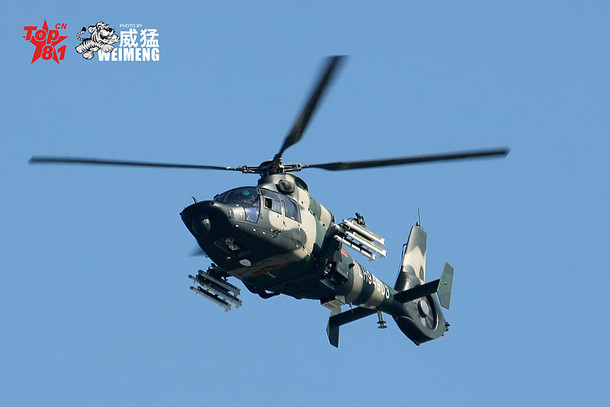
A Z-9G helicopter mounting the TY-90 lightweight air-to-air missile. (Photo: http://china-defense.blogspot.com)
The report claimed China “delivered several Mil Mi-17 ‘Hip’ medium- transport helicopters armed with TY-90 air-to-air missiles to the Wa in late February and early March, according to both Myanmar ethnic minority and Myanmar government sources.”
Bertil Lintner, an expert on Burma and author of Great Game East: India, China and the Struggle for Asia’s Most Volatile Frontier, confirmed the accuracy of the Jane’s report.
Lintner said the Burmese government was moving to gain control of the Shan State Army-North’s mountainous bases on the western bank of the Salween River, for an eventual offensive against the Wa rebels.
“Since the Burmese government signed a ceasefire with the Shan, they haven’t withdrawn any troops, but rather they have reinforced their troops,” said Aung Kyaw Zaw, an analyst based on the China-Burma border. “That is not a good sign. So, the Wa wants to prepare [for a possible war].”
The purchase of the gunships is part of Wa moves to make the Wa region more like an independent state, able to project force if necessary.
The United Wa State Army is the largest ethnic armed group in Burma, with an estimated 20,000 well-equipped fighters, and advanced weaponry including surface-to-air missiles.
The Burmese government has carried out an offensive against the SSA-North and Kachin rebels in northern Shan State since mid-April, calling up troops from as far away as Karenni State to back up their forces in Shan State, according to Aung Kyaw Zaw.
Quoting a Wa rebel source, the Jane’s report said “the Mi-17s reached the Wa-administered area by flying across the Mekong River from Lao rather than direct from China.”
Jane’s said five helicopters had been bought, but the Burmese government, which confirmed the deal, said only two aircraft had so far been delivered.
The UWSA headquarters is in Panghsang, northeastern Shan State on the China border, but it has a secondary stronghold in southern Shan State on the border with Thailand.
Burma and the United States have long said the UWSA funds its activities through heroin and methamphetamine production, earning large sums of money through illegal activities.
If the government launches an attack on the Wa, it would be a big war, according to analysts. There have been unconfirmed reports in recent weeks that the Wa have been digging in for a protracted ground war, hollowing out tunnels and constructing fortified positions, according to the sources.
The Burmese government recently bought a number of Mi-24P ‘Hind’ gunships from Russia. The reported sale of the Mi-17s to the Wa, armed with TY-90 short-range air-to-air missiles, would provide a strong deterrent to Naypyidaw moving against the Wa.
Irrawaddy
A Z-9G helicopter mounting the TY-90 lightweight air-to-air missile. (Photo: http://china-defense.blogspot.com)
The report claimed China “delivered several Mil Mi-17 ‘Hip’ medium- transport helicopters armed with TY-90 air-to-air missiles to the Wa in late February and early March, according to both Myanmar ethnic minority and Myanmar government sources.”
Bertil Lintner, an expert on Burma and author of Great Game East: India, China and the Struggle for Asia’s Most Volatile Frontier, confirmed the accuracy of the Jane’s report.
Lintner said the Burmese government was moving to gain control of the Shan State Army-North’s mountainous bases on the western bank of the Salween River, for an eventual offensive against the Wa rebels.
“Since the Burmese government signed a ceasefire with the Shan, they haven’t withdrawn any troops, but rather they have reinforced their troops,” said Aung Kyaw Zaw, an analyst based on the China-Burma border. “That is not a good sign. So, the Wa wants to prepare [for a possible war].”
The purchase of the gunships is part of Wa moves to make the Wa region more like an independent state, able to project force if necessary.
The United Wa State Army is the largest ethnic armed group in Burma, with an estimated 20,000 well-equipped fighters, and advanced weaponry including surface-to-air missiles.
The Burmese government has carried out an offensive against the SSA-North and Kachin rebels in northern Shan State since mid-April, calling up troops from as far away as Karenni State to back up their forces in Shan State, according to Aung Kyaw Zaw.
Quoting a Wa rebel source, the Jane’s report said “the Mi-17s reached the Wa-administered area by flying across the Mekong River from Lao rather than direct from China.”
Jane’s said five helicopters had been bought, but the Burmese government, which confirmed the deal, said only two aircraft had so far been delivered.
The UWSA headquarters is in Panghsang, northeastern Shan State on the China border, but it has a secondary stronghold in southern Shan State on the border with Thailand.
Burma and the United States have long said the UWSA funds its activities through heroin and methamphetamine production, earning large sums of money through illegal activities.
If the government launches an attack on the Wa, it would be a big war, according to analysts. There have been unconfirmed reports in recent weeks that the Wa have been digging in for a protracted ground war, hollowing out tunnels and constructing fortified positions, according to the sources.
The Burmese government recently bought a number of Mi-24P ‘Hind’ gunships from Russia. The reported sale of the Mi-17s to the Wa, armed with TY-90 short-range air-to-air missiles, would provide a strong deterrent to Naypyidaw moving against the Wa.
Irrawaddy
China building Type 052D guided missile destroyers
Taipei, April 30 (CNA) Shanghai Shipbuilding Co. will soon complete construction of three Type 052D destroyers, with sea trials expected to be carried out within months, according to Chinese military news websites.
The launch of the three new guided missile destroyers is seen as a warning amid rising tension between China and its neighbors over disputed islands in the East China Sea and South China Sea, China's dwnews.com reported.
The 052D destroyer uses a flat-array radar similar to the Aegis system, a new vertical launching system (VLS), is powered by combustion turbine engines and has angled surfaces for stealth anti-radar features.
The report said the vessel is a new multifunction guided missile destroyer developed based on its predecessor, the Type 052C. The 052D has been dubbed the "Chinese Aegis," as it is believed to have similar capabilities to the U.S. Navy's Arleigh Burke-class destroyer.
In the West, the Aegis system is a distinct, brand-name phased-array system that allows multiple Aegis-capable warships to share tracking and targeting data.
The 052D is reportedly equipped with 64 new VLS for surface-to- air missiles, cruise missiles, anti-ship missiles and anti-submarine missiles, as well as a new 130mm main gun and a new Active Electronically Scanned Array (AESA) radar system.
Its layout is similar to that of the 052C, but the superstructure slopes inward at a greater angle, providing superior stealth capability.
Judged by its major features, Song Zhongping, a Chinese military analyst, suggested that the new vessels will serve as the backbone of the the People's Liberation Army (PLA)'s naval combat fleet.
(By Zep Hu and Y.L. Kao)
ENDITEM/J
The launch of the three new guided missile destroyers is seen as a warning amid rising tension between China and its neighbors over disputed islands in the East China Sea and South China Sea, China's dwnews.com reported.
The 052D destroyer uses a flat-array radar similar to the Aegis system, a new vertical launching system (VLS), is powered by combustion turbine engines and has angled surfaces for stealth anti-radar features.
The report said the vessel is a new multifunction guided missile destroyer developed based on its predecessor, the Type 052C. The 052D has been dubbed the "Chinese Aegis," as it is believed to have similar capabilities to the U.S. Navy's Arleigh Burke-class destroyer.
In the West, the Aegis system is a distinct, brand-name phased-array system that allows multiple Aegis-capable warships to share tracking and targeting data.
The 052D is reportedly equipped with 64 new VLS for surface-to- air missiles, cruise missiles, anti-ship missiles and anti-submarine missiles, as well as a new 130mm main gun and a new Active Electronically Scanned Array (AESA) radar system.
Its layout is similar to that of the 052C, but the superstructure slopes inward at a greater angle, providing superior stealth capability.
Judged by its major features, Song Zhongping, a Chinese military analyst, suggested that the new vessels will serve as the backbone of the the People's Liberation Army (PLA)'s naval combat fleet.
(By Zep Hu and Y.L. Kao)
ENDITEM/J
Đăng ký:
Bài đăng (Atom)