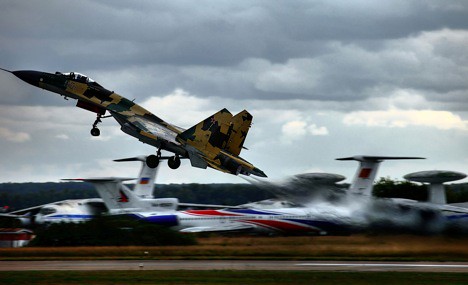
(China Daily Mail)- According to a report by Voice of Russia, China and Russia have concluded an export agreement for 100 Su-35 fighter jets during the Paris Air Show.
At the 50th Paris Air Show at Le Bourget Airport, Russia had it’s most intensive participation over the past few years. All the 46 well-known Russian weapon manufacturers and companies, including Sokhoi, Mikoyan and Ilyushin, had presence there. In the exhibition hall, open-air site and flying shows, the audience has witnessed the Russian aviation industry’s newest achievements.
At that exhibition, there was the first flying show of the Su-35 abroad. The Su-35 is the most intrepid fourth-generation fighter jet in the world today. It is equipped with a 30mm machine gun, a radar with a search range of 400 km, and a flight range of 3,500 km without refuelling.
It’s powerful engine enables it to perform various super difficult movements such as horizontal rolling, plane screw spin, Pugachev Cobra and other stunt manoeuvres. It has its unique super “pancake” manoeuvre – a horizontal 360 degree turnaround without reduction of speed. Western media exclaimed in admiration, “It’s not an airplane, it’s a UFO.”
Mikhail Pogosyan, general manager of United Aircraft Corporation, was tremendously satisfied with the Su-35’s performance this time. He said: “The Su-35 is better than all other types of fourth-generation aircraft. Its performance not only embodies excellent pneumatic technology, but also the ability of the unique equipment it carries and its attack capability.
“It is not yet our newest achievement because we are at the same time developing a fifth-generation fighter jet. The two types of aircraft may supplement each other in the future to enhance the combat efficiency of the air forces of Russia and the countries that use Russian-made weapons.”
Source: huanqiu.com “Russia: China and Russia Have Concluded Export Agreement for 100 Su-35s” (translated from Chinese by Chan Kai Yee)
China Daily Mail
Hiển thị các bài đăng có nhãn China-Russia. Hiển thị tất cả bài đăng
Thứ Tư, 26 tháng 6, 2013
Thứ Bảy, 30 tháng 3, 2013
The future of Russia-China military cooperation
Defence deals between Moscow and Beijing continue to be plagued by Russian worries of intellectual property violations.

The potential contract for Su-35s may become the first export contract for this aircraft, which is already being supplied to the Russian Air Force. Source: Sukhoi.org
China will once again start buying arms from Russia, according to Chinese media reports, which claim that a framework agreement has been signed for 24 Su-35 fighter jets and four Lada-class conventional submarines.
A RIR source familiar with Russia's military-technical cooperation with foreign countries was unable to confirm these reports. “During Chinese leader Xi Jinping's visit to Moscow, the issue of military-technical cooperation with Russia was not raised at all,” the source said.
In the meantime, the very fact that these reports appeared in the Chinese media prompts one to ponder over the current and potential Russian-Chinese arms contracts and wonder why many of the previous contracts have ended in scandal and how to avoid new controversy.
Judging by the wording in Chinese media reports (“framework agreement”), it is not a firm contract but rather an expanded version of a memorandum of intent. Nevertheless, the reported figures, 24 Su-35 fighter jets and four Lada-class submarines, are already being actively discussed in the media.
Launch Customer
The potential contract for Su-35s may become the first export contract for this aircraft, which is already being supplied to the Russian Air Force. The notion of ‘a launch customer’ is very important in arms sales since it is often that the success of this deal sets customers' attitude to the product for years to come.
Potentially, the Su-35 may be supplied to a variety of regions. These include solvent countries that used to buy Su-30MK2 aircraft, like China, Vietnam and Indonesia. In addition, Russia has for a long time been seeking an opportunity to get through to less obvious customers too, for instance Brazil. The launch of the Chinese deal will make it much easier to further promote the Su-35 on the foreign markets.
With help from the Far Eastern friend
However, the story with the submarines is more intriguing. To begin with, there is speculation that the deal will involve not Lada submarines (Project 677 conventional submarine) but their export modification known as Amur-class submarines.
In effect, it is not yet a finished product but a set of requirements for its technical characteristics. And this set of requirements has been waiting for a large and moneyed customer that could finalise the terms of reference and pay for moving the concept to a working design and then into production.
That is why the potential Chinese order can be considered important: it will help develop and test new technological solutions for the Russian Navy, with the help of Chinese capital.
Russian weapons return to China
What does it all mean? Ten years ago the Russian defence industry's passionate love affair with China saw if not an abrupt end then a considerable cooling-off, particularly in the area that today is once again coming to the fore, in military aircraft manufacturing.
In 2003 China, taking advantage of the provisions of the existing contracts for the licensed assembly of 200 Su-27SK fighter aircraft (under the name of J-11), severed the existing agreements, thus robbing Russia of half of its expected revenues.
The row was caused by a scandal surrounding the J-11B version of the aircraft. The Russian side maintained that China had begun introducing changes to the model and producing an aircraft of its own, based on Russian intellectual property and without paying anything in compensation. And now Russia is ready to return to the Chinese combat aircraft market. It is therefore fair to wonder: what will be done differently this time round in order to avoid similar problems?
The first thing that one should pay attention to is the number of aircrafts sold. If the supplier is seriously concerned that China will buy the minimum required number of aircraft and then will just end the agreement, then the talks should be about firm supplies of a maximum possible number of fighter jets.
The toughness of China's position in the talks on the number of Su-35s, which have been going on for a long time, is impressive. At first, there were rumours that the number would be as sought by the Russian side, 70-75 aircraft; whereas China wanted not more than 10-12. At the time, some experts said off the record that “there was no point in selling fewer than a hundred.”
A year ago, the figure under discussion was already 48, with the understanding that it was the lowest possible limit. Now it too has been halved. From the formal point of view, victory in this tug-of-war has gone to China.
New format or old mistakes?
It is not yet clear to what degree Russia will be able to protect its know-how in the deals that have been announced. In principle, the issue here is not such much about guarantees of “integrity” (it is clear that the sold aircraft will be studied in detail and, if possible and necessary, reproduced) as about a set compensation for such disrespectful behaviour. That is to say that the amount of the contract should include an assessment of risks associated with unsanctioned copying.
However, of far more interest is another aspect of the deal – what is in effect a joint Russian-Chinese project for developing a conventional submarine. Here Russia is starting to use a method that it has already successfully tested in cooperation with, for instance, India. Compared with purchasing ready models or agreeing licensed assembly, this is a new step in developing military-technical cooperation. The question is whether the possible benefits of the joint development of technologies for conventional submarines will make up for the risks associated with the supply of Russia's newest fighter jets to China. It is not a coincidence that both these deals were announced as a single package. This is probably how they should be viewed: as an integrated compromise.
A lot in the Russian defence industry's future foreign strategies will depend on whether this will develop into a new format of military-technical cooperation or a repetition of old mistakes.
Indrus.in
The potential contract for Su-35s may become the first export contract for this aircraft, which is already being supplied to the Russian Air Force. Source: Sukhoi.org
China will once again start buying arms from Russia, according to Chinese media reports, which claim that a framework agreement has been signed for 24 Su-35 fighter jets and four Lada-class conventional submarines.
A RIR source familiar with Russia's military-technical cooperation with foreign countries was unable to confirm these reports. “During Chinese leader Xi Jinping's visit to Moscow, the issue of military-technical cooperation with Russia was not raised at all,” the source said.
In the meantime, the very fact that these reports appeared in the Chinese media prompts one to ponder over the current and potential Russian-Chinese arms contracts and wonder why many of the previous contracts have ended in scandal and how to avoid new controversy.
Judging by the wording in Chinese media reports (“framework agreement”), it is not a firm contract but rather an expanded version of a memorandum of intent. Nevertheless, the reported figures, 24 Su-35 fighter jets and four Lada-class submarines, are already being actively discussed in the media.
Launch Customer
The potential contract for Su-35s may become the first export contract for this aircraft, which is already being supplied to the Russian Air Force. The notion of ‘a launch customer’ is very important in arms sales since it is often that the success of this deal sets customers' attitude to the product for years to come.
Potentially, the Su-35 may be supplied to a variety of regions. These include solvent countries that used to buy Su-30MK2 aircraft, like China, Vietnam and Indonesia. In addition, Russia has for a long time been seeking an opportunity to get through to less obvious customers too, for instance Brazil. The launch of the Chinese deal will make it much easier to further promote the Su-35 on the foreign markets.
With help from the Far Eastern friend
However, the story with the submarines is more intriguing. To begin with, there is speculation that the deal will involve not Lada submarines (Project 677 conventional submarine) but their export modification known as Amur-class submarines.
In effect, it is not yet a finished product but a set of requirements for its technical characteristics. And this set of requirements has been waiting for a large and moneyed customer that could finalise the terms of reference and pay for moving the concept to a working design and then into production.
That is why the potential Chinese order can be considered important: it will help develop and test new technological solutions for the Russian Navy, with the help of Chinese capital.
Russian weapons return to China
What does it all mean? Ten years ago the Russian defence industry's passionate love affair with China saw if not an abrupt end then a considerable cooling-off, particularly in the area that today is once again coming to the fore, in military aircraft manufacturing.
In 2003 China, taking advantage of the provisions of the existing contracts for the licensed assembly of 200 Su-27SK fighter aircraft (under the name of J-11), severed the existing agreements, thus robbing Russia of half of its expected revenues.
The row was caused by a scandal surrounding the J-11B version of the aircraft. The Russian side maintained that China had begun introducing changes to the model and producing an aircraft of its own, based on Russian intellectual property and without paying anything in compensation. And now Russia is ready to return to the Chinese combat aircraft market. It is therefore fair to wonder: what will be done differently this time round in order to avoid similar problems?
The first thing that one should pay attention to is the number of aircrafts sold. If the supplier is seriously concerned that China will buy the minimum required number of aircraft and then will just end the agreement, then the talks should be about firm supplies of a maximum possible number of fighter jets.
The toughness of China's position in the talks on the number of Su-35s, which have been going on for a long time, is impressive. At first, there were rumours that the number would be as sought by the Russian side, 70-75 aircraft; whereas China wanted not more than 10-12. At the time, some experts said off the record that “there was no point in selling fewer than a hundred.”
A year ago, the figure under discussion was already 48, with the understanding that it was the lowest possible limit. Now it too has been halved. From the formal point of view, victory in this tug-of-war has gone to China.
New format or old mistakes?
It is not yet clear to what degree Russia will be able to protect its know-how in the deals that have been announced. In principle, the issue here is not such much about guarantees of “integrity” (it is clear that the sold aircraft will be studied in detail and, if possible and necessary, reproduced) as about a set compensation for such disrespectful behaviour. That is to say that the amount of the contract should include an assessment of risks associated with unsanctioned copying.
However, of far more interest is another aspect of the deal – what is in effect a joint Russian-Chinese project for developing a conventional submarine. Here Russia is starting to use a method that it has already successfully tested in cooperation with, for instance, India. Compared with purchasing ready models or agreeing licensed assembly, this is a new step in developing military-technical cooperation. The question is whether the possible benefits of the joint development of technologies for conventional submarines will make up for the risks associated with the supply of Russia's newest fighter jets to China. It is not a coincidence that both these deals were announced as a single package. This is probably how they should be viewed: as an integrated compromise.
A lot in the Russian defence industry's future foreign strategies will depend on whether this will develop into a new format of military-technical cooperation or a repetition of old mistakes.
Indrus.in
Thứ Hai, 25 tháng 3, 2013
Russia: No Deal on Sale of Fighters, Subs to China
TAIPEI — Russia is denying Chinese media claims that Moscow and Beijing have signed agreements to sell Russian-made arms and military technology to China, including 24 Su-35 multirole fighter jets and four Amur-class diesel submarines.
During a recent visit by Chinese President Xi Jinping to Moscow from Friday to Sunday, no discussions took place regarding “military-technical cooperation” issues, the ITAR-TASS news agency reported Monday. This was in response to an earlier report by China’s CCTV on the same day.
“The Kremlin is officially denying even discussing arms trade during Xi’s visit,” said Vasiliy Kashin, a China military specialist at the Moscow-based Centre for Analysis of Strategies and Technologies (CAST). “In Russia-China relations, specific arms trade contracts are almost never discussed by the top leaders, just the general approaches.”
Another defense industry source in Russia said there are strong reservations about going forward on the memorandum of understanding signed in December to explore the sale of the twin-engine Su-35s and Amur submarines to China.
China intentionally violated intellectual property right (IPR) agreements when it copied and manufactured Russia’s Su-27 fighter as the J-11B, according to Russia.
In 1995, China secured a production deal with Russia to build 200 Su-27SKs, dubbed the J-11A, for $2.5 billion for the Shenyang Aircraft Corp. In 2006, Russia canceled the deal after 95 aircraft when it discovered China had reverse-engineered the fighter and was secretly manufacturing an indigenous copy, the J-11B, with Chinese-made avionics and engines.
There are strong suspicions China will procure the technological know-how of the Su-35 and Amur and simply produce an indigenous version.
But not all agree. Gary Li, a senior analyst at London-based IHS Fairplay, said China’s research and development have moved forward.
“It no longer will seek to directly reverse engineer everything it buys, but maybe adopt parts of the platform for other projects [and] integrate into domestic designs,” he said.
There also are concerns China wants access to the Su-35’s Saturn AL-117S engine, which is outfitted on the T-50, a prototype of Russia’s fifth-generation Sukhoi PAK FA stealth fighter.
However, Kashin said the risks of selling the Russian engine to China are negligible.
“An engine cannot be copied by obtaining a sample,” he said.
Li said he could envision Chinese aerospace engineers studying the aircraft’s engine and thrust-vectoring for future inclusion, as well as the Amur sub’s air-independent propulsion, but it will still be more than a decade before China will stop having to order engines to replace “worn-out ones,” as it has been doing with the J-11 and J-10 fighters.
“It always takes a few years before they can make a domestic alternative,” Li said.
Kashin cautions that a Chinese attempt to copy the Su-35, as they did with the Su-27, would be more difficult, “because this time, our Ukrainian ‘brothers’ cannot help them by selling the Chinese all the technology they lacked for a handful of dollars. I think the Amur situation will be generally the same.”
Ukraine has been accused of selling China former Soviet defense technologies, but it has no access to information regarding newer systems, such as the Su-35 and Amur.
“The Amur ultimately isn’t a strategic submarine, and as Russia’s interests in the Far East are not yet that ambitious, they can afford to sell them to China,” Li said. “How better to keep the U.S. pivot off their backs?”
Defense News
During a recent visit by Chinese President Xi Jinping to Moscow from Friday to Sunday, no discussions took place regarding “military-technical cooperation” issues, the ITAR-TASS news agency reported Monday. This was in response to an earlier report by China’s CCTV on the same day.
“The Kremlin is officially denying even discussing arms trade during Xi’s visit,” said Vasiliy Kashin, a China military specialist at the Moscow-based Centre for Analysis of Strategies and Technologies (CAST). “In Russia-China relations, specific arms trade contracts are almost never discussed by the top leaders, just the general approaches.”
Another defense industry source in Russia said there are strong reservations about going forward on the memorandum of understanding signed in December to explore the sale of the twin-engine Su-35s and Amur submarines to China.
China intentionally violated intellectual property right (IPR) agreements when it copied and manufactured Russia’s Su-27 fighter as the J-11B, according to Russia.
In 1995, China secured a production deal with Russia to build 200 Su-27SKs, dubbed the J-11A, for $2.5 billion for the Shenyang Aircraft Corp. In 2006, Russia canceled the deal after 95 aircraft when it discovered China had reverse-engineered the fighter and was secretly manufacturing an indigenous copy, the J-11B, with Chinese-made avionics and engines.
There are strong suspicions China will procure the technological know-how of the Su-35 and Amur and simply produce an indigenous version.
But not all agree. Gary Li, a senior analyst at London-based IHS Fairplay, said China’s research and development have moved forward.
“It no longer will seek to directly reverse engineer everything it buys, but maybe adopt parts of the platform for other projects [and] integrate into domestic designs,” he said.
There also are concerns China wants access to the Su-35’s Saturn AL-117S engine, which is outfitted on the T-50, a prototype of Russia’s fifth-generation Sukhoi PAK FA stealth fighter.
However, Kashin said the risks of selling the Russian engine to China are negligible.
“An engine cannot be copied by obtaining a sample,” he said.
Li said he could envision Chinese aerospace engineers studying the aircraft’s engine and thrust-vectoring for future inclusion, as well as the Amur sub’s air-independent propulsion, but it will still be more than a decade before China will stop having to order engines to replace “worn-out ones,” as it has been doing with the J-11 and J-10 fighters.
“It always takes a few years before they can make a domestic alternative,” Li said.
Kashin cautions that a Chinese attempt to copy the Su-35, as they did with the Su-27, would be more difficult, “because this time, our Ukrainian ‘brothers’ cannot help them by selling the Chinese all the technology they lacked for a handful of dollars. I think the Amur situation will be generally the same.”
Ukraine has been accused of selling China former Soviet defense technologies, but it has no access to information regarding newer systems, such as the Su-35 and Amur.
“The Amur ultimately isn’t a strategic submarine, and as Russia’s interests in the Far East are not yet that ambitious, they can afford to sell them to China,” Li said. “How better to keep the U.S. pivot off their backs?”
Defense News
China to buy 4 submarines, 24 fighter jets from Russia
BEIJING: China has agreed to buy two dozen fighter jets and four submarines from Russia, state media reported on Monday, the country's first large-scale weapons technology purchases from Moscow in a decade.
Update: Russia has denied that No Deal on Sale of Fighters, Subs to China
The agreement to buy the 24 Su-35 fighters and four Lada-class submarines was signed just before President Xi Jinping's weekend visit to Russia, said the People's Daily, the Communist Party organ, citing state television.
The report, which did not give a value for the purchases, said it was the first time in 10 years China had bought "large military technological equipment" from Russia.
The deal comes as Beijing expands its military reach - it commissioned its first aircraft carrier last year - and is embroiled in a bitter territorial row with Japan over disputed islands in the East China Sea.
Two of the submarines will be built in Russia, with the other two to be built in China.
"The Su-35 fighters can effectively reduce pressure on China's air defence before Chinese-made stealth fighters come online," the report said.
China and Russia are expected to co-operate further in developing military technology, the report said, including that for S-400 long-range anti-aircraft missiles, 117S large thrust engines, IL-476 large transport aircraft and IL-78 aerial tankers.
China's defence ministry had no immediate comment on the report.
Xi visited Moscow from Friday to Sunday for talks with his Russian counterpart Vladimir Putin, his first trip abroad since becoming head of state earlier this month.
The countries signed around 30 energy and other agreements during the visit.
Xi also met Defence Minister Sergei Shoigu and became the first foreign leader to visit the Russian armed forces' control centre.
Moscow and Beijing, which were once bitter foes during the Cold War, have strengthened cooperation in recent years to counterbalance what they see as US global dominance.
Earlier this month China announced a further double-digit rise in its defence budget, raising it by 10.7 per cent to 720.2 billion yuan ($116.3 billion) in 2013.
Agence France-Presse (AFP)
Update: Russia has denied that No Deal on Sale of Fighters, Subs to China
The agreement to buy the 24 Su-35 fighters and four Lada-class submarines was signed just before President Xi Jinping's weekend visit to Russia, said the People's Daily, the Communist Party organ, citing state television.
The report, which did not give a value for the purchases, said it was the first time in 10 years China had bought "large military technological equipment" from Russia.
The deal comes as Beijing expands its military reach - it commissioned its first aircraft carrier last year - and is embroiled in a bitter territorial row with Japan over disputed islands in the East China Sea.
Two of the submarines will be built in Russia, with the other two to be built in China.
"The Su-35 fighters can effectively reduce pressure on China's air defence before Chinese-made stealth fighters come online," the report said.
China and Russia are expected to co-operate further in developing military technology, the report said, including that for S-400 long-range anti-aircraft missiles, 117S large thrust engines, IL-476 large transport aircraft and IL-78 aerial tankers.
China's defence ministry had no immediate comment on the report.
Xi visited Moscow from Friday to Sunday for talks with his Russian counterpart Vladimir Putin, his first trip abroad since becoming head of state earlier this month.
The countries signed around 30 energy and other agreements during the visit.
Xi also met Defence Minister Sergei Shoigu and became the first foreign leader to visit the Russian armed forces' control centre.
Moscow and Beijing, which were once bitter foes during the Cold War, have strengthened cooperation in recent years to counterbalance what they see as US global dominance.
Earlier this month China announced a further double-digit rise in its defence budget, raising it by 10.7 per cent to 720.2 billion yuan ($116.3 billion) in 2013.
Agence France-Presse (AFP)
Đăng ký:
Bài đăng (Atom)